|
(11) | EP 0 398 422 B1 |

| (12) | EUROPEAN PATENT SPECIFICATION |
|
|
| (54) |
An exposure and printing device Belichtungs- und Druckeinrichtung Dispositif d'exposition lumineuse et d'impression |
|
|
|||||||||||||||||||||||||||||||
| Note: Within nine months from the publication of the mention of the grant of the European patent, any person may give notice to the European Patent Office of opposition to the European patent granted. Notice of opposition shall be filed in a written reasoned statement. It shall not be deemed to have been filed until the opposition fee has been paid. (Art. 99(1) European Patent Convention). |
[0001] The invention relates to an exposure device comprising one straight row of light-emitting elements disposed with fixed spacing b between them in one plane, and to a printing device comprising the above exposure device, for image-wise exposure line by line of a photosensitive medium advanced in an auxiliary scanning direction perpendicularly to the row of light-emitting elements, the light-emitting elements being imaged on the photosensitive medium in order to form line by line a row of image dots on the photosensitive medium.
[0002] Exposure devices and printing devices of this kind are known from European Patent 0 097 261, in which, to form an image, LED's disposed in a straight row are imaged, via a Selfoc array, on a moving photoconductor. In order to increase the light yield, the LED's are constructed in the form of elongate rectangles or parallelograms. By disposing a cylindrical lens between the row of LED's and the photoconductor, the elongate LED's are imaged as small squares or diamonds.
[0003] European Patent EP-A-0 189 664, against which claim 1 is delimited, discloses an exposure device in which the light emitting elements of one embodiment are disposed in the form of one straight row of equally spaced parallelograms.
[0004] A disadvantage of these known devices is that the light distribution on the photosensitive medium as considered in the direction of the row is not equal, and between two image dots there is a zone where there is distinctly less light. To enable the photoconductor to be exposed at these places too, the total light level has to be increased e.g. by increasing the LED's energisation current and this increases the heat development and reduces the LED life.
[0005] The object of the invention is to obviate these and other disadvantages. According to the invention this object is attained by an exposure device according to the characterising portion of claim 1 in that the said light emitting elements are arranged such that any of the arbitrary imaginary strips 54, 55 having a fixed width which are situated in said plane and which extend perpendicularly to said row always cover a constant area 56; 57+58 of the light-emitting elements 45-49 i.e. this object is attained in that the printing device comprises an energisation device for energising the light-emitting elements in such manner that each zone receives exactly the same amount of light in the exposed areas.
[0006] Consequently, for a giving printing speed it is possible to use a minimum energisation current and non-exposed zones which would cause dark strips in the direction of transit of the photosensitive medium are effectively obviated in the print.
[0007] These and other advantages will be apparent from the following description with reference to the drawings wherein:
[0015] Fig. 6 shows a number of image dots on the photosensitive medium produced by means of an exposure device according to Figure 5.
[0018] Fig. 1 is a diagram showing a printing device in which an electrophotographic belt 11 is trained about three rollers 12,13 and 20 in the direction of arrow 14 (auxiliary scanning direction). A belt of this kind provided, for example, with a zinc oxide layer or an organic photosensitive layer, is charged in known manner by means of a charging unit 1 and then exposed image-wise. Those places which have not received any light are developed with toner powder by means of developing device 2. The resulting powder image is transferred in known manner to a heated silicone rubber belt 3. A sheet of receiving material is fed from a sheet tray 6 between rollers 4 and 5, the powder image being transferred from the silicone rubber belt 3 to the receiving sheet and fused thereon. The resulting print is deposited in a receiving tray 7. An exposure device 19 comprises a support 15 having a row of LED's 16 thereon extending perpendicularly to the direction of advance 14 of the belt 11 above the latter. An array of imaging glass fibres is disposed between the exposure device 19 and the belt 11 and images each LED on the electrophotographic belt 11 with an imaging ration of 1:1 (position 18). An image signal is fed via line 23 to an energising device 22. A pulse disc is disposed on the shaft of roller 13 and delivers a-signal in proportion to the movement of belt 11. This signal is fed to a synchronisation device 21 in which a synchronisation signal is generated. In response to the synchronisation signal the image signals are fed to the exposure device 19 so that the electrophotographic belt 11 is exposed image-wise line by line so that a row of image dots is formed on the belt 11.
[0019] Fig. 2a is a diagrammatic top plan view of an LED array as known, for example, from European Patent 0 097 261. A number of parallelogram-shaped LED's 24-28 are disposed in a row on a support 15. A photosensitive medium passes the row of LED's in the direction of arrow 14 (auxiliary scanning direction). The individual LED's are spaced apart. The axis 29 along which the row of LED's extends indicates the main scanning direction.
[0020] The light distribution forming in a plane through the main scanning direction and perpendicular to the drawing plane is shown in Fig. 2b. In this the x-axis is to the same scale as that of the row of LED's in Fig. 2a. Thus point 31 of light distribution curve 34 in Fig. 2b indicates the amount of light received by a point on the photosensitive medium if that point is fed in the auxiliary scanning direction 14 over the broken line 30 along the row of LED's in Fig. 2a. The amount of light received by a point on the photosensitive medium fed along line 32 past the row of LED's is also denoted by point 33 in the light distribution curve 34.
[0021] In areas situated straight above the LED's the light distribution curve 34 has a maximum (Lmax) while in the areas between the LED's it has a minimum (Lmin).
[0022] Since a specific quantity of light is necessary to expose the photosensitive medium, Lmin will have to be at least such that this specific quantity is met. As a result, areas on the photosensitive medium fed, for example, over broken line 30 along the row of LED's will receive too much light.
[0023] Fig. 2a show a number of imaginary strips 35,36,37 of equal width dx and situated in the auxiliary scanning direction 14. A small surface on the photosensitive medium having width dx passing the strip 35 receives light - if LED 27 is energised - only during the period when said surface is situated opposite the zone 38. An equally wide surface on the photosensitive medium passing the strip 36 receives a quantity of light during the period that LED 28 is energised and this surface is situated opposite zone 39.
[0024] It will be apparant from the drawing that this is a maximum quantity of light. A surface on the photosensitive medium passing the strip 37 receives a minimum quantity of light. This surface receives light only when it is situated opposite the zone 41 and then when it is situated opposite zone 40.
[0025] The amount of light that a surface on the photosensitive medium receives during the passage of said surface along the row of LED's is proportional to the area of the traversed light-emitting surface of the LED.
[0026] Fig. 3a is a diagram of an exposure device according to the invention. A row of parallelogram-shaped LED's 45-49 is disposed on a support. Each LED is so constructed that the corner points 50, 51 of one short side of an LED 46, as considered in the auxiliary scanning direction 14, are in line with the corner points 52, 53 of the other short side of a neighbouring LED 47. Thus corner point 50 of LED 46 and corner point 52 of LED 47 are on the same straight line 59 as considered in the auxiliary scanning direction, and corner point 51 of LED 46 and corner point 53 of LED 47 are on the same straigh line 60 as considered in the auxiliary scanning direction.
Here again, as in Fig. 2a, a number of imaginary strips 54, 55 are shown with equal width (dx) and extending in the auxiliary scanning direction 14. A surface on the photosensitive medium having a width dx passing the strip 54 in the auxiliary scanning direction 14 receives light during the period that LED 48 is energised and said surface is situated opposite the zone 56. A surface of equal width on the photosensitive medium passing the strip 55 receives light during the period that LED 49 is energised and said surface is situated opposite zone 58 and during the period that LED 48 is energised and said surface is situated opposite zone 57.
[0027] As a result of the specific geometry of the light-emitting surfaces (the LED's) the area of zone 56 is equal to the sum of the areas of the zones 57 and 58.
[0028] This relationship will apply to any arbitrary imaginary strip of width dx so that each arbitrary surface in the exposed part of the photosensitive medium will receive exactly the same amount of light.
In Fig. 3b this equal light distribution is shown by curve 61. The quantity of light is equivalent to the minimum quantity Lmin in Fig. 2b.
[0029] The advantage of this equal light distribution is that the amount of light required becomes as small as possible, so that the energisation current becomes a minimum and over-exposure of specific zones is avoided.
[0030] An additional advantage is that the influence of stray light is also small and the exposure latitude increased.
[0031] Exposure latitude in this context denotes the ratio between the minimum quantity of light falling on the photosensitive medium locations requiring to be exposed (Lmin), and the quantity of stray light (Lst) that the photosensitive medium receives in those zones which are not exposed image-wise.
[0032] In the exposure device according to the invention, this ratio is at a maximum as a result of a distribution which is as uniform as possible. Other steps to make this ratio as large as possible are based on further reducing the quantity of stray light. Thus in an array of LED's the surface which does not emit light may be provided with a non-reflecting layer. The connecting leads, which frequently make a considerable contribution to stray light, may also be provided with a non-reflecting layer, or be disposed so far away from the light-emitting surface that the reflections meet the Selfoc array disposed above the LED's at too large an angle of incidence, so that these reflections are not imaged on the photosensitive layer.
[0033] In Fig. 3a, the distance b betweeen two LED's 45,46 is equal to the width a of an LED. Under the conditions drawn, the angle a is equal to 45°. In the embodiment illustrated, a = 30 µm, b = 30 µm. For the dimension c of an LED as considered perpendicular to the main scanning direction, c = 60 µm. It will also be clear that any other dimension can be adapted to specific needs.
[0034] An image that has to be depicted on a photosensitive medium consists of a large number of image dots which, in order not to leave any unexposed portions, must adjoin one another accurately. Fig. 4 shows a number of image dots on the photosensitive medium obtained with an exposure device according to Fig. 3a. The main scanning direction 29 is shown in the drawing and the row of LED's (not shown) is situated straight above this. The photosensitive medium moves in the auxiliary scanning direction 14.
[0035] The instant zone 65 is straight opposite LED 45 (Fig. 3a) LED 45 is energised pulse-wise with a first image signal and thus exposes zone 65. Similarly zone 69 is exposed with LED 46 and zone 73 with LED 47. The instant that the photosensitive medium has been conveyed on over a distance of ½ c, or 30 µm, LED 45 is again energised with the same first image signal and thus exposes the zone 66. This zone 66 exactly adjoins zone 65 as a result of the geometry chosen for the LED's.
[0036] Accordingly, LED's 46 and 47 expose the zones 70 and 74 with the first image signals for the LED's 46 and 47. After the photosensitive medium has again been conveyed over a distance
c = 30 µm a second image signal is fed to LED 45. This second image signal energises LED 45 so that zone 67 is exposed. This zone again exactly adjoins zone 66. After another movement of
c = 30 µm LED 45 is again energised with the same second image signal and zone 68 is exposed. Similarly, zones 71 and 72 are exposed by means of LED 46 with the same image signal and zones 75 and 76 by means of LED 47.
[0037] An image line is a row of image dots situated adjacent one another as considered in the main scanning direction. An image dot is a zone on the photosensitive medium obtained by exposing such zone with one and the same image signal. It is again shown additionally in Fig. 4 by means of zones 77 and 78. The dimension of this image dot in the main scanning direction p and auxiliary scanning direction q is 90 x 90 µm.
[0038] As will also be seen from Fig. 4, all the exposed zones adjoin one another exactly in the main scanning direction and in the auxiliary scanning direction so that there are no unexposed zones left.
[0039] Fig. 5 shows another embodiment of the exposure device according to the invention. Here again the corner points 86, 87, of an LD 81 are in line with the corner points 88,89 of a neighbouring LED 82. However, the distance b between two LED's 80,81 is exactly twice that of the dimension a of the LED's 80,81. In the embodiment illustrated a = 15 µm, b = 30 µm and c = 60 µm.
[0040] Fig. 6 illustrates a number of image dots on the photosensitive medium obtained with an exposure device according to Fig. 5.
[0041] On analogy with Fig. 4, the auxiliary scanning direction is denoted by arrow 14 and the main scanning direction and the position of the row of LED's by line 29. The instant that zone 90 is straight opposite LED 80 (Fig. 5), LED 80 is energised pulse-wise with a first image signal. When the photosensitive medium has been conveyed on over a distance of 1/3c = 20 µm LED 80 is again energised with the same first image signal and zone 91 is exposed. After the photosensitive medium has again advanced 1/3c = 20 µm, LED 80 is energised for the third time with the same first image signal and zone 92 is exposed. Each time that the photosensitive medium has moved 1/3c = 20 µm, LED 80 is then energised three times with the next image signal so that zones 93, 94 and 95 are exposed. In this way, a photosensitive medium is exposed to light accurately without any holes or overlaps.
[0042] The size of an image dot 96 is p x q or 60 x 100 µm. Thus many other dimensions are possible to obtain accurate exposure of a photosensitive layer, according to the idea of the invention. Provided that the condition is satisfied to the effect that the corner points of two adjacent parallelograms are situated perpendicularly above one another, exposure can always be obtained so as to fill the image completely.
After each movement of the photosensitive medium over distance k, where:
an LED must be energised in order to obtain complete filling of the image. Here a is the width of an LED measured in the main scanning direction, c is the dimension of an LED measured in the auxiliary scanning direction and b is the distance between two adjacent LED's, also measured in the main scanning direction. D is a distance (preferably the largest distance) of which both a and b are complete multiples. if, for example, a = b, then for the maximum value of D, D is equal to a or b. Alternatively, D may be made equal to 1/2 a or 1/3 a for example.
[0043] In an exposure device according to the invention the distance b between two LED's can be selected to be smaller than the width a of an LED. In order to obtain complete filling of the image in this situation, an LED must just as well be energised after each movement of the photosensitive medium over a distance k in accordance with the same formula. For a row of LED's having the dimensions a = 45 µm, b = 15 µm, c = 60 µm and D = 15 µm applies k = 15 µm. In these circumstances each zone on the photosensitive medium is exposed three times by an LED with pulse-wise energisation of the LED's, while here again all the exposed zones receive exactly the same amount of light. Since these zones overlap to some extent, some unsharpness occurs in this way at the edges of an image to be depicted. In the above-described example, therefore, an adjoining strip of 15 µm will be exposed twice at the edge of an image and a strip situated between 15 µm and 30 µm from the edge of an image will be exposed once. The result of this, after development, is an edge which terminates via two grey steps, so that in particular, oblique lines on the photosensitive medium have a more uniform less sharply graduated appearance.
[0044] In the examples described it has always been assumed that an image dot is formed by energising a light-emitting element a number of times with the same image signal. It is equally possible, for example, with an exposure device according to Fig. 5, not to energise an LED 80 three times successively with the same image signal to form an image dot, but, for example, only twice so that only the zones 90 and 91 (Fig. 6) are exposed. Zone 92 remains unexposed. The result is an image dot of which two-thirds is white and one-third is black. This is a form of image dot size modulation with which a number of grey tints can be obtained.
[0045] The same technique is also applicable with light-emitting elements satisfying the relation a > b, in which each image dot is obtained by a number of overlapping exposures. Here again by applying for each image dot less exposures (energisations) than is necessary for a complete exposure, image dots are formed with a specific grey tint.
[0046] However, it is always a requirement, for complete exposure of image dots as considered in the main scanning direction, that such image dots should exactly adjoin one another so that a flat light distribution is obtained in the main scanning direction too, so that there are no unexposed zones left on the photosensitive medium.
[0047] Fig. 7 shows a further embodiment of a row of LED's. Light-emitting zones 98, 99 are disposed on a substrate 106. Electrodes 102, 105 are then vapour-applied thereover to energise the light-emitting zones 98, 99. As a result each LED comprises two partial zones 100, 101; 103, 104 respectively which are energised simultaneously when an image signal is applied. For each of these partial zones the corner points of one short side of a partial zone as considered in the auxiliary scanning direction must again be in line with the corner points of the other short side of an adjacent partial zone. In the embodiment illustrated, the width of a partial zone is the electrode width, and the distance between two LED's is in each case 15 µm, while the length c of the LED's measured in the auxiliary scanning direction is 30 µm, so that applies k = 15 µm.
[0048] Fig. 8 shows an image dot formed with this array. The dimension in the auxiliary scanning direction is q = 45 µm and in the main scanning direction p = 75 µm.
[0049] The description of the images on photo-sensitive medium is based on ideal optics and the use of pulses of very short duration for control purposes. However, the inventive idea can be applied equally to a system in which the optics are not ideal and with any arbitrary pulse duration, an equal light distribution always being obtained.
1. An exposure device comprising one straight row of light-emitting elements (45-49)
disposed in the form of parallelograms of unequal sides with fixed spacing b between
them in one plane, characterised in that the said light emitting elements are arranged
such that any of the arbitrary imaginary strips (54, 55) having a fixed width which
are situated in said plane and which extend perpendicularly to said row always cover
a constant area (56; 57+58) of the light-emitting elements (45-49).
2. An exposure device according to claim 1, characterised in that each one of the comer
points (50, 51) of one short side of a light-emitting element (46) is always in line,
as considered in a direction (14) perpendicular to the row, with one of the comer
points (52, 53) of the other short side of an adjacent light-emitting element (47).
3. An exposure device according to claim 2, characterised in that the ratio between the
spacing b and the length a of the short side is a whole multiple.
4. An exposure device according to claim 3, characterised in that the spacing b is substantially
equal to the length a of the short side.
5. An exposure device according to any one of claims 1,2,3 or 4, characterised in that
the light-emitting elements are formed by LED's.
6. A printing device comprising an exposure device according to any one of the preceding
claims, for image-wise exposure line by line of a photosensitive medium advanced in
an auxiliary scanning direction perpendicular to the row of light-emitting elements,
the light-emitting elements being imaged on the photosensitive medium in order to
form line by line a row of image dots on the photosensitive medium, characterised
in that the printing device comprises an energisation device for energising the light-emitting
elements in such manner that each zone receives exactly the same amount of light in
de exposed areas.
7. A printing device according to claim 6, characterised in that after each movement
of the photosensitive medium over a distance k, where
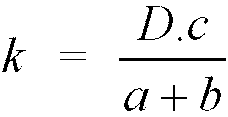
in which a is the width of a light-emitting element measured in the main scanning direction, b is the distance between two adjacent light-emitting elements in said direction, and c is the dimension of the light-emitting element in the auxiliary scanning direction, and D is a distance of which both a and b are a whole multiple, the energisation device energises the light-emitting elements.
in which a is the width of a light-emitting element measured in the main scanning direction, b is the distance between two adjacent light-emitting elements in said direction, and c is the dimension of the light-emitting element in the auxiliary scanning direction, and D is a distance of which both a and b are a whole multiple, the energisation device energises the light-emitting elements.
8. A printing device according to claim 7, characterised in that D is the maximum distance
of which both a and b are a whole multiple.
9. A printing device according to claim 6, 7 or 8, characterised in that two light-emitting
elements are in each case energised simultaneously to form one image dot.
1. Belichtungseinrichtung mit einer geraden Reihe lichemittierender Elemente (45-49),
die in Form von Parallelogrammen mit ungleichen Seiten mit festem Abstand b zwischen
ihnen in einer Ebene angeordnet sind, dadurch gekennzeichnet, daß die lichtemittierenden
Elemente so angeordnet sind, daß beliebige der gedachten Streifen (54. 55) mit einer
festen Breite, die in dieser Ebene liegen und sich senkrecht zu der Reihe erstrecken,
stets eine konstante Fläche (56; 57+58) der lichtemittierenden Elemente (45-49) überdecken.
2. Belichtungseinrichtung nach Anspruch 1, dadurch gekennzeichnet, daß jeder der Eckpunkte
(50, 51) an einer kurzen Seite eines lichtemittierenden Elements (46) in einer Richtung
(14) senkrecht zu der Reihe gesehen, stets auf einer Linie mit den Eckpunkten (52,
53) der anderen kurzen Seite eines benachbarten lichtemittierenden Elements (47) liegt.
3. Belichtungseinrichtung nach Anspruch 2, dadurch gekennzeichnet, daß das Verhältnis
zwischen dem Abstand b und der Länge a der kurzen Seite ein ganzzahliges Vielfaches
ist.
4. Belichtungseinrichtung nach Anspruch 3, dadurch gekennzeichnet, daß der Abstand b
im wesentlichen gleich der Länge a der kurzen Seite ist.
5. Belichtungseinrichtung nach einem der Ansprüche 1, 2, 3 oder 4, dadurch gekennzeichnet,
daß die lichtemittierenden Elemente durch LEDs gebildet werden.
6. Druckeinrichtung mit einer Belichtungseinrichtung nach einem der vorstehenden Ansprüche,
zum bildmäßigen zeilenweisen Belichten eines fotoempfindlichen Mediums, das in einer
Unterabtastrichtung senkrecht zur Reihe der lichtemittierenden Elemente transportiert
wird, wobei die lichtemittierenden Elemente auf das fotoempfindliche Medium abgebildet
werden, um Zeile für Zeile eine Reihe von Bildpunkten auf dem fotoempfindlichen Medium
zu bilden, dadurch gekennzeichnet, daß die Druckeinrichtung eine Erregungseinrichtung
zum Erregen der lichtemittierenden Elemente aufweist, derart, daß jede Zone in den
belichteten Bereichen exakt dieselbe Lichtmenge empfängt.
7. Druckeinrichtung nach Anspruch 6, dadurch gekennzeichnet, daß die Erregungseinrichtung
die lichtemittierenden Elemente nach jeder Bewegung des fotoempfindlichen Mediums
über eine Entfernung k erregt, mit
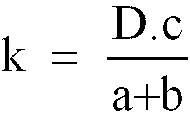
wobei a die Breite eines lichtemittierenden Elements in Hauptabtastrichtung gemessen, b der Abstand zwischen zwei benachbarten lichtemittierenden Elementen in dieser Richtung und c die Abmessung des lichtemittierenden Elements in der Unterabtastrichtung ist und D eine Entfernung ist, von der sowohl a als auch b ganze Vielfache sind.
wobei a die Breite eines lichtemittierenden Elements in Hauptabtastrichtung gemessen, b der Abstand zwischen zwei benachbarten lichtemittierenden Elementen in dieser Richtung und c die Abmessung des lichtemittierenden Elements in der Unterabtastrichtung ist und D eine Entfernung ist, von der sowohl a als auch b ganze Vielfache sind.
8. Druckeinrichtung nach Anspruch 7, dadurch gekennzeichnet, daß D die maximale Entfernung
ist, von der sowohl a als auch b ganze Vielfache sind.
9. Druckeinrichtung nach Anspruch 6, 7 oder 8, dadurch gekennzeichnet, daß zwei lichtemittierende
Elemente in jedem Fall simultan erregt werden, um einen Bildpunkt zu bilden.
1. Dispositif d'exposition comprenant une rangée rectiligne d'éléments émetteurs de lumière
(45-49) disposés sous la forme de parallélogrammes ayant des côtés inégaux, avec un
espacement fixe b entre ces parallélogrammes dans un même plan, caractérisé en ce que lesdits éléments
émetteurs de lumière sont agencés de façon qu'une quelconque des bandes imaginaires
arbitraires (54, 55) ayant une largeur fixe qui sont situées dans ledit plan et qui
s'étendent perpendiculairement à ladite rangée recouvre toujours une surface d'aire
constante (56 ; 57+58) des éléments émetteurs de lumière (45-49).
2. Dispositif d'exposition selon la revendication 1, caractérisé en ce que chacun des
points d'angles (50, 51) d'un côté court d'un élément émetteur de lumière (46) est
toujours en ligne, considéré dans une direction (14) perpendiculaire à la rangée,
avec l'un des points d'angles (52, 53) de l'autre côté court d'un élément émetteur
de lumière adjacent (47).
3. Dispositif d'exposition selon la revendication 2, caractérisé en ce que le rapport
entre l'espacement b et la longueur a du côté court est un multiple entier.
4. Dispositif d'exposition selon la revendication 3, caractérisé en ce que l'espacement
b est sensiblement égal à la longueur a du côté court.
5. Dispositif d'exposition selon l'une quelconque des revendications 1, 2, 3 ou 4, caractérisé
en ce que les éléments émetteurs de lumière sont constitués par des DEL.
6. Dispositif d'impression comprenant un dispositif d'exposition selon l'une quelconque
des revendications précédentes, pour l'exposition selon l'image, ligne après ligne,
d'un milieu photosensible qui est avancé dans une direction du balayage auxiliaire
perpendiculaire à la rangée d'éléments émetteurs de lumière, les éléments émetteurs
de lumière formant leur image sur le milieu photosensible afin de former, ligne après
ligne, une rangée de points d'image sur le milieu photosensible, caractérisé en ce
que le dispositif d'impression comprend un dispositif d'excitation pour exciter les
éléments émetteurs de lumière de telle manière que chaque zone reçoive exactement
la même quantité de lumière dans les surfaces exposées.
7. Dispositif d'impression selon la revendication 6, caractérisé en ce qu'après chaque
déplacement du milieu photosensible d'une distance k, où
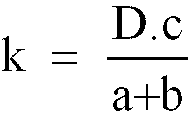
où a est la largeur d'un élément émetteur de lumière mesurée dans la direction du balayage principal, b est la distance entre deux éléments émetteurs de lumière adjacents dans ladite direction et c est la dimension de l'élément émetteur de lumière dans la direction du balayage auxiliaire, et D est une distance dont a et b sont un multiple entier, le dispositif d'excitation excite les éléments émetteurs de lumière.
où a est la largeur d'un élément émetteur de lumière mesurée dans la direction du balayage principal, b est la distance entre deux éléments émetteurs de lumière adjacents dans ladite direction et c est la dimension de l'élément émetteur de lumière dans la direction du balayage auxiliaire, et D est une distance dont a et b sont un multiple entier, le dispositif d'excitation excite les éléments émetteurs de lumière.
8. Dispositif d'impression selon la revendication 7, caractérisé en ce D est la distance
maximum dont a et b sont un multiple entier.
9. Dispositif d'impression selon la revendication 6, 7 ou 8, caractérisé en ce que deux
éléments émetteurs de lumière sont dans chaque cas excités simultanément pour former
un point d'image.