| (19) |
 |
|
(11) |
EP 0 398 479 B1 |
| (12) |
EUROPEAN PATENT SPECIFICATION |
| (45) |
Mention of the grant of the patent: |
|
11.08.1993 Bulletin 1993/32 |
| (22) |
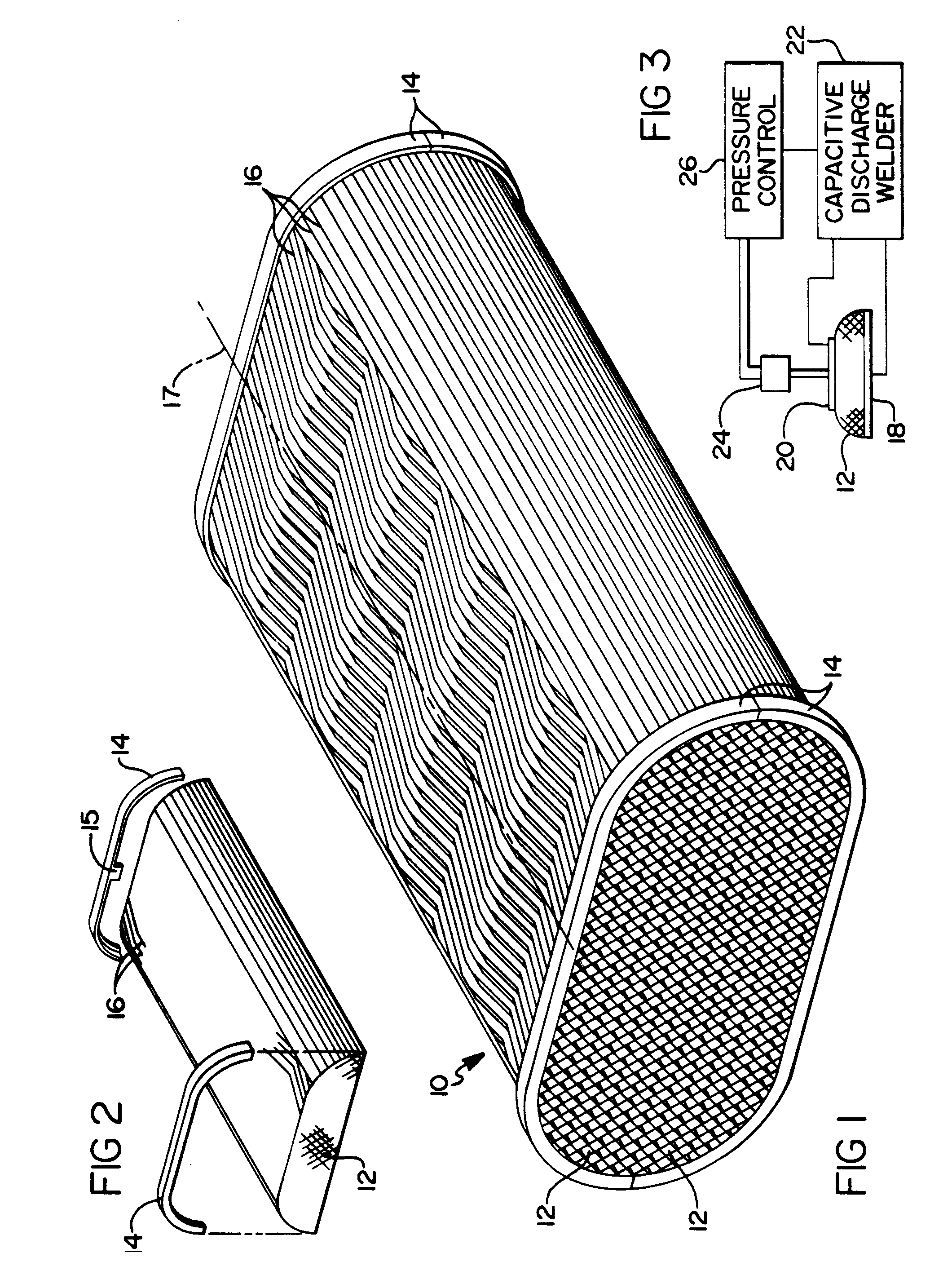
Date of filing: 28.03.1990 |
|
|
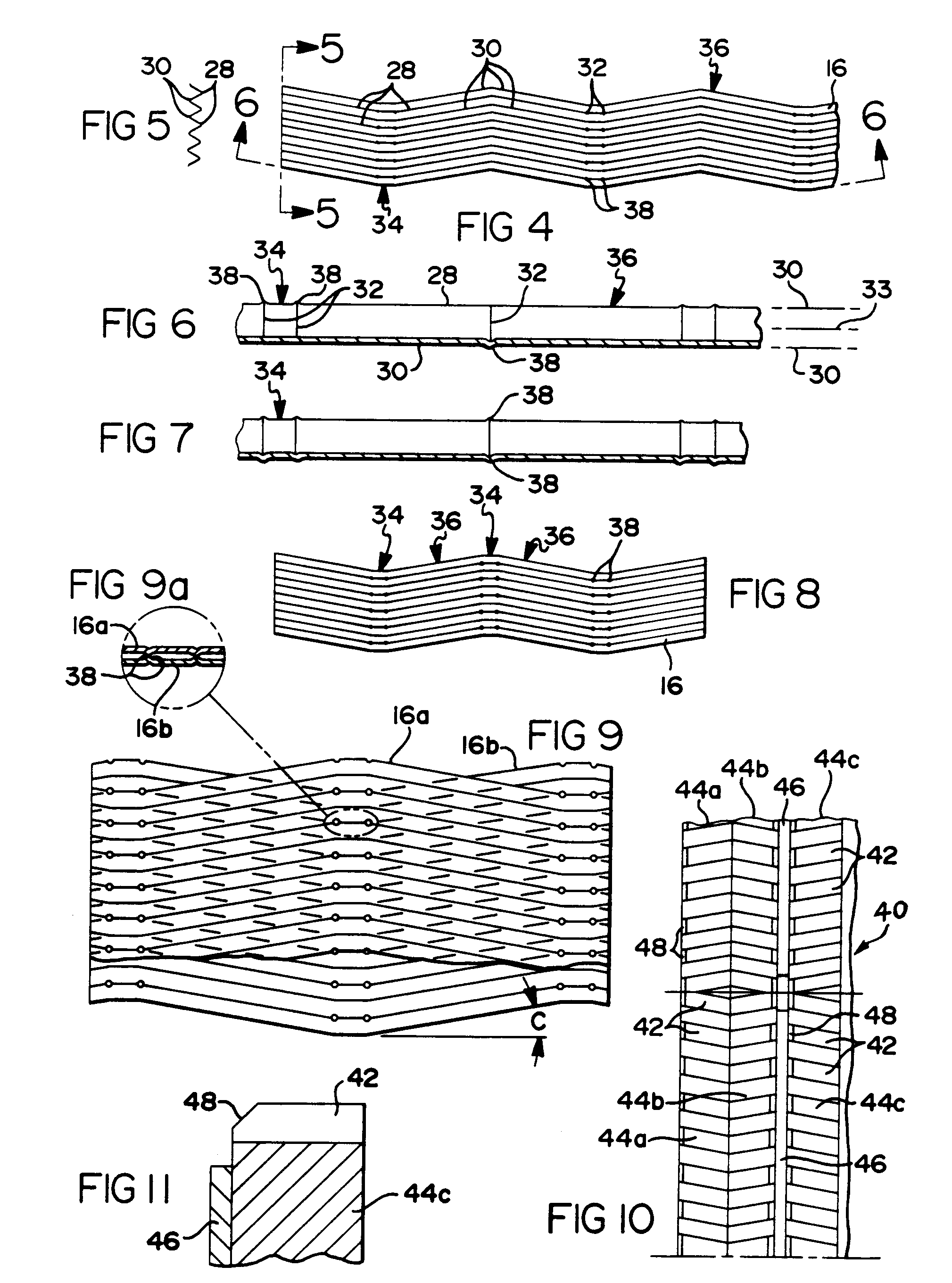
| (54) |
Catalytic converter substrate and assembly
Katalysatorträger und Zusammenbau
Support pour convertisseur catalytique et assemblage
|
| (84) |
Designated Contracting States: |
|
DE FR GB |
| (30) |
Priority: |
15.05.1989 US 351618
|
| (43) |
Date of publication of application: |
|
22.11.1990 Bulletin 1990/47 |
| (73) |
Proprietor: GENERAL MOTORS CORPORATION |
|
Detroit
Michigan 48202 (US) |
|
| (72) |
Inventors: |
|
- Lunkas, Michael John
Otisville, MI 48463 (US)
- Spilker, Matthew Wayne
Flint, MI 48507 (US)
|
| (74) |
Representative: Denton, Michael John et al |
|
Delphi Automotive Systems
Centre Technique Paris
117 avenue des Nations
B.P. 60059
95972 Roissy Charles de Gaulle Cedex
95972 Roissy Charles de Gaulle Cedex (FR) |
| (56) |
References cited: :
EP-A- 0 102 927
GB-A- 2 040 179
US-A- 4 037 073
US-A- 4 753 919
|
FR-A- 1 280 496
US-A- 2 445 801
US-A- 4 282 186
US-A- 4 823 583
|
|
| |
|
|
|
|
| |
|
| Note: Within nine months from the publication of the mention of the grant of the European
patent, any person may give notice to the European Patent Office of opposition to
the European patent
granted. Notice of opposition shall be filed in a written reasoned statement. It shall
not be deemed to
have been filed until the opposition fee has been paid. (Art. 99(1) European Patent
Convention).
|
Field of the Invention
[0001] This invention relates to a welded metal substrate for a catalytic converter and
particularly to a metal substrate assembly for a catalytic converter.
Background of the Invention
[0002] In catalytic converters for automotive vehicles, catalysts are supported on substrates
having a large area and there are exhaust flow passages over that area so that intimate
contact between the exhaust gas and the catalyst can occur. Honeycomb substrates formed
of foil strips have been proposed but they are typically deficient in some respects
and/or present problems from a manufacturing and/or functional standpoint. For example,
it is known to form the honeycomb substrate by spirally winding strips of smooth and
corrugated foil together but there results the problem of relative telescoping or
sliding occurring between the layers which first abrades the catalyst and can end
in structural failure of the substrate. With such an arrangement, it is difficult
to maintain the integrity of the metal substrate without some form of mechanical strengthening
or bonding of the layers. Then there remains another major problem of allowing design
flexibility in the shape of the metal-layered substrate cross-section to meet various
space allocations whilst maintaining a curved profile for housing strength reasons.
This is particularly important in meeting certain vehicle under-floor space requirements
where a low profile cross-section of, for example, an oval shape is desired rather
than a circular one which requires a larger height for the same frontal area. Moreover,
there is the difficulty and expense of manufacture in completely forming a metal-layered
substrate so as to be suitable for a final step of applying a catalyst coating thereon.
[0003] There have been several proposals for containing the corrugated foil in the desired
profile using some form of welding, brazing or mechanical detention. The latter approach
is disclosed by U.S. Patents Nos. 4,619,912 and 4,559,205. In both of these U.S. patents,
alternating layers of smooth foil and corrugated foil of varying widths are stacked
together to achieve the desired oval profile and then are sheathed in a retainer comprising
a pair of metal shells which are assembled by pressing them over the foil layers and
then welding the shells together along mating plane surfaces. The U.S. patents described
below utilize welding of the foil. U.S. Patent No.4,186,172 shows a spirally-wound
structure of circular cross-section having alternating smooth and corrugated sheets.
The welding is done by laser-beam or electron-beam welders either during the winding
process or after winding. U.S. Patent No.4,282,186 also shows a spirally-wound structure
but a structure which has a hollow centre so that it may be flattened to form an oval,
racetrack profile in cross-section. Spot-welds are made in the end faces of the foil
matrix by electron-beam welders; or brazing of the end faces may be used instead.
In another version, instead of welding the end faces of the foil, semi-elliptical
half-shells are pressed around the matrix and welded together to maintain a desired
oval shape.
[0004] It is known to form chevron patterns in metal foil sheets and to stack the sheets
into assemblies having a large surface area for supporting catalysts and having gas
flow passages to promote contact of the exhaust gas with the catalyst. U.S. Patent
No.4,382,323 shows such a chevron pattern foil wound in a spiral but the manner of
retaining it in a wound shape is not disclosed. Ridges in the adjacent layers of the
foil abut and cross one another at their peaks to form passages between the sheets.
U.S. Patent No.4,753,919 discloses a method for optimizing the number of contact points
between confronting surfaces of an accordion-folded metal foil corrugated in a chevron
pattern by specifying a certain mathematical relationship of the chevron and foil
dimensions. The manner of securing the layers of the stack is not discussed.
Summary of the Invention
[0005] It is therefore an object of the present invention to provide a substrate for a catalytic
converter especially configured for welding together and adapted for welding many
layers of foil by a single welding event.
[0006] It is another object of the invention to provide such a substrate having weld projections
that make contact points between adjacent sheets to facilitate capacitor-discharge
welding of the sheets.
[0007] Another object is to provide such a substrate by pre-assembling each of two half-substrates,
and then welding and securing the two halves together by welded end rings.
[0008] The invention is carried out by an assembly of corrugated metal foil sheets for a
substrate comprising: a stack of corrugated sheets secured together so that a plurality
of fluid flow paths are defined between the sheets, each sheet having a centreline
and a plurality of rows of corrugations extending transverse to the centreline and
each row having corrugation-ridges in a chevron pattern with the ridges of adjacent
rows having different directions, the corrugation-ridges having peaks which meet at
vertices at the boundaries of adjacent rows, the peaks defining planes, each sheet
having projections located on at least some of the vertices and extending outwardly
from said planes into contact with an adjacent sheet in the stack, and the sheets
being welded together at the projections.
[0009] The invention is further carried out by a corrugated metal foil substrate for a catalytic
converter comprising a plurality of corrugated foil sheets made by the steps of: forming
each of a plurality of corrugated sheets by crimping a plain sheet with rows of angled
corrugations to form a chevron pattern with vertices at adjoining rows, the angle
between the corrugations at the vertices being sufficient to form outstanding projections
normal to a median plane of the sheet, stacking a plurality of corrugated sheets with
the projections of one sheet extending towards, and in contact with, an adjacent sheet,
the stack being bounded by upper and lower sheets, and the stack being united by passing
a pulse of weld-current through the stack from electrodes at the upper and lower sheets
to resistance-weld the sheets together at the projections.
Brief Description of the Drawings
[0010] The above and other advantages of the invention will become more apparent from the
following description taken in conjunction with the accompanying drawings wherein
like references refer to like parts and wherein:
Figure 1 is an isometric view of a fully-assembled substrate according to the invention.
Figure 2 is an exploded view of a half-substrate and associated half-rings,
Figure 3 is a schematic view of apparatus for welding together corrugated sheets to
form a half-substrate according to the invention,
Figure 4 is a plan view of a corrugated sheet for a substrate according to a first
embodiment of the invention,
Figure 5 is an end view of the sheet of Figure 4 taken along line 5-5 of Figure 4,
Figure 6 is an enlarged sectional view of the sheet of Figure 4 taken along line 6-6
of Figure 4 which follows along a valley of the sheet,
Figure 7 is a sectional view of a sheet similar to that of Figure 6 but modified according
to a second embodiment of the invention,
Figure 8 is a plan view of a corrugated sheet for a substrate according to a third
embodiment of the invention,
Figure 9 is a partly broken-away plan view of two adjacent super-imposed sheets according
to the third embodiment,
Figure 9a is an enlarged sectional view of a portion of Figure 9,
Figure 10 is a partly broken-away front view of tooling for producing the corrugated
sheets according to the invention, and
Figure 11 is an enlarged view of a tool tooth of the tooling of Figure 10.
Description of the Preferred Embodiment
[0011] Corrugated sheets for a catalytic converter substrate are advantageously secured
together by resistance-welding to form a secure core assembly. Because of the large
number of sheets involved in each substrate the prior-art practice of separately welding
pairs of adjacent sheets is time-consuming and expensive. Thus the welding of all
or of at least many sheets at once is an attractive alternative. It has been found
that capacitive-discharge welding is capable of making satisfactory welds when the
sheets have been properly formed with weld projections which define precise weld points
of a number and size to present the proper weld resistance.
[0012] Figure 1 shows a converter substrate 10 which is made up of two half-substrates 12
held together at their ends by half-rings 14 which are assembled to the halves as
shown in Figure 2 and welded at their ends to complete the full substrate assembly.
The rings 14 are L-shaped in cross-section to overlie a portion of the substrate outer
surface as well as a marginal portion of the end faces. A tang 15 depending from the
centre of each half-ring 14 pierces the outer layers of sheets to hold the rings in
place.
[0013] As is evident in Figure 1, the assembly is formed of a stack of corrugated sheets
16 of equal lengths but of varying widths so that an oval profile is attained. Each
sheet has a centreline 17 parallel to the longitudinal axis of the substrate. The
corrugations in the sheets have a modified chevron configuration so that adjacent
sheets define exhaust gas passages in a direction to foster generally longitudinal
gas flow. Such corrugations, as is well known, provide extensive areas for the residence
of catalyst material and contact of the gas with the catalyst material. As will be
further described, the chevron corrugations can be formed with ridges meeting at vertices
so that the sheet metal buckles a controlled amount at the vertices to form weld projections.
The sheets are laid up in a stack so that the projections on adjacent sheets make
contact. As shown in Figure 3, the stack of sheets for one half of the substrate are
placed between electrodes 18 and 20 of a capacitive-discharge welder 22 and compressed
together sufficiently to assure good contact at the weld projections. The upper electrode
20 is manipulated by an air-pressure operated actuator 24 for opening and closing
and for applying the welding pressure under control of a pressure control 26.
[0014] The welder 22 is capable of delivering a single pulse of current to effect welding
at the projections. As is well known, a capacitive-discharge welder comprises a transformer
with a bank of large capacitors in the primary circuit and means for charging the
capacitors to a high voltage, and weld electrodes in the secondary circuit for delivering
a discharge current at a low voltage. For a stack of 48 sheets approximately 44.45
mm (1 3/4 inches) thick and measuring 152.4 x 152.4 mm (6 x 6 inches) for the largest
and 76.2 x 152.4 mm (3 x 6 inches) for the smallest sheet, the weld current pulse
is 1 to 1.5 milliseconds long and delivers 28,000 joules energy at 150 volts.
[0015] The modified chevron pattern shown in Figures 4, 5 and 6 is a series of peaked ridges
28 which define planes 30 and are arranged at angles to one another so that they meet
at vertices 32. A median plane 33 of the corrugated sheet is shown halfway between
the planes 30 of the peaks. The corrugation-ridges are arrayed in parallel rows of
like ridges, the rows extending transverse, i.e., perpendicular to the sheet centreline
17. Narrow rows have short ridge segments 34 whilst wide rows have long segments 36.
The segment lengths between vertices include short segments 34 or lands with ridges
running parallel to the centreline 17 of the sheet and long segments 36 which extend
at an angle to the centreline. Preferably the width of the row with corrugations parallel
to the centreline is less than half the width of the rows with angled corrugations.
The long segments 36 come together at one set of vertices 32 and the short segments
34 are interposed between long segments 36 to form another set of vertices. In either
case the metal buckles to project beyond the peak plane 30 in a direction perpendicular
to the plane 30 or 33 to form projections 38 at some of the vertices. Figure 6 shows
that the projections 38 at the short segments extend upwardly and the projections
38 between the long segments extend downwardly. When the sheets are stacked together
for welding, alternate sheets are flipped over to register the points of adjacent
sheets. In an alternative configuration the projections 38 may extend up and down
from each vertex as shown in Figure 7.
[0016] One effect of the short segments is to increase the number of projections compared
to a pattern having long segments only. In the embodiment of Figures 8 and 9 all long
segments 36 are separated by short segments 34 so that short and long segments alternate.
In addition, projections 38 extend from every vertex 32. This pattern optimizes the
number of projections 38.
[0017] The lay-up of sheets 16 in a stack is illustrated in Figure 9 for a pair of adjacent
sheets 16a and 16b where the upper sheet 16a is broken away to reveal the lower sheet
16b. Figure 9a is a cross-section which shows how the projections from adjacent sheets
are registered to form a weld site.
[0018] The chevron angle c (Fig. 9) between the long segment 36 and the short segment 34
is optimized to enhance the formation of rounded, somewhat conical projections 38.
For stainless steel foil 0.051 mm (0.002 inch) thick having a corrugation pitch of
2.26 mm (0.089 inch) and a corrugation height (peak-to-peak) of 1.02 mm (0.04 inch),
the preferred angle c is 10 degrees. An acceptable range for angle c is 8 to 14 degrees.
The required projection is not obtained at angles less than 8 degrees. At an angle
c of 10 degrees the projections 38 are large enough to form a generally circular contact
area having a diameter of 0.127 mm (0.005 inch) when like projections are pressed
together.Each projection has a height of the order of 0.0254mm (0.001 inch).
[0019] Where a curved substrate profile is desired, sheets made according to the patterns
of any one of the above described embodiments are cut in varying widths to conform
the desired core profile when assembled. If a rectangular core section is preferred,
the sheets will all have the same width. Adjacent sheets are oriented with projections
registered for contact. A stack of sheets for a half substrate 12 is placed between
the electrodes 18 and 20 of the welder and weld pressure applied. Then a single pulse
of weld current is directed through the stack to complete the welds at the contacting
projections. Two such welded half-substrates are clamped together and the half-oval
rings 14 are applied to the ends of the substrate halves 12 with the tang 15 piercing
the outer sheets. The abutting ends of the half-rings 14 are welded together to complete
the assembly of the substrate.
[0020] As an alternative to welding substrate halves and holding them together by end rings,
the sheets may be all welded together at the contacting projections: then the end
rings will not be necessary. One approach to the all-welded structure is to weld all
the sheets at once instead of in halves. Depending on the desired profile, stacking
the sheets with the projections maintained in registry may be somewhat involved or
obtaining adequate welds through the stack may be difficult. Another approach is to
weld the sheets into small packets and then weld two, three or more packets together
to make the whole core. The choice of assembly methods depends on the ability to weld
a large stack of sheets in the desired profile or to weld together the packets of
sheets.
[0021] Tools 40 for corrugating the foil sheets are shown in Figure 10. Gear-like rotary
tools mesh together to roll the corrugations in a plain foil. The corrugation pattern
of Figures 5 and 6 is produced by the illustrated tools 40. Teeth 42 on each wheel
44a, 44b, 44c have alternate right and left pitches to form rows of corrugations of
opposite angles in the foil. Spacers 46 between wheels 44b and 44c separate those
wheels. The corrugations parallel to the centreline are formed in this space without
benefit of a toothed wheel to positively form those corrugations. The metal-bending
action at the adjacent wheels is sufficient to form the corrugations in the space.
A further benefit is that the projections 38 at the vertices of the corrugations are
also formed here due to the buckling at the bend of the metal peaks. A relief in the
form of a chamfer 48 on each tooth edge adjacent to a spacer 46, as best shown in
Figure 11, enhances the projection formation. A 45 degree chamfer 48 of 1.27 mm (0.05
inch) width provides satisfactory relief. While the projections 38 are best formed
at the chamfer in the regions adjacent a short segment 34, they also occur at the
vertices of two long segments 36 as formed by wheels 44a and 44b. If the pattern of
Figures 8 and 9 is desired, a spacer will be used between every pair of wheels 44a,
44b, etc., and both ends of each tooth 42 will be chamfered.
1. A method of making a corrugated metal foil substrate (10) for a catalytic converter,
containing an assembly of corrugated metal foil sheets (16) characterised in that the method comprises the steps of: forming each corrugated sheet (16) by crimping
a plain sheet with rows of angled corrugations (36) to form a chevron pattern with
vertices (32) at adjoining rows, the angle (c) between the corrugations (36) at the
vertices (32) being sufficient to form outstanding projections (38) normal to the
median plane (33) of the sheet (16); stacking a plurality of said corrugated sheets
(16) with the projections (38) of one sheet (16) extending towards and in contact
with the projections of an adjacent sheet (16), the stack (12) being bounded by upper
and lower sheets (16); and uniting the stack (12) by welding the sheets (16) together
at the projections (38) thereof.
2. A method of making a corrugated metal foil substrate for a catalytic converter according
to claim 1, characterised in that the sheets (16) of the stack (12) are welded by passing a pulse of weld current through
the stack (12) between the upper and lower sheets (16) to weld the sheets (16) together
at the projections (38) thereof.
3. A method of making a corrugated metal foil substrate for a catalytic converter according
to claim 1, characterised in that the sheets (16) vary in width and are stacked one upon the other to form, when assembled
together, a stack (12) having a half-oval contour in cross-section; and a complete
substrate (10) which is oval in cross-section is formed by assembling two of said
half-oval stacks (12) together and then welding a retaining collar (14) around each
end of the assembled stacks (12).
4. A method of making a corrugated metal foil substrate for a catalytic converter according
to claim 1, characterised in that the chevron pattern on each sheet (16) is formed with three interdigitated sets of
corrugations comprising a set with corrugations (34) parallel to the centreline (17)
and two sets with corrugations (36) extending at an angle (c) in either direction
from the centreline (17), and the sheets (16) are stacked with the projections (38)
on each sheet (16) substantially in contact with projections (38) on adjacent sheets
(16).
5. An assembly of corrugated metal foil sheets for a substrate comprising: a stack of
corrugated sheets (16) secured together so that a plurality of fluid flow paths are
defined between the sheets, each sheet (16) having a centreline (17) and a plurality
of rows of corrugations extending transverse to the centreline (17) and each row having
corrugation-ridges (28) in a chevron pattern with the ridges of adjacent rows having
different directions, characterised in that the corrugation-ridges (28) have peaks which meet at vertices (32) at the boundaries
of adjacent rows, the peaks defining planes (30); each sheet has projections (38)
located on at least some of the vertices (32) and extending outwardly from said planes
(30) into contact with the projections of an adjacent sheet in the stack; and the
sheets are welded together at the projections (38) thereof.
6. An assembly of corrugated metal foil sheets according to claim 5, characterised in that the projections (38) of each sheet are aligned with and in contact with the projections
(38) of an adjacent sheet.
7. An assembly of corrugated metal foil sheets according to claim 5, characterised in that some rows have corrugations (36) extending at an angle (c) to the centreline (17)
in either direction and other rows have corrugations (34) extending parallel to the
centerline (17) with adjacent rows having different directions.
8. An assembly of corrugated metal foil sheets according to claim 7, characterised in that the rows of corrugations alternate, with two adjacent rows having corrugations (36)
at an angle (c) to the centreline (17) in either direction and a third row having
corrugations (34) extending parallel to the centreline (17).
9. An assembly of corrugated metal foil sheets according to claim 7, characterised in that the rows of angled corrugations (36) alternate in direction and are separated by
a row with corrugations (34) parallel to the centreline (17).
10. An assembly of corrugated metal foil sheets according to any one of claims 6, 7 or
8, characterised in that said angle (c) to the centreline (17) of the corrugations (36) is in the range of
8 degrees to 14 degrees, and the width of the row with corrugations (34) parallel
to the centreline (17) is less than half the width of the rows with angled corrugations
(36).
11. An assembly of corrugated metal foil sheets according to any one of claims 6, 7 or
8, characterised in that the foil is stainless steel approximately 0.051 mm thick, and said angle (c) to the
centreline (17) of the corrugations (36) is about 10 degrees.
12. A catalytic converter substrate (10) formed from assemblies of corrugated metal foil
sheets (16) according to any one of the preceding claims, in which said substrate
(10) comprises: upper and lower half-substrates (12) secured together to form a whole
substrate; each half-substrate (12) comprises an assembly of corrugated metal foil
sheets (16) according to any one of the preceding claims; half-rings (14) conforming
to the half-substrate contour are attached to each end of each half-substrate (12);
and the half-rings (14) at each end of the substrate (10) are welded together to secure
the complete substrate (10).
1. Verfahren zum Herstellen eines Substrats (10) mit gewellten Metallfolien für einen
Katalysatorwandler, der eine Anordnung aus gewellten Metallfolien-Blechen (16) enthält,
dadurch gekennzeichnet, daß das Verfahren die Schritte umfaßt: daß jedes gewellte Blech (16) durch Eindrücken
von Reihen gewinkelter Wellungen (36) in ein ebenes Blech gebildet wird, um ein Fischgrätmuster
zu bilden mit Scheiteln in benachbarten Reihen, wobei der Winkel (c) zwischen den
Wellungen (36) an den Scheiteln (32) ausreicht, nach außen senkrecht zur Mittenebene
(33) des Blechs (16) vorstehende Fortsätze (36) zu bilden; daß eine Vielzahl der gewellten
Bleche (16) gestapelt wird, wobei die Fortsätze (38) einer Schicht (16) sich zu den
Fortsätzen eines benachbarten Blechs (16) hin und in Berührung mit diesen erstrecken,
der Stapel (12) durch obere und untere Bleche (16) begrenzt wird und daß der Stapel
(12) vereinigt wird, indem die Bleche (16) an ihren Fortsätzen (38) miteinander verschweißt
werden.
2. Verfahren zum Herstellen eines Substrats mit gewellten Metallfolien für einen Katalysator-Wandler
nach Anspruch 1, dadurch gekennzeichnet, daß die Bleche (16) des Stapels (12) dadurch verschweißt werden, daß ein Schweißstrom-Impuls
zwischen der oberen und der unteren Schicht (16) durch den Stapel (12) geschickt wird,
um die Bleche (16) an ihren Fortsätzen (38) miteinander zu verschweißen.
3. Verfahren zum Herstellen eines Substrats mit gewellten Metallfolien für einen Katalysator-Wandler
nach Anspruch 1, dadurch gekennzeichnet, daß die Bleche (16) in der Breite variieren und aufeinander gestapelt sind, um im zusammengebauten
Zustand einen Stapel (12) mit einem Halboval-Umriß im Querschnitt zu bilden und daß
ein komplettes im Querschnitt ovales Substrat (10) durch Zusammenbauen von zwei solchen
Halboval-Stapeln (12) und nachfolgendes Schweißen eines Rückhalte-Bundes (14) um jedes
Ende der zusammengebauten Stapel (12) gebildet wird.
4. Verfahren zum Herstellen eines Substrats mit gewellten Metallfolien für einen Katalysator-Wandler
nach Anspruch 1, dadurch gekennzeichnet, daß das Fischgrätmuster an jedem Blech (16) mit drei ineinandergreifenden Sätzen von
Wellungen gebildet wird, welche umfassen einen Satz von Wellungen (34) parallel zur
Mittellinie (17) und zwei Sätze von Wellungen (36), die sich mit einem Winkel (c)
in beiden Richtungen von der Mittellinie (17) erstrecken, und daß die Bleche (16)
so gestapelt werden, daß die Fortsätze (38) an jedem Blech (16) im wesentlichen mit
Fortsätzen (38) an benachbarten Blechen in Berührung sind.
5. Anordnung aus gewellten Metallfolien-Blechen für ein Substrat, welche umfaßt: einen
Stapel aus gewellten Blechen (16), die so aneiander befestigt sind, daß eine Vielzahl
von Fluidströmungswegen zwischen den Blechen gebildet ist, wobei jedes Blech (16)
eine Mittellinie (17) und eine Vielzahl von Wellungsreihen besitzt, die sich quer
zur Mittellinie (17) erstrecken, und jede Reihe Wellungsrippen (28) in einem Fischgrätmuster
besitzt, wobei die Rippen benachbarter Reihen unterschiedliche Richtungen haben, dadurch gekennzeichnet, daß die Wellungsrippen (28) Spitzen besitzen, die sich an Scheiteln (32) an den Grenzen
benachbarter Reihen treffen, wobei die Spitzen Ebenen (30) bestimmen; daß jedes Blech
an mindestens einigen der Scheitel (32) angeordnete Fortsätze (38) besitzt, die von
den Ebenen (30) nach außen in Berührung mit den Fortsätzen an einem benachbarten Blech
in dem Stapel reichen; und daß die Bleche an ihren Fortsätzen (38) zusammengeschweißt
sind.
6. Anordnung aus gewellten Metallfolien-Blechen nach Anspruch 5, dadurch gekennzeichnet, daß die Fortsätze (38) jedes Blechs mit den Fortsätzen (38) eines benachbarten Blechs
ausgerichtet und damit in Berührung sind.
7. Anordnung aus gewellten Metallfolien-Blechen nach Anspruch 5, dadurch gekennzeichnet, daß einige Reihen Wellungen (36) besitzen, die sich mit einem Winkel (c) zu der Mittellinie
(17) in einer der beiden Richtungen erstrecken und andere Reihen Wellungen (34) besitzen,
die sich parallel zu der Mittellinie (17) erstrecken, wobei benachbarte Reihen unterschiedliche
Richtungen haben.
8. Anordnung aus gewellten Metallfolien-Blechen nach Anspruch 7, dadurch gekennzeichnet, daß die Reihen von Wellungen abwechseln, wobei zwei benachbarte Reihen Wellungen (36)
mit einem Winkel (c) zur Mittellinie (17) in einer der beiden Richtungen besitzen
und eine dritte Reihe Wellungen (34) besitzt, die sich parallel zur Mittellinie (17)
erstrecken.
9. Anordnung aus gewellten Metallfolien-Blechen nach Anspruch 7, dadurch gekennzeichnet, daß die Reihen von gewinkelten Wellungen (36) in ihrer Richtung abwechseln und durch
eine Reihe mit Wellungen (34) parallel zu der Mittellinie (17) getrennt sind.
10. Anordnung aus gewellten Metallfolien-Blechen nach einem der Ansprüche 6, 7 oder 8,
dadurch gekennzeichnet, daß der Winkel (c) zur Mittellinie (17) der Wellungen (36) im Bereich von 8° bis 14°
liegt und die Breite der Reihe mit Wellungen (34) parallel zu der Mittellinie (17)
geringer als die halbe Breite der Reihen mit gewinkelten Wellungen (36) ist.
11. Anordnung aus gewellten Metallfolien-Blechen nach einem der Ansprüche 6, 7 oder 8,
dadurch gekennzeichnet, daß die Folie etwa 0,051 mm dicker Edelstahl ist, und daß der Winkel (c) zur Mittellinie
(17) der Wellungen (36) etwa 10° beträgt.
12. Katalysatorwandler-Substrat (10), gebildet aus Anordnungen von gewellten Metallfolien-Blechen
(16) nach einem der vorangehenden Ansprüche, bei dem das Substrat (10) umfaßt: obere
und untere Halbsubstrate (12), die zur Bildung eines ganzen Substrats aneinander befestigt
sind; wobei jedes Halbsubstrat (12) eine Anordnung von gewellten Metallfolien-Blechen
(16) nach einem der vorangehenden Ansprüche umfaßt; der Halbsubstrat-Kontour entsprechende
Halbringe (14), die an jedem Ende jedes Halbsubstrats (12) angebracht sind; und die
Halbringe (14) an jedem Ende des Substrats (10) zusammengeschweißt sind, um das vollständige
Substrat (10) sicher zu verbinden.
1. Procédé de fabrication d'un substrat en feuilles de métal ondulé (10) pour un convertisseur
catalytique. contenant un ensemble de feuilles de métal ondulé (16), caractérisée en ce que le procédé comporte les étapes consistant à : réaliser chaque feuille ondulée (16)
en déformant une feuille pleine avec des rangées d'ondulations inclinées (36) pour
réaliser un motif à chevron avec des apex (32) aux rangées adjacentes, l'angle (c)
entre les ondulations (36) aux apex (32) tant suffisant pour former des projections
(38) s'étendant perpendiculairement au plan médian (33) de la feuille ; à empiler
une pluralité desdites feuilles ondulées (16) avec les projections (38) d'une feuille
(16) s'étendant en direction et en contact avec les projections d'une feuille adjacente
(16), la pile (12) étant délimitée par des feuilles supérieure et extérieure (16)
; et à unifier la pile (12) en soudant les feuilles (16) ensemble aux projections
(38) de celles-ci.
2. Procédé de fabrication d'un substrat en feuille de métal pour un convertisseur catalytique
selon la revendication 1, caractérisé en ce que les feuilles (16) de la pile (12) sont soudées en faisant passer une impulsion de
courant de soudage à travers la pile (12) entre les feuilles supérieure et inférieure
(16) pour souder les feuilles (16) ensemble aux projections (38) de celles-ci.
3. Procédé de réalisation d'un substrat en feuilles métalliques ondulées pour un convertisseur
catalytique selon la revendication 1, caractérisé en ce que les feuilles (16) varient en largeur et sont empilées les unes sur les autres pour
former, lorsqu'elles sont assemblées, une pile (12) ayant un contour de section transversale
semi-ovale, et un substrat terminé (10) qui est oval en section transversale est formé
en assemblant deux desdites piles (12) semi-ovales et en soudant alors un collier
de retenue (14) autour de chaque extrémité des piles assemblées (12).
4. Procédé de fabrication d'un substrat en feuilles de métal pour un convertisseur catalytique
selon la revendication 1, caractérisé en ce que le motif à chevrons sur chaque feuille (16) est formé avec trois jeux enchevêtrés
d'ondulations comprenant un jeu avec des ondulations (34) parallèles à la ligne centrale
et deux jeux avec des ondulations (36) s'étendant en formant un angle (c) dans chaque
direction à partir de la ligne centrale (17), les feuilles (16) étant empilées avec
les projections (38) sur chaque feuille (16) sensiblement en contact avec les projections
(38) sur les feuilles adjacentes (16).
5. Procédé de fabrication d'un substrat en feuilles de métal pour un substrat comprenant
: une pile de feuilles ondulées (16) fixées ensemble de façon qu'une pluralité de
trajets d'écoulement de fluide soit définie entre les feuilles, chaque feuille (16)
ayant une ligne centrale (17) et une pluralité de rangées d'ondulation s'étendant
transversalement par rapport à la ligne centrale (17) et chaque rangée ayant des nervures
(28) d'ondulation dans un motif à chevrons avec les nervures de rangées adjacentes
ayant des directions différentes, caractérisé en ce que les nervures (28) d'ondulation ont des sommets qui se rencontrent aux apex (32) aux
frontières de rangées adjacentes, les sommets définissant des plans (30) ; chaque
feuille a des projections (38) disposées sur au moins certains des apex (32) et s'étendant
vers l'extérieur à partir desdits plans (30) en contact avec les projections d'une
feuille adjacente de la pile ; et les feuilles sont soudées ensemble aux projections
(38) de celles-ci.
6. Ensemble de feuilles de métal ondulées selon la revendication 5, caractérisé en ce que les projections (38) de chaque feuille sont alignées avec et en contact avec les
projections (38) d'une feuille adjacente.
7. Ensemble de feuilles de métal ondulées selon la revendication 5, caractérisé en ce que certaines rangées ont des ondulations (36) s'étendant en formant un angle (c), par
rapport à la ligne centrale (17), dans l'une ou l'autre direction, et d'autres rangées
ont des ondulations (34) s'étendant parallèlement à la ligne centrale (17), avec des
rangées adjacentes ayant des directions différentes.
8. Ensemble de feuilles de métal ondulées selon la revendication 7, caractérisé en ce que les rangées d'ondulation alternent, avec deux rangées adjacentes ayant des ondulations
(36) formant un angle (c) par rapport à la ligne centrale (17) dans l'une ou l'autre
direction, et une troisième rangée ayant des ondulations (34) s'étendant parallèlement
à la ligne centrale (17).
9. Ensemble de feuilles de métal ondulées selon la revendications 7, caractérisé en ce que les rangées d'ondulation inclinées (36) alternent en directions et sont séparées
par une rangée avec des ondulations (34) parallèles à la ligne centrale (17).
10. Ensemble de feuilles de métal ondulées selon l'une quelconque des revendications 6,
7 ou 8, caractérisé en ce que ledit angle (c) par rapport à la ligne centrale (17) des ondulations (36) est compris
dans une plage de 8° à 14°, et en ce que la largeur de la rangée avec les ondulations
(34) parallèles à la ligne centrale (17) est inférieure à la moitié de la largeur
des rangées avec des ondulations (36) inclinées.
11. Ensemble de feuilles de métal ondulées selon l'une quelconque des revendications 6,
7 ou 8, caractérisé en ce que la feuille est en acier inoxydable d'une épaisseur d'approximativement 0,051 mm,
et en ce que ledit angle (c) par rapport à la ligne centrale (17) des ondulations
(36) est d'environ 10°.
12. Substrat (10) pour convertisseur catalytique réalisé à partir d'ensemble de feuilles
de métal ondulées. (16) selon l'une quelconque des revendications précédentes, dans
lequel ledit substrat (10) comporte : des demi-substrats supérieur et inférieur (12)
fixés ensemble pour former un substrat complet ; chaque demi-substrat (12) comprend
un ensemble de feuilles de métal ondulé (16) selon l'une quelconque des revendications
précédentes ; des demi-anneaux (14) adaptés au contour des demi-substrats sont fixés
à chaque extrémité de chaque demi-substrat (12) ; et les demi-anneaux (14) à chaque
extrémité de chaque demi-substrat (12) ; sont soudés ensemble pour fixer le substrat
complet.