| (19) |
 |
|
(11) |
EP 0 400 134 B1 |
| (12) |
EUROPEAN PATENT SPECIFICATION |
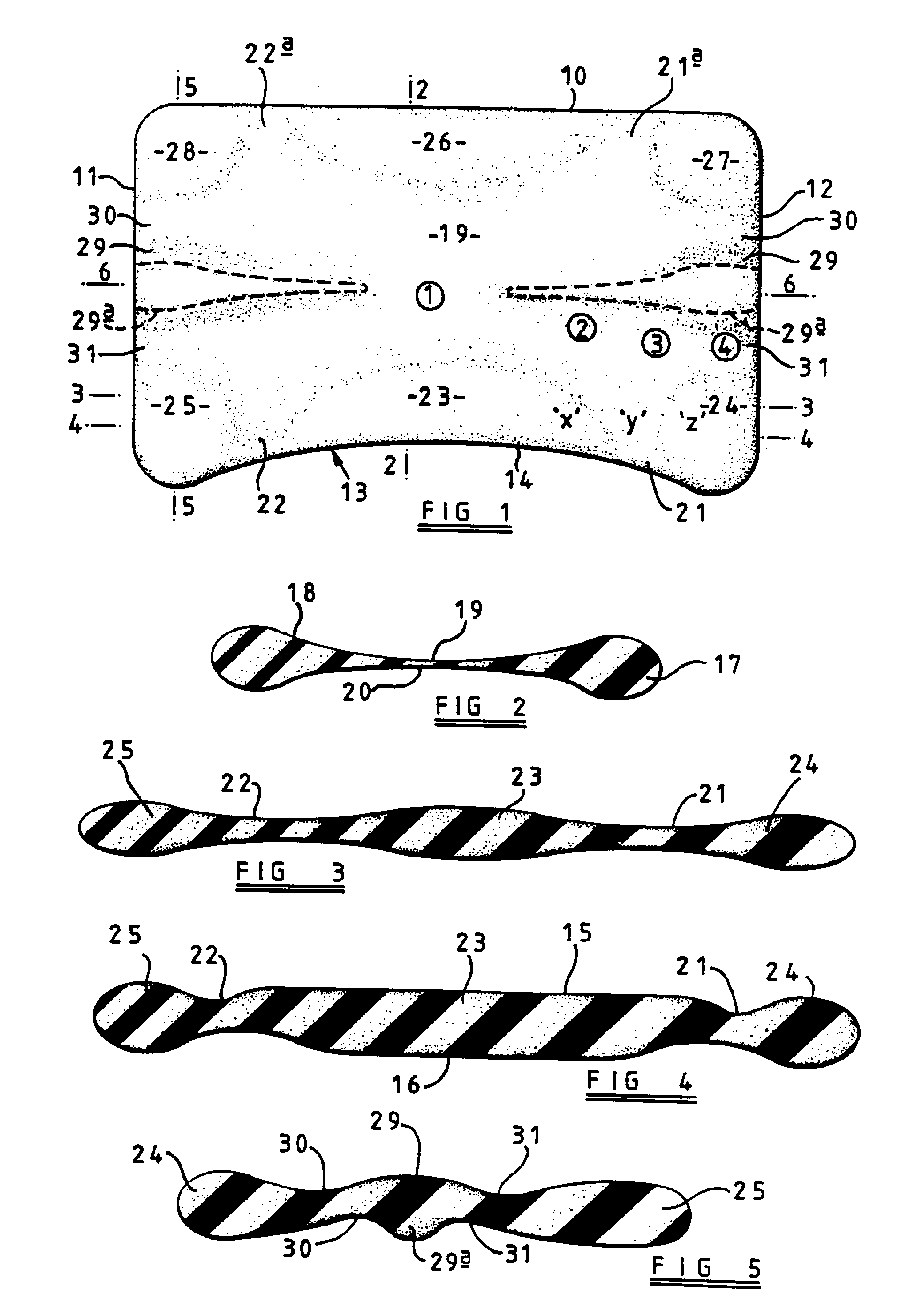
| (45) |
Mention of the grant of the patent: |
|
04.08.1993 Bulletin 1993/31 |
| (22) |
Date of filing: 11.12.1989 |
|
| (51) |
International Patent Classification (IPC)5: A47G 9/00 |
| (86) |
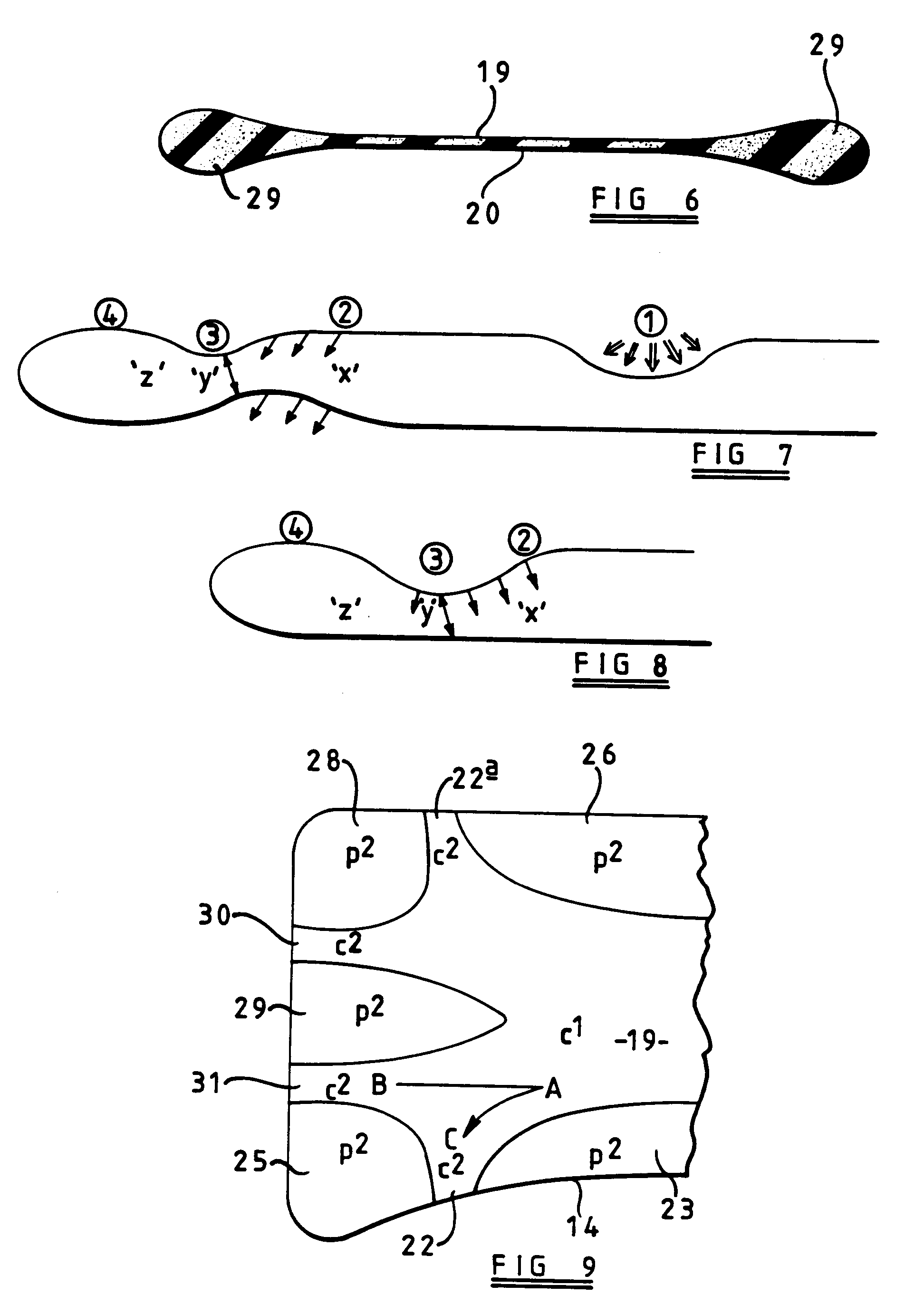
International application number: |
|
PCT/GB8901/475 |
| (87) |
International publication number: |
|
WO 9006/708 (28.06.1990 Gazette 1990/15) |
|
| (54) |
CONTOUR PILLOW
PROFILKISSEN
COUSSIN A PROFIL
|
| (84) |
Designated Contracting States: |
|
AT BE CH DE ES FR IT LI LU NL SE |
| (30) |
Priority: |
15.12.1988 GB 8829313
|
| (43) |
Date of publication of application: |
|
05.12.1990 Bulletin 1990/49 |
| (73) |
Proprietor: BRITISH TECHNOLOGY GROUP LIMITED |
|
London SE1 6BU (GB) |
|
| (72) |
Inventors: |
|
- WATTIE, James, Alistair
Leicester LE2 3TD (GB)
- WATTIE, Joanna, MacKenzie
Leicester LE2 3TD (GB)
|
| (74) |
Representative: Mosey, Stephen George et al |
|
MARKS & CLERK
Alpha Tower
Suffolk Street Queensway
Birmingham B1 1TT
Birmingham B1 1TT (GB) |
| (56) |
References cited: :
FR-A- 2 609 616
US-A- 2 835 905
|
US-A- 2 700 779
US-A- 3 400 413
|
|
| |
|
|
|
|
| |
|
| Note: Within nine months from the publication of the mention of the grant of the European
patent, any person may give notice to the European Patent Office of opposition to
the European patent
granted. Notice of opposition shall be filed in a written reasoned statement. It shall
not be deemed to
have been filed until the opposition fee has been paid. (Art. 99(1) European Patent
Convention).
|
[0001] This invention relates to improvements in or relating to pillows, particularly pillows
formed of deformable moulded rubber or plastics material, and has as its object the
provision of a pillow in a convenient and effective form. As used herein, the word
'pillow' includes analogous items, such as cushions.
[0002] GB-A-2 212 391 discloses a pillow having upper and lower outer surfaces and at least
one peripheral outer surface therebetween, the upper outer surface being smooth and
the lower outer surface having a large central recessed area therein, there being
respective first buttress portions at opposite sides of said central recessed area
extending to said at least one peripheral outer surface, with further recessed areas
extending from said central recessed area to said at least one peripheral outer surface.
[0003] According to the present invention there is provided a pillow having upper and lower
outer surfaces and at least one peripheral outer surface therebetween, at least one
of the upper and lower outer surfaces having a large central recessed area, the central
recessed area being larger than the area of engagement of a user's head on the pillow,
in use, respective first buttress portions at opposite sides of said central recessed
area extending to said at least one peripheral outer surface, further recessed areas
extending from said central recessed area to said at least one peripheral outer surface,
characterised by a pair of second buttress portions each extending to said at least
one peripheral outer surface and being disposed adjacent to and at respective opposite
sides of one of the first buttress portions and spaced therefrom by a pair of said
further recessed areas respectively.
[0004] The dependent claims describe preferred forms of embodiments of the invention.
[0005] The invention will now be described, by way of example, with reference to the accompanying
drawings, in which:
Figure 1 is a top plan view of a pillow of the invention,
Figure 2 is a cross-section on the line 2-2 of Figure 1,
Figure 3 is a schematic cross-section on the line 3-3 of Figure 1,
Figure 4 is a schematic cross-section on the line 4-4 of Figure 1,
Figure 5 is a schematic cross-section on the line 5-5 of Figure 1, but showing an
alternative underside form of the pillow,
Figure 6 is a cross-section on the line 6-6 of Figure 1,
Figures 7 and 8 are fragmentary enlarged cross-sections on the line 4-4 showing how
the pillow alters its shape, in use, and
Figure 9 is a fragmentary view of the upper surface of the pillow schematically showing
various areas defined thereon.
[0006] The pillow shown in the drawings is moulded from latex material or soft polyurethane
either as one piece or in two identical, upper and lower halves, which are adhered
together thereafter. The pillow is intended for use as an underpillow, with a top
pillow of a user's own choice, i.e. foam, feather or man-made fibre filled, being
used on top of the underpillow. Thus the user's head is only indirectly received on
the underpillow.
[0007] The pillow is of generally rectangular shape in plan, having a straight rear edge
or side surface 10, shorter straight transverse edge or side surfaces 11, 12 respectively,
and a front edge or side surface 13 which is concave and thus defines a bight 14.
The depth of the pillow is small as compared to the depth of conventional top pillows.
The pillow has upper and lower surfaces 15, 16 respectively.
[0008] In alternative constructions of the pillow, the front and rear edges could both be
straight, or both concave, and moreover either or both of the surfaces 15, 16 could
be slightly convex instead of flat.
[0009] The pillow has front and rear rolls 17, 18 respectively, and also side rolls, of
generally ovoid shape, i.e. with generally flattened upper and lower surfaces. Respective
identical, central, large concave recessed areas 19, 20 are formed in the upper and
lower surfaces and as the pillow is in fact symmetrical about a plane midway through
it and parallel to upper and lower surfaces, i.e., through the front and rear rolls.
The recesses overlie one another in a direction normal to the surfaces 15, 16. With
the recessed areas 19, 20 the term 'large' is used in comparison in surface area with
the area of load (head) applied to the upper surface, in use.
[0010] On both its upper and lower surface the front roll 17 has a pair of symmetrically,
longitudinally spaced apart minor recesses 21, 22 which effectively extend from the
central recessed area to the front edge surface 13 of the pillow. The front roll is
thus divided into a middle section or central buttress 23 and outer corner sections
or major buttresses 24, 25 respectively. The inner boundary of each of these three
sections of the front roll is convexly curved, as can be seen in Figure 1. The rear
roll 18 is similarly arranged on its upper and lower surface having a middle section
or central buttress 26 and corner or major buttresses 27, 28 respectively, with minor
recesses 21a, 22a therebetween.
[0011] As stated, the buttresses 24, 25 and 27, 28 are corner buttresses, and they are in
fact formed partly by the respective side rolls as they extend along the shorter sides
of the pillow. On its upper and lower surfaces each side roll has respective side
or minor buttresses 29 extending inwardly from the side surface. Each side buttress
is of generally triangular shape, tapering down away from its side surface and also
towards its adjacent corner buttresses. Additionally the buttress is at the level
of the corner buttresses at its junction with the side surface, but it slopes towards
the central recessed area and thus reduces in height until it runs into said central
recessed area.
[0012] Although, as described, the upper and lower buttresses 29 are identical, the lower
buttresses can be slightly less wide, as indicated at 29a by the dashed lines in Figure
1, and as shown in Figure 5. Moreover, as shown in Figure 4, the lower central buttress
could be of shorter length than the upper central buttress for the front and/or rear
of the pillow.
[0013] Between the buttresses 29 and the front and rear corner buttresses adjacent thereto
are respective further minor recesses 30, 31 which like the recessed areas 21, 22
effectively extend from the central recessed area, to the respective side surfaces
11, 12. Each minor recess 21, 21a, 22, 22a, 30 and 31 widens outwardly, i.e. away
from its associated side surface.
[0014] In use, with the pillow used either way up, a conventional top pillow is placed on
the top surface of the underpillow and the user's head acts through the top pillow
and onto the recessed area and/or rear roll of the underpillow with the user's neck
similarly acting through the top pillow onto the supporting, i.e. non- recessed area
of the underpillow, namely the front roll.
[0015] The manner in which the pillow supports the head and neck of a user will now be explained,
firstly generally with reference to Figures 1, 7 and 8, and then in more detail with
reference to Figure 9.
[0016] In position ① shown in Figures 1, 7 and 8, the user's neck is supported by the front
roll, while the back of the head or the side of the face (if the user is lying on
the side) occupies area around ① with the top of the head being supported by the rear
roll. The central area is slightly concave and this is accentuated by the weight of
the user's head. The side buttresses 29 shown in Figure 1 taper, slope and are curved,
providing support as the user's head moves laterally from the transverse midline of
the pillow, usually in an arc to positions ②, ③ or ④.
[0017] In the second position, the neck remains supported by the front roll, whilst the
back of the head or side of the face lies in the recess at ②. The back of the head
begins to be supported by the central buttresses. The curved shape facilitates free
arcuate movement of the head laterally. A 'graduated cradling effect' is now starting
at approximately point 'x' (Figures 7 and 8), as the lateral part of the front roll
depresses towards the surface of the bed, or other article on which the pillow rests,
due to the weight of the user's neck, as indicated by the arrows in Figure 7.
[0018] Position ③ shows the neck now at 'y' (Figures 7 and 8) with maximum 'cradling effect',
in conjunction with corner buttress 'z'. The back of the head or the side of the face
is at ③ with the top of the head now obtaining more support from the central buttress.
The recess narrows towards the side of the pillow due to the curved shape of the central
and corner buttresses, which provide gradually increasing support as the head moves
towards position ④ so preventing the head slipping off the end of the pillow. A further
advantage is that if the sleeper is facing laterally (i.e. with the side of the face
on the pillow) there is a much reduced tendency for the pillow lateral to the side
of the face to impinge upon the sleeper's nose.
[0019] The upper recess areas ②, ③ and area ④ in particular tend to retain the head in the
same plane relative to the plane of the surface of the bed, further aided by the lower
surface asymmetric recess 30 or 31 (Figure 5), which provides an increased cradling
effect for the head towards the transverse centre line of the pillow. This combined
recess effect avoids elevation of the head during extreme arcuate movement or lateral
positions of the head (if user lying to either side of the pillow midline) in relation
to the plane of the bed surface
[0020] Recent medical research has suggested an increased risk of a sleeper developing the
sleep apnoea syndrome, where the sleeper's head flexes excessively in relation to
the neck during sound sleep. The underpillow of the invention, when used with a top
pillow of e.g. latex foam, man-made fibre, feather or down, will maintain the head
in an optimum position relative to the neck and also correctly support the neck and
its position relative to the shoulders.
[0021] The provision of a major recess in the upper surface of the pillow as well as in
the lower surface allows natural deformation of the top pillow to be readily accommodated
by the underpillow whilst still providing sufficient support.
[0022] Considering now the various areas of the pillow in detail, the recesses of the pillow
are concerned with supporting loads perpendicular to the horizontal plane of the pillow,
and in addition loads acting and moving in planes parallel to the plane of the pillow.
A single, central major recess with eight peripheral minor recesses is provided in
each of the upper and lower surfaces of the pillow. These recesses are concerned with
load support and transfer across surface planes of the pillow, in conjunction with
a top pillow.
[0023] The major recesses 19, 20 gradually reduce in depth towards the front and rear rolls
and also towards the lateral sides of the pillow by virtue of the varying cross-sectional
shape of the central pad of the pillow. The major recesses lead into the minor recesses
by relatively wide openings which narrow progressively towards the peripheral part
of each minor recess in the horizontal plane and also in the vertical plane (due to
progressive thickening of the pad in the floor of opposing upper and lower surface
minor recesses towards the periphery). Both major and minor recesses progressively
widen away from the surface plane of the pillow, i.e. they are upwardly (outwardly)
widening.
[0024] All upper and lower surface recesses narrow towards each other, i.e. towards the
horizontal mid plane of the pillow. The minor recesses between buttresses and also
between rolls and buttresses function synergistically to provide variation in vertical
and horizontal load support (cradling) and transfer.
[0025] As described previously, the corner and side buttresses have a variable convex shape
outwards from the horizontal plane of the pillow, with a gentle taper towards their
apex, to be dome-shaped. They thus provide a gradually variable material counterforce
to perpendicular loads moving in a horizontal plane. There is synergism of function
between buttresses or a buttress and a roll in conjunction with the recesses. Buttresses
are gently spread apart by simultaneous perpendicular and horizontal plane loads,
so the head and neck are cradled.
[0026] Figure 9 shows the various regions of the base part discussed above, with c¹ denoting
the central area of the major recess 19, c² the central area of the minor recesses
and p² the highest point of a major buttress or roll.
[0027] A load moving in the horizontal plane from A to B will encounter progressively increasing
vertical and horizontal plane counterforces by virtue of the narrowing of minor recess
c², the main buttresses outline shape and convexity, together with the minor buttress,
acting synergistically. Similar counter-forces also act on a load moving in the direction
A - C. The possibility of excessive arcuate movements of the head and neck is reduced
by the synergistic actions of roll, buttresses and recesses.
[0028] Considering a section through a minor recess, e.g. line B - A, there is a gradual
increase of 'pad' thickness towards the sides of the pillow and also towards the front
and rear rolls. This results in pad counterforces gradually increasing towards the
periphery. The major recess areas both have a reducing volume towards both the sides
and the front and rear rolls.
[0029] The cradling effect of the minor recesses is further enhanced by their opposing configuration.
A load applied in the region of an upper surface minor recess will result in depression
of the intervening pad and its peripheral portion, viz. the minor buttress, towards
the surface of the bed or other supporting surface. Further application of load will
result in vertical compression of the pad material itself. The gradual progressive
cradling effect of the lower surface minor recess can be further enhanced if it has
an asymmetrical shape compared to its opposite surface minor recess. The laterally
moving load in such a case has, for example, a relatively greater volume of lower
surface minor recess to obliterate, resulting in a more gradual, progressive cradling
effect. Similar principles apply to all other recesses, including upper and lower
surface major recesses.
[0030] The front and rear rolls have a specific shape and function, i.e. the curvature of
the front roll/plan view, the straight rear roll and the taper of both rolls from
their mid points towards their lateral limits at their junctions with the minor recesses.
In plan view the front roll tapers asymmetrically. Only the medial (inner) border
of the rear roll tapers. In front elevation the front/rear roll may taper towards
its lateral limits symmetrically or asymmetrically.
[0031] The rolls provide a progressively reducing counterforce to the head and neck towards
their lateral limits, particulary during arcuate movements of the head and neck towards
a minor recess. This reducing counterforce is balanced by an increasing counterforce
of the centripetal part of the side buttress and then the front buttress. As previously
described, cradling of the head and neck occurs by synergism between roll, buttress
(front and side) and the minor recesses thus reducing the possibility of the head
moving beyond the front or side limits of the pillow, particularly during sound sleep.
[0032] The symmetrical nature of the pillow makes it relatively easy to manufacture. However
as mentioned it could be produced by adhering together two identical halves. Additionally
one half could be made deeper than the other. In an alternative embodiment, the lower
half of the underpillow has secured, preferably adhered, to its non-recessed flat
upper surface the flat base surface of a top part having a wholly smooth upper, outer
surface. With such a construction the cradling effect is carried out by the undersurface
of the pillow. The upper half of the pillow, i.e. the part with the smooth upper surface,
would be moulded in latex material of a density less than that of the lower half,
so that the top half would provide sufficient 'give' to accommodate natural deformation
of the top pillow.
[0033] Small, circular section relief holes can be provided, for softening purposes, in
the six buttresses and in the middle sections of the rolls 17, 18 if required. If
the underpillow is a one-piece moulding the holes would be open at one or both of
the upper and lower surfaces of the underpillow, but if made in two halves, each relief
hole could be formed by respective semi-circular recesses in the flat surfaces of
each half to be adhered together, so that an internal spherical relief space is formed
in the finished article.
[0034] Thus in summary the underpillow of the invention:
i) provides correct support for the head and neck of a user during sleep and therefore
improves sleeping comfort for all users of all ages. The pillow does not seek to position
the head in a central fixed position by a central recess totally surrounded by raised
portions;
ii) is of special benefit to people who complain of a stiff, painful neck and shoulders
and associated headache on awakening. Correct support of the head and neck during
sleep avoids overstretching of muscles, tendons and ligaments and also reduces the
risk of aggravating any underlying osteoarthritis in cervical vertebrae, disc prolapse
and/or cervical nerve root pressure;
iii) reduces the risk to the user of developing the sleep apnoea syndrome.
1. A pillow having upper and lower outer surfaces (15, 16) and at least one peripheral
outer surface (10-13) therebetween, at least one of the upper and lower outer surfaces
having a large central recessed area (19, 20), the central recessed area being larger
than the area of engagement of a user's head on the pillow, in use, respective first
buttress portions (23, 26) at opposite sides of said central recessed area extending
to said at least one peripheral outer surface, further recessed areas (21, 21a, 22,
22a) extending from said central recessed area to said at least one peripheral outer
surface, characterised by a pair of second buttress portions (24, 25:27, 28) each
extending to said at least one peripheral outer surface and being disposed adjacent
to and at respective opposite sides of one of the first buttress portions and spaced
therefrom by a pair (21, 22: 21a, 22a) of said further recessed areas respectively.
2. A pillow as claimed in Claim 1, wherein each first buttress portion (23, 26) has a
pair of second buttress portions (24, 25: 27, 28) disposed adjacent thereto at its
opposite sides respectively, spaced therefrom by a respective pair of said further
recessed areas (21, 22: 21a, 22a).
3. A pillow as claimed in Claim 2, wherein between adjacent ones of the two pairs of
second buttress portions (24, 27: 25, 28) respectively are respective minor buttress
portions (29).
4. A pillow as claimed in Claim 3, wherein between each minor buttress portion (29) and
an adjacent one of said second buttress portions is a minor recess area (30, 31) extending
from said central recessed area to said at least one peripheral surface.
5. A pillow as claimed in any one of the preceding claims, which is of rectangular configuration,
having longer front and rear peripheral surfaces (13, 10), and shorter peripheral
side surfaces (11, 12), said first buttress portions being formed by respective front
and rear rolls (17, 18) which define said front and rear peripheral surfaces respectively,
each of said front and rear rolls also partly defining at its respective opposite
ends said second buttress portions (24, 25: 27, 28) in the form of corner buttresses,
each corner buttress being spaced from its adjacent first buttress portion by one
of said further recessed areas (21, 22: 21a, 22a) in the form of a minor recess.
6. A pillow as claimed in Claim 5, wherein respective side rolls define said shorter
peripheral side surfaces (11, 12) and partly define said corner buttresses.
7. A pillow as claimed in Claim 6, wherein formed as part of said side rolls are respective
minor or side buttress portions (29), each disposed centrally between said corner
buttresses of the front and rear rolls respectively.
8. A pillow as claimed in Claim 7, wherein between each side buttress portion (29) and
an adjacent corner buttress is a minor recess (30, 31) extending from said central
recessed area to a side surface.
9. A pillow as claimed in any one of Claims 1 to 8, wherein the boundary of each of the
first buttress portions (23, 26) with said central recessed area is generally convex
in the plane of the pillow.
10. A pillow as claimed in any one of Claims 5 to 9, wherein each of the front and rear
rolls (17, 18) is of ovoid transverse cross-section.
11. A pillow as claimed in any one of Claims 1 to 10, wherein the boundary of each second
buttress portion (24, 25, 27, 28) with said central recessed area (19, 20) is convex
in the plane of the pillow.
12. A pillow as claimed in any one of Claims 3, 4, 7 and 8, wherein each side or minor
buttress portion (29) is of tapering shape towards the central recessed area, reducing
in width, in the plane of the pillow.
13. A pillow as claimed in Claim 7, wherein the first buttress portions (23, 26), the
corner buttresses (24, 25, 27, 28) and the side buttress portions (29) are all at
the same height at the peripheral surfaces of the pillow and all slope towards the
central recessed area.
14. A pillow as claimed in any one of the preceding claims, wherein two of said large
central recessed areas (19, 20) are provided in the upper and lower surfaces (15,
16) respectively, the central recessed areas being in at least partly overlapping
relationship in a direction perpendicular to said upper and lower outer surfaces.
15. A pillow as claimed in Claim 14, which is symmetrical about a plane mid-way between
its upper and lower outer surfaces (15, 16).
16. A pillow as claimed in Claim 12, which is asymmetric about a plane mid-way between
its upper and lower outer surfaces (15, 16) by virtue only of side buttress portions
(29a) on the lower outer surface (16) being less wide than side buttress portions
(29) on the upper outer surface (15) respectively.
17. A pillow as claimed in any one of the preceding claims, wherein there are respective
first buttress portions (23, 26) on said upper and lower outer surfaces respectively,
the lower first buttress portion being of shorter length than the upper first buttress
portion.
18. A pillow as claimed in any one of the preceding claims, formed in one piece.
19. A pillow as claimed in Claim 18, moulded from latex material.
20. A pillow as claimed in any one of Claims 1 to 17, formed by two halves which are adhered
together.
21. A pillow as claimed in Claim 20, formed by two halves moulded from latex material
which are adhered together.
22. A pillow as claimed in any one of Claims 1 to 13, comprising separate base and top
parts secured together, a central recessed area (20) being provided in a lower surface
(16) of the base part, the base part having a non-recessed upper surface to which
a non-recessed lower surface of the top part, is secured, the top part having a wholly
smooth outer surface.
23. A pillow as claimed in Claim 22, wherein the top part is moulded of latex material
of a density less than that of the base part.
24. A pillow as claimed in any one of the preceding claims, wherein relief holes are provided
in at least one of said upper and lower outer surfaces (15, 16), at positions other
than in the or each central recessed area (19, 20).
1. Ein Kissen mit oberer und unterer äußerer Oberfläche (15, 16) und wenigstens einer
umlaufenden äußeren Oberfläche (10-13) dazwischen, wobei wenigstens eine der oberen
und unteren äußeren Oberflächen einen großen mittleren ausgenommenen Bereich (19,
20) aufweist, wobei der mittlere ausgenommene Bereich größer als die Auflagefläche
eines Kopfes eines Benutzers auf dem Kissen bei der Verwendung ist, wobei jeweilige
erste Stützbereiche (23, 26) an gegenüberliegenden Seiten des mittleren ausgenommen
Bereichs, die sich bis zu der wenigstens einen äußeren umlaufenden Oberfläche erstrecken,
und weitere ausgenommene Bereiche (21, 21a, 22, 22a), die sich von dem mittleren ausgenomme
Bereich bis zu der wenigstens einen umlaufenden äußeren Oberfläche erstrecken, vorgesehen
sind, gekennzeichnet durch ein Paar zweiter Stützbereiche (24, 25; 27, 28), die sich
jeweils zu der wenigstens einen äußeren Oberfläche erstrecken und benachbart einem
der ersten Stützbereiche sowie an gegenüberliegenden Seiten desselben angeordnet sind
und von ihm jeweils durch ein Paar (21, 22: 21a, 22a) weiterer ausgenommener Bereiche
getrennt sind.
2. Kissen nach Anspruch 1, bei dem jeder erste Stützbereich (23, 26) ein Paar zweiter
Stützbereiche (24, 25: 27, 28) aufweist, die an seinen jeweiligen gegenüberliegenden
Seiten angeordnet, und davon jeweils durch ein Paar der weiteren ausgenommenen Bereiche
(21, 22: 21a, 22a) getrennt sind.
3. Kissen nach Anspruch 2, bei dem zwischen benachbarten Stützbereichen der beiden Paare
zweiter Stützbereiche (24, 27: 25, 28) jeweils zugehörige kleinere Stützbereiche (29)
vorgesehen sind.
4. Kissen nach Anspruch 3, bei dem zwischen jedem kleineren Stützbereich (29) und einem
angrenzenden der zweiten Stützbereiche ein kleiner ausgenommener Bereich (30, 31)
vorgesehen ist, der sich von dem mittleren ausgenommen Bereich zu der wenigstens einen
umlaufenden Oberfläche erstreckt.
5. Kissen nach einem oder mehreren der vorhergehenden Ansprüche, das eine rechteckige
Gestalt mit längeren vorderen und hinteren Umfangsoberflächen (13, 10) und kürzeren
Randseitenoberflächen (11, 12) aufweist, wobei die ersten Stützbereiche durch jeweilige
vordere und hintere Rollen (17, 18) geformt sind, die jeweils die vorderen und hinteren
randseitigen Oberflächen bilden, wobei jede der vorderen und hinteren Rollen auch
teilweise an ihren jeweiligen gegenüberliegenden Enden die zweiten Stützbereiche (24,
25: 27, 28) in der Form von Eckstützen bildet, wobei jede Eckstütze von ihrem benachbarten
ersten Stützbereich durch einen der weiteren ausgenommen Bereiche (21, 22: 21a, 22a)
in der Gestalt eines kleineren Ausschnitts beabstandet ist.
6. Kissen nach Anspruch 5, bei dem jeweilige Seitenrollen die kürzeren randseitigen Seitenoberflächen
(11, 12) bilden und teilweise die Eckstützen bilden.
7. Kissen nach Anspruch 6, bei dem kleinere oder Seitenstützbereiche (29) jeweils als
Teil der Seitenrollen gebildet sind, die jeweils mittig zwischen den Eckstützen der
jeweiligen vorderen und hinteren Rollen angeordnet sind.
8. Kissen nach Anspruch 7, bei dem zwischen jedem Seitenstützbereich (29) und einer angrenzenden
Eckstütze eine kleinere Ausnehmung (30, 31) vorhanden ist, die sich von dem mittleren
ausgenommenen Bereich zu einer Seitenoberfläche erstreckt.
9. Kissen nach einem oder mehreren der Ansprüche 1 bis 8, bei dem die Grenze von jedem
der ersten Stützbereiche (23, 26) zu dem mittleren ausgenommenen Bereich im wesentlichen
konvex in der Ebene des Kissen verläuft.
10. Kissen nach einem oder mehreren der Ansprüche 5 bis 9, bei dem jede der vorderen und
hinteren Rollen (17, 18) einen eiförmigen querschnitt aufweist.
11. Kissen nach einem oder mehreren der Ansprüche 1 bis 10, bei dem die Grenze jedes zweiten
Stützbereichs (24, 25, 27, 28) zu dem mittleren ausgenommenen Bereich (19, 20) in
der Ebene des Kissens konvex verläuft.
12. Kissen nach einem oder mehreren der Ansprüche 3, 4, 7, und 8, bei dem jeder Seiten-
oder kleinere Stützbereich (29) eine sich in Richtung auf den mittleren ausgenommenen
Bereich verjüngende Gestalt aufweist, die sich in der Ebene des Kissen in der Breite
verringert.
13. Kissen nach Anspruch 7, bei dem die ersten Stützbereiche (23, 26) die Eckstützen (24,
25, 27, 28) und die Seitenstützbereiche (29) an den umlaufenden Oberflächen des Kissens
alle die gleiche Höhe aufweisen und alle in Richtung auf den mittleren ausgenommenen
Bereich geneigt sind.
14. Kissen nach einem oder mehreren der vorhergehenden Ansprüche, bei dem zwei der großen
mittleren ausgenommenen Bereiche (19, 20) in den oberen und unteren Oberflächen (15,
16) jeweils vorgesehen sind, wobei sich die mittleren ausgenommenen Bereiche in zumindest
teilweise überlappender Beziehung in einer Richtung senkrecht zu den oberen und unteren
äußeren Oberflächen befinden.
15. Kissen nach Anspruch 14, das zu einer mittig zwischen seinen oberen und unteren äußeren
Oberflächen (15, 16) verlaufenden Ebene symmetrisch ist.
16. Kissen nach Anspruch 12, das in Bezug auf eine Ebene, die sich in der Mitte zwischen
seinen oberen und unteren äußeren Oberflächen (15, 16) erstreckt, nur dadurch asymmetrisch
ist, daß Seitenstützbereiche (29a) an der unteren äußeren Oberfläche (16) eine geringere
Weite aufweisen als Seitenstützabschnitte (29) an der oberen äußeren Oberfläche (15).
17. Kissen nach einem oder mehreren der vorhergehenden Ansprüche, bei denen jeweilige
erste Stützbereiche (23, 26) jeweils an den oberen und unteren äußeren Oberflächen
angeordnet sind, wobei der untere erste Stützbereich kürzer als der obere erste Stützbereich
ist.
18. Kissen nach einem oder mehreren der vorhergehenden Ansprüche, das einstückig geformt
ist.
19. Kissen nach Anspruch 18, das aus Latexmaterial gegossen ist.
20. Kissen nach einem oder mehreren der Ansprüche 1 bis 17, das durch zwei Hälften gebildet
ist, die zusammengeklebt sind.
21. Kissen nach Anspruch 20, das durch zwei aus Latexmaterial gegossene Hälften gebildet
ist, die zusammengeklebt sind.
22. Kissen nach einem oder mehreren der Ansprüche 1 bis 13, das getrennte Unter- und Oberteile
aufweist, die zusammengefügt sind, wobei ein mittlerer ausgenommener Bereich (20)
in einer unteren Oberfläche (16) des Unterteils angeordnet ist, wobei das Unterteil
eine nicht ausgenommene obere Oberfläche aufweist, an der eine nicht ausgenommene
untere Oberfläche des Oberteils befestigt ist, und wobei das Oberteil eine vollständig
glatte äußere Oberfläche aufweist.
23. Kissen nach Anspruch 23, bei dem das Oberteil aus Latex-material mit einer geringeren
Dichte als das des Unterteils gegossen ist.
24. Kissen nach einem oder mehreren der vorhergehenden Ansprüche, bei dem Löcher in wenigstens
einer der oberen oder unteren äußeren Oberflächen (15, 16) an von dem oder den mittleren
ausgenommenen Bereichen (19, 20) abweichenden Stellen vorgesehen sind.
1. Un oreiller ayant des surfaces supérieure et inférieure (15, 16) séparées par au moins
une surface extérieure périphérique (10-13), au moins une des surfaces extérieures
supérieure et inférieure comportant une grande zone centrale creusée (19,20), la zone
centrale creusée étant plus grande que la zone d'appui de la tête d'un utilisateur
sur l'oreiller pendant l'utilisation de ce dernier, les premières portions de dosseret
(23, 26) sur les côtés opposés de la zone centrale creusée s'étendant jusqu'à au moins
une surface extérieure périphérique, d'autres zones creusées (21, 21a ; 22, 22a) s'étendant
de la zone centrale creusée jusqu'à au moins une surface extérierue périphérique,
caractérisé par une paire de secondes portions de dosseret (24, 25 ; 27, 28) dont
chacune s'étend jusqu'à au moins une surface extérieure périphérique et est adjacente
à et sur les côtés opposés de l'une des premières portions de dosseret et en est séparée
par une paire (21, 22 ; 21a, 22a) de ces autres zones creusées, respectivement.
2. Un oreiller selon la Revendication 1, où chacune des premières portions de dosseret
(23, 26) a une paire de secondes portions de dosseret (24, 25 ; 27, 28) qui lui sont
adjacentes à ses côtés opposés, et qui en est séparée par une paire correspondante
de ces autres zones creusées (21, 22 ; 21a, 22a).
3. Un oreiller selon la Revendication 2, où entre chacune de deux paires adjacentes des
secondes portions de dosseret (24, 27 ; 25, 28) se trouvent des petites portions de
dosseret correspondantes (29).
4. Un oreiller selon la Revendication 3, où entre chaque petite portion de dosseret (29)
et une des secondes portions adjacentes se trouve une petite zone creusée (30, 31)
qui s'étend de cette zone centrale creusée jusqu'à au moins une surface périphérique.
5. Un oreiller selon l'une des revendications qui précèdent, qui a une configuration
rectangulaire, ayant des surfaces périphériques avant et arrière plus longues (13,
10) et des surfaces latérales périphériques plus courtes (11, 12), ces premières portions
de dosseret étant formées par les renflements avant et arrière correspondants (17,
18), qui définissent respectivement ces surfaces périphériques avant et arrière, chacun
de ces renflements avant et arrière définissant aussi partiellement à ses extrémités
opposées respectives lesdites secondes portions de dosseret (24, 25 ; 27, 28) sous
la forme de dosserets d'angle, chaque dosseret d'angle étant séparé de la première
portion de dosseret adjacente par une de ces autres zones creusées (21, 22 ; 21a,
22a) sous la forme d'un petit creux.
6. Un oreiller selon la Revendication 5, où les renflements latéraux respectifs définissent
ces surfaces latérales périphériques plus courtes (11, 12) et définissent partiellement
ces dosserets d'angle.
7. Un oreiller selon la Revendication 6, où des portions de dosseret petites ou latérales
(29) font partie intégrante des renflements latéraux, chacune de ces portions étant
disposée centralement entre les dosserets d'angle des renflements avant et arrière,
respectivement.
8. Un oreiller selon la Revendication 7, où entre chacun portion de dosseret latéral
(29) et un dosseret d'angle adjacent se trouve un petit creux (30, 31) qui s'étend
de la zone centrale creusée à la surface latérale.
9. Un oreiller selon l'une des Revendications 1 à 8, où la limite de chacune des premières
portions de dosseret (23, 26) avec chacune des zones centrales creusées est généralement
convexe dans le plan de l'oreiller.
10. Un oreiller selon l'une des Revendications 5 à 9, où chacun des renflements avant
et arrière (17, 18) a une section transversale ovoïde.
11. Un oreiller selon l'une des Revendications 1 à 10, où la limite de chacune des secondes
portions de dosseret (24, 25, 27, 28) avec chacune des zones centrales creusées (19,
20) est convexe dans le plan de l'oreiller.
12. Un oreiller selon l'une des Revendications 3, 4, 7 et 8, où chaque portion de dosseret
latérales ou petite (29) a une section décroissante versla zone centrale creusée,
avec une largeur réduite, dans le plan de l'oreiller.
13. Un oreiller selon la Revendication 7, où les premières portions de dosseret (23, 26),
les dosserets d'angle (24, 25, 27, 28) et les portions de dosseret latérales (29)
sont toutes à la même hauteur aux surfaces périphériques de l'oreiller et présentent
toutes une pente vers la zone centrale creusée.
14. Un oreiller selon l'une des revendications précédentes, où deux des grandes zones
centrales creusées (19, 20) sont ménagées respectivement dans les surfaces supérieure
et inférieure (15, 16), les zones centrales creusées ayant au moins partiellement
un rapport de recouvrement dans un sens perpendiculaire à ces surfaces extérieures
supérieure et inférieure.
15. Un oreiller selon la Revendication 14, qui est symétrique autour d'un demi-plan entre
ses surfaces extérieures supérieure et inférieure.
16. Un oreiller selon la Revendication 12, qui est asymétrique autour d'un demi-plan entre
ses surfaces extérieures supérieure et inférieure (15, 16) du seul fait que les portions
de dosseret latérales (29a) sur la surface extérieure inférieure (16) sont moins larges
que les portions de dosseret latérales (29) sur la surface extérieure supérieure (15)
correspondante.
17. Un oreiller selon l'une des revendications qui précèdent, où il y a des premières
portions de dosseret (23, 26) sur les surfaces extérieures supérieure et inférieure
correspondantes, la première portion de dosseret inférieure étant plus courte que
la première portion de dosseret supérieure.
18. Un oreiller selon l'une des revendications qui précèdent, formé d'une seule pièce.
19. Un oreiller selon la Revendication 18, en latex moulé.
20. Un oreiller selon l'une des Revendications 1 à 17, formé de deux moitiés qui sont
collées entre elles.
21. Un oreiller selon la Revendication 20, formé de deux moitiés en latex moulé qui sont
collées entre elles.
22. Un oreiller selon l'une des Revendications 1 à 13, constitué de parties de base et
supérieure réunies ensemble, une zone centrale creuse (20) étant ménagée dans unesurface
inférieure (16) de la base, la base ayant une surface supérieure non creusée sur laquelle
vient se fixer une surface inférieure non creusée de la partie supérieure, la partie
supérieure ayant une surface extérieure totalement unie.
23. Un oreiller selon la Revendication 22, où la partie supérieure est en latex moulé
d'une densité inférieure à celle de la base.
24. Un oreiller selon l'une des revendications qui précèdent, où des trous de décompression
sont ménagés dans au moins une des surfaces extérieures supérieure et inférieure (15,
16) à d'autres emplacements que dans la zone centrale creusée ou chacune d'elles (19,
20).