|
(11) | EP 0 400 558 B1 |

| (12) | EUROPEAN PATENT SPECIFICATION |
|
|
| (54) |
Phenylacetic acid derivative Phenylessigsäurederivat Dérivé de l'acide phénylacétique |
|
|
|||||||||||||||||||||||||||||||
| Note: Within nine months from the publication of the mention of the grant of the European patent, any person may give notice to the European Patent Office of opposition to the European patent granted. Notice of opposition shall be filed in a written reasoned statement. It shall not be deemed to have been filed until the opposition fee has been paid. (Art. 99(1) European Patent Convention). |
Technical field of the invention
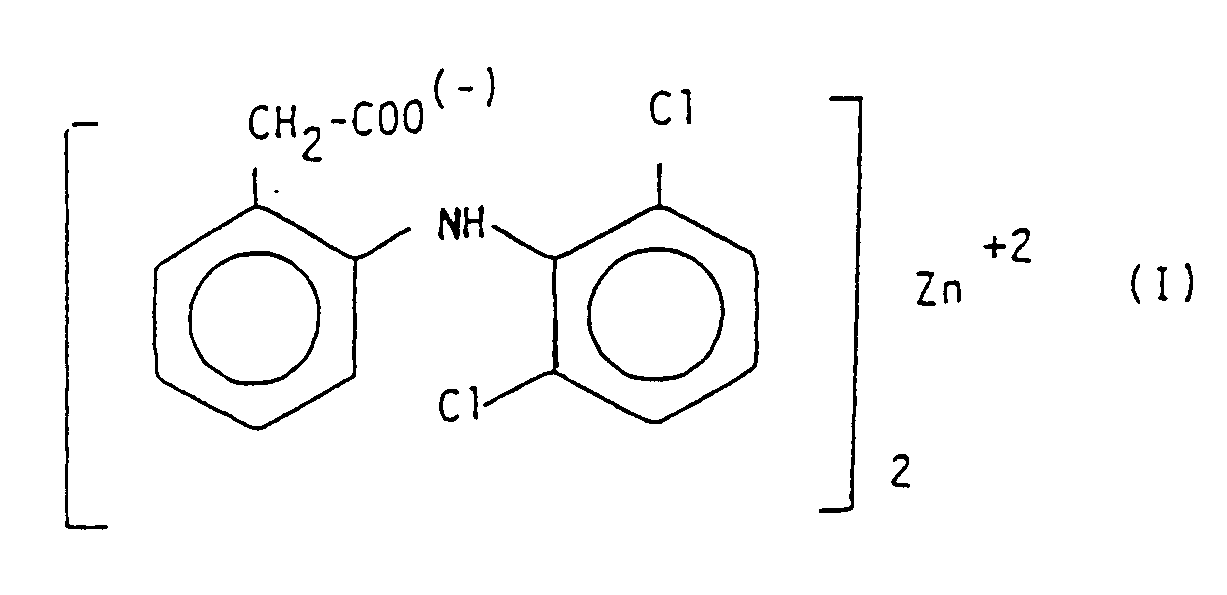
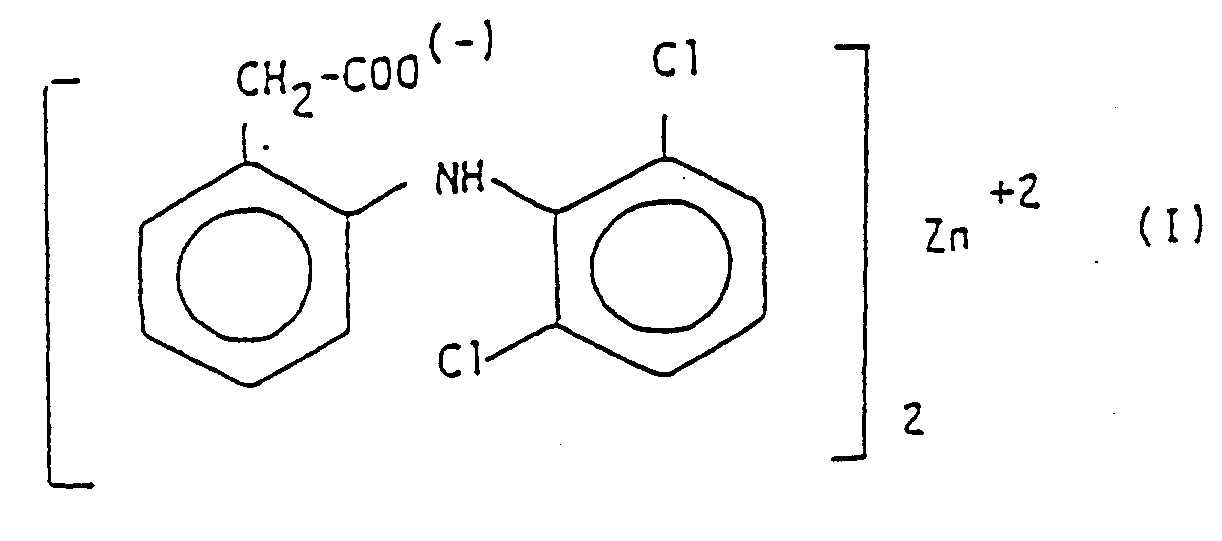
[0001] This invention relates to a new phenylacetic acid derivative, a procedure for the preparation of the new derivative and to pharmaceutical compositions containing it. More specific, this invention relates to a zinc salt of 2-(2,6-dichloroaniline) phenylacetic acid.
Background of the invention
[0003] 2-(2, 6-Dichloroaniline) phenylacetic acid is known (e.g. from GB-A-1139332) for its anti-inflammatory and anti-rheumatic properties and is generally administered in the form of sodium salt, which enables it to be dissolved since the acid as such is practically insoluble in water..
[0004] Moreover, zinc is a trace element which can be used both in the treatment of gastric and duodenal ulcers and for protection of the corresponding mucous membranes against aggressive agents and also in rheumatoid arthritis (EP-A-369088 and Spanish Patent nº 488.563).
[0005] However, there is no knowledge to date of any reporting of derivative compounds that permit the administration of both constituents together and in a single dose with beneficial results. This would, moreover, avoid the administration of other ions which are either unnecessary for reaching the required therapeutic activity or may have some other kind of undesired effects.
Description of the invention
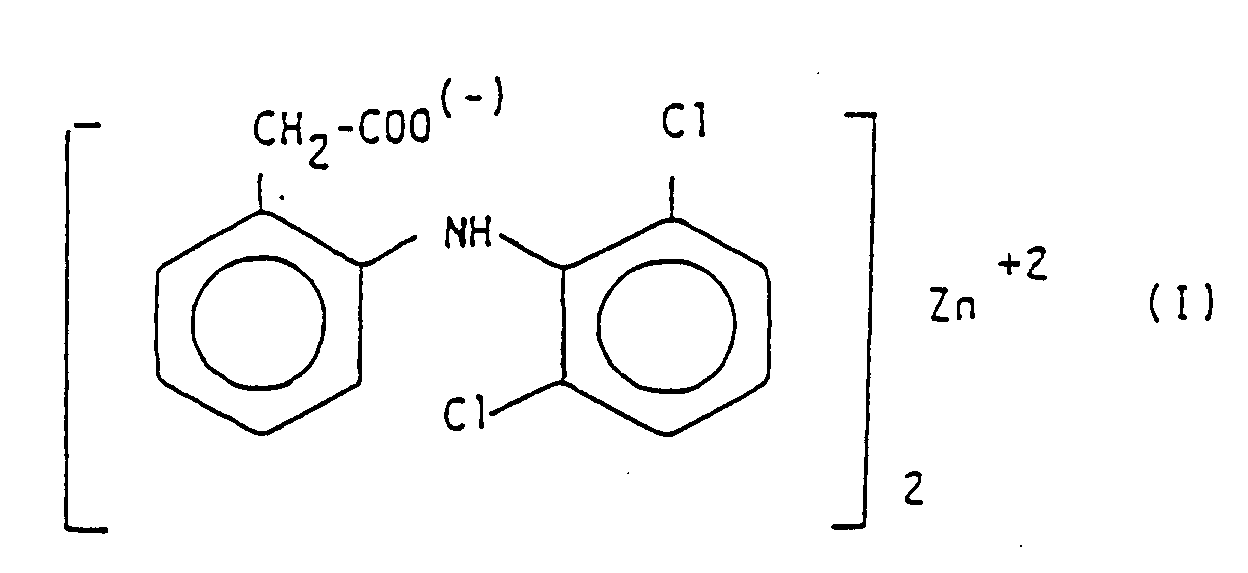
[0006] The new compound as per formula (I), according to the invention, means patients can be given both the aforementioned constituents, that is, 2-(2,6-dichloroaniline) phenylacetic acid and zinc, together and in a single dose.
[0007] Apart from this advantage in its administration, the new compound developed and described in this invention has been shown to have an anti-inflammatory, anti-rheumatic and protective action, which is another advantage over the acid itself and other cationic derivatives. This is particularly important if one considers that one of the most undesirable effects of the latter is precisely their gastric intolerance, which often means treatment has to be stopped, especially in chronic cases.
[0008] This new derivative is therefore a novelty as it is an active constituent with therapeutic application not only in patients who cannot tolerate the aforesaid anti-inflammatory preparation and its other salts, but also in patients under regular treatment with them, thereby avoiding this type of side effects.
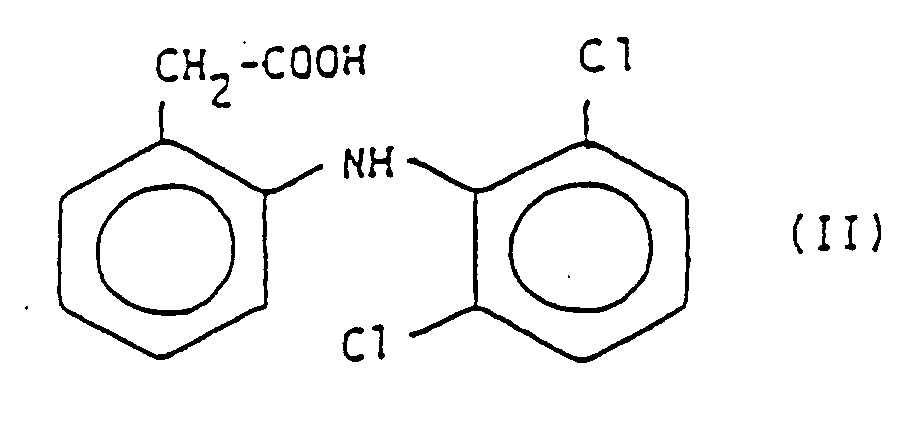
[0009] The procedure for obtaining the new compound as per formula (I), according to this invention, is characterised by reacting 2-(2,6-dichloroaniline) phenylacetic acid of formula (II)
or an ammonium, alkaline or alkali-earth salt thereof (as such or prepared in situ and unisolated) with zinc oxide, hydroxides, carbonates or salts respectively. The zinc salt may be a chloride, nitrate, sulphate, phosphate, etc. The reagent may be present in equimolar amounts and also in greater or lesser quantity in relation to the substrate.
[0010] In preference, the procedure is based on an alkaline or ammonium salt (as such or produced in situ) and equimolar amounts of zinc chloride or nitrate.
[0011] The reaction may be carried out in a solvent or mixture of polar solvents, preferably in water or in a mixture of water and low-molecular-weight alcohols.
[0012] The reaction temperature may be from ambient temperature up to the reflux temperature of the solvent or solvents mixture. Nevertheless, the work zone is important since depending on this parameter different crystalline forms can be obtained with different degrees of moisture. Thus, when the reaction is carried out between 60 °C and the solvent's reflux temperature, the derivative obtained is anhydrous zinc, while the same reaction carried out at near-ambient temperatures (10-25°C) produces the derivative hydrated basically with 3 and 1/2 molecules of water.
[0013] The importance of controlling the reaction temperature lies in the fact that the anhydrous and hydrated forms possess certain different physical and chemical properties which can affect both the bioavailability and, for example, the wettability-solubility, and therefore give rise to some differences in their pharmacological activity, as well as affecting the facility of their industrial processing, which inevitably influences the cost of the end product.
[0014] The zinc reagent may be added as follows: as a solid, bit by bit; dissolved in the solvent whenever said reagent is soluble; and in the form of a paste or suspension in the solvent.
[0015] The compound may be crystallised or precipitated out. For reasons of purity crystallisation is preferred. It is subsequently filtered and dried.
[0016] The zinc derivative of the 2-(2,6-dichloroaniline) phenylacetic acid obtained according to this procedure is, both in its anhydrous and its hydrated form, extremely water-insoluble, unlike the known sodium salt.
Examples of obtaining the compound
[0017] Described below are three examples of the procedure for obtaining the compound of formula (I) according to the invention:
Example 1
[0018] To a solution consisting of 4.0 g (12.6 mmol) of 2-(2,6-dichloroaniline) sodium phenylacetate in 300 ml of water at 60 °C, is added another solution of 0.86 g (6.3 mmol) of zinc chloride in water. After addition the reaction is maintained for one hour at 60 °C, following which it is filtered and the solid washed and then dried at 50 °C.
[0019] This procedure gives a white or ivory-coloured crystalline solid with the following characteristics:
Water solubility: 1-5/10,000
Alcohol solubility: 10-50/10,000
Melting point: 252-256 °C
IR (KBr): 3324, 1626, 1579, 1542, 1453, 1394, 1294 and 742 cm-1.
| Elementary analysis for C₂₈H₂₀Cl₄N₂O₄Zn: | |||||
| C | H | Cl | N | Zn | |
| Calculated (%) | 51.29 | 3.07 | 21.63 | 4.27 | 9.97 |
| Found (%) | 51.43 | 3.21 | 21.48 | 4.25 | 10.05 |
Example 2
[0020] To a solution consisting of 1.5 g (5.0 mmol) of 2-(2,6-dichloroaniline) phenylacetic acid in 200 ml of ethanol at 96.5 °C is added 0.50 g (5.0 mmol) of zinc hydroxide and the mixture is kept at reflux for one hour. It is then filtered and the filtrate allowed to cool and crystallise. The solid is filtered off, washed and allowed to dry at 40 °C.
[0021] This procedure gives a white, crystalline solid with the same characteristics as that of the previous example.
Example 3
[0022] To a solution of 4.0 g (12.6 mmol) of 2-(2,6-dichloroaniline) sodium phenylacetate in 120 ml of a 70/50 water/methanol mixture at ambient temperature (15-20°C) is added another solution of 0.86 g of anhydrous zinc chloride in 50 ml of water. Following addition the reaction is kept under agitation and at the aforementioned temperature for one hour, after which it is filtered, the solid being washed and then dried at ambient temperature for 24 hours.
[0023] This procedure gives a white or ivory-coloured crystalline solid with the following characteristics:
Water solubility: 1-5/10,000
Alcohol solubility: 10-15/100
Melting point: 250-254°C
IR (KBr): 3700-2800, 3281, 1578, 1561, 1510, 1453, 1403, 1304, 1201, 840, 770 and 750 cm-1.
Water (K-F): 8.9-9.2%
Loss of volatiles (P₂O₅, 60°C, vacuum): 8.9-9.1%
| Elementary analysis for C₂₈H₂₀Cl₄N₂O₄Zn (desiccated sample): | |||||
| C | H | Cl | N | Zn | |
| Calculated (%) | 51.29 | 3.07 | 21.63 | 4.27 | 9.97 |
| Found (%) | 51.17 | 2.90 | 21.85 | 4.12 | 9.83 |
Pharmacological activity
[0024] As explained previously, the formula (I) compound, which shall henceforth be called LV-216, combines to advantage an anti-inflammatory and protective action. It is worth noting that in rats with ulcers induced by ethanol, at doses of between 5 and 15 mg/kg of the new compound the protective action reached an inhibition of even 80%.
[0025] Likewise, the compared anti-inflammatory and ulcerogenic activities of LV-216, diclofenac and diclofenac + zinc have been studied, showing surprising results and an unexpectedly superior protective effect concerning the ulcerogenic action.
[0026] Set out below are the results of tests carried out to show the pharmacological activity of the product LV-216.
A) Anti-inflammatory action
[0027] The anti-inflammatory action of LV-216 has been studied in the carragheenin oedema described by Winter et al. (Proc. Soc. Exp. Biol. Med. 111: 544, 1962), using Wistar rats weighing 170 +- 20 g. The inflammation was induced by intradermal injection of a suspension of carragheenin into the plantar pad and the volume of the paw was measured by plethysmography. The anti-inflammatory effect was assessed by calculating the percentage of inhibition of the inflammation in the groups treated, compared to the control group.
[0028] The results obtained with the LV-216 show a 55% inhibition of inflammation at a dose of 11 mg/kg, for the anhydrous LV-216 and 66% for the hydrated LV-216.
B) Protective activity
[0029] Using the experimental model of ulcers induced by absolute ethanol described by Robert et al. (Gastroenterology, 77: 433, 1979) the cytoprotective activity of LV-216 was compared with that of 2-(2,6-dichloroaniline) phenylacetic acid at equimolecular doses and with a control group that was given only excipient.
[0030] The enclosed Table shows the lesion indices (in ulcerated mm) for the groups studied, as well as the percentages of ulcer inhibition in the groups treated compared with the control group (average values subject to mean error).
| mm lesion | % inhibition | |
| Control | 86.3 + 9.4 | --- |
| 2-(2,6-dichloroaniline) phenylacetic acid (sodium salt) | 70.8 ± 8.2 | 17.9 |
| LV-216 (11 mg/kg) | 36.1 ± 8.9a,b | 58.2 |
| t test: a = p < 0.01 versus control b = p < 0.05 versus 2-(2,6-dichloroaniline) phenylacetic acid (sodium salt) |
||
[0031] As can be seen, the starting acid does not inhibit the ulcers induced by absolute ethanol while the LV-216 produces over 50% inhibition, which is statistically significant with regard to the control group and to the group treated with the acid.
C) Compared ulcerogenic action of LV-216
[0032] A comparative study has been done of the ulcerogenic action of LV-216, diclofenac and diclofenac + zinc. The group of animals treated with diclofenac + zinc, both constituents separately, was introduced to compare it with the group of LV-216, a derivative in which both constituents form one and the same molecule.
[0033] Female Wistar rats of 195±15 g body weight were used for the experiment and were distributed in accordance with the following method:
- Group I : control (excipient) (n=8)
- Group II : diclofenac 10mg/kg (n=8)
- Group III: LV-216 11 mg/kg (n=8)
- Group IV: diclofenac 10 mg/kg + zinc sulphate 2.5 mg/kg (n=8) (equivalent doses)
The products were administered orally every day for four consecutive days. The animals were given no food during the 24 hours prior to the last dose. Three hours after this last dose the rats were put down and the ulcerous lesions that had appeared in the stomach and intestine (duodenum, jejunum and proximal section of the ileum) were submitted to examination as per Adami's criterion (Arch. Int. Pharmacodyn.; 147, 113-145, 1964).
[0034] The following table shows the macroscopic lesion indices corresponding to the different groups of animals studied.
[0035] The results set out in table 1 show substantial differences in the ulcerous indices among the groups studied. The rats treated with diclofenac present ulcerous lesions in the stomach and intestine, the differences being statistically significant versus the control groups. Significant differences versus the control were also observed in the animals that were given diclofenac + zinc, although the ulcerous index is lower than that of the diclofenac. On the other hand, treatment with LV-216 gave an average ulcerous index of 1.1, far below those obtained in the other groups treated and not significant versus the control.
[0036] These results indicate that the LV-216 possesses a surprisingly high degree of gastric tolerance, greater than that shown by the diclofenac administered alone or in combination with zinc. We can therefore talk about a synergic effect of the LV-216 in comparison with the diclofenac and zinc, which was unpredictable, as the tolerance increases when this new zinc derivative is administered.
[0037] This synergic effect of gastric tolerance in the ulcerogenic action is all the more surprising bearing in mind both the insolubility (lower bioavailability) of the new zinc derivative (LV-216) and the amount of zinc (1.1 mg/kg) corresponding to the dose of LV-216 administered compared to the usual pharmacological doses of other zinc derivatives (15-40 mg/kg).
[0038] These results therefore allow for the possibility of administering a new, different compound with better pharmacological properties than its constituents.
Pharmaceutical forms
[0039] For therapeutic purposes, the new zinc compound derived from 2-(2,6-dichloroaniline) phenylacetic acid as per formula (I), according to this invention, will normally be administered in pharmaceutical forms that include as the essential active ingredient at least the aforesaid compound, either on its own or in association with a pharmaceutical vehicle.
[0040] The pharmaceutical vehicle used may be, for example, a solid, a liquid or a mixed vehicle. Examples of solid vehicles are: lactose, terra alba, saccharose, talc, gelatine, agar-agar, pectin, acacia, magnesium stearate, stearic acid and such like. Examples of liquid vehicles are: syrup, peanut oil, olive oil, water and such like.
[0041] Evidently, therefore, a wide variety of pharmaceutical forms are possible. So, if a solid vehicle is used, the formula (I) compound can be made up in tablets, encapsulated in hard gelatine, or prepared as powder, granules, pills, etc.
[0042] If a liquid vehicle is used, the preparation containing the active constituent of formula (I) can be made up in the form of a syrup, emulsion, soft gelatine capsule, injectable sterile liquid solution in ampoules or an aqueous or non-aqueous liquid suspension, etc.
[0043] When mixed vehicles are used the formula (I) compound can be presented in the form of creams, ointments, suppositories, etc.
[0044] Using any of the pharmaceutical vehicles mentioned above - solid, liquid or mixed - the active compound referred to in this invention can also be formulated for delayed action by oral administration or topical application.
[0045] The pharmaceutical forms are prepared according to conventional galenic techniques involving procedures such as the mixing, granulation and pressing, dispersion or dissolving of the ingredients depending on the type of preparation required.
1. A compound having the following formula (I):
2. A procedure for preparing the compound of formula (I) characterised in that 2-(2,6-dichloroaniline)
phenylacetic acid of the following formula (II):
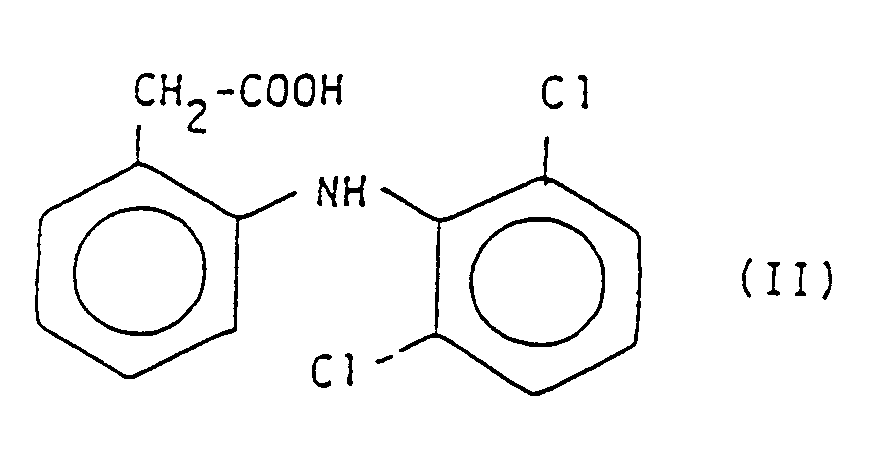
is reacted with zinc oxide, hydroxides, carbonates or salts, or a corresponding salt of the 2-(2,6-dichloroaniline) phenylacetic acid, which may be an ammonium, alkaline or alkali-earth salt, is reacted with a zinc salt such as chloride, nitrate, sulphate, phosphate, the reaction taking place in a polar solvent.
is reacted with zinc oxide, hydroxides, carbonates or salts, or a corresponding salt of the 2-(2,6-dichloroaniline) phenylacetic acid, which may be an ammonium, alkaline or alkali-earth salt, is reacted with a zinc salt such as chloride, nitrate, sulphate, phosphate, the reaction taking place in a polar solvent.
3. A procedure according to claim 2), characterised in that said polar solvent is water
or a mixture of water and low-molecular-weight alcohols.
4. A procedure according to claims 2 ) or - 3), characterised in that the reaction temperature
is the same as, or lower than that of reflux of the solvent or mixture of solvents.
5. A procedure according to any of the claims 2) to 4), characterised in that said zinc
derivative crystallises out in the actual solvent and is then filtered and dried.
6. A pharmaceutical composition comprising as ingredient a compound of formula (I) together
with pharmaceutically acceptable carriers therefor.
7. A compound of formula (I) for use as anti-inflammatory agent.
1. Verbindung der folgenden Formel (I):
2. Verfahren zur Herstellung der Verbindung der Formel (I), dadurch gekennzeichnet, daß
2-(2,6-Dichloranilin)phenylessigsäure der folgenden Formel (II):
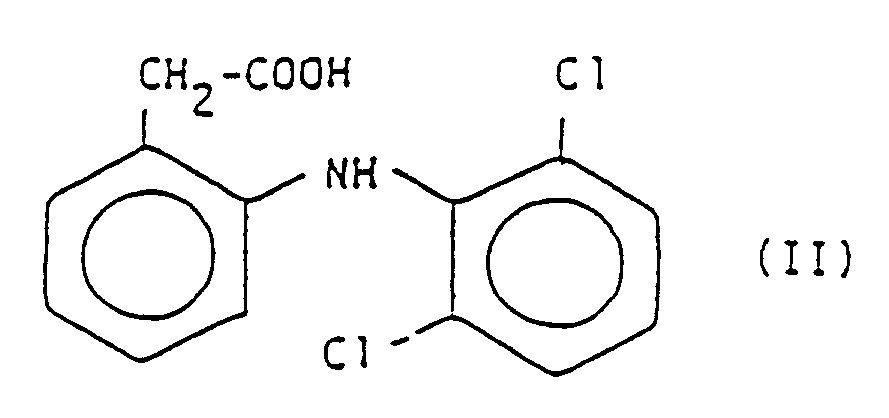
mit Zinkoxid, Hydroxiden, Carbonaten oder Salzen zur Umsetzung gebracht wird oder ein entsprechendes Salz der 2-(2,6-Dichloranilin)phenylessigsäure, das ein Ammonium-, Alkali oder Erdalkalisalz sein kann, mit einem Zinksalz wie Chlorid, Nitrat, Sulfat, Phosphat, zur Umsetzung gebracht wird, wobei die Reaktion in einem polaren Lösungsmittel stattfindet.
mit Zinkoxid, Hydroxiden, Carbonaten oder Salzen zur Umsetzung gebracht wird oder ein entsprechendes Salz der 2-(2,6-Dichloranilin)phenylessigsäure, das ein Ammonium-, Alkali oder Erdalkalisalz sein kann, mit einem Zinksalz wie Chlorid, Nitrat, Sulfat, Phosphat, zur Umsetzung gebracht wird, wobei die Reaktion in einem polaren Lösungsmittel stattfindet.
3. Verfahren nach Anspruch 2, dadurch gekennzeichnet, daß das polare Lösungsmittel Wasser
oder eine Mischung aus Wasser und Alkoholen mit niedrigem Molekulargewicht ist.
4. Verfahren nach Anspruch 2 oder 3, dadurch gekennzeichnet, daß die Reaktionstemperatur
die gleiche oder niedriger ist als die Rückflußtemperatur des Lösungsmittels oder
der Lösungsmittelmischung.
5. Verfahren nach einem der Ansprüche 2 bis 4, dadurch gekennzeichnet, daß das Zinkderivat
im eigentlichen Lösungsmittel auskristallisiert und dann filtriert und getrocknet
wird.
6. Pharmazeutische Zubereitung, die als Bestandteil eine Verbindung der Formel (I) zusammen
mit pharmazeutischen verträglichen Trägerstoffen umfaßt.
7. Verbindung der Formel (I) zur Verwendung als entzündungshemmendes Mittel.
1. Un composé chimique de formule suivante (I) :
2. Un procédé de préparation du composé chimique de formule (I) caractérisé en ce que
l'acide phénylacétique 2-(2,6-dichloroaniline) de formule suivante (II) :
est mis à réagir avec l'oxyde de zinc, des hydroxydes, des carbonates ou des sels de zinc , ou avec un sel correspondant de l'acide phénylacétique 2-(2,6-dichloroaniline) qui peut être un sel d'ammonium, un sel alcalin ou un sel de terre alcaline mis à réagir avec un sel de zinc tel qu'un chlorure, un nitrate, un sulfate, un phosphate, la réaction s'opérant dans un solvant polaire.
est mis à réagir avec l'oxyde de zinc, des hydroxydes, des carbonates ou des sels de zinc , ou avec un sel correspondant de l'acide phénylacétique 2-(2,6-dichloroaniline) qui peut être un sel d'ammonium, un sel alcalin ou un sel de terre alcaline mis à réagir avec un sel de zinc tel qu'un chlorure, un nitrate, un sulfate, un phosphate, la réaction s'opérant dans un solvant polaire.
3. Un procédé selon la revendication 2, caractérisé en ce que ledit solvant polaire est
de l'eau ou un mélange d'eau et d'alcool de faible poids moléculaire.
4. Un procédé selon les revendications 2 ou 3 caractérisé en ce que la température de
réaction est égale ou inférieure à celle du reflux du solvant ou du mélange de solvants.
5. Un procédé selon l'une quelconque des revendications 2 à 4, caractérisé en ce que
ledit dérivé de zinc cristallise dans le solvant de réaction et est ensuite filtré et séché.
6. Une composition pharmaceutique comprenant comme ingrédient ou principe actif un composé
de formule (I) associé à des porteurs ou excipients pharmaceutiquement acceptables.
7. Un composé de formule (I) pour utilisation comme agent antiinflammatoire.