|
(11) | EP 0 402 561 B1 |

| (12) | EUROPEAN PATENT SPECIFICATION |
|
|
| (54) |
Process for the manufacture of anilinofumarate via chloromaleate or chlorofumarate or mixtures thereof Verfahren zur Herstellung von Anilinofumarat via Chloromaleat oder Chlorofumarat oder Mischungen davon Procédé de fabrication d'anilinofumarate utilisant un chloromaléate ou un chlorofumarate ou des mélanges de ceux-ci |
|
|
|||||||||||||||||||||||||||||||
| Note: Within nine months from the publication of the mention of the grant of the European patent, any person may give notice to the European Patent Office of opposition to the European patent granted. Notice of opposition shall be filed in a written reasoned statement. It shall not be deemed to have been filed until the opposition fee has been paid. (Art. 99(1) European Patent Convention). |
[0001] The invention herein described relates to a novel process for the preparation of anilinofumarate via chloromaleate or chlorofumarate or mixtures thereof. Anilinofumarate is an important intermediate in the preparation of a class of highly potent herbicidal agents, 2-(imidazolin-2-yl)quinoline-3-carboxylates.
[0002] EP-A-0 309 711 relates to a method for preparing anilinofumarates and quinoline-2,3-dicarboxylic acid and esters thereof comprising reacting a dichlorosuccinate with molar equivalents of aniline and a minimum of two molar equivalents of aqueous base in the presence of a tri- or tetra-alkylammonium phase transfer catalyst at a temperature in the range of about 85° to 100°C for about one to four hours in the absence of a solvent, and isolating the thus-formed anilinofumarate.
[0003] US-A-4,656,283 relates to a method for the preparation of quinoline-2,3-dicarboxyclic acid and esters thereof, by reacting a beta-anilino-alpha,beta-unsaturated ester with an immonium salt (commonly called a Vilsmeier reagent). The beta-alpha,beta-unsaturated esters are obtained by the reaction and appropriately substituted aniline with keto-esters or dialkyl acetylene dicarboxylates.
[0004] US-A-4,675,432 relates to a method for the preparation of anilinofumarates in which dichlorosuccinates are reacted with aniline in an organic solvent in the presence of aqueous base and a phase transfer catalyst in a temperature in the range of about 20°C to 90°C for 1 to 24 hours.
[0005] It has now been found that anilinofumarates of formula I may be prepared efficiently and effectively from chloromaleates of formula II or chlorofumarates of formula III or mixtures thereof by reacting the chloromaleate or chlorofumarate with 1.0 to 1.5 equivalents of aniline in the presence of 1.0 to 1.8 molar equivalents of base as about a 15% to 50% aqueous solution containing phase transfer catalyst at an elevated temperature. The reaction is illustrated in Diagram I wherein R is C₁-C₄ alkyl.
The thus-obtained anilinofumarates of formula I may be converted to quinoline-2,3-dicarboxylic acid (as shown in Diagram II), useful as an intermediate in the preparation of 2-(imidazolin-2-yl)quinoline-3-carboxylate herbicidal agents.
DESCRIPTION OF THE INVENTION
[0006] The present invention relates to a novel and efficient process for preparing anilinofumarates of formula I from chloromaleates of formula II or chlorofumarates of formula III, or mixtures thereof, as illustrated in diagram I, shown hereinabove, wherein R is C₁-C₄ alkyl. The anilinofumarates thus-produced are useful in the preparation of quinoline-2,3-dicarboxylic acid as shown hereinabove in flow diagram II. Quinolin-2,3-dicarboxylic acid is an important intermediate in the manufacture of 2-(imidazolin-2-yl)quinoline-3-carboxylates a class of potent herbicidal agents.
[0007] In accordance with the method of the present invention, anilinofumarates of formula I are prepared by reacting chloromaleates of formula II or chlorofumarates of formula III, or mixtures thereof, with 1.0-1.5 molar equivalents of aniline in the presence of 1.0-1.8 (preferably 1.0-1.5) molar equivalents of an aqueous base as a 15% to 50% (preferably 20% to 30%) aqueous solution containing a phase transfer catalyst at an elevated temperature preferably 70°-110°C, with 90°-95°C being especially preferred. The reaction may optionally be conducted in the presence of an organic co-solvent which has a boiling point within 100°C and 250°C. The product anilinofumarate is isolated using conventional isolation procedures such as extraction into an organic solvent followed by distillation.
[0008] Bases preferred for use in the present method are alkali metal bases, for example sodium and potassium hydroxides, bicarbonates or carbonates, especially preferred is sodium carbonate.
[0009] Preferred phase transfer catalysts employed in the present invention include tetraalkylated ammonium salts such as tetra-n-butylammonium bromide, tricaprylylmethylammonium chloride, tetrabutylammonium hydrogen sulfate, benzyltriethylammonium chloride, tributylmethylammonium chloride and the like.
[0010] In order to facilitate a further understanding of the invention, the following examples are presented primarily for the purpose of illustrating more specific details thereof. The invention is not be be limited thereby except as defined in the claims. Unless otherwise noted, all parts are by weight.
EXAMPLE 1
Preparation of diethyl anilinofumarate from diethyl chloromaleate
[0011] Tetra-n-butylammonium bromide (1.0 g, 0.003 mole) is added to a 23.5% aqueous solution of sodium carbonate (9.3 g, 0.088 mole). Chlorodiethylmaleate (13.7 g, 0.0663 mole) is added at 20°-25°C followed by the addition of aniline (6.5 g, 0.070 mole). The reaction mixture is heated to 95°C over 30 minutes and held at this temperature for 2 hours. Toluene (20.0 mL) is added to facilitate phase separation and the phases are separated at 40°-50°C. The organic product phase is washed with water (20 mL), and the anilinofumarate product is dried by azeotropic distillation, to give 17.54 g (86.6% pure by gas-liquid chromatography analysis, 87.0% yield).
EXAMPLE 2
Preparation of diethyl anilinofumarate from diethyl chlorofumarate
[0012] To a stirred solution of diethyl chlorofumarate (2.1 g, 0.01 mole) in toluene is added aniline (0.93 g, 0.01 mole), and 6.72 g of 15% aqueous sodium bicarbonate and tricaprylylmethyl ammonium chloride (0.20 g, 0.005 mole). The reaction mixture is heated at 75°C-80°C for 10 hours. Analysis of the organic phase by gas-liquid chromatography indicates a 71% yield of diethyl anilinofumarate.
EXAMPLE 3
Preparation of diethyl quinoline-2,3-dicarboxylate from anilinofumarate
[0013] Phosphorus oxychloride (15.1 g, 9.0 mL, 0.098 mole) is added over a 20 minute period at 14°-23°C to a solution of dimethylformamide (7.2 g, 0.098 mole) in toluene. The two phase reaction mixture is stirred for 1 hour at 23°-25°C, cooled to 16°C, and treated with a solution of anilinofumarate (21.92 g, 0.0833 mole) in toluene over a 30 minute period at 16°-22°C. The reaction mixture is stirred for 1 hour at 23°C, and heated to reflux temperature (110°C) for about 2 hours. After cooling to 105°C, the reaction mixture is quenched with water. The organic layer is washed with 20 mL of water and concentrated in vacuo to give the title product, 30.0 g (63.5% pure by gas-liquid chromatography analysis, 83.7% yield).
EXAMPLE 4
Preparation of diethyl quinoline-2,3-dicarboxylic acid
[0014] A solution of diethyl quinoline-2,3-dicarboxylate (15.60 g, 0.0567 mole) in toluene is added to a solution of 50% sodium hydroxide (16.7 g, 0.21 mole NaOH) in water and heated at reflux temperature, with stirring, for a 3 hour period. The toluene/water/ethanol azeotrope is removed by distillation. The remaining reaction mixture is cooled to room temperature and treated with a solution of sulfuric acid (12.8 g of 96% H₂SO₄, 0.125 mole) in water, with cooling to 30°C, to pH 1.4. After a 10 minute period at 30°C, the reaction mixture is filtered and the filter cake is washed with water and dried in vacuo to give the title product, 12.2 g, (97.4% pure by high pressure liquid chromatography analysis, 96.6% yield).
1. A method for the preparation of anilinofumarate of formula I
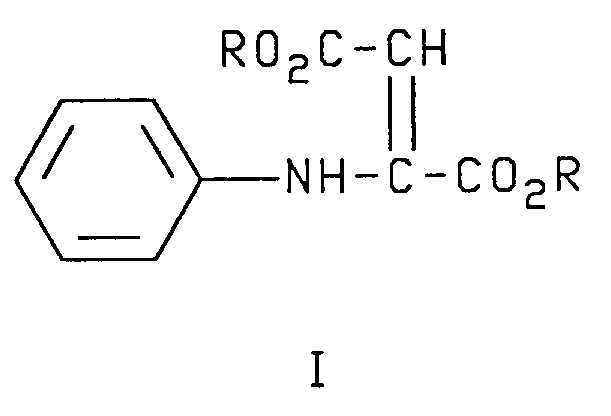
wherein R is C₁-C₄ alkyl which comprises reacting chloromaleate of formula II or chlorofumarate of formula III or mixtures thereof
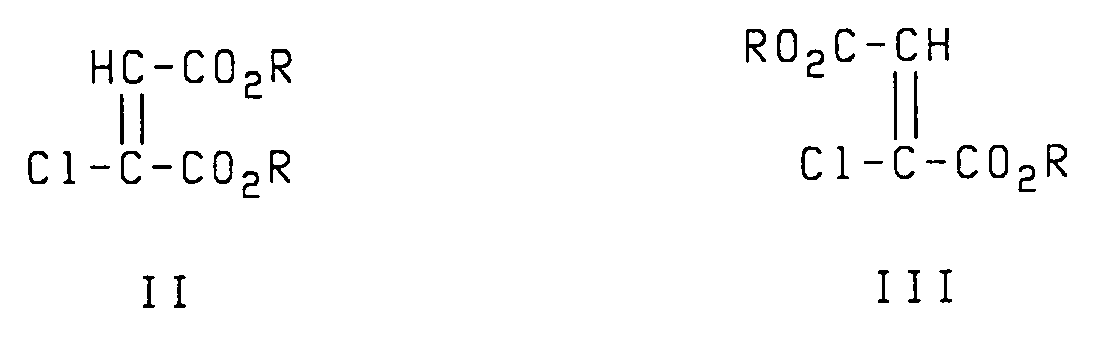
wherein R is C₁-C₄ alkyl with 1.0 to 1.5 molar equivalents of aniline in the presence of 1.0 to 1.8 molar equivalents of aqueous base containing a phase transfer catalyst to form the anilinofumarate.
wherein R is C₁-C₄ alkyl which comprises reacting chloromaleate of formula II or chlorofumarate of formula III or mixtures thereof
wherein R is C₁-C₄ alkyl with 1.0 to 1.5 molar equivalents of aniline in the presence of 1.0 to 1.8 molar equivalents of aqueous base containing a phase transfer catalyst to form the anilinofumarate.
2. A method according to claim 1 wherein the aqueous base is a 15% to 50% aqueous solution
of an alkali metal hydroxide, bicarbonate or carbonate.
3. A method according to claim 2 wherein the base is sodium carbonate present as a 20%
to 30% aqueous solution.
4. A method according to claim 1 wherein the phase transfer catalyst is a tetraalkylated
ammonium salt.
5. A method according to claim 4 wherein the phase transfer catalyst is tetra-n-butylammonium
bromide.
6. A method according to claim 1 wherein the method is carried out at a temperature of
70°C to 110°C.
7. A method according to claim 6 wherein the temperature is 90°C to 95°C.
8. A method according to claim 1 wherein the Formula II chloromaleate is diethyl chloromaleate.
1. Verfahren zur Herstellung von Anilinofumarat der Formel I
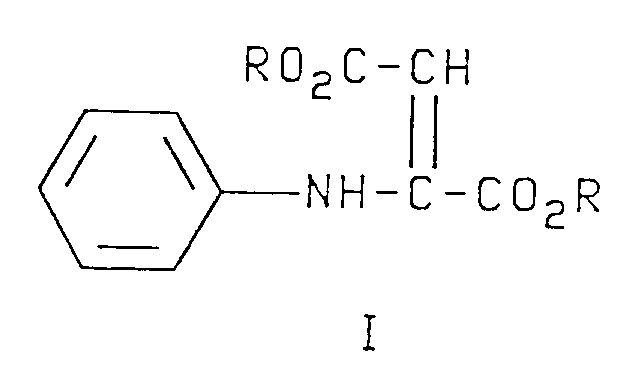
wobei R für C₁₋₄-Alkyl steht, umfassend die Umsetzung von Chlormaleat der Formel II oder Chlorfumarat der Formel III oder deren Mischungen
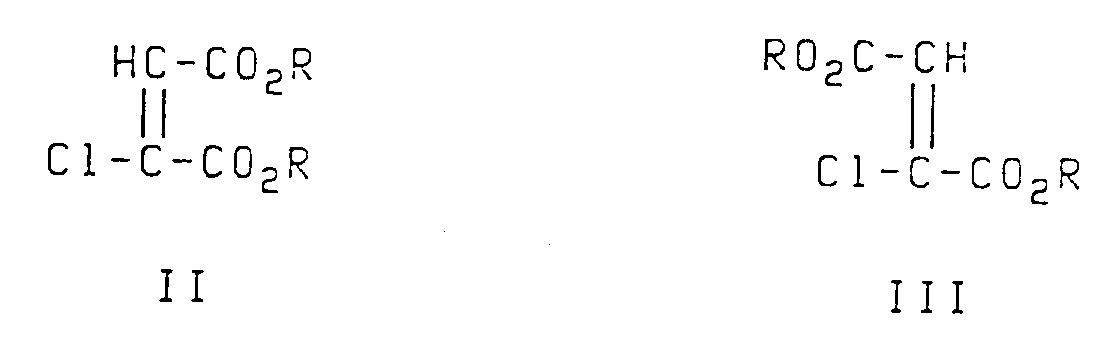
wobei R für C₁₋₄-Alkyl steht, mit 1,0 bis 1,5 molaren Äquivalenten Anilin in Gegenwart von 1,0 bis 1,8 molaren Äquivalenten wässrige Base, enthaltend einen Phasentransferkatalysator, um das Anilinofumarat zu bilden.
wobei R für C₁₋₄-Alkyl steht, umfassend die Umsetzung von Chlormaleat der Formel II oder Chlorfumarat der Formel III oder deren Mischungen
wobei R für C₁₋₄-Alkyl steht, mit 1,0 bis 1,5 molaren Äquivalenten Anilin in Gegenwart von 1,0 bis 1,8 molaren Äquivalenten wässrige Base, enthaltend einen Phasentransferkatalysator, um das Anilinofumarat zu bilden.
2. Verfahren gemäß Anspruch 1, wobei die wässrige Base eine 15 bis 50 %ige wässrige Lösung
eines Alkalimetallhydroxids, -bicarbonats oder -carbonats ist.
3. Verfahren gemäß Anspruch 2, wobei die Base Natriumcarbonat ist, das als eine 20 bis
30 %ige wässrige Lösung vorliegt.
4. Verfahren gemäß Anspruch 1, wobei der Phasentransferkatalysator ein tetraalkyliertes
Ammoniumsalz ist.
5. Verfahren gemäß Anspruch 4, wobei der Phasentransferkatalysator Tetra-n-butylammoniumbromid
ist.
6. Verfahren gemäß Anspruch 1, wobei das Verfahren bei einer Temperatur von 70 °C bis
110 °C durchgeführt wird.
7. Verfahren gemäß Anspruch 6, wobei die Temperatur 90 °C bis 95 °C beträgt.
8. Verfahren gemäß Anspruch 1, wobei das Chlormaleat der Formel II Diethylchlormaleat
ist.
1. Procédé de préparation d'un anilinofumarate de formule I :
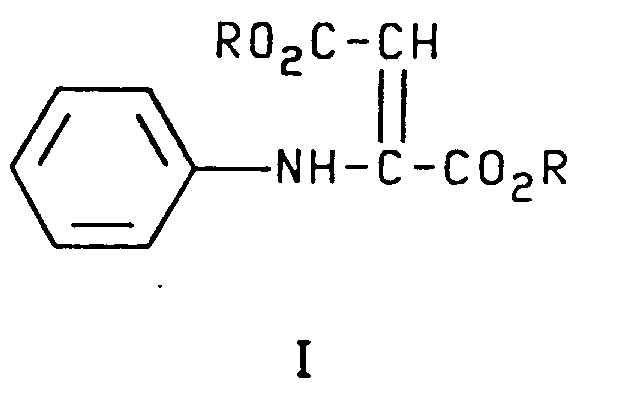
dans laquelle R représente un groupe alkyle en C₁-C₄, selon lequel on fait réagir un chloromaléate de formule II ou un chlorofumarate de formule III, ou des mélanges de ceux-ci :
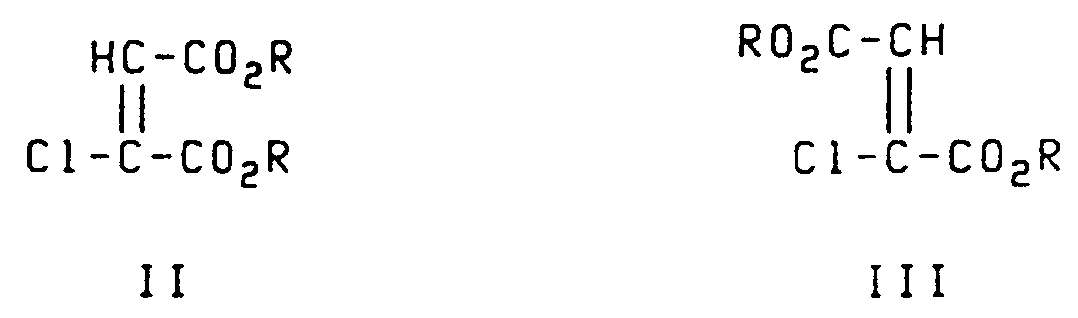
dans lesquelles R représente un groupe alkyle en C₁-C₄, avec de 1,0 à 1,5 équivalents molaires d'aniline en présence de 1,0 à 1,8 équivalents molaires d'une base aqueuse contenant un catalyseur de transfert de phase, afin de former l'anilinofumarate.
dans laquelle R représente un groupe alkyle en C₁-C₄, selon lequel on fait réagir un chloromaléate de formule II ou un chlorofumarate de formule III, ou des mélanges de ceux-ci :
dans lesquelles R représente un groupe alkyle en C₁-C₄, avec de 1,0 à 1,5 équivalents molaires d'aniline en présence de 1,0 à 1,8 équivalents molaires d'une base aqueuse contenant un catalyseur de transfert de phase, afin de former l'anilinofumarate.
2. procédé selon la revendication 1, dans lequel la base aqueuse consiste en une solution
aqueuse contenant de 15 % à 50 % d'un hydroxyde, d'un bicarbonate ou d'un carbonate
de métal alcalin.
3. Procédé selon la revendication 2, dans lequel la base est le carbonate de sodium présent
sous la forme d'une solution aqueuse à 20 % - 30 %.
4. Procédé selon la revendication 1, dans lequel le catalyseur de transfert de phase
est un sel d'ammonium tétraalkylé.
5. Procédé selon la revendication 4, dans lequel le catalyseur de transfert de phase
est le bromure de tétra-n-butylammonium.
6. Procédé selon la revendication 1, dans lequel le procédé est effectué à une température
de 70 °C à 110 °C.
7. Procédé selon la revendication 6, dans lequel la température est de 90 °C à 95 °C.
8. Procédé selon la revendication 1, dans lequel le chloromaléate de formule II, est
le chloromaléate de diéthyle.