|
(11) | EP 0 403 809 B2 |

| (12) | NEW EUROPEAN PATENT SPECIFICATION |
|
|
| (54) |
Chemiluminescent solution based on substituted perylene Chemilumineszente Lösung auf Basis von substituierten Perylenen Solution chimiluminescente à base de pérylène substitué |
|
|
|||||||||||||||||||||||||||||||
|
||||||||||||||||||||||||||||||||
[0001] The present invention relates to the production of light by chemiluminescence and, more particularly, the use of specific fluorescent agents for this purpose.
[0002] The principle and the techniques for the production of chemiluminescent light are described in detail in U.S. Patent No. 4,678,608 which is incorporated in the present description as a reference.
[0003] Chemiluminescence is produced by a reaction in the liquid phase of an activator such as hydrogen peroxide with a fluorescent agent and an oxalate. Optionally, other secondary compounds can be present, in general, they are also fluorescent agents, which modify the characteristics of the emitted light.
[0004] Until now, there exits no simple means to produce red chemiluminescent light which is satisfactory for the users. Although there has been a report on the use of derivatives of naphthacenes and tetracenes as auxiliary fluorescent agents to produce red chemiluminescence. Thus, U.S. Patent No. 3,557,233 cites the use of 5,12-bis(phenylethynyl)naphthacene, pentacene and 6,13-bis(phenylethynyl)pentacene as a fluorescent agent to produce fluorescence at a wavelength of 578, 578 and 690 nanometers, respectively. Nevertheless, these compounds were shown to be unstable in the reaction and the duration of the chemiluminescence obtained in this manner is too short to be of commercial interest.
[0005] However, on the market side, there exists a significant demand for red chemiluminescent light. Red is a color which is greatly appreciated by the public at large and, in addition, under several circumstances where chemiluminescence is applied for safety and rescue purposes, the color red is imperatively required because of traditions or conventions.
[0006] Because there is no commercially usable red chemiluminescent liquid, U.S. Patent No. 4,379,320 has proposed a method which consists in using a non-red chemiluminescent liquid, whose luminosity is satisfactory both with regard to intensity as well as duration, and to use it in a container whose translucent walls are dyed in the composition by a red fluorescent dye. The claimed chemiluminescent liquid emits wavelength which is lower than that of the dye of the wall. Thus, the color is yellow is cited preferentially. Some articles based on this principle are in fact commercially available on a large scale; however, the drawback that is mentioned is that it produces a red-orange color and not a true pure red color, the latter could be designated as "signal red" with an emission which would be at a wavelength of approximately 625 nanometers.
[0007] It has now been observed unexpectedly that known fluorescent dyes which are soluble in organic solvents and, particularly, esters, can be used advantageously to produce a chemiluminescent light, particularly a red chemiluminescent light, which is particularly appreciated by the users and which differs from the colors produced in the prior art.
[0008] It is the problem of the invention to provide articles containing a compound suitable for providing chemiluminescent signal red light over a sufficiently long period of time.
[0010] The preferred fluorescent dye is 1,6,7,12-tetraphenoxy-N-N'-bis(2,6-diisopropylphenyl)-3,4,9,10-perylene dicarboximide.
[0011] The above-mentioned compounds are described in European Patent Application No. 227,980 and U.S. Patent No. 4,845,223. The preferred compound is used under the trade name Lumogen F Rot 200 as a fluorescent dye in plastic materials with light-concentration effects. These patents also describe the preparation of analog derivatives.
[0012] Some dicarboximide perylenes have already been used for the production of chemiluminescent light. Thus, Patent No. 4,678,608 claims the use of dyes of this family, not particularly substituted in position 1, 6, 7, or 12. These derivatives are however used in association with another fluorescent compound. The association can produce advantageously a white color, which is difficult to produce otherwise, or other colors, but different from red.
[0013] To produce chemiluminescent light, the compounds according to the present invention are used under the conditions already described in the literature, particularly in said U.S. Patent No. 4,678,608. In general, one can use any known solvent or oxalate which can be used for the production of chemiluminescent light. The solvent can be an ester, aromatic derivatives or a chlorinated hydrocarbon. Preferably, phthalates are used, in particular dibutyl phthalate.
[0014] Oxalate, such as those described in U.S. Patent Nos. 3,749,679 and 3,846,316, incorporated herein by reference, may be used to produce the chemical reaction to cause chemiluminescent light when mixed with the fluorescers described above, with bis(2,4,5-trichloro-6-carbopentoxylphenyl) oxalate being exemplary. Substituted carbalkoxyphenyl oxalate are the preferred class of oxalates used herein the oxalate and perylene fluorescer each being used in sufficient quantity to cause chemiluminescent light, preferably in a 20-40:1 oxalate to fluorescer, molar ratio.
[0015] The perylene fluorescer is used in amounts ranging from about 0.005 mole per liter of oxalate solution i.e. the solvent solution of the oxalate and the perylene fluorescer.
[0016] Useful catalysts are disclosed in U.S. Patent No. 3,775,336, incorporated herein by reference, in concentrations disclosed therein, and usually in the solvent solution of the hydrogen peroxide.
[0017] The areas of application are well known and they include the production of useful objects, particularly signs, decorative objects, games and gadgets such as chemiluminescent colors, etc... In such articles, the chemiluminescent light is produced by mixing a solution of an activator, in general oxygenated water (hydrogen peroxide), with a solution which contains the derivatives of perylene and an oxalate diester. The article consists of, in its passive state, two compartments between which a communicating link was established at the time of use, for example as described in French Patent No. 87 11296, for the case of flexible luminescent tubes.
Example 1.
[0019] To a liter of dibutyl phthalate, heated to 150 °C and purged with nitrogen, one adds 110 g of bis(2,4,5-trichloro-6-carbopentoxylphenyl) oxalate and 1 part of 1,6,7,12-tetraphenoxy-N-N'-bis(2,6-diisopropylphenyl)-3,4,9.10-perylene dicarboximide, by continuing the mixing until dissolution is completed.
[0020] In addition, one prepares a mixture of 80 parts by volume of dimethyl phthalate and 20 parts of t-butanol, in which one dissolves 50 g of hydrogen peroxide and 25 mg of sodium salicylate. This solution constitutes the activator
[0021] To produce the chemiluminescence, one mixes one part by volume of the activator and 3 parts of the colored solution in a container with translucent walls.
[0022] One compares the chemiluminescence emitted by such a mixture to the chemiluminescence emitted by a commercial cylinder ("Cyalume®) red manufactured by American Cyanamid) which contains a chemiluminescent solution which emits in the yellow range and whose translucent cylinder walls are colored composition by a red fluorescent dye. The cylinder is activating by breaking a glass ampule which floats in the colored liquid and which is filled with the activator solution.
[0023] One observes that, in the case of the Cyalume® article, the initial luminous intensity is, in a first step, higher than that produced according to the present invention. After approximately three hours, the luminosities are equivalent; subsequently, the system according to the invention produces a more intense light. During the entire test duration, the light emitted according to the invention is comparable to the wanted red "signal" light and not to a red-orange as produced by the above-mentioned commercially available article.
Examples 2-10 (Reference)
[0024] The procedure of Example 1 is again followed except that the 1,6,7,12-tetraphenoxy-N,N'-bis(2,6-diisopropylphenyl)-3,4,9,10-perylene dicarboximide is replaced by other perylene compounds according to the generic formulae above. In each instance, a red chemiluminescent light is produced in the absence of any other fluorescer in the solution or in the walls of the container.
[0025] Reference Example 2. 1,7-dichloro-6,12-diphenoxy-N,N'-bis(2,6-diisopropylphenyl)-3,4,9,10-perylene dicarboximide.
[0026] Reference Example 3. 1,6,7,12-tetra(p-bromophenoxy)-N,N1-bis(2,6-diisopropylphenyl)-3,4,9,10-perylene dicarboximide.
[0028] Reference Example 5. 1,6,7,12-tetra(p-t-butylphenoxy)-N,N1-dineopentyl-3,4,9,10-perylene dicarboximide.
[0029] Reference Example 6. 1,6,7,12-tetra(o-chlorophenoxy)-N,N1-bis(2,6-diisopropylphenyl)-3,4,9,10-perylene dicarboximide.
[0030] Reference Example 7. 1,6,7,12-tetra(p-fluorophenoxy)-N,N1-bis(2,6-diisopropylphenyl)-3,4,9,10-perylene dicarboximide.
[0031] Reference Example 8. 1,6,7,12-tetra(p-fluorophenoxy)-N,N1-bis(2,6-diisopropylphenyl)-3,4,9,10-perylene dicarboximide.
[0032] Reference Example 9. 1,6,7,12-tetra(p-chlorophenoxy)-N,N'-bis(2,6-diisopropylphenyl)-3,4,9,10-perylene dicarboximide.
[0033] Reference Example 10. 1,6,7,12-tetra(p-t-butylphenoxy)-N,N'-dineopentyl-3,4,9,10-perylene dicarboximide.
1. A composition adapted to be reacted with hydrogen peroxide to provide chemiluminescent
light, said composition comprising an oxalate compound and a solvent solution of a
compound having the formula:
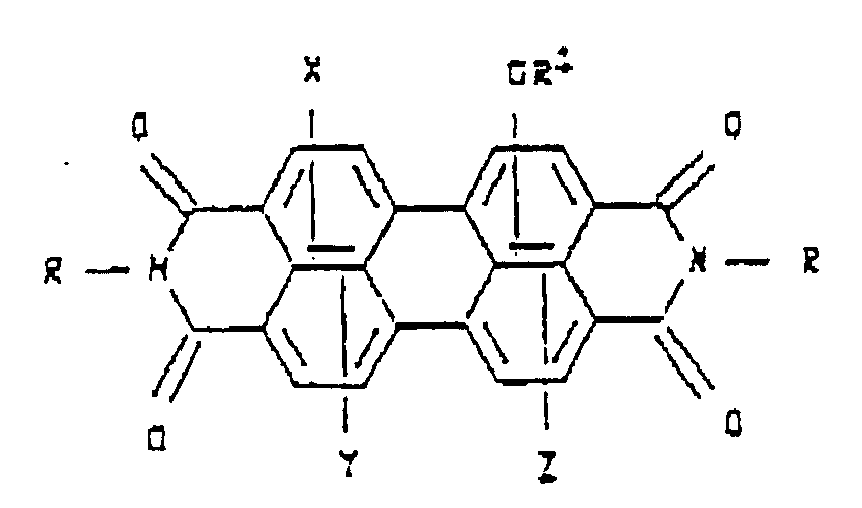
wherein each R is 2,6-diisopropylphenyl X.Y and Z are OR' and R1 is phenyl, the amount of said compound being such that it provides signal red light.
wherein each R is 2,6-diisopropylphenyl X.Y and Z are OR' and R1 is phenyl, the amount of said compound being such that it provides signal red light.
2. A composition according to Claim 1 wherein said oxalate is a substituted carbalkoxyphenyl
oxalate.
3. A composition according to Claim 1 wherein said oxalate is bis(2.4,5-trichloro-6-carbopentoxylphenyl)
oxalate.
4. A composition according to Claim 1 wherein said solvent is t-butylphthalate.
5. A composition according to Claim 1 wherein said compound is the only fluorescer in
the composition.
6. A method of producing red chemiluminescent light which comprises adding to the composition
of Claim 2 a solution of hydrogen peroxide.
1. Zusammensetzung zur Reaktion mit Wasserstoffperoxid zur Erzeugung von chemilumineszentem
Licht, wobei die Zusammensetzung eine Oxalatverbindung und eine Lösungsmittellösung
einer Verbindung der folgenden Formel umfasst:
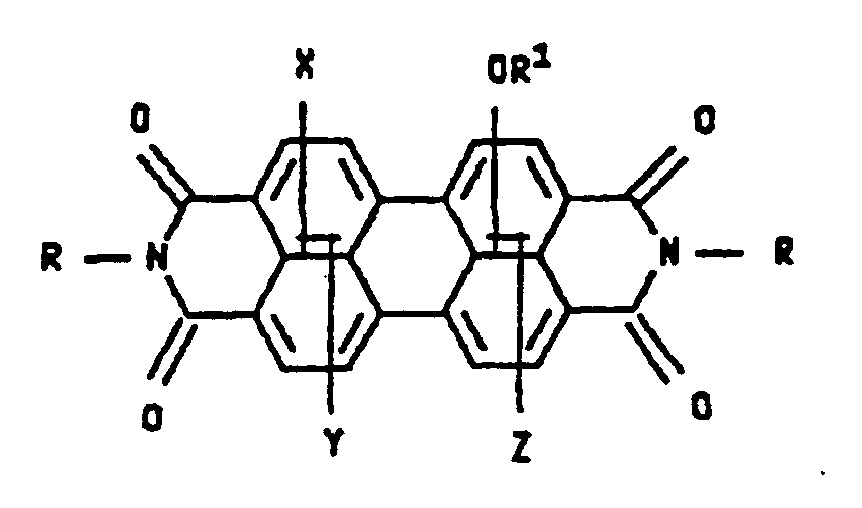
worin jedes R 2,6-Diisopropylphenyl ist,
X, Y und Z OR1 sind und R1 Phenyl ist,
wobei die Menge der Verbindung derart ist, dass sie signalrotes Licht erzeugt.
worin jedes R 2,6-Diisopropylphenyl ist,
X, Y und Z OR1 sind und R1 Phenyl ist,
wobei die Menge der Verbindung derart ist, dass sie signalrotes Licht erzeugt.
2. Die Zusammensetzung gemäß Anspruch 1, wobei die Oxalatverbindung ein substituiertes
Carbalkoxyphenyloxalat ist.
3. Die Zusammensetzung gemäß Anspruch 1, wobei die Oxalatverbindung Bis(2,4,5-trichlor-6-carbopentoxyphenyl)oxalat
ist.
4. Die Zusammensetzung gemäß Anspruch 1, wobei das Lösungsmittel t-Butylphthalat ist.
5. Verfahren zur Erzeugung von rotem chemilumineszentem Licht, umfassend das Hinzugeben
einer Wasserstoffperoxidlösung zu einer Zusammensetzung gemäß Anspruch 2.
6. Die Zusammensetzung gemäß Anspruch 1, wobei die Verbindung die einzige fluoreszierende
Verbindung in der Zusammensetzung ist.
1. Composition adaptée pour réagir avec du peroxyde d'hydrogène pour procurer de la lumière
par chimioluminescence, cette composition comprenant un composé dérivé d'oxalate et
une solution dans un solvant d'un composé de formule :
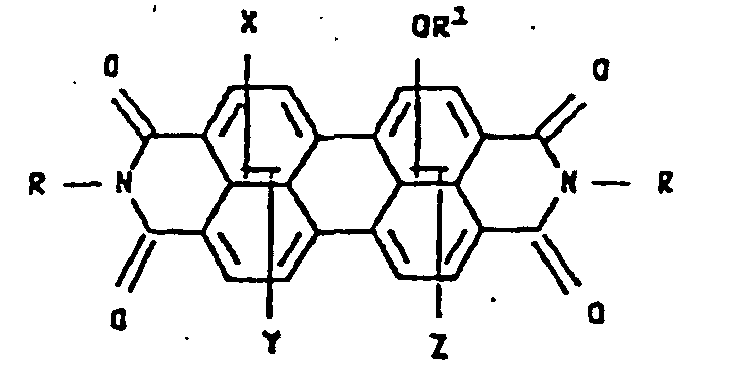
dans laquelle chaque groupe R représente un 2,6-diisopropylphényl, X, Y et Z représentent OR1, avec R1 représentant un groupe phényle, la quantité de ce composé étant telle qu'elle procure un signal lumineux rouge.
dans laquelle chaque groupe R représente un 2,6-diisopropylphényl, X, Y et Z représentent OR1, avec R1 représentant un groupe phényle, la quantité de ce composé étant telle qu'elle procure un signal lumineux rouge.
2. Composition selon la revendication 1, dans laquelle l'oxalate est un oxalate de carbalkoxyphényle
substitué.
3. Composition selon la revendication 1, dans laquelle l'oxalate est l'oxalate de bis(2,4,5-trichloro-6-carbopentoxyphényle).
4. Composition selon la revendication 1, dans laquelle le solvant est le phtalate de
t-butyle.
5. Composition selon la revendication 1, dans laquelle le composé est le seul agent fluorescent
dans la composition.
6. Procédé de production de lumière rouge par chimioluminescence, comprenant un ajout,
dans la composition de la revendication 2, d'une solution de peroxyde d'hydrogène.