| (19) |
 |
|
(11) |
EP 0 403 944 B1 |
| (12) |
EUROPEAN PATENT SPECIFICATION |
| (45) |
Mention of the grant of the patent: |
|
13.04.1994 Bulletin 1994/15 |
| (22) |
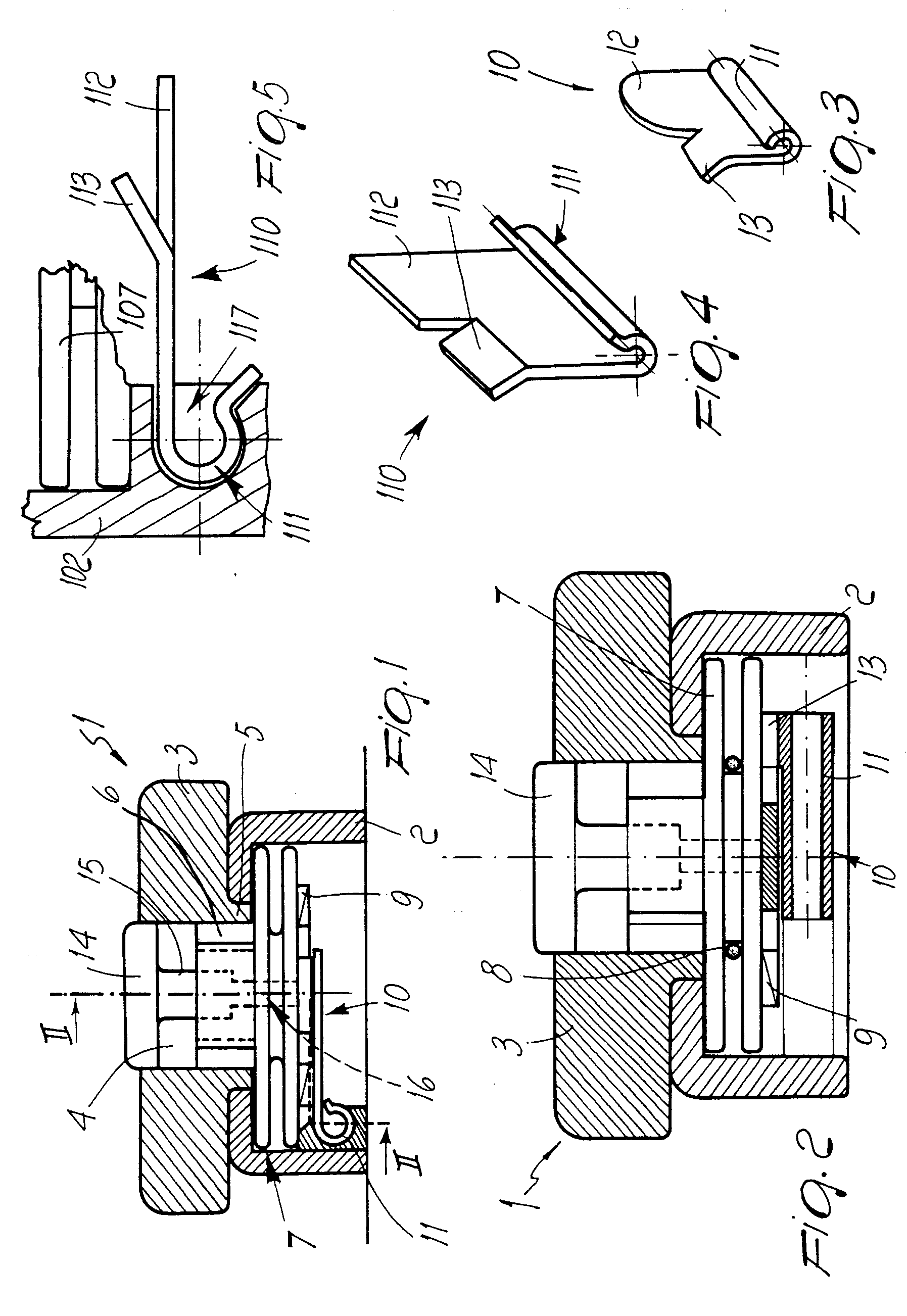
Date of filing: 13.06.1990 |
|
| (51) |
International Patent Classification (IPC)5: A43C 11/16 |
|
| (54) |
Securing and adjustment device particularly for ski boots
Halte- und Einstellvorrichtung, insbesondere für Schischuhe
Dispositif de maintien et d'ajustement, en particulier pour chaussures de ski
|
| (84) |
Designated Contracting States: |
|
AT CH DE FR IT LI |
| (30) |
Priority: |
22.06.1989 IT 8255789
|
| (43) |
Date of publication of application: |
|
27.12.1990 Bulletin 1990/52 |
| (73) |
Proprietor: NORDICA S.p.A. |
|
31040 Trevignano (Treviso) (IT) |
|
| (72) |
Inventors: |
|
- De Bortoli, Giuseppe
I-31044 Montebelluna,
Treviso (IT)
- Zorzi, Claudio
I-31057 Silea,
Treviso (IT)
|
| (74) |
Representative: Modiano, Guido, Dr.-Ing. et al |
|
Modiano & Associati S.r.l.
Via Meravigli, 16
20123 Milano
20123 Milano (IT) |
| (56) |
References cited: :
EP-A- 0 056 953
|
DE-A- 2 341 658
|
|
| |
|
|
- RICHTER UND VOSS 'BAUELEMENTE DER FEINMECHANIK' 1959 , VEB VERLAG TECHNIK , BERLIN
|
|
| |
|
| Note: Within nine months from the publication of the mention of the grant of the European
patent, any person may give notice to the European Patent Office of opposition to
the European patent
granted. Notice of opposition shall be filed in a written reasoned statement. It shall
not be deemed to
have been filed until the opposition fee has been paid. (Art. 99(1) European Patent
Convention).
|
[0001] The present invention relates to a securing and adjustment device particularly usable
in ski boots.
[0002] Several devices are known for securing one or more cables and having a knob to wind
the cables at adapted winders or pulleys.
[0003] For this purpose, the same Applicant filed, on January 14, 1982, a European Patent
application No. 82100223.5, granted on 21.11.1985 No. EP-B-0056953 disclosing a device
which comprises a case body provided with a knob for the actuation of a spool for
winding at least one cable.
[0004] The device further has a pawl which is provided at one end with an axial seat for
a pivot for pivoting to the case and has a tooth which engages ratchet-like with a
set of teeth of the spool, said tooth being forced toward said spool by means of a
spring conveniently fit within the case.
[0005] The above described device effectively secures and adjusts the cables, however it
has the disadvantage of being of a relatively complicated structure and assembling.
[0006] US-A-3.834.048 and DE-A-2.341.658, disclose winders having a simplified structure.
[0007] In these winders, though, the cable is not properly wound because it axially oscillates
during its rotation owing to the interaction of its axial toothing with a fixed tooth
or catch.
[0008] The aim of the present invention is to provide a securing and adjustment device of
a simple structure and assembling and having an improved winding operation with respect
to the prior art devices.
[0009] Within the above aim, an important object is to provide a device which associates
with the preceding characteristics that of having modest production costs.
[0010] Not least object is to provide a device which is reliable and safe in use as well
as easily operated by the skier.
[0011] This aim, and these and other objects which will become apparent hereinafter are
achieved by a securing and adjustment device, particularly for ski boots, as defined
in the appended claims.
[0012] Further characteristics and advantages of the invention will become apparent from
the detailed description of a particular but not exclusive embodiment, illustrated
only by way of non-limitative example in the accompanying drawings, wherein:
figure 1 is a sectional front view of the device according to a median longitudinal
sectional plane;
figure 2 is a sectional side view taken along the sectional plane II-II of figure
1;
figure 3 is a detail isometric view of the resilient planar element of the device
of figure 1;
figure 4 is a view, similar to that of figure 3, of a different embodiment of the
resilient planar element;
figure 5 is an enlarged detail sectional view similar to that of figure 1, of the
arrangement of the resilient element of figure 4;
figure 6 is a sectional front view, similar to that of figure 1, of a device according
to a second aspect of the invention;
figure 7 is a sectional bottom view of the device of figure 6.
[0013] With reference to figures 1-5, the reference numeral 1 indicates the securing and
adjustment device, particularly usable for ski boots, which is constituted by a case
member 2 associable with a section of the boot.
[0014] A knob 3 is rotatably associated with the case 2; said knob has an axial seat 4 and
is provided with a first stem 5 which is keyed at an adapted tab 6 which protrudes
from a spool 7 adapted to wind at least one cable 8 arranged inside the case 2.
[0015] The spool 7 has an axial toothing, or serration, 9 in the shape of a circular crown
on the side opposite to the tab 6.
[0016] The device comprises a substantially planar resilient element 10 which is advantageously
constituted by a sheet having a loop 11, at one end, which can be accommodated at,
and rigidly coupled to, an adapted seat provided laterally to said case 2 below the
spool 7.
[0017] The planar element 10 is furthermore arranged at a plane which is parallel to the
plane of arrangement of the toothing 9.
[0018] A wing 13 is defined proximate to the free end 12 of the planar element 10, protrudes
toward the spool 7 and interacts ratchet-like with the toothing, or serration, 9 thereof.
[0019] A release means for the element 10, such as a button 14 is slidably associated at
the axial seat 4 of the knob 3; said button 14 has a second stem 15 which passes at
an adapted hole 16 defined on the spool 7 and interacts with the free end 12 of the
planar element 10.
[0020] The operation of the device is therefore as follows: when the skier turns the knob
3 in the direction of winding of the cable 8, the planar element 10 allows the one-way
rotation of the spool by virtue of the ratchet-like interaction of the wing 13 with
the toothing 9 of said spool 7.
[0021] This is obtained by virtue of the elastic deformation of said planar element 10.
[0022] In order to release the cable it is sufficient for the skier to press the button
14 within the axial seat 4 provided on the knob 3; in this manner the second stem
15 of said button bends the free end 12 of the planar element 10, disengaging the
wing 13 from the toothing 9 of the spool 7.
[0023] The latter is therefore free to rotate, allowing the unwinding of the cable.
[0024] Once the button has been released, the resiliency of the planar element 10 returns
the wing 13 to interact with the toothing 9 so as to again allow the winding of the
cable.
[0025] An advantage of the above described device is that the pivoting pin and the return
spring required for the operation of the pawl are combined into a single member constituted
by the planar element 10.
[0026] Figures 4 and 5 illustrate a different embodiment of the planar element 110 which
again has, proximate to the free end 112, a wing 113 which interacts with the front
set of teeth of the spool 107.
[0027] On the opposite side with respect to the free end 112, the planar element 110 again
has a loop 111 which however has an open configuration and can be accommodated in
an adapted seat 117 defined at a side of the case 102.
[0028] This embodiment of the planar element further reduces the number of components of
the device by eliminating the necessity of a fastening member for the planar element.
[0029] Figures 6-7 illustrate a device 201, according to a further aspect of the invention,
comprising a case 202 for a spool 207 adapted to wind a cable 208, substantially as
in the previously described device 1.
[0030] The spool 207 is actuated by a knob 206 which has a push-button 214 adapted to engage
a planar element 210, which is in turn adapted to engage an axial toothing or serration
209, formed on the spool 207, substantially as previously described.
[0031] The planar element 210 has a loop 211 embracing a pivot 220 adapted to pivotally
secure the planar element 210 to the case 202.
[0032] A spring 221 is coaxially arranged at the pivot 220 and has a first end 221a, fastened
to the case 202, and a second end 221b connected to said planar element 210 and biasing
the wing 213 against the axial toothing 209 of the spool 207.
[0033] To this purpose, the planar element 210 comprises an angled wing 213 adapted to ratchet-like
engage the toothing 209, substantially as previously described.
[0034] The operation of the device 201 is identical to the operation of the previously illustrated
embodiment.
[0035] The materials and dimensions which constitute the individual components of the device
may also naturally be the most pertinent according to the specific requirements.
[0036] Where technical features mentioned in any claim are followed by reference signs,
those reference signs have been included for the sole purpose of increasing the intelligibility
of the claims and accordingly such reference signs do not have any limiting effect
on the scope of each element identified by way of example by such reference signs.
1. Securing and adjustment device, particularly for ski boots, comprising a case body
(2,102,202), a knob (3,203) and at least one spool (7,107,207), said knob being rotatably
connected with said case and being actuated by a skier for rotating said spool associated
with said case, said spool being adapted to wind at least one cable (8,208) and comprising
releasable ratchet means (9,209,10,110,210) comprising a resilient member (10,110,210)
adapted to engage a retaining member (13,113,213) to an axial toothing (9,209) for
preventing a rotation of said spool in an unwinding direction, characterized in that
said resilient member comprises a substantially planar element (10,110,210) being
arranged along a plane which is parallel to the plane of arrangement of said axial
toothing and having a loop (11,111,211) at one end fastened to said case (2,102,202)
and having proximate to its free end at least one angled wing (13,113,213) forming
the retaining member and adapted to engage said toothing which is formed on said spool.
2. Device according to claim 1, characterized in that said knob (3,203) has an axial
seat (4) and a first stem (5) which is keyed at an adapted tab (6) which protrudes
from said at least one winding spool (7,107,207) arranged inside said case (2,102,202),
said spool having, on the opposite side with respect to said tab, said axial toothing
(9,209).
3. Device according to claim 2, characterized in that said releasable means comprises
a push-button (14,214) arranged at said axial seat (4) formed in said knob (3,203),
said button having a second stem (15) adapted to slide in a hole (16) formed in said
spool (7,207), said second stem (15) being adapted to interact with said planar element
(10,110,210) to disengage said wing (13,113,213) from said toothing (9,209), when
said push-button is depressed.
4. Device, according to claim 3, characterized in that said loop (11,111) of said planar
element (10,110) is fastened to an adapted seat (117) provided at a side of said case
(2,102), said wing (13,113) being disengaged from said toothing (9) by elastic deformation
of said planar element (10,110) upon actuation of said push-button (14).
5. Device, according to claim 3, characterized in that said loop (211) is rotatably associated
with a pivot (220), said pivot being fastened to said case (202), a spring (221) being
associated with said pivot and having a first end (221a) secured to said case (202)
and a second end (221b) connected to said planar element (210) and adapted to bias
said wing (213) to engage said toothing (209), said wing (213) being disengaged from
said toothing (209) by elastic deformation of said spring (221), upon actuation of
said push-button (214).
6. Device, according to one or more of the preceding claims, characterized in that said
loop (111) is open.
1. Halte- und Einstellvorrichtung, insbesondere für Skistiefel, enthaltend ein Aufnahmegehäuse
(2, 102, 202), einen Knopf (3, 203) und wenigstens eine Spule (7, 107, 207), wobei
der Knopf drehbeweglich mit dem Gehäuse verbunden ist und von einem Skifahrer betätigt
wird, um die mit dem Gehäuse verbundene Spule zu drehen, wobei die Spule wenigstens
ein Kabel (8, 208) aufwickelt, und eine lösbare Ratscheneinrichtung (9, 209, 10, 110,
210) mit einem verformbaren Teil (10, 110, 210) enthält, die ein Rückhalteteil (13,
113, 213) mit einer Axialverzahnung (9, 209) zur Verhinderung einer Drehbewegung der
Spule in einer Abwickelrichtung in Eingriff bringen kann, dadurch gekennzeichnet,
daß das verformbare Teil ein im wesentlichen planares Element (10, 110, 210) enthält,
das längs einer Ebene angeordnet ist, die im wesentlichen parallel zu der Ebene verläuft,
in der die Axialverzahnung angeordnet ist und das eine Schlinge (11, 111, 211) an
einem an das Gehäuse (2, 102, 202) befestigten Ende aufweist und nahe seinem freien
Ende wenigstens einen gewinkelten Flügel (13, 113, 213) aufweist, der das Rückhalteteil
bildet und mit der auf der Spule ausgebildeten Verzahnung in Eingriff kommen kann.
2. Vorrichtung nach Anspruch 1, dadurch gekennzeichnet, daß der Knopf (3, 203) einen
axialen Sitz (4) sowie einen ersten Schaft (5) aufweist, der mit einem entsprechend
geformten Zapfen (6) drehfest verbunden ist, der von der genannten Aufwickelspule
(7, 107, 207) absteht, die innerhalb des Gehäuses (2, 102, 202) angeordnet ist, wobei
die Spule auf der gegenüber dem Zapfen abgewandten Seite eine Axialverzahnung (9,
209) aufweist.
3. Vorrichtung nach Anspruch 2, dadurch gekennzeichnet, daß die lösbare Einrichtung einen
Druckknopf (14, 214) enthält, der am im Knopf (3, 203) ausgebildeten axialen Sitz
(4) vorgesehen ist, wobei der Knopf einen zweiten Schaft (15) aufweist, der in einem
in der Spule (7, 207) ausgebildeten Loch (16) gleiten kann, wobei der zweite Schaft
(15) mit dem planaren Element (10, 110, 210) zusammenwirken kann, um den Flügel (13,
113, 213) aus der Verzahnung (9, 209) zu lösen, wenn der Druckknopf gedrückt ist.
4. Vorrichtung nach Anspruch 3, dadurch gekennzeichnet, daß die Schlinge (11, 111) des
planaren Elements (10, 110) an einem geeigneten Sitz (117) befestigt ist, der auf
einer Seite des Gehäuses (2, 102) vorgesehen ist, wobei der Flügel (13, 113) aus der
Verzahnung (9) durch elastische Verformung des planaren Elements (10, 110) bei der
Betätigung des Druckknopfs (14) gelöst wird.
5. Vorrichtung nach Anspruch 3, dadurch gekennzeichnet, daß die Schlinge (211) drehbar
mit einem Zapfen (220) verbunden ist, wobei der Zapfen am Gehäuse (202) befestigt
ist, wobei eine Feder (221) mit dem Zapfen verbunden ist und ein mit dem Gehäuse (202)
verbundenes erstes Ende (221a) sowie ein zweites Ende (221b) aufweist, das mit dem
planaren Element (210) verbunden ist und den Flügel (213) vorspannt, um mit der Verzahnung
(209) in Eingriff zu kommen, wobei der Flügel (213) aus der Verzahnung (209) durch
elastische Verformung der Feder (221) bei der Betätigung des Druckknopfes (214) gelöst
wird.
6. Vorrichtung nach einem oder mehreren der vorhergehenden Ansprüche, dadurch gekennzeichnet,
daß die Schlinge (111) offen ist.
1. Dispositif de fixation et d'ajustement, particulièrement pour des chaussures de ski,
comprenant un corps (2, 102, 202) de boîte, un bouton (3, 203) et au moins une bobine
(7, 107, 207), ledit bouton étant relié à rotation à ladite boîte et actionné par
un skieur pour faire tourner ladite bobine associée avec ladite boîte, ladite bobine
étant adaptée pour enrouler au moins un câble (8, 208) et comprenant un moyen à cliquet
libérable (9, 209, 10, 110, 210) comprenant un organe élastique (10, 110, 210) apte
à engager un organe de retenue (13, 113, 213) à une denture axiale (9, 209) pour prévenir
une rotation de ladite bobine dans une direction de déroulement, caractérisé en ce
que ledit organe élastique comprend un élément (10, 110, 210) sensiblement plan disposé
selon un plan parallèle au plan d'agencement de ladite denture axiale et ayant une
boucle (11, 111, 211) attachée à une extrémité à ladite boîte (2, 102, 202), et ayant
au voisinage de son extrémité libre au moins une aile coudée (13, 113, 213) formant
l'organe de retenue et adaptée pour s'engager dans ladite denture formée sur ladite
bobine.
2. Dispositif selon la revendication 1, caractérisé en ce que ledit bouton (3, 203) possède
un siège axial (4) et une première tige (5) qui est calée sur une patte adaptée (6)
qui fait saillie par rapport à ladite bobine d'enroulement (7, 107, 207) disposée
à l'intérieur de ladite boîte (2, 102, 202), ladite bobine ayant, sur le côté opposé
à ladite patte, ladite denture axiale (9, 209).
3. Dispositif selon la revendication 1, caractérisé en ce que ledit moyen libérable comprend
un bouton-poussoir (14, 214) disposé sur le siège axial (4) formé dans ledit bouton
(3, 203), ledit bouton ayant une seconde tige (15) adaptée pour coulisser dans un
trou (16) formé dans ladite bobine (7, 207), ladite seconde tige (15) étant adaptée
pour coopérer avec ledit élément plan (10, 110, 210) pour dégager ladite aile (13,
113, 213) de ladite denture (9, 209) quand ledit bouton-poussoir est pressé.
4. Dispositif selon la revendication 3, caractérisé en ce que ladite boucle (11, 111)
dudit élément plan (10, 110) est fixée à un siège adapté (117) pratiqué sur un côté
de ladite boîte (2, 102), ladite aile (13, 113) étant dégagée de ladite denture (9)
par déformation élastique dudit élément plan (10, 110) lors de l'actionnement dudit
bouton-poussoir (14).
5. Dispositif selon la revendication 3, caractérisé en ce que ladite boucle (211) est
associée de façon à pouvoir tourner avec un pivot (220), ledit pivot étant fixé à
ladite boîte (202), un ressort (221) étant associé avec ledit pivot et ayant une première
extrémité (221a) fixée à ladite boîte (202), et une seconde extrémité (221b) connectée
audit élément plan (210), et adaptée pour contraindre ladite aile (213) à un engagement
avec ladite denture (209), ladite aile (213) étant dégagée de ladite denture (209)
par déformation élastique dudit ressort (221), lors de l'actionnement dudit bouton-poussoir
(214).
6. Dispositif selon une ou plusieurs des revendications précédentes, caractérisé en ce
que ladite boucle (111) est ouverte.