|
(11) | EP 0 404 747 B1 |

| (12) | EUROPEAN PATENT SPECIFICATION |
|
|
| (54) |
Novel polystyrenesulfonate Sulfoniertes Polystyrol Polystyrène sulfoné |
|
|
|||||||||||||||||||||||||||||||
| Note: Within nine months from the publication of the mention of the grant of the European patent, any person may give notice to the European Patent Office of opposition to the European patent granted. Notice of opposition shall be filed in a written reasoned statement. It shall not be deemed to have been filed until the opposition fee has been paid. (Art. 99(1) European Patent Convention). |
[0001] The invention relates to a novel polystyrenesulfonate, process for its preparation and its use.
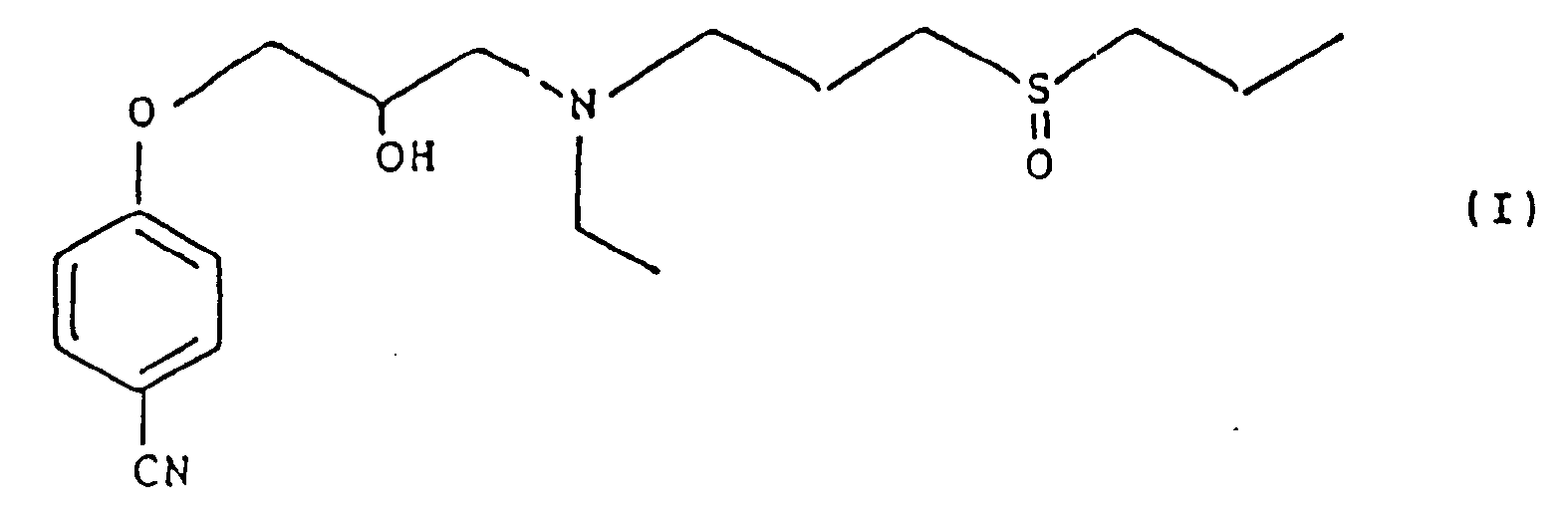
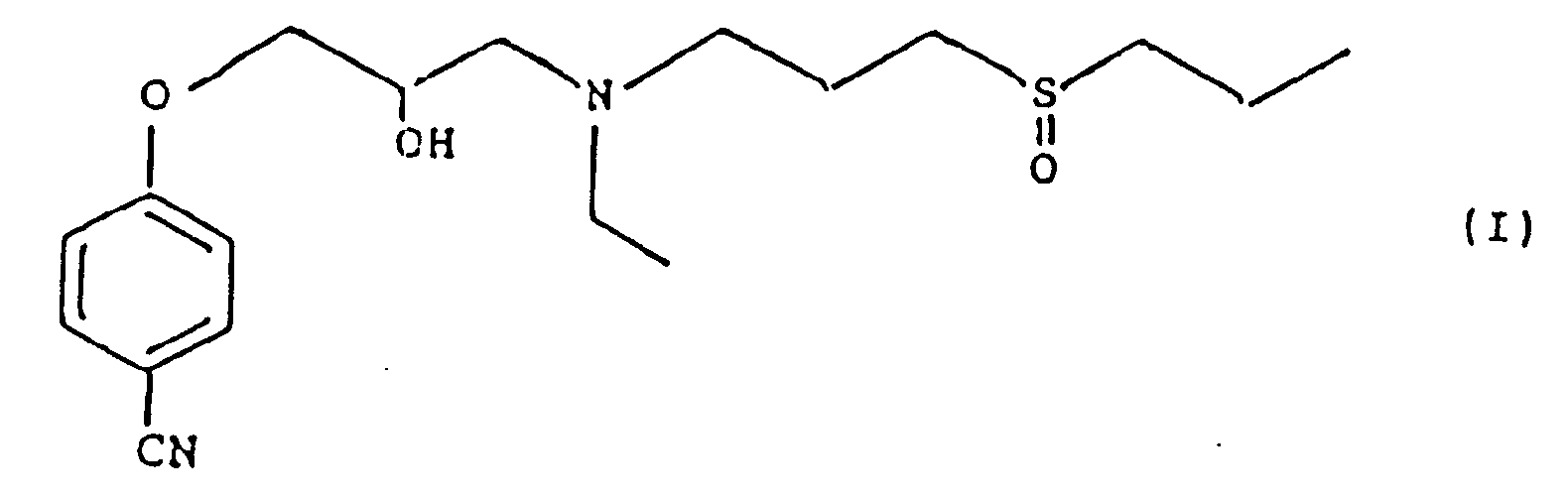
[0002] More particularly, the present invention relates to the salt of the compound 4-[3-[ ethyl[3-(propylsulfinyl)propyl]amino]-2-hydroxypropoxy]-benzonitrile with polystyrenesulfonic acid, its preparation and use.
[0003] Our prior patent application PCT/SE88/00691 , filed on December 20 , 1988 and published after the filing date of this application, relates to a group of novel compounds which are useful in the treatment, acute as well as long term, of cardiac arrhythmias of diverse etiology. Among the compounds included in the group of compounds disclosed in said application is the compound 4-[3-[ ethyl[3-(propylsulfinyl)propyl]amino]-2-hydroxypropoxy]-benzonitrile having the formula I
which can be obtained as a stereoisomeric mixture as well as in the form av the different stereoisomers, for instance:
4-[3-[ethyl[3-(propylsulfinyl)propyl]amino]-2(R)-hydroxypropoxy]-benzonitrile,
4-[3-[ethyl[3-(propylsulfinyl)propyl]amino]-2(S)-hydroxypropoxy]-benzonitrile.
[0004] The stereoisomeric mixture as well as the above mentioned pure stereoisomers can be by oxidizing the appropriate 4-[3-[ethyl[3-(propylthio)-propyl]amino]-2-hydroxy]benzonitrile with m-chloroperbenzoic acid or analogous to methods disclosed in the above mentioned prior patent application or the co-pending application filed the same day, our reference H 1037.
The invention
[0006] It has now been found that the salt of the compound of formula I with polystyrenesulfonic acid is a valuable new product having the same basic antiarrhythmic effect as the compound of the formula I but being a solid.
[0007] Accordingly the present invention relates to the salt of the compound of the formula I with polystyrenesulfonic acid.
[0008] According to one embodiment of the salt according to the invention the compound of the formula I is present in the form of stereoisomeric mixture.
[0009] According to another embodiment of the present invention the compound of the formula I is present in the form of one of the pure stereoisomers.
[0010] Examples of stereoisomers are, in addition to the two stereoisomers mentioned above, the following:
4-[3-[ethyl[3-((R*)-propylsulfinyl)propyl]amino]-2(R)-hydroxypropoxy]-benzonitrile
4-[3-[ethyl[3-((S*) propylsulfinyl]propyl]amino-2(R)-hydroxypropoxy]-benzonitrile
4-[3-[ethyl[3-((R*)-propylsulfinyl)propyl]amino]-2(S)-hydroxypropoxy]-benzonitrile, and
4-[3-[ethyl[3-((S*)-propylsulfinyl]propyl]amino]-2(S)-hydroxypropoxy]-benzonitrile
[0011] The present invention also relates to a process for the preparation of the salt according to the present invention, which process comprises reacting the compound of the formula I above with polystyrenesulfonic acid.
[0013] Usually the polystyrenesulfonic acid is cross-linked with divinylbenzene, the degree of crosslinking preferably being 2 - 10 %.
[0014] According to one embodiment of the process according to the invention small particles of polystyrenesulfonic acid, either in the acid (H⁺) form or in the form of a salt with a metal ion suited for ion exchange reactions, e.g. Na⁺, K⁺ or Ca²⁺, are added to a solution of the compound having the formula I and of a suitable salt of said compound, respectively, in a suitable reaction medium.
[0015] According to another embodiment of the process according to the invention small particles of polystyrenesulfonic acid in the form of a salt with a metal ion suited for ion exchange reactions are packed into a column for ion exchange operations and a solution of the compound having the formula I in the form of a suitable salt is applied to the column.
[0016] A method of preventing or reducing cardiac arrhythmias in mammals, including man, comprises administering to a host in need of such treatment an effective amount of the salt of the compound of the formula I with polystyrenesulfonic acid.
[0017] The invention yet further relates to the salt of the compound of the formula I with polystyrenesulfonic acid for use as a medicament, particularly as an antiarrhythmic agent.
[0018] The invention also relates to the use of the salt of the compound of the formula I with polystyrenesulfonic acid for the manufacture of medicaments with action against cardiac arrhythmias.
Example 1
[0020] The polystyrenesulfonate of 4-[3-[ethyl[3-(propylsulfinyl)-propyl]amino]-2-hydroxypropoxy]-benzonitrile
[0021] To a stirred solution of 4-[3-[ethyl[3-(propylsulfinyl)propyl]-amino]-2-hydroxypropoxy]-benzonitrile (92.28 g) in methanol (900 ml) was added polystyrenesulfonic acid (63.15 g) at 0°C under nitrogen atmosphere. Stirring was continued for 18 h. The resin was filtered, washed with methanol (500 ml), extracted in a Soxhlet extractor at room temperature over night with ethanol and finally dried under high vacuum to constant weight. Analysis showed 59.3 % binding of active substance.
Example 2
[0022] The polystyrenesulfonate of 4-[3-[ethyl[3-(propylsulfinyl)-propyl]amino]-2-hydroxypropoxy]-benzonitrile
[0023] To a stirred solution of 4-[3-[ethyl[3-(propylsulfinyl)-propyl]amino]-2-hydroxypropoxy]-benzonitrile x HCl (5.5 g) in ethanol:water (1:1) (30 ml) was added sodium polystyrenesulfonate (5 g) at room temperature. After 30 minutes the resin was filtered and washed with ethanol:water (1:1) three times, dried under high vacuum to constant weight.
Example 3
[0026] 2.45 g of 4-[3-[ethyl[3-(propylthio)propyl/amino/-2-hydroxypropoxy]-benzonitrile and 1.4 g p-toluenesulfonic acid were mixed in 50 ml of ethanol. The mixture was cooled to -10°C and 1.7 g of m-chloroperbenzoic acid was added in small protions. The mixture was stirred for 0.5 hour at -10°C and one hour at room temperature and then evaporated. The residue was dissolved in dichloromethane and washed with three portions of sodium carbonate and twice with water and thereafter dried over sodium sulfate, filtrated and evaporated. The residue, 2.3 g yellow oil, was purified by column chromatography. Yield: 1.4 g of the title compound.
- NMR:
- ¹³C in CDCl₃; 11.21, 11.33, 13.11, 16.02, 20.30, 20.43, 47.41, 47.45, 49.69, 49.95, 52.18, 52.41, 54.29, 54.41, 56.06, 56.09, 66.08, 70.41, 70.49, 103.76, 115.09, 118.83, 133.62, 161.88 ppm
Example 4
[0028] Oxidation of 4-[3-[ethyl[3-(propylthio)propyl]amino]-2(R)-hydroxypropoxy]benzonitrile with m-chloroperbenzoic acid was carried out as described for the stereoisomeric mixture in example 3. [α]
- 18.6° (C 1.0, CH₃OH)
- NMR:
- ¹³C in CDCl₃; 11.35, 11.47, 13.30, 16.24, 20.47, 20.62, 47.59, 47.63, 49.83, 50.12, 52.30, 52.57, 54.53, 54.66, 56.28, 56.31, 66.13, 70.52, 70.60, 104.08, 115.24, 119.02, 133.85, 162.0 ppm.
Example 5
[0030] The title compound was prepared in analogy with method described in example 4 and example 3. [α]
+ 18.0° (C 1.0, CH₃OH).
- NMR:
- ¹³C in CDCl₃; 11.31, 11.43, 13.26, 16.18, 20.41, 20.57, 47.53, 47.58, 49.8, 50.08, 52.26, 52.53, 54.48, 54.61, 56.22, 56.24, 66.09, 70.48, 70.57, 104.0, 115.20, 118.97, 133.79, 161.96 ppm.
[0031] Any of the isomers prepared according to Examples 4 and 5 may replace the stereoisomeric mixture used in Examples 1 and 2.
Example 6
a) Ethyl (3-(S*)-propylsulfinyl)propylamine
[0033] A hot solution of 27.2 g (0.1 mol) of (-)-1,3,2-dioxaphosphorinane-5,5-dimethyl-2-hydroxy-4-(2-methoxyphenyl)-2-oxide and 17.73 9 (0.1 mol) of racemic ethyl (3-propylsulfinyl)-propylamine in 750 ml of acetone and 32.5 ml of methanol was allowed to cool to room temperature, yielding 23.9 g of crytalline material. The experiment was repeated on a 0.25 mol scale, this time yielding 53.0 g of crystals. The combined crops were recrystallized five times from acetone-methanol finally yielding 8.95 g of salt.
[0034] A solution of 15.06 g (0.0392 mol) of trioctylamine in dichloromethane was shaken with 19.6 ml of 2M hydrochloric acid. The phases were separated and the organic layer was washed with water. The organic phase, now containing trioctylammonium chloride, was stirred for 90 min. with a solution of 8.8 g (0.0196 mol) of the above mentioned resolved salt in water. The phases were separated, and the organic layer was washed with water. The combined aqueous phases were washed with dichloromethane, and then brought to pH 11.5 with 10 M sodium hydroxide. Extraction four times with dichloromethane yielded 2.3 g of laevorotatory amine base, arbitrarily denoted S* [α]
-8.0° (c = 1, CH₃OH).
[0035] ¹³C NMR (as salt with (-)-1,3,2-dioxaphosphorinane-5,5-dimethyl-2-hydroxy-4-(2-methoxyphenyl)-2-oxide); in CDCl₃: 10.80, 12.95, 15.81, 17.55, 19.49, 19.58, 20.41, 36.59, 36.61, 42.37, 45.50, 48.73, 53.67, 54.71, 76.79, 76.83, 77.34, 109.63, 119.69, 126.42, 126.50, 128.33, 128.93, 155.83.
b) (R)-4-(oxiranylmethoxy)-benzonitrile
[0036] A solution of 2.71 g of (2S)-1-(4-cyanophenoxy)-3-methane-sulfonyloxypropan-2-ol in 40 ml of 1,2-dimethoxyethane was stirred with 1.0 g of powdered sodium hydroxide at room temperature for 22 h. 10 ml of saturated sodium chloride solution was added, and the mixture was extracted twice with ether. Washing with 5 % sodium hydrogen carbonate, drying over magnesium sulfate, filtration and evaporation gave 1.76 g of crystalline material, m.p. 67.5°C,
[α]
-14.7° (c = 1, acetone).
- NMR:
- ¹³C in CDCl₃; 44.40, 49.71, 69.02, 104.59, 115.34, 118.95, 133.98, 161.66 ppm.
c) 4-[3-[ethyl[3-((S*)-propylsulfinyl)propyl]amino]-2(R)-hydroxypropoxy]-benzonitrile
[0037] A mixture of 3 g of ethyl (3-(S*)-propylsulfinyl)propylamine and 3.18 g of (R)-4-(oxiranylmethoxy)-benzonitrile was refluxed for 16 h in 25 ml of isopropyl alcohol. After evaporation of the solvent, the crude product was dissolved in 2 M hydrochloric acid, washed with ether, the solution brought to pH 11.5 with 2 M sodium hydroxide and extracted with dichloromethane. Evaporation of the organic phase gave 6.11 g of an oil,
[0038] ¹³C NMR in CDCl₃: 11.23, 13.17, 16.08, 20.46, 47.41, 49.98, 52.41, 54.46, 56.11, 66.05, 70.50, 103.80, 115.13, 118.92, 133.69, 161.92 ppm.
EXAMPLE 7
a) Ethyl(3-(R*)-propylsulfinyl)propylamine
[0040] Resolution of racemic ethyl (3-propylsulfinyl)propylamine with (+)-1,3,2-dioxaphosphorinane-5,5-dimethyl-2-hydroxy-4-(2-methoxyphenyl)-2-oxide in analogy with example 6a gave dextrorotatory amine base. This compound, arbitrarily denoted R*, has the following data: [α]
+ 7.6° (c=1, CH₃OH)
[0041] ¹³C NMR (as salt with (+)-1,3,2-dioxaphosphorinane-5,5-dimethyl-2-hydroxy-4-(2-methoxyphenyl)-2-oxide); in CDCl₃: 10.92, 13.07, 15.93, 17.66, 19.56, 19.70, 20.52, 36.72, 36.73, 42.48, 45.61, 48.85, 53.79, 54.82, 76.92, 76.96, 77.45, 77.49, 109.73, 119.81, 126.54, 126.62, 128.44, 129.06, 155.95.
b) (S)-4-(oxiranylmethoxy)-benzonitrile
[0042] From 2.7 g (2R)-1-(4-cyanophenoxy)-3-methanesulfonyl-oxypropan-2-ol in analogy with example 6b was obtained 1.75 g crystalline material; m.p. 68.0°C [α]
+14.5° (c=1, acetone)
c) 4-[3-[ethyl[3-((R*)-propylsulfinyl)propyl]amino]-2(S)-hydroxypropoxy]-benzonitrile
[0044] A mixture of 2.3 g of ethyl[(R*)-3-propylsulfinyl]propylamine and 3.18 g of (S)-4-(oxiranylmethoxy)-benzonitrile in 19 ml of isopropyl alcohol was refluxed 16 h and thereafter worked up in analogy with 6c yielding 4.1 g of an oil: [α]
+ 26.5° (c=1, CH₃OH)
[0045] ¹³C NMR in CDCl₃: 11.16, 13.05, 15.96, 20.37, 47.38, 49.87, 52.37, 54.31, 56.05, 66.10, 70.47, 103.65, 115.06, 118.78, 133.55, 161.86.
EXAMPLE 8
[0047] A mixture of 2.3 g of ethyl[(R*)-3-propylsulfinyl]propylamine and 2.5 g of (R)-4-(oxiranylmethoxy)-benzonitrile was refluxed for 16 h in 19 ml of isopropyl alcohol in analogy with example 6c. Traditional work up procedures gave 4.27 g of an oil; [α]
- 13.4° (c=1, CH₃OH)
[0048] ¹³C NMR in CDCl₃: 11.58, 13.36, 16.29, 20.57, 47.70, 49.96, 52.41, 54.64, 56.36, 66.24, 70.63, 104.18, 115.33, 119.07, 133.91, 162.09.
EXAMPLE 9
Claims for the following Contracting State(s): AT, BE, CH, DE, DK, FR, GB, IT, LU,
LI, NL, SE
1. The salt of the compound 4-[3-[ethyl[3-(propylsulfinyl)propyl]amino]-2-hydroxypropoxy]-benzonitrile
having the formula I
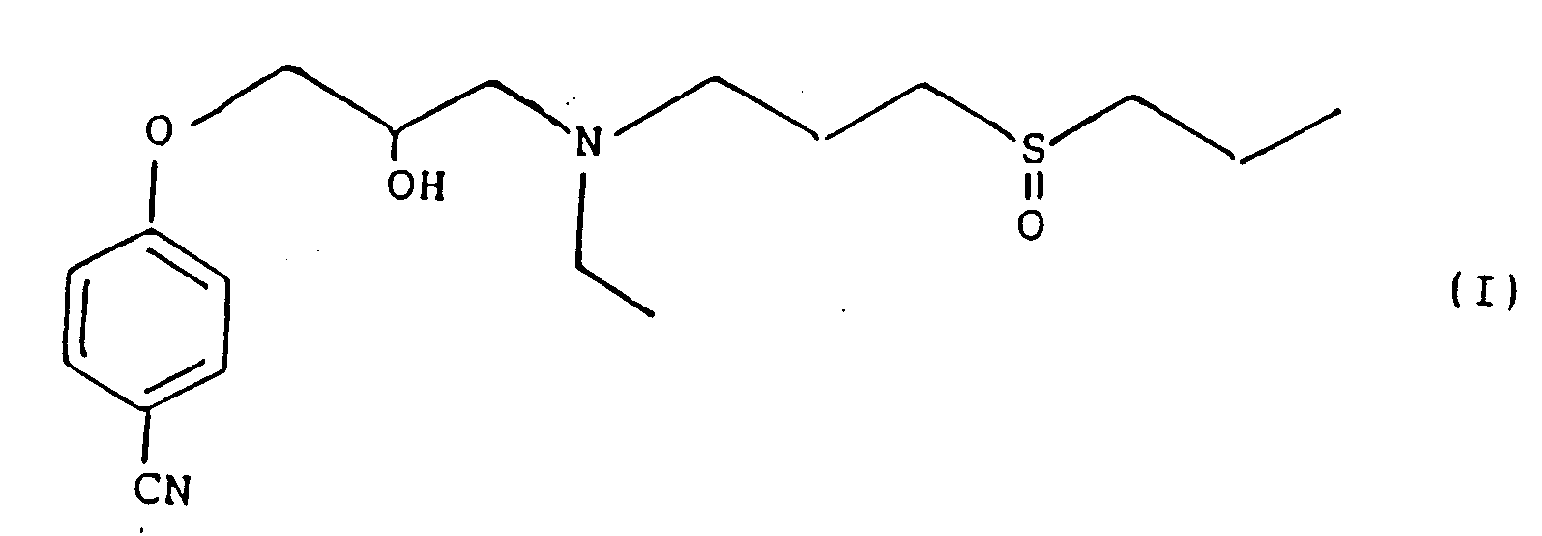
with polystyrenesulfonic acid, said compound being in the form of the stereoisomeric mixture or in the form of a pure stereoisomer thereof.
with polystyrenesulfonic acid, said compound being in the form of the stereoisomeric mixture or in the form of a pure stereoisomer thereof.
2. The salt according to claim 1, wherein the compound of the formula I is in the form
of the stereoisomeric mixture.
3. The salt according to claim 1, wherein the compound of the formula I is in the form
of one of the pure stereoisomers:
4-[3-[ethyl[3-(propylsulfinyl)propyl]amino]-2(R)-hydroxypropoxy]-benzonitrile,
4-[3-[ethyl[3-(propylsulfinyl)propyl]amino]-2(S)-hydroxypropoxy]-benzonitrile,
4-[3-[ethyl[3-((R*)-propylsulfinyl]propyl]amino]-2(R)-hydroxypropoxy]-benzonitrile,
4-[3-[ethyl[3-((S*)-propylsulfinyl)propyl]amino]-2(R)-hydroxypropoxy]-benzonitrile,
4-[3-[ethyl[3-((R*)-propylsulfinyl)propyl]amino]-2(S)-hydroxypropoxy]-benzonitrile, and
4-[3-[ethyl[3-((S*)propylsulfinyl)propyl]aminol-2(S)-hydroxypropoxy]-benzonitrile.
4-[3-[ethyl[3-(propylsulfinyl)propyl]amino]-2(R)-hydroxypropoxy]-benzonitrile,
4-[3-[ethyl[3-(propylsulfinyl)propyl]amino]-2(S)-hydroxypropoxy]-benzonitrile,
4-[3-[ethyl[3-((R*)-propylsulfinyl]propyl]amino]-2(R)-hydroxypropoxy]-benzonitrile,
4-[3-[ethyl[3-((S*)-propylsulfinyl)propyl]amino]-2(R)-hydroxypropoxy]-benzonitrile,
4-[3-[ethyl[3-((R*)-propylsulfinyl)propyl]amino]-2(S)-hydroxypropoxy]-benzonitrile, and
4-[3-[ethyl[3-((S*)propylsulfinyl)propyl]aminol-2(S)-hydroxypropoxy]-benzonitrile.
4. Process for the preparation of a salt as defined in any of claims 1 - 3, which process
comprises reacting the compound of the formula I given in claim 1 with polystyrenesulfonic
acid.
5. Process according to claim 4, wherein the polystyrenesulfonic acid is in the form
of small particles.
6. Process according to claim 5, wherein the small particles of polystyrenesulfonic acid,
either in the acid form or in the form of a salt with a metal ion suited for ion exchange
reactions, are added to a solution of the compound having the formula I in a suitable
reaction medium.
7. Process according to claim 5, wherein the small particles of polystyrenesulfonic acid
in the form of a salt with a metal ion suited for ion exchange reactions are packed
into a column for ion exchange operations and a solution of the compound having the
formula I in the form of a suitable salt is applied to the column.
8. A salt as defined in any of claims 1 to 3 for use in a method for preventing or reducing
cardiac arrhythmias in mammals, including man.
9. A salt as defined in any of claims 1 - 3 for use as a medicament, particularly as
an antiarrhythmic agent.
10. The use of a salt as defined in any of claims 1 - 3 for the manufacture of medicaments
with action against cardiac arrhythmias.
Claims for the following Contracting State(s): ES, GR
1. Process for the preparation of a salt of the compound 4-[3-[ethyl[3-(propylsulfinyl)propyl]amino]-2-hydroxypropoxy]-benzonitrile
having the formula I
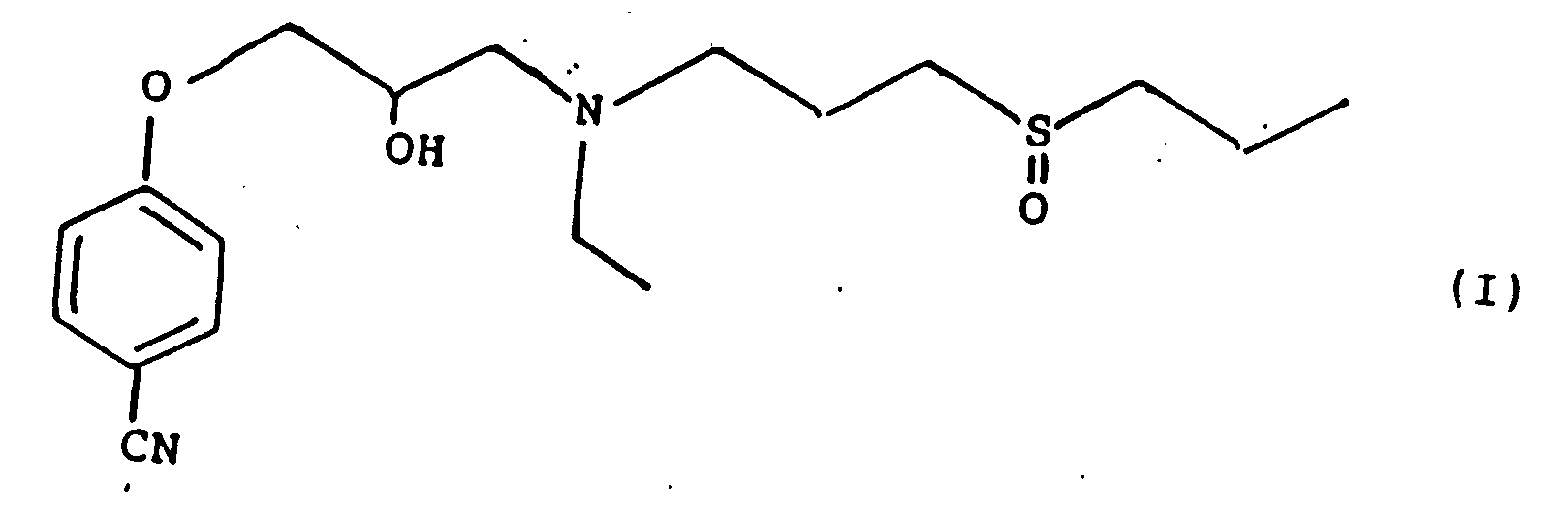
with polystyrenesulfonic acid, said compound being in the form of the stereoisomeric mixture or in the form of a pure stereoisomer thereof, which process comprises reacting the compound of the formula I with polystyrenesulfonic acid.
with polystyrenesulfonic acid, said compound being in the form of the stereoisomeric mixture or in the form of a pure stereoisomer thereof, which process comprises reacting the compound of the formula I with polystyrenesulfonic acid.
2. Process for the preparing of a salt according to claim 1, wherein the compound of
the formula I is in the form of the stereoisomeric mixture.
3. Process for the preparation of a salt according to claim 1, wherein the compound of
the formula I is in the form of one of the pure stereoisomers:
4-[3-[ethyl[3-(propylsulfinyl)propyl]amino]-2(R)-hydroxypropoxy]- benzonitrile,
4-[3-[ethyl[3-(propylsulfinyl)propyl]amino]-2(S)-hydroxypropoxy]-benzonitrile,
4-[3-[ethyl[3-((R*)-propylsulfinyl)propyl]amino]-2(R)-hydroxypropoxy]-benzonitrile,
4-[3-[ethyl[3-((S*)-propylsulfinyl)propyl]amino]-2(R)-hydroxypropoxy]-benzonitrile,
4-[3-[ethyl[3-((R*)-propylsulfinyl)propyl]amino]-2(S)-hydroxypropoxy]-benzonitrile, and
4-[3-[ethyl[3-((S*)-propylsulfinyl)propyl]amino]-2(S)-hydroxypropoxy]-benzonitrile.
4-[3-[ethyl[3-(propylsulfinyl)propyl]amino]-2(R)-hydroxypropoxy]- benzonitrile,
4-[3-[ethyl[3-(propylsulfinyl)propyl]amino]-2(S)-hydroxypropoxy]-benzonitrile,
4-[3-[ethyl[3-((R*)-propylsulfinyl)propyl]amino]-2(R)-hydroxypropoxy]-benzonitrile,
4-[3-[ethyl[3-((S*)-propylsulfinyl)propyl]amino]-2(R)-hydroxypropoxy]-benzonitrile,
4-[3-[ethyl[3-((R*)-propylsulfinyl)propyl]amino]-2(S)-hydroxypropoxy]-benzonitrile, and
4-[3-[ethyl[3-((S*)-propylsulfinyl)propyl]amino]-2(S)-hydroxypropoxy]-benzonitrile.
4. Process according to claim 1, wherein the polystyrenesulfonic acid is in the form
of small particles.
5. Process according to claim 4, wherein the small particles of polystyrenesulfonic acid,
either in the acid form or in the form of a salt with a metal ion suited for ion exchange
reactions, are added to a solution of the compound having the formula I in a suitable
reaction medium.
6. Process according to claim 4, wherein the small particles of polystyrenesulfonic acid
in the form of a salt with a metal ion suited for ion exchange reactions are packed
into a column for ion exchange operations and a solution of the compound having the
formula I in the form of a suitable salt is applied to the column.
7. A process for the preparation of a salt as defined in any of claims 1 - 3 for use
as a medicament, particularly as an antiarrhythmic agent.
8. The use of a salt as defined in any of claims 1 - 3 for the manufacture of medicaments
with action against cardiac arrhythmias.
Patentansprüche für folgende(n) Vertragsstaat(en): AT, BE, CH, DE, DK, FR, GB, IT,
LU, LI, NL, SE
1. Das Salz der Verbindung 4-[3-[Ethyl-[3-(propylsulfinyl)propyl]-amino]-2-hydroxypropoxy]-benzonitril
mit der Formel I
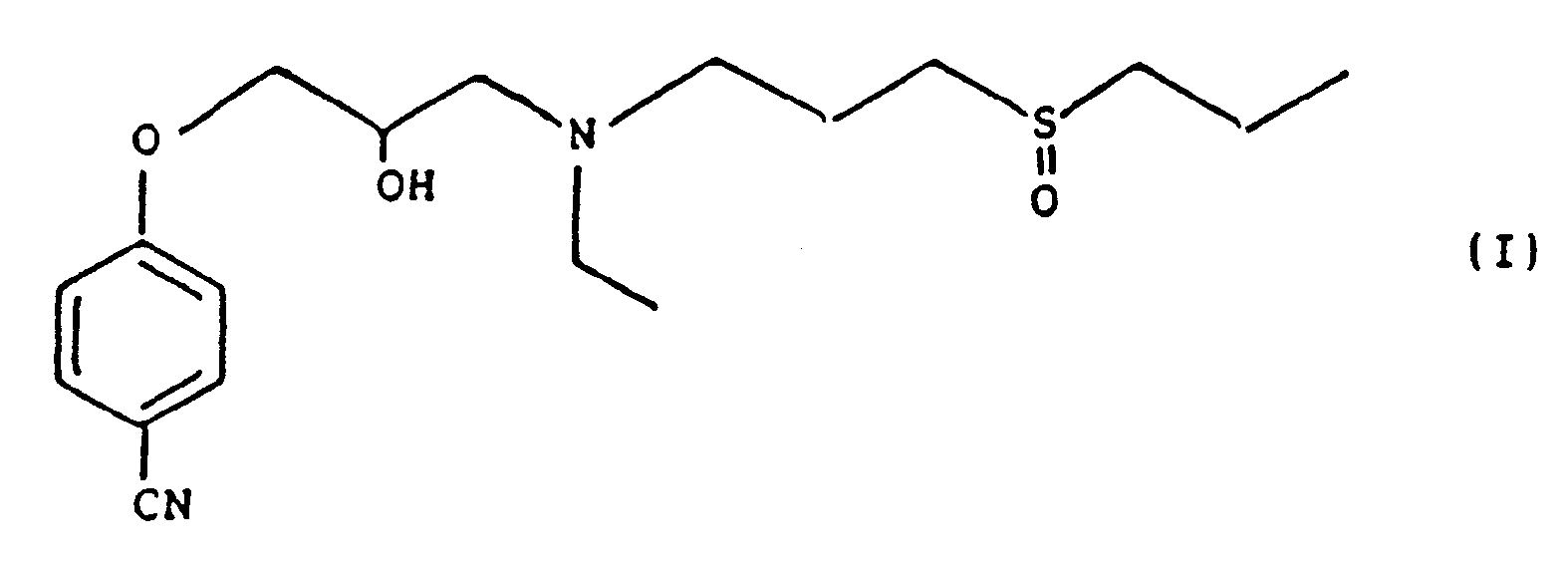
mit Polystyrolsulfonsäure, welche Verbindung in Form der Stereoisomerenmischung oder in Form eines reinen Stereoisomeren hievon vorliegt.
mit Polystyrolsulfonsäure, welche Verbindung in Form der Stereoisomerenmischung oder in Form eines reinen Stereoisomeren hievon vorliegt.
2. Das Salz nach Anspruch 1, worin die Verbindung der Formel I in Form der Stereoisomerenmischung
vorliegt.
3. Das Salz nach Anspruch 1, worin die Verbindung der Formel I in Form eines der reinen
Stereoisomeren:
4-[3-[Ethyl-[3-(propylsulfinyl)-propyl]-amino]-2(R)-hydroxypropoxy]-benzonitril,
4-[3-[Ethyl-[3-(propylsulfinyl)-propyl]-amino]-2(S)-hydroxypropoxy]-benzonitril,
4-[3-[Ethyl-[3-((R*)-propylsulfinyl)-propyl]-amino]-2(R)-hydroxypropoxy]-benzonitril,
4-[3-[Ethyl-[3-((S*)-propylsulfinyl)-propyl]-amino]-2(R)-hydroxypropoxy]-benzonitril,
4-[3-[Ethyl-[3-((R*)-propylsulfinyl)-propyl]-amino]-2(S)-hydroxypropoxy]-benzonitril und
4-[3-[Ethyl-[3-((S*)-propylsulfinyl)-propyl]-amino]-2(S)-hydroxypropoxy]-benzonitril
vorliegt.
4-[3-[Ethyl-[3-(propylsulfinyl)-propyl]-amino]-2(R)-hydroxypropoxy]-benzonitril,
4-[3-[Ethyl-[3-(propylsulfinyl)-propyl]-amino]-2(S)-hydroxypropoxy]-benzonitril,
4-[3-[Ethyl-[3-((R*)-propylsulfinyl)-propyl]-amino]-2(R)-hydroxypropoxy]-benzonitril,
4-[3-[Ethyl-[3-((S*)-propylsulfinyl)-propyl]-amino]-2(R)-hydroxypropoxy]-benzonitril,
4-[3-[Ethyl-[3-((R*)-propylsulfinyl)-propyl]-amino]-2(S)-hydroxypropoxy]-benzonitril und
4-[3-[Ethyl-[3-((S*)-propylsulfinyl)-propyl]-amino]-2(S)-hydroxypropoxy]-benzonitril
vorliegt.
4. Verfahren zur Herstellung eines Salzes nach einem der Ansprüche 1-3, welches Verfahren
die Umsetzung der in Anspruch 1 angeführten Verbindung der Formel I mit Polystyrolsulfonsäure
umfaßt.
5. Verfahren nach Anspruch 4, worin die Polystyrolsulfonsäure in Form kleiner Teilchen
vorliegt.
6. Verfahren nach Anspruch 5, worin die kleinen Teilchen der Polystyrolsulfonsäure entweder
in Form der Säure oder in Form eines Salzes mit einem für Ionenaustauschreaktionen
geeigneten Metallion zu einer Lösung der Verbindung der Formel I in einem geeigneten
Reaktionsmedium zugegeben werden.
7. Verfahren nach Anspruch 5, worin die kleinen Teilchen der Polystyrolsulfonsäure in
Form eines Salzes mit einem für Ionenaustauschreaktionen geeigneten Metallion in eine
Säule für Ionenaustauschvorgänge gepackt und eine Lösung der Verbindung der Formel
I in Form eines geeigneten Salzes auf die Säule aufgetragen wird.
8. Ein Salz nach einem der Ansprüche 1 bis 3 zur Verwendung bei einem Verfahren zur Verhinderung
oder Verringerung von Herzarrhythmien bei Säugern, inklusive dem Menschen.
9. Ein Salz nach einem der Ansprüche 1 bis 3 zur Verwendung als Medikament, insbesondere
als Antiarrhythmiemittel.
10. Verwendung eines Salzes nach einem der Ansprüche 1 bis 3 zur Herstellung eines Medikaments
mit Wirkung gegen Herzarrhythmien.
Patentansprüche für folgende(n) Vertragsstaat(en): ES, GR
1. Verfahren zur Herstellung eines Salzes der Verbindung 4-[3-[Ethyl-[3-(propylsulfinyl)-propyl]-amino]-2-hydroxypropoxy]-benzonitril
mit der Formel I
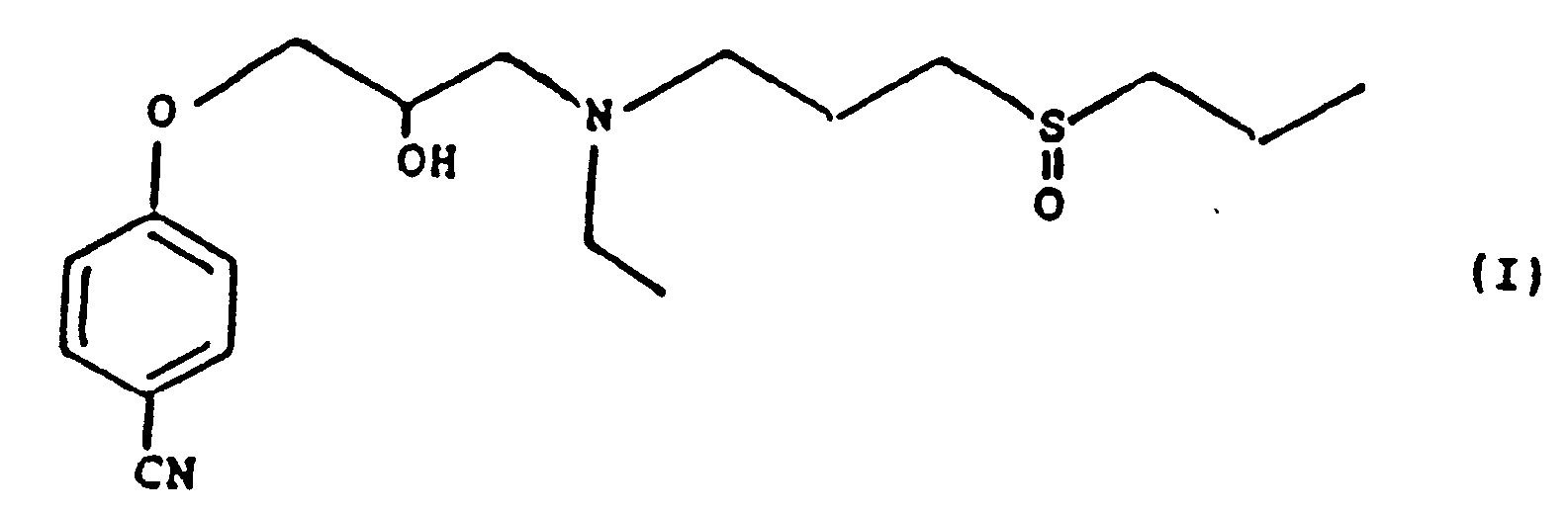
mit Polystyrolsulfonsäure, welche Verbindung in Form der Stereoisomerenmischung oder in Form eines reinen Stereoisomeren hievon vorliegt, welches Verfahren die Umsetzung der Verbindung der Formel I mit Polystyrolsulfonsäure umfaßt.
mit Polystyrolsulfonsäure, welche Verbindung in Form der Stereoisomerenmischung oder in Form eines reinen Stereoisomeren hievon vorliegt, welches Verfahren die Umsetzung der Verbindung der Formel I mit Polystyrolsulfonsäure umfaßt.
2. Verfahren zur Herstellung eines Salzes nach Anspruch 1, worin die Verbindung der Formel
I in Form der Stereoisomerenmischung vorliegt.
3. Verfahren zur Herstellung eines Salzes nach Anspruch 1, worin die Verbindung der Formel
I in Form eines der reinen Stereoisomeren:
4-[3-[Ethyl-[3-(propylsulfinyl)-propyl]-amino]-2(R)-hydroxypropoxy]-benzonitril,
4-[3-[Ethyl-[3-(propylsulfinyl)-propyl]-amino]-2(S)-hydroxypropoxy]-benzonitril,
4-[3-[Ethyl-[3-((R*)-propylsulfinyl)-propyl]-amino]-2(R)-hydroxypropoxy]-benzonitril,
4-[3-[Ethyl-[3-((S*)-propylsulfinyl)-propyl]-amino]-2(R)-hydroxypropoxy]-benzonitril,
4-[3-[Ethyl-[3-((R*)-propylsulfinyl)-propyl]-amino]-2(S)-hydroxypropoxy]-benzonitril und
4-[3-[Ethyl-[3-((S*)-propylsulfinyl)-propyl]-amino]-2(S)-hydroxypropoxy]-benzonitril
vorliegt.
4-[3-[Ethyl-[3-(propylsulfinyl)-propyl]-amino]-2(R)-hydroxypropoxy]-benzonitril,
4-[3-[Ethyl-[3-(propylsulfinyl)-propyl]-amino]-2(S)-hydroxypropoxy]-benzonitril,
4-[3-[Ethyl-[3-((R*)-propylsulfinyl)-propyl]-amino]-2(R)-hydroxypropoxy]-benzonitril,
4-[3-[Ethyl-[3-((S*)-propylsulfinyl)-propyl]-amino]-2(R)-hydroxypropoxy]-benzonitril,
4-[3-[Ethyl-[3-((R*)-propylsulfinyl)-propyl]-amino]-2(S)-hydroxypropoxy]-benzonitril und
4-[3-[Ethyl-[3-((S*)-propylsulfinyl)-propyl]-amino]-2(S)-hydroxypropoxy]-benzonitril
vorliegt.
4. Verfahren nach Anspruch 1, worin die Polystyrolsulfonsäure in Form kleiner Teilchen
vorliegt.
5. Verfahren nach Anspruch 4, worin die kleinen Teilchen der Polystyrolsulfonsäure entweder
in Form der Säure oder in Form eines Salzes mit einem für Ionenaustauschreaktionen
geeigneten Metallion zu einer Lösung der Verbindung der Formel I in einem geeigneten
Reaktionsmedium zugegeben werden.
6. Verfahren nach Anspruch 4, worin die kleinen Teilchen der Polystyrolsulfonsäure in
Form eines Salzes mit einem für Ionenaustauschreaktionen geeigneten Metallion in eine
Säule für Ionenaustauschvorgänge gepackt und eine Lösung der Verbindung der Formel
I in Form eines geeigneten Salzes auf die Säule aufgetragen wird.
7. Verfahren zur Herstellung eines Salzes nach einem der Ansprüche 1 bis 3 zur Verwendung
als Medikament, insbesondere als Antiarrhythmiemittel.
8. Verwendung eines Salzes nach einem der Ansprüche 1 bis 3 zur Herstellung eines Medikaments
mit Wirkung gegen Herzarrhythmien.
Revendications pour l'(les) Etat(s) contractant(s) suivant(s): AT, BE, CH, DE, DK,
FR, GB, IT, LU, LI, NL, SE
1. Sel du composé 4-[3-[éthyl[3-(propylsulfinyl)propyl]amino]-2-hydroxypropoxy]-benzonitrile
de formule I
avec l'acide polystyrènesulfonique, ledit composé étant sous la forme du mélange stéréoisomérique ou sous la forme d'un de ses stéréoisomères purs.
avec l'acide polystyrènesulfonique, ledit composé étant sous la forme du mélange stéréoisomérique ou sous la forme d'un de ses stéréoisomères purs.
2. Sel selon la revendication 1, dans lequel le composé de formule I est sous la forme
du mélange stéréoisomérique.
3. Sel selon la revendication 1, dans lequel le composé de formule I est sous la forme
d'un des stéréoisomères purs:
4-[3-[éthyl[3-(propylsulfinyl)propyl]amino]-2(R)-hydroxypropoxy]-benzonitrile,
4-[3-[éthyl[3-(propylsulfinyl)propyl]amino]-2(S)-hydroxypropoxy]-benzonitrile,
4-[3-[éthyl[3-((R*)-propylsulfinyl)propyl]amino]-2(R)-hydroxypropoxy]-benzonitrile,
4-[3-[éthyl[3-((S*)-propylsulfinyl)propyl]amino]-2(R)-hydroxypropoxy]-benzonitrile,
4-[3-[éthyl[3-((R*)-propylsulfinyl)propyl]amino]-2(S)-hydroxypropoxy]-benzonitrile, et
4-[3-[éthyl[3-((S*)-propylsulfinyl)propyl]amino]-2(S)-hydroxypropoxy]-benzonitrile.
4-[3-[éthyl[3-(propylsulfinyl)propyl]amino]-2(R)-hydroxypropoxy]-benzonitrile,
4-[3-[éthyl[3-(propylsulfinyl)propyl]amino]-2(S)-hydroxypropoxy]-benzonitrile,
4-[3-[éthyl[3-((R*)-propylsulfinyl)propyl]amino]-2(R)-hydroxypropoxy]-benzonitrile,
4-[3-[éthyl[3-((S*)-propylsulfinyl)propyl]amino]-2(R)-hydroxypropoxy]-benzonitrile,
4-[3-[éthyl[3-((R*)-propylsulfinyl)propyl]amino]-2(S)-hydroxypropoxy]-benzonitrile, et
4-[3-[éthyl[3-((S*)-propylsulfinyl)propyl]amino]-2(S)-hydroxypropoxy]-benzonitrile.
4. Procédé de préparation d'un sel tel que défini dans l'une quelconque des revendications
1-3, dans lequel on fait réagir le composé de formule I donné dans la revendication
1 avec de l'acide polystyrènesulfonique.
5. Procédé selon la revendication 4 dans lequel l'acide polystyrènesulfonique est sous
la forme de petites particules.
6. Procédé selon la revendication 5, dans lequel on ajoute les petites particules d'acide
polystyrènesulfonique, soit sous la forme d'acide, soit sous la forme d'un sel avec
un ion métallique approprié à une réaction d'échange d'ions, à une solution du composé
de formule I dans un milieu réactionnel approprié.
7. Procédé selon la revendication 5, dans lequel on garnit une colonne pour opérations
d'échange d'ions avec les petites particules d'acide polystyrènesulfonique sous la
forme d'un sel formé avec un ion métallique approprié aux réactions d'échange d'ions,
et on applique à la colonne une solution du composé ayant la formule I sous la forme
d'un sel approprié.
8. Sel tel que défini dans l'une quelconque des revendications 1 à 3, pour utilisation
dans un procédé de prévention ou de réduction de l'arythmie cardiaque chez les mammifères,
y compris l'homme.
9. Sel tel que défini dans l'une quelconque des revendications 1-3, pour utilisation
comme médicament, en particulier comme agent anti-arythmique.
10. Utilisation d'un sel tel que défini dans l'une quelconque des revendications 1-3,
pour préparer des médicaments ayant une action contre les arythmies cardiaques.
Revendications pour l'(les) Etat(s) contractant(s) suivant(s): ES, GR
1. Procédé de préparation d'un sel du composé 4[3-[éthyl[3-(propylsulfinyl)propyl] amino]-2-hydroxypropoxy]-benzonitrile
de formule I
avec l'acide polystyrènesulfonique, ledit composé étant sous la forme du mélange stéréoisomérique ou sous la forme d'un de ses stéréoisomères purs, dans lequel on fait réagir le composé de formule I avec de l'acide polystyrènesulfonique.
avec l'acide polystyrènesulfonique, ledit composé étant sous la forme du mélange stéréoisomérique ou sous la forme d'un de ses stéréoisomères purs, dans lequel on fait réagir le composé de formule I avec de l'acide polystyrènesulfonique.
2. Procédé de préparation d'un sel selon la revendication 1, dans lequel le composé de
formule I est sous la forme du mélange stéréoisomérique.
3. Procédé de préparation d'un sel selon la revendication 1, dans lequel le composé de
formule I est sous la forme d'un des stéréoisomères purs:
4-[3-[éthyl[3-(propylsulfinyl)propyl]amino]-2(R)-hydroxypropoxy]-benzonitrile,
4-[3-[éthyl[3-(propylsulfinyl)propyl]amino]-2(S)-hydroxypropoxy]-benzonitrile,
4-[3-[éthyl[3-((R*)-propylsulfinyl)propyl]amino]-2(R)-hydroxypropoxy]-benzonitrile,
4-[3-[éthyl[3-((S*)-propylsulfinyl)propyl]amino]-2(R)-hydroxypropoxy]-benzonitrile,
4-[3-[éthyl[3-((R*)-propylsulfinyl)propyl]amino]-2(S)-hydroxypropoxy]-benzonitrile, et
4-[3-[éthyl[3-((S*)-propylsulfinyl)propyl]amino]-2(S)-hydroxypropoxy]-benzonitrile.
4-[3-[éthyl[3-(propylsulfinyl)propyl]amino]-2(R)-hydroxypropoxy]-benzonitrile,
4-[3-[éthyl[3-(propylsulfinyl)propyl]amino]-2(S)-hydroxypropoxy]-benzonitrile,
4-[3-[éthyl[3-((R*)-propylsulfinyl)propyl]amino]-2(R)-hydroxypropoxy]-benzonitrile,
4-[3-[éthyl[3-((S*)-propylsulfinyl)propyl]amino]-2(R)-hydroxypropoxy]-benzonitrile,
4-[3-[éthyl[3-((R*)-propylsulfinyl)propyl]amino]-2(S)-hydroxypropoxy]-benzonitrile, et
4-[3-[éthyl[3-((S*)-propylsulfinyl)propyl]amino]-2(S)-hydroxypropoxy]-benzonitrile.
4. Procédé selon la revendication 1, dans lequel l'acide polystyrènesulfonique est sous
la forme de petites particules.
5. Procédé selon la revendication 4, dans lequel on ajoute les petites particules d'acide
polystyrènesulfonique, soit sous la forme acide, soit sous la forme d'un sel formé
avec un ion métallique approprié aux réactions d'échange d'ions, à une solution du
composé de formule I dans un milieu réactionnel approprié.
6. Procédé selon la revendication 4, dans lequel on garnit une colonne pour opérations
d'échange d'ions avec les petites particules d'acide polystyrènesulfonique sous la
forme d'un sel formé avec un ion métallique approprié aux réactions d'échange d'ions,
et on applique à la colonne une solution du composé ayant la formule I sous la forme
d'un sel approprié.
7. Procédé de préparation d'un sel tel que défini dans l'une quelconque des revendications
1-3 pour utilisation comme médicament, en particulier comme agent anti-arythmique.
8. Utilisation d'un sel tel que défini dans l'une quelconque des revendications 1-3 à
la préparation de médicaments ayant une action contre les arythmies cardiaques.