|
(11) | EP 0 405 413 A1 |

| (12) | EUROPEAN PATENT APPLICATION |
|
|
|
|
|||||||||||||||||||||||||||
| (54) | Magnetic recording medium |
| (57) The magnetic recording medium comprises a non-magnetic substrate and a magnetic recording
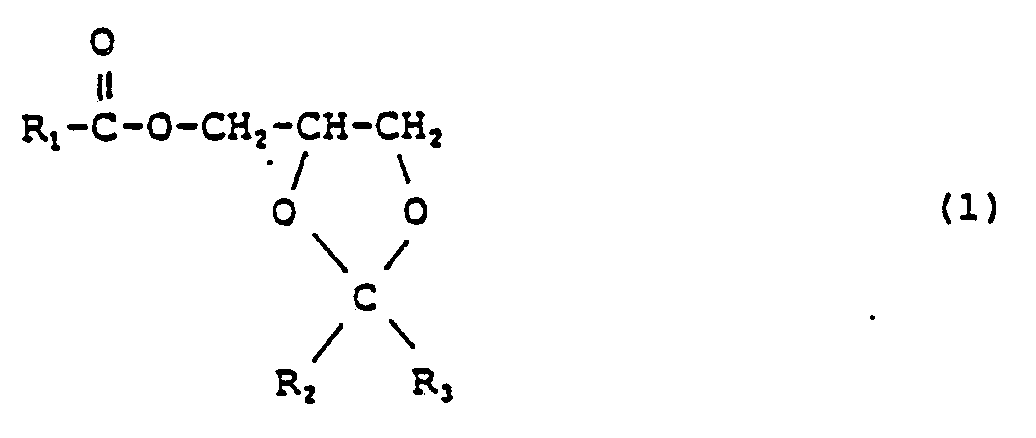
layer, coated on the substrate, said layer comprising a compound having the formula
(1):
in which R1 is an alkyl having 11 to 31 carbon atoms, R2 and R3 each are hydrogen, an alkyl having 1 to 8 carbon atoms or an aryl. |
Field of industrial application
[0001] The present invention relates to a magnetic recording medium, and more particularly, to a magnetic recording medium having good durability.
Prior art
[0002] Since the magnetic recording medium vigorously rubs on the magnetic head or pad during recording and reproducing, causing the magnetic layer to wear easily, there has been a demand for an improved one having a magnetic layer which wears less and has better durability than before.
[0003] The wear resistance of the magnetic layer has been improved by incorporating or coating the magnetic layer with a lubricant. The lubricant used for this purpose includes higher fatty acids and esters thereof, fatty acid amides, liquid paraffin, and silicone oil. However, they are not necessarily satisfactory for the performance required.
Summary of the Invention
[0004] The present inventors carried out extensive studies on a magnetic recording medium which has greatly improve durability owing to good lubricity. The results of the studies led to the present invention.
[0005] The magnetic recording medium of the invention comprises a non-magnetic substrate and a magnetic recording layer, coated on the substrate, said layer comprising a compound having the formula (1):
in which R1 is an alkyl having 11 to 31 carbon atoms, R2 and R3 each are hydrogen, an alkyl having 1 to 8 carbon atoms or an aryl.
[0006] It is preferable that in compound (1), in which R1 is an alkyl having 13 to 21 carbon atoms, R2 and R3 each are hydrogen, methyl, ethyl or an aryl such as phenyl and a phenyl having a substituent of a lower alkyl. The magnetic recording layer comprises 100 parts by weight of a magnetic material, 0.05 to 15 parts by weight of the compound and a binder. The compound represented by the general formula (1) (which will be referred to as the compound (1) hereinafter) contains a group represented by R₁ which is a C₁₁₋₃₁ alkyl group, preferably a C₁₃₋₂₁ alkyl group, more preferably a C₁₅₋₁₇ alkyl group. R₁ may be a straight-chain group or branched-chain group, and it may also be a saturated group or unsaturated group.
[0007] The compound (1) also contains groups represented by R₂ and R₃ each of which denotes a hydrogen atom, a C₁₋₈ alkyl group (preferably a C₁₋₂ hydrocarbon group, an aryl group, or a hydrogen atom), or an aryl group.
[0008] The compound (1) is obtained by the ordinary esterification reaction of a fatty acid represented by the formula (2) below
R₁-COOH (2)
with an alcohol represented by the formula (3) below.
[0009] The alcohol represented by the general formula (3) can be readily obtained by the reaction of a ketone or aldehyde represented by the general formula (4) below
R₂-
-R₃ (4)
with glycerin, according to the process described in Org. Synth., III, 502 (1955).
[0010] According to the present invention, the compound (1) should be added in an amount of 0.05-15 parts by weight for 100 parts by weight of the magnetic powder. If necessary, it may be used in combination with other general-purpose lubricants, which include esters such as butyl stearate, fatty acids such as oleic acid, and hydrocarbons such as squalane.
[0011] The compound (1) may be previously incorporated into the coating material or applied, in the form of solution in a general-purpose solvent such as isopropanol and hexane, to the magnetic coating film, followed by drying. The coating method may also be used for the magnetic recording medium having a magnetic layer formed by sputtering or vapor deposition on a non-magnetic substrate.
[0012] The magnetic recording medium of the present invention contains magnetic powder of various types, which include metal oxide in the form of fine needles such as γ-Fe₂O₃, Fe₃O₄, and CrO₂; processed γ-Fe₂O₃ such as Co-coated γ-Fe₂O₃ and Co-doped γ-Fe₂O₃; metallic iron powder; barium ferrite in the form of fine plates, with Fe atoms partly replaced by Ti, Co, Zn, V, Nb, etc. alone or in combination; and ultrafine powder of metal and alloy such as Co, Fe-Co, and Fe-Ni.
[0013] Metallic iron powder may be incorporated or surface-treated with a small amount of nickel, cobalt, titanium, silicon, or aluminum in the form of metal, salt, or oxide, for the improvement of its chemical stability. In addition, the metallic iron powder may be treated in a weak oxidative atmosphere to form a thin oxide film thereon for the improvement of its chemical stability. The above-mentioned magnetic powders may be used in combination with one another.
[0014] The magnetic powder is dispersed into a binder to form the magnetic layer. Examples of the binder include polyurethane, polyvinyl chloride, vinyl chloride-vinyl acetate copolymer, polyacrylonitrile, nitrile rubber, epoxy resin, alkyd resin, polyamide, polyacrylic ester, polymethacrylic ester, polyvinyl acetate, polyvinyl butyral, vinylidene chloride, nitrocellulose, maleic acid-modified vinyl chloride-vinyl acetate copolymer, and ethyl cellulose. They may be used alone or in combination with one another. The binder may be used in combination with a plasticizer or hardener for the adjustment of hardness of the magnetic layer.
[0015] The magnetic layer of the magnetic recording medium of the present invention may be incorporated with commonly used additives such as abrasive and antistatic agent, in addition to the above-mentioned components.
[0016] The magnetic recording medium of the present invention may be formed on a non-magnetic substrate which is prepared from polyesters (such as polyethylene terephthalate), polyolefins (such as polyethylene and polypropylene), cellulose derivatives (such as cellulose triacetate and cellulose diacetate), polycarbonate, polyvinyl chloride, polyimide, and aromatic polyamide. The non-magnetic substrate may also be prepared from a metal (such as aluminum and copper) and paper. The non-magnetic substrate may be in the form of film, tape, sheet, disc, card, or drum. The non-magnetic substrate may have a surface which has been treated with corona discharge, radiation, or UV light, or coated with a proper resin.
Examples
[0017] The invention will be described in more detail with reference to the following examples, which are not intended to restrict the scope of the invention.
Examples 1 to 4
[0018] A mixture of the following composition was prepared by mixing in a sand mill for 10 hours, followed by filtration.
| Metallic iron powder | 100 pbw |
| vinyl chloride-vinyl acetate copolymer *¹ | 11 pbw |
| Polyurethane resin *² | 11 pbw |
| Carbon black (antistatic agent) | 2 pbw |
| Cr₂O₃ (abrasive) | 10 pbw |
| Toluene | 71 pbw |
| Methyl ethyl ketone | 71 pbw |
| Cyclohexanone | 107 pbw |
| *1 "VAGH", a product of Union Carbide Corp. | |
| *2 "N-2301", a product of Nippon Polyurethane Co., Ltd. |
[0019] The mixture was mixed with 4.4 parts by weight of hardener, and the resulting binder was applied to both sides of a 32-µm thick polyethylene terephthalate film such that the magnetic layer after drying was 4 µm thick. After drying, the coated film was wound up, followed by calendering and curing. Finally, the coated film was punched into disc, and each disc was coated with an isopropanol solution containing 2.0 wt% of the lubricant shown in Table 1. The coating weight of the lubricant was 600 mg/m².
Comparative Examples 1 to 4
[0020] The same procedure as in Example 1 to 4 was repeated to prepare sample discs, except that the lubricants were replaced by those which are shown in Table 2.
Table 2
| Comparative Example No. | Lubricant |
| 1 | Oleic acid |
| 2 | 2-Ethylhexyl stearate |
| 3 | Squalane |
| 4 | Tridecyl stearate |
Test Examples
[0021] The disc samples obtained in Examples 1 to 4 and Comparative Examples 1 to 4 were examined for durability in the following manner. Each disc sample was placed in a case with non-woven fabric, and the assembly was mounted on a recording-reproducing unit. The disc was run continuously at a peripheral speed of 7 m/sec, with the head fixed on the same track. The magnetic layer was visually inspected for damage after a certain number of passes. The results are shown in Table 3.
Table 3
| Example No. (Comparative Example No.) | After 200,000 passes | After 1,000,000 passes | After 5,000,000 passes |
| 1 | Not damaged | Not damaged | Not damaged |
| 2 | Not damaged | Not damaged | Not damaged |
| 3 | Not damaged | Not damaged | Not damaged |
| 4 | Not damaged | Not damaged | Not damaged |
| (1) | Slightly damaged | Badly damaged | Unmeasurable |
| (2) | Not damaged | Slightly damaged | Slightly damaged |
| (3) | Slightly damaged | Badly damaged | Unmeasurable |
| (4) | Slightly damaged | Damaged | Badly damaged |
1. A magnetic recording medium, which comprises a non-magnetic substrate and a magnetic
recording layer, coated on the substrate, said layer comprising a compound having
the formula (1):
in which R1 is an alkyl having 11 to 31 carbon atoms, R2 and R3 each are hydrogen, an alkyl having 1 to 8 carbon atoms or an aryl.
in which R1 is an alkyl having 11 to 31 carbon atoms, R2 and R3 each are hydrogen, an alkyl having 1 to 8 carbon atoms or an aryl.
2. The medium as claimed in Claim 1, in which R1 is an alkyl having 13 to 21 carbon
atoms, R2 and R3 each are hydrogen, methyl, ethyl or an aryl.
3. The medium as claimed in Claim 1, in which the magnetic recording layer comprises
100 parts by weight of a magnetic material, 0.05 to 15 parts by weight of the compound
and a binder.