|
(11) | EP 0 405 928 B1 |

| (12) | EUROPEAN PATENT SPECIFICATION |
|
|
| (54) |
Process for producing 1,4-dihydroxy-2-arylnaphthoate Verfahren zur Herstellung von 1,4-Dihydroxy-2-arylnaphthoat Procédé pour la préparation d'un 1,4-dihydroxy-2-arylnaphtoate |
|
|
|||||||||||||||||||||||||||||||
| Note: Within nine months from the publication of the mention of the grant of the European patent, any person may give notice to the European Patent Office of opposition to the European patent granted. Notice of opposition shall be filed in a written reasoned statement. It shall not be deemed to have been filed until the opposition fee has been paid. (Art. 99(1) European Patent Convention). |
[0001] This invention relates to a process for producing 1,4-dihydroxy-2-arylnaphthoate which is useful as an intermediate for photo-chemicals, dyes and pigments.
[0002] Polycyclicoxy-arylcarbonate is prepared by an esterification, i.e. dehydration, of polycyclicoxycarboxylic acid and phenol. Strong acid, which is usually used as a catalyst for esterifications, is difficult to use as a catalyst, because it decomposes the carboxylic acid. Instead, phosphorus trichloride, phosphorus oxychloride, phosphorous pentachloride or the like is used as the catalyst or a dehydrating agent. However, these conventional processes are still not satisfactory as industrial processes, because they produce colored products. In addition, many difficulties are encountered such as complicated or troublesome after-treatments for removal of phenols from waste water because a large-excess amount of phenols are used as solvents as well as reactants.
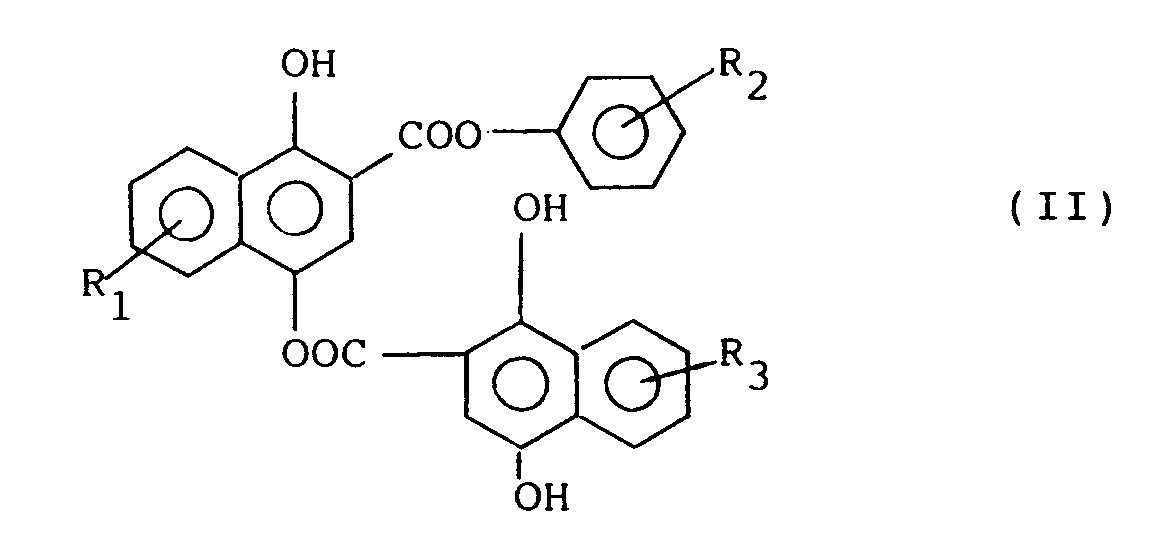
[0003] In order to solve above mentioned problems, Japanese patent publication No. 83-22021 and Japanese laid open No. 89-45341 disclose a process using triarylphosphite as a reactant. The process, however, has a problem that products of high purity are difficult to obtain, because it is accompanied by a considerable amount of by-products such as a dimer of the following formula (Japanese laid open No. 89-45343):
wherein R is a hydrogen, halogen atom or C₁₋₁₀ alkyl.
[0004] An object of this invention is to provide a favorable industrial process for preparing 1,4-dihydroxy-2-arylnaphthoate of high purity.
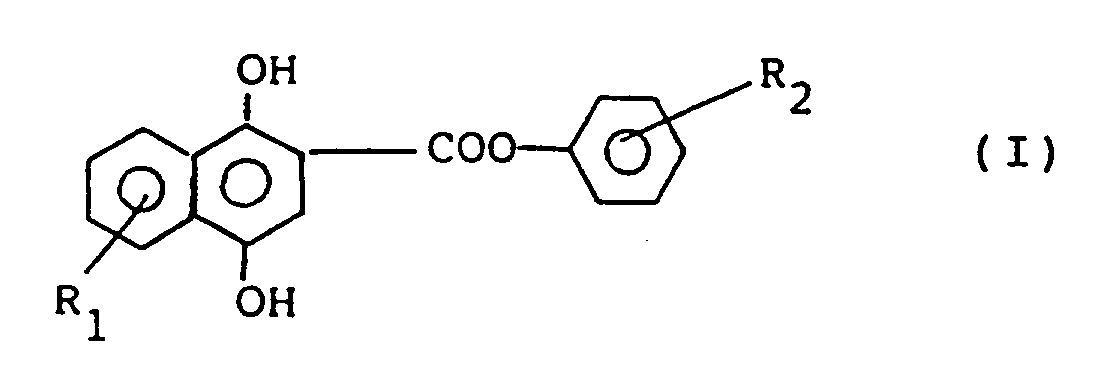
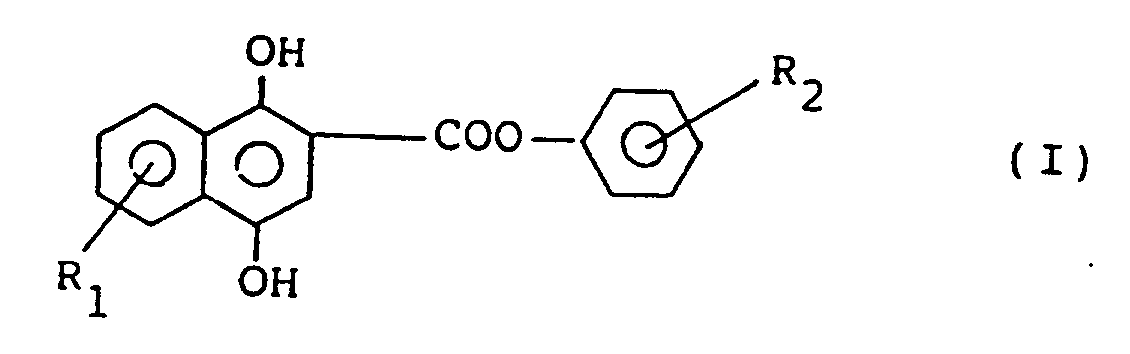
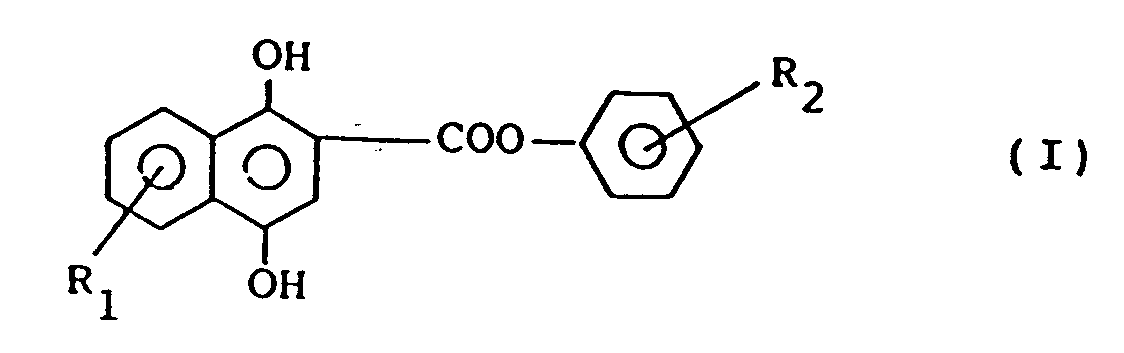
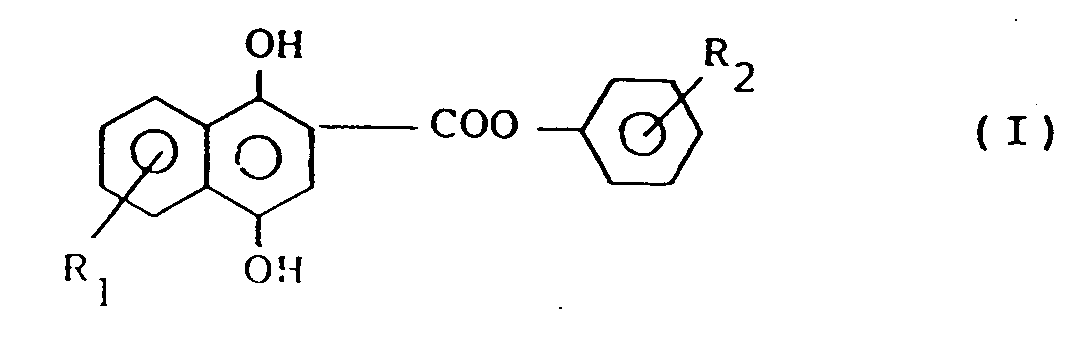
[0005] According to the present invention, 1,4-dihydroxy-2-arylnaphthoate of the formula (I)
wherein R₁ and R₂ are the same or different and a hydrogen atom, a lower alkyl group and a halogen atom, is prepared by allowing 1,4-dihydroxy-2-naphthoic acid to react with triarylphosphite in the presence of an acid catalyst selected from organic or inorganic acids (hereinafter this process is referred to as process I).
[0006] This invention also provides a process for producing 1,4-dihydroxy-2-arylnaphthoate of the formula (I) above which comprises crystallizing a reaction product containing 1,4-dihydroxy-2-arylnaphthoate as the principal ingredient, which is obtained by allowing 1,4-dihydroxy-2-naphthoic acid to react with triarylphosphite, in a mixed solvent consisting essentially of lower alcohol and water (hereinafter this process is referred to as process II).
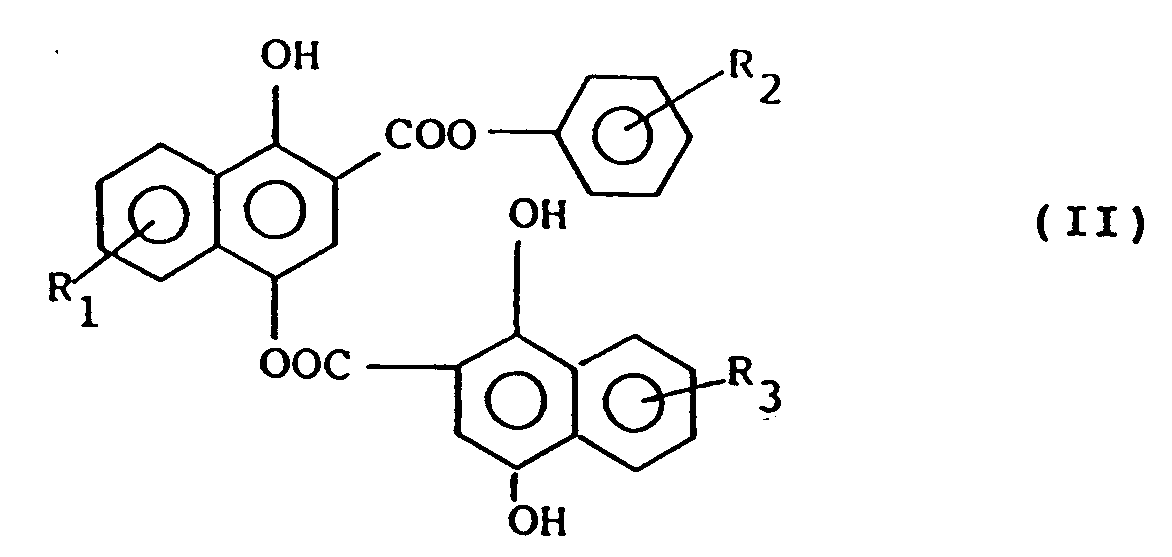
[0007] This invention further provides a purification process for 1,4-dihydroxy-2-arylnaphthoate of the formula (I) which contains dimer of the formula (II) mentioned above as the main by-product,
wherein each of R₁, R₂ and R₃ is a hydrogen atom, a lower alkyl group and a halogen atom, individually, which comprises adding water and an extraction solvent selected from a group consisting of alkyl-substituted aromatic hydrocarbons, halogen-substituted aliphatic hydrocarbons and halogen-substituted aromatic hydrocatons to a solution of 1,4-dihydroxy-2-arylnaphthoate containing the dimer in a mixed solvent consisting essentially of alcohol and water until 1,4-dihydroxy-2-arylnaphthoate is crystallized (hereinafter this process is referred to as process III).
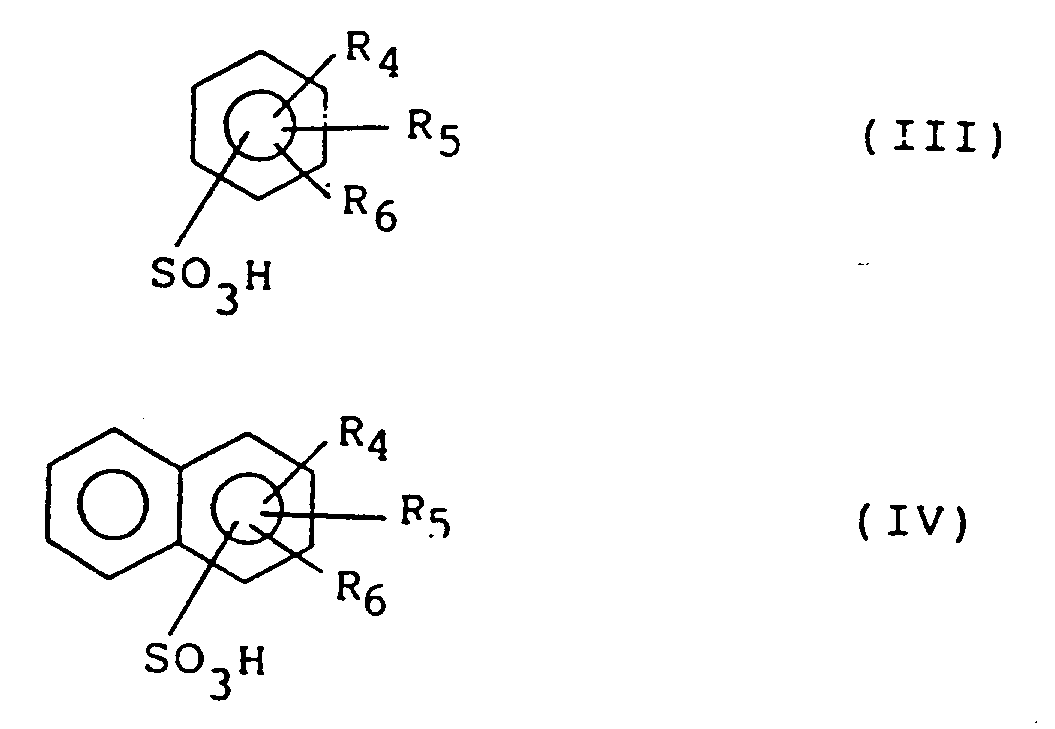
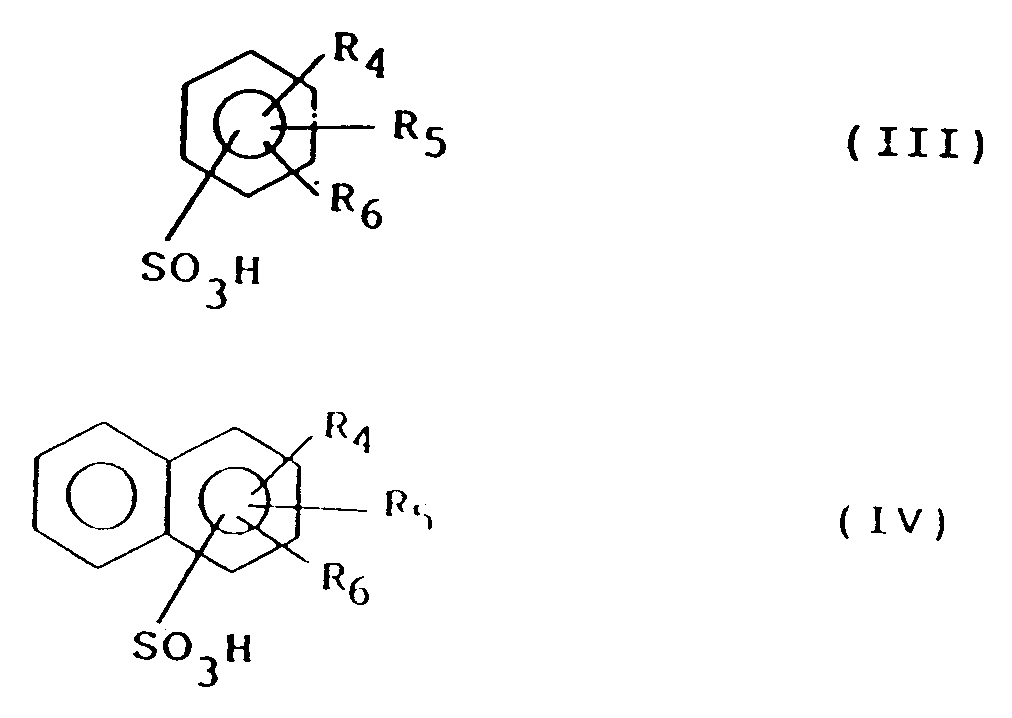
[0008] Triarylphosphite used in process I is prepared by a known method (Japanese patent publication No. 83-22021, Japanese laid open No. 89-45341). That is, phosphorus trichloride (one mol) is allowed to react with phenols such as phenols, halogenated phenols, and phenols substituted with a C₁₋₂₀ alkyl group (not less than 3 mols) in the presence of an acid catalyst. The acid catalysts include an organic acid such as an aromatic sulfonic acid of the following formula (III) or (IV)
wherein each of R₄, R₅ or R₆ is individually a hydrogen atom, a C₁₋₁₀ alkyl group, a halogen atom, a nitro group, a sulfonic acid group, a carboxylic group, a hydroxy group or an alkoxy group, or a C₁₋₁₀ aliphatic sulfonic acid such as methane sulfonic acid or ethane sulfonic acid; an inorganic acid such as sulfuric acid or nitric acid; and a Lewis acid such as anhydrous aluminum chloride, anhydrous zinc chloride, iron chloride, tin chloride, boron trifluoride or the like.
[0009] Examples of the aromatic sulfonic acid of the formula (III) or (IV) are benzene sulfonic acid; alkyl (C₁₋₁₀)-substituted benzene sulfonic acid, alkyl(C₁₋₁₀)-substituted benzene disulfonic acid such as toluene sulfonic acid and xylene sulfonic acid; naphthalene sulfonic acid; alkyl(C₁₋₁₀)-substituted naphthalene sulfonic acid; and alkyl(C₁₋₁₀)-substituted naphthalene disulfonic acid. Among them, p-toluene sulfonic acid and chloronitrobenzene sulfonic acid are preferred.
[0010] The amount of triarylphosphite used as a reactant in the process I is 0.9 - 3.5 mol, preferably 1.5 - 3.0 mol, per mol of 1,4-dihydroxy-2-naphthoic acid. The amount of the catalyst used in the process I is 0.01 - 0.5 mol per mol of 1,4-dihydroxy-2-naphthoic acid, preferably 0.05 -0.3 mol.
[0012] The process I is conducted in the absence or presence of a solvent, preferably absence of a solvent. The solvent includes aromatic hydrocarbons such as phenols, cresols, toluene, xylene and the like; halogenated hydrocarbons such as chlorobenzene; and ketones such as methyl-n-propyl ketones, methyl-n-butyl ketone, methyl-isobutyl ketone, diisobutyl ketone and the like.
[0013] 1,4-Dihdyroxy-2-arylnaphthoate is isolated according to a known process. The process II, is convenient to use, since the compound is obtained in a shorter period of time with high purity.
[0014] In process I, the amount of by-products is so small that 1,4-dihydroxy-2-arylnaphthoate is obtained with high purity in high yield. Accordingly, process I is a very economical process.
[0015] The process II may preferably be applied to the reaction product obtained by the process I but also to a reaction product of 1,4-dihydroxy-2-arylnaphthoic acid with triarylphosphite obtained by a process such as mentioned in Japanese patent publication No. 83-22021 and Japanese laid open No. 89-45341.
[0016] The lower alcohol used in the process II is C₁₋₄ aliphatic alcohol such as methanol, ethanol, n-propyl alcohol, isopropyl alcohol, n-butyl alcohol or the like. Among them, methanol is preferable. The amount of the lower alcohol in the mixed solvent used in the process II is 5 - 50 parts by volume every 100 parts by volume of the mixed solvent, preferably 10 - 30 parts. The amount of the mixed solvent used in the process II is 1 - 10 parts by weight per part by weight of the reaction product used in the process II, preferably 2 - 8 parts.
[0017] Crystallization of the reaction product from the mixed solvent may be conducted at a temperature of 0 - 80°C, preferably 20 - 55°C.
[0018] The crystallization process in the process II is usually conducted by discharging and diluting the reaction product into the mixed solution, and then, if necessary, heating and/or cooling, under stirring, until the product is crystallized. The crystallized product thus obtained is subjected to an after-treatment such as filtration, washing, drying or the like according to known methods.
[0019] In the process II, not only can the time for crystallizing the reaction product and the time for the filtration be reduced, but also highly pure 1,4-dihydroxy-2-arylnaphthoate can be isolated in high yield. Accordingly, the process II is also very economical.
[0020] 1,4-Dihydroxy-2-arylnaphthoate thus obtained may often contain the dimer of formula (II) as an impurity. The process III can be used to in order to remove the dimer. However, the process III is applicable not only to the product obtained by the processes I and II, but also to other 1,4-dihydroxy-2-arylnaphthoate containing the dimer of the formula (II) as the main by-product. For instance, the process III is applicable to a reaction product produced according to a process using triarylphosphite as a reactant such as process I or a process mentioned in Japanese patent publication No. 83-22021 or Japanese laid open No. 89-45341.
[0021] In the process III, the amount of the alcohol can be 2.0 - 20.0, preferably 30 - 10.0 more preferably 5.0 - 7.0 parts by weight per part by weight of 1,4-dihydroxy-2-arylnaphthoate. Initially, the amount of the water in the mixed solvent can be preferably 0.5 - 10 parts every 100 parts of the alcohol.
[0022] Water and an extraction solvent are added to a solution of 1,4-dihydroxy-2-arylnaphthoate in the mixed solvent. Preferably, the extraction solvent is added first before water is added. The amount of the water to be added is preferably so determined that alcohol content in the following formula is 20 - 60%, preferably 25 - 50%.
The amount of the extraction solvent in the mixed solvent can be 0.3 - 3.0, preferably 0.5 - 2.5 parts by weight per part by weight of 1,4-dihydroxy-2-arylnaphthoate.
[0023] Examples of the alcohol used in process III are methanol, ethanol and the like, preferably methanol. The extraction solvent includes alkyl-substituted hydrocarbons such as toluene, xylene, ethylbenzene and the like; halogenated aliphatic hydrocarbons such as dichloromethane; and halogenated aromatic hydrocarbons such as monochlorobenzene and dichlorobenzne.
[0024] According to the process III, 1,4-dihydroxy-2-arylnaphthoate containing a greatly reduced amount of by-product is obtained. The process III is very favorable from an industrial point of view.
[0025] This invention is explained in more detail by the following Examples, but it is not limited thereto.
Example 1
[0026] Into a reactor (one liter) equipped with a stirrer, were charged 241 g of triphenylphosphite (hereinafter referred to as TPP), 59.5 g of 1,4-dihydroxy-2-naphthoic acid (hereinafter referred to as AOH), and 6.6 g of p-toluenesulfonic acid (hereinafter referred to as PTS). The mixture was heated until temperature reached 80°C and kept at 80°C for 5 hours in order to complete the reaction. The reaction product was brownish transparent liquid. Completion of the reaction was determined by amount of unaltered AOH which was measured by liquid chromatography during the reaction.
Example 2
[0027] The reaction product obtained in Example 1 was poured dropwise into 1200 g of a methanol/water mixed solvent in which weight percentage of methanol was 16.7%. The mixture was stirred at 50°C for 3 hours, and then cooled until crystals were precipitated. The crystallized product was filtrated, washed with water to obtain 100 g of crude 1,4-dihydroxy-2-phenylnaphthoate (hereinafter referred to as crude ONH). Using a very small amount of crude ONH obtained, a solid content was measured, and a composition of the crude ONH was analized by liquid chromatography, to give the results that
solid: 80 g in 100 g of the crude ONH,
composition of the solid: pure 1,4-dihydroxy-2-phenylnaphthoate 92.5% by weight
4-(1′,4′-dihydroxy-2′-naphthoyl)-oxy-1-hydroxy-2-phenylnaphthoate (one of the dimers of the formula II, hereinafter referred to as DNO): about 7.5%.
Example 3
[0028] Into a reactor (one liter) equipped with a stirrer, was charged about 100 g of the crude ONH obtained in Example 1, 528 g of methanol and 6.4 g of water. The mixture was heated until temperature reached 50°C and kept at 50°C for 30 minutes. The mixture was filtrated while the solution was warm and 88 g of toluene was added to the filtrate. The solution obtained was stirred at 30 - 40°C for 10 minutes, and diluted with water to control weight percentage of methanol (=(weight of methanol) x 100/(weight of methanol and water)) to 40% until 1,4-dihydroxy-2-phenylnaphthoate was crystallized. The crystals (hereinafter referred to as ONH) were filtrated, washed with 200 g of 40% methanol in water and dried to obtain 64 g of ONH. Analysis by liquid chromatography showed that the ONH contains 1,4-dihydroxy-2-phenylnaphthoate (99.6%) and DNO (0.4%).
Example 4
[0029] Examples 1 and 2 were repeated except that an amount of the TPP was changed to 171.8 g, and 79.5 g of crude ONH was obtained. Composition of the crude ONH obtained was analyzed by liquid chromatography. The results are shown in Table 1.
Example 5
[0030] Examples 1 and 2 were repeated except that 6.0 g of benzene sulfonic acid was used in place of the PTS (6.6 g) and 79.5 g of crude ONH was obtained. Composition of the crude ONH obtained was analyzed by liquid chromatography. The results are shown in Table 1.
Example 6
[0031] Into a reactor (one liter) equipped with a stirrer, were charged 241 g of TPP, 59.6 g of AOH and 3.7 g of methanesulfonic acid. The reaction and isolation were carried out in the same manner as in Examples 1 and 2 to obtain 77 g of crude ONH. Composition of crude ONH obtained was analyzed by liquid chromatography. The results are shown in Table 1.
Example 7
[0032] Into a reactor (one liter) equipped with a stirrer, were charged 241 g of TPP, 59.6 g of AOH, 6 g of PTS and 130 ml of methylisobutylketone. The reaction was carried out in the same manner as in Example 1. After completion of the reaction was confirmed, methylisobutylketone was distilled off under reduced pressure and isolation of the reaction product was carried out in the same manner as in Example 2 to obtain 75.0 g of crude ONH. Composition of crude ONH obtained was analyzed by liquid chromatography. The results are shown in Table 1.
Example 8
[0033] Into a reactor (one liter) equipped with a stirrer, were charged 241 g of TPP, 59.6 g of AOH and 9.0 g of 3-nitro-4-chlorobenzene sulfonic acid. The mixture was heated until temperature reached 50°C, and kept at 50°C for 5 hours to complete the reaction. The reaction product was brownish transparent liquid. Completion of the reaction was determined by an amount of unaltered AOH measured by liquid chromatography.
Example 9
[0034] The reaction product obtained in Example 8 was poured dropwise into 1200 g of methanol/water mixed solvent (50°C) in which weight percentage of methanol is 16.7%. The mixture was stirred at 50°C for 3 hours, and then cooled to the room temperature until crystals were obtained. Then, the crysallized product was filtrated and washed with water to obtain 100 g of crude ONH. Solid content and composition of the crude ONH was analyzed in the same manner as in Example 2. The results are:
solid: 80 g in 100 g of crude ONH
composition of the solid: pure 1,4-dihydroxy-2-phenylnaphthoate 94.5% by weight
DNO: about 5.5% by weight.
Example 10
[0035] Into a reactor (one liter) equipped with a stirrer, were charged 241 g of TPP, 63.6 g of 1,4-dihydroxy-7-methyl-2-naphthoic acid (hereinafter referred to as methyl AOH), and 6.6 g of PTS. The mixture was heated until temperature reached 80°C, and kept at 80°C for 5 hours in order to complete the reaction. The reaction product was brownish transparent liquid. Completion of the reaction was determined by an amount of unaltered methyl AOH measured by liquid chromatography.
Example 11
[0036] The reaction product obtained in Example 10 was poured dropwise into 1200 g of a methanol/water mixed solvent (80°C) in which weight percentage of methanol is 16.7%. The mixture was stirred at 50°C for 3 hours, and then cooled to room temperature until crystals were precipitated. Then the crystallized product was filtrated, washed with water, and dried to obtain 82.3 g of crude product (hereinafter referred to as crude methyl-ONH).
[0037] Analysis of the crude methyl-ONH gave the results that the crude methyl-ONH contains 92.0% of pure 1,4-dihydroxy-7-methyl-2-phenylnaphthoate.
Comparative Example 1
[0038] Into a reactor (one liter) equipped with a stirrer, were charged 59.6 g of AOH and 241 g of TPP. Reaction and isolation were carried out in the same manner as in Examples 1 and 2 to obtain 61 g of crude ONH. The results of analysis of the crude ONH by liquid chromatography are shown in Table 1.
Comparative Example 2
[0039] Into a reactor (one liter) equipped with a stirrer, were charged 59.6 g of AOH and 181.3 g of TPP. The mixture was heated up to 110°C and kept at 110°C for 10 hours. Then the reaction products was cooled to 50°C, mixed with 300 ml of water, cooled and kept at room temperature for 5 hours in order to crystallize the product. The crystallized product was filtrated, washed with water and dried to obtain 72 g of crude ONH. The results of analysis of the crude ONH by liquid chromatography are shown in Table 1.
Example 12
[0040] Example 1 was repeated and completion of the reaction was confirmed. The reaction product obtained was poured dropwise into 1200 g of an ethanol/water mixed solvent in which weight percentage of ethanol was 16.7%. Isolation of the product was carried out in the same manner as in Example 2 to obtain 78 g of crude ONH.
Example 13
[0041] Example 1 was repeated and completion of the reaction was confirmed. The reaction product obtained was poured dropwise into 1200 g of an isopropyl alcohol/water mixed solvent in which weight percentage of isopropyl alcohol was 16.7%. Isolation of the product was carried out in the same manner as in Example 2 to obtain 79 g of crude ONH.
Example 14
[0042] Example 1 was repeated and completion of the reaction was confirmed. The reaction product obtained was poured dropwise into 750 g of a methanol/water mixed solvent in which weight percentage of methanol was 25%. Isolation of the product was carried out in the same manner as in Example 2 to obtain 77 g of crude ONH.
Example 15
[0043] Example 1 was repeated and completion of the reaction was confirmed. The reaction product obtained was poured dropwise into 1600 g of a methanol/water mixed solvent in which weight percentage of methanol was 5%. Isolation of the product was carried out in the same manner as in Example 2 to obtain 80 g of crude ONH.
Comparative Example 3
[0044] Example 1 was repeated and completion of the reaction was confirmed. The reaction product obtained was poured into 1200 g of water and stirred at 50°C for 10 hours. The reaction product was not dispersed well in the water until a dumpling-like solid was formed. After removing the aqueous solution by decantation, 1200 g of warm water was added again and stirring was made at 50°C for 5 hours to obtain a crystalline product. The crystalline product was filtrated, washed and dried to obtain 79 g of crude ONH. Analysis of the crude ONH by liquid chromatography gave the results that the crude ONH obtained contains 90.5% of pure 1,4-dinhdroxy-2-phenylnaphthoate and 8.5% of DNO.
Example 16
[0045] Examples 1 and 2 were repeated to obtain crude ONH to which 400 g of methanol was added until a solution was obtained. The solution was heated until temperature reached 50°C and filtrated to remove insoluble matters. Toluene (50 g) was added to the filtrate. The solution obtained was stirred at 30 - 40°C for 10 minutes, and diluted with water in order to control weight percentage of the methanol (=(weight of methanol) x 100/(weight of methanol and water)) to 30% and crystallize ONH. The crystallized ONH was filtrated, washed with 30% methanol/water and dried to obtain 67 g of ONH. Analysis by liquid chromatography shows that the ONH contains 1,4-dihydroxy-2-phenylnaphthoate (99.0%) and DNO (1.0%).
Example 17
[0046] Examples 1, 2 and 3 were repeated excpet that 88 g of xylene was used in place of the toluene to obtain 63 g of ONH. Analysis of the ONH by liquid chromatography shows that the ONH contains 1,4-dihydroxy-2-phenylnaphthoate (99.1%) and DNO (0.9%).
Comparative Example 4
[0047] Examples 1 and 2 were repeated to obtain crude ONH. Into a reactor (one liter) equipped with a stirrer, were charged 100 g of the crude ONH obtained, 528 g of methanol, and 6.4 g of water. The mixture was heated until temperature reached 50°C and kept at 50°C for 30 minutes. The mixture was filtrated while the solution was still warm to obtain filtrate. The solution, i.e. the filtrate obtained was diluted with water in order to control weight percentage of methanol (= (weight of methanol) x 100/(weight of methanol and water)) to 40% and to crystallize 1,4-dihydroxy-2-phenylnaphthoate. The crystallized ONH was filtrated, washed with 200 g of 40% methanol/water and dried to obtain 66 g of ONH. Analysis of the ONH by liquid chromatography shows that the ONH contains 1,4-dihydroxy-2-phenylnaphthoate (95.5%) and DNO (4.5%).
1. A process for producing 1,4-dihydroxy-2-arylnaphthoate of the formula (I)
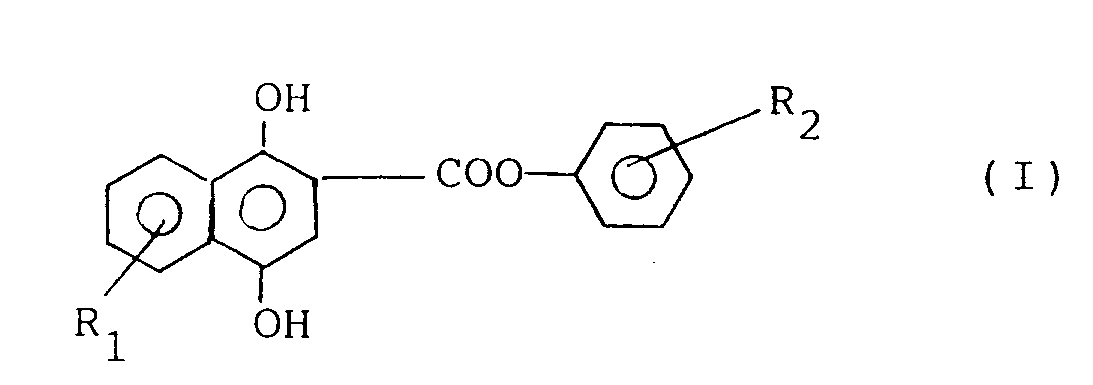
wherein R₁ and R₂ are the same or different and selected from a hydrogen atom, a lower alkyl group and a halogen atom, which comprises allowing a 1,4-dihydroxy-2-naphthoic acid to react with a triarylphosphite in the presence of an acid catalyst selected from organic and inorganic acids.
wherein R₁ and R₂ are the same or different and selected from a hydrogen atom, a lower alkyl group and a halogen atom, which comprises allowing a 1,4-dihydroxy-2-naphthoic acid to react with a triarylphosphite in the presence of an acid catalyst selected from organic and inorganic acids.
2. The process according to claim 1, wherein the acid catalyst is an aromatic sulfonic
acid of the following formula (III) or (IV)
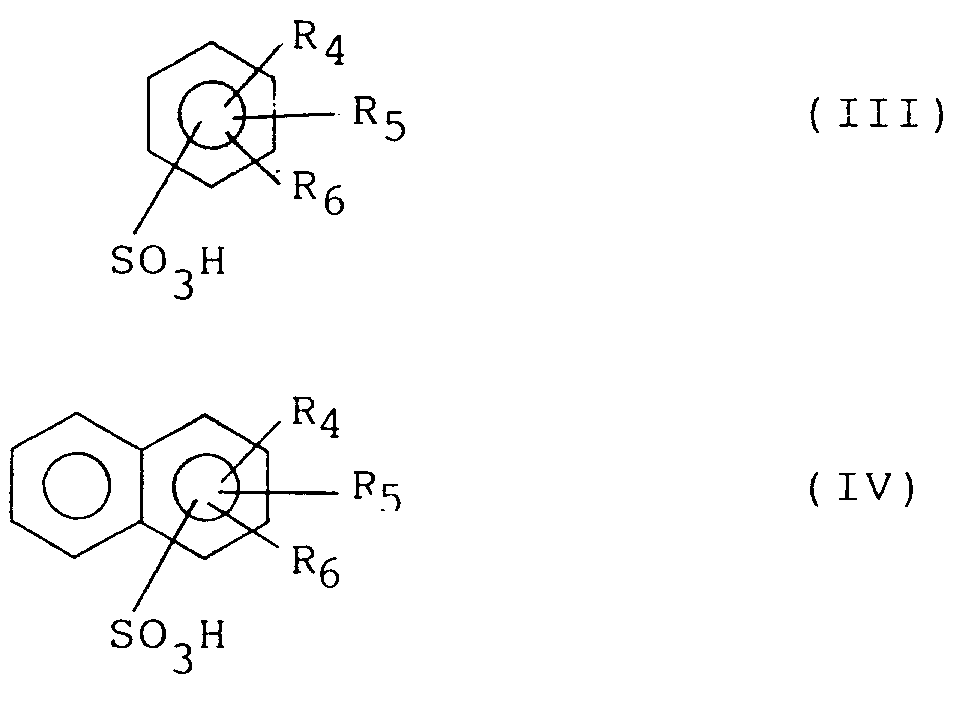
, wherein each of R₄, R₅ or R₆ is individually a hydrogen atom, a C₁₋₁₀ alkyl group, a halogen atom, a nitro group, a sulfonic acid group, a carboxylic group, a hydroxy group or an alkoxy group or a C₁₋₁₀ aliphatic sulfonic acid.
, wherein each of R₄, R₅ or R₆ is individually a hydrogen atom, a C₁₋₁₀ alkyl group, a halogen atom, a nitro group, a sulfonic acid group, a carboxylic group, a hydroxy group or an alkoxy group or a C₁₋₁₀ aliphatic sulfonic acid.
3. The process according to claim 2, wherein the acid catalyst is p-toluene sulfonic
acid or chloronitrobenzene sulfonic acid.
4. The process according to any preceding claim, wherein the amount of triarylphosphite
is 0.9 - 3.5 mol per mol of 1,4-dihydroxy-2-naphthoic acid.
5. The process according to any preceding claim, wherein the amount of acid catalyst
is 0.01 - 0.5 mol per mol of 1,4-dihydroxy-2-naphthoic acid.
6. The process according to any preceding claim, wherein the reaction temperature is
40 to 85°C.
7. A process for producing 1,4-dihydroxy-2-arylnaphthoate of the formula (I)
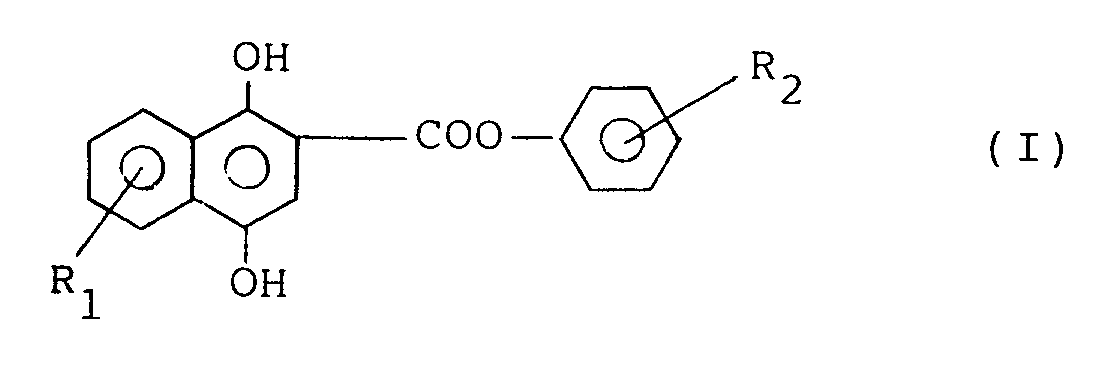
wherein R₁ and R₂ are the same or different and selected from a hydrogen atom, a lower alkyl group and a halogen atom, which comprises crystallizing, in a mixed solvent which consists essentially of lower alcohols and water, a reaction product which contains the 1,4-dihydroxy-2-arylnaphthoate as the principal ingredient, and is obtained by allowing a 1,4-dihydroxy-2-naphthoic acid to react with a triarylphosphite.
wherein R₁ and R₂ are the same or different and selected from a hydrogen atom, a lower alkyl group and a halogen atom, which comprises crystallizing, in a mixed solvent which consists essentially of lower alcohols and water, a reaction product which contains the 1,4-dihydroxy-2-arylnaphthoate as the principal ingredient, and is obtained by allowing a 1,4-dihydroxy-2-naphthoic acid to react with a triarylphosphite.
8. The process according to claim 7, wherein the amount of the lower alcohols in the
mixed solvent is 5 to 50 parts by volume every 100 parts by volume of the mixed solvent.
9. The process according to claim 8, wherein the amount of the mixed solvent is 1 to
10 parts by weight per part by weight of the reaction product.
10. The process according to claim 7 8 or 9, wherein the reaction product is obtained
by allowing 1,4-dihydroxy-2-naphthoic acid to react with triarylphosphite in the presence
of an acid catalyst selected from organic and inorganic acids.
11. The process according to any of claims 7 to 10, wherein the lower alcohols are C₁₋₄
aliphatic alcohols.
12. The process according to any of claims 7 to 10, wherein the lower alcohol is methanol.
13. The process according to any of claims 7 to 12, wherein crystallizing the reaction
product is conducted at a temperature of 20 to 55°C.
14. A purification process for a 1,4-dihydroxy-2-arylnaphthoate of formula (I)
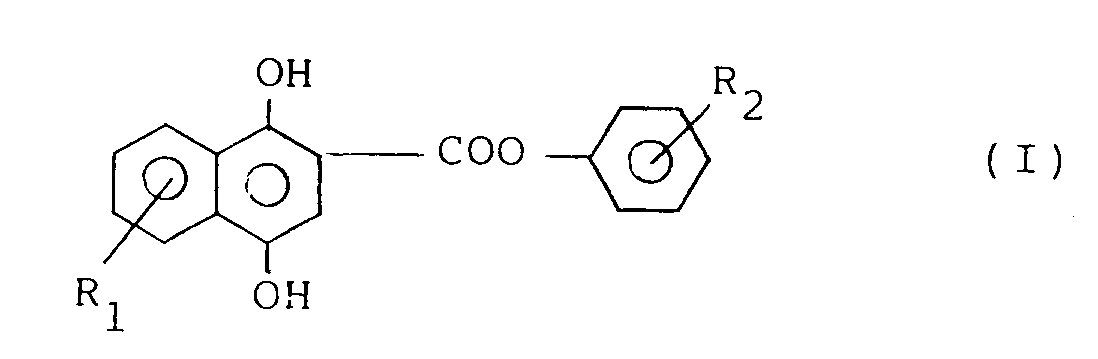
wherein R₁ and R₂ are the same or different and selected from a hydrogen atom, a lower alkyl group and a halogen atom, containing dimer of formula (II) as a main by-product,
wherein each of R₁, R₂ and R₃ is a hydrogen atom, a lower alkyl group or a halogen atom individually, which comprises dissolving the 1,4-dihydroxy -2-arylnaphthoate containing the dimer in a mixed solvent which consists essentially of alcohols and water (1), and adding water (2) and an extraction solvent selected from a group consisting of alkyl-substituted aromatic hydrocarbons, halogen-substituted aliphatic hydrocarbons and halogen-substituted aromatic hydrocarbons to the solution in order to crystallize the 1,4-dihydroxy-2-arylnaphthoate.
wherein R₁ and R₂ are the same or different and selected from a hydrogen atom, a lower alkyl group and a halogen atom, containing dimer of formula (II) as a main by-product,
wherein each of R₁, R₂ and R₃ is a hydrogen atom, a lower alkyl group or a halogen atom individually, which comprises dissolving the 1,4-dihydroxy -2-arylnaphthoate containing the dimer in a mixed solvent which consists essentially of alcohols and water (1), and adding water (2) and an extraction solvent selected from a group consisting of alkyl-substituted aromatic hydrocarbons, halogen-substituted aliphatic hydrocarbons and halogen-substituted aromatic hydrocarbons to the solution in order to crystallize the 1,4-dihydroxy-2-arylnaphthoate.
15. The process according to claim 14, wherein the amount of alcohols is 3.0 to 10.0 parts
by weight per part by weight of 1,4-dihydroxy-2-arylnaphthoate.
16. The process according to claim 14 or 15, wherein the amount of water (1) in the mixed
solvent is 0.5 to 10 parts by weight every 100 parts by weight of alcohols.
17. The process according to claim 14 15 or 16, wherein alcohol content of the following
formula is 20 - 60%;

18. The process according to any of claims 14 to 17, wherein the amount of the extraction
solvent is 0.3 to 3.0 parts by weight per part by weight of 1,4-dihydroxy-2-arylnaphthoate.
19. The process according to claim 14, wherein the alcohol is methanol.
20. The process according to claim 14, wherein the extraction solvent is toluene.
21. The process according to claim 14, wherein the 1,4-dihydroxy-2-arylnaphthoate containing
the dimer of formula (II) is obtained by a process which comprises allowing 1,4-dihydroxy-2-naphthoic
acid to react with triarylphosphite, crystallizing the reaction product in a mixed
solvent consisting essentially of lower alcohols or lower alcohols and water, and
filtrating it.
1. Verfahren zur Herstellung eines 1,4-Dihydroxy-2-naphthoesäurearylesters der Formel
( I ),
wobei R₁ und R₂ gleich oder verschieden sind und aus einem Wasserstoffatom, einem Niederalkylrest und einem Halogenatom gewählt sind, umfassend die Umsetzung einer 1,4-Dihydroxy-2-naphthoesäure mit einem Triarylphosphit in Gegenwart eines Säurekatalysators, gewählt aus organischen und anorganischen Säuren.
wobei R₁ und R₂ gleich oder verschieden sind und aus einem Wasserstoffatom, einem Niederalkylrest und einem Halogenatom gewählt sind, umfassend die Umsetzung einer 1,4-Dihydroxy-2-naphthoesäure mit einem Triarylphosphit in Gegenwart eines Säurekatalysators, gewählt aus organischen und anorganischen Säuren.
2. Verfahren nach Anspruch 1, wobei der Säurekatalysator eine aromatische Sulfonsäure
der folgenden Formel ( III ) oder ( IV ) ist,
wobei R₄, R₅ oder R₆ einzeln jeweils ein Wasserstoffatom, C₁₋₁₀-Alkylrest, Halogenatom, eine Nitro-, Sulfonsäure-, Carboxyl-, Hydroxylgruppe oder ein Alkoxyrest oder eine C₁₋₁₀-aliphatische Sulfonsäure bedeuten.
wobei R₄, R₅ oder R₆ einzeln jeweils ein Wasserstoffatom, C₁₋₁₀-Alkylrest, Halogenatom, eine Nitro-, Sulfonsäure-, Carboxyl-, Hydroxylgruppe oder ein Alkoxyrest oder eine C₁₋₁₀-aliphatische Sulfonsäure bedeuten.
3. Verfahren nach Anspruch 2, wobei der Säurekatalysator p-Toluolsulfonsäure oder Chlornitrobenzolsulfonsäure
ist.
4. Verfahren nach einem der vorstehenden Ansprüche, wobei die Menge an Triarylphosphit
0,9 - 3,5 Mol pro Mol 1,4-Dihydroxy-2-naphthoesäure beträgt.
5. Verfahren nach einem der vorstehenden Ansprüche, wobei die Menge des Säurekatalysators
0,01 - 0,5 Mol pro Mol 1,4-Dihydroxy-2-naphthoesäure beträgt.
6. Verfahren nach einem der vorstehenden Ansprüche, wobei die Reaktionstemperatur 40
bis 85°C beträgt.
7. Verfahren zur Herstellung eines 1,4-Dihydroxy-2-naphthoesäurearylesters der Formel
( I )
wobei R₁ und R₂ gleich oder verschieden sind und aus einem Wasserstoffatom, einem Niederalkylrest und einem Halogenatom gewählt sind, umfassend die Kristallisation eines Reaktionsprodukts, das als Hauptbestandteil den 1,4-Dihydroxy-2-naphthoesäurearylester enthält und durch Umsetzen von 1,4-Dihydroxy-2-naphthoesäure mit Triarylphosphit erhalten wird, in einem Lösungsmittelgemisch, das im wesentlichen aus niederen Alkoholen und Wasser besteht.
wobei R₁ und R₂ gleich oder verschieden sind und aus einem Wasserstoffatom, einem Niederalkylrest und einem Halogenatom gewählt sind, umfassend die Kristallisation eines Reaktionsprodukts, das als Hauptbestandteil den 1,4-Dihydroxy-2-naphthoesäurearylester enthält und durch Umsetzen von 1,4-Dihydroxy-2-naphthoesäure mit Triarylphosphit erhalten wird, in einem Lösungsmittelgemisch, das im wesentlichen aus niederen Alkoholen und Wasser besteht.
8. Verfahren nach Anspruch 7, wobei die Menge der niederen Alkohole in dem Lösungsmittelgemisch
5 bis 50 Volumenteile pro 100 Volumenteile des Lösungsmittelgemischs beträgt.
9. Verfahren nach Anspruch 8, wobei die Menge des Lösungsmittelgemischs 1 bis 10 Gewichtsteile
pro Gewichtsteil des Reaktionsproduktes beträgt.
10. Verfahren nach Anspruch 7, 8 oder 9, wobei das Reaktionsprodukt durch Umsetzen von
1,4-Dihydroxy-2-naphthoesäure mit Triarylphosphit in Gegenwart eines Säurekatalysators,
gewählt aus organischen und anorganischen Säuren, erhalten wird.
11. Verfahren nach einem der Ansprüche 7 bis 10, wobei die niederen Alkohole C₁₋₄-aliphatische
Alkohole sind.
12. Verfahren nach einem der Ansprüche 7 bis 10, wobei der niedere Alkohol Methanol ist.
13. Verfahren nach einem der Ansprüche 7 bis 12, wobei das Kristallisieren des Reaktionsproduktes
bei einer Temperatur von 20 bis 55°C durchgeführt wird.
14. Reinigungsverfahren für einen 1,4-Dihydroxy-2-naphthoesäurearylester der Formel (
I )
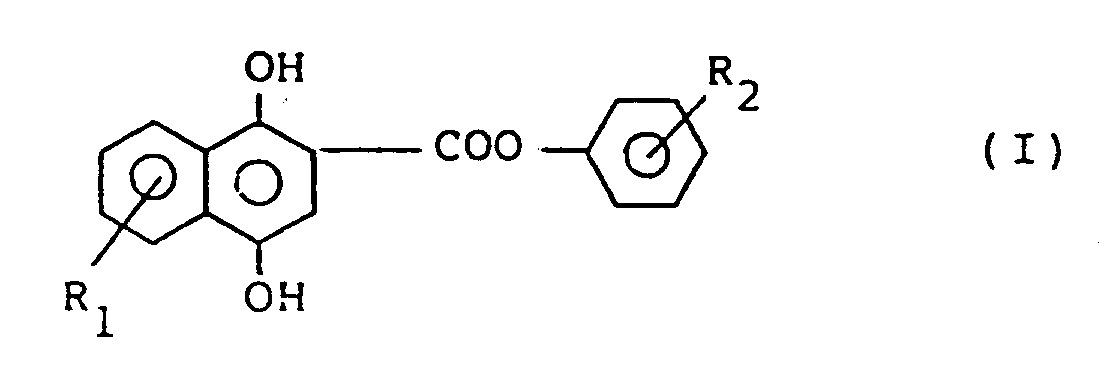
wobei R₁ und R₂ gleich oder verschieden sind und aus einem Wasserstoffatom, einem Niederalkylrest und einem Halogenatom gewählt sind, der ein Dimer der Formel ( II ) als hauptsächliches Nebenprodukt enthält,
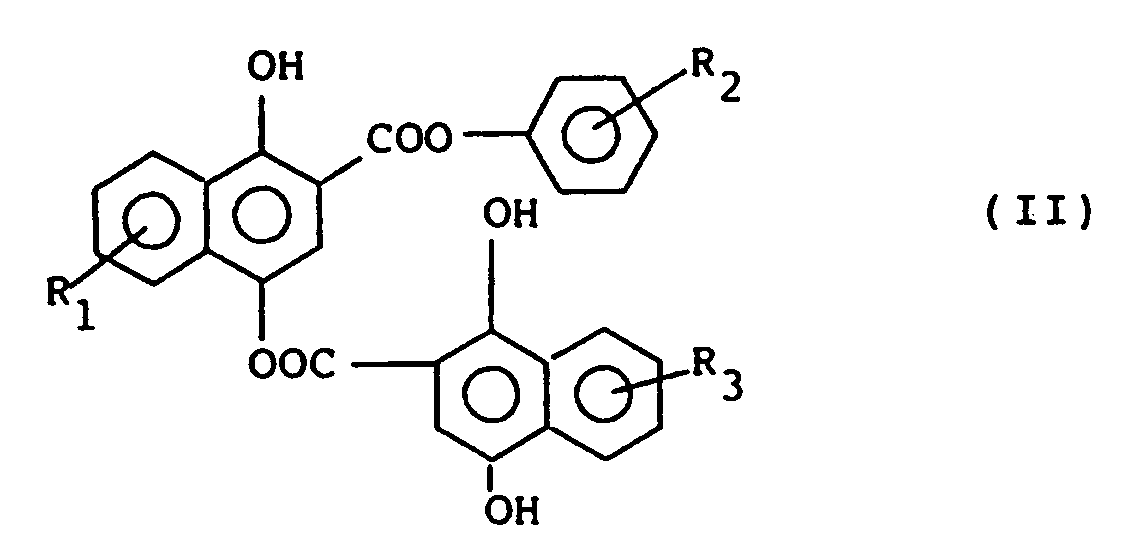
wobei R₁, R₂ und R₃ einzeln jeweils ein Wasserstoffatom, Niederalkylrest oder Halogenatom bedeuten, umfassend das Auflösen des 1,4-Dihydroxy-2-naphthoesäurearylesters, der das Dimer enthält, in einem Lösungsmittelgemisch, das im wesentlichen aus Alkoholen und Wasser ( 1 ) besteht und die Zugabe von Wasser ( 2 ) und eines Extraktionsmittels, gewählt aus der Gruppe bestehend aus alkylsubstituierten aromatischen Kohlenwasserstoffen, halogensubstituierten aliphatischen Kohlenwasserstoffen und halogensubstituierten aromatischen Kohlenwasserstoffen, zu der Losung, um den 1,4-Dihydroxy-2-naphthoesäurearylester auszukristallisieren.
wobei R₁ und R₂ gleich oder verschieden sind und aus einem Wasserstoffatom, einem Niederalkylrest und einem Halogenatom gewählt sind, der ein Dimer der Formel ( II ) als hauptsächliches Nebenprodukt enthält,
wobei R₁, R₂ und R₃ einzeln jeweils ein Wasserstoffatom, Niederalkylrest oder Halogenatom bedeuten, umfassend das Auflösen des 1,4-Dihydroxy-2-naphthoesäurearylesters, der das Dimer enthält, in einem Lösungsmittelgemisch, das im wesentlichen aus Alkoholen und Wasser ( 1 ) besteht und die Zugabe von Wasser ( 2 ) und eines Extraktionsmittels, gewählt aus der Gruppe bestehend aus alkylsubstituierten aromatischen Kohlenwasserstoffen, halogensubstituierten aliphatischen Kohlenwasserstoffen und halogensubstituierten aromatischen Kohlenwasserstoffen, zu der Losung, um den 1,4-Dihydroxy-2-naphthoesäurearylester auszukristallisieren.
15. Verfahren nach Anspruch 14, wobei die Menge der Alkohole 3,0 bis 10,0 Gewichtsteile
pro Gewichtsteil des 1,4-Dihydroxy-2-naphthoesäurearylesters beträgt.
16. Verfahren nach Anspruch 14 oder 15, wobei die Menge an Wasser ( 1 ) in dem Lösungsmittelgemisch
0,5 bis 10 Gewichtsteile pro 100 Gewichtsteile der Alkohole beträgt.
17. Verfahren nach Anspruch 14, 15 oder 16, wobei der Alkoholgehalt nach der folgenden
Formel 20 - 60% beträgt;
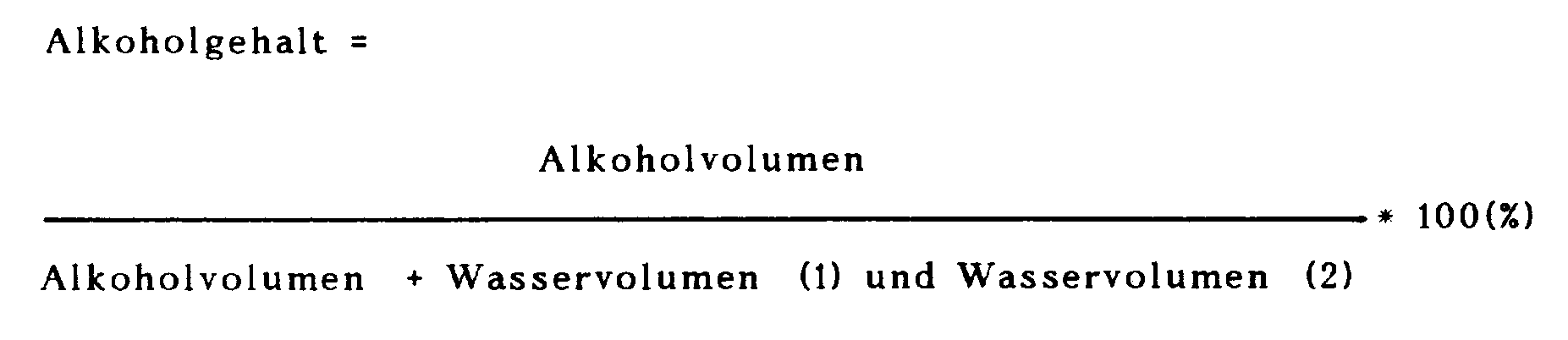
18. Verfahren nach einem der Ansprüche 14 bis 17, wobei die Menge des Extraktionslösungsmittels
0,3 bis 3,0 Gewichtsteile pro Gewichtsteil des 1,4-Dihydroxy-2-naphthoesäurearylesters
beträgt.
19. Verfahren nach Anspruch 14, wobei der Alkohol Methanol ist.
20. Verfahren nach Anspruch 14, wobei das Extraktionslösungsmittel Toluol ist.
21. Verfahren nach Anspruch 14, wobei der 1,4-Dihydroxy-2-naphthoesäurearylester, der
ein Dimer der Formel ( II ) enthält, durch ein Verfahren erhalten wird, das das Umsetzen
von 1,4-Dihydroxy-2-naphthoesäure mit Triarylphosphit, das Kristallisieren des Reaktionsproduktes
in einem Lösungsmittelgemisch, das im wesentlichen aus niederen Alkoholen oder aus
niederen Alkoholen und Wasser besteht, und seine Filtration umfaßt.
1. Procédé de préparation d'un 1,4-dihydroxy-2-arylnaphtoate de formule (I)
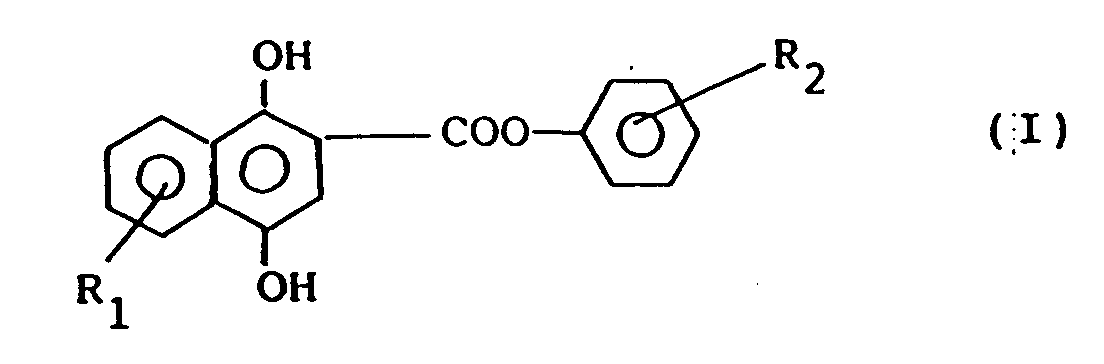
dans laquelle R₁ et R₂ sont identiques ou différents et choisis parmi un atome d'hydrogène, un groupe alcoyle inférieur et un atome d'halogène, qui consiste à mettre un acide 1,4-dihydroxy-2-naphtoïque à réagir sur un triarylphosphite en la présence d'un catalyseur acide choisi parmi les acides organiques et minéraux.
dans laquelle R₁ et R₂ sont identiques ou différents et choisis parmi un atome d'hydrogène, un groupe alcoyle inférieur et un atome d'halogène, qui consiste à mettre un acide 1,4-dihydroxy-2-naphtoïque à réagir sur un triarylphosphite en la présence d'un catalyseur acide choisi parmi les acides organiques et minéraux.
2. Procédé suivant la revendication 1, dans lequel le catalyseur acide est un acide sulfonique
aromatique de formule (III) ou (IV) suivante
dans lesquelles chacun de R₄, R₅ ou R₆ est individuellement un atome d'hydrogène, un groupe alcoyle ayant de 1 à 10 atomes de carbone, un atome d'halogène, un groupe nitro, un groupe acide sulfonique, un groupe carboxylique, un groupe hydroxy ou un groupe alcoxy ou un acide sulfonique aliphatique ayant de 1 à 10 atomes de carbone.
dans lesquelles chacun de R₄, R₅ ou R₆ est individuellement un atome d'hydrogène, un groupe alcoyle ayant de 1 à 10 atomes de carbone, un atome d'halogène, un groupe nitro, un groupe acide sulfonique, un groupe carboxylique, un groupe hydroxy ou un groupe alcoxy ou un acide sulfonique aliphatique ayant de 1 à 10 atomes de carbone.
3. Procédé suivant la revendication 2, dans lequel le catalyseur acide est l'acide p-toluène
sulfonique ou l'acide chloronitrobenzène sulfonique.
4. Procédé suivant l'une des quelconques revendications précédentes, dans lequel la quantité
de triarylphosphite est de 0,9 à 3,5 mole par mole d'acide 1,4-dihydroxy-2-naphtoïque.
5. Procédé suivant l'une des quelconques revendications précédentes, dans lequel la quantité
du catalyseur acide est comprise entre 0,01 et 0,5 mole par mole d'acide 1,4-dihydroxy-2-naphtoïque.
6. Procédé suivant l'une des quelconques revendications précédentes, dans lequel la température
de réaction est comprise entre 40 et 85°C.
7. Procédé de préparation d'un 1,4-dihydroxy-2-arylnaphtoate de formule (I)
dans laquelle R₁ et R₂ sont identiques ou différents et choisis parmi un atome d'hydrogène, un groupe alcoyle inférieur et un atome d'halogène, qui consiste à cristalliser dans un solvant mixte consistant essentiellement en alcools inférieurs et en eau un produit de réaction qui contient le 1,4-dihydroxy-2-arylnaphtoate comme constituant principal et qui est obtenu en mettant un acide 1,4-dihydroxy-2-naphtoïque à réagir sur un triarylphosphite.
dans laquelle R₁ et R₂ sont identiques ou différents et choisis parmi un atome d'hydrogène, un groupe alcoyle inférieur et un atome d'halogène, qui consiste à cristalliser dans un solvant mixte consistant essentiellement en alcools inférieurs et en eau un produit de réaction qui contient le 1,4-dihydroxy-2-arylnaphtoate comme constituant principal et qui est obtenu en mettant un acide 1,4-dihydroxy-2-naphtoïque à réagir sur un triarylphosphite.
8. Procédé suivant la revendication 7, dans lequel la quantité des alcools inférieurs
du solvant mixte est de 5 à 50 parties en volume pour chaque 100 parties en volume
du solvant mixte.
9. Procédé suivant la revendication 8, dans lequel la quantité du solvant mixte est de
1 à 10 parties en poids par partie en poids du produit de réaction.
10. Procédé suivant la revendication 7, 8 ou 9, dans lequel le produit de réaction est
obtenu en mettant un acide 1,4-dihydrory-2-naphtoïque à réagir sur un triarylphosphite
en la présence d'un catalyseur acide choisi parmi des acides organiques et minéraux.
11. Procédé suivant l'une des quelconques revendications 7 à 10, dans lequel les alcools
inférieurs sont des alcools aliphatiques ayant de 1 à 4 atomes de carbone.
12. Procédé suivant l'une des quelconques revendications 7 à 10, dans lequel l'alcool
inférieur est le méthanol.
13. Procédé suivant l'une des quelconques revendications 7 à 12, qui consiste à effectuer
la cristallisation du produit de réaction à une température de 20 à 55°C.
14. Procédé de purification d'un 1,4-dihydroxy-2-arylnaphtoate de formule (I)
dans laquelle R₁ et R₂ sont identiques ou différents et choisis parmi un atome d'hydrogène, un groupe alcoyle inférieur et un atome d'halogène contenant un dimère de formule (II) comme sous-produit principal,
dans laquelle chacun de R₁, R₂ et R₃ est indépendamment un atome d'hydrogène, un groupe alcoyle inférieur ou un atome d'halogène, qui consiste à dissoudre le 1,4-dihydroxy-2-arylnaphtoate contenant le dimère dans un solvant mixte qui consiste essentiellement en alcools et en eau (1), et ajouter de l'eau (2) et un solvant d'extraction choisi parmi les hydrocarbures aromatiques à substitution alcoyle, les hydrocarbures aliphatiques à substitution halogène et les hydrocarbures aromatiques à substitution halogène à la solution pour cristalliser le 1,4-dihydroxy-2-arylnaphtoate.
dans laquelle R₁ et R₂ sont identiques ou différents et choisis parmi un atome d'hydrogène, un groupe alcoyle inférieur et un atome d'halogène contenant un dimère de formule (II) comme sous-produit principal,
dans laquelle chacun de R₁, R₂ et R₃ est indépendamment un atome d'hydrogène, un groupe alcoyle inférieur ou un atome d'halogène, qui consiste à dissoudre le 1,4-dihydroxy-2-arylnaphtoate contenant le dimère dans un solvant mixte qui consiste essentiellement en alcools et en eau (1), et ajouter de l'eau (2) et un solvant d'extraction choisi parmi les hydrocarbures aromatiques à substitution alcoyle, les hydrocarbures aliphatiques à substitution halogène et les hydrocarbures aromatiques à substitution halogène à la solution pour cristalliser le 1,4-dihydroxy-2-arylnaphtoate.
15. Procédé suivant la revendication 14, dans lequel la quantité des alcools est comprise
entre 3,0 et 10,0 parties en poids par partie en poids de 1,4-dihydroxy-2-arylnaphtoate.
16. Procédé suivant la revendication 14 ou 15, dans lequel la quantité d'eau (1) du solvant
mixte est comprise entre 0,5 et 10 parties en poids pour chaque 100 parties en poids
des alcools.
17. Procédé suivant la revendication 14, 15 ou 16, dans lequel la teneur en alcool de
formule suivante est comprise entre 20 et 60% ;

18. Procédé suivant l'une des quelconques revendications 14 à 17, dans lequel la quantité
du solvant d'extraction est comprise entre 0,3 et 3,0 parties en poids par partie
en poids du 1,4-dihydroxy-2-arylnaphtoate.
19. Procédé suivant la revendication 14, dans lequel l'alcool est du méthanol.
20. Procédé suivant la revendication 14, dans lequel le solvant d'extraction est du toluène.
21. Procédé suivant la revendication 14, dans lequel le 1,4-dihydroxy-2-arylnaphtoate
contenant le dimère de formule (II) est obtenu par un procédé qui consiste à mettre
l'acide 1,4-dihydroxy-2-naphtoïque à réagir sur un triarylphosphite, à cristalliser
le produit de réaction dans un solvant mixte consistant essentiellement en alcools
inférieurs ou en alcools inférieurs et en eau, et à le filtrer.