| (19) |
 |
|
(11) |
EP 0 408 370 B1 |
| (12) |
EUROPEAN PATENT SPECIFICATION |
| (45) |
Mention of the grant of the patent: |
|
13.09.1995 Bulletin 1995/37 |
| (22) |
Date of filing: 12.07.1990 |
|
|
| (54) |
Stable tretinoin emulsified cream formulations
Stabile emulgierte Tretinoin-Cremeformulierungen
Formulations de crème trétinoine émulsifiée stable
|
| (84) |
Designated Contracting States: |
|
AT BE CH DE DK ES FR GB GR IT LI LU NL SE |
| (30) |
Priority: |
13.07.1989 US 379294
20.12.1989 US 453640
|
| (43) |
Date of publication of application: |
|
16.01.1991 Bulletin 1991/03 |
| (73) |
Proprietor: Bristol-Myers Squibb Company |
|
New York, N.Y. 10154 (US) |
|
| (72) |
Inventor: |
|
- Parab, Prakash
Williamsville,
New York 14221 (US)
|
| (74) |
Representative: Jones, Alan John et al |
|
CARPMAELS & RANSFORD
43 Bloomsbury Square
London, WC1A 2RA
London, WC1A 2RA (GB) |
| (56) |
References cited: :
EP-A- 0 350 438
GB-A- 1 466 062
US-A- 3 966 967
|
GB-A- 906 000
US-A- 3 906 108
US-A- 4 727 088
|
|
| |
|
|
- USAN and the USP Dictionary of Drug Names,p.613
|
|
| |
|
|
|
Remarks: |
|
The file contains technical information submitted after the application was filed
and not included in this specification |
|
| Note: Within nine months from the publication of the mention of the grant of the European
patent, any person may give notice to the European Patent Office of opposition to
the European patent
granted. Notice of opposition shall be filed in a written reasoned statement. It shall
not be deemed to
have been filed until the opposition fee has been paid. (Art. 99(1) European Patent
Convention).
|
Background of the Invention
[0001] This invention relates to stable tretinoin (also known as all-trans retinoic acid
and vitamin A acid) cream formulations.
[0002] Acne vulgaris, the most common skin disease in the United States, affects some 17
million people. It is found most frequently in those aged 12 to 25 years old and accounts
for about one-fifth of the practice of dermatology.
[0003] The acne lesions occur in sebaceous follicles, with maximum density existing on the
face, chest and back. The characteristic lesion of acne is a comedone. Blackheads
are open comedones, so colored due to melanin deposition. The follicle is filled with
keratin, lipids and bacteria, and has a widely dilated orifice that allows its contents
to escape.
[0004] Closed comedones, or whiteheads, are small and flesh colored and have microscopic
openings that prevent the contents from escaping. Continued production of keratin
and sebum may, however, lead to the rupture of the whitehead, releasing the contents
into the dermis and subsequently initiating an inflammatory process. Inflammation
close to the skin's surface results in the formation of papules and pustules, whereas
in deeper sites the result is the formation of nodules and cysts. In severe cases,
acne vulgaris will lead to permanent scarring, causing the patient mental pain and
suffering.
[0005] A. M. Kligman (U.S. Patent 3,729,568) discloses the use of Vitamin A acid in the
treatment of acne. This therapy was found to be markedly effective compared to prior
methods, such as the use of peeling agents, hormone therapy (in females), antibacterial
treatment and surgical skin planing.
[0006] More recently, A. M. Kligman (U.S. Patent 4,603,146) discloses the use of tretinoin
to retard the aging of human facial skin. Normal aging and exposure to environmental
traumas and sunlight lead to decreases in cellular turnover rates in the epidermis,
a decrease in collagen fibers and the formation of abnormal elastic fibers in the
dermis, causing the loss of elasticity and wrinkling of the skin. A leather-like consistency,
mottling (hyperpigmentation), and various premalignant growths are also associated
with the photoaging of the skin.
[0007] The elderly tend to have thin skin with decreased blood flow, accompanied by the
skin's loss of sensory acuity and ability to heal. Tretinoin increases the proliferation
of epidermal cells, thus thickening the epidermis, correcting atrophy and facilitating
healing. Tretinoin also corrects the abnormal cell differentiation found in sun-damaged
skin and reduces or stops hyperpigmentation. Furthermore, tretinoin stimulates dermal
fibroblasts to produce new collagen and ground substance such as mucopolysaccharides,
resulting in livelier, smoother, tighter skin possessing increased turgor. Finally,
tretinoin stimulates blood flow and helps in the formation of new blood vessels in
the skin. This in turn increases the following: skin temperature, clearance of irritants
and toxins from the skin and sensitivity to pain and irritation.
[0008] In addition to acne treatment and treatment for photoaging, natural aging and other
environmental traumas, other uses of Vitamin A acid have been reviewed by Thomas and
Doyle (
The Journal of the American Academy of Dermatology, Vol. 4, No. 5; May, 1981). These uses include the treatment of ichthyosis, psoriasis,
acanthosis nigricans, lichen planus, molluscum contagiosum, reactive perforating collagenosis,
melasma, geographical tongue, corneal epithelial peeling, Fox-Fordyce disease, cutaneous
metastatic melanoma, keloids, hypertrophic scars, linear verrucous nevus, plantar
warts, pseudofolliculitis, keratoacanthoma, solar keratosis of extremities, callosities
and Darier's disease.
[0009] In the treatment of acne, A. M. Kligman (U.S. Patent 3,729,568) discloses solution
formulations of tretinoin. The drug was dissolved in water miscible organic solvents
such as ethyl alcohol, propylene glycol, polyethylene glycol and isopropyl alcohol.
U.S. Patent 4,247,547 to Marks discloses a tretinoin gel formulation containing organic
solvents, such as ethyl alcohol, isopropyl alcohol and propylene glycol thickened
with hydroxypropyl cellulose. This gel composition was demonstrated to be highly effective
in treating acne and is capable of being stored without refrigeration as well.
[0010] The prior art has used organic solvents that are potential irritants and or stinging
agents. Although propylene glycol has been used in topical formulations for quite
some time, it has a history of causing irritation and sensitization (C. Huriez, "Allergy
to Propylene Glycol",
Rev. Franc. Allerg. 6:200, 1966; M. Hannuksela, V. Pivila and O.P. Salo, "Skin Reactions to Propylene
Glycol",
Contact Dermatitis, 1:112, 1975; S. Aagren-Jonsson and B. Magnusson, "Sensitization to Propantheline
Bromide, Trichlorocarbanilide and Propylene Glycol in Anti-Perspirants",
Contact Dermatitis, 2:79, 1976).
[0011] Furthermore, the glycols, for example propylene glycol and PEG-400, are hygroscopic.
When used in higher concentrations, they may absorb water from the skin, thus making
it dry and irritated. The alcohols, such as ethyl alcohol and isopropyl alcohol, are
also well known for causing stinging and drying effects when applied topically.
[0012] Tretinoin is known to be an irritant when applied topically (A. M. Kligman, U.S.
Patent 3,729,568). Hence, it would be desirable to formulate tretinoin products devoid
of stinging, irritating and sensitizing agents. One solution is a cream formulation
in which either oil is dispersed in water or water is dispersed in oil. Emollients
or lubricating agents present in the cream will be beneficial because they may reduce
the erythema, itching and stinging associated with tretinoin. Also, water will hydrate
the skin, reducing the irritation caused by dry skin.
[0013] A cosmetic cream formulation having Vitamin A acid for the regulation of cornification
in human skin is disclosed in British Patent 906,000. No mention is made of its use
for the treatment of acne.
[0014] British Patent 1,466,062 discloses both cream and solution formulations of tretinoin
that bring marked cosmetic improvement to the skin and also condition the nails and
hair.
[0015] Retin-A, a cream formulation containing tretinoin, has been produced for the commercial
market. This formulation is disclosed in
Physicians' Desk Reference, 43d Edition, page 1517 (1989). The formulation is described as containing tretinoin
in either of two strengths, 0.1% or 0.05% by weight, in a hydrophilic cream vehicle
of stearic acid, isopropyl myristate, stearyl alcohol, xanthan gum, sorbic acid, butylated
hydroxytoluene, and purified water.
[0016] U.S. Patent 3,906,108 to Felty discloses a stabilized cream emulsion of tretinoin,
capable of being stored without refrigeration for long periods of time without losing
therapeutic effectiveness and while maintaining the uniformity and stability of the
cream, containing xanthan gum as the stabilizer to prevent breaking of the emulsion.
A "Declaration Pursuant to Rule 132" filed during the prosecution of U.S. Patent 3,906,108
discloses an unstable, comparative formula containing no xanthan gum, and 3.0% by
weight of stearyl alcohol.
[0017] The United States Pharmacopeia (USP) XXI, page 1075, specifies that during its shelf
life, the marketed tretinoin cream should contain not less than 90% and not more than
130% of the labelled amount of tretinoin. The 30% overage allowed by the USP is due
to the instability of tretinoin in cream formulations. Tretinoin may degrade by free
radical mediated oxidation, photochemical reactions, heat mediated reactions, and
isomerization. Furthermore, tretinoin may react with the excipients in the formulation,
resulting in degraded by-products. These by-products may be irritating, sensitizing
or phototoxic, or may have unknown side effects. Hence, it would be preferable to
formulate a tretinoin cream product for the market in which degradation is minimal.
This would result in a reduction of by-products, and therefore side effects, during
the product shelf-life.
[0018] U.S. Patent 4,727,088 to Scott et al discloses an anhydrous pharmaceutical preparation
for the treatment of acne containing tretinoin, volatile silicones and a mixture of
stearyl and cetyl alcohol.
[0019] U.S. Patent 4,837,213 to Caron et al discloses a stable anhydrous gel of tretinoin
containing paraffin oil, fatty acid ester and silicone. The patent states that the
anhydrous composition is useful as a carrier for oxidation sensitive dermatological
medicaments such as cis- or trans-retinoic acid and anthralin.
[0020] EP-A-0350438 which was published on 10th January 1990 discloses a composition for
cosmetic or pharmaceutical use containing as active ingredient an acid or ester of
vitamin A in combination with a stable aqueous emulsion of hydrogen peroxide.
[0021] US-A-3966967 concerns the promotion of wound healing, in the treatment of acne, psoriasis
and related skin disorders by applying to the site as a solution, ointment or powder,
the C₂₀ and C₂₂ vinylogs of desmethyl retinoic acid.
Summary of the Invention
[0022] Emulsified aqueous cream formulations of tretinoin, which do not contain xanthan
gum and which are capable of being stored without refrigeration for long periods of
time without losing therapeutic effectiveness and while maintaining physical and chemical
stability, have been discovered. Physical stability refers to the stability of the
emulsion, i.e., whether or not it breaks upon storage, whereas chemical stability
refers to the amount of tretinoin remaining in the emulsion after storage. According
to this invention from 4 to 30% by weight of stearyl alcohol, or 12 to 30% by weight
of cetyl alcohol, or cetyl alcohol and 4 to 30% by weight of stearyl alcohol is used
to stabilise an emulsified aqueous tretinoin cream formulation comprising a therapeutically
active amount of tretinoin and a pharmaceutically acceptable aqueous carrier whereby
breaking of the emulsion is prevented
Detailed Description of the Invention
[0023] In a preferred embodiment, the emulsified aqueous cream formulation of this invention
contains from about 0.005% to about 0.5% by weight of tretinoin; from about 1 to about
15% by weight of primary emulsifier; from about 10 to about 50% by weight of a hydrophobic
material such as fatty acids having 12 to 20 carbon atoms, fatty acid esters in which
the fatty acids have 6 to 20 carbon atoms, fatty alcohols having 12 to 20 carbon atoms,
cocoa butter, mineral oil, petrolatum, beeswax, white wax, hydrocarbon wax, sperm
wax, and silicone oils; from about 0.05 to about 5% by weight of preservatives; from
about 0.01 to about 1% of antioxidants; from about 4 to about 30% by weight of stearyl
alcohol alone or in combination with cetyl alcohol or 12 to 30% by weight of cetyl
alcohol alone as a stabilizer to prevent breaking of the emulsion; and water.
[0024] The amount of stearyl alcohol or cetyl alcohol needed will depend upon the percentage
of oil phase in the emulsion. The higher the oil content, the higher the amount of
stearyl alcohol or cetyl alcohol required and vice-versa. Thus, the amount of stearyl
and cetyl alcohol required has to be optimized, depending on the percentage of oil
phase present. It is also preferred to use a blend of emulsifiers with high and low
HLB values.
[0025] When a combination of cetyl alcohol and 4 to 30% by weight of stearyl alcohol is
used, it is preferred to use from 3 to 6% by weight of cetyl alcohol. This combination
has been found to be synergistic.
[0026] In a more preferred embodiment, the formulation contains from about 4 to about 10%
by weight of stearyl alcohol, especially 6 to 9% by weight of stearyl alcohol or 4-30%
by weight of stearyl alcohol and at least 3% by weight of cetyl alcohol. The primary
emulsifier may be either a non-ionic emulsifier, a cationic emulsifier, an anionic
emulsifier, or a mixture thereof. Examples of suitable non-ionic emulsifiers include
polyoxyethylene-2-stearyl ether, polyoxyethylene-21-stearyl ether, polyoxyethylene-4-lauryl
ether, polyethylene glycol-23-lauryl ether, sorbitan monostearate and polyoxyethylene-20-sorbitan
monostearate. An example of a suitable anionic emulsifier is sodium lauryl sulfate
and a suitable cationic emulsifier is cetyl trimethyl ammonium bromide. Suitable preservatives
include diazolidinyl urea, benzyl alcohol, methyl paraben, propyl paraben, DMDM hydantoin
(1,3-dimethylol-5,5-dimethyl hydantoin), iodo propynyl butyl carbamate, methylisothiazolinone
and methylchloroisothiazolinone. Suitable antioxidants include butylated hydroxyanisole,
butylated hydroxytoluene, tocopherol and propyl gallate. Examples of suitable hydrophobic
materials include dibutyl adipate, diisopropyl adipate, other adipic acid esters,
petrolatum, mineral oil, silicone oil, cocoa butter, hexyl laurate, isopropyl myristate,
propylene glycol dipelargonate, glyceryl stearate, beeswax, white wax, hydrocarbon
wax, sperm wax, lanolin and cetyl palmitate. The formulation may also contain from
about 1 to about 25% by weight of ammonium lactate, a topically active medicament
used for relief of dry skin and hyperkeratotic conditions such as ichthyosis.
[0027] The formulations of this invention may be used in the treatment of acne or other
dermatological conditions where tretinoin is indicated or to retard the effects of
aging of the skin. The formulations are applied topically to the area to be treated
at regular intervals, as needed. The duration of the treatment will depend upon the
nature and severity of the condition to be treated as well as the frequency of application
of the formulation.
[0029] The methods for processing Examples 1 to 4 are set forth below:
Example 1
[0030]
1. In a suitable size premix vessel, warm the dibutyl adipate to 45-50°C. With rapid
mixing, add tretinoin and continue the mixing until uniform, while maintaining the
temperature between 45-50°C.
2. In a separate premix vessel, warm the following to 65°C: polyoxyethylene-2-stearyl
ether, polyoxyethylene-21-stearyl ether, stearyl alcohol, butylated hydroxytoluene,
butylated hydroxyanisole, glyceryl stearate, polyoxyethylene-4-lauryl ether and cetyl
alcohol. Mix until uniform, maintaining the temperature between 60-65°C.
3. Add 95% of the water to the main mix vessel. While rapidly mixing, add the glycerin
and citric acid. Mix until uniform and then warm and maintain the temperature at 60-65°C.
4. With rapid mixing, add the step 2 oil phase contents to step 3 water phase contents
to form an emulsion. When the temperature of this emulsion is between 55-60°C, add
step 1 tretinoin solution and continue rapid mixing while cooling to between 40-45°C.
Adjust the pH of the cream in 3.8 to 4.5 range using citric acid.
5. In a small premix vessel, dissolve the diazolidinyl urea and Kathon CGTM in the remaining 5% of water. Add this solution to the step 4 cream and mix while
cooling to room temperature.
Example 2
[0031]
1. In a suitable size premix vessel, warm the dibutyl adipate to 45-50°C. With rapid
mixing, add tretinoin and continue the mixing until uniform, while maintaining the
temperature between 45-50°C.
2. In a separate premix vessel, warm the following to 65°C: cocoa butter, polyoxyethylene-2-stearyl
ether, polyoxyethylene-21-stearyl ether, stearyl alcohol, butylated hydroxytoluene,
butylated hydroxyanisole, glyceryl stearate, polyoxyethylene-4-lauryl ether and cetyl
alcohol. Mix until uniform, maintaining the temperature between 60-65°C.
3. Add 95% of the water to the main mix vessel. While rapidly mixing, add the glycerin
and citric acid. Mix until uniform and then warm and maintain the temperature at 60-65°C.
4. With rapid mixing, add the step 2 oil phase contents to step 3 water phase contents
to form an emulsion. When the temperature of this emulsion is between 55-60°C, add
step 1 tretinoin solution and continue rapid mixing while cooling to between 40-45°C.
Adjust the pH of the cream in 3.8 to 4.5 range using citric acid.
5. In a small premix vessel, dissolve the diazolidinyl urea and Kathon CGTM in the remaining 5% of water. Add this solution to the step 4 cream and mix while
cooling to room temperature.
Example 3
[0032]
1. In a suitable size premix vessel, warm the hexyl laurate to 45-50°C. With rapid
mixing, add tretinoin and continue the mixing until uniform, while maintaining the
temperature between 45-50°C.
2. In a separate premix vessel, warm the following to 65°C: methyl gluceth P-20, polyoxyethylene-2-stearyl
ether, polyoxyethylene-21-stearyl ether, stearyl alcohol, butylated hydroxytoluene,
butylated hydroxyanisole, glyceryl stearate, polyoxyethylene-4-lauryl ether and cetyl
alcohol. Mix until uniform, maintaining the temperature between 60-65°C.
3. Add 95% of the water to the main mix vessel. While rapidly mixing, add the glycerin
and citric acid. Mix until uniform and then warm and maintain the temperature at 60-65°C.
4. With rapid mixing, add the step 2 oil phase contents to step 3 water phase contents
to form an emulsion. When the temperature of this emulsion is between 55-60°C, add
step 1 tretinoin solution and continue rapid mixing while cooling to between 40-45°C.
Adjust the pH of the cream in 3.8 to 4.5 range using citric acid.
5. In a small premix vessel, dissolve the diazolidinyl urea and Kathon CGTM in the remaining 5% of water. Add this solution to the step 4 cream and mix while
cooling to room temperature.
Example 4
[0033]
1. In a suitable size premix vessel, warm the propylene glycol dipelargonate and isopropyl
myristate to 45-50°C. With rapid mixing, add tretinoin and continue the mixing until
uniform, while maintaining the temperature between 45-50°C.
2. In a separate premix vessel, warm the following to 65°C: cocoa butter, polyoxyethylene-2-stearyl
ether, polyoxyethylene-21-stearyl ether, stearyl alcohol, butylated hydroxytoluene,
butylated hydroxyanisole, glyceryl stearate, polyoxyethylene-4-lauryl ether and cetyl
alcohol. Mix until uniform, maintaining the temperature between 60-65°C.
3. Add 95% of the water to the main mix vessel. While rapidly mixing, add the glycerin
and citric acid. Mix until uniform and then warm and maintain the temperature at 60-65°C.
4. With rapid mixing, add the step 2 oil phase contents to step 3 water phase contents
to form an emulsion. When the temperature of this emulsion is between 55-60°C, add
step 1 tretinoin solution and continue rapid mixing while cooling to between 40-45°C.
Adjust the pH of the cream in 3.8 to 4.5 range using citric acid.
5. In a small premix vessel, dissolve the diazolidinyl urea and Kathon CGTM in the remaining 5% of water. Add this solution to the step 4 cream and mix while
cooling to room temperature.
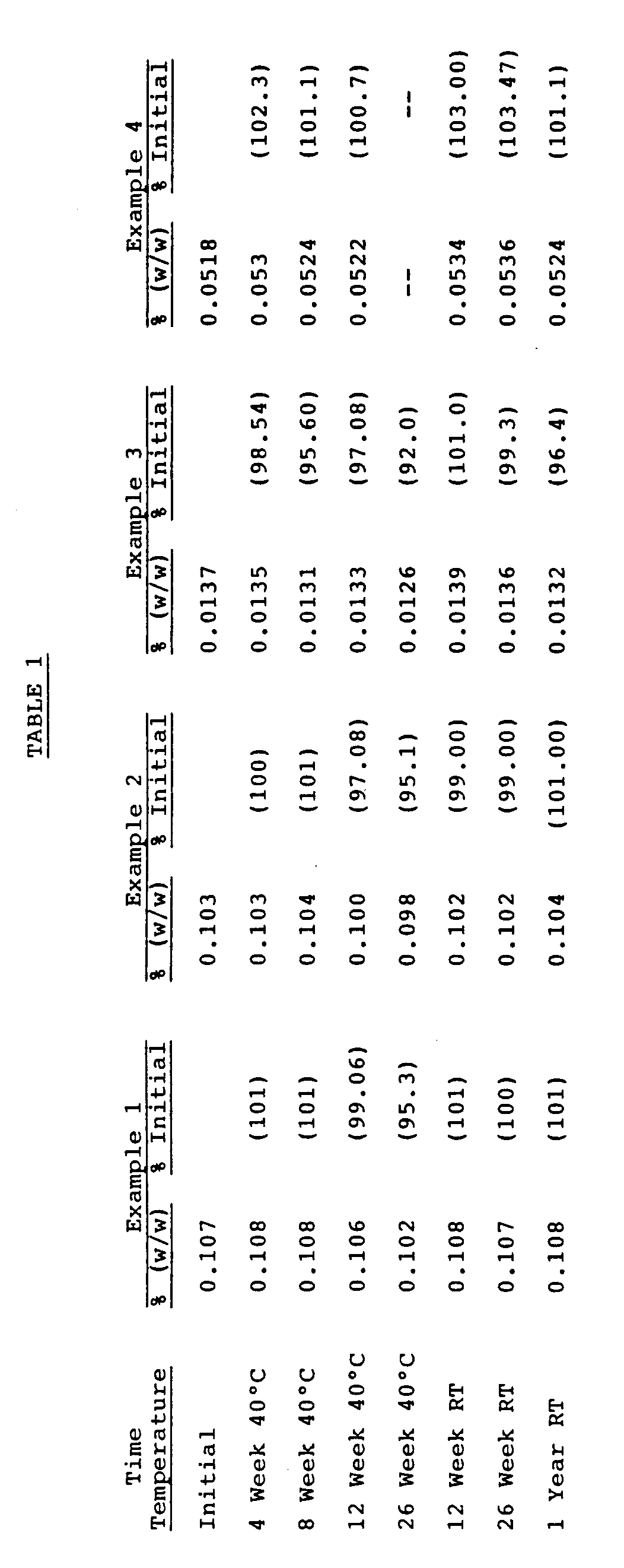
[0034] Table 1 sets forth the concentrations of tretinoin in the cream formulations of Examples
1-4 at room temperature (RT) and at 40°C as determined at different time intervals.
It will be appreciated that experimental error gave rise to those instances wherein
more than 100% of tretinoin was found to be in the formulation after storage.
[0035] Hereinafter, "% (w/w)" means the percent by weight of tretinoin based upon the weight
of the total composition; and "% Initial" means the percent of tretinoin remaining
after storage for the designated times and temperatures based upon the initial amount
of tretinoin in the formulation. Tretinoin content in these formulations was measured
by stability indicating HPLC assay. Table 1 illustrates that the chemical stability
of the emulsified tretinoin cream formulations of this invention is very high.
[0036] The physical stability of the emulsified tretinoin cream formulations of this invention
is also very high. Thus, these formulations show no separation when stored at 40°C
(104°F) for 26 weeks.
[0037] Table 2 sets forth the concentrations of tretinoin in the cream formulations of Examples
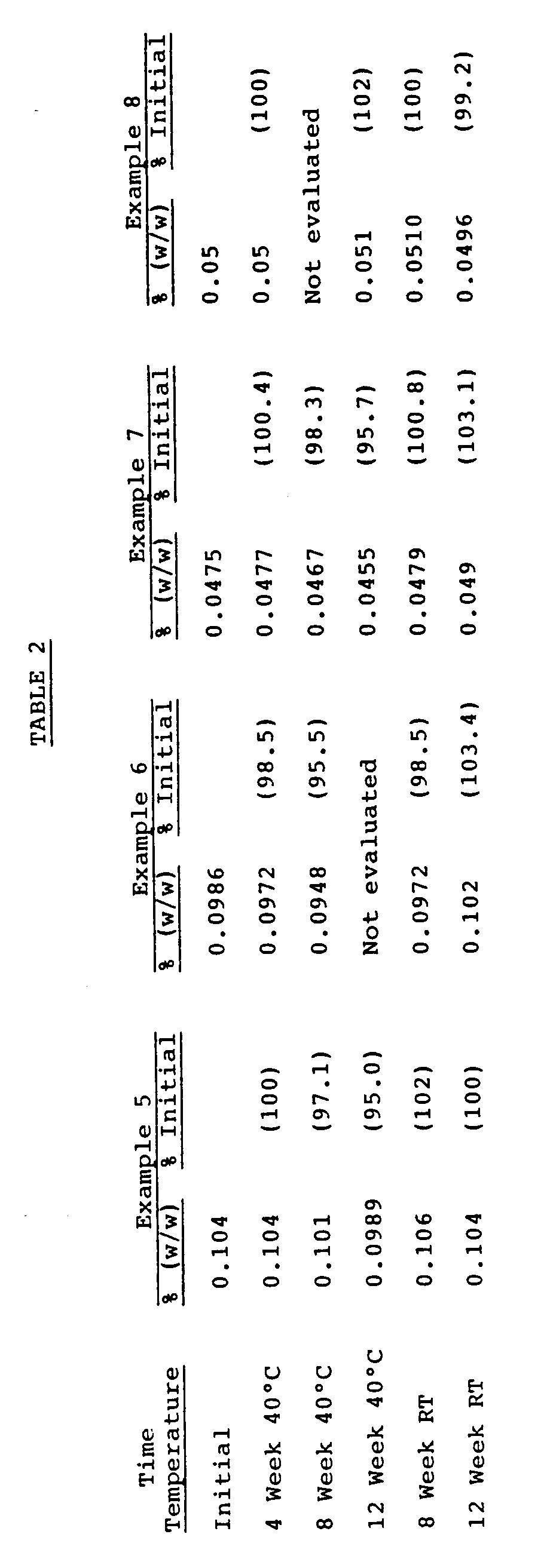
5-8 at room temperature (RT) and at 40°C as determined at different time intervals.
Experimental error gave rise to those instances where more than 100% of tretinoin
was found to be in the formulation after storage.
[0038] Examples 9 and 10 illustrate the necessity of using at least 4.0% by weight of stearyl
alcohol or 15% by weight of cetyl alcohol and the synergism achieved by the use of
stearyl alcohol in combination with cetyl alcohol.
Example 9
[0039] The basic formulation was as follows:
| Ingredient |
% w/w |
| Tretinoin |
0.10 |
| Dibutyl adipate |
20.0 |
| Polyoxyethylene-21-stearyl ether |
2.5 |
| Polyoxyethylene-2-stearyl ether |
2.5 |
| Glyceryl stearate |
1.0 |
| Polyoxyethylene-4-lauryl ether |
1.0 |
| Cetyl alcohol |
Test variable |
| Stearyl alcohol |
Test variable |
| Glycerin |
4.0 |
| Kathon CG™ |
0.05 |
| Diazolidinyl urea |
0.10 |
| Butylated hydroxytoluene |
0.05 |
| Butylated hydroxyanisole |
0.05 |
| Citric acid |
0.005 |
| Water, purified |
qs100.00 |
[0040] The following formulations were provided:
| Example No. |
% w/w Stearyl Alcohol |
% w/w Cetyl Alcohol |
| 9A |
6 |
3 |
| 9B |
0 |
3 |
| 9C |
2 |
3 |
| 9D |
3 |
3 |
| 9E |
4 |
3 |
| 9F |
4 |
0 |
| 9G |
6 |
0 |
| 9H |
9 |
0 |
| 9I |
- |
9 |
| 9J |
- |
15 |
| 9K |
- |
20 |
[0041] The physical stabilities of these examples at 45°C (113°F), which are given in Table
3, illustrate the amounts of stearyl alcohol and/or cetyl alcohol required to stabilize
tretinoin formulations.
TABLE 3
| Time |
Example |
| |
9A |
9B |
9C |
9D |
9E |
9F |
9G |
9H |
9I |
9J |
9K |
| 1 week |
N |
S |
S |
N |
N |
N |
N |
N |
N |
N |
N |
| 2 week |
N |
- |
- |
S |
N |
S |
N |
N |
N |
N |
N |
| 3 week |
N |
- |
- |
- |
N |
- |
N |
N |
S |
N |
N |
| 4 week |
N |
- |
- |
- |
N |
- |
N |
N |
- |
N |
N |
| 5 week |
N |
- |
- |
- |
N |
- |
N |
N |
- |
N |
N |
| 6 week |
N |
- |
- |
- |
N |
- |
N |
N |
- |
N |
N |
| 7 week |
N |
- |
- |
- |
N |
- |
N |
N |
- |
N |
N |
| 8 week |
N |
- |
- |
- |
N |
- |
N |
N |
- |
N |
N |
| 9 week |
N |
- |
- |
- |
N |
- |
N |
N |
- |
N |
N |
| 10 week |
N |
- |
- |
- |
N |
- |
N |
N |
- |
N |
N |
[0042] In the above Table, "N" means no separation and "S" means that the oil and water
phase is separated. As a rule, emulsions showing no separation when stored at 45°C
(113°F) for eight weeks should be stable for a minimum of two years when stored at
room temperature.
Example 10
[0043] The following formulations were prepared.
| Ingredient |
% w/w of Ingredient in Example Number |
| |
10A |
10B |
10C |
10D |
10E |
10F |
| Tretinoin |
0.125 |
0.125 |
0.125 |
0.125 |
0.125 |
0.125 |
| Isopropyl myristate |
10.00 |
10.00 |
10.00 |
10.00 |
10.00 |
10.00 |
| Polyoxyl 40 stearate |
5.00 |
5.00 |
2.50 |
5.00 |
5.00 |
5.00 |
| Stearyl alcohol |
3.00 |
7.00 |
7.00 |
7.00 |
7.00 |
3.00 |
| Stearic acid |
19.00 |
19.00 |
19.00 |
19.00 |
12.00 |
19.00 |
| Butylated hydroxytoluene |
0.10 |
0.10 |
0.10 |
0.10 |
0.10 |
0.10 |
| Polyoxyethylene-2-stearyl ether |
0 |
1.45 |
2.50 |
0 |
0 |
1.66 |
| Cetyl alcohol |
0 |
3.00 |
3.00 |
3.00 |
3.00 |
0 |
| Sorbic acid |
0.20 |
0.20 |
0.20 |
0.20 |
0.20 |
0.2 |
| Water purified qs |
100.00 |
100.00 |
100.00 |
100.00 |
100.00 |
100.00 |
[0044] In formulations 10B and 10C, the HLB was adjusted using a blend of emulsifiers (polyoxyl-40-stearate
and polyoxyethylene-2-stearyl ether), as well as including cetyl and stearyl alcohol.
Thus, formulations 10B and 10C illustrate the importance of an HLB adjustment and
the effects of cetyl alcohol and stearyl alcohol. Formulas 10D and 10E contain cetyl
and stearyl alcohol, but provide no HLB adjustment, whereas formulation 10F had only
HLB adjustments. The physical stabilities of these tretinoin creams at 45°C are shown
in Table 4.
TABLE 4
| Time |
Formulation Number |
| |
10A |
10B |
10C |
10D |
10E |
10F |
| 1 week |
N |
N |
N |
N |
N |
N |
| 2 week |
S |
N |
N |
N |
N |
S |
| 3 week |
- |
N |
N |
N |
N |
- |
| 4 week |
- |
N |
N |
N |
N |
- |
| 5 week |
- |
N |
N |
N |
N |
- |
| 6 week |
- |
N |
N |
N |
N |
- |
| 7 week |
- |
N |
N |
N |
N |
- |
| 8 week |
- |
N |
N |
N |
N |
- |
| 9 week |
- |
N |
N |
N |
N |
- |
| 10 week |
- |
N |
N |
S |
N |
- |
[0045] In Table 4, the designations "N" and "S" have the same meanings as discussed previously
with respect to Table 3. Formulations 10A and 10F have reduced stabilizing thickener
(stearyl alcohol). Neither formulation is physically stable. HLB adjustment in formulation
10F was not adequate to stabilize the formulation 10A. Formulations 10B, 10C, 10D
and 10E demonstrate that with adequate amounts of stearyl alcohol and cetyl alcohol,
the formulation 10A can be stabilized with or without HLB adjustment.
Claims for the following Contracting State(s): AT, BE, CH, DE, DK, FR, GB, IT, LU,
NL, SE
1. The use of either
(a) from 4 to 30% by weight of stearyl alcohol, or
(b) 12 to 30% by weight of cetyl alcohol, or
(c) cetyl alcohol and 4 to 30% by weight of stearyl alcohol to stabilise an emulsified
aqueous tretinoin cream formulation comprising a therapeutically active amount of
tretinoin and a pharmaceutically acceptable aqueous carrier, whereby breaking of the
emulsion is prevented.
2. The use of claim 1 wherein the formulation comprises from 0.005 to 0.5% by weight
of tretinoin; from 1 to 15% by weight of primary emulsifier; from 10 to 50% by weight
of hydrophobic material; from 0.05 to 5% by weight of preservatives; from 0.01 to
1% by weight of antioxidants; and water.
3. The use of claim 2 wherein said hydrophobic material is selected from fatty acids
having 12 to 20 carbon atoms, fatty acid esters in which the fatty acid portion has
6 to 20 carbon atoms, fatty alcohols having 12 to 20 carbon atoms, cocoa butter, mineral
oil, petroleum, beeswax, white wax, hydrocarbon wax, sperm wax, and silicone oils.
4. The use of claim 2 or claim 3 wherein the primary emulsifier is a non-ionic emulsifier.
5. The use of claim 2 or claim 3 wherein the primary emulsifier is non-ionic, cationic,
anionic or a mixture thereof.
6. The use of claim 4 wherein the emulsifier is selected from polyoxyethylene-2-stearyl
ether, polyoxyethylene-21-stearyl ether, polyoxy-ethylene-4-lauryl ether, polyethylene
glycol-23-lauryl ether, sorbitan monostearate and polyoxythlene-20-sorbitan monostearate.
7. The use of claim 5 wherein the anionic emulsifier is sodium lauryl sulfate and/or
the cationic emulsifier is cetyl trimethyl ammonium bromide.
8. The use of any one of claims 1 to 7 wherein the formulation contains a preservative
selected from diazolidinyl urea, benzyl alcohol, methyl paraben, propyl paraben, DMDM
hydantoin, iodo propynyl butyl carbamate and methylisothiazolinone, and methylchloroisothiazolinone.
9. The use of any one of claims 1 to 8 wherein the formulation contains an antioxidant
selected from butylated hydroxyanisole, butylated hydroxytoluene, tocopherol and propyl
gallate.
10. The use of any one of claims 1 to 9 wherein the formulation contains from about 1
to about 25% by weight of ammonium lactate.
11. The use of any one of claims 1 to 10 wherein the stabilizer comprises a combination
of from 4 to 30% by weight of stearyl alcohol and from 3 to 6% by weight of cetyl
alcohol.
12. The use according to any one of claims 1 to 10 wherein the stabilizer comprises either
6-9% by weight of stearyl alcohol or a combination of 4-30% by weight of stearyl alcohol
with at least 3% by weight cetyl alcohol.
13. A stable emulsified tretinoin cream formulation which does not contain xanthan gum,
containing 0.1 parts by weight tretinoin, 2.5 parts by weight polyoxyethylene-2-stearyl
ether, 2.5 parts by weight polyoxyethylene-21-stearyl ether, 3.0 parts by weight cetyl
alcohol, 6.0 parts by weight stearyl alcohol, 4.0 parts by weight glycerin, 20.0 parts
by weight dibutyl adipate, 0.005 parts by weight citric acid, 1.00 parts by weight
polyoxyethylene-4-lauryl ether, 1.00 parts by weight glyceryl stearate, 0.05 parts
by weight butylated hydroxytoluene, 0.05 parts by weight butylated hydroxyanisole,
0.15 parts by weight diazolidinyl urea, a mixture of 0.05 percent methylchloroisothiazolinone
and methylisothiazolinone, and 59.60 parts by weight purified water.
14. A stable emulsified tretinoin cream formulation which does not contain xanthan gum,
containing 0.1 parts by weight tretinoin, 2.5 parts by weight polyoxyethylene-2-stearyl
ether, 2.5 parts by weight polyoxyethylene-21-stearyl ether, 3.0 parts by weight cetyl
alcohol, 5.0 parts by weight stearyl alcohol, 2.0 parts by weight glycerin, 20.0 parts
by weight dibutyl adipate, 0.0039 parts by weight citric acid, 1.00 parts by weight
polyoxyethylene-4-lauryl ether, 1.00 parts by weight glyceryl stearate, 0.05 parts
by weight butylated hydroxytoluene, 0.05 parts by weight butylated hydroxyanisole,
0.15 parts by weight diazolidinyl urea, a mixture of 0.05 parts by weight methylchloroisothiazolinone
and methylisothiazolinone, 8.00 parts by weight cocoa butter, and 54.59 parts by weight
purified water.
15. A stable emulsified tretinoin cream formulation which does not contain xanthan gum,
containing 0.01 parts by weight tretinoin, 2.00 parts by weight polyoxyethylene-2-stearyl
ether, 2.00 parts by weight polyoxyethylene-21-stearyl ether, 3.00 parts by weight
cetyl alcohol, 6.00 parts by weight stearyl alcohol, 2.00 parts by weight glycerin,
0.0039 parts by weight citric acid, 1.00 parts by weight polyoxyethylene-4-lauryl
ether, 1.00 parts by weight glyceryl stearate, 0.05 parts by weight butylated hydroxytoluene,
0.05 parts by weight butylated hydroxyanisole, 0.10 parts by weight diazolidinyl urea,
a mixture of 0.05 parts by weight methylchloroisothiazolinone and methylisothiazolinone,
10.00 parts by weight hexyl laurate, 2.00 parts by weight methyl gluceth P-20, and
70.73 parts by weight purified water.
16. A stable emulsified tretinoin cream formulation which does not contain xanthan gum
containing 0.05 parts by weight tretinoin, 2.5 parts by weight polyoxyethylene-2-stearyl
ether, 2.5 parts by weight polyoxyethylene-21-stearyl ether, 3.00 parts by weight
cetyl alcohol, 5.00 parts by weight stearyl alcohol, 2.00 parts by weight glycerin,
0.0039 parts by weight citric acid, 1.00 parts by weight polyoxyethylene-4-lauryl
ether, 1.00 parts by weight glyceryl stearate, 0.05 parts by weight butylated hydroxytoluene,
0.05 parts by weight butylated hydroxyanisole, 0.20 parts by weight diazolidinyl urea,
a mixture of 0.05 parts by weight methylchloroisothiazolinone and methylisothiazolinone,
8.00 parts by weight cocoa butter, 5.00 parts by weight propylene glycol dipelargonate,
5.00 parts by weight isopropyl myristate, and 64.59 parts by weight purified water.
17. Formulation as claimed in any one of claims 13 to 15 for use in the treatment of dermatological
conditions.
18. The formulation of claim 17 wherein the dermatological condition is acne vulgaris.
19. A method for producing a stable emulsified aqueous tretinoin cream formulation wherein
the ingredients specified in any one of the preceding claims are emulsified.
Claims for the following Contracting State(s): ES, GR
1. A process for stabilising an emulsified aqueous tretinoin cream formulation comprising
a therapeutically active amount of tretinoin and a pharmaceutically acceptable aqueous
carrier; which process comprises emulsifying said tretinoin and carrier with either
(a) from 4 to 30% by weight of stearyl alcohol, or
(b) 12 to 30% by weight of cetyl alcohol, or
(c) cetyl alcohol and 4 to 30% by weight of stearyl alcohol as the stabiliser, whereby
breaking of the emulsion is prevented.
2. The process of claim 1 wherein the formulation contains from 0.005 to 0.5% by weight
of tretinoin; from 1 to 15% by weight of primary emulsifier; from 10 to 50% by weight
of hydrophobic material; from 0.05 to 5% by weight of preservatives; from 0.01 to
1% by weight of antioxidants; and water.
3. The process of claim 2 wherein said hydrophobic material is selected from fatty acids
having 12 to 20 carbon atoms, fatty acid esters in which the fatty acid portion has
6 to 20 carbon atoms, fatty alcohols having 12 to 20 carbon atoms, cocoa butter, mineral
oil, petroleum, beeswax, white wax, hydrocarbon wax, sperm wax, and silicone oils.
4. The process of claim 2 or claim 3 wherein the primary emulsifier is a non-ionic emulsifier.
5. The process of claim 2 or claim 3 wherein the primary emulsifier is non-ionic, cationic,
anionic or a mixture thereof.
6. The process of claim 4 wherein the emulsifier is selected from polyoxyethylene-2-stearyl
ether, polyoxyethylene-21-stearyl ether, polyoxy-ethylene-4-lauryl ether, polyethylene
glycol-23-lauryl ether, sorbitan monostearate and polyoxyethylene-20-sorbitan monostearate.
7. The process of claim 5 wherein the anionic emulsifier is sodium lauryl sulphate and/or
the cationic emulsifier is cetyl trimethyl ammonium bromide.
8. The process of any one of claims 1 to 7 wherein the formulation contains a preservative
selected from diazolidinyl urea, benzyl alcohol, methyl paraben, propyl paraben, DMDM
hydantoin, iodo propynyl butyl carbamate and methylisothiazolinone, and methylchloroisothiazolinone.
9. The process of any one of claims 1 to 8 wherein the formulation contains an antioxidant
selected from butylated hydroxyanisole, butylated hydroxytoluene, tocopherol and propyl
gallate.
10. The process of any one of claims 1 to 9 wherein the formulation contains from 1 to
25% by weight of ammonium lactate.
11. The process of any one of claims 1 to 10 wherein the stabiliser comprises a combination
of from 4 to 30% by weight of stearyl alcohol and from 3 to 6% by weight of cetyl
alcohol.
12. The process of any of claims 1 to 10 wherein the stabiliser comprises either 6-9%
by weight of stearyl alcohol or a combination of 4-30% by weight of stearyl alcohol
with at least 3% by weight cetyl alcohol.
13. A process for making a stable emulsified tretinoin cream formulation which does not
contain xanthan gum, comprising emulsifying 0.1 parts by weight tretinoin, 2.5 parts
by weight polyoxyethylene-2-stearyl ether, 2.5 parts by weight polyoxyethylene-21-stearyl
ether, 3.0 parts by weight cetyl alcohol, 6.0 parts by weight stearyl alcohol, 4.0
parts by weight glycerin, 20.0 parts by weight dibutyl adipate, 0.005 parts by weight
citric acid, 1.00 parts by weight polyoxyethylene-4-lauryl ether, 1.00 parts by weight
glyceryl stearate, 0.05 parts by weight butylated hydroxytoluene, 0.05 parts by weight
butylated hydroxyanisole, 0.15 parts by weight diazolidinyl urea, a mixture of 0.05
percent methylchloroisothiazolinone and methylisothiazolinone, and 59.60 parts by
weight purified water.
14. A process for making a stable emulsified tretinoin cream formulation which does not
contain xanthan gum, comprising emulsifying 0.1 parts by weight tretinoin, 2.5 parts
by weight polyoxyethylene-2-stearyl ether, 2.5 parts by weight polyoxyethylene-2-stearyl
ether, 3.0 parts by weight cetyl alcohol, 5.0 parts by weight stearyl alcohol, 2.0
parts by weight glycerin, 20.0 parts by weight dibutyl adipate, 0.0039 parts by weight
citric acid, 1.00 parts by weight polyoxyethylene-4-lauryl ether, 1.00 parts by weight
glyceryl stearate, 0.05 parts by weight butylated hydroxytoluene, 0.05 parts by weight
butylated hydroxyanisole, 0.15 parts by weight diazolidinyl urea, a mixture of 0.05
parts by weight methylchoroisothiazolinone and methylisothiazolinone, 8.00 parts by
weight cocoa butter, and 54.59 parts by weight purified water.
15. A process for making a stable emulsified tretinoin cream formulation which does not
contain xanthan gum, comprising emulsifying 0.01 parts by weight tretinoin, 2.00 parts
by weight polyoxyethylene-2-stearyl ether, 2.00 parts by weight polyoxyethylene-21-stearyl
ether, 3.00 parts by weight cetyl alcohol, 6.00 parts by weight stearyl alcohol, 2.00
parts by weight glycerin, 0.0039 parts by weight citric acid, 1.00 parts by weight
polyoxyethylene-4-lauryl ether, 1.00 parts by weight glyceryl stearate, 0.05 parts
by weight butylated hydroxytoluene, 0.05 parts by weight butylated hydroxyanisole,
0.10 parts by weight diazolidinyl urea, a mixture of 0.05 parts by weight methylchloroisothiazolinone
and methylisothiazolinone, 10.00 parts by weight hexyl laurate, 2.00 parts by weight
methyl gluceth P-20, and 70.73 parts by weight purified water.
16. A process for making a stable emulsified tretinoin cream formulation which does not
contain xanthan gum which comprises emulsifying together 0.05 parts by weight tretinoin,
2.5 parts by weight polyoxyethylene-2-stearyl ether, 2.5 parts by weight polyoxyethylene-21-stearyl
ether, 3.00 parts by weight cetyl alcohol, 5.00 parts by weight stearyl alcohol, 2.00
parts by weight glycerin, 0.0039 parts by weight citric acid, 1.00 parts by weight
polyoxyethylene-4-lauryl ether, 1.00 parts by weight glyceryl stearate, 0.05 parts
by weight butylated hydroxytoluene, 0.05 parts by weight butylated hydroxyanisole,
0.20 parts by weight diazolidinyl urea, a mixture of 0.05 parts by weight methylchlorisothiazolinone
and methylisothiazolinone, 8.00 parts by weight cocoa butter, 5.00 parts by weight
propylene glycol dipelargonate, 5.00 parts by weight isopropyl myristate, and 64.59
parts by weight purified water.
Patentansprüche für folgende(n) Vertragsstaat(en): AT, BE, CH, DE, DK, FR, GB, IT,
LU, NL, SE
1. Verwendung von
(a) 4 bis 30 Gew.-% Stearylalkohol, oder
(b) 12 bis 30 Gew.-% Cetylalkohol, oder
(c) Cetylalkohol und 4 bis 30 Gew.-% Stearylalkohol, zur Stabilisierung einer emulgierten
wäßrigen Tretinoincremeformulierung, die eine therapeutisch wirksame Menge an Tretinoin
und einen pharmazeutisch akzeptablen wäßrigen Träger umfaßt, wobei ein Brechen der
Emulsion verhindert wird.
2. Verwendung nach Anspruch 1, wobei die Formulierung 0,005 bis 0,5 Gew.-% Tretinoin;
1 bis 15 Gew.-% eines Primäremulgators; 10 bis 50 Gew.-% eines hydrophoben Materials;
0,05 bis 5 Gew.-% Konservierungsmittel; 0,01 bis 1 Gew.-% Antioxidanzien; und Wasser
umfaßt.
3. Verwendung nach Anspruch 2, wobei das hydrophobe Material ausgewählt ist unter Fettsäuren
mit 12 bis 20 Kohlenstoffatomen, Fettsäureestern, bei denen der Fettsäureteil 6 bis
20 Kohlenstoffatome aufweist, Fettalkoholen mit 12 bis 20 Kohlenstoffatomen, Kakaobutter,
Mineralöl, Petroleum, Bienenwachs, weißes Wachs, Kohlenwasserstoffwachs, Spermacetwachs
und Silikonölen.
4. Verwendung nach Anspruch 2 oder Anspruch 3, wobei der Primäremulgator ein nicht-ionischer
Emulgator ist.
5. Verwendung nach Anspruch 2 oder Anspruch 3, wobei der Primäremulgator ein nicht-ionischer,
kationischer, anionischer Emulgator oder ein Gemisch davon ist.
6. Verwendung nach Anspruch 4, wobei der Emulgator ausgewählt ist unter Polyoxyethylen-2-stearylether,
Polyoxyethylen-21-stearylether, Polyoxyethylen-4-laurylether, Polyethylenglycol-23-laurylether,
Sorbitanmonostearat und Polyoxyethylen-20-sorbitanmonostearat.
7. Verwendung nach Anspruch 5, wobei der anionische Emulgator Natriumlaurylsulfat ist
und/oder der kationische Emulgator Cetyltrimethylammoniumbromid ist.
8. Verwendung nach einem der Ansprüche 1 bis 7, wobei die Formulierung ein Konservierungsmittel
enthält, das ausgewählt ist unter Diazolidinylharnstoff, Benzylalkohol, Methylparaben,
Propylparaben, DMDM-Hydantoin, Jodpropinyl-butylcarbamat und Methylisothiazolinon
und Methylchlorisothiazolinon.
9. Verwendung nach einem der Ansprüche 1 bis 8, wobei die Formulierung ein Antioxidans
enthält, das ausgewählt ist unter butyliertem Hydroxyanisol, butyliertem Hydroxytoluol,
Tocopherol und Propylgallat.
10. Verwendung nach einem der Ansprüche 1 bis 9, wobei die Formulierung etwa 1 bis etwa
25 Gew.-% Ammoniumlactat enthält.
11. Verwendung nach einem der Ansprüche 1 bis 10, wobei der Stabilisator eine Kombination
aus 4 bis 30 Gew.-% Stearylalkohol und 3 bis 6 Gew.-% Cetylalkohol umfaßt.
12. Verwendung nach einem der Ansprüche 1 bis 10, wobei der Stabilisator entweder 6 bis
9 Gew.-% Stearylalkohol oder eine Kombination aus 4 bis 30 Gew.-% Stearylalkohol mit
wenigstens 3 Gew.-% Cetylalkohol umfaßt.
13. Stabile, emulgierte Tretinoincremeformulierung, die keinen Xanthangummi enthält, und
die 0,1 Gewichtsteile Tretinoin, 2,5 Gewichtsteile Polyoxyethylen-2-stearylether,
2,5 Gewichtsteile Polyoxyethylen-21-stearylether, 3,0 Gewichtsteile Cetylalkohol,
6,0 Gewichtsteile Stearylalkohol, 4,0 Gewichtsteile Glycerin, 20,0 Gewichtsteile Dibutyladipat,
0,005 Gewichtsteile Zitronensäure, 1,00 Gewichtsteile Polyoxyethylen-4-laurylether,
1,00 Gewichtsteile Glycerylstearat, 0,05 Gewichtsteile butyliertes Hydroxytoluol,
0,05 Gewichtsteile butyliertes Hydroxyanisol, 0,15 Gewichtsteile Diazolidinylharnstoff,
ein Gemisch aus 0,05 % Methylchlorisothiazolinon und Methylisothiazolinon und 59,60
Gewichtsteile gereinigtes Wasser enthält.
14. Stabile emulgierte Tretinoincremeformulierung, die keinen Xanthangummi enthält und
die 0,1 Gewichtsteile Tretinoin, 2,5 Gewichtsteile Polyoxyethylen-2-stearylether,
2,5 Gewichtsteile Polyoxyethylen-21-stearylether, 3,0 Gewichtsteile Cetylalkohol,
5,0 Gewichtsteile Stearylalkohol, 2,0 Gewichtsteile Glycerin, 20,0 Gewichtsteile Dibutyladipat,
0,0039 Gewichtsteile Zitronensäure, 1,00 Gewichtsteile Polyoxyethylen-4-laurylether,
1,00 Gewichtsteile Glycerylstearat, 0,05 Gewichtsteile butyliertes Hydroxytoluol,
0,05 Gewichtsteile butyliertes Hydroxyanisol, 0,15 Gewichtsteile Diazolidinylharnstoff,
ein Gemisch aus 0,05 Gewichtsteilen Methylchlorisothiazolinon und Methylisothiazolinon,
8,00 Gewichtsteile Kakaobutter und 54,59 Gewichtsteile gereinigtes Wasser enthält.
15. Stabile emulgierte Tretinoincremeformulierung, die keinen Xanthangummi enthält und
die 0,01 Gewichtsteile Tretinoin, 2,00 Gewichtsteile Polyoxyethylen-2-stearylether,
2,00 Gewichtsteile Polyoxyethylen-21-stearylether, 3,00 Gewichtsteile Cetylalkohol,
6,00 Gewichtsteile Stearylalkohol, 2,00 Gewichtsteile Glycerin, 0,0039 Gewichtsteile
Zitronensäure, 1,00 Gewichtsteile Polyoxyethylen-4-laurylether, 1,00 Gewichtsteile
Glycerylstearat, 0,05 Gewichtsteile butyliertes Hydroxytoluol, 0,05 Gewichtsteile
butyliertes Hydroxyanisol, 0,10 Gewichtsteile Diazolidinylharnstoff, ein Gemisch aus
0,05 Gewichtsteilen Methylchlorisothiazolinon und Methylisothiazolinon, 10,00 Gewichtsteile
Hexyllaurat, 2,00 Gewichtsteile Methylgluceth P-20 und 70,73 Gewichtsteile gereinigtes
Wasser enthält.
16. Stabile emulgierte Tretinoincremeformulierung, die keinen Xanthangummi enthält und
die 0,05 Gewichtsteile Tretinoin, 2,5 Gewichtsteile Polyoxyethylen-2-stearylether,
2,5 Gewichtsteile Polyoxyethylen-21-stearylether, 3,00 Gewichtsteile Cetylalkohol,
5,00 Gewichtsteile Stearylalkohol, 2,00 Gewichtsteile Glycerin, 0,0039 Gewichtsteile
Zitronensäure, 1,00 Gewichtsteile Polyoxyethylen-4-laurylether, 1,00 Gewichtsteile
Glycerylstearat, 0,05 Gewichtsteile butyliertes Hydroxytoluol, 0,05 Gewichtsteile
butyliertes Hydroxyanisol, 0,20 Gewichtsteile Diazolidinylharnstoff, ein Gemisch aus
0,05 Gewichtsteilen Methylchlorisothiazolinon und Methylisothiazolinon, 8,00 Gewichtsteile
Kakaobutter, 5,00 Gewichtsteile Propylenglycoldipelargonat, 5,00 Gewichtsteile Isopropylmyristat
und 64,59 Gewichtsteile gereinigtes Wasser enthält.
17. Formulierung nach einem der Ansprüche 13 bis 15 zur Anwendung bei der Behandlung dermatologischer
Zustände.
18. Formulierung nach Anspruch 17, wobei es sich bei dem dermatologischen Zustand um Akne
vulgaris handelt.
19. Verfahren zur Herstellung einer stabilen emulgierten wäßrigen Tretinoincremeformulierung,
wobei die in einem der vorhergehenden Ansprüche spezifizierten Bestandteile emulgiert
werden.
Patentansprüche für folgende(n) Vertragsstaat(en): ES, GR
1. Verfahren zur Herstellung einer emulgierten, wäßrigen Tretinoincremeformulierung,
die eine therapeutisch wirksame Menge an Tretinoin und einen pharmazeutisch akzeptablen
wäßrigen Träger umfaßt, wobei man das Tretinoin und den Träger mit
(a) 4 bis 30 Gew.-% Stearylalkohol, oder
(b) 12 bis 30 Gew.-% Cetylalkohol, oder
(c) Cetylalkohol und 4 bis 30 Gew.-% Stearylalkohol, emulgiert, wobei ein Brechen
der Emulsion verhindert wird.
2. Verfahren nach Anspruch 1, wobei die Formulierung 0,005 bis 0,5 Gew.-% Tretinoin;
1 bis 15 Gew.-% eines Primäremulgators; 10 bis 50 Gew.-% eines hydrophoben Materials;
0,05 bis 5 Gew.-% Konservierungsmittel; 0,01 bis 1 Gew.-% Antioxidanzien; und Wasser
umfaßt.
3. Verfahren nach Anspruch 2, wobei das hydrophobe Material ausgewählt ist unter Fettsäuren
mit 12 bis 20 Kohlenstoffatomen, Fettsäureestern, bei denen der Fettsäureteil 6 bis
20 Kohlenstoffatome aufweist, Fettalkoholen mit 12 bis 20 Kohlenstoffatomen, Kakaobutter,
Mineralöl, Petroleum, Bienenwachs, weißes Wachs, Kohlenwasserstoffwachs, Spermacetwachs
und Silikonölen.
4. Verfahren nach Anspruch 2 oder Anspruch 3, wobei der Primäremulgator ein nicht-ionischer
Emulgator ist.
5. Verfahren nach Anspruch 2 oder Anspruch 3, wobei der Primäremulgator ein nicht-ionischer,
kationischer, anionischer Emulgator oder ein Gemisch davon ist.
6. Verfahren nach Anspruch 4, wobei der Emulgator ausgewählt ist unter Polyoxyethylen-2-stearylether,
Polyoxyethylen-21-stearylether, Polyoxyethylen-4-laurylether, Polyethylenglycol-23-laurylether,
Sorbitanmonostearat und Polyoxyethylen-20-sorbitanmonostearat.
7. Verfahren nach Anspruch 5, wobei der anionische Emulgator Natriumlaurylsulfat ist
und/oder der kationische Emulgator Cetyltrimethylammoniumbromid ist.
8. Verfahren nach einem der Ansprüche 1 bis 7, wobei die Formulierung ein Konservierungsmittel
enthält, das ausgewählt ist unter Diazolidinylharnstoff, Benzylalkohol, Methylparaben,
Propylparaben, DMDM-Hydantoin, Jodpropinyl-butylcarbamat und Methylisothiazolinon
und Methylchlorisothiazolinon.
9. Verfahren nach einem der Ansprüche 1 bis 8, wobei die Formulierung ein Antioxidans
enthält, das ausgewählt ist unter butyliertem Hydroxyanisol, butyliertem Hydroxytoluol,
Tocopherol und Propylgallat.
10. Verfahren nach einem der Ansprüche 1 bis 9, wobei die Formulierung etwa 1 bis etwa
25 Gew.-% Ammoniumlactat enthält.
11. Verfahren nach einem der Ansprüche 1 bis 10, wobei der Stabilisator eine Kombination
aus 4 bis 30 Gew.-% Stearylalkohol und 3 bis 6 Gew.-% Cetylalkohol umfaßt.
12. Verfahren nach einem der Ansprüche 1 bis 10, wobei der Stabilisator entweder 6 bis
9 Gew.-% Stearylalkohol oder eine Kombination aus 4 bis 30 Gew.-% Stearylalkohol mit
wenigstens 3 Gew.-% Cetylalkohol umfaßt.
13. Verfahren zur Herstellung einer stabilen, emulgierten Tretinoincremeformulierung,
die keinen Xanthangummi enthält, wobei man 0,1 Gewichtsteile Tretinoin, 2,5 Gewichtsteile
Polyoxyethylen-2-stearylether, 2,5 Gewichtsteile Polyoxyethylen-21-stearylether, 3,0
Gewichtsteile Cetylalkohol, 6,0 Gewichtsteile Stearylalkohol, 4,0 Gewichtsteile Glycerin,
20,0 Gewichtsteile Dibutyladipat, 0,005 Gewichtsteile Zitronensäure, 1,00 Gewichtsteile
Polyoxyethylen-4-laurylether, 1,00 Gewichtsteile Glycerylstearat, 0,05 Gewichtsteile
butyliertes Hydroxytoluol, 0,05 Gewichtsteile butyliertes Hydroxyanisol, 0,15 Gewichtsteile
Diazolidinylharnstoff, ein Gemisch aus 0,05 % Methylchlorisothiazolinon und Methylisothiazolinon
und 59,60 Gewichtsteile gereinigtes Wasser emulgiert.
14. Verfahren zur Herstellung einer stabilen emulgierten Tretinoincremeformulierung, die
keinen Xanthangummi enthält, wobei man 0,1 Gewichtsteile Tretinoin, 2,5 Gewichtsteile
Polyoxyethylen-2-stearylether, 2,5 Gewichtsteile Polyoxyethylen-21-stearylether, 3,0
Gewichtsteile Cetylalkohol, 5,0 Gewichtsteile Stearylalkohol, 2,0 Gewichtsteile Glycerin,
20,0 Gewichtsteile Dibutyladipat, 0,0039 Gewichtsteile Zitronensäure, 1,00 Gewichtsteile
Polyoxyethylen-4-laurylether, 1,00 Gewichtsteile Glycerylstearat, 0,05 Gewichtsteile
butyliertes Hydroxytoluol, 0,05 Gewichtsteile butyliertes Hydroxyanisol, 0,15 Gewichtsteile
Diazolidinylharnstoff, ein Gemisch aus 0,05 Gewichtsteilen Methylchlorisothiazolinon
und Methylisothiazolinon, 8,00 Gewichtsteile Kakaobutter und 54,59 Gewichtsteile gereinigtes
Wasser emulgiert.
15. Verfahren zur Herstellung einer stabilen emulgierten Tretinoincremeformulierung, die
keinen Xanthangummi enthält, wobei man 0,01 Gewichtsteile Tretinoin, 2,00 Gewichtsteile
Polyoxyethylen-2-stearylether, 2,00 Gewichtsteile Polyoxyethylen-21-stearylether,
3,00 Gewichtsteile Cetylalkohol, 6,00 Gewichtsteile Stearylalkohol, 2,00 Gewichtsteile
Glycerin, 0,0039 Gewichtsteile Zitronensäure, 1,00 Gewichtsteile Polyoxyethylen-4-laurylether,
1,00 Gewichtsteile Glycerylstearat, 0,05 Gewichtsteile butyliertes Hydroxytoluol,
0,05 Gewichtsteile butyliertes Hydroxyanisol, 0,10 Gewichtsteile Diazolidinylharnstoff,
ein Gemisch aus 0,05 Gewichtsteilen Methylchlorisothiazolinon und Methylisothiazolinon,
10,00 Gewichtsteile Hexyllaurat, 2,00 Gewichtsteile Methylgluceth P-20 und 70,73 Gewichtsteile
gereinigtes Wasser emulgiert.
16. Verfahren zur Herstellung einer stabilen emulgierten Tretinoincremeformulierung, die
keinen Xanthangummi enthält, wobei man 0,05 Gewichtsteile Tretinoin, 2,5 Gewichtsteile
Polyoxyethylen-2-stearylether, 2,5 Gewichtsteile Polyoxyethylen-21-stearylether, 3,00
Gewichtsteile Cetylalkohol, 5,00 Gewichtsteile Stearylalkohol, 2,00 Gewichtsteile
Glycerin, 0,0039 Gewichtsteile Zitronensäure, 1,00 Gewichtsteile Polyoxyethylen-4-laurylether,
1,00 Gewichtsteile Glycerylstearat, 0,05 Gewichtsteile butyliertes Hydroxytoluol,
0,05 Gewichtsteile butyliertes Hydroxyanisol, 0,20 Gewichtsteile Diazolidinylharnstoff,
ein Gemisch aus 0,05 Gewichtsteilen Methylchlorisothiazolinon und Methylisothiazolinon,
8,00 Gewichtsteile Kakaobutter, 5,00 Gewichtsteile Propylenglycoldipelargonat, 5,00
Gewichtsteile Isopropylmyristat und 64,59 Gewichtsteile gereinigtes Wasser emulgiert.
Revendications pour l'(les) Etat(s) contractant(s) suivant(s): AT, BE, CH, DE, DK,
FR, GB, IT, LU, NL, SE
1. Utilisation de soit:
(a) 4 à 30% en poids d'alcool stéarylique, soit
(b) 12 à 30% en poids d'alcool cétylique, soit
(c) de l'alcool cétylique et 4 à 30% en poids d'alcool stéarylique pour stabiliser
une formule de crème de trétinoïne aqueuse émulsifiée comprenant une quantité thérapeutiquement
active de trétinoïne et un support aqueux pharmaceutiquement acceptable, grâce à quoi
la cassure de l'émulsion est empêchée.
2. Utilisation selon la revendication 1 dans laquelle la formule comprend 0,005 à 0,5%
en poids de trétinoïne; 1 à 15% en poids d'émulsifiant primaire; 10 à 50% en poids
de matériau hydrophobe; 0,05 à 5% en poids de conservateurs; 0,01 à 1% d'antioxydants;
et de l'eau.
3. Utilisation selon la revendication 2, dans laquelle ledit matériau hydrophobe est
sélectionné parmi des acides gras ayant 12 à 20 atomes de carbone, des esters d'acides
gras dans lesquels la portion acide gras a 6 à 20 atomes de carbone, des alcools gras
ayant 12 à 20 atomes de carbone, du beurre de cacao, de l'huile minérale, du pétrole,
de la cire d'abeille, de la cire blanche, de la cire d'hydrocarbure, de la cire de
spermacéti et des huiles de silicone.
4. Utilisation selon la revendication 2 ou la revendication 3 dans laquelle l'émulsifiant
primaire est un émulsifiant non-ionique.
5. Utilisation selon la revendication 2 ou la revendication 3 dans laquelle l'émulsifiant
primaire est non-ionique, cationique, anionique ou un de leurs mélanges.
6. Utilisation selon la revendication 4, dans laquelle l'émulsifiant est sélectionné
parmi le polyoxyéthylène-2-stéaryléther, le polyoxyéthylène-21-stéaryléther, le polyoxy-éthylène-4-lauryléther,
le polyéthylèneglycol-23-lauryléther, le monostéarate de sorbitanne et le monostéaarate
de polyoxyéthylène-20-sorbitanne.
7. Utilisation selon la revendication 5, dans laquelle l'émulsifiant anionique est le
lauryl sulfate de sodium et/ou l'émulsifiant cationique est le bromure de cétyl triméthyl
ammonium.
8. Utilisation selon l'une quelconque des revendications 1 à 7 dans laquelle la formule
contient un conservateur sélectionné parmi la diazolidinylurée, l'alcool benzylique,
le méthylparabène, le propylparabène, la DMDM hydantoïne, l'iodo propynyl butyl carbamate
et la méthylisothiazolinone, et la méthylchloroisothiazolinone.
9. Utilisation selon l'une quelconque des revendications 1 à 8 dans laquelle la formule
contient un antioxydant sélectionné parmi l'hydroxyanisole butylé, l'hydroxytoluène
butylé, le tocophérol et le gallate de propyle.
10. Utilisation selon l'une quelconque des revendications 1 à 9, dans laquelle la formule
contient environ 1 à environ 25% en poids de lactate d'ammonium.
11. Utilisation selon l'une quelconque des revendications 1 à 10, dans laquelle le stabilisateur
comprend une combinaison de 4 à 30% en poids d'alcool stéarylique et de 3 à 6% en
poids d'alcool cétylique.
12. Utilisation selon l'une quelconque des revendications 1 à 10, dans laquelle le stabilisant
comprend soit 6 à 9% en poids d'alcool stéarylique soit une combinaison de 4 à 30%
en poids d'alcool stéarylique avec au moins 3% en poids d'alcool cétylique.
13. Formule de crème de trétinoïne émulsifiée stable qui ne contient pas de gomme xanthane,
contenant 0,1 partie en poids de trétinoïne, 2,5 parties en poids de polyoxyéthylène-2-stéaryléther,
2,5 parties en poids de polyoxyéthylène-21-stéaryléther, 3,0 parties en poids d'alcool
cétylique, 6,0 parties en poids d'alcool stéarylique, 4,0 parties en poids de glycérine,
20,0 parties en poids de dibutyladipate, 0,005 partie en poids d'acide citrique, 1,00
partie en poids de polyoxyéthylène-4-lauryléther, 1,00 partie en poids de stéarate
de glycéryle, 0,05 partie en poids d'hydroxytoluène butylé, 0,05 partie en poids d'hydroxyanisole
butylé, 0,15 partie en poids de diazolidinylurée, un mélange de 0,05 pourcent de méthylchloroisothiazolinone
et de méthyliso-thiazolinone, et 59,60 parties en poids d'eau purifiée.
14. Formule de crème de trétinoïne émulsifiée stable qui ne contient pas de gomme xanthane,
contenant 0,1 partie en poids de trétinoïne, 2,5 parties en poids de polyoxyéthylène-2-stéaryléther,
2,5 parties en poids de polyoxyéthylène-21-stéaryléther, 3,0 parties en poids d'alcool
cétylique, 5,0 parties en poids d'alcool stéarylique, 2,0 parties en poids de glycérine,
20,0 parties en poids de dibutyladipate, 0,0039 partie en poids d'acide citrique,
1,00 partie en poids de polyoxyéthylène-4-lauryléther, 1,00 partie en poids de stéarate
de glycéryle, 0,05 partie en poids d'hydroxytoluène butylé, 0,05 partie en poids d'hydroxyanisole
butylé, 0,15 partie en poids de diazolidinylurée, un mélange de 0,05 partie en poids
de méthylchloroisothiazolinone et de méthylisothiazolinone, 8,00 parties en poids
de beurre de cacao, et 54,59 parties en poids d'eau purifiée.
15. Formule de crème de trétinoïne émulsifiée stable qui ne contient pas de gomme xanthane,
contenant 0,01 partie en poids de trétinoïne, 2,00 parties en poids de polyoxyéthylène-2-stéaryléther,
2,00 parties en poids de polyoxyéthylène-21stéaryléther, 3,00 parties en poids d'alcool
cétylique, 6,00 parties en poids d'alcool stéarylique, 2,00 parties en poids de glycérine,
0,0039 partie en poids d'acide citrique, 1,00 partie en poids de polyoxyéthylène-4-lauryléther,
1,00 partie en poids de stéarate de glycéryle, 0,05 partie en poids d'hydroxytoluène
butylé, 0,05 partie en poids d'hydroxyanisole butylé, 0,10 partie en poids de diazolidinylurée,
un mélange de 0,05 partie en poids de méthylchloroisothiazolinone et de méthylisothiazolinone,
10,00 parties en poids de laurate d'hexyle, 2,00 parties en poids de méthyl gluceth
P-20, et 70,73 parties en poids d'eau purifiée.
16. Formule de crème de trétinoïne émulsifiée stable qui ne contient pas de gomme xanthane
contenant 0,05 partie en poids de trétinoïne, 2,5 parties en poids de polyoxyéthylène-2-stéaryléther,
2,5 parties en poids de polyoxyéthylène-21-stéaryléther, 3,00 parties en poids d'alcool
cétylique, 5,00 parties en poids d'alcool stéarylique, 2,00 parties en poids de glycérine,
0,0039 partie en poids d'acide citrique, 1,00 partie en poids de polyoxyéthylène-4-lauryléther,
1,00 partie en poids de stéarate de glycéryle, 0,05 partie en poids d'hydroxytoluène
butylé, 0,05 partie en poids d'hydroxyanisole butylé, 0,20 partie en poids de diazolidinylurée,
un mélange de 0,05 partie en poids de méthylchloroisothiazolinone et de méthylisothiazolinone,
8,00 parties en poids de beurre de cacao, 5,00 parties en poids de propylène glycol
dipélargonate, 5,00 parties en poids de myristate d'isopropyle et 64,59 parties en
poids d'eau purifiée.
17. Formule comme revendiquée dans l'une quelconque des revendications 13 à 15 pour utilisation
dans le traitement de conditions dermatologiques.
18. Formule selon la revendication 17 dans laquelle la condition dermatologique est l'acné
vulgaris.
19. Méthode pour produire une formule de crème de trétinoïne aqueuse émulsifiée stable
dans laquelle les ingrédients spécifiés dans l'une quelconque des revendications précédentes
sont émulsifiés.
Revendications pour l'(les) Etat(s) contractant(s) suivant(s): ES, GR
1. Procédé de stabilisation d'une formule de crème de trétinoïne aqueuse émulsifiée comprenant
une quantité thérapeutiquement active de trétinoïne et un support aqueux pharmaceutiquement
acceptable; lequel procédé comprend l'émulsification desdits trétinoïne et support
avec soit:
(a) 4 à 30% en poids d'alcool stéarylique, soit
(b) 12 à 30% en poids d'alcool stéarylique, soit
(c) de l'alcool cétylique 4 à 30% en poids d'alcool stéarylique comme stabilisaant,
grâce à quoi la cassure de l'émulsion est empêchée.
2. Procédé selon la revendication 1 dans lequel la formule comprend de 0,005 à 0,5% en
poids de trétinoïne; 1 à 15% en poids d'émulsifiant primaire; 10 à 50% en poids de
matériau hydrophobe; 0,05 à 5% en poids de conservateurs; 0,01 à 1% d'antioxydant;
et de l'eau.
3. Procédé selon la revendication 2, dans lequel ledit matériau hydrophobe est sélectionné
parmi des acides gras ayant 12 à 20 atomes de carbone, des esters d'acides gras dans
lesquels la portion acide gras a 6 à 20 atomes de carbone, des alcools gras ayant
12 à 20 atomes de carbone, du beurre de cacao, de l'huile minérale, du pétrole, de
la cire d'abeille, de la cire blanche, de la cire d'hydrocarbure, de la cire de spermacéti
et des huiles de silicone.
4. Procédé selon la revendication 2 ou la revendication 3 dans lequel l'émulsifiant primaire
est un émulsifiant non-ionique.
5. Procédé selon la revendication 2 ou la revendication 3 dans lequel l'émulsifiant primaire
est non-ionique, cationique, anionique ou un de leurs mélanges.
6. Procédé selon la revendication 4, dans lequel l'émulsifiant est sélectionné parmi
le polyoxyéthylène-2-stéaryléther, le polyoxyéthylène-21-stéaryléther, le polyoxyéthylène-4-lauryléther,
le polyéthylèneglycol-23-lauryléther, le monostéarate de sorbitanne et le monostéarate
de polyoxyéthylène-20-sorbitanne.
7. Procédé selon la revendication 5, dans lequel l'émulsifiant anionique est le lauryl
sulfate de sodium et/ou l'émulsifiant cationique est le bromure de cétyl triméthyl
ammonium.
8. Procédé selon l'une quelconque des revendications 1 à 7 dans lequel la formule contient
un conservateur sélectionné parmi la diazolidinylurée, l'alcool benzylique, le méthylparabène,
le propylparabène, la DMDM hydantoïne, l'iodo propynyl butyl carbamate et la méthylisothiazolinone,
et la méthylchloroisothiazolinone.
9. Procédé selon l'une quelconque des revendications 1 à 8 dans lequel la formule contient
un antioxydant sélectionné parmi l'hydroxyanisole butylé, l'hydroxytoluène butylé,
le tocophérol et le gallate de propyle.
10. Procédé selon l'une quelconque des revendications 1 à 9, dans lequel la formule contient
1 à 25% en poids de lactate d'ammonium.
11. Procédé selon l'une quelconque des revendications 1 à 10, dans lequel le stabilisant
comprend une combinaison de 4 à 30% en poids d'alcool stéarylique et de 3 à 6% en
poids d'alcool cétylique.
12. Procédé selon l'une quelconque des revendications 1 à 10, dans lequel le stabilisant
comprend soit 6 à 9% en poids d'alcool stéarylique soit une combinaison de 4 à 30%
en poids d'alcool stéarylique avec au moins 3% en poids d'alcool cétylique.
13. Procédé de fabrication d'une formule de crème de trétinoïne émulsifiés stable qui
ne contient pas de gomme xanthane, comprenant l'émulsification de 0,1 partie en poids
de trétinoïne, 2,5 parties en poids de polyoxyéthylène-2-stéaryléther, 2,5 parties
en poids de polyoxyéthylène-21-stéaryléther, 3,0 parties en poids d'alcool cétylique,
6,0 parties en poids d'alcool stéarylique, 4,0 parties en poids de glycérine, 20,0
parties en poids de dibutyladipate, 0,005 partie en poids d'acide citrique, 1,00 partie
en poids de polyoxyéthylène-4-lauryléther, 1,00 partie en poids de stéarate de glycéryle,
0,05 partie en poids d'hydroxytoluène butylé, 0,05 partie en poids d'hydroxyanisole
butylé, 0,15 partie en poids de diazolidinylurée, un mélange de 0,05 % de méthylchloroisothiazolinone
et de méthylisothiazolinone, et 59,60 parties en poids d'eau purifiée.
14. Procédé de fabrication d'une formule de crème de trétinoïne émulsifiée stable qui
ne contient pas de gomme xanthane, comprenant l'émulsification de 0,1 partie en poids
de trétinoïne, 2,5 parties en poids de polyoxyéthylène-2-stéaryléther, 2,5 parties
en poids de polyoxyéthylène-21-stéaryléther, 3,0 parties en poids d'alcool cétylique,
5,0 parties en poids d'alcool stéarylique, 2,0 parties en poids de glycérine, 20,0
parties en poids de dibutyladipate, 0,0039 partie en poids d'acide citrique, 1,00
partie en poids de polyoxyéthylène-4-lauryléther, 1,00 partie en poids de stéarate
de glycéryle, 0,05 partie en poids d'hydroxytoluène butylé, 0,05 partie en poids d'hydroxyanisole
butylé, 0,15 partie en poids de diazolidinylurée, un mélange de 0,05 partie en poids
de méthylchloroisothiazolinone et de méthylisothiazolinone, 8,00 parties en poids
de beurre de cacao, et 54,59 parties en poids d'eau purifiée.
15. Procédé de fabrication d'une formule de crème de trétinoïne émulsifiée stable qui
ne contient pas de gomme xanthane, comprenant l'émulsification de 0,01 partie en poids
de trétinoïne, 2,00 parties en poids de polyoxyéthylène-2-stéaryléther, 2,00 parties
en poids de polyoxyéthylène-21-stéaryléther, 3,00 parties en poids d'alcool cétylique,
6,00 parties en poids d'alcool stéarylique, 2,00 parties en poids de glycérine, 0,0039
partie en poids d'acide citrique, 1,00 partie en poids de polyoxyéthylène-4-lauryléther,
1,00 partie en poids de stéarate de glycéryle, 0,05 partie en poids d'hydroxytoluène
butylé, 0,05 partie en poids d'hydroxyanisole butylé, 0,10 partie en poids de diazolidinylurée,
un mélange de 0,05 partie en poids de méthylchloroisothiazolinone et de méthylisothiazolinone,
10,00 parties en poids de laurate d'hexyle, 2,00 parties en poids de méthyl gluceth
P-20, et 70,73 parties en poids d'eau purifiée.
16. Procédé de fabrication d'une formule de crème de trétinoïne émulsifiée stable qui
ne contient pas de gomme xanthane comprenant l'émulsification de 0,05 partie en poids
de trétinoïne, 2,5 parties en poids de polyoxyéthylène-2-stéaryléther, 2,5 parties
en poids de polyoxyéthylène-21-stéaryléther, 3,00 parties en poids d'alcool cétylique,
5,00 parties en poids d'alcool stéarylique, 2,00 parties en poids de glycérine, 0,0039
partie en poids d'acide citrique, 1,00 partie en poids de polyoxyéthylène-4-lauryléther,
1,00 partie en poids de stéarate de glycéryle, 0,05 partie en poids d'hydroxytoluène
butylé, 0,05 partie en poids d'hydroxyanisole butylé, 0,20 partie en poids de diazolidinyl
urée, un mélange de 0,05 parties en poids de méthylchloroisothiazolinone et de méthylisothiazolinone,
8,00 parties en poids de beurre de cacao, 5,00 parties en poids de dipélargonate de
propylèneglycol, 5,00 parties en poids de myristate d'isopropyl et 64,59 parties en
poids d'eau purifiée.