|
(11) | EP 0 410 609 B1 |

| (12) | EUROPEAN PATENT SPECIFICATION |
|
|
| (54) |
Germicidal composition Keimtötende Zusammensetzung Composition germicide |
|
|
|||||||||||||||||||||||||||||||
| Note: Within nine months from the publication of the mention of the grant of the European patent, any person may give notice to the European Patent Office of opposition to the European patent granted. Notice of opposition shall be filed in a written reasoned statement. It shall not be deemed to have been filed until the opposition fee has been paid. (Art. 99(1) European Patent Convention). |
[0001] This invention relates generally to a germicide suitable for preventing growth of various germs such as yeasts and filamentous fungi in industrial water such as waste water from pulp mills or cooling water for heat exchangers and, more specifically, to a germicidal composition of the above-mentioned type which is stable and has an improved shelf life.
[0002] In industrial water such as waste water from paper making steps in pulp-related industries and recirculating cooling water used in various mills, microorganisms such as germs, fungi and bacteria are apt to grow to form slimes which cause various problems. To cope with this, various germicides have been proposed and some of them are actually used for destroying germs or preventing growth of germs in various fields. Among various germicides, an isothiazolone compound is known to be especially effective in preventing the occurrence of slimes. Isothiazolone compound-containing germicides are generally stored, transported or placed on sales in the form of concentrated solutions. Glycols, ketones or ethers are generally used as solvents for such germicidal solutions.
[0003] It has been found, however, that isothiazolone compounds in such solutions are not stable and, therefore, the germicidal activity of such solutions is gradually degraded when stored for a long period of time.
[0004] The present invention has been made with the above problem of the conventional germicides in view and is contemplated to provide an isothiazolone-type germicide having an improved shelf life. In accordance with the present invention there is provided a composition in the form of a solution, comprising:
an isothiazolone compound; and
a solvent containing at least 50 % by weight of 3-methyl-3-methoxybutyl alcohol.
[0005] Any isothiazolone compound may be used for the purpose of the present invention as long as it has a germicidal activity. If desired, a mixture of two or more isothiazolone compounds may be used. Particularly suited are isothiazolone compounds represented by the following general formula:
wherein R₃ stands for hydrogen or halogen and R₄ stands for hydrogen or alkyl. Illustrative of suitable isothiazolone compounds are 2-methyl-3-isothiazolone, 5-chloro-2-methyl-3-isothiazolone, 2-octyl-3-isothiazolone, 2-ethyl-3-isothiazolone and mixtures thereof. Complexes of isothiazolones, such as calcium chloride complexes, magnesium nitrate complexes and iron chloride complexes, may also be used, though the use of free form isothiazolones is preferred.
[0006] The present invention is characterized by using 3-methyl-3-methoxybutyl alcohol as a stabilizing liquid which constitutes the major component of a solvent for the isothiazolone compound. It is important that the solvent should comprise at least 50 % by weight, preferably at least 60 % by weight of the stabilizing liquid in order to attain the object of the present invention.
[0007] If desired, an auxiliary organic solvent may be used in conjunction with the stabilizing liquid. Examples of such auxiliary solvents include monohydric alcohols such as benzyl alcohol, butanol and isopropyl alcohol; glycols such as ethylene glycol, diethylene glycol, triethylene glycol, polyethylene glycol and propylene glycol; ethers such as ethylene glycol mono(or di)alkyl ether, 1,4-dioxane, dibenzyl ether and propylene oxide; esters such as ethylene glycol monoacetate, alkyl acetates and alkyl adipates; hydrocarbons such as dodecylbenzene and psuedocumene, amides such as dimethylformamide; ketones such as methyl isobutyl ketone; and dimethylsulfoxide. The amount of such an auxiliary solvent should not exceed 50 % by weight of the solvent.
[0008] The solvent, is comprising the above stabilizing liquid and, optionally, the above auxiliary solvent, is generally used in an amount so that the concentration of the isothiazolone compound is 0.1-70 % by weight, preferably 0.4-50 % by weight, based on the total weight of the isothiazolone compound and the solvent.
[0009] If desired, isothiazolone compounds may be used in conjunction with one or more other germicides such as 4,5-dichloro-1,2-dithiole-3-one, 2,2-dibromo-3-nitrilepropionamide, 2,2-dibromo-2-nitroethanol, methylenebisthiocyanate, 1-chlorobenzaldoxime acetate and bis(bromoacetoxy)butene.
[0010] Solutions of an isothiazolone compound in the above solvent comprising stabilizing liquid are excellent in stability and the isothiazolone compound in the solution is prevented from decomposing for a long period of time. Thus, degradation of germicidal activity during storage or transportation is effectively prevented, so that the solution is advantageously used as a germicide or a raw material for the production of germicides.
Examples 1-17
[0012] One or more of the isothiazolone compounds shown in Table 1 were dissolved in 3-methyl-3-methoxybutyl alcohol of the formula: CH₃O - C(CH₃)₂ - CH₂ - CH₂ - OH or a mixed solvent composed of 3-methyl-3-methoxybutyl alcohol and the auxiliary solvent shown in Table 1. The amounts (parts by weight) of the isothiazolone compounds, 3-methyl-3-methoxybutyl alcohol and the auxiliary solvents are also shown in Table 1.
Isothiazolone Compound:
[0014]
- ITZ-1:
- 5-Chloro-2-methylisothiazolone
- ITZ-2:
- 2-Methylisothiazolone
- ITZ-3:
- 2-Octylisothiazolone
Stabilizing Liquid:
Auxiliary Solvent:
[0016]
- EG:
- Ethylene glycol
- DEG:
- Diethylene glycol
- PG:
- Propylene glycol
- DGME:
- Diethylene glycol monomethyl ether
- MBK:
- Methyl isobutyl ketone
- DBE:
- Dibenzyl ether
- PO:
- Propylene oxide
- PEG:
- Polyethylene glycol (molecular weight: 400)
[0017] The thus prepared solutions were then allowed to stand at 40 °C for 30 days. The concentration (C) of the isothiazolone compound or compounds in each solution was measured 5, 10, 20 and 30 days after the preparation thereof to evaluate the stability thereof in terms of "survival rate" calculated from the following equation:
wherein C represents the measured concentration and C₀ represents the initial concentration. The results are also shown in Table 1.
Comparative Examples 1-17
1. A germicidal composition comprising:
a solvent which comprises at least 50% by weight of 3-methyl-3-methoxybutyl alcohol, and
an isothiazolone compound dissolved in said solvent.
a solvent which comprises at least 50% by weight of 3-methyl-3-methoxybutyl alcohol, and
an isothiazolone compound dissolved in said solvent.
2. A composition according to Claim 1, wherein the isothiazolone compound is present
in an amount of 0.1-70% by weight.
3. A composition according to Claim 1 or Claim 2, wherein said isothiazolone compound
is at least one compound selected from those represented by the following general
formula:
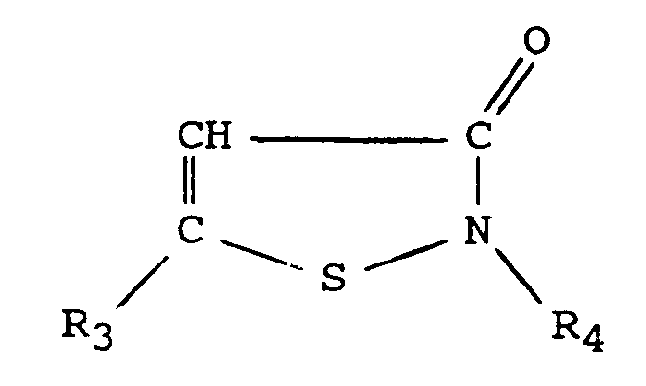
wherein R₃ stands for hydrogen or halogen and R₄ stands for hydrogen or alkyl, and complexes thereof.
wherein R₃ stands for hydrogen or halogen and R₄ stands for hydrogen or alkyl, and complexes thereof.
4. A composition according to any preceding claim, wherein the content of said 3-methyl-3-methoxybutyl
alcohol in said solvent is at least 60% by weight.
5. A composition according to any preceding claim, further comprising one or more germicide
selected from the group consisting of 4,5-dichloro-1,2-dithiole-3-one, 2,2-dibromo-3-nitrilepropionamide,
2,2-dibromo-2-nitroethanol, methylenebisthiocyanate, 1-chlorobenzaldoxime acetate
and bis(bromoacetoxy)butene.
6. A composition according to any preceding claim, wherein the solvent comprises one
or more auxiliary organic solvents.
1. Eine keimtötende Verbindung umfassend :
ein Lösungsmittel mit mindestens 50 Gew.% 3-Methyl-3- Methoxybutylalkohol und
eine in dem besagten Lösungsmittel aufgelöste Isothiazolonverbindung.
ein Lösungsmittel mit mindestens 50 Gew.% 3-Methyl-3- Methoxybutylalkohol und
eine in dem besagten Lösungsmittel aufgelöste Isothiazolonverbindung.
2. Eine Verbindung nach Anspruch 1, bei der die Isothiazolonverbindung in einer Menge
von 0,1-70 Gew.% vorhanden ist.
3. Eine Verbindung nach Anspruch 1 oder Anspruch 2, bei der die besagte Isothiazolonverbindung
mindestens eine Verbindung aus der der folgenden allgemeinen Formel
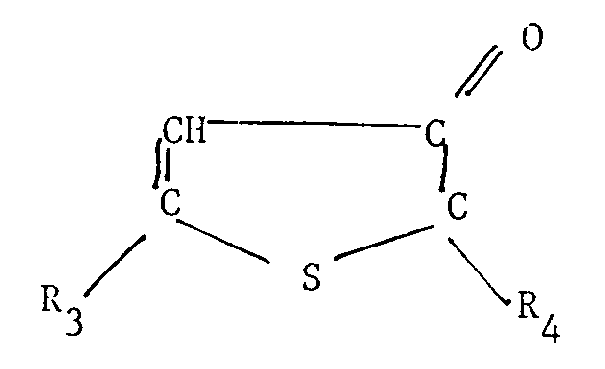
entsprechenden Gruppe ist, wobei R₃ für Wasserstoff oder Halogen und R₄ für Wasserstoff oder Alkyl und Komplexe davon steht.
entsprechenden Gruppe ist, wobei R₃ für Wasserstoff oder Halogen und R₄ für Wasserstoff oder Alkyl und Komplexe davon steht.
4. Eine Verbindung nach einem der vorstehenden Ansprüche, bei der der Anteil des besagten
3-Methyl-3- Methoxybutylalkohols in dem besagten Lösungsmittel mindestens 60 Gew.%
beträgt.
5. Eine Verbindung nach einem der vorstehenden Ansprüche, die des weiteren ein oder mehrere
keimtötende Verbindungen aus der 4,5-Dichlor- 1,2-Dithiol-3-on, 2,2-Dibrom-3-Nitrilpropionamid,
2,2-Dibrom-2-Nitroäthanol, Methylenbisthiocyanat, 1-Chlorbenzaldoximacetat und Bis(Bromacetoxy)Buten
umfassenden Gruppe enthält.
6. Eine Verbindung nach einem der vorstehenden Ansprüche, bei der das Lösungsmittel ein
oder mehr organische Zusatzlösungsmittel umfaßt.
1. Composition germicide comprenant:
un solvant contenant au moins 50% en poids d'alcool 3-méthyle-3-méthoxybutyl, et
un composé d'isothiazolone dissous dans ledit solvant.
un solvant contenant au moins 50% en poids d'alcool 3-méthyle-3-méthoxybutyl, et
un composé d'isothiazolone dissous dans ledit solvant.
2. Composition selon Revendication 1, dans laquelle le composé d'isothiazolone est présent
en proportion de 0,1-70% en poids.
3. Composition selon Revendication 1 ou Revendication 2, dans laquelle le composé d'isothiazolone
est au moins un composé choisi entre ceux qui sont représentés par la formule générale:
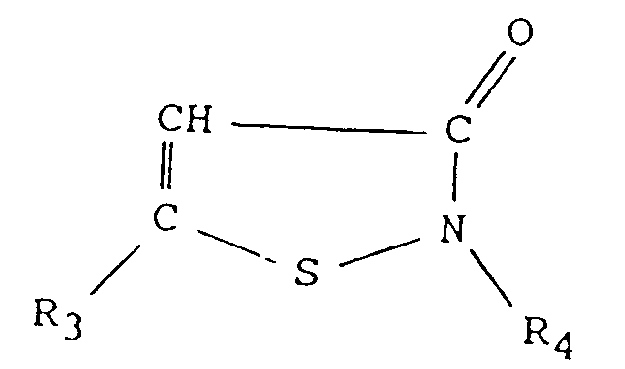
dans laquelle R₃ représente l'hydrogène ou un halogène et R₄ représente l'hydrogène ou un alkyle, et des composés de ces éléments.
dans laquelle R₃ représente l'hydrogène ou un halogène et R₄ représente l'hydrogène ou un alkyle, et des composés de ces éléments.
4. Composition selon l'une quelconque des revendications précédentes, où la teneur en
alcool 3-méthyle-3-méthoxybutyl dudit solvant est d'au moins 60% en poids.
5. Composition selon l'une quelconque des revendications précédentes, comprenant en outre
un ou plusieurs germicides choisis dans le groupe comprenant le 4,5-dichloro-1,2-
dithiol-3-one, le 2,2-dibromo-3-nitrilepropionamide, le 2,2-dibromo-2-nitroéthanol,
le méthylénébisthiocyanate, l'acétate de l-chlorobenzaldoxime et le bis(bromoacétoxy)butène.
6. Composition selon l'une quelconque des revendications précédentes, dans laquelle le
solvant comprend un ou plusieurs solvants organiques auxiliaires.