|
(11) | EP 0 411 702 B1 |

| (12) | EUROPEAN PATENT SPECIFICATION |
|
|
| (54) |
4-(2-methyl-2-hydroxypropyl-amino)-5,6-dihydrothieno-2(2,3-B)thiopyran-2-sulfonamide-7,7-dioxide 4-(2-Methyl-2-hydrooxypropylamino)-5,6-dihydrothieno-(2,3-B)thiopyran-2-sulfonamid-7,7-dioxid 4-(2-Méthyl-2-hydroxypropylamino)-5,6-dihydrothiéno-(2,3-B)thiopyrane-2-sulfonamide-7,7-dioxide |
|
|
|||||||||||||||||||||||||||||||
| Note: Within nine months from the publication of the mention of the grant of the European patent, any person may give notice to the European Patent Office of opposition to the European patent granted. Notice of opposition shall be filed in a written reasoned statement. It shall not be deemed to have been filed until the opposition fee has been paid. (Art. 99(1) European Patent Convention). |
SUMMARY OF THE INVENTION
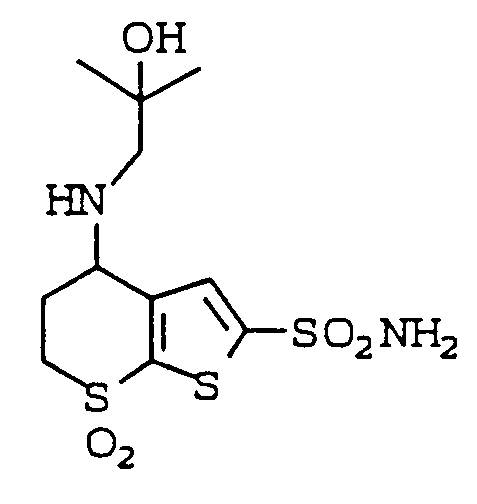
[0001] This invention relates to the novel compound of structural formula:
as well as the pharmaceutically and ophthalmologically acceptable salts thereof. This invention also relates to pharmaceutical compositions and the use thereof for systemic and ophthalmic use employing the novel compound of this invention as active ingredient for the manufacture of medicament for the treatment of elevated intraocular pressure, especially when accompanied by pathological damage such as in the disease known as glaucoma.
BACKGROUND OF THE INVENTION
[0002] Glaucoma is an ocular disorder associated with elevated intraocular pressures which are too high for normal function and may result in irreversible loss of visual function. If untreated, glaucoma may eventually lead to blindness. Ocular hypertension, i.e., the condition of elevated intraocular pressure without optic nerve head damage or characteristic glaucomatous visual field defects, is now believed by many ophthalmologists to represent the earliest phase of glaucoma.
[0003] Many of the drugs formerly used to treat glaucoma proved not entirely satisfactory. Indeed, few advances were made in the treatment of glaucoma since pilocarpine and physostigmine were introduced. Only recently have clinicians noted that many β-adrenergic blocking agents are effective in reducing intraocular pressure. While many of these agents are effective in reducing intraocular pressure, they also have other characteristics, e.g. membrane stabilizing activity, that are not acceptable for chronic ocular use. (S)-1-tert-Butylamino--[(4-morpholino-1,2,5-thiadiazol-3-yl)oxy]-2-propanol, a β-adrenergic blocking agent, was found to reduce intraocular pressure and to be devoid of many unwanted side effects associated with pilocarpine and, in addition, to possess advantages over many other β-adrenergic blocking agents, e.g. to be devoid of local anesthetic properties, to have a long duration of activity, and to display minimal tolerance.
[0004] Although pilocarpine, physostigmine and the β-blocking agents mentioned above reduce intraocular pressure, none of these drugs manifests its action by inhibiting the enzyme carbonic anhydrase and, thereby, impeding the contribution to aqueous humor formation made by the carbonic anhydrase pathway.
[0005] Agents referred to as carbonic anhydrase inhibitors block or impede this inflow pathway by inhibiting the enzyme, carbonic anhydrase. While such carbonic anhydrase inhibitors are now used to treat intraocular pressure by oral, intravenous or other systemic routes, they thereby have the distinct disadvantage of inhibiting carbonic anhydrase throughout the entire body. Such a gross disruption of a basic enzyme system is justified only during an acute attack of alarmingly elevated intraocular pressure, or when no other agent is effective. Despite the desirability of directing the carbonic anhydrase inhibitor only to the desired ophthalmic target tissue, no topically effective carbonic anhydrase inhibitors are available for clinical use.
[0006] However, topically effective carbonic anhydrase inhibitors are reported in U.S. Patents 4,386,098; 4,416,890; and 4,426,388. The compounds reported therein are 5 (and 6)-hydroxy-2-benzothiazolesulfonamides and acyl esters thereof.
[0007] More recently, U.S. Patents 4,677,115 and 4,797,413 and U.S. Application with Attorney Docket No. 17905 filed concurrently herewith describe topically effective carbonic anhydrase inhibitors which also are thieno[2,3-b]thiopyran-2-sulfonamides.
DETAILED DESCRIPTION OF THE INVENTION
[0008] The novel compound of this invention has structural formula:
or a pharmaceutically acceptable salt thereof.
[0009] The novel compound of this invention was originally isolated from rat urine and erythrocytes following chronic oral dosing with the compound of formula:
at dosage levels of 50 and 100 mg/kg/day. The compound was isolated from the biological matrix by selective solvent extraction under alkaline conditions and purified by repetitive HPLC techniques using different mobile phase conditions. The structure of the metabolite was tentatively assigned based upon derivatization reactions, chromatographic properties, NMR analyses and MS analysis. Unequivocal proof of structure was attained upon comparison of the aforementioned properties with those of the subsequently synthesized material (vide infra). Further studies with a homochiral reagent established that the major enantiomeric composition of the metabolite in the erythrocyte possessed the (+)-configuration. In addition, this metabolite has also been isolated and quantitated in rhesus monkey urine and erythrocytes following single and multiple dosing at doses of 2, 15 and 100 mg/kg/day.
[0010] The compound is synthesized by treatment of the unsubstituted amine with isobutylene oxide in a lower alkanol such as methanol in a closed system at 60-70°C for about 18 hours.
This invention is also concerned with formulations adapted for topical ocular administration in the form of solutions, gellable solutions, ointments, solid water soluble inserts or gels for the treatment of glaucoma and other stages of elevated intraocular pressure and contain about 0.1% to 15% by weight of medicament, especially about 0.5 to 2% by weight of medicament, the remainder being comprised of carriers and other excipients well known in the art.
[0011] The medicament in the novel topical ocular formulations comprises the novel compound of this invention either alone or in combination with a β-adrenergic blocking agent such as timolol maleate or a parasympathomimetic agent such as pilocarpine. In such combinations the two active agents are present in approximately equal amounts.
[0012] Such a medicament is useful in the treatment of elevated intraocular pressure. Of primary concern is the treatment by topical ocular administration of about 0.1 to 25 mg and especially 0.2 to 10 mg of such compound per day, either by single dose or on a 2 to 4 dose per day regimen.
EXAMPLE 1
Preparation of 4-(2-methyl-2-hydroxypropylamino)-5,6-dihydrothieno[2,3-b]-thiopyran-2-sulfonamide-7,7-dioxide hydrochloride
[0013] A suspension of racemic 4-amino-5,6-dihydrothieno[2,3-b]thiopyran-2-sulfonamide-7,7-dioxide (1.129 g, 4.0 mmol) in methanol (10 mℓ) containing isobutylene oxide (2.5 mℓ, 30 mmol) was sealed in a screw-top tube and warmed at 60-80°C for 18 hours. The cooled suspension was filtered giving nearly pure product (1.2 g). This material was chromatographed on silica gel and separated by gradient elution with 10-15% methanol/chloroform containing 1% ammonium hydroxide. The purified product (948 mg) was suspended in ethanol (10 mℓ) and treated with excess ethanolic HCl. This suspension was warmed to give a clear solution and upon cooling the racemic hydrochloride salt crystallized out (987 mg, 63% yield), mp 227-228°C decomposition.
Analysis calculated for C₁₁H₁₈N₂O₅S₃·HCl: N-7.17, C-33.79, H-4.90. Found: N-7.04, C-33.91, H-4.98.
EXAMPLE 2
[0014]
| Active ingredient | 1 mg | 15 mg |
| Monobasic sodium phosphate 2H₂O | 9.38 mg | 6.10 mg |
| Dibasic sodium phosphate .12H₂O | 28.48 mg | 16.80 mg |
| Benzalkonium chloride | 0.10 mg | 0.10 mg |
| Water for injection q.s. and. | 1.0 ml | 1.0 ml |
[0015] The novel compound, phosphate buffer salts, and benzalkonium chloride are added to and dissolved in water. The pH of the composition is adjusted to 6.8 and diluted to volume. The composition is rendered sterile by ionizing radiation.
EXAMPLE 3
EXAMPLE 4
[0019] Ophthalmic inserts are manufactured from compression molded films which are prepared on a Carver Press by subjecting the powdered mixture of the above ingredients to a compressional force of 5442 kg (12,000 lbs) (gauge) at 149°C (300°F) for one to four minutes.
[0020] The film is cooled under pressure by having cold water circulate in the platen. Ophthalmic inserts are then individually cut from the film with a rod-shaped punch. Each insert is placed into a vial, which is then placed in a humidity cabinet (88% R.H. at 30°C) for two to four days. After removal from the humidity cabinet, the vials are stoppered and then capped. The vials containing the hydrate insert are then autoclaved at 121°C (250°F) for 1/2 hour.
1. A compound of structural formula:
2. An ophthalmological formulation for the treatment of ocular hypertension comprising
an ophthalmologically acceptable carrier and an effective ocular antihypertensive
amount of a compound of Claim 1.
3. The use of the compound of Claim 1 for the manufacture of a medicament suitable for
treating elevated intraocular pressure.
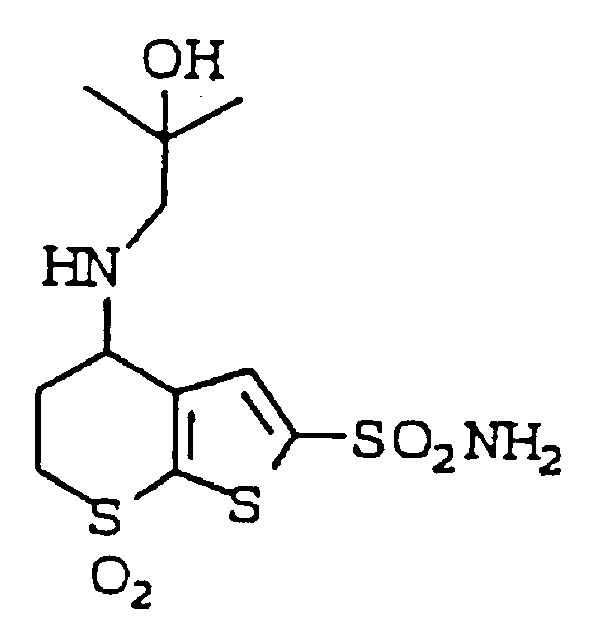
1. Verbindung der Strukturformel:
2. Ophthalmologische Rezeptur zur Behandlung von Augenüberdruck, umfassend einen ophthalmologisch
verträglichen Träger und eine wirksame, für das Auge antihypertensive Menge einer
Verbindung nach Anspruch 1.
3. Verwendung der Verbindung nach Anspruch 1 zur Herstellung eines Medikaments, das zur
Behandlung des erhöhten Augeninnendruckes geeignet ist.
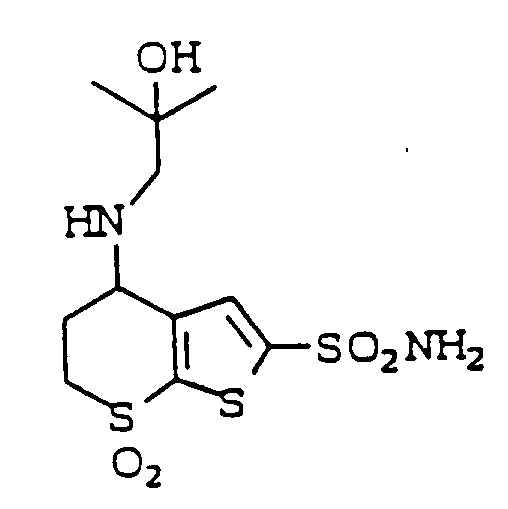
1. Composé de formule développée:
2. Formulation ophtalmologique pour le traitement de l'hypertension oculaire, comprenant
un véhicule acceptable en ophtalmologie et une quantité anti-hypertensive oculaire
efficace d'un composé de la revendication 1.
3. Utilisation du composé de la revendication 1 pour la fabrication d'un médicament capable
de traiter une pression intra-oculaire élevée.