|
(11) | EP 0 412 596 B1 |

| (12) | EUROPEAN PATENT SPECIFICATION |
|
|
| (54) |
Process for oxidising paraffinic compounds Verfahren zur Oxidation paraffinischer Verbindungen Procédé pour l'oxydation de composés paraffiniques |
|
|
|||||||||||||||||||||||||||||||
|
||||||||||||||||||||||||||||||||
| Note: Within nine months from the publication of the mention of the grant of the European patent, any person may give notice to the European Patent Office of opposition to the European patent granted. Notice of opposition shall be filed in a written reasoned statement. It shall not be deemed to have been filed until the opposition fee has been paid. (Art. 99(1) European Patent Convention). |
[0001] The present invention relates to a process for oxidising paraffinic compounds in order to yield the corresponding alcoholic and/or ketonic compounds, using H₂O₂ and,as the catalyst, a titanium-silicalite of formula
pHMO₂.qTiO₂.SiO₂
wherein
- M
- is a metal selected from among aluminium, gallium and iron,
- p
- is comprised within the range of from 0 to 0.05, including 0, and
- q
- is comprised within the range of from 0.0001 to 0.05,
[0002] It is known that paraffins are poorly reactive compounds and in order to functionalize them high temperatures or considerably strong reactants such as, e.g., ozone, trifluoroperacetic acid, chromic acid, permanganate are necessary. Of course, so severe conditions result in unsatisfactory selectivity values: the oxidation of, e.g., straight paraffins, with oxygen requires temperatures close to 150°C and leads to the formation of a complex mixture of products containing, among others, acids, ketones, alcohols and peroxides, some derivating from the fragmentation of the paraffinic compound (N.M. Emanuel, E.T. Denisov, Z.K. Maizus, "Liquid-Phase Oxidation of Hydrocarbons", Plenum Press, New York, 1967).
[0003] The oxidation of paraffinic compounds by means of hydrogen peroxide or of peroxy compounds in general is reported as well. It is carried out in the presence of metal complexes as catalysts. However, rather low yields are generally obtained, as referred to the peroxy reactant, owing to parallel reactions of decomposition to oxygen (J.T. Groves, G.A. McClusky, J.A.C.S. page 859, 1976; J.B. Vincent et al., J.A.C.S. page 6898, 1988; R.H. Fish et al., J.C.S. Chem. Commun. page 1504, 1988).
[0004] As the catalyst for the oxidation of paraffins with hydrogen peroxide generated in situ, also a zeolite of 5A type was used in the past, on which metal palladium and iron ion were deposited (N. Herron et al., J.A.C.S. page 2837, 1987). In this case too, the reaction yields are poor.
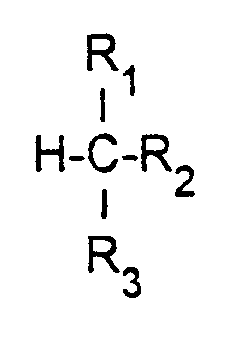
[0005] In EP-A-0376453 (date of publication of the application: 04.07.90), saturated hydrocarbon chains are oxidised using hydrogen peroxide and a titanium containing silicalite catalyst having an infra red absorption band around 950 cm⁻¹. Hydrogen peroxide is used in such an amount that the molar ratio of the starting saturated hydrocarbon to hydrogen peroxide is of from 0.5 to 1.5. The present Applicant has surprisingly found now that paraffinic compounds can be oxidised in order to yield the corresponding alcoholic and/or ketonic derivatives by means of hydrogen peroxide and operating at low temperatures, with high values of conversion and selectivity being achieved, as referred to both said reactants, using as catalyst a titanium silicalite having the general formula pHMO₂ . qTiO₂.SiO₂. The object of the instant invention is hence a Process for catalytically oxidising with hydrogen peroxide to corresponding alcohol and/or ketone derivatives, a paraffin compound having the general formula:
wherein:
R₁ and R₂ are selected from straight-chain C₁-C₂₀ alkyls, and branched or cyclic C₃-C₂₀ alkyls, or
R₁ and R₂ together can form a divalent radical closed on the C-atom linking them to generate a ring structure;
R₁ and R₂ being equal to, or different from one another and optionally additionally containing substituents selected from Cl, Br, I, F and nitro, amino, carbonyl, alkoxy, carboxy, carboxy ester, nitrile and amide groups, and
R₃ is hydrogen, or has the same meaning as R₁ or R₂,
the catalyst being a titanium silicalite having the general formula:
pHMO₂.qTiO₂.SiO₂
wherein:
M is a metal selected from Al, Ga and Fe;
p is within the range of from nil to 0.05, including nil, and
q is within the range of from 0.0001 to 0.05, preferably from 0.01 to 0.025,
characterized in that the molar ratio of the starting paraffin compound to the hydrogen peroxide is of from 0.5 to 100, preferably from 1 to 10, with the proviso that the 0.5 to 1.5 range is excluded whenever p in the titanium silicalite formula is zero.
[0006] The titanium-silicalites used as the catalysts in the process according to the present invention are disclosed in IT-A-1,207,519; IT-A-1,207,520; in US-A-4,666,692; US-A-4,410,501; US-A-4,701,428 and in IT-A-1,213,363 and IT-A-1,213,504.
[0007] The use of such catalysts in the process of hydroxylation of aromatic hydrocarbons (IT-A-1,150,699) and of epoxidation of olefinic compounds (IT-A-1,152,299), both carried out in the presence of hydrogen peroxide, was already described in the past.
[0008] Some specific examples of paraffinic compounds which can be oxidised by means of the method according to the present invention, are: propane, n-butane, isobutane, n-pentane, n-hexane, cyclohexane, chlorohexane, methyl heptanoate, amylonitrile, dodecane.
[0009] The reaction products obtained by means of the process according to the present invention are oxygen-containing compounds, deriving from the oxidation of substantially one single carbon atom of the paraffinc compound used as the starting compound. Therefore, monoalcohols or ketones or mixtures thereof are obtained -- depending on the paraffinic compound used as the starting compound and of the reaction conditions -- with a very good selectivity.
[0010] The process according to the present invention is carried out in practice by reacting the two reactants, i.e., the paraffin and hydrogen peroxide, in the presence of titanium-silicalite, at a temperature comprised within the range of from 0°C to 100°C, possibly in an autoclave, according to the nature of the paraffin and of the solvent.
[0011] The reaction takes place within a rather short time, and the reaction time is generally comprised within the range of from a few minutes to some hours, still depending on the other reaction parameters and of the nature of the paraffinic compound. Reaction times comprised within the range of from 10 minutes to 4 hours can be advantageously used.
[0012] The reaction can be carried out in a solventless system or in the presence of an inert solvent, either under the autogenous system pressure, or under room pressure, either batchwise or continuously, with the reaction products being separated from the effluent and any unconverted reactants being recycled to the reaction.
[0013] Suitable solvents for this process can be methanol, tert.-butyl alcohol, acetonitrile, acetone, water or mixtures thereof. In some cases, the product(s) from the oxidation reaction can be advantageously used as the solvent.
[0015] Hydrogen peroxide in used in aqueous solution at a concentration comprised within the range of from 1 to 70%, by weight/volume.
[0016] The following examples are supplied for the purpose of merely illustrating the invention, and in no way shall they be construed as being limitative of the same invention.
[0017] Examples from 1 to 3 describe the preparation of the catalysts useful in the process according to the present invention.
[0018] Examples 4, 8 and 9 illustrate the process according to the present invention, carried out by using the catalysts described in Examples 1 and 3.
[0019] Examples 5 to 7 are reported for comparative purposes, and do not fall within the scope of the present invention.
Example 1
[0021] A solution obtained by dissolving 230 g of tetraethyl titanate in 4,160 g of tetraethyl silicate is added with vigorous stirring to 7,250 g of a solution at 14%, of tetrapropylammonium hydroxide. The resulting mixture is kept with strong stirring until a single-phase, clear solution is obtained. Said solution is then diluted with 8,165 g of demineralized water.
[0022] The so obtained solution is charged to an autoclave and is kept heated 4 hours at 170°C under its autogenous pressure.
[0023] The reaction product is discharged from the autoclave, is centrifuged and the centrifugation cake is washed twice by being re-dispersed and centrifuged again. The centrifugation cake is calcined in air for 5 hours at 550°C, and at the end it, at the I.R. and R.X. analyses, shows to be a titanium-silicalite (TS-1), whose composition, in its calcined and anhydrous form, is the following:
0.023 TiO₂; SiO₂.
Example 2
[0024] 497 g of TiOCl₂ is dissolved in 26,350 g of an aqueous solution of tetrapropylammonium hydroxide (TPA/OH-) at 14% by weight, and 14,538 g of colloidal silica at 30% is added with vigorous stirring to said solution. The resulting mixture is heated to 60°C and is kept stirred at that temperature for about 2 hours; then 29,680 g of demineralized water is added and the resulting mixture is stirred for one further hour, still at 60°C.
[0025] The clear solution, having the following molar composition:
5 TPA-OH; TiO₂; 20 SiO₂; 800 H₂O
is charged to an autoclave equipped with stirring means, is heated to 170°C and is kept stirred at this temperature for a three-hours time.
[0026] The so obtained suspension, of milky appearance, containing in suspension zeolite microcrystals, is centrifuged and the centrifugation cake is washed by being redispered in water; the zeolite product is then totally recovered by means of a following centrifugation (3,500 g of titanium-silicalite).
[0027] In the mean time, 1,346 g of tetraethyl silicate is added with vigorous stirring to 1,437 g of solution at 12%, by weight of tetrapropylammonium hydroxide and the resulting mixture is heated 1 hour at 60°C. Then 5,890 g of demineralized water is added and the mixture is kept stirred for a further hour. A clear solution is so obtained, in which the previously prepared titanium-silicalite is carefully dispersed.
[0028] The resulting suspension of milky appearance is fed to a spray-dryer (a NIRO ATOMIZER disk drier; temperature of entering air 300°C; temperature of leaving air 120°C; chamber diameter 1.5 m), with compact microspheres being obtained, which have an average diameter close to 20 »m.
[0029] The atomized product is charged to a muffle under an N₂atmosphere and is heated up to 550°C. After a 2-hours stay at that temperature under an N₂ atmosphere, said atmosphere is gradually turned from N₂ into air, and the product is allowed to rest for a further 2 hours at 550°C in air. The so obtained catalyst has the following chemical composition, as mol ratio:
1 TiO₂; 43 SiO₂.
Example 3
[0030] 27 g of aluminium isopropylate is dissolved in 5400 g of solution at 18.7% by weight of tetrapropylammonium hydroxide. In a separate vessel, 230 g of tetraethyl orthotitanate is dissolved in 4160 g of tetraethyl silicate and this solution is added with stirring to the preceding one.
[0031] The resulting reaction mixture is heated up to 50-60°C, and is kept at this temperature, still with stirring, until a single-phase solution is obtained; 10,000 cc of water is then added.
[0032] The so obtained solution is charged to an autoclave and is heated, under its autogenous pressure, up to 170°C, then is kept 4 hours at this temperature.
[0033] The product is discharged from the autoclave, is centrifuged and the centrifugation cake is washed twice by re-dispersion and centrifugation. A portion of the washed centrifugation cake is calcined 5 hours in air at the temperature of 550°C, and at the end it is shown to be a zeolite having, in its anhydrous form, the following composition:
0.0081 Al₂O₃; 0.0250 TiO₂; SiO₂.
Example 4
[0034] 2.5 ml of distilled n-hexane and about 1.5 ml of H₂O₂ at 33% by w/v are dissolved in25 ml of solvent. The exact titre of hydrogen peroxide is determined by iodometric titration.
[0035] Then 0.5 g of catalyst of example 3 is added to the solution maintained at the controlled temperature of 55°C, and the resulting reaction mixture kept strongly stirred.
[0036] At regular time intervals, small aliquots of suspension are drawn in order to determine the concentration of hydrogen peroxide and the reaction products. The amounts of these latter are determined by gas-phase chromatography, by means of the method of the internal standard (2.3 m long glass column, packed with LAC 728 at 20% an Chromosorb, T = 100°C).
Examples 5-7 (comparative)
[0041] The catalyst constituted by a dispersion of TiO₂ on amorphous silica was obtained according to Example 1 of US-A-3,923,843.
[0042] The so obtained compounds are used according to the modalities as already disclosed in Example 4.
Example 8
[0044] 4 ml of n-hexane is added to a suspension of 0.5 g of catalyst prepared as disclosed in Example 1, in 25 ml of aqueous H₂O₂ at the concentration of 0.585 M, maintained at the controlled temperature of 56°C and kept stirred by means of a magnetic stirrer.
[0045] The titre of hydrogen peroxide is checked at regular time intervals, and after 120 minutes the reaction is discontinued. The liquid phase is homogenized by means of the addition of tert.-butyl alcohol and methanol, and the reaction products are then determined analogously to the preceding Examples.
[0046] The reaction products are constituted by 0.055 mmol of 2-hexanol, 2.02 mmol of 2-hexanone, 0.328 mmol of 3-hexanol, 1.34 mmol of 3-hexanone.
Example 9
[0049] 0.51 g of the catalyst prepared in Example 1 is added with stirring to 30 cc of this solution, kept at the temperature of 74°C. After 120 minutes the conversion of H₂O₂ results to be of 49%.
1. Process for catalytically oxidising with hydrogen peroxide to corresponding alcohol
and/or ketone derivatives, a paraffin compound having the general formula:
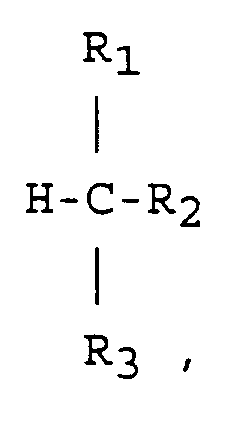
wherein:
R₁ and R₂ are selected from straight-chain C₁-C₂₀ alkyls, and branched or cyclic C₃-C₂₀ alkyls, or
R₁ and R₂ together can form a divalent radical closed on the C-atom linking them to generate a ring structure;
R₁ and R₂ being equal to, or different from one another and optionally additionally containing substituents selected from Cl, Br, I, F and nitro, amino, carbonyl, alkoxy, carboxy, carboxy ester, nitrile, and amide groups, and
R₃ is hydrogen, or has the same meaning as R₁ or R₂,
the catalyst being a titanium silicalite having the general formula:
pHMO₂.qTiO₂.SiO₂
wherein:
M is a metal selected from Al, Ga and Fe;
p is within the range of from nil to 0.05, including nil, and
q is within the range of from 0.0001 to 0.05,
characterized in that the molar ratio of the starting paraffin compound to the hydrogen peroxide is of from 0.5 to 100, with the proviso that the 0.5 to 1.5 range is excluded whenever p in the titanium silicalite formula is zero.
wherein:
R₁ and R₂ are selected from straight-chain C₁-C₂₀ alkyls, and branched or cyclic C₃-C₂₀ alkyls, or
R₁ and R₂ together can form a divalent radical closed on the C-atom linking them to generate a ring structure;
R₁ and R₂ being equal to, or different from one another and optionally additionally containing substituents selected from Cl, Br, I, F and nitro, amino, carbonyl, alkoxy, carboxy, carboxy ester, nitrile, and amide groups, and
R₃ is hydrogen, or has the same meaning as R₁ or R₂,
the catalyst being a titanium silicalite having the general formula:
pHMO₂.qTiO₂.SiO₂
wherein:
M is a metal selected from Al, Ga and Fe;
p is within the range of from nil to 0.05, including nil, and
q is within the range of from 0.0001 to 0.05,
characterized in that the molar ratio of the starting paraffin compound to the hydrogen peroxide is of from 0.5 to 100, with the proviso that the 0.5 to 1.5 range is excluded whenever p in the titanium silicalite formula is zero.
2. Process according to claim 1, characterized in that q, in the titanium silicalite
formula, is within the range of from 0.01 to 0.025.
3. Process according to claim 1 or 2, characterized in that the paraffin compound is
selected from among propane, butane, isobutane, n-pentane, n-hexane, cyclohexane,
chlorohexane, methyl heptanoate, amylonitrile and dodecane.
4. Process according to any of claims 1 to 3, characterized in that the oxidation is
carried out at temperatures within the range of from 0°C to 100°C.
5. Process according to claim 4, characterized in that the oxidation is carried out at
temperatures within the range of from 25°C to 70°C.
6. Process according to any of claims 1 to 5, characterized in that the oxidation is
carried out in the presence of a solvent selected from among methanol, tert.-butyl
alcohol, acetonitrile, acetone, water and mixtures thereof.
7. Process according to claim 6, characterized in that the product from the oxidation
reaction is used as the solvent.
8. Process according to any of claims 1 to 7, characterized in that the oxidation is
carried out under pressure.
9. Process according to any of claims 1 to 8, characterized in that the hydrogen peroxide
used has a concentration within the range of from 1 to 70% by weight/volume.
10. Process according to any of claims 1 to 9, characterized in that the molar ratio of
the paraffinic compound to hydrogen peroxide is selected from within the range of
from 1 to 10.
1. Verfahren zum katalytischen Oxidieren einer Paraffinverbindung mit der allgemeinen
Formel:
worin:
R₁ und R₂ unter geradkettigen C₁-C₂₀-Alkylresten und verzweigten oder cyclischen C₃-C₂₀-Alkylresten ausgewählt sind, oder
R₁ und R₂ gemeinsam einen zweiwertigen, am C-Atom geschlossenen Rest ausbilden können, das sie unter Ausbildung einer Ringstruktur verknüpft;
wobei R₁ und R₂ gleich oder voneinander verschieden sind und gegebenenfalls weitere Substituenten enthalten, ausgewählt unter Cl, Br, J, F und Nitro-, Amino-, Carbonyl-, Alkoxy-, Carboxy-, Carboxyester-, Nitril- und Amidgruppen, und
R₃ Wasserstoff bedeutet oder die gleiche Bedeutung wie R₁ oder R₂ hat,
mit Wasserstoffperoxid zu den entsprechenden Alkohol- und/oder Ketonderivaten, wobei der Katalysator ein Titansilicalit mit der allgemeinen Formel:
pHMO₂.qTiO₂.SiO₂
ist, worin:
M ein unter Al, Ga und Fe ausgewähltes Metall darstellt;
p im Bereich von Null bis 0,05 liegt und Null einschließt, und
q im Bereich von 0,0001 bis 0,05 liegt,
dadurch gekennzeichnet, daß das Molverhältnis der eingesetzten Paraffinverbindung zu Wasserstoffperoxid von 0,5 bis 100 beträgt, mit der Maßgabe, daß der Bereich 0,5 bis 1,5 ausgeschlossen ist, wenn p in der Titansilicalit-Formel den Wert Null aufweist.
worin:
R₁ und R₂ unter geradkettigen C₁-C₂₀-Alkylresten und verzweigten oder cyclischen C₃-C₂₀-Alkylresten ausgewählt sind, oder
R₁ und R₂ gemeinsam einen zweiwertigen, am C-Atom geschlossenen Rest ausbilden können, das sie unter Ausbildung einer Ringstruktur verknüpft;
wobei R₁ und R₂ gleich oder voneinander verschieden sind und gegebenenfalls weitere Substituenten enthalten, ausgewählt unter Cl, Br, J, F und Nitro-, Amino-, Carbonyl-, Alkoxy-, Carboxy-, Carboxyester-, Nitril- und Amidgruppen, und
R₃ Wasserstoff bedeutet oder die gleiche Bedeutung wie R₁ oder R₂ hat,
mit Wasserstoffperoxid zu den entsprechenden Alkohol- und/oder Ketonderivaten, wobei der Katalysator ein Titansilicalit mit der allgemeinen Formel:
pHMO₂.qTiO₂.SiO₂
ist, worin:
M ein unter Al, Ga und Fe ausgewähltes Metall darstellt;
p im Bereich von Null bis 0,05 liegt und Null einschließt, und
q im Bereich von 0,0001 bis 0,05 liegt,
dadurch gekennzeichnet, daß das Molverhältnis der eingesetzten Paraffinverbindung zu Wasserstoffperoxid von 0,5 bis 100 beträgt, mit der Maßgabe, daß der Bereich 0,5 bis 1,5 ausgeschlossen ist, wenn p in der Titansilicalit-Formel den Wert Null aufweist.
2. Verfahren nach Anspruch 1, dadurch gekennzeichnet, daß in der Titansilicalit-Formel
q im Bereich von 0,01 bis 0,025 liegt.
3. Verfahren nach Anspruch 1 oder 2, dadurch gekennzeichnet, daß die Paraffinverbindung
unter Propan, Butan, Isobutan, n-Pentan, n-Hexan, Cyclohexan, Chlorhexan, Methylheptanoat,
Amylonitril und Dodecan ausgewählt wird.
4. Verfahren nach einem der Ansprüche 1 bis 3, dadurch gekennzeichnet, daß die Oxidation
bei Temperaturen im Bereich von 0° bis 100°C ausgeführt wird.
5. Verfahren nach Anspruch 4, dadurch gekennzeichnet, daß die Oxidation bei Temperaturen
im Bereich von 25°C bis 70°C ausgeführt wird.
6. Verfahren nach einem der Ansprüche 1 bis 5, dadurch gekennzeichnet, daß die Oxidation
in Anwesenheit eines unter Methanol, tert.Butylalkohol, Acetonitril, Aceton, Wasser
und Gemischen hievon ausgewählten Lösungsmittels ausgeführt wird.
7. Verfahren nach Anspruch 6, dadurch gekennzeichnet, daß das Produkt aus der Oxidationsreaktion
als das Lösungsmittel verwendet wird.
8. Verfahren nach einem der Ansprüche 1 bis 7, dadurch gekennzeichnet, daß die Oxidation
unter Druck ausgeführt wird.
9. Verfahren nach einem der Ansprüche 1 bis 8, dadurch gekennzeichnet, daß das eingesetzte
Wasserstoffperoxid eine Konzentration im Bereich von 1 bis 70 % Gew./Vol. aufweist.
10. Verfahren nach einem der Ansprüche 1 bis 9, dadurch gekennzeichnet, daß das Molverhältnis
der Paraffinverbindung zu Wasserstoffperoxid im Bereich von 1 bis 10 gewählt wird.
1. Procédé d'oxydation par voie catalytique, avec du peroxyde d'hydrogène et en les dérivés
correspondants de type alcool et/ou cétone, d'un composé de type paraffine, de formule
générale
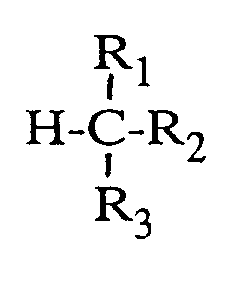
dans laquelle
R₁ et R₂ sont choisis parmi les groupes alkyle à chaîne droite en C₁₋₂₀ et les groupes alkyle à chaîne ramifiée ou cyclique en C₃₋₂₀, ou bien
R₁ et R₂ peuvent former conjointement un groupe divalent, refermé sur l'atome de carbone qui les relie, de façon à former une structure cyclique,
R₁ et R₂ étant identiques ou différents l'un de l'autre et portant en outre, le cas échéant, des substituants choisis parmi les atomes de chlore, de brome, d'iode et de fluor et les groupes nitro, amino, carbonyle, alcoxy, carboxy, carboxy estérifié, cyano et carbamyle, et
R₃ représente un atome d'hydrogène ou répond à la même définition que R₁ ou R₂,
le catalyseur utilisé étant une silicalite au titane de formule générale
pHMO₂.qTiO₂.SiO₂
dans laquelle
M représente un métal choisi parmi aluminium, gallium et fer,
p est un nombre valant de 0 à 0,05, y compris la valeur zéro, et
q est un nombre valant de 0,0001 à 0,05,
caractérisé en ce que le rapport molaire du composé de départ de type paraffine au peroxyde d'hydrogène vaut de 0,5 à 100,
sous réserve que l'intervalle allant de 0,5 à 1,5 soit exclu quand, dans la formule de la silicalite au titane, p vaut zéro.
dans laquelle
R₁ et R₂ sont choisis parmi les groupes alkyle à chaîne droite en C₁₋₂₀ et les groupes alkyle à chaîne ramifiée ou cyclique en C₃₋₂₀, ou bien
R₁ et R₂ peuvent former conjointement un groupe divalent, refermé sur l'atome de carbone qui les relie, de façon à former une structure cyclique,
R₁ et R₂ étant identiques ou différents l'un de l'autre et portant en outre, le cas échéant, des substituants choisis parmi les atomes de chlore, de brome, d'iode et de fluor et les groupes nitro, amino, carbonyle, alcoxy, carboxy, carboxy estérifié, cyano et carbamyle, et
R₃ représente un atome d'hydrogène ou répond à la même définition que R₁ ou R₂,
le catalyseur utilisé étant une silicalite au titane de formule générale
pHMO₂.qTiO₂.SiO₂
dans laquelle
M représente un métal choisi parmi aluminium, gallium et fer,
p est un nombre valant de 0 à 0,05, y compris la valeur zéro, et
q est un nombre valant de 0,0001 à 0,05,
caractérisé en ce que le rapport molaire du composé de départ de type paraffine au peroxyde d'hydrogène vaut de 0,5 à 100,
sous réserve que l'intervalle allant de 0,5 à 1,5 soit exclu quand, dans la formule de la silicalite au titane, p vaut zéro.
2. Procédé conforme à la revendication 1, caractérisé en ce que, dans la formule de la
silicalite au titane, q se situe dans l'intervalle allant de 0,01 à 0,025.
3. Procédé conforme à la revendication 1 ou 2, caractérisé en ce que le composé de type
paraffine est choisi parmi les propane, butane, isobutane, n-pentane, n-hexane, cyclohexane,
chlorohexane, heptanoate de méthyle, amylonitrile et dodécane.
4. Procédé conforme à l'une des revendications 1 à 3, caractérisé en ce que l'on effectue
l'oxydation à des températures situées dans l'intervalle allant de 0°C à 100°C.
5. Procédé conforme à la revendication 4, caractérisé en ce que l'on effectue l'oxydation
à des températures situées dans l'intervalle allant de 25°C à 70°C.
6. Procédé conforme à l'une des revendications 1 à 5, caractérisé en ce que l'on effectue
l'oxydation en présence d'un solvant choisi parmi le méthanol, l'alcool tertiobutylique,
l'acétonitrile, l'acétone, l'eau et leurs mélanges.
7. Procédé conforme à la revendication 6, caractérisé en ce que l'on utilise le produit
de la réaction d'oxydation en tant que solvant.
8. Procédé conforme à l'une des revendications 1 à 7, caractérisé en ce que l'on effectue
l'oxydation sous pression.
9. Procédé conforme à l'une des revendications 1 à 8, caractérisé en ce que la concentration
du peroxyde d'hydrogène utilisé se situe dans l'intervalle allant de 1 à 70 % en poids/volume.
10. Procédé conforme à l'une des revendications 1 à 9, caractérisé en ce que le rapport
molaire du composé de type paraffine au peroxyde d'hydrogène est choisi dans l'intervalle
allant de 1 à 10.