|
(11) | EP 0 413 192 B1 |

| (12) | EUROPEAN PATENT SPECIFICATION |
|
|
| (54) |
Method of making 1,1'-oxybis(3-nitro-5-Trifluoromethyl)benzene Verfahren zur Herstellung von 1,1'-Oxybis(3-nitro-5-trifluormethyl)benzol Procédé pour la préparation de 1,1'-oxybis(3-nitro-5-trifluorométhyl)benzène |
|
|
|||||||||||||||||||||||||||||||
| Note: Within nine months from the publication of the mention of the grant of the European patent, any person may give notice to the European Patent Office of opposition to the European patent granted. Notice of opposition shall be filed in a written reasoned statement. It shall not be deemed to have been filed until the opposition fee has been paid. (Art. 99(1) European Patent Convention). |
[0001] Disclosed is a method of making 1,1'-oxybis (3-nitro-5-trifluoromethyl)-benzene by heating 3,5-dinitro-benzotrifluoride. Also disclosed is the reduction of 1,1'-oxybis (3-nitro-5-trifluoromethyl)-benzene to 5,5'-oxybis (3-trifluoromethyl) benzamine.
[0002] In European Patent Application EP 90 11 4686.0, filed of even date by Occidental Chemical Corporation, titled "Novel Bis-M-Benzotrifluoride Compounds", there is described the novel compound 1,1'-oxybis (3-nitro-5-trifluoromethyl)-benzene (OBB), and the novel compound 5,5'-oxybis (3-trifluoromethyl)-benzamine, which is made by reducing OBB. The benzamine compound is useful in making polyimides, polyamides, polyamide-imides, and polyurethanes. Polyimides made using the benzamine compound have excellent electronic properties, particularly a high solubility in organic solvents and a low dielectric constant, which make them very useful in the electronics industries. In addition, they also have the properties that polyimides are noted for -- outstanding mechanical strength and excellent thermal and oxidative stability.
[0003] Patent Abstracts of Japan, Vol. 4, No. 54 (C-8) [536] page 18, Abstract 55-24125 (1980) provides an abstract of JP-A-53 96726 which discloses preparation of certain substituted diphenyl ethers by reacting Xn substituted nitrobenzene in the presence of an alkali metal salt or hydroxide in an organic aprotic polar solvent under specified conditions, wherein X is halogen, trihalomethyl, cyano, acyl, carbamoyl, nitro group, "etc." and n is an integer from 1 to 5.
[0004] It has been discovered that 1,1'-oxybis (3-nitro-5-trifluoromethyl)-benzene
can be made by heating 3,5-dinitrobenzotrifluoride with an alkali metal fluoride in an organic solvent in the presence of water.
[0005] That this reaction occurs is quite surprising because the activating groups, the two nitro groups and the single trifluoromethyl group on the 3,5-dinitrobenzotrifluoride, are not in the correct ring position for producing that product. That is, both nitro groups and trifluoromethyl groups are known to activate the ortho and para positions on the benzene ring, and, because they are meta in this compound, one would expect a poor reaction to occur even under harsh conditions. Actually, the reaction is a very good reaction and occurs under mild conditions (temperatures of less than 150°C).
[0006] The starting material for the process of this invention is a known and commercially available nitro benzotrifluoride compound having the formula:
where "X" is independently selected from NO₂, Cl, F, and mixtures thereof. In the preferred starting material "X" is NO₂, i.e., the compound is 3,5-dinitrobenzotrifluoride, because that compound is more readily available and NO₂ is a better leaving group.
[0007] In the preparation of 1,1'-oxybis(3-nitro-5-trifluoromethyl) benzene, according to this invention, the nitrobenzotrifluoride compound is heated in the presence of water with an alkali metal fluoride which can be potassium fluoride, cesium fluoride, or a mixture thereof; potassium fluoride is preferred as it is less expensive. Any organic solvent that will dissolve the starting material can be used, preferably at 10 to 50% solids. Examples of suitable solvents include dimethyl formamide, dimethyl acetamide, N-methyl pyrrolidinone, sulfolane, methyl sulfone, dimethyl sulfoxide, and methyl sulfoxide. Amide solvents are preferred, and dlmethyl formamide in particular is preferred, as it is inexpensive and is easy to purify and remove. At least 1/2 equivalent of water, based on the amount of the OBB, should be used. The reaction mixture is heated to a temperature of 140 to 210°C and the reaction can be followed on a gas chromatograph to determine when it is complete. Depending on the temperature, the reaction takes 1 to 24 hours. The product can be isolated by distilling off the solvent, extracting the product from water, and crystallizing. A yield greater than 50% can be expected.
[0008] The corresponding benzamine compound, 5,5'-oxybis (3-trifluoromethyl)-benzamine, can be prepared by reducing the two nitro groups on OBB to amine groups. The reduction reaction is a relatively simple reaction which can be performed in the presence of a reducing agent, such as a mixture of 10 to 50% by weight Fe⁺³ and 1 to 20% by weight HCl. Other useful reducing agents include palladium, ammonium sulfide, hydrazine, etc.
[0009] The benzamine compound is useful in making polyimides, polyamide-imides, and polyamides. The polyimides can be prepared by well-known reactions of diamines with dianhydrides or tetracarboxylic acids, substituting the benzamine of this invention for a diamine that would otherwise be used. Further information on those reactions can be found in the co-pending European Patent Application EP 90 11 4686.0.
EXAMPLE 1
[0011] To a 500 ml round bottom flask was charged 3,5-dinitrobenzotrifluoride (25.1 g.), potassium fluoride (21.2 g.), water (2.4 ml.), and dimethylformamide (DMF, 125 ml.). The reaction was heated to 160°C for 24 hours. The reaction mixture was diluted with water (400 ml.) and extracted with ether (3 times with 150 ml.). The ether was dried with magnesium sulfate and cooled to 5°C. The solid was collected and hexane added to the filtrate until the filtrate was cloudy. The filtrate was cooled to 5°C and the resulting solid collected to give a total of 11.3 g (53.8% yield) of the desired 1,1-oxybis(3-nitro-5-trifluoromethyl)benzene.
Example 2
[0012] The following experiment was conducted to determine if the other leaving groups could be used in place of nitro for the preparation of 1,1-oxybis(3-nitro-5-trifluoromethyl)benzene. To a solution of 3-fluoro-5-nitrobenzotrifluoride, isolated by distillation from the mother liquor of Example 1, in DMF (5 ml.) was added potassium fluoride (0.7 g.). The suspension was heated to 150°C and 2 drops of water were added. The reaction progress was monitored by gas chromatography (GC). After 7 hours, GC analysis indicated that a 0.17:1 mixture of 1,1-oxybis(3-nitro-5-trifluoromethyl)benzene to the starting fluoride had been obtained. This ratio increased to 2.1:1 after heating for 17.5 hours.
1. A method of making 1,1'-oxybis (3-nitro-5-trifluoromethyl)-benzene comprising heating
a nitro-benzotrifluoride compound having the formula
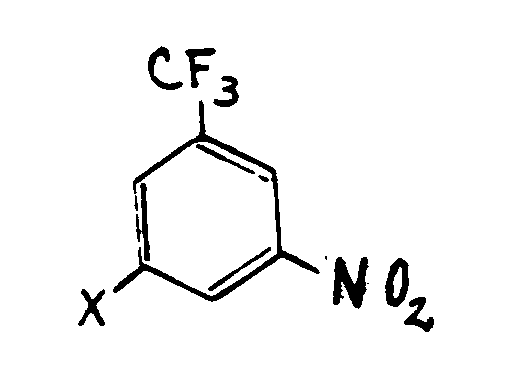
where "X" is independently selected from the group consisting of NO₂, Cl, F, and mixtures thereof, with an alkali metal fluoride selected from the group consisting of potassium fluoride, cesium fluoride, and mixtures thereof in an organic solvent in the presence of water.
where "X" is independently selected from the group consisting of NO₂, Cl, F, and mixtures thereof, with an alkali metal fluoride selected from the group consisting of potassium fluoride, cesium fluoride, and mixtures thereof in an organic solvent in the presence of water.
2. A method according to Claim 1 wherein X is NO₂.
3. A method according to Claim 1 or 2 wherein said alkali metal fluoride is potassium
fluoride.
4. A method according to any one of claims 1 to 3 wherein said nitro benzotrifluoride
is heated at a temperature of 140 to 210°C.
5. A method according to any one of claims 1 to 4 wherein said organic solvent is an
amide.
6. A method according to Claim 5 wherein said organic solvent is dimethyl formamide.
7. A method according to Claim 1 including the additional last step of distilling off
said organic solvent and crystallizing said 1,1'-oxybis (3-nitro-5-trifluoromethyl)-benzene.
8. A method according to Claims 1 to 5 wherein at least ½ equivalent of water, based
on the amount of said 1,1'-oxybis (3-nitro-5-trifluoromethyl)-benzene is present.
9. A method of making 5,5'-oxybis(3-trifluoromethyl)-benzamine comprising preparing 1,1'-oxybis
(3-nitro-5-trifluoromethyl)-benzene according to Claim 1 and thereafter reducing it
to 5,5'-oxybis (3-trifluoromethyl)-benzamine.
10. A method according to Claim 9 wherein said reduction is performed by heating in the
presence of 10 to 50% by weight Fe⁺³ and 1 to 20% by weight HCl.
11. A method according to Claim 9 wherein "X" is NO₂.
1. Verfahren zur Herstellung von 1,1'-Oxybis-(3-nitro-5-trifluormethyl)-benzol, umfassend
Erhitzen einer Nitrobenzotrifluoridverbindung der Formel
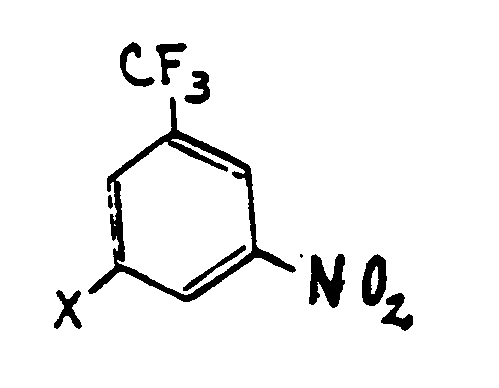
in der "X" eine NO₂-Gruppe, ein Chlor- oder Fluoratom bedeutet, und Gemischen davon, mit einem Alkalimetallfluorid, ausgewählt aus Kaliumfluorid, Cäsiumfluorid und Gemischen davon, in einem organischen Lösungsmittel in Gegenwart von Wasser.
in der "X" eine NO₂-Gruppe, ein Chlor- oder Fluoratom bedeutet, und Gemischen davon, mit einem Alkalimetallfluorid, ausgewählt aus Kaliumfluorid, Cäsiumfluorid und Gemischen davon, in einem organischen Lösungsmittel in Gegenwart von Wasser.
2. Verfahren nach Anspruch 1, wobei X eine NO₂-Gruppe bedeutet.
3. Verfahren nach Anspruch 1 oder 2, wobei das Alkalimetallfluorid Kaliumfluorid ist.
4. Verfahren nach einem der Ansprüche 1 bis 3, wobei das Nitrobenzotrifluorid bei einer
Temperatur von 140 bis 210°C erhitzt wird.
5. Verfahren nach einem der Ansprüche 1 bis 4, wobei das organische Lösungsmittel ein
Amid ist.
6. Verfahren nach Anspruch 5, wobei das organische Lösungsmittel Dimethylformamid ist.
7. Verfahren nach Anspruch 1, einschließlich des zusätzlich letzten Schrittes, nämlich
Abdestillieren des organischen Lösungsmittels und Kristallisieren des 1,1'-Oxybis-(3-nitro-5-trifluormethyl)-benzols.
8. Verfahren nach einem der Ansprüche 1 bis 5, wobei mindestens 1/2 Äquivalent Wasser,
bezogen auf die Menge des 1,1'-Oxybis-(3-nitro-5-trifluormethyl)-benzols vorliegt.
9. Verfahren zur Herstellung von 5,5'-Oxybis-(3-trifluormethyl)-benzamin, umfassend die
Herstellung von 1,1'-Oxybis-(3-nitro-5-trifluormethyl)-benzol nach Anspruch 1 und
anschließend Reduktion zu 5,5'-Oxybis-(3-trifluormethyl)-benzamin.
10. Verfahren nach Anspruch 9, wobei die Reduktion durch Erhitzen in Gegenwart von 10
bis 50 Gew.-% Fe⁺³ und 1 bis 20 Gew.-% HCl ausgeführt wird.
11. Verfahren nach Anspruch 9, wobei "X" eine NO₂-Gruppe bedeutet.
1. Procédé pour la préparation de 1,1'-oxybis(3-nitro-5-trifluorométhyl)benzène comprenant
le chauffage d'un composé nitrobenzotrifluoré ayant la formule :
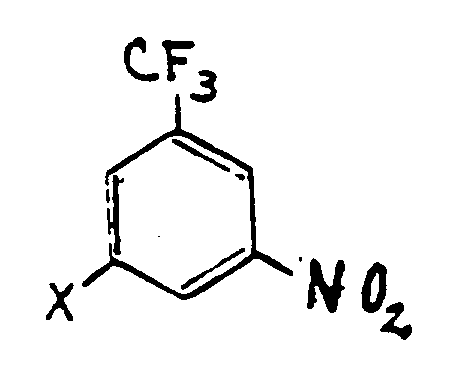
où
X est indépendamment choisi parmi le groupe consistant en NO₂, Cl, F et des mélanges de ceux-ci, avec un fluorure de métal alcalin choisi parmi le groupe consistant en fluorure de potassium, fluorure de césium et des mélanges de ceux-ci dans un solvant organique en présence d'eau.
où
X est indépendamment choisi parmi le groupe consistant en NO₂, Cl, F et des mélanges de ceux-ci, avec un fluorure de métal alcalin choisi parmi le groupe consistant en fluorure de potassium, fluorure de césium et des mélanges de ceux-ci dans un solvant organique en présence d'eau.
2. Procédé suivant la revendication 1, où X est NO₂.
3. Procédé suivant la revendication 1 ou 2, où le fluorure de métal alcalin est le fluorure
de potassium.
4. Procédé suivant l'une quelconque des revendications 1 à 3, où le nitrobenzotrifluorure
est chauffé à une température de 140 à 210°C.
5. Procédé suivant l'une quelconque des revendications 1 à 4, où le solvant organique
est un amide.
6. Procédé suivant la revendication 5, où le solvant organique est le diméthylformamide.
7. Procédé suivant la revendication 1, comprenant l'étape finale additionnelle de distillation
du solvant organique et de recristallisation du 1,1'-oxybis(3-nitro-5-trifluorométhyl)benzène.
8. Procédé suivant les revendications 1 à 5, où au moins 0,5 équivalent d'eau, sur base
de la quantité d'1,1'-oxybis(3-nitro-5-trifluorométhyl)benzène est présent.
9. Procédé pour la préparation de 5,5'-oxybis(3-trifluorométhyl)benzamine comprenant
la préparation du 1,1'-oxybis(3-nitro-5-trifluorométhyl)benzène suivant la revendication
1 et ensuite réduction de celui-ci en 5,5'-oxybis(3-trifluorométhyl)benzamine.
10. Procédé suivant la revendication 9, où la réduction est réalisée par chauffage en
présence de 10 à 50% en poids de Fe⁺³ et de 1 à 20% en poids d'HCl.
11. Procédé suivant la revendication 9, où X est NO₂.