|
(11) | EP 0 415 524 A1 |

| (12) | EUROPEAN PATENT APPLICATION |
|
|
|
|
|||||||||||||||||||||||||||
| (54) | Process for the production of 2-halomethyl-6-methoxy naphthalene |
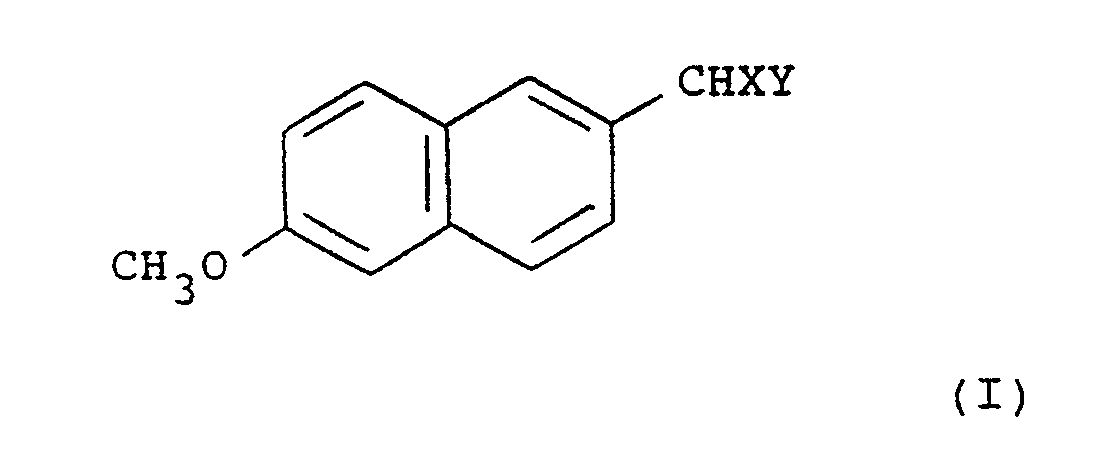
| (57) A process for the preparation of a compound of formula (I):
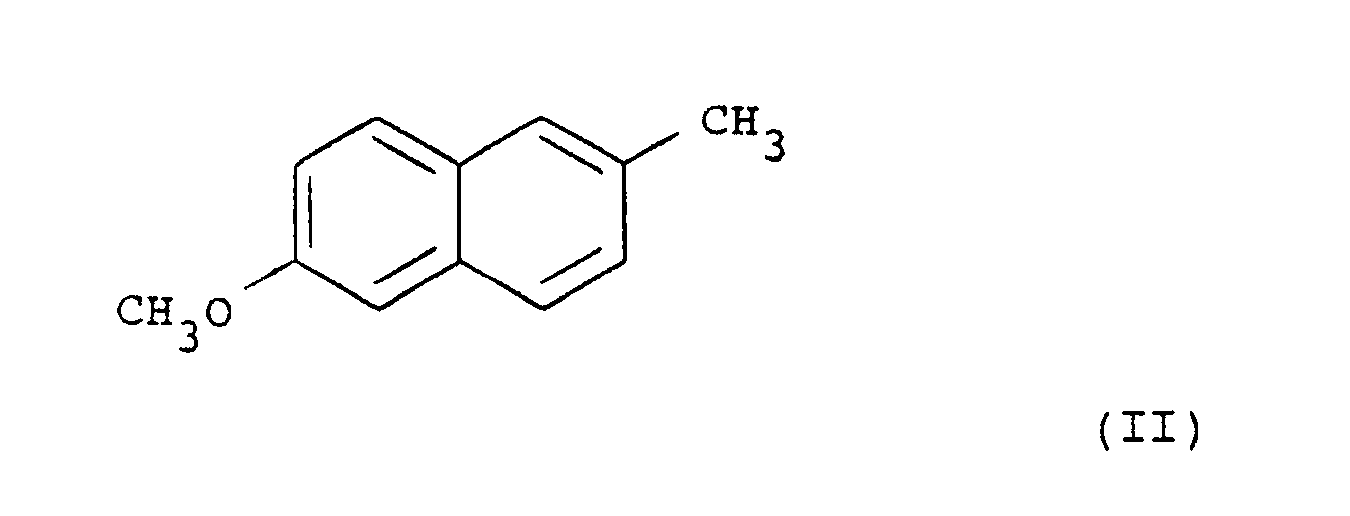
in which X and Y are identical and represent halogen, or X is halogen and Y is hydrogen, which comprises halogenating 2-methyl-6-methoxynaphthalene, of formula (II): in the presence of a free radical initiator. |
[0001] This invention relates to a novel process for preparing an intermediate compound useful for preparing 4-(6′-methoxy-2′-naphthyl)butan-2-one (hereinafter referred to as nabumetone).
[0002] US Patent 4420639 describes nabumetone and its use in the treatment of rheumatic and arthritic conditions. A number of processes for preparing the compound are also described in the Patent, one of which proceeds via the intermediate 6-methoxy-2-naphthaldehyde, of formula (A):
[0003] The intermediate of formula (A) may itself be prepared by treating a 6-methoxy-2-halomethyl naphthaldehyde of formula (B):
with hexamine in aqueous acetic acid (the Sommelet reaction).
[0004] A novel process for the preparation of compounds of formula (B), together with dihalo analogues thereof, has now been devised which utilises free radical catalysed halogenation of a 2-methyl precursor.
[0005] According to the present invention, there is provided a process for the preparation of a compound of formula (I):
in which X and Y are identical and represent halogen, or X is halogen and Y is hydrogen, which comprises halogenating 2-methyl-6-methoxynaphthalene, of formula (II):
in the presence of a free radical initiator.
[0006] The process is preferably carried out in an inert solvent such as carbon tetrachloride and at temperatures from ambient to reflux , preferably reflux.
[0008] In order to carry out the halogenation reaction, a conventional halogenating agent may be used, and examples of these are N-halosuccinimide; 1,3-dihalo-5,5-dimethylhydantoin and free halogen. When the halogen is bromine, the preferred halogenating agent is N-bromosuccinimide.
[0009] Examples of free radical initiators include benzoyl peroxide, azoisobutyronitrile and UV light, and the preferred initiator is azoisobutyronitrile.
[0010] It has been found advantageous to add a major proportion (ca. 80%) of the free radical initiator to the compound of formula (II) prior to treatment with the halogenating agent, and then to add the halogenating agent together with the remainder of the initiator. The addition of halogenating agent is preferably carried out gradually over a period of up to 3 hours, so as to prevent the occurence of ring halogenation.
[0011] In a preferred aspect of the process of the invention, an excess of halogenating agent is employed in order to obtain maximum yield of the di-halo compound of formula (I) (where X and Y are both halo-), which is more easily converted to the compound of formula (A) than is the mono-halo compound of formula (I). By excess, it is meant a molar ratio of N-bromosuccinimide to 2-methyl-6-methoxynaphthalene of >1:1. For example, a favourable yield of the 2-dibromo compound of formula (I) can be obtained by using a molar ratio of N-bromo succinimide to 2-methyl-6-methoxynaphthalene of about 2:1.
[0012] As mentioned above, compounds of formula (I) in which X is halogen and Y is hydrogen may be converted to the compound of formula (A) using the Sommelet reaction. However, the conversion may also be carried out using base catalysed hydrolysis to the hydroxy methyl intermediate, followed by oxidation to the aldehyde, or by reaction with dimethyl sulphoxide. Compounds of formula (I) in which X and Y are both halogen may be converted to the compound of formula (A) by hydrolysis such as by treatment with aqueous acetone.
[0013] Accordingly, in a further aspect of the invention, a process for preparing 6-methoxy-2-naphthaldehyde comprises halogenating a compound of formula (II), as hereinbefore defined, in the presence of a free radical initiator, and subsequently converting the compound of formula (I) thereby produced to 6-methoxy-2-naphthaldehyde.
[0014] Compounds of formula (I) in which X is halogen and Y is hydrogen are known. For example, they are disclosed in the aforementioned US Patent. However, compounds of formula (I) in which X and Y are both halogen are novel, and these form a further aspect of the invention.
[0015] The compound of formula (II) is itself known, but may conveniently be prepared by treating the known compound 6-methyl-2-naphthol with dimethyl sulphate in conventional manner.
Example 1
2-Bromomethyl-6-methoxynaphthalene
[0017] A solution of 2-methyl-6-methoxynaphthalene (4.1g, 23.8mmole) and azoisobutyronitrile (80mg) in dry carbon tetrachloride (30ml) was heated to reflux with stirring. A slurry of N-bromosuccinimide (4.6g, 25.8mmole) and azoisobutyronitrile (20mg) in dry carbon tetrachloride (10ml) was added gradually over 2 hours. The resulting solution was heated under reflux for 30 minutes and then cooled to 35oC. The succinimide was filtered off and washed with carbon tetrachloride (5ml). The filtrate was evaporated to dryness to afford a creamy coloured solid which was dried under vacuum at 40oC. It weighed 5.8g and contained 70.3% 2-bromomethyl-6-methoxynaphthalene giving an activity yield of 69.5%.
Example 2
2-Dibromomethyl-6-methoxynaphthalene
[0018] A solution of 2-methyl-6-methoxynaphthalene (4.1g, 23.8mmole) and azoisobutyronitrile (80mg) in dry carbon tetrachloride (30ml) was heated to reflux with stirring. A slurry of N-bromosuccinimide (8.65g, 48.6mmole) and azoisobutyronitrile (40mg) in dry carbon tetrachloride (15ml) was added gradually over 2.5 hours. The resulting mixture was heated under reflux for 30 minutes and then cooled to 35oC. The succinimide was filtered off and washed with carbon tetrachloride (35ml). The filtrate plus washings were cooled to 20oC and extracted with water (2 x 15ml). The organic phase was dried (MgSO₄), filtered and the filtrate evaporated to dryness. The resulting beige solid was recrystallised from dry carbon tetrachloride at +5oC as cream coloured needles of 2-dibromomethyl-6-methoxynaphthalene. The dried compound weighed 4g, 52% weight yield, and gave a melting point of 116oC (darkening).
Example 3
Conversion of 2-bromomethyl-6-methoxynaphthalene to 6-Methoxynaphthaldehyde (Sommelet reaction conditions)
[0019] A mixture of 2-bromomethyl-6-methoxynaphthalene (12.68g), hexamine (14g), glacial acetic acid (21ml) and water (21ml) were heated under reflux with stirring for 30 minutes. Concentrated hydrochloric acid (16.6ml) was then added and the mixture stirred and refluxed for a further 15 minutes. The reaction was cooled to room temperature and extracted with toluene (2 x 25ml). The combined toluene extracts were washed with water (2 x 10ml), saturated sodium bicarbonate solution (2 x 10 ml) and water (1 x 8ml) and the toluene solution dried over MgSO₄. The drying agent was filtered off and the solvent was removed by distillation under vacuum. This afforded 8.6g of crude product which was recrystallised twice from isopropanol (2 x 50ml) to give 6.07g of 97.8% purity 2-methoxynaphthaldehyde as a light beige solid. The material had a melting point of 79.2oC.
Example 4
Hydrolysis of 2-dibromomethyl-6-methoxynaphthalene to 6-methoxynaphthaldehyde
[0020] A solution of 2-dibromomethyl-6-methoxynaphthalene (3g) in acetone (25ml) was treated with water (7ml) and the mixture stirred at 24oC for 10 hours. The solvent was removed under vacuum and the residue dissolved in toluene (30ml). The toluene solution was washed with saturated sodium bicarbonate solution (2 x 10ml) and water (10ml) and dried over MgSO₄. The dried solution was filtered and the filtrate evaporated down to a yellowish-brown semi-solid. This was recrystallised twice from isopropanol (2 x 10ml) to give 0.5g of pure 2-methoxynaphthaldehyde as confirmed using HPLC (conditions; spheresorb C₁₈ 25cm x 4.5mm i.d. (column), 65% acetonitrile/35% water (eluent), 1ml/min (flowrate), 310nm (wavelength). The samples were dissolved in acetonitrile and 20µl injected onto the column. The retention time for 2-methoxynaphthaldehyde was about 6 minutes.
1. A process for the preparation of a compound of formula (I):
in which X and Y are identical and represent halogen, or X is halogen and Y is hydrogen, which comprises halogenating 2-methyl-6-methoxynaphthalene, of formula (II):
in the presence of a free radical initiator.
in which X and Y are identical and represent halogen, or X is halogen and Y is hydrogen, which comprises halogenating 2-methyl-6-methoxynaphthalene, of formula (II):
in the presence of a free radical initiator.
2. A process according to claim 1 wherein the halogenating agent is an N-halosuccinimide,
1,3-dihalo-5-5-dimethylhydantoin or free halogen.
3. A process according to claim 2, wherein the halogenating agent is N-bromosuccinimide.
4. A process according to any one of claims 1 to 3, wherein the free radical initiator
is benzoyl peroxide, azoisobutyronitrile or UV light.
5. A process according to any one of claims 1 to 4, wherein the addition of halogenating
agent is carried out gradually over a period of up to 3 hours.
6. A process according to any one of claims 1 to 5, wherein an excess of halogenating
agent is employed.
7. A process for preparing 6-methoxy-2-naphthaldehyde, which comprises halogenating
a compound of formula (II), as defined in claim 1, in the presence of a free radical
initiator, and subsequently converting the compound of formula (I), as defined in
claim 1, thereby produced to 6-methoxy-2-naphthaldehyde.
8. A process according to claim 7, in which a compound of formula (I) wherein X is
halogen and Y is hydrogen is converted to 6-methoxy-2-naphthaldehyde using either
the Sommelet reaction or base catalysed hydrolysis followed by oxidation.
9. A process according to claim 7, in which a compound of formula (I), as defined
in claim 1, wherein X and Y are identical and represent halogen is converted to 6-methoxy-2-naphthaldehyde
by hydrolysis.
10. A compound of formula (I) as defined in claim 1 in which X and Y are both halogen.