|
(11) | EP 0 415 540 A1 |

| (12) | EUROPEAN PATENT APPLICATION |
|
|
|
|
|||||||||||||||||||||||||||
| (54) | Antimicrobial rinse cycle additive |
| (57) A method of treating fabrics in order to eliminate odor caused by microbial growth
by adding an antibacterially effective amount of an organosilicon quaternary ammonium
compound to the rinse cycle of a textile laundering operation containing the fabrics
in order to destroy bacteria and fungi. The organosilicon quaternary ammonium compound
is the silane 3-(trimethoxysilyl) propyldimethyloctadecyl ammonium chloride of the
formula
|
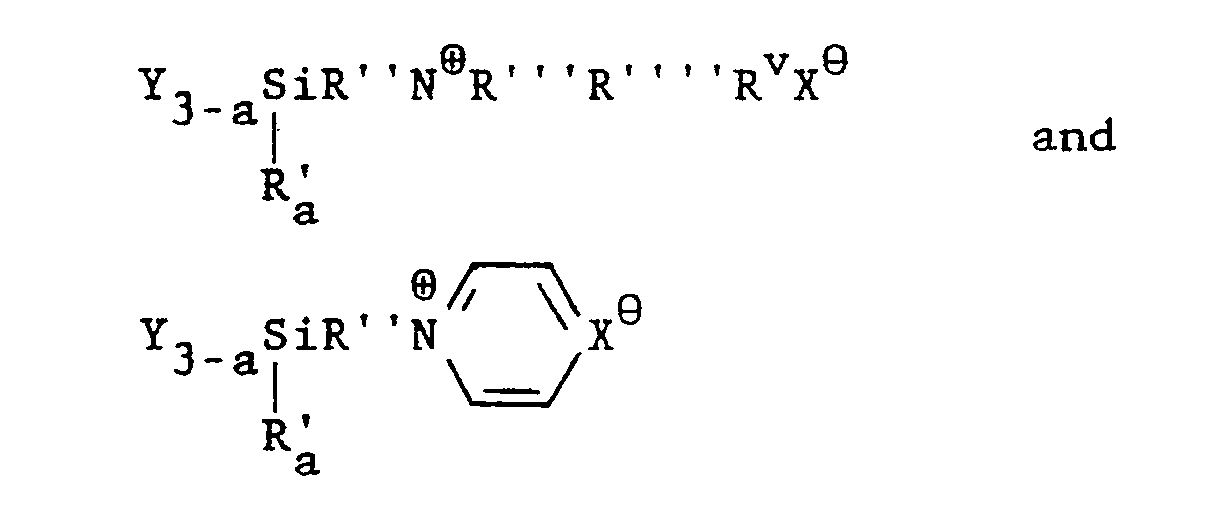
[0001] This invention relates to a method of treating fabrics in order to eliminate odor caused by microbial growth by adding an antibacterially effective amount of an organosilicon quaternary ammonium compound to the rinse cycle of a textile laundering operation containing the fabrics in order to destroy bacteria and fungi, the organosilicon quaternary ammonium compound being an organosilane having the formula selected from the group consisting of
wherein, in each formula,
Y is R or RO where each R is an alkyl radical of 1 to 4 carbon atoms or hydrogen;
a has a value of 0, 1 or 2;
R′ is a methyl or ethyl radical;
R˝ is an alkylene group of 1 to 4 carbon atoms;
R‴, R˝˝ and Rv are each independently selected from a group consisting of alkyl radicals of 1 to 18 carbon atoms, -CH₂C₆H₅, -CH₂CH₂OH, -CH₂OH and -(CH₂)xNHC(O)Rvi, wherein x has a value of from 2 to 10 and Rvi is a perfluoroalkyl radical having from 1 to 12 carbon atoms; and
X is chloride, bromide, fluoride, iodide, acetate or tosylate.
[0002] In one embodiment, the treatment can be applied in the form of an emulsion including water, the silane and a water immiscible liquid which is a polysiloxane selected from the group consisting of polysiloxanes having the general formula
R′₃SiO(R˝₂SiO)w(R‴QSiO)zSiR₃ and (R′R˝SiO)y wherein R′ is an alkyl radical of 1 to 3 carbon atoms, phenyl, an alkoxy radical having the formula R˝˝O-, wherein R˝˝ is an alkyl radical of 1 to 4 carbon atoms or hydrogen; R˝ is an alkyl radical of 1 or 2 carbon atoms or the phenyl group; R‴ has the same meaning as R˝; Q is a substituted or unsubstituted radical composed of carbon and hydrogen, or carbon, hydrogen and oxygen, or carbon, hydrogen and sulfur, or carbon, hydrogen and nitrogen; w has a value of from 1 to 500; z has a value of 1 to 25 and y has a value of 3 to 5
[0003] In some other more specific embodiments of the present invention, the organosilane can be added to the rinse cycle in the amount of from 0.001 to 0.025 percent by weight based on the weight of the fabrics. The organosilane may be added to the rinse cycle in the form of a solution in methanol containing about forty-two percent by weight of the organosilane active ingredient; in the form of a solution in methanol containing about seventy-two percent by weight of the organosilane active ingredient; in the form of a solution in propylene glycol containing about sixty-five percent by weight of the organosilane active ingredient; in the form of an emulsion containing the organosilane active ingredient as noted above; or in the form of a microemulsion containing the organosilane active ingredient.
[0004] The organosilane may be added to the rinse cycle in in any of the above forms in a sequential series of incremental steps which are conducted until the additive effect of the organosilane deposit on the fabrics reaches an amount approximating 0.025 percent by weight of the organosilane active ingredient based on the weight of the fabrics.
[0005] In a preferred emobodiment, the organosilane is added to the rinse cycle in admixture with an organic quaternary ammonium compound, the organosilane and the organic quaternary ammonium compound being added to the rinse cycle in an amount of about 0.01 percent by weight of the admixture based on the weight of the fabrics. In this embodiment, the organosilane and the organic quaternary ammonium compound are each present in the admixture in approximately equal amounts by weight. In this embodiment, a synergistic effect is achieved in employing both the organosilane and the organic quaternary ammonium compound in admixture, whereas the use of either component individually at the 0.01 percent level is ineffective.
[0006] The most preferred organosilane quaternary ammonium compound for application in accordance with the method of the present invention is 3-(trimethoxysilyl) propyldimethyloctadecyl ammonium chloride of the formula
[0007] In any of the foregoing embodiments, it should be noted that the active ingredients including the organosilane are present in amounts much lower than industrial treatment levels which may employ as much as upwards of one-tenth of one percent to one percent by weight of active ingredient.
[0008] It is also an object of the present invention to provide a rinse cycle fabric laundering additive composition which is a mixture of at least one organic quaternary ammonium compound and at least one organosilicon quaternary ammonium compound, the organosilicon quaternary ammonium compound being an organosilane having the formulae described hereinabove.
[0009] These and other features, objects and advantages, of the present invention will be apparent when considered in light of the following detailed description thereof.
[0010] Ammonium compounds in which all of the hydrogen atoms on nitrogen have been substituted by alkyl groups are called quaternary ammonium salts. These compounds may be represented in a general sense by the formula:
[0011] The nitrogen atom includes four covalently bonded substituents that provide a cationic charge. The R groups can be any organic substituent that provides for a carbon and nitrogen bond with similar and dissimilar R groups. The counterion X is typically halogen. Use of quaternary ammonium compounds is based on the hydrophilic portion of the molecule which bears a positive charge. Since most surfaces are negatively charged, solutions of these cationic surface active agents are readily adsorbed to the negatively charged surface. This affinity for negatively charged surfaces is exhibited by 3-(trimethoxysilyl)propyldimethyloctadecyl ammonium chloride of the formula:
[0012] In the presence of moisture, this antimicrobial agent imparts a durable, wash resistant, broad spectrum biostatic surface antimicrobial finish to a substrate. The organosilicon quaternary ammonium compound is leach resistant, nonmigrating and is not consumed by microorganisms. It is effective against gram positive and gram negative bacteria, fungi algae, yeasts, mold, rot and mildew. The silicone quaternary ammonium salt provides durable, bacteriostatic, fungistatic and algistatic surfaces. It can be applied to organic or inorganic surfaces as a dilute aqueous or solvent solution of 0.1-1.5 percent by weight of active ingredient. After the alkoxysilane is applied to a surface, it is chemically bonded to the substrate by condensation of the silanol groups at the surface. The pure compound is crystalline whereas methanol solutions of the compound are low viscosity, light to dark amber liquids, soluble in water, alcohols, ketones, esters, hydrocarbons and chlorinated hydrocarbons. The compound has been used in applications such as, for example, socks, filtration media, bed sheets, blankets, bedspreads, carpet, draperies, fire hose fabric materials, humidifier belts, mattress pads, health care apparel, mattress ticking, underwear, nonwoven disposable diapers, nonwoven fabrics, outerwear fabrics, nylon hosiery, vinyl paper, wallpaper, polyurethane cushions, roofing materials, sand bags, tents, tarpaulins, sails, rope, blood pressure cuffs, athletic and casual shoes, shoe insoles, shower curtains, toilet tanks, toilet seat covers, throw rugs, towels, umbrellas, upholstery fiberfill, intimate apparel, wiping cloths and medical devices such as blood pressure cuffs.
[0013] In the examples as well as in the tables, the composition identified as TMS refers to a product manufactured by the Dow Corning Corporation, Midland, Michigan, as an antimicrobial agent. This compound is 3-(trimethoxysilyl)-propyloctadecyldimethyl ammonium chloride referred to above diluted to forty-two percent active ingredients by weight with methanol.
[0015] It should be noted that generically, these materials are quaternary ammonium salts of silanes. Most of the silanes falling within the scope of this invention are known silanes and references disclosing such silanes are numerous. One such reference, United States Patent No. 4,259,103, issued to James R. Malek and John L. Speier, on March 31, 1981, discusses the use of such silanes to render the surfaces of certain substrates antimicrobial. British Patent No. 1,433,303, issued to Charles A. Roth shows the use of fillers treated with certain silanes to be used in paints and the like to give antimicrobial effects.
[0016] Numerous other publications have disclosed such silanes, namely, A. J. Isquith, E. A. Abbott and P A. Walters, Applied Microbiology, December, 1972, pages 859-863; P. A. Walters, E. A. Abbott and A. J. Isquith, Applied Microbiology, 25, No. 2, p. 253-256, February 1973 and E. A. Abbott and A. J. Isquith, United States Patent No. 3,794,736 issued February 26, 1974, U.S. Patent No. 4,406,892, issued September 27, 1983, among others.
[0017] For purposes of this invention, the silanes can be used neat or they can be used in solvent or aqueous-solvent solutions. When the silanes are used neat, the inventive process is preferably carried out in a system in which some small amount of water is present. If it is not possible to have a system with some small amount of water present, then a water soluble or water-dispersable, low molecular weight hydrolyzate of the silane may be used. What is important is the fact that the durability of any effect produced by the silane as part of a product requires that the silane molecule react with a surface to a certain extent. The most reactive species, as far as the silanes are concerned, is the ≡SiOH that is formed by hydrolysis of the alkoxy groups present on the silane. The ≡SiOH groups tend to react with the surface and bind the silanes to the surface. It is believed by the inventor that even though the prime mode of coupling to the surface system is by the route described above, it is also believed by the inventor that the alkoxy groups on the silicon atom may also participate in their own right to bind to the surface.
[0018] Preferred for this invention is a reactive surface containing some small amount of water. By "reactive", it is meant that the surface must contain some groups which will react with some of the silanols generated by hydrolysis of the silanes of this invention.
[0019] R in the silanes of this invention are alkyl groups of 1 to 4 carbon atoms. Thus, useful as R in this invention are the methyl, ethyl, propyl and butyl radicals. In the above formulas RO can also be R. R can also be hydrogen thus indicating the silanol form, i.e. the hydrolyzate. The value of a is 0, 1 or 2 and R′ is a methyl or ethyl radical.
[0020] R˝ for purposes of this invention is an alkylene group of 1 to 4 carbon atoms. Thus, R˝ can be alkylene groups such as methylene, ethylene, propylene and butylene. R‴, R˝˝ and Rv are each independently selected from a group which consists of alkyl radicals of 1 to 18 carbons, -CH₂C₆H₅ , -CH₂CH₂OH, -CH₂OH and -(CH₂)xNHC(O)Rvi. x has a value of from 2 to 10 and Rvi is a perfluoroalkyl radical having from 1 to 12 carbon atoms. X is chloride, bromide, fluoride, iodide, acetate or tosylate.
[0021] Preferred for this invention are the silanes of the general formula
R is methyl or ethyl; a has a value of zero; R˝ is propylene; R‴ is methyl or ethyl; R˝˝ and Rv are selected from alkyl groups containing 1 to 18 carbon atoms wherein at least one such group is larger than eight carbon atoms and x is either chloride, acetate or tosylate.
[0022] Exemplary silanes for this invention are those silanes having the formula
(CH₃O)₃Si(CH₂)₃N⊕(CH₃)₂C₁₈H₃₇Cl⁻ and
(CH₃O)₃Si(CH₂)₃N⊕CH₃(C₁₀H₂₁)₂Cl⁻.
[0023] As indicated above, most of these silanes are known from the literature and methods for their preparation are known as well. See, for example, U.S. Patent 4,282,366, issued August 4, 1981; U.S. Patent 4,394,378, issued July 19, 1983 and U.S. Patent 3,661,963 issued May 9, 1972, among others.
[0024] Specific silanes within the scope of the invention are represented by the formulae:
(CH₃O)₃Si(CH₂)₃N⁺(CH₃)₂C₁₈H₃₇Cl⁻,
(CH₃O)₃Si(CH₂)₃N⁺(CH₃)₂C₁₈H₃₇Br⁻,
(CH₃O)₃Si(CH₂)₃N⁺(C₁₀H₂₁)₂CH₃Cl⁻,
(CH₃O)₃Si(CH₂)₃N⁺(C₁₀H₂₁)₂CH₃Br⁻,
(CH₃O)₃Si(CH₂)₃N⁺(CH₃)₃Cl⁻,
(CH₃O)₃SiCH₂CH₂CH₂P⁺(C₆H₅)₃Cl⁻,
(CH₃O)₃SiCH₂CH₂CH₂P⁺(C₆H₅)₃Br⁻,
(CH₃O)₃SiCH₂CH₂CH₂P⁺(CH₃)₃Cl⁻,
(CH₃O)₃SiCH₂CH₂CH₂P⁺(C₆H₁₃)₃Cl⁻,
(CH₃)₃Si(CH₂)₃N⁺(CH₃)₂C₁₂H₂₅Cl⁻,
(CH₃)₃Si(CH₂)₃N⁺(C₁₀H₂₁)₂CH₃Cl⁻,
(CH₃)₃Si(CH₂)₃N⁺(CH₃)₂C₁₈H₃₇Cl⁻,
(CH₃O)₃Si(CH₂)₃N⁺(CH₃)₂C₄H₉Cl⁻,
(C₂H₅O)₃Si(CH₂)₃N⁺(CH₃)₂C₁₈H₃₇Cl⁻,
(CH₃O)₃Si(CH₂)₃N⁺(CH₃)₂CH₂C₆H₅Cl⁻,
(CH₃O)₃Si(CH₂)₃N⁺(CH₃)₂CH₂CH₂OHCl⁻,
(CH₃O)₃Si(CH₂)₃N⁺(CH₃)₂(CH₂)₃NHC(O)(CF₂)₆CF₃Cl⁻,
(CH₃O)₃Si(CH₂)₃N⁺(C₂H₅)₃Cl⁻.
[0025] The water immiscible liquids or volatiles as used in the emulsions of the present invention, are silicone oils which are highly volatile and low in viscosity and molecular weight. For example, there may be employed trimethylsiloxy endblocked polydimethylsiloxanes, cyclic siloxanes such as dimethylsiloxane cyclic tetramer and phenylmethyl fluids such as linear polyphenylmethylsiloxanes. Preferred for this invention are those silicone oils having a viscosity at 25°C. ranging from about 0.65 cs to about one thousand cs. A particularly preferred range is from about 0.65 cs to about 20 cs, although those silicone oils of viscosities of 50 cs and 350 cs, can be employed These silicone oils are more particularly described and set forth in detail in U.S. Patent No. 4,631,273, issued December 23, 1986. Such silicone oils are siloxanes which are low molecular weight cyclics and polysiloxanes having the general formula
R′₃SiO(R˝₂SiO)w(R‴QSiO)zSiR₃ and (R′R˝SiO)y
wherein R′ is an alkyl radical of 1 to 3 carbon atoms, phenyl, an alkoxy radical having the formula R˝˝O-, wherein R˝˝ is an alkyl radical of 1 to 4 carbon atoms or hydrogen; R˝ is an alkyl radical of 1 or 2 carbon atoms or the phenyl group; R‴ has the same meaning as R˝; Q is a substituted or unsubstituted radical composed of carbon and hydrogen, or carbon, hydrogen and oxygen, or carbon, hydrogen and sulfur, or carbon, hydrogen and nitrogen; w has a value of from 1 to 500; z has a value of 1 to 25 and y has a value of 3 to 5.
[0026] The organosilane may also be employed in accordance with the present invention in the form of a microemulsion containing the organosilane. Such microemulsions and their preparation are described in applicants' prior copending application U.S. Serial No. 07/015,645, filed February 17, 1987, and assigned to the same assignee as the present application. Solutions with particle sizes less than 0.150 microns are disclosed which are either oil-in-water or water-in-oil microemulsions including the organosilane and at least one surfactant.
[0027] In accordance with the present invention, the organosilane may be mixed with organic quaternary ammonium salts and specifically any of the cationic compounds described in British Patent No. 1,549,180, such as quaternary mono-ammonium compounds having either two C₁₂-C₂₀ alkyl chains or one C₁₈-C₂₄ alkyl chain; quaternary imidazolinium textile softeners; polyammonium compounds; fabric softening polyamine salts; fully substituted polyquaternary compounds; and polyalkylene imine salts. Particular quaternary ammonium compounds suitable for use herein may include, for example, trimethyltallowammonium chloride, trimethylsoyaammonium chloride, trimethylcocoammonium chloride, dimethyldicocoammonium chloride, dimethyldi(hydrogenated tallow)ammonium chloride, trimethyldodecylammonium chloride, trimethylocta decylammonium chloride, trimethylhexadecylammonium chloride, dimethylalkylbenzylammonium chloride, 1:1 mixture of trimethyltallowammonium chloride and dimethyldicocoammonium chloride, N,N,N′,N′,N′-pentamethyl-N-tallow-1,3-propanediammonium dichloride, methylbis(2-hydroxyethyl)cocoammonium chloride, methylpolyoxyethylene cocoammonium chloride, methylbis(2-hydroxyethyl)oleylammonium chloride, methylpolyoxyethylene oleylammonium chloride, methylbis(2-hydroxyethyl)oleylammonium chloride, methylbis(2-hydroxyethyl)octadecylammonium chloride, methylpolyoxyethylene octadecylammonium chloride, n-dodecyl tetradecyl dimethylbenzylammonium chloride, n-tetradecyl hexadecyl dimethylbenzylammonium chloride, n-dodecyl tetradecyl dimethyldichlorobenzylammonium chloride, n-octadecyldimethylbenzylammonium chloride, dialkylmethylbenzylammonium chloride, n-dodecyl tetradecyl hexadecyl dimethylbenzylammonium chloride, n-dodecyl tetradecyl hexadecyl dimethylethylbenzylammonium chloride, methyl sulfate quaternary of ethyoxylated tallow diethylenetriamine condensate, methyl sulfate quaternary of propoxylated tallow diethylenetriamine condensate and 1-(tallow amidoethylene)-2-nor (tallow alkyl)2-imidazolinium, methyl sulfate quaternary.
[0028] Various procedures are employed in order to test the organosilanes of the present invention. For example, the presence of the chemical on a substrate can be determined by complexing a standardized solution of bromophenol blue in water with the quaternary nitrogen of the organosilane and recording the color change spectrophotometrically. Results of this test can be used in order to determine whether the organosilane has bound itself to a particular surface. Such a test procedure is set forth below.
[0029] The anion of an aqueous sodium salt of bromphenol blue can be complexed with the cation of polymerized silanes of this invention while on a substrate. The blue colored complex, substantive to a water rinse, is qualitatively indicative of the presence of the cation on the substrate thus indicating the extent of antimicrobial agent on a given substrate. A comparison of the intensity of retained blue color to a color standard is used as a check to determine if the treatment has been applied properly.
[0030] One method consists of preparing a 0.02 to 0.04 weight percent solution of bromphenol blue in distilled water. This solution is made alkaline using a few drops of saturated Na₂CO₃ solution per 100 milliliters of the solution. Two to three drops of this solution are placed on the treated substrate and allowed to stand for two minutes. The substrate is then rinsed with copious amounts of tap water and the substrate is observed for a blue stain and it is compared to a color standard.
[0031] For a spectrophotometric determination the following test is used. The sodium salt of bromphenol blue is depleted from a standard solution by complexing with the cations on a treated substrate. The change in bromphenol blue concentration is determined spectrophotometrically or by comparison with color standards whereby the level of substrate treatment by the cationic silane is determinable.
[0032] The method consists of preparing a 0.02 weight percent standard solution of bromphenol blue in distilled water. It is made alkaline with a few drops of saturated Na₂CO₃ solution per 100 milliliters of bromphenol blue solution. The color of this solution is purple. The blank solution is adjusted to yield a 10 to 12% transmittance reading when measured in 1 cm cells using a spectrophotometer set at 589 nm by the following method. Fill a container 3/4 full of distilled water and add 2 ml of the 0.02% standard bromphenol blue solution for every 50 ml of distilled water. Add 0.5 ml of a 1% Triton® X-100 surfactant (manufactured by Rohm and Haas, Philadelphia, PA, USA) aqueous solution for every 50 ml of water. Mix and, using the spectrophotometer, determine the maximum absorbance. Adjust the upper zero to 100% transmittance with distilled water. Check the percent transmittance of the working bromphenol blue solution at the maximum absorbance setting. Adjust the blank solution to 10 to 12% transmittance with either water or bromphenol blue standard solution as necessary.
[0033] The samples of treated substrate can be tested by placing 0.5 gram samples of the substrate standards in a flask large enough for substantial agitation of the sample and the test solution. Add 50 ml of the working solution. Agitate for 20 minutes on a wrist-action shaker. Fill the test curvette with the test solution. Centrifuge if particulate matter is present. Measure the % transmittance at the wavelength set forth above. The transmittance is compared against a standard curve prepared by preparing several substrate samples of known concentration of the cationic silane. For example, samples containing a known amount of cationic silane at, for example, 0%, 0.25%, 0.50%, 0.75% and 1% are read spectrophotometrically and a curve is plotted.
[0034] The antimicrobial activity of a treated surface is normally evaluated by shaking a sample weighing 0.75 grams in a 750,000 to 1,500,000 count Klebsiella pneumoniae suspension for a one hour contact time. The suspension is serially diluted, both before and after contact and cultured. The number of viable organisms in the suspensions is determined. The percent reduction based on the original count is determined. The method is intended for those surfaces having a reduction capability of 75 to 100% for the specified contact time. The results are reported as the percent reduction. Media used in this test are nutrient broth, catalog No. 0003-01-6 and tryptone glucose extract agar, catalog No. 0002-01-7 both available from Difco Laboratories, Detroit, Michigan, U.S.A. The microorganism used is Klebsiella pneumoniae American Type Culture Collection; Rockville, Md. U.S.A., catalog No. 4352. The procedure used for determining the zero contact time counts is carried out by utilizing two sterile 250 ml. screw-cap Erlenmeyer flasks for each sample. To each flask is added 70 ml of sterile buffer solution. To each flask is added, aseptically, 5 ml of the organism inoculum. The flasks are capped and placed on a wrist action shaker. They are shaken at maximum speed for 1 minute. Each flask is considered to be at zero contact time and is immediately subsampled by transferring 1 ml of each solution to a separate test tube containing 9 ml of sterile buffer. The tubes are agitated with a vortex mixer and then 1 ml of each solution is transferred to a second test tube containing 9 ml of sterile buffer. Then, after agitation of the tubes, 1 ml of each tube is transferred to a separate sterile petri dish. Duplicates are also prepared. Sixteen ml of molten (42°C.) tryptone glucose extract agar is added to each dish. The dishes are each rotated ten times clockwise and ten times counterclockwise. The dishes are then incubated at 37°C. for 24 to 36 hours. The colonies are counted considering only those between 30 and 300 count as significant. Duplicate samples are averaged. The procedure used for determining the bacterial count after 1 hour is essentially the same as that used to determine the count at the zero contact time. The only difference is that pour plating is performed at the 10⁰ and 10⁻¹ dilutions as well as at the 10⁻² dilution. "Percent reduction" is calculated by the formula
where A is the count per milliliter for the flask containing the treated substrate; B is zero contact time count per milliliter for the flask used to determine "A" before the addition of the treated substrate and C is zero contact time count per milliliter for the untreated control substrate.
[0035] The foregoing Shake Flask Test measures antimicrobial substrate activity. An alternative test sometimes employed is the Agar Plate Graphing Technique which again affords a measure of antimicrobial substrate activity, in which treated swatches of fabric are placed on agar impregnated with Klebsiella pneumoniae. Antimicrobial activity is measured by the existence of a zone of inhibition and diffusability in the agar.
[0036] It is also possible to measure antimicrobial solution activity and this is performed in accordance with the procedures of the Minimum Inhibitory Concentration Test(MIC) in which the level of chemical required to inhibit the growth of microorganisms in a system is determined, typically employing organisms such as Staphylococcus aureus, Klebsiella pneumoniae and Aspergillus niger.
[0037] One species of organosilane and an organosilicon quaternary ammonium compound in accordance with the present invention is 3-(trimethoxysilyl) propyldimethyloctadecyl ammonium chloride of the formula:
[0038] This complex molecule has three active areas. The presence in the molecule of the long chain aliphatic alkyl group C₁₈H₃₇ which is non-polar and oil-like, determines the hydrophobic/oleophilic properties of the molecule. The molecule attaches itself to surfaces via the methoxy silane functionality which serves as the anchor or coupler, whereas the quaternary ammonium salt functionality portion of the molecule which is cationically charged, performs the antimicrobial or microorganism killing function.
[0039] It is this unique and complex arrangement which sets the organosilicon compounds of the present invention apart from the conventional organic antimicrobial materials of the prior art.
[0040] The antimicrobial agents described herein may be employed in a number of forms and in a number of delivery mechanisms, some of which are applicable to the treatment herein. For example, water solutions of the organosilanes may be used as the delivery medium for the treatment. Treated powders such as silica, fumed silica, talc, diatomaceous earth and sand, are representative of particulates that may be employed to deliver the organosilanes. Water soluble powders may also be used such as sugar or aluminum chlorohydrate and, in this form, dissolution of the substrate frees the organosilane for coupling to another substrate. Solvent solutions may be used and such solvent solutions maintain the organosilane in an otherwise unhydrolyzed form. Propylene glycol can also be used to deliver the organosilane and when mixed with water and a surfactant, microemulsions are formed. Gels of water solutions of the organosilane can be prepared by adding sodium chloride and substrates are treated by contacting a surface of the substrate with the gel. The organosilanes may be blended with various organic acids to provide a synergistic action and, as noted above, the organosilanes may be delivered in the form of emulsions and microemulsions.
EXAMPLE I
[0042] Three different textile goods were treated in a top loading MAYTAG washer with 0.75 weight percent based on weight of fabrics of TMS (3-trimethoxysilylpropyl dimethyloctadecyl ammonium chloride). The textile goods were a bundle of mixed 100 percent cotton T-shirts; 50 percent acrylic and 50 percent cotton sweat shirts; and 100 percent cotton toweling. In order to assimilate only the rinse cycle in the washer, no detergent was employed, and a special treatment protocol was followed in the washer. The machine including the fabric bundle was filled with water at 150°F. The silane antimicrobial was added and the machine was agitated. This was followed by a soak cycle, after which the water was drained from the machine and the bundle spun dry and transferred to a MAYTAG dryer to be dried. The percent reduction based on the Shake Flask antimicrobial test outlined above was determined for each category of dried fabric in the bundle. The percent reduction was found to be 99.8 percent for both the T-shirt and toweling goods, while the percent reduction for the sweat shirt goods was 98.6 percent. The results indicate excellent antimicrobial activity at a relatively high concentration of the silane antimicrobial agent.
EXAMPLE II
[0043] In order to demonstrate the effectiveness of the antimicrobial agents of the present invention as rinse cycle additives at relatively low concentrations, Example I was repeated except on a laboratory scale. A Tergitometer was employed but a protocol similar to the protocol of Example I was followed in order to assimilate a fabric laundering rinse cycle treatment. An all cotton fabric goods sample was treated instead of a mixed goods bundle. In this example, much lower concentration levels of antimicrobial agent TMS were tested. The TMS antimicrobial agent was added as a single additive and as an additive in admixture with non-quaternized and quaternized amines. The unquaternized amine was a simple amine with no ionization of the nitrogen. Each amine was also tested as a single additive and a suitable control was employed. The Shake Flask antimicrobial test was employed in order to determine antimicrobial activity and the percent reduction which was determined is reported in Table I for each of the various categories of combinations of rinse cycle additives employed in the assimilated laundering operation.
[0044] The Table clearly shows that a synergy was obtained between the TMS antimicrobial agent and the quaternized amine at low levels of concentration of additive. Thus, excellent antimicrobial activity was achieved as evidenced by a percent reduction of 95.6 employing an admixture of both ingredients. At the indicated ratio, this is equivalent to about 0.008 weight percent TMS and 0.001 weight percent BTC 2125 or levels at which neither additive was effective as a single ingredient. The non-quaternized amine is available from Armack Chemical Company and the quaternized amine is available from Lonza, Inc., Fairlawn, New Jersey.
TABLE I
| Additive | Ratio | Treatment Level Weight Percent Total Actives | Percent Reduction³ |
| ARQUAD¹ | ----- | .001 | 0 |
| .01 | 30.4A | ||
| TMS:ARQUAD¹ | 5:1 | .001 | 2.4 |
| 5:1 | .01 | 2.6A | |
| BTC² 2125 | ----- | .001 | 0 |
| .01 | 99.9A | ||
| TMS:BTC² 2125 | 5:1 | .001 | 0 |
| 5:1 | .01B | 95.6A | |
| TMS | ----- | .001 | 8.4 |
| .01 | 0 | ||
| Control | ----- | ----- | ---- |
| ¹= A non-quaternized amine C₁₈H₃₇NH₃ and a trademark of Armour Hess Chemical Company. | |||
| ²= A quaternized amine C₁₈H₃₇N⁺H₃Cl⁻ and a trademark of Onyx Chemical Company, Jersey City, New Jersey. | |||
| ³= Shake Flask test. | |||
| A= Average of three determinations. | |||
| B= At the prescribed ratio, this is equivalent to about 0.008 weight percent TMS and 0.001 weight percent BTC 2125; levels at which neither alone was effective. |
[0045] Regarding the activity of the compounds of the present invention, such compounds have been found to be effective against a number of microorganisms, such as "BACTERIA": Gram (-); Escherichia coli, Klebsiella pneumoniae, Klebsiella oxytoca, Pseudomonas aeruginosa, Pseudomonas fluorescens, Proteus mirabilis, Proteus vulgaris, Salmonella typhi, Salmonella typhimurium, Salmonella cholera suis, Enterobacter cloacae, Enterobacter aerogenes, Morganella morganii, Aeromonas hydrophila, Citrobacter freundii, Citrobacter deversus, Serratia marcescens, Serratia liquifaciens, Xanthomonas campestris, Acinetobacter calcoaceticus; Gram (+): Staphylococcus aureus, Staphylococcus epidermidis, Streptococcus mutans, Streotococcus pyogenes, Streptococcus fecalis, Micrococcus lutea, Bacillus sp. (vegetative cell); "Fungi": Aspergillus niger, Aspergillus flavus, Aspergillus sydowi, Aspergillus versicolor, Aspergillus terreus, Penicillium chrysogenum, Penicillium variabile, Penicillium funiculosum, Penicillium pinophilum, Poria placenta, Aureobasidium pullulans, Gloeophyllum trabeum, Chaetomium globosum, Trichoderma viride, Trichophyton mentagrophytes; "Fungi" (yeasts): Candida albicans, Candida pseudotropicalis, Saccharomyces cerevisiae.
[0046] The treatment disclosed herein can be carried out with the quaternary ammonium compounds of this invention per se. Often, however, it is desirable to extend the compounds of this invention by incorporating therein hydrocarbon or halohydrocarbon substituted siloxanes of the formula
in which R is a hydrocarbon or halohydrocarbon radical and a varies from 0 to 3. The incorporation of such siloxanes in no way effects the property of the quaternary ammonium compound so that the claims of this invention are construed to cover both the use of quaternary ammonium siloxane per se and mixtures or copolymers of such siloxanes with said hydrocarbon substituted siloxanes or halohydrocarbon substituted siloxanes.
[0047] For example, surfaces can be treated with an aqueous solution of a mixture of 10 mols of monomethyl trimethysilane and 1 mol of
Cl⁻C₁₈H₃₇NE₂N⁺(CH₂)₃Si(OMe)₃.
[0048] It has also been found that combinations of 1 mol
Cl⁻C₁₈H₃₇Me₂N⁺(CH₂)₃Si(OMe)₃
and 0.5 mol of 3-chloropropyltrimethoxysilane give effective siloxane coatings. The use of hydrocarbon and halohydrocarbon siloxane extenders often give cheaper, more durable, more oleophilic or oleophobic surface treatments, than the pure quaternary siloxane.
[0049] It will be apparent from the foregoing that many other variations and modifications may be made in the compounds, compositions and methods described herein without departing substantially from the essential features and concepts of the present invention. Accordingly, it should be clearly understood that the forms of the invention described herein are exemplary only and are not intended as limitations on the scope of the present invention.
1. A method of treating fabrics in order to eliminate odor caused by microbial growth
comprising the step of adding an antibacterially effective amount of an organosilicon
quaternary ammonium compound to the rinse cycle of a textile laundering operation
containing the fabrics in order to destroy bacteria and fungi causing the odor, the
organosilicon quaternary ammonium compound being an organosilane having the formula
selected from the group consisting of
wherein, in each formula,
Y is R or RO where each R is an alkyl radical of 1 to 4 carbon atoms or hydrogen;
a has a value of 0, 1 or 2;
R′ is a methyl or ethyl radical;
R˝ is an alkylene group of 1 to 4 carbon atoms; R‴, R˝˝ and Rv are each independently selected from a group consisting of alkyl radicals of 1 to 18 carbon atoms, -CH₂C₆H₅, -CH₂CH₂OH, -CH₂OH and -(CH₂)xNHC(O)Rvi, wherein x has a value of from 2 to 10 and Rvi is a perfluoroalkyl radical having from 1 to 12 carbon atoms; and
X is chloride, bromide, fluoride, iodide, acetate or tosylate.
wherein, in each formula,
Y is R or RO where each R is an alkyl radical of 1 to 4 carbon atoms or hydrogen;
a has a value of 0, 1 or 2;
R′ is a methyl or ethyl radical;
R˝ is an alkylene group of 1 to 4 carbon atoms; R‴, R˝˝ and Rv are each independently selected from a group consisting of alkyl radicals of 1 to 18 carbon atoms, -CH₂C₆H₅, -CH₂CH₂OH, -CH₂OH and -(CH₂)xNHC(O)Rvi, wherein x has a value of from 2 to 10 and Rvi is a perfluoroalkyl radical having from 1 to 12 carbon atoms; and
X is chloride, bromide, fluoride, iodide, acetate or tosylate.
2. A rinse cycle fabric laundering additive composition comprising a mixture of at
least one organic quaternary ammonium compound and at least one organosilicon quaternary
ammonium compound, the organosilicon quaternary ammonium compound being an organosilane
having the formula selected from the group consisting of
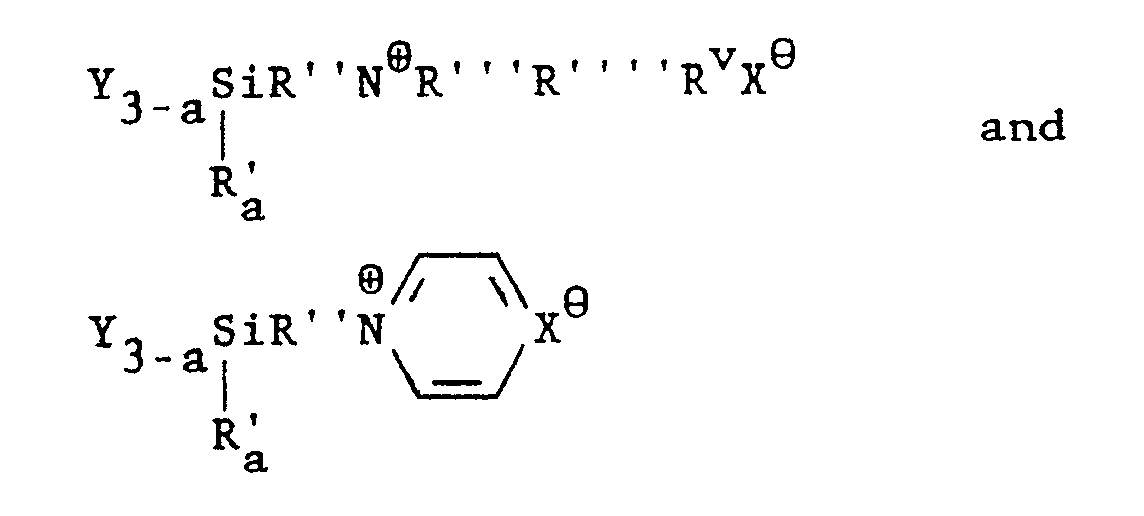
wherein, in each formula,
Y is R or RO where each R is an alkyl radical of 1 to 4 carbon atoms or hydrogen;
a has a value of 0, 1 or 2;
R′ is a methyl or ethyl radical;
R˝ is an alkylene group of 1 to 4 carbon atoms;
R‴, R˝˝ and Rv are each independently selected from a group consisting of alkyl radicals of 1 to 18 carbon atoms, -CH₂C₆H₅, -CH₂CH₂OH, -CH₂OH and -(CH₂)xNHC(O)Rvi wherein x has a value of from 2 to 10 and Rvi is a perfluoroalkyl radical having from 1 to 12 carbon atoms; and
X is chloride, bromide, fluoride, iodide, acetate or tosylate.
wherein, in each formula,
Y is R or RO where each R is an alkyl radical of 1 to 4 carbon atoms or hydrogen;
a has a value of 0, 1 or 2;
R′ is a methyl or ethyl radical;
R˝ is an alkylene group of 1 to 4 carbon atoms;
R‴, R˝˝ and Rv are each independently selected from a group consisting of alkyl radicals of 1 to 18 carbon atoms, -CH₂C₆H₅, -CH₂CH₂OH, -CH₂OH and -(CH₂)xNHC(O)Rvi wherein x has a value of from 2 to 10 and Rvi is a perfluoroalkyl radical having from 1 to 12 carbon atoms; and
X is chloride, bromide, fluoride, iodide, acetate or tosylate.