|
(11) | EP 0 417 814 B1 |

| (12) | EUROPEAN PATENT SPECIFICATION |
|
|
| (54) |
Elastic revolution body having a silicone rubber composition and fixing device Elastischer Drehkörper mit Silikonkautschukzusammensetzung und Befestigungsvorrichtung Cylindre élastique utilisant une composition de caoutchouc de silicone et dispositif de fixation |
|
|
|||||||||||||||||||||||||||||||
|
||||||||||||||||||||||||||||||||
| Note: Within nine months from the publication of the mention of the grant of the European patent, any person may give notice to the European Patent Office of opposition to the European patent granted. Notice of opposition shall be filed in a written reasoned statement. It shall not be deemed to have been filed until the opposition fee has been paid. (Art. 99(1) European Patent Convention). |
[0001] This invention relates to an elastic revolution body provided with an elastic member having a surface layer formed from a silicone rubber composition and a fixing device having the elastic revolution body.
[0002] In an image-forming apparatus such as an electrophotographic copying machine, carryability, releasability and durability are generally required for a carrier roller which carries a sheet-form transfer material or a recording material such as plain paper along the predetermined route.
[0003] Particularly, a fixing device provided with a fixing roller or a press roller which carries the transfer material to the predetermined route while giving heat to the unfixed toner images on the transfer material under pressing and preventing the offset phenomena of the toner in a semi-molten or molten state requires more strict carryability, releasability, wear resistance, fixability and durability. The fixing device of this type has at least a heating means such as a fixing roller and a rotating press roller in contact with the heating means under pressing.
[0004] The heating means such as a fixing roller comprises a hollow core cylinder made from such a material as aluminum or iron, and a layer coated on the surface of the hollow core cylinder, the layer being composed of a material having a good releasability such as fluorocarbon resin, for example, polytetrafluoroethylene (PTEF) or tetrafluoroethylene-fluoroalkoxyethylene copolymer (PFA) or silicone rubber.
[0005] At the inside of the fixing roller, a heater such as a halogen lamp is provided, when required, to heat the surface of the fixing roller to a specific temperature suitable for the fixation. In many cases, the surface temperature of the fixing roller is continuously controlled to keep a set temperature by a sensor.
[0006] At the outer peripheral surface of the fixing roller, a cleaning means for removing the attached toner or paper dusts, or a separation means such as a separation nail for preventing a toner image-carrying material such as a transfer material from coiling around the fixing roller is sometimes provided.
[0007] On the other hand, the press roller comprises a core cylinder made from such a material as iron or stainless steel, and an elastic member having a good releasability coated on the surface of the core cylinder, the elastic member being composed of silicone rubber. The press roller presses the heating means such as a fixing roller by a pressing means such as a spring.
[0008] The toner image-carrying material having an unfixed toner image on the surface is carried by the heating means such as the fixing roller and the press roller with heating under pressing, as pinched therebetween, thereby, heat-fixing under pressing the unfixed toner image on the surface.
[0009] When a positively charged toner is to be fixed in a fixing device, such problems have been often encountered as to the image quality such as offset phenomena of toner and line blurr of toner image, and as to the toner attachment to the surface of the press roller. Particularly in a fixing device without a cleaning means for cleaning the surface of the fixing roller, these problems have been more often encountered.
[0010] The EP-A-0 322 099 discloses an organic polymer composition to be applied to an elastic revolution body and fixing device using the same, the organic polymer composition having an antistatic property and comprising at least an organic polymer and a porous inorganic fine powder carrying a liquid antistatic agent. The porous inorganic fine powder is dispersed in the organic polymer and has an oil absorption of 100 ml/100 g or more before it carries the liquid antistatic agent. As liquid antistatic agents, polyether-modified silicone oil and amino-modified silicone oil are mentioned. By virtue of the polysiloxane portion as a hydrophobic group and the non-ionic or cationic hydrophilic groups, the silicone oil molecule is provided both with surfactant and antistatic properties. This leads to antistatic as well as discharging properties of the elastic revolution body. In effect, staining on and attaching to of the toner to the roller are prevented by decreasing the potential on the roller surface by virtue of the antistatic agent.
[0011] An object of the present invention is to provide a silicone rubber composition for an elastic revolution body and a fixing device being free from the foregoing problems.
[0012] Another object of the present invention is to provide a silicone rubber composition capable of containing polydimethylsilicone oil at a high concentration for a molding product and an elastic revolution body.
[0013] Other object of the present invention is to provide a silicone rubber composition capable of forming a molding product having good dimensional stability and releasability.
[0014] Further object of the present invention is to provide a molding product of silicone rubber having good electrical insulating property and mechanical strength.
[0015] Still further object of the present invention is to provide an elastic revolution body capable of efficiently maintaining a minus potential.
[0016] Still further object of the present invention is to provide an elastic revolution body of slow polydimethylsilicone oil release.
[0017] Still further object of the present invention is to provide an elastic revolution body having good releasability, were resistance and durability.
[0018] Still further object of the present invention is to provide a fixing device for fixing a positively charged toner.
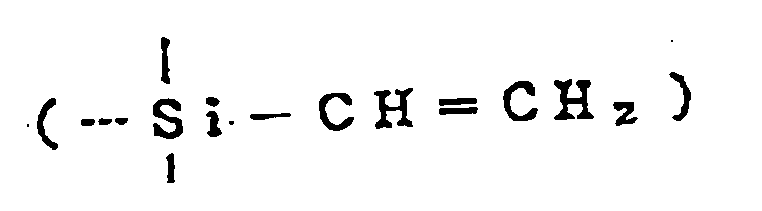
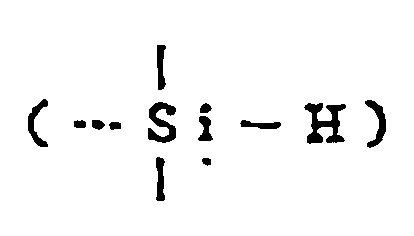
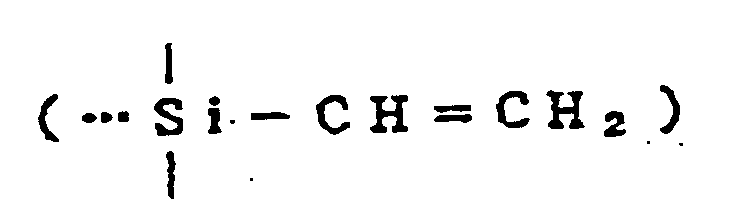
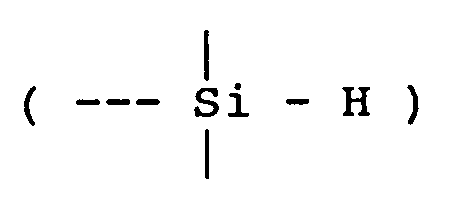
[0019] Still further object of the present invention is to provide a fixing device with good durability and offset resistance.
[0020] Still further object of the present invention is to provide a silicone rubber composition comprising a silicone rubber and porous inorganic fine powders holding polydimethylsilicone oil.
[0021] Still further object of the present invention is to provide a molding product comprising a solid silicone rubber and porous inorganic fine powders holding polydimethylsilicone oil as contained in the solid silicone rubber.
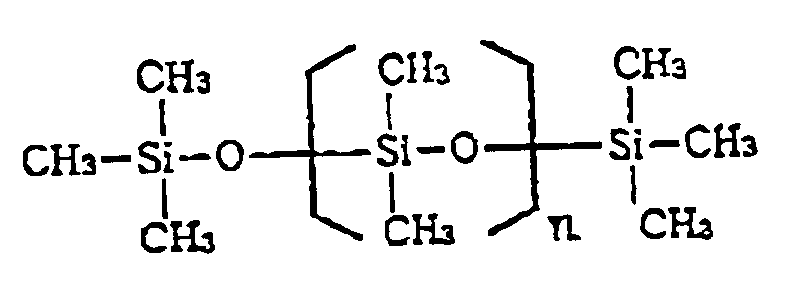
[0022] Still further object of the present invention is to provide an elastic revolution body comprising an elastic layer formed from a silicone rubber composition comprising a silicone rubber and porous inorganic fine powders a holding polydimethylsilicone oil.
[0023] Still further object of the present invention is to provide a fixing device for fixing an unfixed toner image on a toner image-carrying material with heating and pressing by carrying the toner image-carrying material at least between a heating means and a roller, as pinched therebetween, which comprises a roller having an elastic layer as a surface layer, the elastic layer being formed from a silicone rubber composition comprising a silicone rubber and porous inorganic fine powders holding polydimethylsilicone oil.
[0024] According to the present invention, an elastic revolution body comprises an elastic layer formed from a silicone rubber composition comprising a silicone rubber and porous inorganic fine powders having an average particle size of 1 to 40 »m and an oil absorbability of 200 to 800 ml/100 g determined according to JIS K5101 procedure, which inorganic fine powders hold a polydimethyl silicone oil.
[0025] Fig. 1 is a vertical cross-sectional view showing one embodiment of a fixing device according to the present invention.
[0026] Fig. 2 is a diagram showing changes in the surface potential of silicone rubber surface with lapse of time.
[0027] Fig. 3 is a diagram showing percent changes in the weight of a molding product of silicone rubber with lapse of time when the molding product sandwiched between copy sheets was compressed to 25 % and left at 100 °C.
[0028] According to the present invention, a large amount of polydimethylsilicone oil can be contained in a molding product formed from a silicone rubber composition to be used for the elastic revolution body by adding porous inorganic fine powders having micropores containing polydimethylsilicone oil to the silicone rubber composition and the electrical insulation of the molding product formed from the silicone rubber composition can be improved thereby.
[0029] The present silicone rubber composition may be any of compositions of condensation reaction type, addition reaction type and radical reaction type. The polymer component constituting the present silicone rubber composition has the following structural unit in the main chain skeleton:
wherein R₁ and R₂ are the same or different groups and represent alkyl such as methyl and ethyl; aryl such as phenyl; and polyfluoroalkyl such as trifluoropropyl.
[0030] Examples of silicone rubber of condensation type include silicone rubber of dealcoholization type, silicone rubber of deoximization type, silicone rubber of deacetylization type, silicone rubber of dehydrogenation type, etc.
[0031] Silicone rubber of addition reaction type can be prepared, for example, by mixing a first liquid containing at least a liquid vinyl-containing
diorganopolysiloxane
as a base polymer and a platinum catalyst as a curing reaction catalyst with a second liquid containing at least an active hydrogen radical-containing siloxane
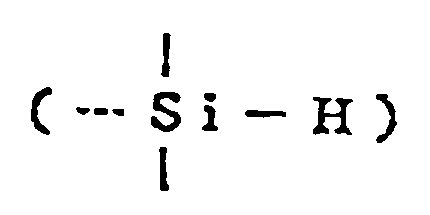
as a cross-linking agent (working as a curing agent) and a liquid vinyl-containing diorganopolysiloxane in a predetermined ratio (for example, a ratio of 1 : 1), defoaming and then heating the mixture, thereby curing the mixture. The thus obtained silicone rubber of addition reaction type has a cross-linked structure and thus is in a solid state and has elasticity.
[0032] For example, the silicone rubber of addition reaction type can be prepared by reacting a vinyl-containing organopolysiloxane containing a vinyl group as an unsaturated group, represented by the following formulae:
wherein m and n are positive integers, with an active hydrogen radical-containing siloxane having a reactive
group, represented by the following formula:
wherein m is a positive integer, in the presence of a platinum-based catalyst at a reaction temperature of 60 ° to 170 °C.
[0033] Silicone rubber of radical reaction type is a so-called heat vulcanization type silicone rubber. For example, unvulcanized silicone rubber having the following structural unit:
wherein R is methyl: R' is vinyl, phenyl or fluoroalkyl; and ℓ is a positive integer) is kneaded with an organic peroxide as a vulcanizing agent and then the mixture is heated, thereby vulcanizing the mixture. As a result, an elastic vulcanized silicone rubber can be formed.
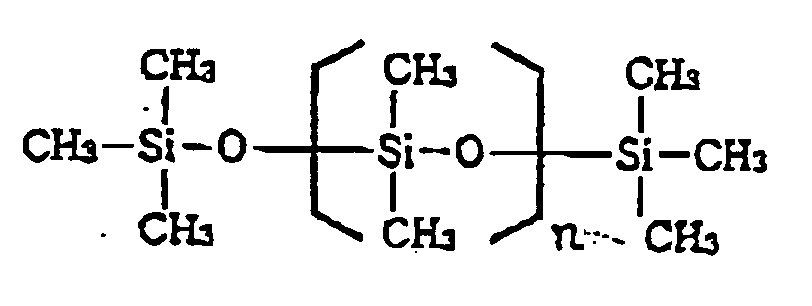
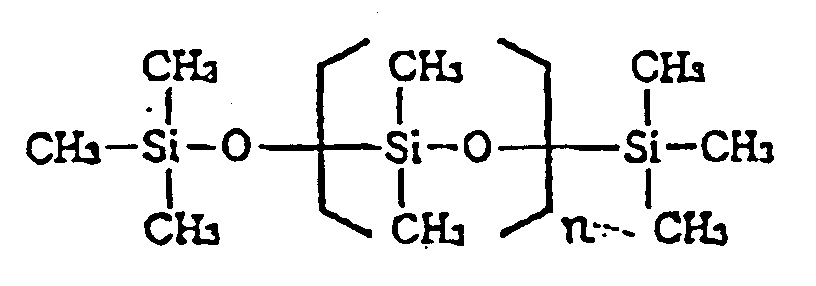
[0034] In the present invention, polydimethylsilicone oil is a well known one represented by the following general formula:
wherein n is a positive integer.
[0035] Polydimethylsilicone oil having a viscosity at 25 °C of 0.01 to 100 Pa·s (10 to 100,000 cs), preferably 0.1 to 60 Pa·s (100 to 60,000 cs) is preferable from the viewpoints of impregnation efficiency to the porous inorganic fine powders and slow release of the dimethylsilicone oil from the molding product.
[0036] As the porous fine powders having micropores for use in the present invention, inorganic fine powders are preferable from the viewpoint of heat stability, and porous inorganic fine powders having a high oil absorbability capable of holding a large amount of polydimethylsilicone oil for use in the present invention is preferable. Examples of such porous inorganic fine powders may include: Gyrolite-type calcium silicate (e.g. Florite, trade name of a product made by Tokuyama Soda K.K.); Spherical porous silica (e.g. M.S. Gel, trade name of a product made by Dokai Kagaku Kogyo K.K.; Silica Microbeads, trade name of a product made by Shokubai Kasei Kogyo K.K.; and Syloid, trade name of a product made by Fuji-Davison K.K.) and Sirasu-balloon (special powder obtained from volcanic ash).
[0037] The porous inorganic fine powders for their use in the present invention have a particle size ranging from 1 to 70 »m, an average particle size ranging from 1 to 40 »m and an oil absorbability of 200 to 800 ml/100 g, preferably 300 to 600 ml/100 g. The oil absorbability of the porous inorganic fine powders is determined according to JIS K5101 procedure.
[0038] Impregnation ratio of the polydimethylsilicone oil to the porous inorganic fine powders is preferably 100 to 600 parts by weight of the oil to 100 parts by weight of the powder, more preferably 200 - 500 parts by weight of the oil to 100 parts by weight of the powder.
[0039] An amount of the porous inorganic fine powders with micropores holding the dimethylsilicone oil to be added to the silicone rubber composition is 0.1 to 30 % by weight, preferably 1 to 20 % by weight in terms of net content of dimethylsilicone oil on the basis of the silicone rubber. Below 0.1 % by weight, no remarkable increase in the electrical insulation is expectable, whereas above 30 % by weight the physical properties of molding product of silicone rubber are lowered.
[0040] The present silicone rubber composition may contain a filler such as fine synthetic silica powders, quartz powders, molten quartz powders, diatomaceous earth, calcium carbonate, etc. Furthermore, the present silicone rubber composition may contain a heat resistance-improving agent such as iron oxide, i.e. red iron oxide; a compression set-improving agent such as titanium oxide and zinc oxide; and a dispersing agent such as a low molecular weight siloxane.
[0041] The present molding product of silicone rubber includes, for example, products in a sheet form and a roller form.
[0042] The present elastic revolution body comprises an elastic member formed from the present silicone rubber composition containing porous inorganic fine powders with micropores holding polydimethylsilicone oil.
[0043] The present fixing device has a function to fix an infixed toner image formed on a toner image-carrying material with heating under pressing by passing the toner image-carrying material at least between a heating means and a roller, as pinched therebetween. The present fixing device is suitable for fixation of positively charged toner.
[0044] Embodiments of the present elastic revolution body and the present fixing device will be described in detail below, referring to the accompanying drawings.
[0045] Fig. 1 is a vertical cross-sectional view of the structure of a fixing device provided with the present elastic revolution body as a press roller.
[0046] In Fig. 1, a fixing roller 1 comprises a core cylinder 2 made from such a material as aluminum, iron or stainless steel and a layer 3 of resin having a good heat resistance and a good releasability such as polytetrafluoroethylene (PTFE), and tetrafluoroethylene-fluoroalkoxyethylene copolymer (PFA), formed on the outer surface of the core cylinder 2. At the inside of the core cylinder 2, a heating means 9 such as a heater is provided.
[0047] A press roller 4 is pressed onto the fixing roller 1 by a pressing means such as a spring (not shown in the drawing), making the press roller to undergo follower revolution corresponding to the revolution of the fixing roller 1. The press roller 4 comprises a core cylinder 5 formed from such a material as iron or stainless steel and a layer 6 of elastomer formed from the present silicone rubber composition, laid on the surface of the core cylinder 5.
[0048] A thermister 8 for detecting the surface temperature of the fixing roller 1 and a cleaner for cleaning the surface of the fixing roller 1 through contact with the fixing roller 1 may be provided at positions near the outer peripheral surface of the fixing roller 1. Furthermore, an inlet guide 12 for leading a toner image-carrying material 11 such as a transfer material, for example, plain paper having a toner image 10 between the fixing roller 1 and the press roller 4 may be also provided at a position near the fixing roller 1.
[0049] The present invention will be described in detail below, referring to Examples, where parts are by weight.
Example 1
[0050] Porous fine inorganic powders holding polydimethylsilicone oil were prepared as follows:
100 parts of gyrolite-type calcium silicate (Florite R, trade name of a product made by Tokuyama Soda K.K.) having an average particle size of 25 »m, micropore size of about 0.01 to about 10 »m, an oil absorbability of 500 ml/100 g, an apparent specific gravity of 0.1, and a BET specific surface area of 115 m²/g was charged into a vessel with a stirrer, and then the vessel was heated to 150 °C. Then, 400 parts of polydimethylsilicone oil (KF96H, trade name of a product made by Shinetsu Kagaku Kogyo K.K.) having a viscosity of 10 Pa·s (10,000 cs) (25 °C) heated likewise to 150 °C were slowly dropwise added to the fine calcium silicate powders in a stirred state. After the addition of the total amount (400 parts) of the oil, the stirring was continued for some period of time, and then the mixture was taken out of the vessel, whereby fine calcium silicate powders holding the polydimethylsilicone oil having a viscosity of 10 Pa·s (10,000 cs) were obtained.
[0051] 100 parts of vinyl-containing diorganopolysiloxane, 5 parts of dry fine silica powders, 20 parts of quartz powders, 1 part of red iron oxide and a catalytic amount of a platinum-based catalyst were mixed to prepare a liquid silicone composition having a viscosity of 90 Pa·s (900 poises). To 100 parts of the thus prepared, liquid silicone composition was added 10 parts of the porous inorganic fine powders with micropores holding the polydimethylsilicone oil (KF96H, trade name of a product made by Shinetsu Kagaku Kogyo K.K.) having a viscosity of 10 Pa·s (10,000 cs) as obtained above, followed by uniform stirring and dispersion. The resulting liquid silicone composition was designated as liquid A.
[0052] On the other hand, 100 parts of a mixture of vinyl-containing diorganopolysiloxane and an active hydrogen radical-containing diorganopolysiloxane, 5 parts of dry fine silica powders, 20 parts of quartz powders and 1 part of red iron oxide were mixed to prepare a liquid silicone composition having a viscosity of 60 Pa·s (600 poises). To 100 parts of thus prepared, liquid silicone composition was added 10 parts of the same porous inorganic fine powders with the micropores holding the polydimethylsilicone oil as used for the preparation of the liquid A, followed by uniform stirring and dispersion. The resulting liquid silicone composition was designated as liquid B.
[0053] Then, the liquids A and B were mixed together in a ratio of 100 : 100 by weight, and the mixture was subjected to defoamation and then heated at 150 °C for 10 minutes, whereby addition reaction of the vinyl group and the silicon-bonded active hydrogen radical in the mixed compositions started in the presence of a platinum catalyst to cure the mixed composition, thereby forming a rubbery elastomer.
Comparative Example 1
[0054] A liquid silicone composition having a viscosity of 90 Pa·s (900 poises) was prepared as liquid C in the same manner as that for the preparation of liquid A in Example 1, except that no such inorganic fine powders holding the polydimethylsilicone oil having a viscosity of 10 Pa·s (10,000 cs) as used in Example 1 was used at all.
[0055] Furthermore, a liquid silicone composition having a viscosity of 60 Pa·s (600 poises) was prepared as liquid D in the same manner as that for the preparation of liquid B in Example 1, except that no such inorganic fine powders holding the polydimethylsilicone oil having a viscosity of 10 Pa·s (10,000 cs) as used in Example 1 was used at all.
[0056] Then, the liquids C and D were mixed together in a ratio of 100 : 100 by weight, and the mixture was subjected to defoamation and then heated at 150 °C for 10 minutes, whereby addition reaction of the vinyl group and the silicon-bonded active hydrogen radical in the mixed compositions started in the presence of a platinum catalyst to cure the mixed composition, thereby forming a rubbery elastomer.
Comparative Example 2
[0057] A liquid silicone composition was prepared as liquid E in the same manner as that for the preparation of liquid A in Example 1, except that 10 parts of polydimethylsilicone oil (KF96H, trade name of a product made by Shinetsu Kagaku Kogyo K.K.) having a viscosity of 10 Pa·s (10,000 cs) itself was used in place of the inorganic fine powders holding the polydimethylsilicone oil having a viscosity of 10 Pa·s (10,000 cs).
[0058] A liquid silicone composition was prepared as liquid F in the same manner as that for the preparation of liquid B in Example 1, except that 10 parts of polydimethylsilicone oil (KF96H, trade name of a product made by Shinetsu Kagaku Kogyo K.K.) having a viscosity of 10 Pa·s (10,000 cs) itself was used in place of the inorganic fine powders holding the polydimethylsilicone oil having a viscosity of 10 Pa·s (10,000 cs).
[0059] Then, the liquids E and F were mixed together in a ratio of 100 : 100 by weight, and the mixture was subjected to defoamation and then heated at 150 °C for 10 minutes, whereby addition reaction of the vinyl group and the silicon-bonded active hydrogen radical in the mixed compositions started in the presence of a platinum catalyst to cure the mixed composition, thereby forming a rubbery elastomer.
Test Example 1
[0060] Electrical insulation of the rubbery elastomers obtained in Example 1 and Comparative Example 1 was investigated in the following manner. Test pieces of the rubbery elastomers, 20 mm x 60 mm x 2 mm , were subjected to application of corona discharge at -5,000 V for a predetermined time (one second) and immediately thereafter changes in the potential on the surfaces of the test pieces of the rubbery elastomers were measured by an induction probe of a surface potentiometer. The results are shown in Fig. 2.
Test Example 2
[0061] Bleeding state of the silicone oil contained in the rubbery elastomers obtained in Example 1 and Comparative Example 2 was investigated in the following manner.
[0062] Test pieces of the rubbery elastomers in the form of true circular disk, 12.7 mm thick and 29.0 mm in diameter, were each pinched between a pair of 4 sheets of copy paper (NP paper, trade name of a product made by Canon) in a press device comprising a pair of flat press plates for pinching and fixing the test piece, bolts and spacers, and pressed to 25 % compression and left at 100 °C as they were. Weight of the test piece was measured at predetermined time intervales. The results are shown in Fig. 3.
[0063] As is apparent from Fig. 3, the present molding product was distinguished in the slow release of polydimethylsilicone oil.
Test Example 3
[0064] Hardness and impact resilience of the rubbery elastomers obtained in Example 1 and Comparative Examples 1 and 2 are shown in the following Table.
Table
| Example 1 | Comp. Example 1 | Comp. Example 2 | |
| Hardness (JISA) | 27 | 25 | 16 |
| Impact resilience (%) | 74 | 76 | 69 |
[0065] As is apparent from the foregoing Table, the rubbery elastomer of Example 1 had physical properties equivalent to those of Comparative Example 1 without the polydimethylsilicone oil. The rubbery elastomer of Comparative Example 2 with the polydimethylsilicone oil as directly admixed had poor hardness and impact resilience.
Example 2
[0066] A press roller for a fixing device utilizing heating and pressing, which had an elastic layer of the present silicone rubber composition, was produced in the following manner:
Into a cylindrical mold provided with a press roller core cylinder of stainless steel, 10 mm in outer diameter, coated with a siloxane-based primer on the surface in advance, and preheated to 130 °C, a uniform liquid mixture of liquid A and liquid B of the silicone rubber compositions of Example 1 in a weight ratio of 100 : 100 was injected after defoamation, and kept at 130 °C for 10 minutes to cure the mixture. After the curing, the silicone rubber-coated press roller was formed and taken out of the mold. Its outer diameter was 16 mm, and the thickness of the silicone rubber coating layer was 3 mm.
[0067] The thus obtained press roller was mounted on a fixing device of heat fixation type as shown in Fig. 1 and subjected to a fixation test with continuous copy sheet passage under the following conditions. The fixing roller 1 comprising an aluminum core cylinder, 20 mm in outer diameter, and a layer of tetrafluoroethylene resin having a thickness of 15 »m, laid on the outer surface of the core cylinder, was used in the fixing device.
| Fixing conditions: | |
| Controlled surface temperature of the fixing roller: | 150 °C |
| Pressing force between the fixing roller and the press roller: | 58.86 N (6 kgf) |
| Test sheet: | A4-size, transfer sheets (plain paper), provided each with an unfixed, positively charged toner image of a test pattern on the surface |
| Sheet test speed: | 4 sheets/min. |
[0068] The results showed that no failing due to attachment of toner was observed on the press roller surface or no attachment of toner to the fixing roller surface was observed at all even after passage of 10,000 sheets. Deterioration of image quality, image fouling and blank images were not observed at all. That is, good image quality and fixation were maintained throughout the test. Particularly coiling of sheets around the roller, sheet clogging, sheet curling, sheet wrinkling were not observed at all, or no jam troubles were observed. Thus, a good carryability was maintained throughout the test. Changes in the shape of the roller was very small and a good dimensional stability was maintained.
Comparative Example 3
[0069] A press roller was produced in the same manner as in Example 1 except that the liquids C and D of Comparative Example 1 were used.
[0070] The results showed that failing due to the attachment of toner was developed on the press roller surface after passage of 5,000 sheets, and deterioration of image quality, image failing, blank image, sheet wrinkling, sheet clogging, sheet curling, etc. were developed.
Comparative Example 4
[0071] A press roller was produced in the same manner as in Example 2 except that the liquid E and F of Comparative Example 2 were used.
[0072] The results showed that failing due to the attachment of toner was developed on the press roller surface after passage of 6,000 sheets, and deterioration of image quality, image fouling, blank images, sheet wrinkling, sheet clogging, sheet curling, etc. were developed.
[0073] According to the present invention, the electrical insulation of rubber molding product can be improved by adding porous inorganic fine powders with micropores holding polydimethylsilicone oil to a silicone rubber composition.
[0074] Furthermore, according to the present invention, bleeding of polydimethylsilicone oil onto the surface of rubber molding product can be suppressed or reduced by holding polydimethylsilicone oil in micropores of the porous inorganic fine powders.
[0075] Still furthermore, according to the present invention, deterioration of the physical properties such as hardness, impact resilience, etc. of rubber molding product when polydimethylsilicone oil is added to a silicone rubber composition can be suppressed.
[0076] When the present silicone rubber composition is used as an elastic surface layer of a press roller in an image-fixing device in an image- forming apparatus such as an electrophotographic copying machine using a positively charged toner as a developing agent, the fixation efficiency of a positively charged toner image on a toner image-carrying material, such as plain paper, can be increased, because the roller surface is negatively charged, and as a result, the amount of toner attached to the fixing roller surface can be considerably reduced, and thus poor image such as offset or fouling of the roller surface due to the attachment of toner can be prevented, thereby solving such problems as encountered in carrying the sheet, for example, sheet coiling around the roller, sheet curling, etc.
1. An elastic revolution body, comprising an elastic layer formed from a silicone rubber
composition comprising a silicone rubber and porous inorganic fine powders having
an average particle size of 1 to 40 »m and an oil absorbability of 200 to 800 ml/100
g determined according to JIS K5101 procedure, which inorganic fine powders hold a
polydimethylsilicone oil.
2. The elastic revolution body according to claim 1, wherein 100 to 600 parts by weight
of the polydimethylsilicone oil is held in 100 parts by weight of the porous inorganic
fine powders.
3. The elastic revolution body according to claim 1, wherein 200 to 500 parts by weight
of the polydimethylsilicone oil is held in 100 parts by weight of the porous inorganic
fine powders.
4. The elastic revolution body according to claim 1, wherein the porous inorganc fine
powders holding the polydimethylsilicone oil are contained in the silicone rubber
at a polydimethylsilicone oil concentration of 0.1 to 30 % by weight on the basis
of the silicone rubber.
5. The elastic revolution body according to claim 1, wherein the porous inorganic fine
powders holding the polydimethylsilicone oil are contained in the silicone rubber
at a polydimethylsilicone oil concentration of 1 to 20 % by weight on the basis of
the silicone rubber.
6. The elastic revolution body according to claim 1, wherein the silicone rubber is a
silicone rubber of addition reaction type.
7. The elastic revolution body according to claim 1, wherein the silicone rubber is a
silicone rubber of condensation reaction type.
8. The elastic revolution body according to claim 1, wherein the silicone rubber is a
silicone rubber of radical reaction type.
9. The elastic revolution body according to claim 6, wherein the silicone rubber of addition
reaction type is prepared by mixing a first liquid containing at least a liquid vinyl-containing
diorganopolysiloxane
and a platinum catalyst as a curing reaction catalyst with a second liquid containing at least an active hydrogen radical-containing siloxane
and a liquid vinyl-containing diorganopolysiloxane, and heating the mixture, thereby curing the mixture.
and a platinum catalyst as a curing reaction catalyst with a second liquid containing at least an active hydrogen radical-containing siloxane
and a liquid vinyl-containing diorganopolysiloxane, and heating the mixture, thereby curing the mixture.
10. The elastic revolution body according to claim 9, wherein the silicone rubber of addition
reaction type is prepared by reacting the first liquid with the second liquid in the
presence of the porous inorganic fine powders holding the polydimethylsilicone oil.
11. The elastic revolution body according to claim 1, wherein the porous inorganic fine
powders have an oil absorbability of 300 to 600 ml/100 g.
12. The elastic revolution body according to claim 1, wherein the polydimethylsilicone
oil has a viscosity of 10 to 100,000 centistokes (0.01 to 100 Pa·s) at 25°C.
13. The elastic revolution body according to claim 1, wherein the polydimethylsilicone
oil has a viscosity of 100 to 60,000 centistokes (0.1 to 60 Pa·s) at 25°C.
14. The elastic revolution body according to claim 1, wherein the silicone rubber is a
liquid silicone rubber.
15. The elastic revolution body according to claim 1, wherein the silicone rubber is a
solid silicone rubber.
16. The elastic revolution body according to claim 1, wherein the polydimethylsilicone
oil is represented by the following formula:
wherein n is positive integer, and wherein 100 to 600 parts by weight of the polydimethylsilicone oil is held in 100 parts by weight of the porous inorganic fine powders and the polydimethylsilicone oil has a viscosity of 100 to 60,000 centistokes (0.1 to 60 Pa·s) at 25°C and wherein said elastic revolution body maintains a minus potential and gradually releases the polydimethylsilicone oil.
wherein n is positive integer, and wherein 100 to 600 parts by weight of the polydimethylsilicone oil is held in 100 parts by weight of the porous inorganic fine powders and the polydimethylsilicone oil has a viscosity of 100 to 60,000 centistokes (0.1 to 60 Pa·s) at 25°C and wherein said elastic revolution body maintains a minus potential and gradually releases the polydimethylsilicone oil.
17. Use of the elastic revolution body according to claim 1, as a pressure roller for
fixing, under heating and pressure, a positively charged toner image to a toner image-carrying
material.
18. A fixing device for fixing an unfixed toner image on a toner image-carrying material
by heating under pressing by carrying the toner image carrying-material at least between
a heating means and a roller, as pinched therebetween, which comprises an elastic
layer as a surface layer on the roller, the elastic layer being formed from a silicone
rubber composition comprising a silicone rubber and porous inorganic fine powders
having an average particle size of 1 to 40 »m and an oil absorbability of 200 to 800
ml/100 g determined according JIS K5101 procedure, which inorganic fine powders hold
a polydimethylsilicone oil.
19. The fixing device according to claim 18, wherein 100 to 600 parts by weight of the
polydimethylsilicone oil is held in 100 parts by weight of the porous inorganic fine
powders.
20. The fixing device according to claim 18, wherein 200 to 500 parts by weight of the
polydimethylsilicone oil is held in 100 parts by weight of the porous inorganic fine
powders.
21. The fixing device according to claim 18, wherein the porous inorganic fine powders
holding the polydimethylsilicone oil are contained in the silicone rubber at a polydimethylsilicone
oil concentration of 0.1 to 30 % by weight on the basis of the silicone rubber.
22. The fixing device according to claim 18, wherein the porous inorganic fine powders
holding the polydimethylsilicone oil are contained in the silicone rubber at a polydimethylsilicone
oil concentraticn of 1 to 20 % by weight on the basis of the silicone rubber.
23. The fixing device according to claim 18, wherein the silicone rubber is a silicone
rubber of addition reaction type.
24. The fixing device according to claim 18, wherein the silicone ruber is a silicone
rubber of condensation reaction type.
25. The fixing device according to claim 18, wherein the silicone rubber is a silicone
rubber of radical reaction type.
26. The fixing device according to claim 23, wherein the silicone rubber of addition reaction
type is prepared by mixing a first liquid containing at least a liquid vinyl-containing
diorganopolysiloxane
and a platinum catalyst as a curing reaction catalyst with a second liquid containing at least an active hydrogen radical-containing siloxane and a liquid vinyl-containing diorganopolysiloxane,
and heating the mixture, thereby curing the mixture.
and a platinum catalyst as a curing reaction catalyst with a second liquid containing at least an active hydrogen radical-containing siloxane and a liquid vinyl-containing diorganopolysiloxane,
and heating the mixture, thereby curing the mixture.
27. The fixing device according to claim 26, wherein the silicone rubber of addition reaction
type is prepared by reacting the first liquid with the second liquid in the presence
of the porous inorganic fine powders holding the polydimethylsilicone oil.
28. The fixing device according to claim 18, wherein the porous inorganic fine powders
have an oil absorbability of 300 to 600 ml/100 g.
29. The fixing device according to claim 18, wherein the polydimethylsilicone oil has
a viscosity of 10 to 100,000 centistokes (0.01 to 100 Pa·s) at 25°C.
30. The fixing device according to claim 18, wherein the polydimethylsilicone oil has
a viscosity of 100 to 60,000 centistokes (0.1 to 60 Pa·s) at 25°C.
31. The fixing device according to claim 18, wherein the silicone rubber is a liquid silicone
rubber.
32. The fixing device according to claim 18, wherein the silicone rubber is a solid silicone
rubber.
33. The fixing device according to claim 18, wherein the polydimethylsilicone oil is represented
by the following formula:
wherein n is positive integer, and wherein 100 to 600 parts by weight of the porous inorganic fine powders and the polydimethylsilicone oil has a viscosity of 100 to 60,000 centistokes at 25°C and wherein said roller maintains a minus potential and gradually releases the polydimethylsilicone oil.
wherein n is positive integer, and wherein 100 to 600 parts by weight of the porous inorganic fine powders and the polydimethylsilicone oil has a viscosity of 100 to 60,000 centistokes at 25°C and wherein said roller maintains a minus potential and gradually releases the polydimethylsilicone oil.
34. The fixing device according to claim 18, wherein the roller is a pressure roller for
fixing, under heating and pressure, a positively charged toner image to a toner image
carrying material.
1. Elastischer Umdrehungskörper, umfassend eine elastische Schicht, gebildet aus einer
Siliconkautschukzusammensetzung, umfassend einen Siliconkautschuk und poröse, anorganische,
feine Pulver mit einer durchschnittlichen Teilchengröße von 1 bis 40 »m und einer
Ölabsorptionsfähigkeit von 200 bis 800 ml / 100 g, bestimmt nach dem Verfahren gemäß
JIS K5101, wobei die anorganischen, feinen Pulver ein Polydimethylsiliconöl tragen.
2. Elastischer Umdrehungskörper nach Anspruch 1, worin 100 bis 600 Gewichtsteile des
Polydimethylsiliconöls auf 100 Gewichtsteilen der porösen, anorganischen, feinen Pulver
getragen werden.
3. Elastischer Umdrehungskörper nach Anspruch 1, worin 200 bis 500 Gewichtsteile des
Polydimethylsiliconöls auf 100 Gewichtsteilen der porösen, anorganischen, feinen Pulver
getragen werden.
4. Elastischer Umdrehungskörper nach Anspruch 1, worin die porösen, anorganischen, feinen
Pulver, die das Polydimethylsiliconöl tragen, in der Siliconkautschukzusammensetzung
bei einer Polydimethylsiliconölkonzentration von 0,1 bis 30 Gew.-%, bezogen auf den
Siliconkautschuk, enthalten sind.
5. Elastischer Umdrehungskörper nach Anspruch 1, worin die porösen, anorganischen, feinen
Pulver, die das Polydimethylsiliconöl tragen, in der Siliconkautschukzusammensetzung
bei einer Polydimethylsiliconölkonzentration von 1 bis 20 Gew.-%, bezogen auf den
Siliconkautschuk, enthalten sind.
6. Elastischer Umdrehungskörper nach Anspruch 1, worin der Siliconkautschuk ein Siliconkautschuk
vom Additionsreaktionstyp ist.
7. Elastischer Umdrehungskörper nach Anspruch 1, worin der Siliconkautschuk ein Siliconkautschuk
vom Kondensationsreaktionstyp ist.
8. Elastischer Umdrehungskörper nach Anspruch 1, worin der Siliconkautschuk ein Siliconkautschuk
vom Radikalreaktionstyp ist.
9. Elastischer Umdrehungskörper nach Anspruch 6, worin der Siliconkautschuk vom Additionsreaktionstyp
hergestellt wird durch Mischen einer ersten Flüssigkeit, die mindestens ein flüssiges,
vinylhaltiges Diorganopolysiloxan der Formel:
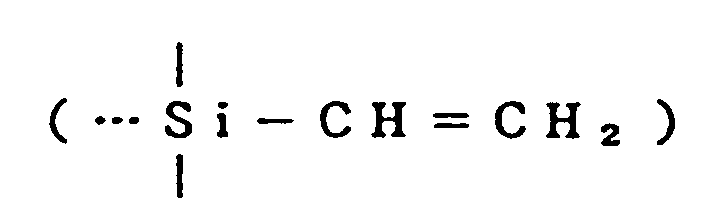
und einen Platinkatalysator als Katalysator für die Härtungsreaktion enthält, mit einer zweiten Flüssigkeit, die wenigstens ein Siloxan mit aktiven Wasserstoffresten der Formel:
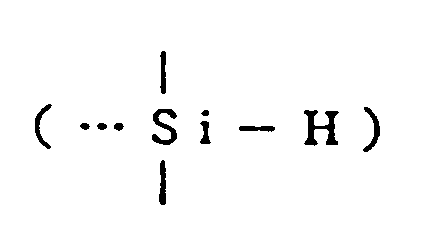
und ein flüssiges, vinylhaltiges Diorganopolysiloxan enthält, und Erhitzen dieser Mischung, wobei die Mischung härtet.
und einen Platinkatalysator als Katalysator für die Härtungsreaktion enthält, mit einer zweiten Flüssigkeit, die wenigstens ein Siloxan mit aktiven Wasserstoffresten der Formel:
und ein flüssiges, vinylhaltiges Diorganopolysiloxan enthält, und Erhitzen dieser Mischung, wobei die Mischung härtet.
10. Elastischer Umdrehungskörper nach Anspruch 9, worin der Siliconkautschuk des Additionsreaktionstyp
hergestellt wird, indem die erste Flüssigkeit mit der zweiten Flüssigkeit in der Gegenwart
der porösen, anorganischen, feinen Pulver, die das Polydimethylsiliconöl tragen, umgesetzt
wird.
11. Elastischer Umdrehungskörper nach Anspruch 1, worin die porösen, anorganischen, feinen
Pulver eine Ölabsorptionsfähigkeit von 300 bis 600 ml / 100 g besitzen.
12. Elastischer Umdrehungskörper nach Anspruch 1, worin das Polydimethylsiliconöl eine
Viskosität von 10 bis 100000 Centistokes (0,01 bis 100 Pa·s) bei 25°C besitzt.
13. Elastischer Umdrehungskörper nach Anspruch 1, worin das Polydimethylsiliconöl eine
Viskosität von 100 bis 60000 Centistokes (0,1 bis 60 Pa·s) bei 25°C besitzt.
14. Elastischer Umdrehungskörper nach Anspruch 1, worin der Siliconkautschuk ein flüssiger
Siliconkautschuk ist.
15. Elastischer Umdrehungskörper nach Anspruch 1, worin der Siliconkautschuk ein fester
Siliconkautschuk ist.
16. Elastischer Umdrehungskörper nach Anspruch 1, worin das Polydimethylsiliconöl durch
die folgende Formel dargestellt ist:
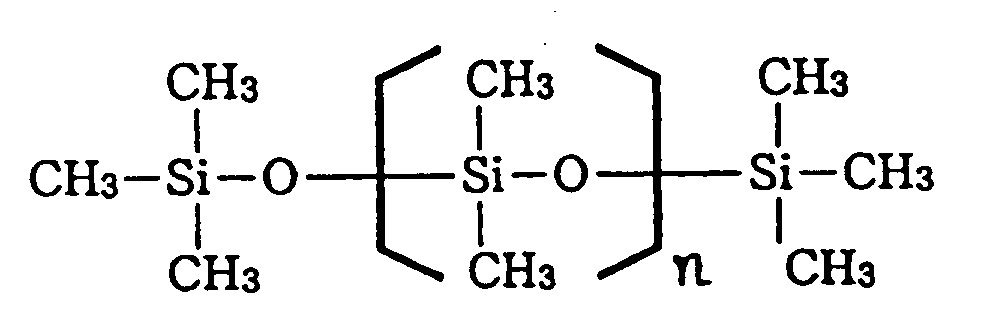
worin n eine positive ganze Zahl ist, und worin 100 bis 600 Gewichtsteile des Polydimethylsiliconöls auf 100 Gewichtsteilen der porösen, anorganischen, feinen Pulver getragen werden und das Polydimethylsiliconöl eine Viskosität von 100 bis 60000 Centistokes (0,1 bis 60 Pa·s) bei 25°C besitzt, und worin der elastische Umdrehungskörper ein negatives Potential beibehält und langsam das Polydimethylsiliconöl abgibt.
worin n eine positive ganze Zahl ist, und worin 100 bis 600 Gewichtsteile des Polydimethylsiliconöls auf 100 Gewichtsteilen der porösen, anorganischen, feinen Pulver getragen werden und das Polydimethylsiliconöl eine Viskosität von 100 bis 60000 Centistokes (0,1 bis 60 Pa·s) bei 25°C besitzt, und worin der elastische Umdrehungskörper ein negatives Potential beibehält und langsam das Polydimethylsiliconöl abgibt.
17. Verwendung des elastischen Umdrehungskörpers nach Anspruch 1 als eine Druckwalze zur
Fixierung eines Bildes aus positiv geladenem Toner auf einem tonerbildtragenden Material
unter Erwärmung und Druck.
18. Fixiereinrichtung zur Fixierung eines unfixierten Tonerbildes auf einem tonerbildtragenden
Material durch Erhitzen unter Druck, indem das tonerbildtragende Material mindestens
zwischen einer Heizeinrichtung und einer Walze hindurchtransportiert wird, so daß
es zwischen den beiden gepreßt wird, die eine elastische Schicht als Oberflächenschicht
auf der Walze umfaßt, und wobei die elastische Schicht, die aus einer Siliconkautschukzusammensetzung
gebildet wird, einen Siliconkautschuk und poröse, anorganische, feine Pulver, die
eine mittlere Teilchengröße von 1 bis 40 »m und eine Ölabsorptionsfähigkeit von 200
bis 800 ml / 100 g, gemessen nach dem Verfahren gemäß JIS K5101, besitzen, umfaßt,
wobei die anorganischen, feinen Pulver ein Polydimethylsiliconöl tragen.
19. Fixiereinrichtung nach Anspruch 18, worin 100 bis 600 Gewichtsteile des Polydimethylsiliconöls
auf 100 Gewichtsteilen der porösen, anorganischen, feinen Pulver getragen werden.
20. Fixiereinrichtung nach Anspruch 18, worin 200 bis 500 Gewichtsteile des Polydimethylsiliconöls
auf 100 Gewichtsteilen der porösen, anorganischen, feinen Pulver getragen werden.
21. Fixiereinrichtung nach Anspruch 18, worin die porösen, anorganischen, feinen Pulver,
die das Polydimethylsiliconöl tragen, in der Siliconkautschukzusammensetzung bei einer
Polydimethylsiliconölkonzentration von 0,1 bis 30 Gew.-%, bezogen auf den Siliconkautschuk,
enthalten sind.
22. Fixiereinrichtung nach Anspruch 18, worin die porösen, anorganischen, feinen Pulver,
die das Polydimethylsiliconöl tragen, in der Siliconkautschukzusammensetzung bei einer
Polydimethylsiliconölkonzentration von 1 bis 20 Gew.-%, bezogen auf den Siliconkautschuk,
enthalten sind.
23. Fixiereinrichtung nach Anspruch 18, worin der Siliconkautschuk ein Siliconkautschuk
vom Additionsreaktionstyp ist.
24. Fixiereinrichtung nach Anspruch 18, worin der Siliconkautschuk ein Siliconkautschuk
vom Kondensationsreaktionstyp ist.
25. Fixiereinrichtung nach Anspruch 18, worin der Siliconkautschuk ein Siliconkautschuk
vom Radikalreaktionstyp ist.
26. Fixiereinrichtung nach Anspruch 23, worin der Siliconkautschuk vom Additionsreaktionstyp
hergestellt wird durch Mischen einer ersten Flüssigkeit, die mindestens ein flüssiges,
vinylhaltiges Diorganopolysiloxan der Formel:
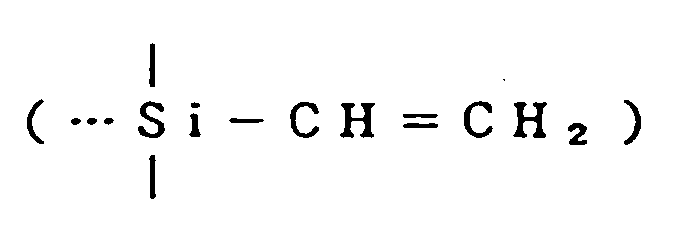
und einen Platinkatalysator als Katalysator für die Härtungsreaktion enthält, mit einer zweiten Flüssigkeit, die wenigstens ein Siloxan mit aktiven Wasserstoffresten der Formel:
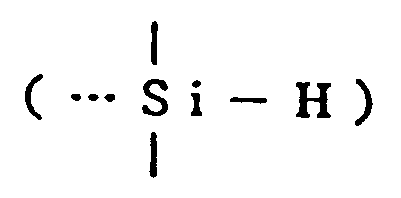
und ein flüssiges, vinylhaltiges Diorganopolysiloxan enthält, und Erhitzen dieser Mischung, wobei die Mischung härtet.
und einen Platinkatalysator als Katalysator für die Härtungsreaktion enthält, mit einer zweiten Flüssigkeit, die wenigstens ein Siloxan mit aktiven Wasserstoffresten der Formel:
und ein flüssiges, vinylhaltiges Diorganopolysiloxan enthält, und Erhitzen dieser Mischung, wobei die Mischung härtet.
27. Fixiereinrichtung nach Anspruch 18, worin der Siliconkautschuk des Additionsreaktionstyp
hergestellt wird, indem die erste Flüssigkeit mit der zweiten Flüssigkeit in der Gegenwart
der porösen, anorganischen, feinen Pulver, die das Polydimethylsiliconöl tragen, umgesetzt
wird.
28. Fixiereinrichtung nach Anspruch 18, worin die porösen, anorganischen, feinen Pulver
eine Ölabsorptionsfähigkeit von 300 bis 600 ml / 100 g besitzen.
29. = Fixiereinrichtung nach Anspruch 18, worin das Polydimethylsiliconöl eine Viskosität
von 10 bis 100000 Centistokes (0,01 bis 100 Pa·s ) bei 25°C besitzt.
30. Fixiereinrichtung nach Anspruch 18, worin das Polydimethylsiliconöl eine Viskosität
von 100 bis 60000 Centistokes (0,1 bis 60 Pa·s) bei 25°C besitzt.
31. Fixiereinrichtung nach Anspruch 18, worin der Siliconkautschuk ein flüssiger Siliconkautschuk
ist.
32. Fixiereinrichtung nach Anspruch 18, worin der Siliconkautschuk ein fester Siliconkautschuk
ist.
33. Fixiereinrichtung nach Anspruch 18, worin das Polydimethylsiliconöl durch die folgende
Formel dargestellt ist:
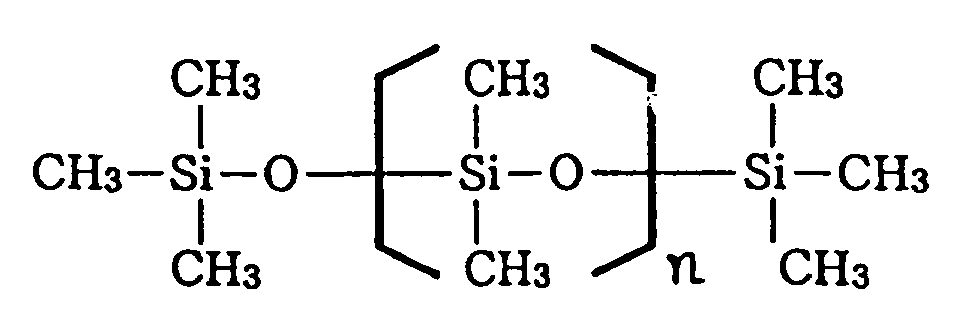
worin n eine positive ganze Zahl ist, und worin 100 bis 600 Gewichtsteile des Polydimethylsiliconöls auf 100 Gewichtsteilen der porösen, anorganischen, feinen Pulver getragen werden und das Polydimethylsiliconöl eine Viskosität von 100 bis 60000 Centistokes (0,1 bis 60 Pa·s) bei 25°C besitzt, und worin die Walze ein negatives Potential beibehält und langsam das Polydimethylsiliconöl abgibt.
worin n eine positive ganze Zahl ist, und worin 100 bis 600 Gewichtsteile des Polydimethylsiliconöls auf 100 Gewichtsteilen der porösen, anorganischen, feinen Pulver getragen werden und das Polydimethylsiliconöl eine Viskosität von 100 bis 60000 Centistokes (0,1 bis 60 Pa·s) bei 25°C besitzt, und worin die Walze ein negatives Potential beibehält und langsam das Polydimethylsiliconöl abgibt.
34. Fixiereinrichtung nach Anspruch 18, worin die Walze eine Druckwalze zur Fixierung
eines Bildes aus positiv geladenem Toner auf einem tonerbildtragenden Material unter
Erwärmung und Druck ist.
1. Corps rotatif élastique, comprenant une couche élastique formée d'une composition
de caoutchouc silicone comprenant un caoutchouc silicone et des poudres fines inorganiques
poreuses possédant un diamètre moyen de particules de 1 à 40 »m et une capacité d'absorption
d'huile de 200 à 800 ml/100 g déterminée suivant le mode opératoire JIS K5101, poudres
fines inorganiques qui renferment une huile de polydiméthylsilicone.
2. Corps rotatif élastique suivant la revendication 1, dans lequel une quantité de 100
à 600 parties en poids de l'huile de polydiméthylsilicone est maintenue dans 100 parties
en poids des poudres fines inorganiques poreuses.
3. Corps rotatif élastique suivant la revendication 1, dans lequel une quantité de 200
à 500 parties en poids de l'huile de polydiméthylsilicone est maintenue dans 100 parties
en poids des poudres fines inorganiques poreuses.
4. Corps rotatif élastique suivant la revendication 1, dans lequel les poudres fines
inorganiques poreuses renfermant l'huile de polydiméthylsilicone sont présentes dans
le caoutchouc silicone à une concentration d'huile de polydiméthylsilicone de 0,1
à 30 % en poids sur la base du caoutchouc silicone.
5. Corps rotatif élastique suivant la revendication 1, dans lequel les poudres fines
inorganiques poreuses renfermant l'huile de polydiméthylsilicone sont présentes dans
le caoutchouc silicone à une concentration d'huile de polydiméthylsilicone de 1 à
20 % en poids sur la base du caoutchouc silicone.
6. Corps rotatif élastique suivant la revendication 1, dans lequel le caoutchouc silicone
est un caoutchouc silicone du type formé par réaction d'addition.
7. Corps rotatif élastique suivant la revendication 1, dans lequel le caoutchouc silicone
est un caoutchouc silicone du type formé par réaction de condensation.
8. Corps rotatif élastique suivant la revendication 1, dans lequel le caoutchouc silicone
est un caoutchouc silicone du type formé par réaction radicalaire.
9. Corps rotatif élastique suivant la revendication 6, dans lequel le caoutchouc silicone
du type formé par réaction d'addition est préparé en mélangeant un premier liquide
contenant au moins un diorganopolysiloxane liquide à fonction vinyle
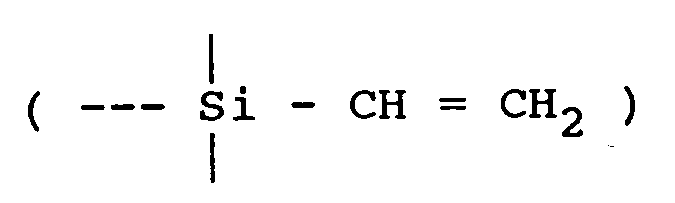
et un catalyseur au platine servant de catalyseur de réaction de durcissement avec un second liquide contenant au moins un siloxane contenant des radicaux hydrogène actifs
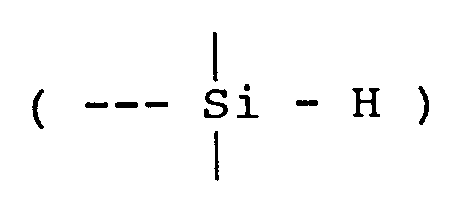
et un diorganopolysiloxane liquide à fonction vinyle, et en chauffant le mélange, ce qui provoque le durcissement du mélange.
et un catalyseur au platine servant de catalyseur de réaction de durcissement avec un second liquide contenant au moins un siloxane contenant des radicaux hydrogène actifs
et un diorganopolysiloxane liquide à fonction vinyle, et en chauffant le mélange, ce qui provoque le durcissement du mélange.
10. Corps rotatif élastique suivant la revendication 9, dans lequel le caoutchouc silicone
du type formé par réaction d'addition est préparé en faisant réagir le premier liquide
avec le second liquide en présence des poudres fines inorganiques poreuses renfermant
l'huile de polydiméthylsilicone.
11. Corps rotatif élastique suivant la revendication 1, dans lequel les poudres fines
inorganiques poreuses possèdent une capacité d'absorption d'huile de 300 à 600 ml/100
g.
12. Corps rotatif élastique suivant la revendication 1, dans lequel l'huile de polydiméthylsilicone
possède une viscosité de 10 à 100 000 centistokes (0,01 à 100 Pa.s) à 25°C.
13. Corps rotatif élastique suivant la revendication 1, dans lequel l'huile de polydiméthylsilicone
possède une viscosité de 100 à 60 000 centistokes (0,1 à 60 Pa.s) à 25°C.
14. Corps élastique rotatif suivant la revendication 1, dans lequel le caoutchouc silicone
est un caoutchouc silicone liquide.
15. Corps rotatif élastique suivant la revendication 1, dans lequel le caoutchouc silicone
est un caoutchouc silicone solide.
16. Corps rotatif élastique suivant la revendication 1, dans lequel l'huile de polydiméthylsilicone
est représentée par la formule suivante :
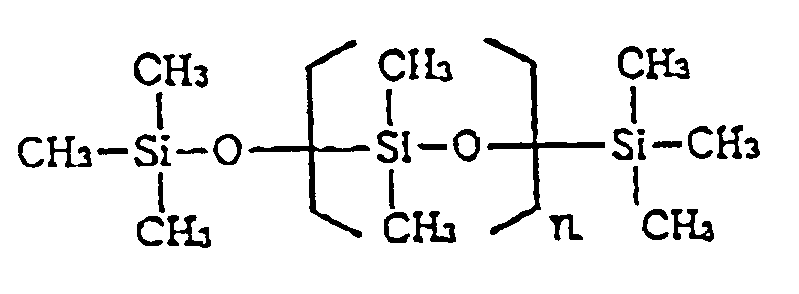
dans laquelle n est un nombre entier positif, et dans lequel 100 à 600 parties en poids de l'huile de polydiméthylsilicone sont maintenues dans 100 parties en poids des poudres fines inorganiques poreuses et l'huile de polydiméthylsilicone possède une viscosité de 100 à 60 000 centistokes (0,1 à 60 Pa.s) à 25°C, ledit corps rotatif élastique conservant un potentiel négatif et libérant progressivement l'huile de polydiméthylsilicone.
dans laquelle n est un nombre entier positif, et dans lequel 100 à 600 parties en poids de l'huile de polydiméthylsilicone sont maintenues dans 100 parties en poids des poudres fines inorganiques poreuses et l'huile de polydiméthylsilicone possède une viscosité de 100 à 60 000 centistokes (0,1 à 60 Pa.s) à 25°C, ledit corps rotatif élastique conservant un potentiel négatif et libérant progressivement l'huile de polydiméthylsilicone.
17. Utilisation d'un corps rotatif élastique suivant la revendication 1, comme rouleau
presseur pour le fixage, à chaud et sous pression, d'une image de toner chargée positivement
à une matière de support d'image de toner.
18. Dispositif de fixage pour le fixage d'une image de toner non fixée sur une matière
de support d'image de toner par chauffage sous pression en transportant la matière
de support d'image de toner au moins entre un moyen de chauffage et un rouleau, par
pinçage entre ce moyen de chauffage et ce rouleau, qui comprend une couche élastique
comme couche de surface du rouleau, la couche élastique étant formée d'une composition
de caoutchouc silicone comprenant un caoutchouc silicone et des poudres fines inorganiques
poreuses possédant un diamètre moyen de particules de 1 à 40 »m et une capacité d'absorption
d'huile de 200 à 800 ml/100 g, déterminée suivant le mode opératoire JIS K5101, poudres
fines inorganiques qui renferment une huile de polydiméthylsilicone.
19. Dispositif de fixage suivant la revendication 18, dans lequel une quantité de 100
à 600 parties en poids de l'huile de polydiméthylsilicone est maintenue dans 100 parties
en poids des poudres fines inorganiques poreuses.
20. Dispositif de fixage suivant la revendication 18, dans lequel une quantité de 200
à 500 parties en poids de l'huile de polydiméthylsilicone est maintenue dans 100 parties
en poids des poudres fines inorganiques poreuses.
21. Dispositif de fixage suivant la revendication 18, dans lequel les poudres fines inorganiques
poreuses renfermant l'huile de polydiméthylsilicone sont présentes dans le caoutchouc
silicone à une concentration d'huile de polydiméthylsilicone de 0,1 à 30 % en poids
sur la base du caoutchouc silicone.
22. Dispositif de fixage suivant la revendication 18, dans lequel les poudres fines inorganiques
poreuses renfermant l'huile de polydiméthylsilicone sont présentes dans le caoutchouc
silicone à une concentration d'huile de polydiméthylsilicone de 1 à 20 % en poids
sur la base du caoutchouc silicone.
23. Dispositif de fixage suivant la revendication 18, dans lequel le caoutchouc silicone
est un caoutchouc silicone du type formé par réaction d'addition.
24. Dispositif de fixage suivant la revendication 18, dans lequel le caoutchouc silicone
est un caoutchouc silicone du type formé par réaction de condensation.
25. Dispositif de fixage suivant la revendication 18, dans lequel le caoutchouc silicone
est un caoutchouc silicone du type formé par réaction radicalaire.
26. Dispositif de fixage suivant la revendication 23, dans lequel le caoutchouc silicone
du type formé par réaction d'addition est préparé en mélangeant un premier liquide
contenant au moins un diorganopolysiloxane liquide à fonction vinyle
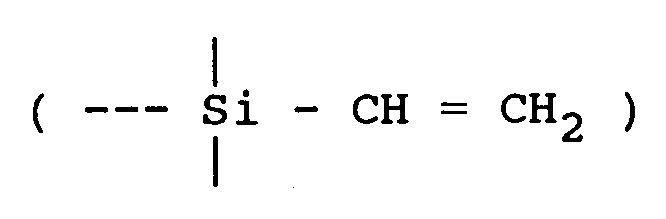
et un catalyseur au platine servant de catalyseur de réaction de durcissement avec un second liquide contenant au moins un siloxane contenant des radicaux hydrogène actifs et un diorganopolysiloxane liquide à fonction vinyle
et en chauffant le mélange, ce qui provoque le durcissement du mélange.
et un catalyseur au platine servant de catalyseur de réaction de durcissement avec un second liquide contenant au moins un siloxane contenant des radicaux hydrogène actifs et un diorganopolysiloxane liquide à fonction vinyle
et en chauffant le mélange, ce qui provoque le durcissement du mélange.
27. Dispositif de fixage suivant la revendication 26, dans lequel le caoutchouc silicone
du type formé par réaction d'addition est préparé en faisant réagir le premier liquide
avec le second liquide en présence des poudres fines inorganiques poreuses renfermant
l'huile de polydiméthylsilicone.
28. Dispositif de fixage suivant la revendication 18, dans lequel les poudres fines inorganiques
poreuses possèdent une capacité d'absorption d'huile de 300 à 600 ml/100 g.
29. Dispositif de fixage suivant la revendication 18, dans lequel l'huile de polydiméthylsilicone
possède une viscosité de 10 à 100 000 centistokes (0,01 à 100 Pa.s) à 25°C.
30. Dispositif de fixage suivant la revendication 18, dans lequel l'huile de polydiméthylsilicone
possède une viscosité de 100 à 60 000 centistokes (0,1 à 60 Pa.s) à 25°C.
31. Dispositif de fixage suivant la revendication 18, dans lequel le caoutchouc silicone
est un caoutchouc silicone liquide.
32. Dispositif de fixage suivant la revendication 18, dans lequel le caoutchouc silicone
est un caoutchouc silicone solide.
33. Dispositif de fixage suivant la revendication 18, dans lequel l'huile de polydiméthylsilicone
est représentée par la formule suivante :
dans laquelle n est un nombre entier positif, et dans lequel une quantité de 100 à 600 parties en poids de l'huile de polydiméthylsilicone est maintenue dans 100 parties en poids des poudres fines inorganiques poreuses et l'huile de polydiméthylsilicone possède une viscosité de 100 à 60 000 centistokes à 25°C, et dans lequel le rouleau maintient un potentiel négatif et libère progressivement l'huile de polydiméthylsilicone.
dans laquelle n est un nombre entier positif, et dans lequel une quantité de 100 à 600 parties en poids de l'huile de polydiméthylsilicone est maintenue dans 100 parties en poids des poudres fines inorganiques poreuses et l'huile de polydiméthylsilicone possède une viscosité de 100 à 60 000 centistokes à 25°C, et dans lequel le rouleau maintient un potentiel négatif et libère progressivement l'huile de polydiméthylsilicone.
34. Dispositif de fixage suivant la revendication 18, dans lequel le rouleau est un rouleau
presseur pour le fixage, à chaud et sous pression, d'une image de toner chargée positivement
à une matière de support d'image de toner.