|
(11) | EP 0 420 789 A1 |

| (12) | EUROPEAN PATENT APPLICATION |
|
|
|
|
|||||||||||||||||||||||||||
| (54) | Alkyl (C12-C22) esters of rosin acid |
| (57) The present invention relates to alkyl (C₁₂-C₂₂) esters of rosin acids which are
useful as a total or partial replacement for extender or processing oil in rubber
formulations. Addition of the alkyl (C₁₂-C₂₂) esters of rosin acid improve the tear
of the vulcanizate. |
Background of the Invention
[0001] Both natural and synthetic elastomers usually require the use of processing aids to assist mechanical breakdown and compounding. Materials such as mixtures of oil soluble sulfonic acids of high molecular weight with a high boiling alcohol, paraffin oils, blends of sulfonated petroleum products and selected mineral oils are conventionally used as processing aids. Additional examples include petroleum, paraffinic and vegetable oils, coal tar, petroleum residues or pitches and naturally occurring or synthetic resins.
[0002] One advantage in using processing aids is they assist the incorporation of fillers and other ingredients with low power consumption since they reduce internal friction in calendering and extrusion. By reducing the amount of friction during compounding, the temperature of the rubber will remain lower and thus minimize the possibility of scorch.
[0003] Various types of rosin acids have been used as extenders for high molecular weight SBR. See Properties of GR-S Extended With Rosin Type Acids, L. H. Howland, J. A. Reynolds, and R. L. Provost, Industrial and Engineering Chemistry, Vol. 45, No. 5, May 1953. Whereas reasonably good cured physical properties can be obtained with the rosin type acids, there are problems associated with their use which include cure retardation, high tack and poor low temperature performance, which limit their use as an extender in rubber formulations.
[0004] U.S. Patent 4,491,655 discloses the use of methyl esters of rosin acid as total or partial replacement for oil in a rubber formulation. Compared with the use of aromatic extending oils in rubbers, methyl esters of rosin acids provide comparable processing and low temperature performance and superior abrasive resistance and flex resistance. Unfortunately, use of methyl esters of rosin acid does not benefit the vulcanizate properties related to rebound and tear. These properties are typically improved by the supplemental addition of a multitude of additives. The cost of compounding all these additives as well as the potential and detrimental interaction of these additives is preferably avoided. Therefore, there is a need for a single additive which can improve a number of properties while decreasing the cost and detrimental interaction by the addition of a multitude of compounds.
Summary of the Invention
[0005] The present invention relates to alkyl (C₁₂-C₂₂) esters of rosin acid. Use of the alkyl (C₁₂-C₂₂) ester of rosin acid in a rubber vulcanizate improves the tear in the vulcanizate.
Detailed Description of the Invention
[0006] There is disclosed a process for preparing rubber compositions which comprises admixing a rubber selected from the group consisting of natural rubber, homopolymers of conjugated diolefins, copolymers of conjugated diolefins and ethylenically unsaturated monomers or mixtures thereof with an alkyl (C₁₂-C₂₂) ester of rosin acid.
[0007] There is also disclosed a rubber composition which comprises (1) a rubber selected from the group consisting of natural rubber, homopolymers of conjugated diolefins, copolymers of conjugated diolefins and ethylenically unsaturated monomers or mixtures thereof and an alkyl ester of rosin acid wherein the alkyl consists of an aliphatic radical having from about 12 to about 22 carbon atoms.
[0008] Rosin is a solid resinous material that occurs naturally in pine trees. The three major sources of rosin are gum rosin, wood rosin and tall oil rosin. Gum rosin is from the oleoresin extrudate of the living pine tree. Wood rosin is from the oleoresin contained in the aged stumps. Tall oil rosin is from the waste liquor recovered as a by-product in the Kraft paper industry.
[0009] The aged virgin pine stump is the source of wood rosin. The stump is allowed to remain in the ground for about ten years so that its bark and sapwood may decay and slough off to leave the heartwood rich in resin. It is known that production of pine stump rosin can be artificially stimulated by injecting the herbicide, Paraquat, into the lower portion of the tree. This treatment of the stump produces Pinex™ rosin.
[0010] Rosins derived from both oleoresin and aged stump wood are composed of approximately 90% resin acids and 10% nonacidic components. Chemical treatment of rosins, such as hydrogenation, dehydrogenation, or polymerization are known which produce modified resins.
[0011] Rosin acids are monocarboxylic acids having the typical molecular formula, C₂₀H₃₀O₂. Examples of the resin acids are abietic, levopimaric, neoabietic, palustric, dehydroabietic, tetrahydroabietic, pimaric, isopimaric, Δ -isopimaric, elliotinoic and sandaracopimaric. Over the years nomenclature of individual acids has changed. IUPAC nomenclature names resin acids as derivatives of abietane. The two major rosin acid components are abietic acid having the following structural formula:
and dehydroabietic acid, having the structural formula:
[0012] The acid number for the rosin acid may vary. Generally the acid number ranges from about 160 to about 175. Preferably the acid number is below 170 with a range of from about 165 to about 168 being particularly preferred.
[0013] The rosin acid or acids are reacted with an aliphatic alcohol having from about 12 to about 22 carbon atoms under esterification conditions. Representative of aliphatic alcohol which may be used in the present invention include dodecyl alcohol, tridecyl alcohol, tetradecyl alcohol, pentadecyl alcohol, hexadecyl alcohol, heptadecyl alcohol, octadecyl alcohol, nonadecyl alcohol, eicosyl alcohol, heneicosyl alcohol, docosyl alcohol or mixtures thereof. Preferably the aliphatic alcohol is dodecyl alcohol, hexadecyl alcohol or octadecyl alcohol.
[0014] The mole ratio of the rosin acid to aliphatic alcohol may vary. Generally, the mole ratio of rosin acid to aliphatic alcohol will range from about 0.5 to about 1.5. Preferably the mole ratio of rosin acid to aliphatic alcohol is from about 0.6 to about 1.0.
[0015] The rosin acid or acids are reacted with the aliphatic alcohol under esterification conditions to form the alkyl (C₁₂-C₂₂) ester of rosin acid. Representative of the products of the present invention are C₁₂-C₂₂ alkyl esters of the following acids: abietic, dehydroabietic, levopimaric, neoabietic, palustric, tetrahydroabietic, pimaric, isopimaric, Δ -isopimaric, elliotinoic and sandaracopimaric. Representative of the above esters are of the formula:
wherein R is an alkyl radical having from about 12 to 22 carbon atoms. Preferably R is an alkyl radical ranging from 12 to 18. In all cases the alkyl radical is an aliphatic group.
[0016] An organic solvent may be used to dissolve the rosin acid, to increase heat transfer and to facilitate water removal through a reflux trap. The solvent is preferably inert to the esterification reaction. Illustrative of solvents suitable for use in the practice of this invention include: saturated and aromatic hydrocarbons, e.g., hexane, octane, dodecane, naphtha, decalin, tetrahydronaphthalene, kerosene, mineral oil, cyclohexane, cycloheptane, alkyl cycloalkane, benzene, toluene, xylene, alkyl-naphthalene, and the like; ethers such as tetrahydrofuran, tetrahydropyran, diethylether, 1,2-dimethoxybenzene, 1,2-diethoxybenzene, the mono- and dialkylethers of ethylene glycol, propylene glycol, butylene glycol, diethylene glycol, dipropylene glycol, oxyethyleneoxypropylene glycol, and the like; fluorinated hydrocarbons that are inert under the reaction conditions such as perfluoroethane, monofluorobenzene, and the like. Another class of solvents are sulfones such as dimethylsulfone, diethylsulfone, diphenolsulfone, sulfolane, and the like. Mixtures of the aforementioned solvents may be employed so long as they are compatible with each other under the conditions of the reaction and will adequately dissolve the rosin acid and not interfere with the esterification reaction.
[0017] The esterification reaction may be conducted in the presence of a catalyst to speed up the reaction. Examples of catalysts that may be used include condensation catalysts, e.g., dibutyltin oxide or butyl stannoic acid. In addition acid catalysts may be used such as sulfuric acid, hydrochloric acid and toluenesulfonic acid. The amount of catalyst that is used will vary depending on the particular catalyst that is selected. For example, when an acid catalyst is used, from about 5 weight percent to about 10 weight percent is recommended.
[0018] The esterification reaction may be conducted over a variety of temperature ranges. The temperatures may range from moderate to an elevated temperature. In general, the esterification reaction may be conducted at a temperature ranging from about 100°C to about 250°C. In most cases, when operating at the lower end of the temperature range, it is desirable to utilize pressures at the higher end of the range. The preferred temperature range is from about 110°C to about 200°C, while the most preferred temperature range is from about 120°C to about 190°C.
[0019] The esterification reaction may be conducted over a variety of pressures. Preferably the reaction is conducted at a pressure range of from about 0 to about 100 psig.
[0020] The esterification reaction is conducted for a period of time sufficient to produce the desired alkyl ester of rosin acid. In general, the reaction time can vary from minutes to several hours. If the more sluggish reaction conditions are selected, then the reaction time will have to be extended until the desired product is produced. It is appreciated that the residence time of the reactants will be influenced by the reaction temperature, concentration and choice of catalyst, if any, reaction pressure, concentration and choice of solvent, and other factors.
[0021] The esterification of the rosin acid may be carried out in a batch, semi-continuous or continuous manner. The esterification reaction may be conducted in a single reaction zone or in a plurality of reaction zones, in series or in parallel. The reaction may be conducted intermittently or continuously. The reaction may be conducted in a vessel equipped with a thermometer, stirrer and a distillation column to separate water that distills from reactants and optionally a Dean Stark trap. The reactor may be fitted with internal and/or external heat exchangers to control temperature fluctuations. Preferably, an agitation means is available to ensure a uniform reaction. Mixing induced by vibration, shaker, stirrer, rotating, oscillation, etc. are all illustrative of the types of agitation means which are contemplated for use in the esterification reaction. Such agitation means are available and well known to those skilled in the art.
[0022] Aside from functioning as a processing oil, addition of the alkyl (C₁₂-C₂₂) ester of rosin acid to sulfur vulcanizable elastomers enhances many physical properties of the vulcanizate. The term "rubber" or "elastomer" as used herein embraces both natural rubber and all its various raw and reclaim forms as well as various synthetic rubbers. Representative synthetic polymers are the homopolymerization products of butadiene and its homologues and derivatives, as for example, methylbutadiene, dimethylbutadiene, chloroprene (neoprene synthetic rubber) and pentadiene as well as copolymers such as those formed from butadiene or its homologues or derivatives with other unsaturated organic compounds. Among the latter are acetylenes, e.g., vinyl acetylene; olefins, for example, isobutylene, which copolymerizes with isoprene to form butyl rubber; vinyl compounds, for example vinylchloride, acrylic acid, acrylonitrile (which polymerizes with butadiene to form NBR), methacrylic acid and styrene, the latter compound polymerizing with butadiene to form SBR, as well as vinyl esters and various unsaturated aldehydes, ketones and ethers, e.g., acrolein, methyl isopropenyl ketone and vinylethyl ether. Also included are the various synthetic rubbers prepared by the homopolymerization of isoprene and the copolymerization of isoprene with other diolefins and various unsaturated organic compounds. Additionally, included are the synthetic rubbers such as 1,4-cis polybutadiene and 1,4-cis polyisoprene and similar synthetic rubbers such as EPDM. The preferred rubbers for use with the present invention are natural rubber, polybutadiene, SBR and polyisoprene.
[0023] The vulcanizates containing the alkyl (C₁₂-C₂₂) esters of rosin acid find utility in, for example, motor mounts, rubber bushings, power belts, printing rolls, rubber shoe heels and soles, rubber floor tiles, caster wheels, elastomer seals and gaskets, conveyor belt covers, wringers, hard rubber battery cases, automobile floor mats, mud flaps for trucks, ball mill liners, and the like.
[0024] The alkyl (C₁₂-C₂₂) esters of rosin acid may be used in a wide variety of proportions in the rubber and may be a substitute, in whole or part for conventional extender or process oils. By the term "extender or process oils", it is meant oils such as aromatic oils, naphthenic oils, paraffinic oils and the like as well as blends thereof. Specific examples of such oils include those largely composed of naphthenic and alkylated naphthenic hydrocarbons and mixtures thereof with various aromatic hydrocarbons. Such oils may be obtained from the high boiling fractions of the so-called naphthenic or mixed crude oils. They may comprise distillate fractions boiling above about 200°C. Suitable fractions are those at least 90 percent of which boil above about 250°C as more volatile members may be lost during or after compounding and curing the rubber. Generally, the level of alkyl (C₁₂-C₂₂) esters of rosin acid that may be added to the rubber may range from about 2 phr (parts per hundred rubber) to about 50 phr. Preferably the amount of alkyl (C₁₂-C₂₂) esters of rosin acid that is added ranges from about 5 phr to about 35 phr.
[0025] The following examples are presented in order to illustrate but not limit the present invention.
Example 1 (Control)
Preparation of the Alkyl (C₆) Ester of Rosin Acid
[0026] 150 grams of tall oil rosin acid and 75 grams of hexyl alcohol were added to 11 grams of toluenesulfonic acid in 224 ml of toluene and charged into a Dean-Stark equipped 1-liter round bottom flask. After 16 hours of reflux at a pot temperature of about 120°C, 100% of the theoretical amount of water was collected. Another 75 grams of hexyl alcohol and 11 grams of toluenesulfonic acid was added and the reaction mixture was refluxed for 8 hours. The acid number of the product was 12. Excess alcohol was removed in the vacuum oven at 80°C. Infrared analysis showed formation of the ester function.
Example 2
Preparation of Alkyl (C₁₂) Ester of Rosin Acid
[0027] 150 grams of tall oil rosin acid and 140 grams of dodecyl alcohol were added to 11 grams of toluenesulfonic acid in 130 ml of m-xylene and charged into a Dean-Stark equipped 1-liter round bottom flask. After 11 hours of reflux at a pot temperature of 194°C, 100% of the theoretical amount of water was removed. The acid number of the ester was 25 after a mild aqueous bicarbonate wash and vacuum oven drying at 80°C. Infrared analysis showed the formation of the ester function.
Example 3
Preparation of the Alkyl (C₁₈) Ester of Rosin Acid
[0028] 150 grams of tall oil rosin acid and 203 grams of octadecyl alcohol were added to 11 grams of toluenesulfonic acid in 130 ml of m-xylene and charged into a Dean-Stark equipped 1-liter round bottom flask. After 4 hours of reflux at a pot temperature of 185°C, 100% of the theoretical amount of water was removed. The acid number of the ester was 8. FTIR analysis of the ester showed the disappearance of the acid group and formation of the ester functionality. The brown-colored wax had a melting point slightly above room temperature. The reaction solvent was removed at 80°C in a vacuum oven until constant weight was attained.
Example 4
Preparation of the Alkyl (C₂₂) Ester of Rosin Acid
[0029] 150 grams of tall oil rosin acid and 163 grams of docosyl alcohol were added to 11 grams of toluenesulfonic acid in 130 ml of m-xylene and charged into a Dean-Stark equipped 1-liter round bottom flask. After 12 hours of reflux with a pot temperature of 185°C, an acid number of 28 was realized. An additional 5 grams of toluenesulfonic acid were added and refluxed for 6 more hours with a pot temperature of 185°C. An acid number of 25 was realized. IR showed formation of the ester function.
Examples 5-8
[0030] Rubber formulations were prepared in a two-stage process which consisted of the preparation of a non-productive stage followed by the preparation of a productive stage. The nonproductive stage was prepared by mixing 40 parts of natural rubber, 60 parts of high cis-polybutadiene, 7.5 parts of wax and tackifiers, 7 parts of antidegradants, 1 part stearic acid, 50 parts of carbon black and 6 parts of the processing aid identified in Table I in a laboratory BR Banbury mixer. The Banbury mixer was operated at 70 rpm for about 3 minutes. After the nonproductive was prepared, 3 parts of zinc oxide, and 2.85 parts sulfur/accelerator were added in a productive Banbury stage which was mixed at 40 rpm for about 2 minutes. Table I lists the physical data for the four examples.
[0031] As can be seen from the above data, the Strebler values for the compound containing C₁₈ ester of rosin acid is significantly higher than for the compounds containing the prior art processing aids.
Examples 9-12
[0032] Rubber formulations were prepared in a two stage process which consisted of the preparation of a non-productive stage followed by the preparation of a productive stage. The nonproductive stage was prepared by mixing 40 parts of natural rubber, 60 parts of high cis-polybutadiene, 7.5 parts of wax and tackifiers, 4 parts of antidegradants, 1 part stearic acid, 50 parts carbon black, 3 parts zinc oxide and 6 parts of the alkyl ester of rosin acid identified in Table II in a laboratory BR Banbury mixer which was operated at 70 rpm for about 30 minutes. After the nonproductive was prepared, 2.85 parts sulfur/accelerator were added in a productive Banbury stage which was mixed at 40 rpm for about 3 minutes. Table I lists the physical data for Examples 9-12.
Table II
| Control | ||||
| C₆ Ester | C₁₂ Ester | C₁₈ Ester | C₂₂ Ester | |
| Rheometer (150°C) | ||||
| Max. Torque | 33.5 | 34.0 | 35.1 | 33.9 |
| Min. Torque | 8.8 | 9.0 | 9.0 | 8.4 |
| t90, (minutes) | 20.2 | 20.2 | 20.1 | 21.4 |
| t25, (minutes) | 7.7 | 7.6 | 7.6 | 7.8 |
| Stress Strain | ||||
| Tensile strength (MPa) | 13.7 | 14.1 | 13.8 | 14.5 |
| Elongation at Break (%) | 540 | 555 | 510 | 550 |
| 300% Modulus (MPa) | 6.5 | 6.6 | 7.1 | 6.9 |
| Adhesion | ||||
| Strebler (itself, 95°C, N) | 72 | 74 | 87 | 75 |
| Strebler (NR/SBR ¹ 95°C, N) | 38 | 45 | 82 | 68 |
| Static Ozone | ||||
| 25% Strain | D3 | D3 | C3 | B3 |
| PG Flex (32nds, hrs, 93°C) | 23/240 | 39/120 | 48/120 | 44/120 |
| Zwick Rebound | ||||
| Room Temperature | 58 | 57 | 59 | 59 |
| Hot | 66 | 65 | 67 | 67 |
| (1) Compounded 70.30 natural rubber.SBR blend. |
1. A composition characterized by an alkyl ester of rosin acid wherein said alkyl
contains from about 12 to about 22 carbon atoms.
2. The composition of claim 1 characterized in that said alkyl ester of rosin acid
is of the formula:
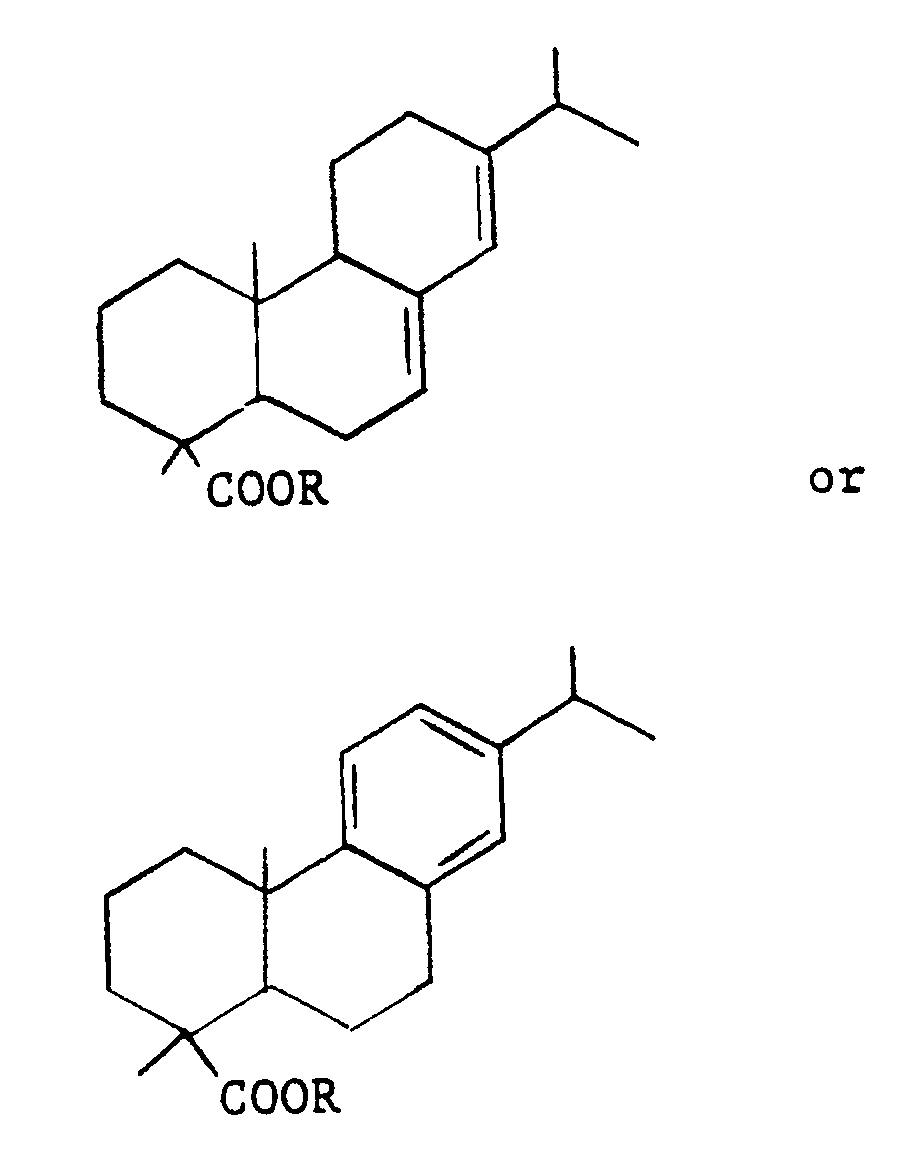
wherein R is selected from an aliphatic radical having from 12 to about 22 carbon atoms.
wherein R is selected from an aliphatic radical having from 12 to about 22 carbon atoms.
3. A process for preparing rubber compositions which is characterized by admixing
a rubber selected from the group consisting of natural rubber, homopolymers of conjugated
diolefins copolymers of conjugated diolefins and ethylenically unsaturated monomers
or mixtures thereof with an alkyl ester of rosin acid wherein the alkyl contains from
about 12 to about 22 carbon atoms.
4. A process for preparing rubber compositions according to claim 3 characterized
in that the alkyl ester of rosin acid is at a concentration of from about 2 parts
per hundred rubber to 50 parts per hundred rubber and is in an intimate mixture with
said rubber.
5. The composition of claim 4 characterized in that said alkyl ester of rosin acid
is added to a rubber selected from the group consisting of natural rubber, homopolymers
of conjugated diolefins and copolymers of conjugated diolefins and ethylenically unsaturated
monomers.
6. A rubber composition which is characterized by (1) a rubber selected from the group
consisting of natural rubber, homopolymers of conjugated diolefins and copolymers
of conjugated diolefins, ethylenically unsaturated monomers or mixtures thereof and
(2) an alkyl ester of rosin acid wherein said alkyl contains from about 12 to about
22 carbon atoms.
7. The rubber composition of claim 6 characterized in that the rubber is selected
from the group consisting of natural rubber, polybutadiene, SBR, polyisoprene or mixtures
thereof.
8. The rubber composition of claim 6 characterized in that said alkyl ester of rosin
acid is at a concentration of from about 20 parts per hundred rubber to 50 parts per
hundred rubber.