| (19) |
 |
|
(11) |
EP 0 425 486 B1 |
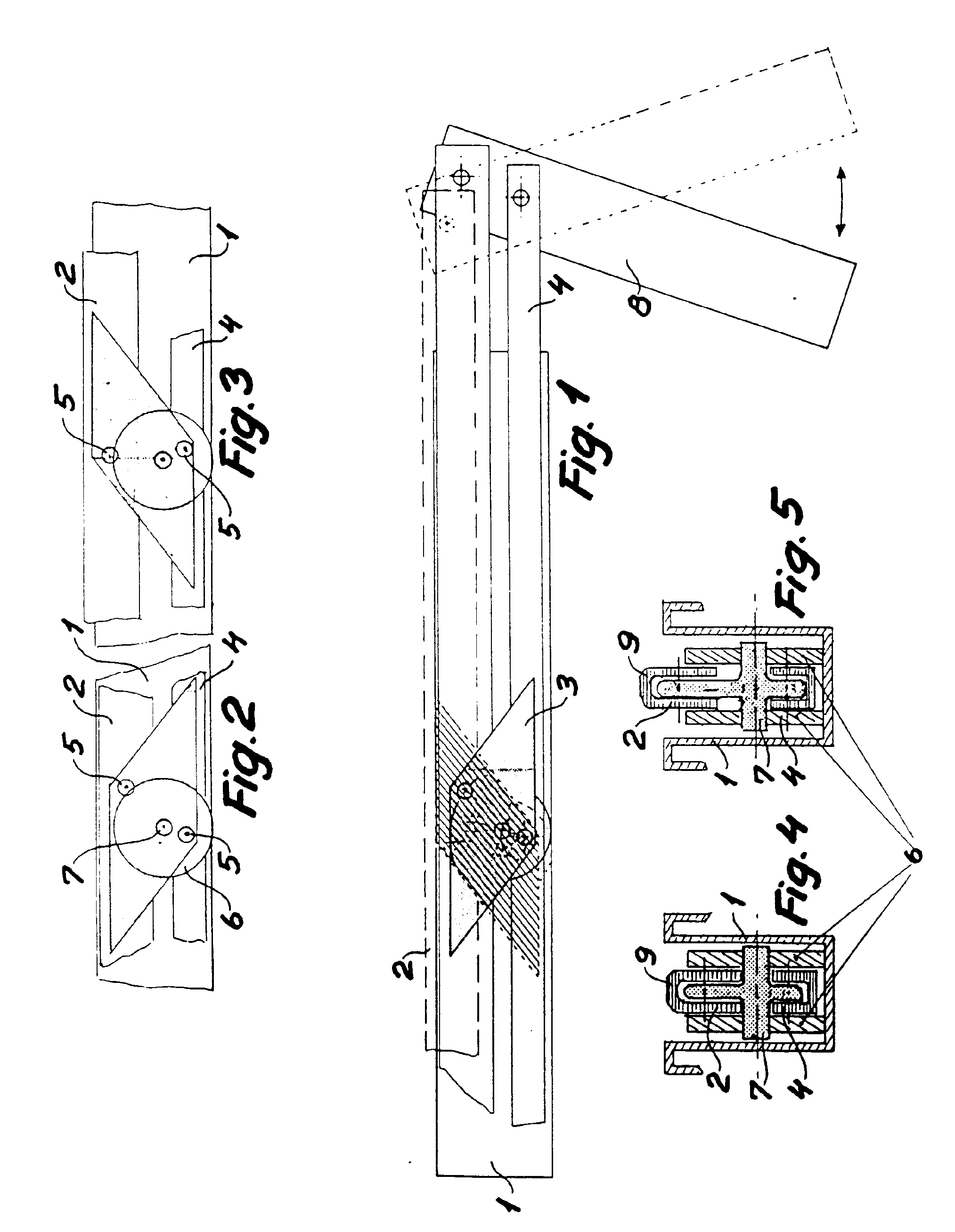
| (12) |
EUROPEAN PATENT SPECIFICATION |
| (45) |
Mention of the grant of the patent: |
|
17.06.1992 Bulletin 1992/25 |
| (22) |
Date of filing: 27.01.1989 |
|
| (86) |
International application number: |
|
PCT/DK8900/014 |
| (87) |
International publication number: |
|
WO 8907/080 (10.08.1989 Gazette 1989/18) |
|
| (54) |
A CONVEYOR, IN PARTICULAR FOR HEAVY OBJECTS
FÖRDERVORRICHTUNG, INSBESONDERE FÜR SCHWERE GEGENSTÄNDE
TRANSPORTEUR DESTINE EN PARTICULIER AUX OBJETS LOURDS
|
| (84) |
Designated Contracting States: |
|
AT BE DE FR GB IT NL SE |
| (30) |
Priority: |
29.01.1988 DK 442/88
|
| (43) |
Date of publication of application: |
|
08.05.1991 Bulletin 1991/19 |
| (73) |
Proprietor: COMSTORE A/S |
|
DK-4733 Tappernoje (DK) |
|
| (72) |
Inventor: |
|
- SOLUND, Jorgen
DK-4733 Tappernoje (DK)
|
| (74) |
Representative: Lichtenberg, Erik et al |
|
c/o Hofman-Bang & Boutard A/S
Adelgade 15
1304 Copenhagen K
1304 Copenhagen K (DK) |
| (56) |
References cited: :
FR-A- 2 194 630
SU-A- 751 726
US-A- 3 590 987
|
FR-A- 2 202 829
US-A- 3 451 532
|
|
| |
|
|
|
|
| |
|
| Note: Within nine months from the publication of the mention of the grant of the European
patent, any person may give notice to the European Patent Office of opposition to
the European patent
granted. Notice of opposition shall be filed in a written reasoned statement. It shall
not be deemed to
have been filed until the opposition fee has been paid. (Art. 99(1) European Patent
Convention).
|
[0001] The invention concerns a conveyor of the type defined in the introductory portion
of claim 1.
[0002] A conveyor of this type is known from SU-A-751726. Here, the rotatable links are
formed as rods. Two of such pivoted rods are in the form of twin-arm levers pivoted
to each other by a rigid tie on which there is a spacer co-acting with fixed stops
and limiters as the load rises and falls. This is an extremely complicated and expensive
construction which, due to said limiters, can only transport the heavy objects to
the left.
[0003] The object of the invention is to provide a conveyor of the type stated in the opening
paragraph which is simpler and cheaper to manufacture, which is easy to operate, and
which can transport the objects both to the left and to the right.
[0004] This is achieved according to the invention in that the conveyor stated in the opening
paragraph is characterized by the features defined in the characterizing portion of
claim 1.
[0005] The invention will be described more fully below with reference to the drawing, in
which
Fig. 1 is a lateral view of the conveyor of the invention, partly in the raised position
shown in broken lines in which objects resting on the conveyor can be transported
to the right by a rod-shaped means, partly in the lowered position shown in solid
lines in which the rod-shaped means of the conveyor may be moved backwards to the
left without said objects being moved,
Figs. 2 and 3 show a section of the conveyor in the lowered and raised positions,
respectively, and
Figs. 4 and 5 show a vertical cross-section of fig. 2 and fig. 3, respectively.
[0006] The conveyor shown in the drawing comprises a cross-sectionally U-shaped stationary
means 1 whose opening faces upwardly.
[0007] The means 1 contains a rod-shaped means 2 which is connected to a rail 4 by means
of a plurality of uniform rotatable links 3, only one of which being shown in the
drawing. The connection between each of the rotatable links 3 and the rod-shaped means
2 consists of a rotatable pin 5, and the connection between each of the rotatable
links 3 and the rail consists of a corresponding rotatable pin 5. The distance between
the rotatable pins 5 in the rod-shaped means 2 is the same as the distance between
the rotatable pins 5 in the rail, so that the rod-shaped means 2 and the rail 4 form
two parallel sides of a parallelogram, whose other sides are the rotatable links 3
or more particularly the distance between the two rotatable pins 5 in each link 3.
[0008] Stop means are provided to limit the movement of the parallelogram connection when
the rod-shaped means 2 is displaced longitudinally with respect to the rail 4. These
stop means are provided by forming the rotatable links 3 as parallelogram-shaped plates,
as shown in figs. 1, 2 and 3. In one extreme position which is shown in fig. 3 and
in which the rod-shaped means 2 is raised with respect to the rail 4, the two parallel
sides of the links 3 engage the rod-shaped means 2 and the rail 4, and in the other
extreme position which is shown in fig. 2 and in which the rod-shaped means 2 is lowered
with respect to the rail 4, the two other parallel sides of the links 3 engage the
rod-shaped means 2 and the rail 4.
[0009] This parallelogram connection consisting of the rod-shaped means 2, the rail 4 and
the connecting rotatable links 3 is journalled in the bottom of the stationary means
1, so that the parallelogram connection 2, 3, 4 can be moved horizontally to the right
or to the left in fig. 1.
[0010] To reduce the frictional resistance in the displacement of the parallelogram connection
2, 3, 4 in the stationary means 1, this parallelogram connection is provided with
wheels 6 whose shafts 7 are secured to the rail 4 or, as shown in the drawing, to
the part of the rotatable links 3, which is close to the rotatable pin 5 of the link
3 in the rail 4 so that the height of said shafts 7 above the bottom of the stationary
means 2 is constant or nearly constant. The shafts 7 may also be secured to one of
the rotatable pins 5 which connect the rail 4 with a parallelogram-shaped plate.
[0011] Displacement in a horizontal direction of the rod-shaped means 2 with respect to
the rail 4 is obtained by means of the handle 8, which is shown in fig. 1 and which
may simultaneously be used for displacing the parallelogram connection 2, 3, 4 horizontally
in the stationary means 1.
[0012] In the raised position of the parallelogram connection 2, 3, 4 the upper edge 9 of
the rod-shaped means 2 extends upwardly above the opening of the stationary means
1, as shown in figs. 3 and 5 and with broken lines in fig. 1. This position is obtained
when the handle 8 in fig. 1 is pulled to the right and objects (not shown) disposed
on or suspended from the conveyor, e.g. on hangers, are transported to the right.
[0013] On the other hand, in the lowered position of the parallelogram connection the upper
edge 9 of the rod-shaped means 2 is disposed below the opening of the stationary means
1, as shown in figs. 2 and 4 and with solid lines in fig. 1. This position is obtained
when the handle 8 in fig. 1 is pushed to the left, and the said objects on the conveyor
will still rest on the stationary means 1.
[0014] Accordingly, as an overall result objects on the conveyor will be transported to
the right in fig. 1 when the handle 8 is reciprocated.
[0015] Instead of the handle 8, it is of course also possible to use another motion mechanism,
e.g. a jack or a piston mechanism.
[0016] Instead of the wheels 6, slide blocks might be used, which are capable of taking
up greater loads than the wheels 6.
[0017] Two or more conveyors may be placed in mutual spaced and parallel relationship, and
the objects may be positioned so as to rest on several conveyors simultaneously.
[0018] It is hereby possible to transport heavier and larger objects. These conveyors arranged
in parallel may be positioned between guides (not shown) preventing the transported
objects from falling down at one or the other side of these parallel conveyors.
1. A conveyor, in particular for heavy objects, and consisting of a cross-sectionally
U-shaped stationary means (1) with the opening facing upwardly and first support means
(2) reciprocable in said stationary means (1) by a motion mechanism, the upper edge
(9) of said first support means (2) being adapted to be lifted upwardly above the
opening of the stationary means (1) upon movement in the forward direction and to
be lowered below this opening upon movement in the return direction by coupling means,
which first support means (2) is so connected to second support means (4), slidable
in the bottom of the U-shaped stationary means (1), by means of rotatable links (3)
that the first support means (2) and the second support means (4) form two parallel
sides of a parallelogram whose other two sides are the rotatable links (3), stop means
being provided to restrict the movement of the parallelogram when the first support
means (2) is moved longitudinally in one or the other direction with respect to the
second support means (4), to an extreme position in which the upper edge (9) of the
first support means (2) is lifted upwardly above the opening of the stationary means
(1) and another extreme position in which said upper edge (9) is lowered below said
opening, respectively, characterized in that the first support means (2) is a rod-shaped means (2) and the second support
means (4) is a rail (4) and that said rotatable links (3) are parallelogram-shaped
plates (3) which are rotatably connected with the rod-shaped means (2) and the rail
(4), respectively, at the obtuse angles, while one or the other pair of opposing parallelogram
sides is adapted to form stop means in one or the other extreme position upon engagement
with the rod-shaped means and the rail, respectively.
2. A conveyor according to claim 1, characterized in that a handle (8) rotatably connected with the rod-shaped means (2) and the rail
(4) is adapted to move the rod-shaped means (2) with respect to the rail (4).
3. A conveyor according to claim 1 or 2, characterized in that both the rod-shaped means (2) and the rail (4) are U-shaped in cross-section
with the openings facing towards each other and surrounding said rotatable links (3).
4. A conveyor according to any of the preceding claims, characterized in that the rail (4) is supported by means of wheels (6) during movement in the stationary
body (1).
5. A conveyor according to claims 1 and 4, characterized in that shafts (7) for said wheels (6) are secured to the parallelogram-shaped plates
(3).
6. A conveyor according to claim 4, characterized in that shafts (7) for said wheels (6) are secured in the rail (4).
7. A conveyor according to claim 6, characterized in that shafts (7) for said wheels (6) are secured to rotatable pins (5) connecting
the rail (4) with a parallelogram-shaped plate (3).
1. Eine Fördervorrichtung, insbesondere für schwere Gegenstände bestehend aus einer
im Querschnitt U-förmigen stationären Vorrichtung (1), deren Öffnung nach oben weist
und einer ersten Stützvorrichtung (2), die in der stationären Vorrichtung (1) durch
einen Bewegungsmechanismus hin- und herbewegbar ist, wobei die Oberkante (9) der ersten
Stützvorrichtung (2) in der Lage ist, mittels Verbindungsvorrichtungen über die Öffnung
der stationären Vorrichtung (1) hinausgehoben zu werden bei einer Bewegung in Vorwärtsrichtung
und unterhalb dieser Öffnung abgesenkt zu werden bei einer Bewegung in die entgegengesetzte
Richtung, wobei die erste Stützvorrichtung (2) hierbei mit einer zweiten Stützvorrichtung
(4) verbunden ist, auf der Bodenseite der U-förmigen stationären Vorrichtung (1) gleitbar
ist mittels drehbaren Verbindungsteilen (3), wobei die erste Stützvorrichtung (2)
und die zweite Stützvorrichtung (4) zwei parallele Seiten eines Parallelogramms bilden,
dessen andere zwei Seiten die drehbaren Verbindungsteile (3) sind, wobei Anschlagvorrichtungen
vorgesehen sind, um die Bewegung des Parallelogramms zu begrenzen, wenn die erste
Stützvorrichtung (2) in Längsrichtung in eine oder die andere Richtung bezüglich
der zweiten Stützvorrichtung (4) in eine Extremlage bewegt wird, in der die Oberkante
(9) der ersten Stützvorrichtung (2) nach oben über die Öffnung der stationären Vorrichtung
(1) angehoben wird und eine andere Extremlage, in der die Oberkante (9) unterhalb
die Öffnung abgesenkt wird, dadurch gekennzeichnet, daß die erste Stützvorrichtung
(2) eine stabförmige Vorrichtung (2) ist und daß die zweite Stützvorrichtung (4) eine
Schiene (4) ist und daß die drehbaren Verbindungsteile (3) parallelogrammförmige Platten
(3) sind, welche drehbar mit der stabförmigen Vorrichtung (2) bzw. der Schiene (4)
stumpfwinklig verbunden sind, wo bei eines oder das andere Paar von entgegengesetzten
Parallelogrammseiten in der Lage ist, Anschlagvorrichtungen in einer oder der anderen
Extremlage bei Bewegung mit der stabförmigen Vorrichtung bzw. der Schiene zu bilden.
2. Eine Fördervorrichtung nach Anspruch 1, dadurch gekennzeichnet, daß ein Handgriff
(8), der drehbeweglich mit der stabförmigen Vorrichtung (2) und der Schiene (4) verbunden
ist, in der Lage ist, die stabförmige Vorrichtung (2) bezüglich der Schiene (4) zu
bewegen.
3. Eine Fördervorrichtung nach Anspruch 1 oder 2, dadurch gekennzeichnet ,daß sowohl
die stabförmige Vorrichtung (2) als auch die Schiene (4) im Querschnitt U-förmig
sind, wobei die Öffnungen einander gegenüberliegen und die drehbaren Verbindungsteile
(3) umgreifen.
4. Eine Fördervorrichtung nach einem der vorhergehenden Ansprüche, dadurch gekennzeichnet,
daß die Schiene (4) während einer Bewegung in dem stationären Körper (1) mittels Rädern
(6) gestützt ist.
5. Eine Fördervorrichtung nach Anspruch 1 und 4, dadurch gekennzeichnet, daß Wellen
(7) für die Räder (6) an den parallelogrammförmigen Platten (3) befestigt sind.
6. Eine Fördervorrichtung nach Anspruch 4, dadurch gekennzeichnet, daß Wellen (7)
für die Räder (6) an der Schiene (4) befestigt sind.
7. Eine Fördervorrichtung nach Anspruch 6, dadurch gekennzeichnet, daß Wellen (7)
für die Räder (6) an drehbaren Zapfen (5) befestigt sind, welche die Schiene (4) mit
einer parallelogrammförmigen Platte (3) verbinden.
1. Transporteur, en particulier pour objets lourds, et constitué d'un moyen fixe (1)
de section transversale en forme de U dont l'ouverture est tournée vers le haut et
d'un premier moyen (2) de support pouvant exécuter un mouvement alternatif dans ledit
moyen fixe (1) à l'aide d'un mécanisme de déplacement, le bord supérieur (9) dudit
premier moyen (2) de support étant destiné à être élevé au-dessus de l'ouverture du
moyen fixe (1) lors d'un mouvement dans le sens d'avance et être abaissé au-dessous
de cette ouverture lors d'un mouvement dans le sens de retour par des moyens d'accouplement,
lequel premier moyen (2) de support est relié à un second moyen (4) de support, pouvant
coulisser dans le fond du moyen fixe (1) de forme en U, à l'aide d'éléments de liaison
tournants (3) de manière que le premier moyen (2) de support et le second moyen (4)
de support forment deux côtés parallèles d'un parallélogramme dont les deux autres
côtés sont les éléments pivotants de liaison (3), des moyens de butée étant prévus
pour limiter le mouvement du parallélogramme lorsque le premier moyen (2) de support
s'est déplacé longitudinalement dans un premier sens ou dans l'autre sens par rapport
au second moyen (4) de support, à une position extrême dans laquelle le bord supérieur
(9) du premier moyen (2) de support est élevé au-dessus de l'ouverture du moyen fixe
(1) et à une autre position extrême dans laquelle ledit bord supérieur (9) est abaissé
au-dessous de ladite ouverture, respectivement, caractérisé en ce que le premier moyen
(2) de support est un moyen (2) en forme de barre et le second moyen (4) de support
est un rail (4), et en ce que lesdits éléments pivotants (3) de liaison sont des plaques
(3) en forme de parallélogramme qui sont reliées de façon à pouvoir tourner, par les
angles obtus, au moyen (2) en forme de barre et au rail (4), respectivement, tandis
qu'une paire ou l'autre paire de côtés opposés du parallélogramme est destinée à former
des moyens de butée dans l'une ou l'autre des positions extrêmes par engagement avec
le moyen en forme de barre et le rail, respectivement.
2. Transporteur selon la revendication 1, caractérisé en ce qu'un levier (8), relié
de façon à pouvoir tourner au moyen (2) en forme de barre et au rail (4), est destiné
à déplacer le moyen (2) en forme de barre par rapport au rail (4).
3. Transporteur selon la revendication 1 ou 2, caractérisé en ce que le moyen (2)
en forme de barre et le rail (4) ont tous deux une section transversale de forme en
U, les ouvertures étant tournées l'une vers l'autre et entourant lesdits éléments
pivotants (3) de liaison.
4. Transporteur selon l'une quelconque des revendications précédentes, caractérisé
en ce que le rail (4) est supporté au moyen de roues (6) durant un mouvement dans
le corps fixe (1).
5. Transporteur selon les revendications 1 et 4, caractérisé en ce que des axes (7)
pour lesdites roues (6) sont montés sur les plaques (3) en forme de parallélogramme.
6. Transporteur selon la revendication 4, caractérisé en ce que des axes (7) pour
lesdites roues (6) sont fixés dans le rail (4).
7. Transporteur selon la revendication 6 , caractérisé en ce que les axes (7) pour
lesdites roues (6) sont fixés à des broches tournantes (5) reliant le rail (4) à une
plaque (3) en forme de parallélogramme.