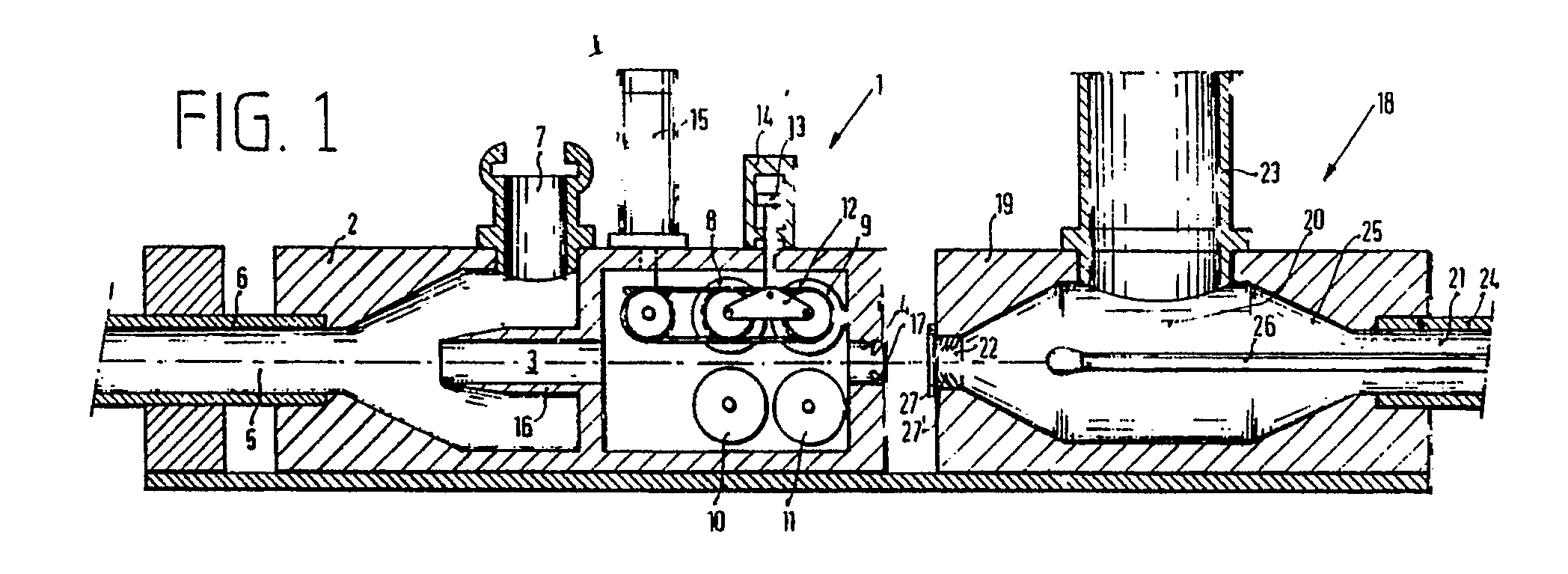
(57) Apparatus for installing cables with a certain stiffness, more in particular glass
fibre cables, into a duct (6, 24) of a channelization system, using the working of
a compressed gas, which apparatus is adapted to exert pushing forces on a cable (26)
being introduced in order to support the compressed gas working on the cable in the
duct. The apparatus comprises cable advancing means and gas inserting means. The cable
advancing means include a hollow, substantially rectilinear cable lead-through channel
(3) with an entrance end (4) and an exit end (5), at least one pair of wheels (8,
10; 9, 11) mounted opposite to each other for moving on a cable (26) disposed between
these wheels into the direction of the outlet end (21) of the duct (6), and a pneumatic
motor (15) coupled to at least one of said wheels for providing a driving couple to
it. At least one of the wheels is coupled to a pneumatic piston/cylinder combination
(13, 14), in such a way that when compressed gas is supplied to the pneumatic cylinder
(14), transverse forces will be exerted on the cable (26) disposed between the wheels
(8, 10; 9, 11). The gas inserting means include a gas channel (7), which debouches
into the cable lead-through channel (3) and which is adapted for inserting compressed
gas into the lead-through channel (3) between the wheels and the exit end (5) of the
lead-through channel (3). The motor (15) is capable of providing a driving couple,
which is larger than the driving couple, which has to act on the cable (26) to compensate
a pressure difference existing at the inlet end of the duct between the pressure inside
and the pressure outside the cable lead-through channel (3) as a consequence of inserting
the compressed gas via the gas channel (7) into the cable lead-through channel
(3). The pushing forces are exerted by the wheels on the cable (26) as a consequence
of the cooperative effect of the driving couple and the transverse forces. The gas
channel (7), the pneumatic motor (15) and the piston/cylinder combination may be coupled
to the same compressor. For use in a tandem arrangement the apparatus comprises further
a coupling unit (18) to be coupled to an outlet end (21) of a preceding duct section
(24), and which includes a mainly hollow housing (19), an outlet pipe (23) for diverting
a flow of gas, which may leave the outlet end (21) of the duct section (24), and an
outlet opening (22) through which a cable may be led into the direction of the entrance
end (4) of the cable lead-through channel (3).
Advantages: the exerted transverse forces are very acurately adjustable and substantially
constant; the apparatus is non-destructive to the cable when cable introduction is
slowing down or stagnates; in a tandem arrangement the apparatus needs hardly any
human interference and is safe for the operating staff.
|
|
