|
(11) | EP 0 428 802 B1 |

| (12) | EUROPEAN PATENT SPECIFICATION |
|
|
| (54) |
Preparation of polyoxyalkylene glycol amines Herstellung von Polyoxyalkylenglycolaminen Préparation de polyoxyalkylène glycolamines |
|
|
||||||||||||||||||||||||||||
| Note: Within nine months from the publication of the mention of the grant of the European patent, any person may give notice to the European Patent Office of opposition to the European patent granted. Notice of opposition shall be filed in a written reasoned statement. It shall not be deemed to have been filed until the opposition fee has been paid. (Art. 99(1) European Patent Convention). |
[0002] Amino alcohols are desirable and well known types of compounds. US-A- 3 231 619 describes a method for manufacturing amino alcohols as does US-A- 4 612 335.
[0003] It would be desirable to provide a facile method for manufacturing amino alcohols which contain a primary amine group and a primary hydroxyl group on each molecule.
[0004] A method for preparing polyoxyalkylene compounds of 200 to 4000 molecular weight which have a primary amine group and a primary hydroxyl group said compounds having the structure:
where
x = up to 50
R = H, CH₃, C₂H₅
comprising reacting a compound of the formula
where R₁ is H, -CH₃ or -CH₂CH₃ with ethylene oxide, propylene oxide and/or 1,2-butylene oxide or mixtures thereof, aminating the product of said reaction and then cleaving the t-butyl group of the aminated compound with an acidic reagent.
[0005] The method of our invention is the manufacture of a polyoxyalkylene polymer in the range of 200 to 4000 molecular weight which have in each molecule a primary amine group at one end and a primary hydroxyl group at the other. This can be accomplished by the use of three known reactions by careful selection of starting materials and reactants. The reaction scheme is shown below:
R = H, CH₃, C₂H₅
R₁ = H, CH₃, C₂H₅
x = up to 50
In reaction I the alkoxylation of a blocked ethylene, propylene or butylene glycol is shown. In order to obtain the primary hydroxyl group on the final amino alcohol the tertiary butyl (t-butyl) ether is preferred. The epoxide may be ethylene oxide, propylene oxide or butylene oxide. Alkoxylation reactions are known in the art and are catalyzed by potassium or sodium hydroxides, for example. US-A- 3 535 307 describes typical alkoxylation techniques useful in this invention. Other known methods for alkoxylation are acceptable for this invention. The degree of alkoxylation will determine the molecular weight of the product. The type of epoxide used will also help determine the solubility characteristics of the final material. It is known, for example, that ethylene oxide adducts are usually more water soluble than propylene oxide adducts and butylene oxide adducts. The desirable molecular weight will be determined by the amount of epoxide added in order to serve the purpose of the end user. Thus, those skilled in the art will be able to adjust both the water solubility and the molecular Weight of the material in reaction I.
[0006] Reaction II is the amination of the alkoxylated material from the reaction I. This amination of polyoxyalkylene alcohols is described for example in US-A- 3 654 370.
[0007] The aminated alcohol, which is the result of reaction II, is then reacted with a strong acid such as hydrochloric acid. Enough acid is necessary to neutralize the amine and enough excess to provide the acid conditions necessary for cleavage on the t-butyl group. Those skilled in the art will be able to determine the proper conditions for cleavage to take place. Conditions may range from room temperature to 150°C and pressure low enough to allow the cleaved isobutylene to escape the reacting mixture. For example, atmospheric is acceptable but any pressure which achieves the results described is acceptable. As a result the tertiary butyl end part of the molecule is cleaved and replaced by a primary hydroxyl group. Thus, the result of this reaction scheme is the manufacture of a variable molecular weight polyoxyalkylene amino alcohol which contains a primary hydroxyl group at one end and a primary amine group at the other end. The acidic groups useful in the cleavage reaction III were found to be materials such as hydrochloric acid or hydrobromic acid. It was found that other materials such as sulfuric acid, Amberlyst® 15 (acidic ion exchange resin), Zeolite® ZM-8 (sodium aluminum phosphate), and salts of a polyether amine and Amberlyst® 15 did not work as well.
Example 1
[0009] This example will illustrate the preparation of a 550 molecular weight propylene oxide adduct of propylene glycol t-butyl ether (Arcosolv PTB, ARCO Chemical Co.)
[0010] 2.72 kg (Six pounds) of propylene glycol t-butyl ether were charged into a 38 litre (ten-gallon) reactor. The reactor was then purged with prepurified nitrogen. The reactor was then heated to 75°C and 45.4g flaked potassium hydroxide was added to the reactor and stirred until it was solubilized. At this point the water content of the charge was 0.295%. It was then nitrogen stripped to a water content of 0.1% or less. 9.67 kg of propylene oxide (21.3 lb) was then reacted at 105-115°C at 0.445 MPa (50 psig). Approximately four hours was required for addition of the propylene oxide. The reaction mixture was then digested two hours to an equilibrium pressure. The alkaline product was then neutralized at 95°C by stirring two hours with 270g Magnesol 30/40 which was added as an aqueous slurry. The neutralized product was then stabilized with 6.2g di-t-butyl-p-cresol, vacuum and nitrogen stripped and filtered. The finished product had the following properties:
| Properties: | |
| Acid no., mg KOH/g | 0.003 |
| Hydroxyl no., mg KOH/g | 102 |
| Water, wt.% | 0.002 |
| pH in 10:6 isopropanol/water | 8.1 |
| Color, Pt-Co | 25 |
| Sodium, ppm | 0.5 |
| Potassium, ppm | 0.3 |
| Viscosity, °C/°F, 10⁻⁶ m²/sec (cSt) | |
| 25/77 | 47.6 |
| 38/100 | 27.1 |
Example 2
[0011] This example will demonstrate the reductive amination of the 550 molecular weight propylene oxide adduct of propylene glycol t-butyl ether prepared in Example 1.
[0012] Into a 1250 cm³ tubular reactor filled with a nickel oxide-copper oxide-chromium oxide catalyst were fed the polyether (363 g/h 0.8 lb/h), ammonia (545 g/h/ 1.20 lb/h), and hydrogen (48 l/h). The reactor was kept at 190°C and the pressure was 13.9 MPa (2000 psig). The crude reactor effluent was then stripped at 70°C and 0.47 kPa (3.5 mm Hg) for 30 minutes. The resultant product had the following properties:
| Properties | |
| Total amine, meq/g | 1.75 |
| Primary amine, meq/g | 1.75 |
| Total acetylatables, meq/g | 1.74 |
Example 3
[0013] Into a 500 cm³ three-necked flask equipped with a stirrer, thermometer, water condenser and nitrogen source were charged 200g of the aminated polyether of Example 2 and 93.6g of 15% aqueous hydrochloric acid. The reaction temperature immediately rose to 58°C at which point heat was applied and the reaction mixture heated at 92-100°C for 3.75 hrs. The product was then neutralized with 144g of 15% aqueous potassium hydroxide. The neutralized product was then vacuum stripped to a minimum pressure at 112°C for one hour and filtered with the aid of Hyflo Supercel. The filtered product was a dark yellow liquid which had the following properties:
| Total amine, meq/g | 2.0 |
| Total acetylatables, meq/g | 3.3 |
Example 4
[0015] Using the procedure outlined in Example 1, a polyether alcohol was made using the following reaction sequence:
Propylene glycol t-butyl ether + 8 moles EO + 10 moles PO.
The product had the following properties:
| Acid no., mg KOH/g | 0.001 |
| Hydroxyl no., mg KOH/g | 65 |
| Water, wt % | 0.13 |
| pH in 10:6 isopropanol-water | 7.9 |
| Color, Pt-Co | 50 |
| Sodium, ppm | 0.5 |
| Potassium, ppm | 1.2 |
| Viscosity, °C/°F, 10⁻⁶ m²/sec/ (cSt) | |
| 25/77 | 108 |
| 38/100 | 61.3 |
Example 5
[0016] The polyether alcohol of Example 4 was reductively aminated over the nickel-copper-chromium catalyst described in Example 2 at 210°C, 13.9 MPa (2000 psig), and a liquid space velocity of 0.75 g/cm³-cat/h. Ammonia was 60% of the liquid feed so the polyol space velocity was 0.30 g/cm³-cat/h. Properties of the aminated polyether were as follows:
| Properties | |
| Total acetylatables, meq/g | 1.14 |
| Total amine, meq/g | 1.09 |
| Primary amine, meq/g | 1.09 |
| Color, Pt-Co | 20 |
Example 6
[0017] This example will demonstrate the cleavage of the polyetheramine of Example 5 to form the corresponding amino alcohol. It will further show that the reaction can be monitored (disappearance of t-butyl group) using ¹³C NMR.
[0018] Into a two-liter four-necked flask equipped with a stirrer, thermometer, water condenser, and nitrogen source were charged 500 g of the polyetheramine and 139.5 g 15% aqueous hydrochloric acid. The reaction mixture was then heated over a 40-minute period to 105°C and held at 104-107°C over a three-hour period. Vigorous evolution of isobutylene occurred at 100-105°C. An additional 6.6 g 15% hydrochloric acid was added to the reaction mixture which was heated an additional hour at 105°C. Samples were withdrawn at one-hour intervals for ¹³C NMR analysis. At the end of the reaction, the product was neutralized by stirring with 75 g 45% aqueous potassium hydroxide and 34 g Magnesol 30/40. The neutralized product was then vacuum stripped to 125°C and 0.667 kPa (5 mm Hg) and filtered with the aid of Hyflo Supercel filter aid. The finished product was a light yellow viscous liquid with the following properties:
| Total acetylatables, meq/g | 2.25 |
| Total amine, meq/g | 1.14 |
| Water, wt% | 0.033 |
[0019] The ¹³C NMR spectra of the product was consistent with the following structure:
The extent of cleavage, as monitored by ¹³C NMR, was as follows:
| Time, h | t-Butyl cleavage, % |
| 0 | 0 |
| 1 | 59 |
| 2 | 61 |
| 3 | 72 |
| 4 | 98 |
Example 7
[0020] This example will demonstrate a scale-up preparation of an amino alcohol by removal of the t-butyl group from the polyether amine of Example 5.
[0021] 2.36 kg (5.2 lb) of the polyetheramine were charged into a 11.35 litre (three-gallon kettle which was then purged with prepurified nitrogen. Fifteen percent aqueous hydrochloric acid (689.3g) was then added to the polyether amine and the mixture heated to 105-110°C for six hours. The kettle was vented to the flare during that period as isobutylene was liberated during the reaction. An additional 31.3g of the 15% hydrochloric acid was then added to the kettle and the mixture heated an additional two hours at 105-110°C. The reaction mixture was then neutralized with 369.9g 45% aqueous potassium hydroxide and stirred an additional two hours with 166.4g Magnesol® 30/40 which was added as an aqueous slurry. The product was then vacuum stripped to a minimum pressure, nitrogen stripped and filtered with the aid of a filter acid. The finished product was a dark yellow viscous liquid which had the following properties:
| Total amine, meq/g | 1.102 |
| Total acetylatables, meq/g | 2.232 |
| Water, wt% | 0.18 |
| pH in 10:6 isopropanol-water | 11.5 |
| Sodium, ppm | 5.8 |
| Potassium, ppm | 19 |
| Viscosity, °C/°F, 10⁻⁶ m²/sec (cSt) | |
| 25/77 | 139 |
| 38/100 | 72.6 |
The NMR spectra of the product indicated that 95% of the t-butyl group had been removed.
1. A method for preparing polyoxyalkylene compounds having the formula:
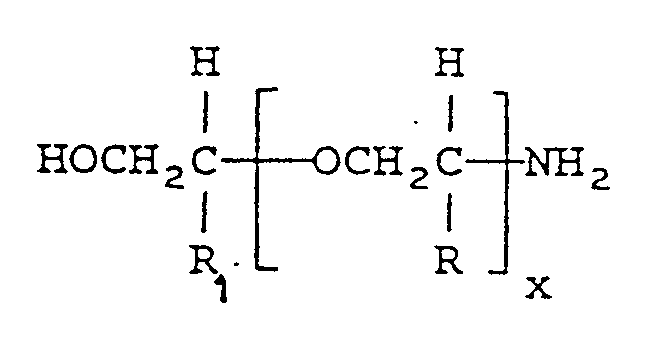
wherein R and R₁, which can be the same or different, are each H, -CH₃ or C₂H₅, and x is up to 50
characterised by reacting a compound of the formula
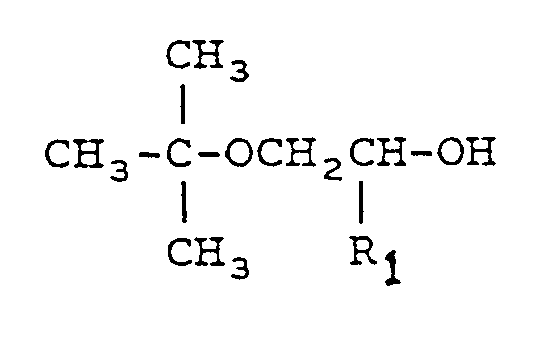
with ethylene oxide, propylene oxide, 1,2-butylene oxide or a mixture thereof, aminating the product of said reaction, and then cleaving the t-butyl group of the aminated compound with a halogen acid.
wherein R and R₁, which can be the same or different, are each H, -CH₃ or C₂H₅, and x is up to 50
characterised by reacting a compound of the formula
with ethylene oxide, propylene oxide, 1,2-butylene oxide or a mixture thereof, aminating the product of said reaction, and then cleaving the t-butyl group of the aminated compound with a halogen acid.
2. A method according to Claim 1 characterised in that R is H and/or CH₃.
3. A method according to Claim 3 characterised in that R₁ is CH₃.
4. A method according to any one of Claims 1 to 4 characterised in that x is 8.
5. A method according to Claim 1 characterised in that a compound of the formula
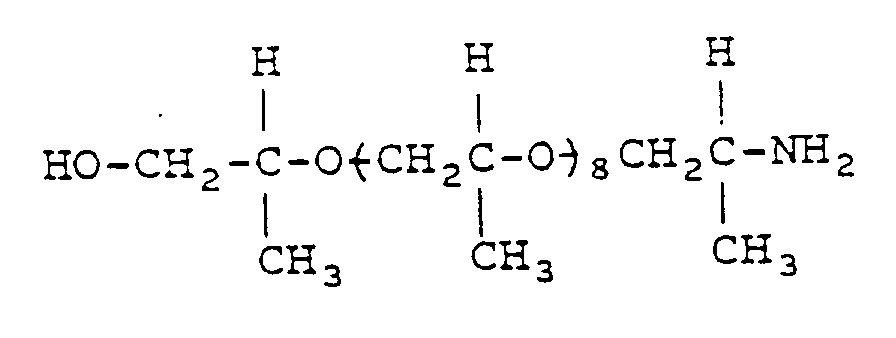
is prepared by reacting a compound of the formula
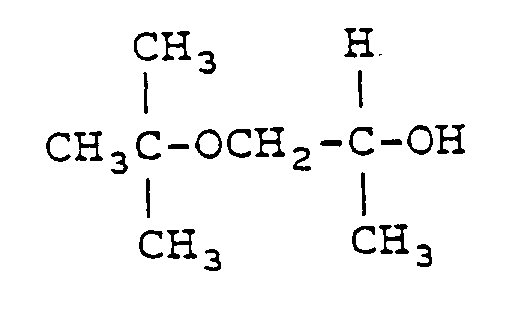
with propylene oxide, aminating the product of the reaction, and then cleaving the t-butyl group of the aminated compound with a halogen acid.
is prepared by reacting a compound of the formula
with propylene oxide, aminating the product of the reaction, and then cleaving the t-butyl group of the aminated compound with a halogen acid.
6. A method according to Claim 1 characterised in that a compound of the formula
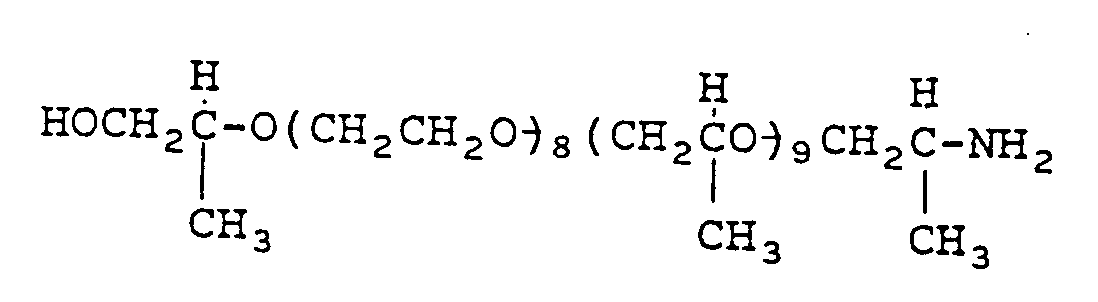
is prepared by reacting a compound of the formula
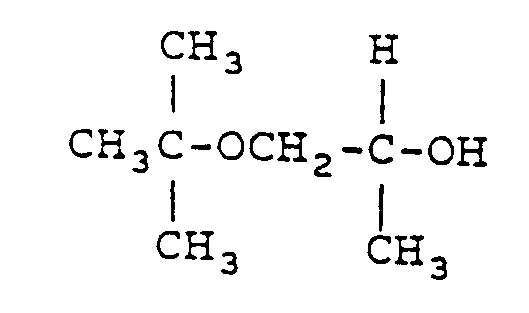
with propylene oxide and ethylene oxide, aminating the product of the reaction and then cleaving the t-butyl group of the aminated compound with a halogen acid.
is prepared by reacting a compound of the formula
with propylene oxide and ethylene oxide, aminating the product of the reaction and then cleaving the t-butyl group of the aminated compound with a halogen acid.
1. Ein Verfahren zur Herstellung von Polyoxyalkylenverbindungen mit der Formel:
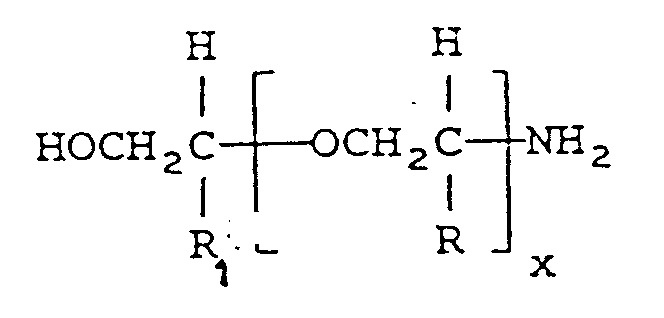
worin R und R₁, die identisch oder verschieden sein können, jeweils H, -CH₃ oder C₂H₅ sind und x bis zu 50 ist,
dadurch gekennzeichnet, daß eine Verbindung der Formel
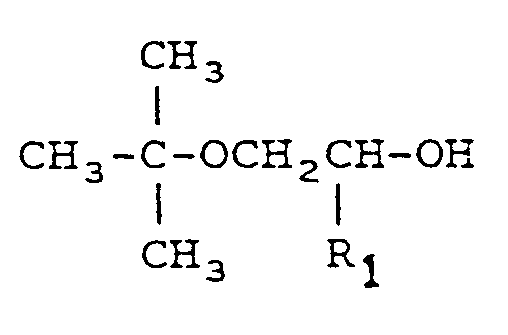
mit Ethylenoxid, Propylenoxid, 1,2-Butylenoxid oder einer Mischung derselben zur Reaktion gebracht, das Produkt besagter Reaktion aminiert und die tert.-Butylgruppe der aminierten Verbindung mit einer Halogensäure abgespalten wird.
worin R und R₁, die identisch oder verschieden sein können, jeweils H, -CH₃ oder C₂H₅ sind und x bis zu 50 ist,
dadurch gekennzeichnet, daß eine Verbindung der Formel
mit Ethylenoxid, Propylenoxid, 1,2-Butylenoxid oder einer Mischung derselben zur Reaktion gebracht, das Produkt besagter Reaktion aminiert und die tert.-Butylgruppe der aminierten Verbindung mit einer Halogensäure abgespalten wird.
2. Ein Verfahren nach Anspruch 1, dadurch gekennzeichnet, daß R H und/oder CH₃ ist.
3. Ein Verfahren nach Anspruch 1, dadurch gekennzeichnet, daß R₁ CH₃ ist.
4. Ein Verfahren nach einem der Ansprüche 1 bis 4, dadurch gekennzeichnet, daß x 8 ist.
5. Ein Verfahren nach Anspruch 1, dadurch gekennzeichnet, daß eine Verbindung der Formel
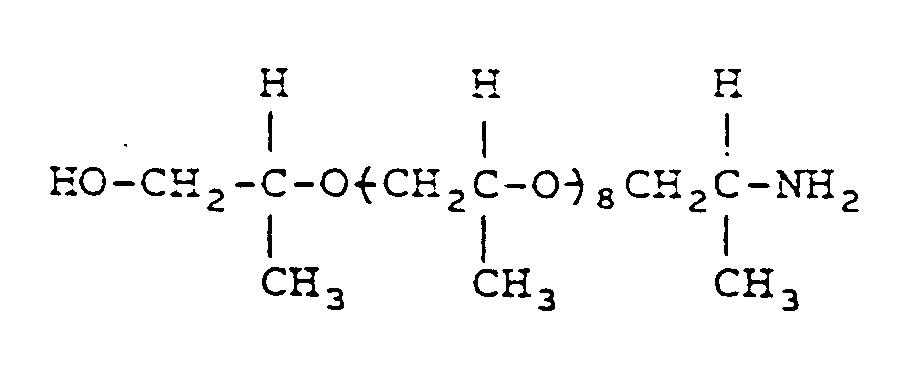
hergestellt wird, indem eine Verbindung der Formel
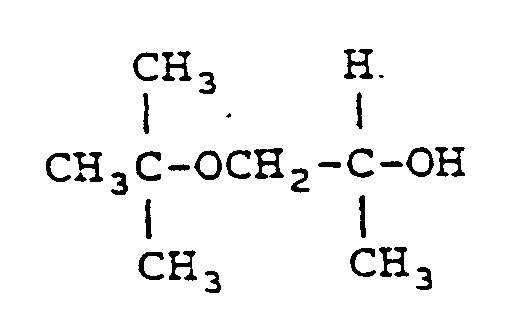
mit Propylenoxid zur Reaktion gebracht, das Produkt der Reaktion aminiert und dann die tert.-Butylgruppe der aminierten Verbindung mit einer Halogensäure abgespalten wird.
hergestellt wird, indem eine Verbindung der Formel
mit Propylenoxid zur Reaktion gebracht, das Produkt der Reaktion aminiert und dann die tert.-Butylgruppe der aminierten Verbindung mit einer Halogensäure abgespalten wird.
6. Ein Verfahren nach Anspruch 1, dadurch gekennzeichnet, daß eine Verbindung der Formel
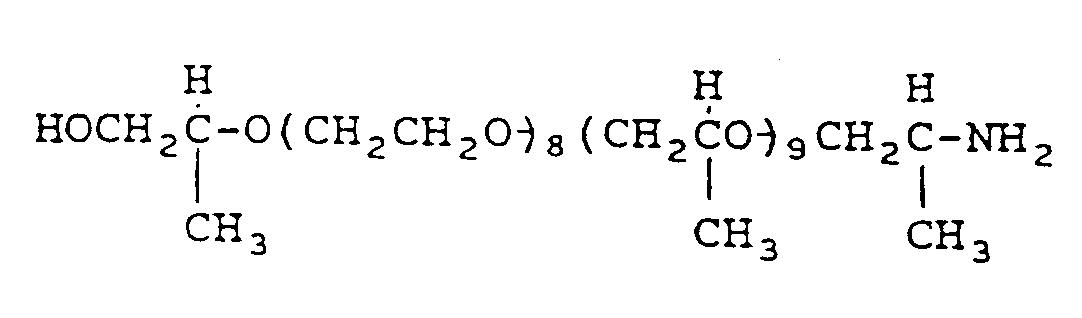
hergestellt wird, indem eine Verbindung der Formel
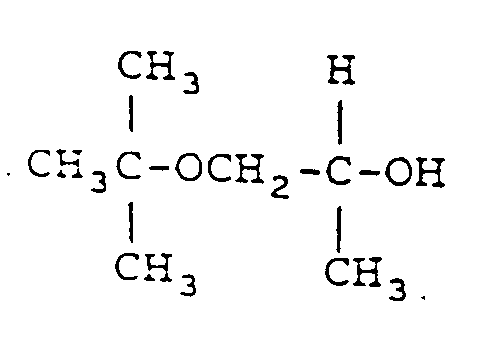
mit Propylenoxid und Ethylenoxid zur Reaktion gebracht, das Produkt der Reaktion aminiert und dann die tert.-Butylgruppe der aminierten Verbindung mit einer Halogensäure abgespalten wird.
hergestellt wird, indem eine Verbindung der Formel
mit Propylenoxid und Ethylenoxid zur Reaktion gebracht, das Produkt der Reaktion aminiert und dann die tert.-Butylgruppe der aminierten Verbindung mit einer Halogensäure abgespalten wird.
1. Procédé pour la préparation de composés polyoxyalkylène ayant la formule :
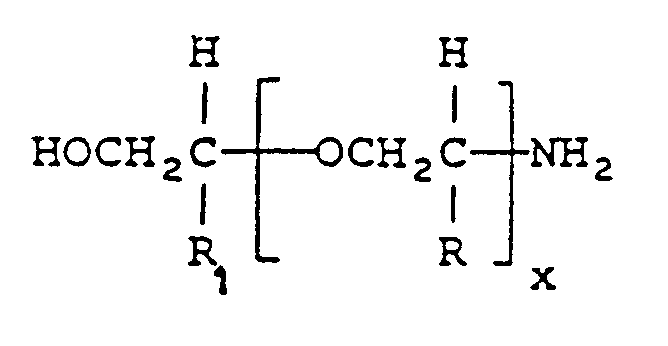
dans laquelle R et R₁, qui peuvent être identiques ou différents, sont chacun H, CH₃ ou C₂H₅, et x est jusqu'à 50
caractérisée par la réaction d'un composé de formule
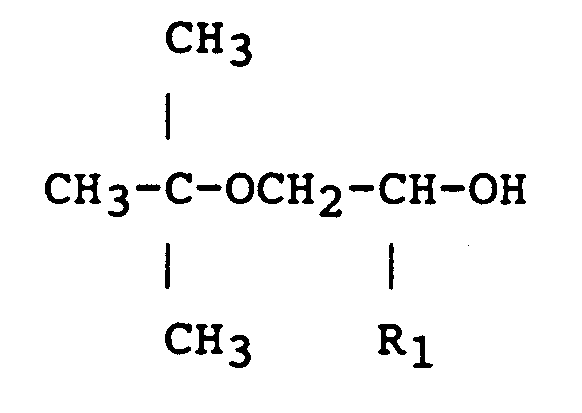
avec l'oxyde d'éthylène, l'oxyde de propylène, l'oxyde du 1,2-butylène ou un mélange de ceux-là, l'amination du produit de ladite réaction, et ensuite la séparation du groupe t-butyle du composé aminé avec un acide halogéné.
dans laquelle R et R₁, qui peuvent être identiques ou différents, sont chacun H, CH₃ ou C₂H₅, et x est jusqu'à 50
caractérisée par la réaction d'un composé de formule
avec l'oxyde d'éthylène, l'oxyde de propylène, l'oxyde du 1,2-butylène ou un mélange de ceux-là, l'amination du produit de ladite réaction, et ensuite la séparation du groupe t-butyle du composé aminé avec un acide halogéné.
2. Procédé selon la revendication 1 caractérisée en ce que R est H et/ou CH₃.
3. Procédé selon la revendication 3 caractérisée en ce que R₁ est CH₃.
4. Procédé selon l'une quelconque des revendications 1 à 4 caractérisée en ce que x est
8.
5. Procédé selon la revendication 1 caractérisée en ce qu'un composé de formule
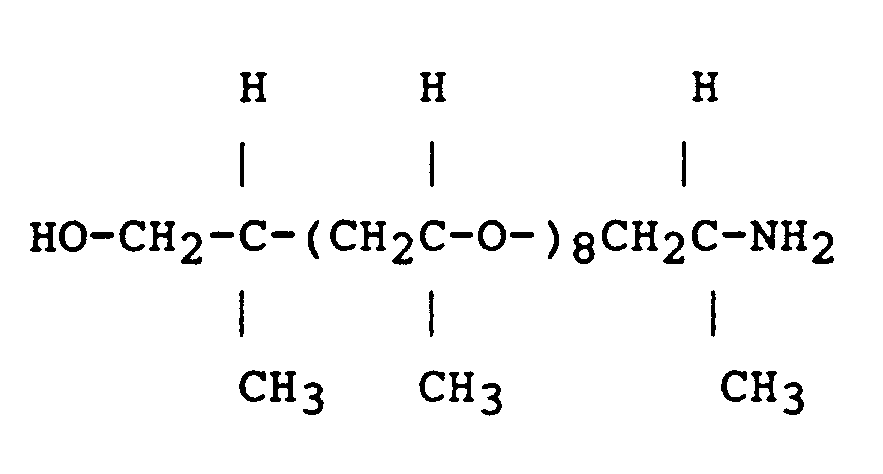
est préparé par la réaction d'un composé de formule
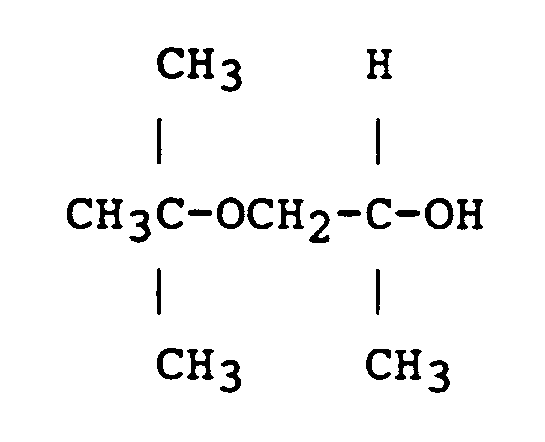
avec l'oxyde de propylène, l'amination du produit de la réaction, et ensuite la séparation du groupe t-butyle du composé aminé avec un acide halogéné.
est préparé par la réaction d'un composé de formule
avec l'oxyde de propylène, l'amination du produit de la réaction, et ensuite la séparation du groupe t-butyle du composé aminé avec un acide halogéné.
6. Procédé selon la revendication 1 caractérisée en ce qu'un composé de formule
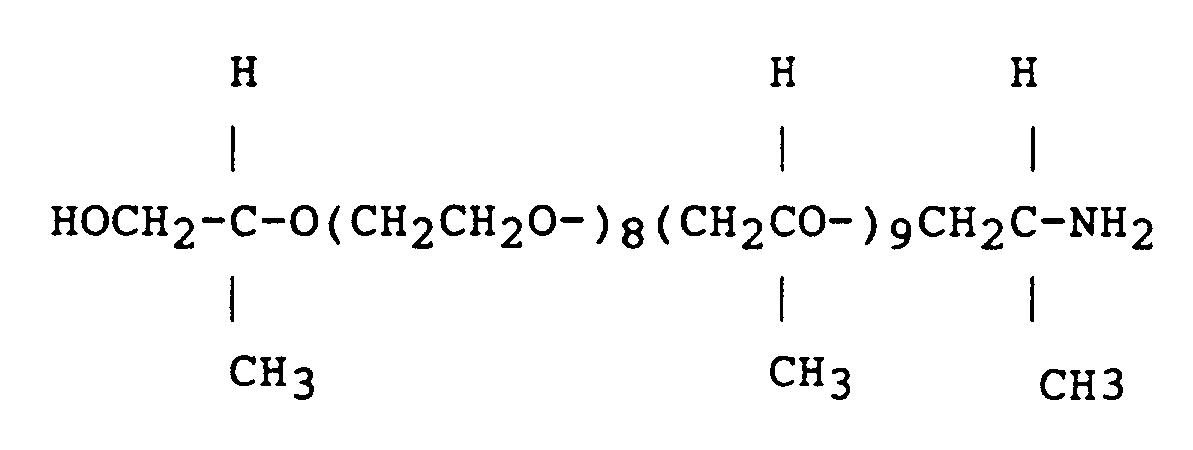
est préparé par la réaction d'un composé de formule
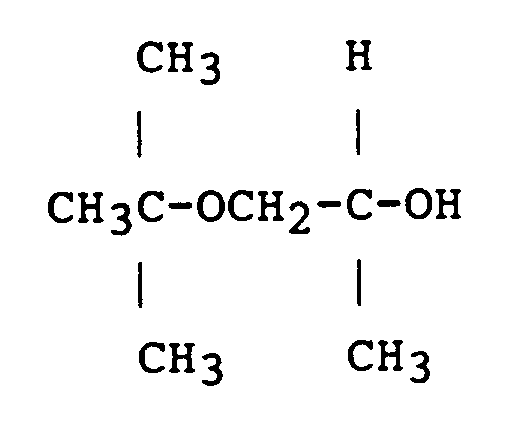
avec l'oxyde de propylène et l'oxyde d'éthylène, l'amination du produit de la réaction, et ensuite la séparation du groupe t-butyle du composé aminé avec un acide halogéné.
est préparé par la réaction d'un composé de formule
avec l'oxyde de propylène et l'oxyde d'éthylène, l'amination du produit de la réaction, et ensuite la séparation du groupe t-butyle du composé aminé avec un acide halogéné.