|
(11) | EP 0 433 009 B1 |

| (12) | EUROPEAN PATENT SPECIFICATION |
|
|
| (54) |
Fire resistant laminar cushioning material Feuerbeständiges laminiertes Polstermaterial Matériau de coussinage laminé résistant au feu |
|
|
|||||||||||||||||||||||||||||||
| Note: Within nine months from the publication of the mention of the grant of the European patent, any person may give notice to the European Patent Office of opposition to the European patent granted. Notice of opposition shall be filed in a written reasoned statement. It shall not be deemed to have been filed until the opposition fee has been paid. (Art. 99(1) European Patent Convention). |
[0001] This invention relates to a laminar cushioning material that is resistant to and does not participate in fire. More particularly, this invention relates to a laminar cushioning material comprising an outer layer of foamed polyphosphazene and an inner layer of foamed polyurethane.
[0002] Pressure for increased flammability resistance of bedding and furniture materials has been on the rise over the last few years. Federal standards originally implemented for cigarette smolder resistance to mattresses has given way to more comprehensive requirements for furniture, aircraft seats and the like including open flame and vertical flame tests.
[0003] The typical structure of cushioning material comprises a core of fire resistant polyurethane having an upholstery outer cover. Smolder resistance is commonly acceptable. In full-scale real life fires, the outer fabric cover rapidly breaks down and the polyurethane core becomes involved in the fire, producing large volumes of potentially lethal smoke, combustible gases and toxic fumes. In order to pass FAA regulations, seat manufacturers have chosen to use a foam core seat cushion fully encased by a fire-blocking sheet which delays the onset of ignition and retards involvement of the core in the fire. However, such fire blocking sheet is not a requirement of any present Federal or state regulations for furniture or bedding materials.
[0004] Mueller in U.S. Pat. No. 4,818,603 discloses a heavy metal loaded polyphosphazene septum bonded to the surface of a foamed polyimide.
[0005] Thompson U.S. Pat. No. 3,994,838 describes polyaryloxy phosphazene foams and suggest their use as thermal insulation because of their fire resistance.
[0006] Polyorganophosphazenes are known compositions. Polyaryloxyphosphazenes are described in U.S. Pat. No. 3,856,713. Polyfluoroalkoxyphosphazenes are described in U.S. Pat. No. 3,970,533. Methods of curing such polymers by sulfur vulcanization, free-radical (e.g., peroxide) cure and by reaction are also well known.
[0007] EP-A-0 337 855 discloses a composite fire resistant laminar cushioning material comprising a foamed polyphosphazene outer lamella and a foamed polyurethane inner lamella.
[0008] The present invention is directed to a fire resistant cushioning material that comprises a fire-blocking sheet and a polyurethane core. Such cushioning material will pass California Technical Bulletin 133 test, as developed by the California Department of Consumer Affairs, Bureau of Home Furnishings. The cushioning material is a laminar structure comprising an outer foamed polyphosphazene lamella and a foamed polyurethane inner lamella. The foamed polyphosphazene lamella contains a substantially unfoamed thin layer at the top and/or bottom surface. The polyphosphazene lamella will cover and/or be attached to the polyurethane lamella by, for example, an adhesive, physical fasteners, and the like and lie on top of or it may partially or totally wrap around the polyurethane lamella. The composite cushioning material may optionally be covered by a decorative fabric such as is commonly used for seat cushions, upholstered furniture, mattresses and the like. In some cases it may be preferred to laminate the polyphosphazene lamella to the decorative fabric and subsequently cover the polyurethane lamella with this laminate.
[0009] The polyphosphazene lamella of the composite fire resistant cushioning material of the invention may overlay or wrap around the polyurethane lamella.
[0010] Polyorganophosphazenes have a linear backbone of
units in which R1 and R2 are the same or different organic groups and n has a value from about 10 up to 100,000 or more. They are made by first heating purified phosphonitrilic chloride trimer to about 200°-250°C in an inert atmosphere preferably in the presence of one of the known catalyst for the polymerization. After about 12-24 hours, a linear polyphosphonitrilic chloride ("chloropolymer") will form having an intrinsic viscosity of about 0.9-1.1 deciliters/gram. This can be purified by dissolving in a solvent such as tetrahydrofuran and then mixing the solution with an aliphatic hydrocarbon such as heptane causing the high molecular weight chloropolymer to precipitate. The purified chloropolymer can then be dissolved in a solvent such as tetrahydrofuran (THF) and a THF solution of the desired sodium alkoxide or aryloxide added to it. These compounds react to form a polyorganophosphazene in which the organo groups correspond to the alkoxide or aryloxide groups in the THF solution. The product can be washed and precipitated with water. The precipitated gum is then dried and then compounded following standard rubber technology such as by intensive mixing in a Banbury mixer.
[0011] The substituents bonded to phosphorus can vary widely and include substituted and unsubstituted alkoxy and aryloxy groups wherein the substituent groups on the alkoxy or aryloxy can be halogen (e.g., chlorine, fluorine), alkyl, alkoxy, polyalkoxy, dialkylamino, trifluoromethyl, aryloxy, alkenyl (e.g., allyl).
[0012] U.S. Pat. No. 3,994,838 describes a phosphazene useful in making the fire blocking sheet used in this invention.
[0013] The preferred polyorganophosphazene is a polyaryloxy phosphazene such as that described in Rose et al. U.S. Pat. No. 3,856,713. These polymers have both phenoxy and alkylphenoxy groups substituted on phosphorus. In a more preferred embodiment about 20-79 mole percent of the substituent groups on phosphorus are phenoxy and about 79-20 mole percent are lower alkyl phenoxy, especially p-ethylphenoxy. At least one mole percent and up to about 15 mole percent of the substituent groups on phosphorus are olefinically unsaturated groups such as allyl, o-allylphenoxy, p-allylphenoxy, eugenoxy, isoeugenoxy and the like. Most preferably the olefinically unsaturated groups are o-allylphenoxy. These groups promote crosslinking during the cure stage whether by sulfur-curing or peroxide-curing. In order to produce the foam used in the present invention, from about 1 to about 40 parts per hundred based on phosphazene polymer of at least one chemical blowing agent and activator are required. Azodicarbonamide is typical of such blowing agent. Foams with densities as low as at least 54.4 kg/m3 (3.4 lbs/ft3) or lower are effective in the barrier sheets of the present invention.
[0014] The polyorganophosphazene gum is compounded with certain additives to enhance its properties. The additives include fillers such as aluminum trihydrate (ATH), magnesium hydroxide, hydrated magnesium carbonate, silane treated silica and the like; processing aids such as silicone rubber, e.g., Silastic HA-2 (Dow Corning Company); and stabilizers such as Ethanox 330 or 376 Antioxidant, (Ethyl Corporation).
[0015] The polyorganophosphazene sheet can be cured or uncured in the composite material. Preferably the sheet is cured. When used as a fire resistant cushioning material, curing is necessary to give adequate physical integrity.
[0016] Curing agents such as a peroxide (e.g., t-butyl perbenzoate) or the combination of sulfur and a vulcanizing accelerator system, e.g., Methyl Zimate, Butyl Zimate, Vanax 552 (products of R.T. Vanderbilt Company) can be used.
[0017] A typical formulation used in making the phosphazene lamella is as follows:
TABLE I
| Parts by Weight | |
| Polyaryloxyphosphazene gum | 100 |
| ATH | 100-200 |
| Titanium Dioxide | 0-10 |
| Sulfur | 0.5-2.0 |
| Processing Aid | 10 |
| Zinc Stearate | 10 |
| Carbowax | 2.0-10.0 |
| Blowing Agent | 18 |
| Trimer Oil | 5-10 |
| Accelerators | 1.0-4.0 |
[0018] The ingredients are mixed in a conventional Banbury mixer, sheeted out on a 2-roll mill to the desired thickness and then fed to a calender to form the uncured polymer which is then cured in an autoclave at about 150°C for 360 minutes.
[0019] Because of the mixing and subsequent curing process, a polyphosphazene foam results that typically is composed of a thin layer of substantially unfoamed material on both sides of the foamed polymer layer. A product with a single layer of substantially unfoamed material is readily obtained from this structure by cutting the sheet in two. A polyphosphazene without any substantially unfoamed layers is obtained by cutting and removing the unfoamed "skins" from both sides of the foamed sheet.
[0020] Where one or both of the unfoamed portions are desired then the thickness of these unfoamed lamelliform layers can be adjusted depending on mixing and curing conditions. Since the fire blocking ability of the polyphosphazene is dependent on the thickness of both the unfoamed layer as well as the foamed layer, it is important to control mixing and curing to result in optimal properties. Thus, the lamelliform, substantially unfoamed layer should have a minimum thickness of about 0.01 mm but should not exceed about 0.2 mm. This unfoamed layer can play a significant role in the fire barrier property of the cushioning material and also provides good physical integrity to the outer surface of foamed polyphosphazene lamella. Resistance to puncture for example is improved by the presence of such unfoamed layer.
[0021] The substantially foamed second layer, in order to be an effective fire barrier should be at least 0.5 mm in thickness. Because of economic considerations the foam should be as thin as possible, typically 1.4 mm in thickness.
[0022] Effective fire protection at decreased sheet thicknesses can be provided by novel polyphosphazene compositions which differ from those described above in that a monomeric flame retardant is incorporated therein, usually in an amount such as to constitute less than about 40 wt.% of the formulation.
[0023] Although a number of different types of flame retardants may be incorporated into the filled polymeric compositions of this invention, monomeric halogen-containing flame retardants are especially effective, and chlorinated, but especially brominated flame retardants are preferred. A number of such flame retardants are known, and the class includes, e.g., tetrabromophthalic anhydride, esters of tetrabromophthalic acid, dibromoneopentylglycol, tetrabromo-bisphenol A, hexabromocyclododecane, dibromoethyl-dibromocyclohexane, octabromodiphenyl oxide, decabromo-diphenyl oxide, tetradecabromodiphenoxybenzene, ethylene bis-tetrabromophthalimide, ethylene bis-dibromonorbornane dicarboximide, pentabromodiphenyl oxide, and vinyl bromide. Among these listed materials, ethylene bis-tetrabromophthalimide (EBTBP) and decabromodiphenyl oxide (DBDPO) are especially useful. The preparation of ethylene bis-tetrabromophthalimide is described, for example, in U.S. 4,914,212. The preparation of decabromodiphenyl oxide is described in U.S. 4,287,373. Both of these flame retardants are available in commerce from Ethyl Corporation as Saytex® BT-93 and Saytex® 102, respectively.
[0024] In addition to the monomeric halogen-containing organic flame retardant, it is often desirable, although not required, that an oxide of a Group V element also be present, e.g., a bizmuth, arsenic, phosphorus or antimony oxide. These oxides, when combined with a halogen-containing, especially bromine-containing, flame retardant, decrease the amount of the latter which is required to achieve a given level of flame retardancy. The relative amounts of the various components in the filled polymeric compositions of this invention are preferably as set forth in the following generalized formulation:
| Component | Parts by Weight |
| Polyaryloxyphosphazene binder | 100 |
| Filler | 50-200 |
| Monomeric flame retardant | 5-175 |
| Blowing agent | 0-30 |
| Blowing agent activator | 0-5 |
| Colorant | 0-10 |
| Curing agent | 0-5 |
| Plasticizer | 0-10 |
| Processing aid | 0-10 |
[0025] The monomeric flame retardant in the composition preferably includes both the halogen-containing organic flame retardant and the Group V metal oxide optionally present. The formulation contains at least about 5 parts by weight of a halogen, preferably bromine-containing organic fire retardant.
[0027] Polyurethanes are a well recognized class of polymer taking their name from ethyl carbamate (urethane). They typically have the repeating unit [R-NH-C(O)O-R'-O(O)CNH] where R is usually an aromatic polyisocyanate and R' an aromatic or aliphatic polyol.
[0028] Representative polyols which may be employed in the preparation of the flame retardant polyurethane foams are well known to those skilled in the art. They are often prepared by the catalytic condensation of an alkylene oxide or mixture of alkylene oxides either simultaneously or sequentially with an organic compound having at least two active hydrogen atoms, such as disclosed in U.S. Pat. Nos. 1,922,459; 3,190,927; and 3,346,557. Representative polyols include polyhydroxyl-containing polyesters, polyoxyalkylene polyether polyols, polyhydroxy-terminated polyurethane polymers, polyhydroxyl-containing phosphorus compounds, and alkylene oxide adducts of polyhydric polythioesters, polyacetals, aliphatic polyols and thiols, ammonia, and amines including aromatic, aliphatic, and heterocyclic amines, as well as mixtures thereof. Alkylene oxide adducts of compounds which contain 2 or more different groups within the above-defined classes may also be used, for example, amino alcohols which contain an amino group and a hydroxyl group. Also, alkylene oxide adducts of compounds which contain one SH group and one OH group as well as those which contain an amino group and an SH group may be used. Generally, the equivalent weight of the polyol will vary from 100 to 10,000.
[0029] The polyhydroxy polyesters are typically prepared from the reaction of polycarboxylic acids and polyhydric alcohols. Any suitable polycarboxylic acid may be used including oxalic acid, malonic acid, maleic acid, fumaric acid, isophthalic acid, terephthalic acid, 1,4-cyclo-hexanedicarboxylic acid and the like. Any suitable polyhydric alcohol, including both aliphatic and aromatic, may be used such as ethylene glycol, propylene glycol, sorbitol, etc. Also included within the term "polyhydric alcohol" are compounds derived from phenol such as 2,2-bis(4-hydroxyphenyl)propane, commonly known as Bisphenol A.
[0030] The hydroxyl-containing polyester may also be a polyester amide such as is obtained by including some amine or amino alcohol in the reactants for the preparation of the polyesters. Thus, polyester amides may be obtained by condensing an amino alcohol such as ethanolamine with the polycarboxylic acids set forth above or they may be made using the same components that make up the hydroxyl-containing polyester with only a portion of the components being a diamine such as ethylene diamine.
[0031] Any suitable polyoxyalkylene polyether polyol may be used such as the polymerization product of an alkylene oxide or a mixture of alkylene oxides with a polyhydric alcohol. Any suitable polyhydric alcohol may be used such as those disclosed above for use in the preparation of the hydroxy-terminated polyesters. Any suitable alkylene oxide may be used such as ethylene oxide, propylene oxide, butylene oxide, amylene oxide, and mixtures of these oxides. The polyoxyalkylene polyether polyols may be prepared from other starting materials such as tetrahydrofuran and alkylene oxide-tetrahydrofuran mixtures; epihalohydrins such as epichlorohydrin; as well as aralkylene oxides such as styrene oxide. The polyoxyalkylene polyether polyols may have either primary or secondary hydroxyl groups. Included among the polyether polyols are polyoxyethylene glycol, polyoxypropylene glycol, polyoxybutylene glycol, polytetramethylene glycol, block copolymers, for example, combinations of polyoxypropylene and polyoxyethylene glycols, poly-1,2-oxybutylene and polyoxyethylene glycols, and random copolymer glycols prepared from blends of two or more alkylene oxides or by the sequential addition of two or more alkylene oxides. The polyoxyalkylene polyether polyols may be prepared by any known process such as, for example, the process disclosed by Wurtz in 1859 and Encylopedia of Chemical Technology, Vol. 7, pp. 257-262, published by Interscience Publishers, Inc. (1951) or in U.S. Pat. No. 1,922,459. Polyethers which are preferred include the alkylene oxide addition products of trimethylolpropane, glycerine, pentaerythritol, sucrose, sorbitol, propylene glycol, and 2,2′-(4,4′-hydroxyphenyl)propane and blends thereof having equivalent weights of from 100 to 10,000.
[0032] Suitable polyhydric polythioethers which may be condensed with alkylene oxides include the condensation product of thiodiglycol or the reaction product of a dicarboxylic acid such as is disclosed above for the preparation of the hydroxyl-containing polyesters with any other suitable thioether glycol.
[0033] Polyhydroxyl-containing phosphorus compounds which may be used include those compounds disclosed in U.S. Pat. No. 3,639,542. Preferred polyhydroxyl-containing phosphorus compounds are prepared from alkylene oxides and acids of phosphorus having a P2O5 equivalency of from 72 percent to about 95 percent.
[0034] The polyurethane foams employed in the present invention are generally prepared by the reaction of one or more of the illustrated polyols with an organic polyisocyanate in the presence of a blowing agent and optionally in the presence of additional polyhydroxyl-containing components, chain-extending agents, catalysts, surface-active agents, stabilizers, dyes, fillers and pigments. Suitable processes for the preparation of cellular polyurethane foams are disclosed in U.S. Reissue Pat. 24,514 together with suitable machinery to be used in conjunction therewith. When water is added as the blowing agent, corresponding quantities of excess isocyanate to react with the water and produce carbon dioxide may be used.
[0035] It is possible to proceed with the preparation of the polyurethane foams by a prepolymer technique wherein an excess of organic polyisocyanate is reacted in a first step with the polyol of the present invention to prepare a prepolymer having free isocyanate groups which is then reacted in a second step with water and/or additional polyol to prepare a foam. Alternatively, the components may be reacted in a single working step commonly known as the "one-shot" technique of preparing polyurethanes. Furthermore, instead of water, low boiling hydrocarbons such as pentane, hexane, heptane, pentene, and heptene; azo compounds such as azohexahydrobenzodinitrile; halogenated hydrocarbons such as dichlorodifluoromethane, trichlorofluoromethane, dichlorodifluoroethane, vinylidene chloride, and methylene chloride may be used as blowing agents.
[0036] Organic polyisocyanates which may be employed include aromatic, aliphatic, and cycloaliphatic polyisocyanates and combinations thereof. Representatives of these types are the diisocyanates such as m-phenylene diisocyanate, 2,4-toluene diisocyanate, 2,6-toluene diisocyanate, mixtures of 2,4- and 2,6-toluene diioscyanate, hexamethylene diisocyanate, tetramethylene diisocyanate, cyclohexane, 1,4-diisocyanate, hexahydrotoluene diisocyanate (and isomers), naphthalene-1,5-diisocyanate, 1-methoxy-phenyl-2,4-diisocyanate, 4,4′-diphenylmethane diisocyanate, 4,4′-biphenylene diisocyanate, 3,3′-dimethoxy-4,4′-biphenyl diisocyanate, 3,3′-methyl-4,4′-biphenyl diisocyanate and 3,3′-dimethyl-diphenylmethane-4,4′-diisocyanate; the triisocyanates such as 4,4',4''-triphenylmethane triisocyanate, and toluene 2,4,6-triisocyanate, and the tetraisocyanates such as 4,4′-dimethyldiphenylmethane-2,2′-5,5′-tetraisocyanate and polymeric polyisocyanates such as polymethylene polyphenylene polyisocyanate. Especially useful due to their availability and properties are toluene diisocyanate, 4,4′-diphenylmethane diisocyanate and polymethylene polyphenylene polyisocyanate. Toluene diisocyanate is preferred.
[0037] Crude polyisocyanates may also be used in the compositions of the present invention, such as crude toluene diisocyanate obtained by the phosgenation of a mixture of toluene diamines or crude diphenylmethane isocyanate obtained by the phosgenation of crude diphenylmethane diamine. The preferred or crude isocyanates are disclosed in U.S. Pat. No. 3,215,652.
[0038] Chain-extending agents which may be employed in the preparation of the polyurethane foams include those compounds having at least two functional groups bearing active hydrogen atoms such as water, hydrazine, primary and secondary diamines, amino alcohols, amino acids, hydroxy acids, glycols, or mixtures thereof. A preferred group of chain-extending agents includes water, ethylene glycol, 1,4-butanediol and primary and secondary diamines which react more readily with the prepolymer than does water such as phenylene diamine, 1,4-cyclohexane-bis-(methylamine), ethylenediamine, diethylenetriamine, N-(2-hydroxypropyl)-ethylenediamine, N-(2-hydroxypropyl)ethylenediamine, N,N′-di(2-hydroxypropyl)-ethylene-diamine, piperazine, and 2-methylpiperazine.
[0039] Any suitable catalyst may be used including tertiary amines such as, for example, triethylenediamine, N-methylmorpholine, N-ethylmorpholine, diethylethanol-amine, N-cocomorpholine, 1-methyl-4-diamethylaminoethyl-piperazine, 3-methoxypropyldimethylamine, N,N,N′-trimethylisopropyl propylenediamine, 3-diethylaminopropyl-diethylamine, dimethylbenzylamine, and the like. Other suitable catalysts are, for example, stannous chloride, dibutyltin di-2-ethyl hexanoate, stannous oxide, as well as other organometallic compounds such as are disclosed in U.S. Pat. No. 2,846,408.
[0040] A surface-active agent is generally necessary for production of high grade polyurethane foam according to the present invention, since in the absence of same, the foams collapse or contain very large uneven cells. Numerous surface-active agents have been found satisfactory. Nonionic surface active agents are preferred. Of these the nonionic surface active agents such as the tertiary amine or alkanolamine salts of long chain alkyl acid sulfate esters, alkyl sulfonic esters, and alkyl arylsulfonic acids are not preferred.
[0041] Flame retarded polyurethane foams also have dispersed throughout their mass melamine particles that may vary in particle size from about 1.5 microns to less than 10 microns. The smaller particle sizes are preferred. Typically such melamine particles are present in the foam from concentrations of about 5% by weight to about 55% by weight based on the total amount of polyurethane starting materials.
[0042] Other flame retardant additives may also be included in the polyurethane foam. Among such other flame retardants, and particularly useful with melamine are tetrakis(2-chloroethyl)- ethylene phosphonate, pentabromodiphenyl oxide, tris(1,3-dichloropropyl)-phosphate, tris(beta-chlorethyl)phosphate, molybdenum trioxide, ammonium molybdate, ammonium phosphate, pentabromodiphenyloxide, tricresyl phosphate, 2,3-dibromopropanol, hexabromocyclododecane, dibromoethyl-dibromocyclohexane, tris(2,3-dibromopropyl)phosphate, and tris(beta-chloropropyl)phosphate. They are preferably used in an amount of from about 1 to about 15 weight percent of the total weight of the composition.
[0043] The actual construction of the cushioning material is shown in its simpliest form in Figure 1. In this cross sectional view of a cushion structure (10), the foamed polyphosphazene outer lamella (11) (approximately 0.25 to 5 mm in thickness; preferably about 1 to 3 mm thick) composed of the substantially unfoamed layer (12) and the foamed layer (13) covers the surface of the foamed polyurethane lower lamella (14). This lower lamella may be from 10 to 300 mm in thickness or more, but is usually 50 to 150 mm in thickness. As noted earlier, these lamella may be secured by physical fasteners (staples, nails, screws, etc.) or by adhesives. Such adhesives are disclosed for example in U.S. Pat. No. 4,468,431. Other useful adhesives are:
| Adhesives | Mfg. |
| Sealfas® Coating | H.B. Fuller |
| Foster 81-33 | H.B. Fuller |
| Spark-Fas | H.B. Fuller |
| ECO-TACK N.F. | Mon-Eco Industries |
| Mono-Tack S-E | Mon-Eco Industries |
| Armstrong 520 Adhesive | Armstrong World Industries |
| 3M80 | 3M Company |
[0044] Figure 2 shows an embodiment of the present invention where the foamed polyphosphazene wraps around the polyurethane lamella. The cushioning material (20) has an outer, upper polyphosphazene sheet of substantially unfoamed polyphosphazene (21) and substantially foamed polyphosphazene (22) and an outer, lower polyphosphazene sheet of substantially unfoamed polyphosphazene (28) and substantially foamed polyphosphazene (29). Side wraps of the polyphosphazene sheet extend down either side of the polyurethane lamella (27). Thus, on either side of the polyurethane substantially unfoamed layers (23 and 25), overlaying substantially foamed layers (24 and 26) can be seen to fully envelope the foamed polyurethane (27). It should be noted that depending on the use, the entire foamed polyurethane lamella can be enveloped by the fire barrier sheet as shown in Figure 2 or only various parts of it.
Testing For Flammability of Cushioning Material
[0045] Testing for Examples 1-18 was conducted by burning five double sheets of newspaper on a full scale mock-up protected by a 4 sided enclosure. Weight loss was the criterion for passage or failure of the sample in accordance with the weight loss requirements given in California Technical Bulletin-133.
[0046] The polyphosphazene foams used in these tests (Examples 1-18) had the following formulations:
| FOAM I | |
| Parts by Weight | |
| Polyaryloxyphosphazene gum | 100 |
| Aluminum trihydrate | 120 |
| Titanium dioxide | 0.8 |
| Silastic® HA-2 | 10 |
| Zinc Stearate | 10 |
| Carbowax | 2 |
| Blowing Agent | 18 |
| Trimer Oil | 5 |
| Sulfur & Accelerators | 1.7 |
| FOAM II Polyphosphazene Foam Composition |
|
| Parts by Weight | |
| Polyaryloxyphosphazene gum | 100 |
| Aluminum trihydrate | 180 |
| N990 | 10 |
| Zinc Stearate | 10 |
| Silastic® HA-2 | 10 |
| Trimer Oil | 12 |
| Carbowax | 2 |
| Blowing Agent | 25 |
| Sulfur & Accelerators | 5.25 |
Examples 1-20
Example 21
[0048]
| Filled Polymeric Compositions | |||||
| Component | A | B | C | D | E |
| EYPEL®-A Polyphosphazenea | 99.1 | 99.6 | 99.6 | 99.5 | 99.1 |
| Alumina Trihydrate | 120.0 | 109.5 | 109.5 | 72 | 72 |
| Zinc Stearate | 10.0 | 10.0 | 10.0 | 10.0 | 10.0 |
| Silastic® HA-2 Silicon rubber | 10.0 | 10.0 | 10.0 | 10.0 | 10.0 |
| Carbowax® 3350 Polyethylene glycol | 2.0 | 2.0 | 2.0 | 2.0 | 2.0 |
| Celogen® AZ 754 Azodicarbonamide | 18.0 | 18.0 | 18.0 | 18.0 | 18.0 |
| TiO2 | 8.0 | 8.0 | 8.0 | 8.0 | 8.0 |
| Sulfur | 0.5 | 0.5 | 0.5 | 0.5 | 0.5 |
| Acceleratorb | 4.3 | 4.3 | 4.3 | 4.3 | 4.3 |
| Phosphazene trimer oil | 4.6 | 4.6 | 4.6 | 4.6 | 4.6 |
| SAYTEX® 102 DBDPO | 0.0 | 10.0 | 0.0 | 0.0 | 50.0 |
| SAYTEX® BT-93W EBTBP | 0.0 | 0.0 | 10.0 | 50.0 | 0.0 |
| Antimony Trioxide | 0.0 | 1.0 | 1.0 | 12.8 | 15.0 |
| a EYPEL® A is a polyaryloxyphosphazene carrying phenoxy, p-ethylphenoxy, and o-allylphenoxy substituents, available from Ethyl Corporation. | |||||
| b The accelerator is 2.1 parts by weight Vanax® 552, 1.8 parts by weight Butyl Zimate®, and 0.4 parts by weight Altax®. The Vanax® 552 is omitted in the unfoamed compositions. |
[0049] The aforesaid filled polymeric compositions are sheeted, and some are foamed as described above, to a size of approximately 0.91 x 0.63 m (36" X 25") in various thicknesses. The subsequently cured sheets are adhesively bonded or laminated to polyurethane foam cushion samples, which have a density of about 28.8 kg/m3 (1.8 lb./ft.3) and meet the requirements of California Technical Bulletin 117, and then covered with various upholstery fabrics. The constructions are then tested for fire-resistance by burning five double sheets of newspaper on a full scale mock-up protected by a four-sided enclosure. Weight loss is the criterion for passage or failure in accordance with the weight loss requirement (i.e., 10% weight loss/10 minutes) given in California Technical Bulletin 133. The results of these tests are set forth in Example 22.
Example 22
[0050]
| Fire Test Results | ||||
| Polymer Composition | Phosphazene Thickness | Fabricb | Weight Loss | Result |
| A | 3mm | polypropylene | 14.5% | Fail |
| A | 4mm | polypropylene | 6.1% | Pass |
| A | 1.5mma | cotton | 27% | Fail |
| B | 3mm | polypropylene | 5.5% | Pass |
| B | 1.5mma | cotton | 10% | Pass |
| B | 0.5mma | cotton | 10% | Pass |
| C | 3mm | polypropylene | 5.1% | Pass |
| C | 1.5mma | cotton | 10% | Pass |
| C | 0.5mma | cotton | 10% | Pass |
| D | 1.5mm | polypropylene | 6% | Pass |
| D | 1.5mm | cotton | 6% | Pass |
| E | 1.5mm | polypropylene | 6% | Pass |
| E | 1.5mm | cotton | 7% | Pass |
| a Unfoamed polyphosphazene sheet | ||||
| b The fabric coverings over the polyphosphazene are the following: Polypropylene - 100% polypropylene fabric. Pattern is tribute and color is ash. It has a fabric weight of 0.51 kg/m2 (15 oz/yd2). By Culp, Inc. Cotton - 100% cotton velvet. The color is blueberry. It has a fabric weight of 0.71 kg/m2 (21 oz/yd2). By J. L. DeBall & Grimes of America. |
1. A composite fire resistant laminar cushioning material comprising (i) a foamed polyphosphazene
outer lamella comprising a substantially foamed layer provided with a substantially
unfoamed layer at the top and/or bottom surface and (ii) a foamed polyurethane inner
lamella.
2. A cushioning material according to claim 1 comprising a composite fire resistant laminar
cushioning material (10,20) comprising (i) a foamed polyphosphazene outer lamella
(11) having a lamelliform, substantially unfoamed first outer layer (12,21,23,25,28)
and a substantially foamed second layer (13,22,24,26,29) and (ii) a foamed polyurethane
inner lamella (14,27).
3. A cushioning material according to claim 1 or 2, wherein said foamed polyphosphazene
is a polyaryloxyphosphazene.
4. A cushioning material according to claim 3, wherein the aryloxy groups of said polyaryloxyphosphazene
comprise phenoxy and C1 to C6 linear or branched alkyl-substituted phenoxy groups.
5. A cushioning material according to any one of the claims 2 to 4, wherein the foamed
polyphosphazene outer lamella (11) further comprises a lamelliform substantially unfoamed
third inner layer.
6. A cushioning material according to any one of the preceding claims in which the polyphosphazene
lamella includes at least one monomeric halogen-containing flame retardant.
7. A cushioning material according to claim 6 wherein the flame retardant material is
ethylene-bis-tetrabromophthalimide or decabromodiphenyl oxide.
8. A cushioning material according to any of the preceding claims wherein the polyphosphazene
is of the formula
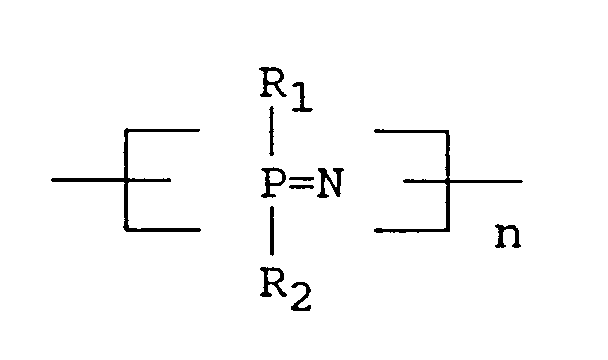
wherein R1 and R2 are the same or different organic groups and n is an integer of from 10 to 105.
wherein R1 and R2 are the same or different organic groups and n is an integer of from 10 to 105.
1. Feuerbeständiges Schichtverbund-Polstermaterial, umfassend (i) eine geschäumte Polyphosphazen-Außenlamelle,
bestehend aus einer im wesentlichen geschäumten Schicht, die mit einer im wesentlichen
ungeschäumten Schicht auf der oberen und/oder unteren Oberfläche versehen ist, und
(ii) eine geschäumte Polyurethan-Innenlamelle.
2. Polstermaterial nach Anspruch 1, umfassend ein feuerbeständiges Schichtverbund-Polstermaterial
(10,20), bestehend aus (i) einer geschäumten Polyphosphazen-Außenlamelle (11) mit
einer lamellenförmigen, im wesentlichen ungeschäumten ersten Außenschicht (12,21,23,25,28)
und einer im wesentlichen geschäumten zweiten Schicht (13,22,24,26,29) und (ii) einer
geschäumten Polyurethan-Innenschicht (14,27).
3. Polstermaterial nach Anspruch 1 oder 2, wobei das geschäumte Polyphosphazen ein Polyaryloxyphosphazen
ist.
4. Polstermaterial nach Anspruch 3, wobei die Aryloxy-Gruppen des Polyaryloxyphosphazens
Phenoxy und C1 bis C6-lineare oder -verzweigte Alkyl-substituierte Phenoxy-Gruppen umfassen.
5. Polstermaterial nach einem der Ansprüche 2 bis 4, wobei die geschäumte Polyphosphazen-Außenlamelle
(11) darüber hinaus eine lamellenförmige, im wesentlichen ungeschäumte dritte Innenschicht
umfaßt.
6. Polstermaterial nach einem der vorangegangenen Ansprüche, wobei die Polyphosphazen-Lamelle
mindestens einen monomeren Halogen-haltigen Flammhemmer enthält.
7. Polstermaterial nach Anspruch 6, wobei der flammhemmende Stoff Ethylen-bis-tetrabromphthalimid
oder Decabromdiphenyloxid ist.
8. Polstermaterial nach einem der vorangegangenen Ansprüche, wobei das Polyphosphazen
die folgende Formel aufweist
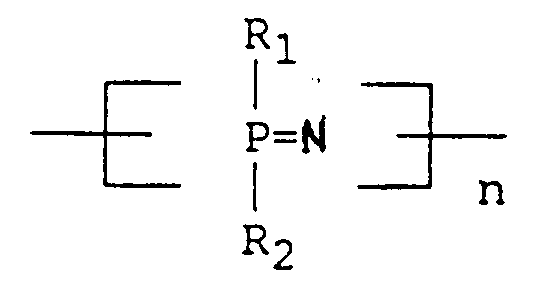
worin R1 und R2 dieselben oder verschiedene organische Gruppen und n eine ganze Zahl von 10 bis 105 ist.
worin R1 und R2 dieselben oder verschiedene organische Gruppen und n eine ganze Zahl von 10 bis 105 ist.
1. Matériau de garnissage composite en feuillets, résistant au feu, comprenant (i) un
feuillet externe à base de polyphosphazène expansé comprenant une couche pratiquement
expansée munie d'une couche pratiquement non expansée à la surface supérieure et/ou
inférieure et (ii) un feuillet interne à base de polyuréthanne expansé.
2. Matériau de garnissage selon la revendication 1 comprenant un matériau de garnissage
(10,20) composite en feuillets, résistant au feu, comprenant (i) un feuillet externe
(11) à base de polyphosphazène expansé ayant une première couche externe (12,21, 23,
25, 28) lamelliforme, pratiquement non expansée, et une seconde couche (13,22, 24,
26, 29) pratiquement expansée et (ii) un feuillet interne (14,27) à base de polyuréthanne
expansé.
3. Matériau de garnissage selon la revendication 1 ou 2, dans lequel ledit polyphosphazène
expansé est un polyaryloxyphosphazène.
4. Matériau de garnissage selon la revendication 3, dans lequel les groupes aryloxy dudit
polyaryloxyphosphazène comprennent des groupes phénoxy et des groupes phénoxy à substituant
alkyle en C1 - C6 linéaire ou ramifié.
5. Matériau de garnissage selon l'une quelconque des revendications 2 à 4, dans lequel
le feuillet externe (11) à base de polyphosphazène expansé comprend en outre une troisième
couche interne lamelliforme pratiquement non expansée.
6. Matériau de garnissage selon l'une quelconque des revendications précédentes dans
lequel le feuillet à base de polyphosphazène comprend au moins un retardateur de flamme
à composant halogéné monomère
7. Matériau de garnissage selon la revendication 6 dans lequel le produit retardateur
de flamme est de l'éthylène-bis-tétrabromophtalimide ou de l'oxyde de décabromodiphényle.
8. Matériau de garnissage selon l'une quelconque des revendications précédentes dans
lequel le polyphosphazène a pour formule :
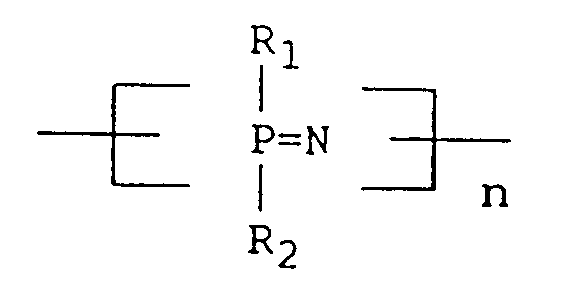
dans laquelle R1 et R2 sont des groupes organiques identiques ou différents et n est un entier valant de 10 à 105.
dans laquelle R1 et R2 sont des groupes organiques identiques ou différents et n est un entier valant de 10 à 105.