|
(11) | EP 0 433 239 B1 |

| (12) | EUROPEAN PATENT SPECIFICATION |
|
|
| (54) |
Use of naphthoxazines Anwendung von Naphthoxazinen Application de naphthoxazines |
|
|
|||||||||||||||||||||||||||
| Note: Within nine months from the publication of the mention of the grant of the European patent, any person may give notice to the European Patent Office of opposition to the European patent granted. Notice of opposition shall be filed in a written reasoned statement. It shall not be deemed to have been filed until the opposition fee has been paid. (Art. 99(1) European Patent Convention). |
[0001] The present invention relates to a new pharmaceutical use of 3,4,4a,5,10,10a-hexahydro-2H-naphth[2,3-b]-1,4-oxazines.
[0002] More particularly the present invention relates to a new pharmaceutical use for compounds of formula I
wherein
- R₁ and R₂
- independently are hydrogen or (C₁₋₄)alkyl,
- R₃
- is hydroxy or (C₁₋₄)alkoxy and
- R₄
- is (C₁₋₄)alkylthio, (C₁₋₄)alkylsulfoxide, (C₁₋₄)alkylsulfone, chlorine, bromine, iodine or trifluoromethyl,
[0003] The compounds of formula I have the trans configuration in positions 4a and 10a. Following accepted nomenclature conventions, the above representation of formula I embraces the trans isomers with the configuration IA as well as those with the configuration IB.
The formula I covers both the racemates and the optically active forms.
[0004] In the case where R₂ is not hydrogen, again both possible isomers as well as the corresponding racemates are covered.
[0005] The compounds for use according to the invention as well as a process for their production are known e.g. from U.S.-Patent No. 4,656,167. This patent also discloses the use of the compounds for stimulating the central nervous system, e.g. for increasing vigilance, and for treating depressions.
[0006] In accordance with the present invention it has now been surprisingly found that the compounds for use according to the invention are useful in the prophylaxis and therapy of conditions associated with cerebral ischaemia, e.g. stroke.
[0007] This utility of said compounds is indicated by animal tests, e.g. by the reduction of mortality in the middle cerebral artery (MCA) occlusion model in rats at a dosage of 1 - 30 mg/kg/day p.o. [cf. A. Tamura et al., J. Cereb. Blood Flow Metabol. 1, 53 - 60 (1981), A. Sauter, M. Rudin, Stroke 17, 1228-1234 (1986)]. The compounds are administered orally each day from the third day after MCA occlusion, during 3 weeks. For example with the (-)-(4aR,10aR)-3,4,4a,5,10,10a-hexahydro-6-methoxy-4-methyl-9-methylthio-2H-naphth[2,3-b]-1,4-oxazine, a marked increase of the number of surviving animals is observed after treatment with 3 mg/kg/day p.o.
[0008] The compounds for use according to the invention are therefore useful in the prophylaxis and therapy of conditions associated with cerebral ischaemia, e.g. stroke.
[0009] For this indication the appropriate dosage will of course vary depending upon, for example, the compound employed, the host, the mode of administration and the nature and severity of the condition being treated. However, in general, satisfactory results in animals are indicated to be obtained at a daily dosage of from about 3 to about 30 mg/kg animal body weight. In larger mammals, for example humans, an indicated daily dosage is in the range from about 1 to about 200 mg of a compound according to the invention conveniently administered, for example, in divided doses up to four times a day.
[0010] The compounds for use according to the invention may be administered by any conventional route, in particular enterally, preferably orally, e.g. in the form of tablets or capsules, or parenterally, e.g. in the form of injectable solutions or suspensions.
[0011] The compounds for use according to the invention may be administered in free base form or in pharmaceutically acceptable acid addition salt form e.g. the hydrogenmalonate. Such salts exhibit the same order of activity as the free base.
[0012] Pharmaceutical compositions for use in the treatment of conditions associated with cerebral ischaemia comprise the compounds for use according to the invention in association with at least one pharmaceutical carrier or diluent. Such compositions may be manufactured in conventional manner. Unit dosage forms may contain for example from about 0.3 mg to about 100 mg of the compound in free base or pharmaceutically acceptable acid addition salt form.
[0013] Capsules containing the ingredients indicated below may be prepared by conventional techniques and are administered at a dose of e.g. one to two capsules up to 3 times a day.
| INGREDIENTS | WEIGHT (mg) |
| (-)-(4aR,10aR)-3,4,4a,5,10,10a-hexahydro-6-methoxy-4-methyl-9-methylthio-2H-naphth[2,3-b]-1,4-oxazine hydrogenmalonate | 4.12 |
| Silica, colloidal anhydrous | 1.80 |
| Magnesium stearate | 3.60 |
| Maize starch | 72.00 |
| Lactose | 278.48 |
| Contents | 360.00 |
[0014] The invention therefore provides the use of a compound of formula I in free base or pharmaceutically acceptable acid additions salt form for the manufacture of a pharmaceutical composition for treating conditions associated with cerebral ischaemia.
[0015] The invention also provides the (-)-(4aR,10aR)-3,4,4a,5,10,10a-hexahydro-6-methoxy-4-methyl-9-methylthio-2H-naphth[2,3-b]-1,4-oxazine in form of its hydrogen malonate. The compound in free base form and in form of its hydrochloride are disclosed in the above mentioned U.S.-Patent No. 4,656,167. According to Example 2, the free base is obtained as an oil. The hydrochloride as well as various other salts prepared by the applicant, including the hydrogen maleinate and the hydrogen fumarate, present the disadvantage of showing polymorphism. It is known, for instance, that polymorphous salts upon p.o. administration cause non-homogenous resorption.
[0016] It has now surprisingly been found that the (-)-(4aR,10aR)-3,4,4a,5,10,10a-hexahydro-6-methoxy-4-methyl-9-methylthio-2H-naphth[2,3-b]-1,4-oxazine in form of its hydrogen malonate, hereinafter referred to as compound according to the invention, does not show polymorphism.
[0017] The compound according to the invention has never been specifically disclosed in literature. It may be prepared from the free base by reaction with malonic acid, e.g. as described in the following example.
[0018] The compound according to the invention possesses central, noradrenergic activity which was demonstrated as indicated in the above mentioned U.S.-Patent No. 4,656,167. It is therefore useful as psychostimulant and as antidepressant. Moreover according to the present invention it is useful in the prophylaxis and therapy of conditions associated with cerebral ischaemia, e.g. stroke.
[0019] The appropriate dosage and administration routes are as disclosed for the 3,4,4a,5,10,10a-hexahydro-2H-naphth[2,3-b]-1,4-oxazines of the above mentioned U.S.-Patent No. 4,656,167 for the psychostimulant and antidepressant uses and for the compounds of formula I of the present invention for the anti-ischaemic use.
[0020] The invention further provides a pharmaceutical composition which incorporates as active agent the compound according to the invention, in association with a pharmaceutical carrier or diluent.
EXAMPLE: (-)-(4aR,10aR)-3,4,4a,5,10,10a-hexahydro-6-methoxy-4-methyl-9-methylthio-2H-naphth[2,3-b]-1,4-oxazin hydrogen malonate
[0022] A solution of 0.75 g (7.2 mmol) of malonic acid in acetone is added to 2.00 g (7.2 mmol) of (-)-(4aR,10aR)-3,4,4a,5,10,10a-hexahydro-6-methoxy-4-methyl-9-methylthio-2H-naphth[2,3-b]-1,4-oxazine in acetone. The crystallisation product is filtered off by suction, washed with ethyl acetate and ether and dried. After recrystallisation from acetone/ethyl acetate/ether, the compound of the title is obtained.
Mp = 127 °; [α]
= - 102.5 ° (c = 0.5 in methylene chloride: methanol, 1: 1).
1. The use of a compound of formula I
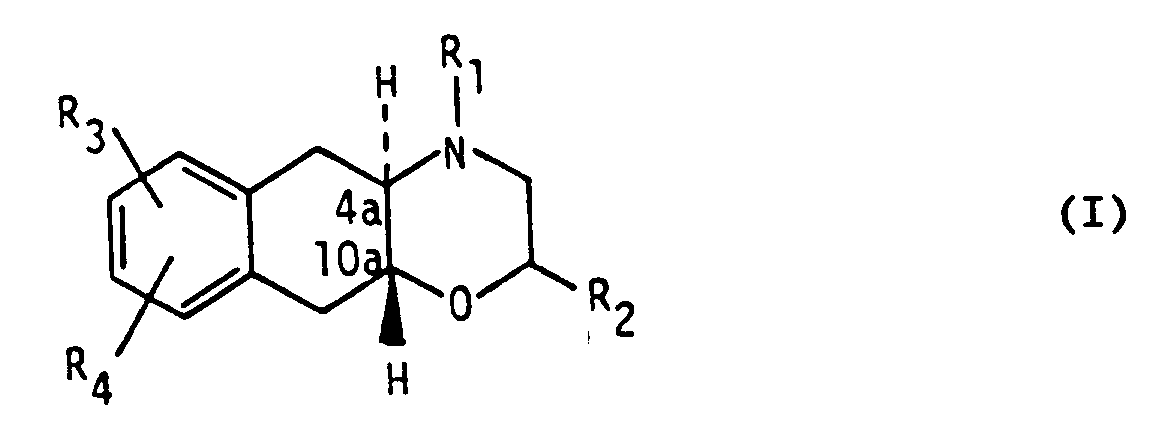
wherein
wherein
R₁ and R₂ independently are hydrogen or (C₁₋₄)alkyl,
R₃ is hydroxy or (C₁₋₄)alkoxy and
R₄ is (C₁₋₄)alkylthio, (C₁₋₄)alkylsulfoxide, (C₁₋₄)alkylsulfone, chlorine, bromine, iodine or trifluoromethyl,
in free base or pharmaceutically acceptable acid addition salt form, for the manufacture of a pharmaceutical composition for the treatment of conditions associated with cerebral ischaemia.2. The use according to claim 1, in which the condition to be treated is stroke.
3. The use according to any one of claims 1 and 2, in which the compound of formula I
is the (-)-(4aR,10aR)-3,4,4a,5,10,10a-hexahadro-6-methoxy-4-methyl-9-methylthio-2H-naphth[2,3-b]-1,4-oxazine
in free base or pharmaceutically acceptable acid addition salt form.
4. The use according to any one of claims 1 and 2, in which the compound of formula I
is the (-)-(4aR,10aR)-3,4,4a,5,10,10a-hexahydro-6-methoxy-4-methyl-9-methylthio-2H-naphth[2,3-b]-
1,4-oxazine hydrogen malonate.
5. The (-)-(4aR,10aR)-3,4,4a,5,10,10a-hexahydro-6-methoxy-4-methyl-9-methylthio-2H-naphth[2,3-b]-1,4-oxazine
hydrogen malonate.
6. A process for the production of the (-)-(4aR,10aR)-3,4,4a,5,10,10a-hexahydro-6-methoxy-4-methyl-9-methylthio-2H-naphth[2,3-b]-1,4-oxazine
hydrogen malonate, which includes the step of reacting the corresponding free base
with malonic acid.
7. A pharmaceutical composition which incorporates as active agent the compound of claim
5, in association with a pharmaceutical carrier or diluent.
1. Verwendung einer Verbindung der Formel
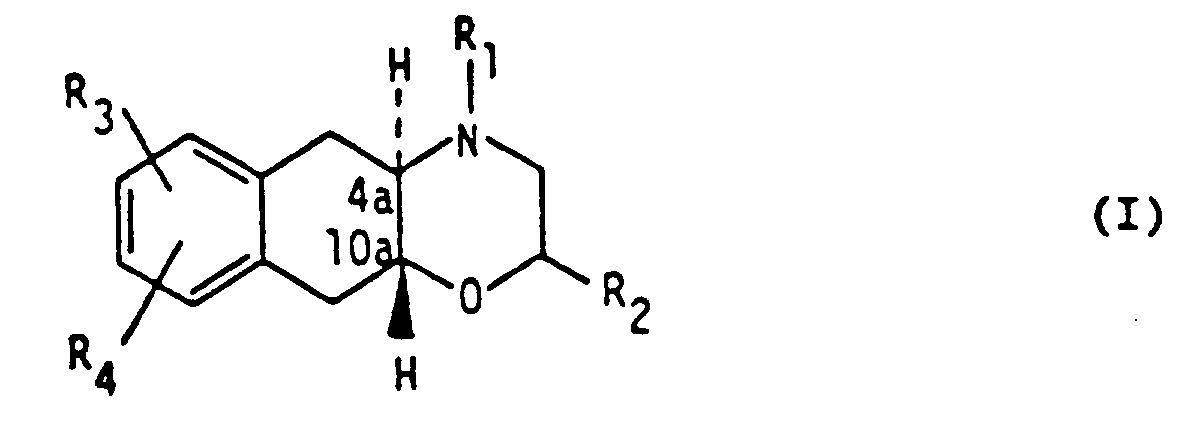
worin R₁ und R₂ unabhängig Wasserstoff oder (C₁₋₄)Alkylreste sind, R₃ ein Hydroxy- oder (C₁₋₄)Alkoxyrest ist und R₄ ein (C₁₋₄)Alkylthio-, (C₁₋₄)Alkylsulfoxid-, (C₁₋₄)Alkylsulfon-, Chlor-, Brom-, Iod- oder Trifluoromethylrest ist, in Form der freien Base oder als pharmazeutisch annehmbares Säureadditionssalz zur Herstellung einer pharmazeutischen Zusammensetzung zur Behandlung von Zuständen, die mit zerebraler Ischämie in Verbindung stehen.
worin R₁ und R₂ unabhängig Wasserstoff oder (C₁₋₄)Alkylreste sind, R₃ ein Hydroxy- oder (C₁₋₄)Alkoxyrest ist und R₄ ein (C₁₋₄)Alkylthio-, (C₁₋₄)Alkylsulfoxid-, (C₁₋₄)Alkylsulfon-, Chlor-, Brom-, Iod- oder Trifluoromethylrest ist, in Form der freien Base oder als pharmazeutisch annehmbares Säureadditionssalz zur Herstellung einer pharmazeutischen Zusammensetzung zur Behandlung von Zuständen, die mit zerebraler Ischämie in Verbindung stehen.
2. Verwendung nach Anspruch 1, worin der zu behandelnde Zustand ein Schlaganfall ist.
3. Verwendung nach einem der Ansprüche 1 oder 2, worin die Verbindung der Formel I (-)-(4aR,10aR)-3,4,4a,5,10,10a-Hexahydro-6-methoxy-4-methyl-9-methylthio-2H-naphth[2,3-b]-1,4-oxazin
in Form der freien Base oder als pharmazeutisch annehmbares Säureadditionssalz ist.
4. Verwendung nach einem der Ansprüche 1 oder 2, worin die Verbindung der Formel I (-)-(4aR,10aR)-3,4,4a,5,10,10a-Hexahydro-6-methoxy-4-methyl-9-methylthio-2H-naphth[2,3-b]-1,4-oxazinhydrogenmalonat
ist.
5. (-)-(4aR,10aR)-3,4,4a,5,10,10a-Hexahydro-6-methoxy-4-methyl-9-methylthio-2H-naphth[2,3-b]-1,4-oxazinhydrogenmalonat.
6. Verfahren zur Herstellung von (-)-(4aR,10aR)-3,4,4a,5,10,10a-Hexahydro-6-methoxy-4-methyl-9-methylthio-2H-naphth[2,3-b]-1,4-oxazinhydrogenmalonat,
das die Stufe einschließt, daß man die entsprechende freie Base mit Malonsäure umsetzt.
7. Pharmazeutische Zusammensetzung enthaltend als aktives Mittel die Verbindung von Anspruch
5 zusammen mit einem pharmazeutischen Träger oder Verdünnungsmittel.
1. L'utilisation d'un composé de formule I
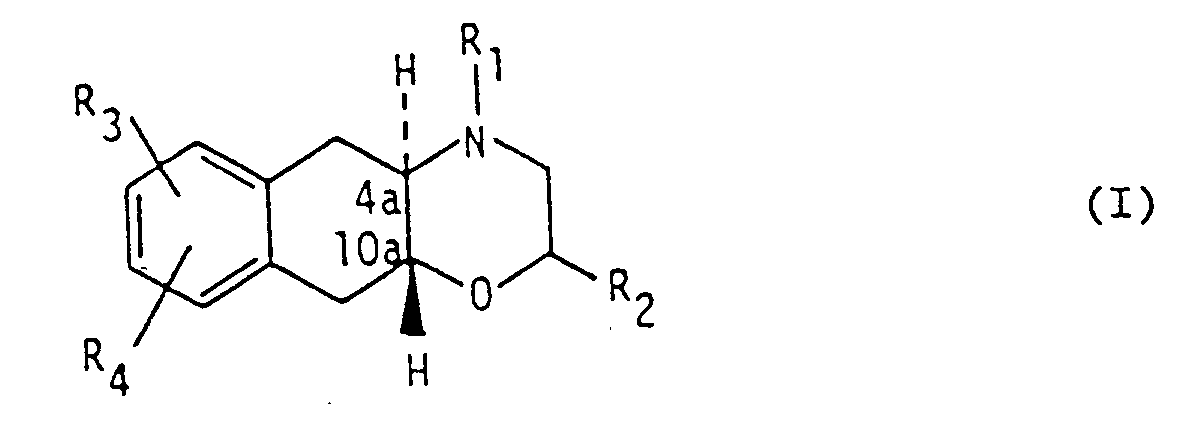
dans laquelle
dans laquelle
R₁ et R₂ signifient indépendamment l'hydrogène ou un groupe alkyle en C₁-C₄,
R₃ signifie un groupe hydroxy ou alcoxy en C₁-C₄, et
R₄ signifie le chlore, le brome, l'iode ou un groupe alkylthio en C₁-C₄, alkylsulfoxyde en C₁-C₄, alkylsulfone en C₁-C₄ ou trifluorométhyle,
sous forme de base libre ou d'un sel d'addition d' acide pharmaceutiquement acceptable, pour la préparation d'une composition pharmaceutique pour le traitement des états associés à l'ischémie cérébrale.2. L'utilisation selon la revendication 1, dans laquelle les états à traiter sont les
accidents vasculaires cérébraux.
3. L'utilisation selon la revendication 1 ou 2, dans laquelle le composé de formule I
est la (-)-(4aR,10aR)-3,4,4a,5,10,10a-hexahydro-6-méthoxy-4-méthyl-9-méthylthio-2H-napht[2,3-b]-1,4-oxazine,
sous forme de base libre ou d'un sel d'addition d' acide pharmaceutiquement acceptable.
4. L'utilisation selon la revendication 1 ou 2, dans laquelle le composé de formule I
est l'hydrogéno-malonate de (-)-(4aR,10aR)-3,4,4a,5,10,10a-hexahydro-6-méthoxy-4-méthyl-9-méthylthio-2H-napht[2,3-b]-1,4-oxazine.
5. L'hydrogéno-malonate de (-)-(4aR,10aR)-3,4,4a,5,10,10a-hexahydro-6-méthoxy-4-méthyl-9-méthylthio-2H-napht[2,3-b]-1,4-oxazine.
6. Un procédé de préparation de l'hydrogéno-malonate de (-)-(4aR,10aR)-3,4,4a,5,10,10a-hexahydro-6-méthoxy-4-méthyl-9-méthylthio-2H-napht[2,3-b]-1,4-oxazine,
qui comprend l'étape de faire réagir la base libre correspondante avec de l'acide
malonique.
7. Une composition pharmaceutique qui comprend comme substance active le composé selon
la revendication 5, en association avec un véhicule ou diluant pharmaceutique.