| (19) |
 |
|
(11) |
EP 0 435 402 B1 |
| (12) |
EUROPEAN PATENT SPECIFICATION |
| (45) |
Mention of the grant of the patent: |
|
04.05.1994 Bulletin 1994/18 |
| (22) |
Date of filing: 19.12.1990 |
|
|
| (54) |
Resin composition based on a polyester resin, an amino resin and an epoxy resin
Harzzusammensetzung auf Basis eines Polyesterharzes, eines Aminoharzes und eines Epoxyharzes
Composition de résine à base d'une résine de polyester, d'une résine amino et d'une
résine époxyde
|
| (84) |
Designated Contracting States: |
|
AT BE CH DE DK ES FR GB GR IT LI NL SE |
| (30) |
Priority: |
23.12.1989 NL 8903155
|
| (43) |
Date of publication of application: |
|
03.07.1991 Bulletin 1991/27 |
| (73) |
Proprietor: DSM N.V. |
|
6411 TE Heerlen (NL) |
|
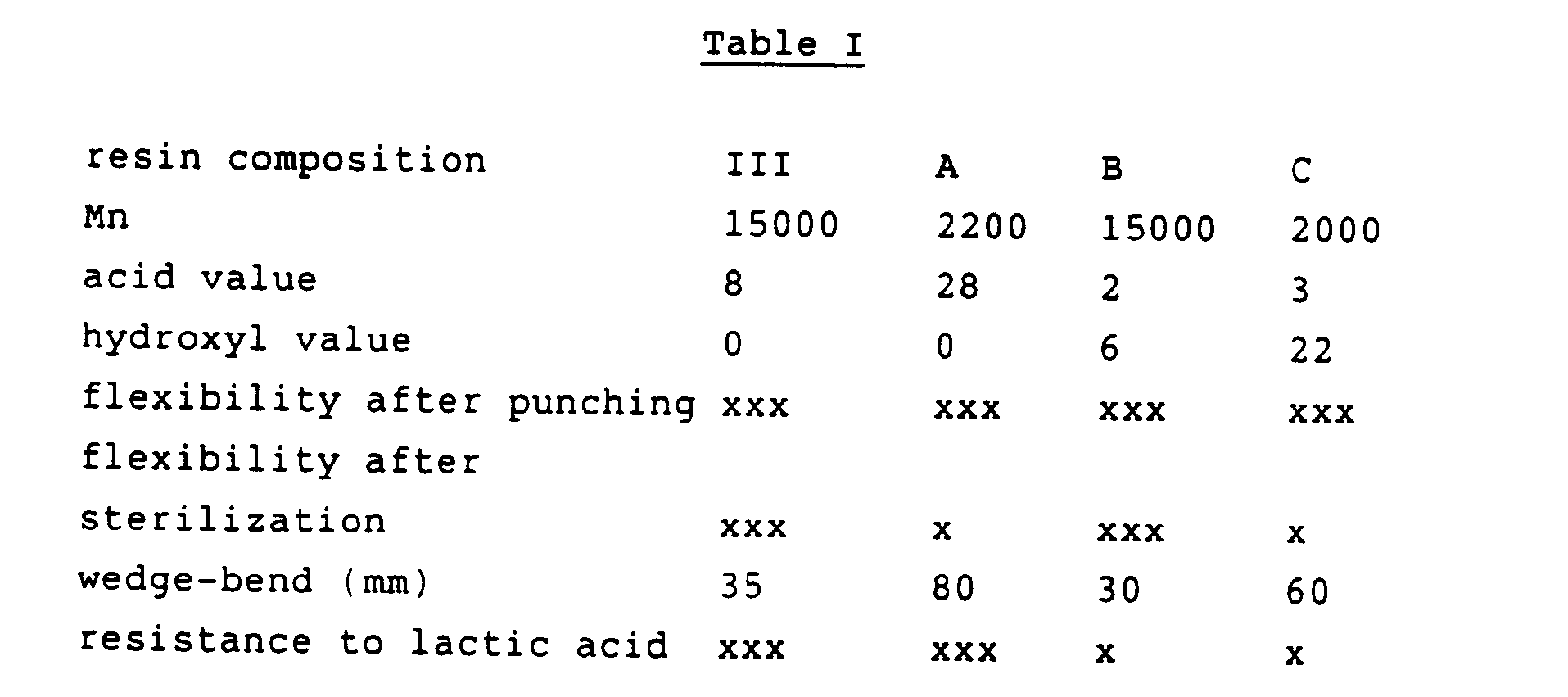
| (72) |
Inventors: |
|
- Hardeman, Gerard
NL-1053 BM Amsterdam (NL)
- Westerhof, Wilhelmina
NL-8023 AA Zwolle (NL)
- Plak, Anthonie Johannes
NL-8051 MV Hattem (NL)
- Beens-Onstenk, Anneke
NL-8281 GJ Genemuiden (NL)
|
| (56) |
References cited: :
EP-A- 0 110 451
EP-A- 0 150 476
DE-A- 1 807 776
US-A- 4 304 804
|
EP-A- 0 136 263
EP-A- 0 330 719
US-A- 3 548 026
|
|
| |
|
|
- PATENT ABSTRACTS OF JAPAN, vol. 3, no. 147 (C-66), 5th December 1979, page 80 C66;
& JP-A-54 125 230
|
|
| |
|
| Note: Within nine months from the publication of the mention of the grant of the European
patent, any person may give notice to the European Patent Office of opposition to
the European patent
granted. Notice of opposition shall be filed in a written reasoned statement. It shall
not be deemed to
have been filed until the opposition fee has been paid. (Art. 99(1) European Patent
Convention).
|
[0001] The invention relates to a resin composition based on a polyester resin, an amino
resin and an epoxy resin.
[0002] Such resin composition is already known from European patent EP-B-150476 and JP-A-54125
230. These patent publications describe a resin compositions based on a hydroxyl-functional
polyester resin, an amino resin and an epoxy resin. Said compositions are used as
a binding agent for interior can coatings in the food industry.
[0003] A disadvantage of these resin compositions is that can coatings based on such resin
compositions have insufficient resistance to lactic acid.
[0004] The object of the invention is to obtain resin compositions which give can coatings
good resistance to chemicals, particularly lactic acid, and also give such coatings
good flexibility.
[0005] The invention is characterized in that the polyester resin is a carboxyl-functional
polyesterwith a molecular weight of between 12000 and 25000 and a hydroxyl value of
substantially zero.
[0006] By this invention resin compositions comprising a polyester resin, an amino resin
and an epoxy resin are obtained which yield can coatings with good resistance to lactic
acid and with a good flexibility.
[0007] According to a preferred embodiment of the invention the carboxyl-functional polyester
has a molecular weight of between 14000 and 17000.
[0008] The acid number of the carboxyl-functional polyester is between 4 and 75, preferably
between 4 and 20, more preferably between 6 and 16.
[0009] The carboxyl-functional polyester is preferably the reaction product of a hydroxyl-functional
polyester and an acid anhydride or a dicarboxylic acid. Suitable acid anhydrides are,
for example, phthalic anhydride, tetrahydrophthalic anhydride, succinic anhydride,
maleic anhydride, trimellitic anhydride, pyromellitic anhydride and/or hexahydrophthalic
anhydride. Preferably, use is made of trimellitic anhydride and phthalic anhydride.
Suitable dicarboxylic acids are, for example, adipic acid, isophthalic acid, hexahydroterephthalic
acid and sebacic acid. Preferably, use is made of an acid anhydride.
[0010] The reaction between the hydroxyl-functional polyester and the acid anhydride or
the dicarboxylic acid is preferably effected in a second step after the hydroxyl-functional
polyester synthesis, but the aforementioned reaction can also be effected during the
curing of the resin composition.
[0011] In the reaction between the hydroxyl-functional polyester and the acid anhydride
or the dicarboxylic acid the molar ratio of the hydroxyl groups and the acid anhydride
or dicarboxylic acid groups is preferably almost equimolar. This results in a hydroxyl
value of substantially 0.
[0012] The hydroxyl-functional polyester can be obtained by causing polyalcohols to react
with acids or acid anhydrides. The molar ratio of the polyalcohols and the acids or
acid anhydrides may vary between 1.2:1.0 and 1.0:1.0 for the preparation of the hydroxyl-functional
polyester.
[0013] The carboxyl-functional polyester can also be obtained directly, by causing polyalcohols
to react with acids or acid anhydrides. The molar ratio of the polyalcohols and the
acids or acid anhydrides may vary between 1.0:1.2 and 1.0:1.0 for the preparation
of the carboxyl-functional polyester.
[0014] Suitable polyalcohols for the preparation of the carboxyl- and hydroxyl-functional
polyester are, for example, ethylene glycol, propylene glycol, diethylene glycol,
butanediol (1,4), hexanediol (1,6), neopentyl glycol, trimethylpentanediol, ester
of hydroxypivalic neopentyl glycol, tricyclodecanedimethanol, cyclohexanedimethanol,
bisphenol-A-bishydroxyethyl ether, trimethylolpropane and/or pentaerythritol. Suitable
acids for the preparation of the carboxyl- and hydroxyl-functional polyester are,
for example, isophthalic acid, terephthalic acid (ester of dimethylterephthalic acid),
adipic acid, sebacic acid, hexahydroterephthalic acid, decanedicarboxylic acid, 5-t-butylisophthalic
acid and/or dimerised fatty acids or acid anhydrides such as phthalic anhydride, tetrahydrophthalic
anhydride, succinic anhydride, maleic anhydride, trimellitic anhydride, pyromellitic
anhydride and/or hexahydrophthalic anhydride.
[0015] The esterification reaction is preferably carried out in a nitrogen atmosphere at
temperatures of between 180°C and 260°C. Catalysts such as dibutyltin oxide, tinchloride
or tetrabutoxy titanate, and antioxidants such as triphenyl phosphite may be used
as additives. The reaction water released during the reaction is removed by distillation.
The desired degree of esterification is reached by means of azeotropic distillation
or vacuum in the last phase. The reaction results in a polyester that can subsequently
be dissolved in an organic solvent or a mixture of solvents. Mixed aromatic hydrocarbons
and esters of glycol ether, such as methylpropylene glycol acetate or ethylpropylene
glycol acetate are, for example, used for this purpose.
[0016] Suitable amino resins are benzoguanamine resins, melamine resins and/or urea-formaldehyde
resins. Preferably, benzoguanamine resin and/or melamine resin is used as amino resin.
[0017] Benzoguanamine and melamine resins can be obtained by converting benzoguanamine and
melamine, respectively, into methylol compounds, with the aid of formaldehyde, and
then etherifying said methylol compounds with(C
i-C
4) alcohols so as to obtain the desired degree of etherification. The amount of formaldehyde
per mole of amino compound varies between 2 and 4 moles in the case of benzoguanamine
and between 3 and 6 moles when use is made of melamine. Alkaline conditions are usually
chosen for the methylolation step. In the subsequent etherification with the aid of
alcohols (preferably n-butanol or isobutanol) use is made of molar amounts of between
0.5 and 1.5 moles per mole of formaldehyde. The etherification takes place under acid
conditions and the reaction water formed is removed by azeotropic distillation. As
end product, a benzoguanamine resin or a melamine resin is obtained and dissolved
in the alcohol used for the etherification. Optionally, the concentration and viscosity
can be adjusted to the values required by distillative removal of this alcohol.
[0018] Suitable epoxy resins are, for example, bisphenol-A-epoxy compounds, hydrogenated
bisphenol-A-epoxy compounds and aliphatic epoxy compounds. Preferably, use is made
of bisphenol-A-epoxy compounds, such as the diglycidyl ether of bisphenol-A and oligomers
thereof.
[0019] The resin composition according to the invention is preferably obtained by first
preparing a pigment paste by mixing a carboxyl-functional polyester resin and a pigment
into a paste at a temperature at or below 70°C; next cooling said paste to room temperature
and adding to said cooled paste said amino resin, said epoxy resin and a catalyst.
The pigment is, for example, titaniumdioxide and a suitable catalyst is, for example,
dodecylbenzene sulphonic acid or paratoluene sulphonic acid. The catalyst is added
in amounts of less than 2 wt.%, relative to the resin composition. Optionally, use
may be made of additives such as flow improvers and substrate moisturizers, such as
cellulose acetobutyrate.
[0020] In this preparation the weight ratio of said carboxyl-functional poylester:pigment
is preferably between 2:3 and 1:1, the polyester resin : amino resin weight ratio
is preferably between 60:40 and 80:20, the polyester resin : epoxy resin weight ratio
is preferably between 70:30 and 80:20 and the polyester resin : (amino resin and epoxy
resin) weight ratio is preferably between 50:50 and 60:40.
[0021] The resin composition may be diluted with solvents, for example aromatic hydrocarbon
fractions such as Solvesso 200 (trade name of Esso), methylpropylene glycol acetate
(MPA) and ethyl-3-ethoxypropionate. In this manner a composition with a solids content
of between 40% and 60% can be obtained.
[0022] US-A-3548026 describes resin compositions based on epoxy resins and low-molecular
weight carboxyl-functional polyesters which are based on a prepolyester having a molecular
weight of 2000-10000. These resin compositions may optionally also contain amino resins.
However, coating compositions based on these resin compositions are insufficiently
flexible.
[0023] The resin composition according to the invention may be applied with the aid of a
roller coater to a metal substrate, for example, tin-plate, aluminium or black-plate
steel, in a dry layer thickness of 8-12 wm. The enamelling cycle takes 12-15 minutes
at 200°C-210°C.
[0024] The resin composition according to the invention is particularly well suited for
use as so-called interiorwhite can coatings, but may also be used for, for example,
coil coatings.
[0025] In the examples below the following tests were used:
[0026] The molecular weight was determined via gas phase chromatography (GPC) using a polyester-styrene
standard.
[0027] The resistance to lactic acid was determined visually in a 2% lactic acid solution
after sterilization for 1 hour at 129°C.
[0028] The flexibility was determined visually after punching and sterilization of a 'DSM
Resins standard can'.
[0029] In addition, the flexibility was measured via the so-called wedge-bend test'. In
this test a 'DSM Resins standard can' is conically deformed by means of an impact,
after which the number of defective millimeters of the coating is determined (with
a magnifier; magnification 8x). This determination takes place after immersion in
a copper sulphate/hydrochloric acid solution. The aim is to obtain the lowest possible
values.
[0030] The above tests are described in 'Epikote Technical Bulletin EP 2.9' of Shell Chemicals.
[0031] The invention is further explained by the following examples without, however, being
limited thereto.
Examples
Example I
Preparation of polyester resin
[0032] 14.11 parts by weight of ethylene glycol, 25.23 parts by weight of neopentyl glycol,
37.77 parts by weight of isophthalic acid, 37.77 parts by weight of terephthalic acid
and 0.05 parts by weight of tin chloride were heated, in a nitrogen atmosphere, in
a glass reaction flask equipped with a mechanical stirrer, a thermometer and a Vigreux
distillation column. The esterification reaction started at 180°C and the reaction
water formed was removed by distillation. The maximum reaction temperature was 260°C.
When the reaction mixture had become clear, it was subjected to azeotropic distillation
using an aromatic hydrocarbon fraction (Solvesso 150, trade name of Esso) until an
acid value of 1 was obtained.
[0033] After cooling to 190°C, 166 parts by weight of phthalic anhydride were added and
the reaction mixture was maintained at 190°C for 1 hour. The resin obtained was diluted
to a solids content of 40% with a solvent mixture consisting of Solvesso 150, Solvesso
200 and MPA, in a weight ratio of 1:1:2.
[0034] The final acid value of the solid resin was 8. The viscosity measured in an Emila
with a 100 spindle, at 23°C, was 20 dPa.s. The number average molecular weight was
determined by means of GPC using a polyester-styrene standard and amounted to 15,000.
Example 11
Example of a resin composition
[0035] 25.3 parts by weight of titanium dioxide (TR92 of Tioxide, LTD, UK) were added to
21.09 parts by weight of a carboxyl-functional polyester resin obtained according
to Example I (dissolved in Solvesso 150, Solvesso 200 and MPA; 8.44 parts by weight
of solids). This mixture was then ground to a pigment paste.
[0036] During the preparation the temperature of the paste did not rise above 70°C. After
cooling to room temperature, 18.37 parts by weight of polyester resin according to
Example I (dissolved in Solvesso 150, Solvesso 200 and MPA; 7.35 parts by weight of
solids), 9.65 parts by weight of benzoguanamine resin (dissolved in Solvesso 150,
n-butanol; 7.04 parts by weight of solids) (Uramex B 70600-RB-73 of DSM Resins BV),
6.09 parts by weight of epoxy resin (dissolved in diacetone alcohol; 5.48 parts by
weight of solids) (Epikote 834 of Shell Chemie BV) and 0.75 parts by weight of dodecylbenzene
sulphonic acid (Nacure 5225 of King Industries) were mixed. The mixture was then diluted
with isophorone to a viscosity of 100-120 seconds flow time (DIN cup 4 at 23°C, DIN
standard 53211).
[0037] The composition obtained was applied to tin-plate, aluminium and black-plate steel,
in a layer thickness of 10 µm, using a roller coater, and subjected to an enamelling
cycle of 12-15 minutes at 210°C.
Example III and Comparative Experiments A-B-C
Test results of resin compositions
[0038] The following properties relating to mechanical strength and resistance were determined
is resin compositions obtained as described in Example II:
a) flexibility after punching of a can ('DSM Resins standard can'),
b) flexibility after sterilization of the can ('DSM Resins standard can'),
c) flexibility via the 'wedge-bend test', and
d) resistance to lactic acid.
[0039] Four resin compositions (III-A-B-C) based on different polyesters were compared:
III. resin composition based on a high-molecular carboxyl-functional polyester resin
(molecular weight 15000),
A. resin composition based on a low-molecular carboxyl-functional polyester resin
(molecular weight 2200),
B. resin composition based on a high-molecular hydroxyl-functional polyester resin
(molecular weight 15000)and
C. resin composition based on a low-molecular hydroxyl-functional polyester resin
(molecular weight 2000),
[0040] The properties 'flexibility after punching', 'flexibility after sterilization' and
'resistance to lactic acid' were visually determined:
xxx = excellent;
xx = satisfactory;
x = unsatisfactory.
[0041] The above results show that resin compositions based on carboxyl-functional polyester
resins with a molecularweight of 15000, an amino resin and an epoxy resin produce
excellent resistance to lactic acid combined with excellent flexibility after sterilization.
Claims for the following Contracting State(s) : AT, BE, CH, DE, DK, FR, GB, GR, IT,
Ll, NL, SE
1. Resin composition based on a polyester resin, an amino resin and an epoxy resin,
characterized in that the polyester resin is a carboxyl-functional polyesterwith a
molecular weight of between 12000 and 25000 and a hydroxyl value of substantially
zero.
2. Resin composition according to claim 1, characterized in that the carboxyl-functional
polyester has a molecular weight of between 14000 and 17000.
3. Resin composition according to any one of claims 1-2, characterized in that the
acid number of the carboxyl-functional polyester is between 4 and 75.
4. Resin composition according to any one of claims 1-3, characterized in that the
carboxyl-functional polyester is the reaction product of a hydroxyl-functional polyester
and an acid anhydride or a dicarboxylic acid.
5. Resin composition according to any one of claims, characterized in that the amino
resin is a benzoguanamine resin and/or a melamine resin.
6. A process for the preparation of a resin composition according to any one of claims
1-5, characterized in that said carboxyl-functional polyester resin and a pigment
are mixed into a paste at a temperature at or below 70°C; next cooling said paste
to room temperature and adding to said cooled paste said amino resin, said epoxy resin
and a catalyst.
7. A process according to claim 6, characterized in that the weight ratio of said
carboxyl-functional polyester resin to said pigment is between 2:3 and 1:1, the weight
ratio of said polyester resin to said amino resin is between 60:40 and 80:20, the
weight ratio of said polyester resin to said epoxy resin is between 70:30 and 80:20
and the weight ratio of said polyester resin to total amount of said amino resin and
said epoxy resin is between 50:50 and 60:40.
8. Use of a resin composition according to any one of claims 1-4, or use of a resin
composition obtained according to any one of claims 6-7.
9. Coating or can coating based on a resin composition according to any one of claims
1-4, or based on a resin composition obtained according to any one of claims 6-7.
10. Completely or partly coated substrate, characterized in that it is coated with
a coating or a can coating according to claim 9.
Claims for the following Contracting State(s) : ES
1. A process for the preparation of a resin composition based on a polyester resin,
an amino resin and an epoxy resin, characterized in that a carboxyl-functional polyester
resin with a molecular weight of between 12000 and 25000 and a hydroxyl value of substantially
zero and a pigment are mixed into a paste at a temperature at or below 70°C; next
cooling said paste to room temperature and adding to said cooled paste an amino resin,
an epoxy resin and a catalyst.
2. A process according to claim 1, characterized in that the weight ratio of said
carboxyl-functional polyester resin to said pigment is between 2:3 and 1:1, the weight
ratio of said polyester resin to said amino resin is between 60:40 and 80:20, the
weight ratio of said polyester resin to sid epoxy resin is between 70:30 and 80:20
and the weight ratio of said polyester resin to total amount of said amino resin and
said epoxy resin is between 50:50 and 60:40.
3. A process according to any one of claims 1-2, characterized in that the carboxyl-functional
polyester has a molecular weight of between 14000 and 17000.
4. A process according to any one of claims 1-3, characterized in that the acid number
of the carboxylfunc- tional polyester is between 4 and 75.
5. A process according to any one of claims 1-4, characterized in that the carboxyl-functional
polyester is the reaction product of a hydroxyl-functional polyester and an acid anhydride
or a dicarboxylic acid.
6. A process according to any one of claims 1-5, characterized in that the amino resin
is a benzoguanamine resin and/or melamine resin.
7. A process for the preparation of a coating comprised of a polyester resin, which
is a carboxyl-functional polyester with a molecularweight between 12,000 and 25,000;
an amino resin; and an epoxy resin; steps of said process comprising: mixing said
carboxyl-functional polyester resin and a pigment into a paste at a temperature at
or below 70°C; cooling said paste to room temperature; adding to said cooled paste
said amino resin, said epoxy resin and a catalyst; diluting said coating composition
with organic solvent to a viscosity of 100-120 seconds flow time.
8. A process according to claim 7, characterized in that, the weight ratio of said
carboxyl-functional polyester resin to said pigment is between 80:20 and 20:80, the
weight ratio of said polyester resin to said amino resin is between 60:40 and 80:20,
the weight ratio of said polyester resin to said epoxy resin is between 70:30 and
80:20, the weight ratio of said polyester resin to total amount of said amino resin
and said epoxy resin is between 50:50 and 60:40.
9. A process according to any one of claims 7-8, wherein said pigment is titanium
dioxide.
10. A process according to any one of claims 7-8, wherein said catalyst dodeclybenzene
sulphonic acid or paratoluene sulphonic acid.
Patentansprüche für folgende(n) Vertragsstaat(en) : AT, BE, CH, DE, DK, FR, GB, GR,
IT, LI, NL, SE
1. Harzzusammensetzung auf Basis eines Polyesterharzes, eines Aminoharzes und eines
Epoxyharzes, dadurch gekennzeichnet, daß das Polyesterharz ein Carboxyl-funktioneller
Polyester mit einer Molmasse zwischen 12 000 und 25 000 und einer Hydroxylzahl von
im wesentlichen Null ist.
2. Harzzusammensetzung nach Anspruch 1, dadurch gekennzeichnet, daß der Carboxyl-funktionelle
Polyester eine Molmasse zwischen 14 000 und 17 000 aufweist.
3. Harzzusammensetzung nach Anspruch 1 oder 2, dadurch gekennzeichnet, daß die Säurezahl
des Carboxyl-funktionellen Polyesters zwischen 4 und 75 beträgt.
4. Harzzusammensetzung nach einem der Ansprüche 1 bis 3, dadurch gekennzeichnet, daß
der Carboxyl-funktionelle Polyester das Reaktionsprodukt eines Hydroxyl-funktionellen
Polyesters und eines Säureanhydrids oder einer Dicarbonsäure ist.
5. Harzzusammensetzung nach einem der vorhergehenden Ansprüche, dadurch gekennzeichnet,
daß das Aminoharz ein Benzoguanaminharz und/oder ein Melaminharz ist.
6. Verfahren zur Herstellung einer Harzzusammensetzung nach einem der Ansprüche 1
bis 5, dadurch gekennzeichnet, daß das Carboxyl-funktionelle Polyesterharz und ein
Pigment bei einer Temperatur von 70°C oder weniger in eine Paste gemischt werden;
als nächstes die Paste auf Raumtemperatur abgekühlt wird und der abgekühlten Paste
das Aminoharz, das Epoxyharz und ein Katalysator zugesetzt werden.
7. Verfahren nach Anspruch 6, dadurch gekennzeichnet, daß das Masseverhältnis des
Carboxyl-funktionellen Polyesterharzes zum Pigment zwischen 2:3 und 1:1 beträgt, das
Masseverhältnis des Polyesterharzes zum Aminoharz zwischen 60:40 und 80:20 beträgt,
das Masseverhältnis des Polyesterharzes zum Epoxyharz zwischen 70:30 und 80:20 beträgt,
und das Masseverhältnis des Polyesterharzes zur Gesamtmenge des Aminoharzes und Epoxyharzes
zwischen 50:50 und 60:40 beträgt.
8. Verwendung einer Harzzusammensetzung nach einem der Ansprüche 1 bis 4, oder Verwendung
einer nach einem der Ansprüche 6 oder 7 erhaltenen Harzzusammensetzung.
9. Beschichtung oder Dosenbeschichtung auf Basis einer Harzzusammensetzung nach einem
derAnsprüche 1 bis 4, oder auf Basis einer nach einem der Ansprüche 6 oder 7 erhaltenen
Harzzusammensetzung.
10. Vollständig oder teilweise beschichtetes Substrat, dadurch gekennzeichnet, daß
es mit einer Beschichtung oder Dosenbeschichtung nach Anspruch 9 beschichtet ist.
Patentansprüche für folgende(n) Vertragsstaat(en) : ES
1. Verfahren zur Herstellung einer Harzzusammensetzung auf Basis eines Polyesterharzes,
eines Aminoharzes und eines Epoxyharzes, dadurch gekennzeichnet, daß ein Carboxyl-funktionelles
Polyesterharz mit einer Molmasse zwischen 12 000 und 25 000 und einer Hydroxylzahl
von im wesentlichen Null und ein Pigment bei einer Temperatur von 70°C oder weniger
in eine Paste gemischt werden; als nächstes die Paste auf Raumtemperatur abgekühlt
wird und der abgekühlten Paste ein Aminoharz, ein Epoxyharz und ein Katalysator zugesetzt
werden.
2. Verfahren nach Anspruch 1, dadurch gekennzeichnet, daß das Masseverhältnis des
Carboxyl-funktionellen Polyesterharzes zum Pigment zwischen 2:3 und 1:1 beträgt, das
Masseverhältnis des Polyesterharzes zum Aminoharz zwischen 60:40 und 80:20 beträgt,
das Masseverhältnis des Polyesterharzes zum Epoxyharz zwischen 70:30 und 80:20 beträgt,
und das Masseverhältnis des Polyesterharzes zur Gesamtmenge des Aminoharzes und Epoxyharzes
zwischen 50:50 und 60:40 beträgt.
3. Verfahren nach Anspruch 1 oder2, dadurch gekennzeichnet, daß der Carboxyl-funktionelle
Polyester eine Molmasse zwischen 14 000 und 17 000 aufweist.
4. Verfahren nach einem der Ansprüche 1 bis 3, dadurch gekennzeichnet, daß die Säurezahl
des Carboxyl-funktionellen Polyesters zwischen 4 und 75 beträgt.
5. Verfahren nach einem der Ansprüche 1 bis 4, dadurch gekennzeichnet, daß der Carboxyl-funktionelle
Polyester das Reaktionsprodukt eines Hydroxyl-funktionellen Polyesters und eines Säureanhydrids
oder einer Dicarbonsäure ist.
6. Verfahren nach einem der Ansprüche 1 bis 5, dadurch gekennzeichnet, daß das Aminoharz
ein Benzoguanaminharz und/oder ein Melaminharz ist.
7. Verfahren zur Herstellung einer Beschichtung, die ein Polyesterharz, das ein Carboxyl-funktioneller
Polyester mit einem Molgewicht zwischen 12 000 und 25 000 ist; ein Aminoharz; und
ein Epoxyharz umfaßt; wobei die Schritte des Verfahrens umfassen: Mischen des Carboxyl-funktionellen
Polyesterharzes und eines Pigments in eine Paste bei einer Temperatur von 70°C oder
weniger; Abkühlen der Paste auf Raumtemperatur; Zusetzen des Aminoharzes, des Epoxyharzes
und eines Katalysators zurabgekühlten Paste; Verdünnen der Beschichtungszusammensetzung
mit organischem Lösungsmittel auf eine Viskosität von 100 bis 120 Sekunden Fließzeit.
8. Verfahren nach Anspruch 7, dadurch gekennzeichnet, daß das Masseverhältnis des
Carboxyl-funktionellen Polyesterharzes zum Pigment zwischen 80:20 und 20:80 beträgt,
das Masseverhältnis des Polyesterharzes zum Aminoharz zwischen 60:40 und 80:20 beträgt,
das Masseverhältnis des Polyesterharzes zum Epoxyharz zwischen 70:30 und 80:20 beträgt,
und das Masseverhältnis des Polyesterharzes zur Gesamtmenge des Aminoharzes und Epoxyharzes
zwischen 50:50 und 60:40 beträgt.
9. Verfahren nach einem der Ansprüche 7 oder 8, bei welchem das Pigment Titandioxid
ist.
10. Verfahren nach einem der Ansprüche 7 oder 8, bei welchem der Katalysator Dodecylbenzolsulfonsäure
oder p-Toluolsulfonsäure ist.
Revendications pour l'(les) Etat(s) contractant(s) suivant(s) : suivants : AT, BE,
CH, DE, DK, FR, GB, GR, IT, LI, NL, SE
1. Composition de résines à base d'une résine polyester, d'une résine amino et d'une
résine époxy, caractérisée en ce que la résine polyester est un polyester à fonctionnalité
carboxyle, avec une masse moléculaire comprise entre 12 000 et 25 000 et un indice
d'hydroxyle pratiquement nul.
2. Composition de résines selon la revendication 1, caractérisée en ce que le polyester
à fonctionnalité carboxyle a une masse moléculaire comprise entre 14 000 et 17 000.
3. Composition de résines selon l'une quelconque des revendications 1 et 2, caractérisée
en ce que l'indice d'acide du polyester à fonctionnalité carboxyle est compris entre
4 et 75.
4. Composition de résines selon l'une quelconque des revendications 1 à 3, caractérisée
en ce que le polyester à fonctionnalité fonctionnelle est le produit de la réaction
d'un polyester à fonctionnalité hydroxyle et d'un anhydride ou d'un acide dicarboxylique.
5. Composition de résines selon l'une quelconque des revendications précédentes, caractérisée
en ce que la résine amino est une résine benzoguanamine et/ou résine mélamine.
6. Procédé pour la préparation d'une composition de résines selon l'une quelconque
des revendications 1 à 5, caractérisé en ce que l'on mélange ladite résine polyester
à fonctionnalité carboxyle et un pigment en une pâte à une température inférieure
ou égale 70°C; on refroidit ensuite ladite pâte à la température ambiante et on ajoute
à ladite pâte refroidie ladite résine amino, ladite résine époxy, et un catalyseur.
7. Procédé selon la revendication 6, caractérisé en ce que le rapport pondéral de
ladite résine polyester à fonctionnalité carboxyle audit pigment est 2:3 et 1:1, le
rapport pondéral de ladite résine polyester à ladite résine amino est compris entre
60:40 et 80:20, le rapport pondéral de ladite résine polyester à ladite résine époxy
est compris entre 70:30 et 80:20 et le rapport pondéral de ladite résine polyester
à la quantité totale de ladite résine amino et de ladite résine époxy est compris
entre 50:50 et 60:40.
8. Utilisation d'une composition de résines selon l'une quelconque des revendications
1 à 4, ou utilisation d'une composition de résines selon l'une quelconque des revendications
6 et 7.
9. Revêtement ou revêtement de boîte de conserve à base d'une composition de résines
selon l'une quelconque des revendications 1 à 4, ou à base d'une composition de résines
obtenue selon l'une quelconque des revendications 6 et 7.
10. Substrat partiellement ou totalement revêtu, caractérisé en ce qu'il est revêtu
avec un revêtement ou un revêtement de boîte de conserve selon la revendication 9.
Revendications pour l'(les) Etat(s) contractant(s) suivant(s) : suivant : ES
1. Procédé pour la préparation d'une composition de résines à base d'une résine polyester,
d'une résine amino et d'une résine époxy, caractérisé en ce qu'on mélange une résine
polyester à fonctionnalité carboxyle ayant une masse moléculaire comprise entre 12
000 et 25 000 et un indice d'hydroxyle pratiquement nul, et un pigment en une pâte
à une température inférieure ou égale à 70°C; on refroidit ensuite ladite pâte à la
température ambiante et on ajoute à ladite pâte une résine amino, une résine époxy
et un catalyseur.
2. Procédé selon la revendication 1, caractérisé en ce que le rapport pondéral de
ladite résine à fonctionnalité carboxyle audit pigment est compris entre 2:3 et 1:1,
le rapport pondéral de ladite résine polyester à ladite résine amino est compris entre
60:40 et 80:20, le rapport pondéral de ladite résine polyester à ladite résine époxy
est compris entre 70:30 et 80:20 et le rapport pondéral de ladite résine polyester
à la quantité totale de ladite résine amino et de ladite résine époxy est compris
entre 50:50 et 60:40.
3. Procédé selon l'une quelconque des revendications 1 à 2, caractérisé en ce que
le polyester à fonctionnalité carboxyle a une masse moléculaire comprise entre 14
000 et 17 000.
4. Procédé selon l'une quelconque des revendications 1 à 3, caractérisé en ce que
l'indice d'acide du polyester à fonctionnalité carboxyle est compris entre 4 et 75.
5. Procédé selon l'une quelconque des revendications 1 à 4, caractérisé en ce que
le polyester à fonctionnalité carboxyle est le produit de la réaction d'un polyester
à fonctionnalité hydroxyle et d'un anhydride ou d'un acide dicarboxylique.
6. Procédé selon l'une quelconque des revendications 1 à 5, caractérisé en ce que
la résine amino est une résine benzoguanamine et/ou une résine mélamine.
7. Procédé pour la préparation d'un revêtement constitué d'une résine de polyester,
qui est un polyester à fonctionnalité carboxyle, ayant une masse moléculaire comprise
entre 12 000 et 25 000; d'une résine amino; et d'une résine époxy, le procédé comprenant
les étapes consistant: à mélanger ladite résine polyester à fonctionnalité carboxyle
et un pigment en une pâte à une température inférieure ou égale à 70°C; à refroidir
ladite pâte à la température ambiante; à ajouter à ladite pâte refroidie ladite résine
amino, ladite résine époxy et un catalyseur; et à diluer ladite composition de revêtement
avec un solvant organique à une viscosité de 100 à 120 secondes de temps d'écoulement.
8. Procédé selon la revendication 7, caractérisé en ce que, le rapport pondéral de
ladite résine polyester à fonctionnalité carboxyle audit pigment est compris entre
80:20 et 20:80, le rapport pondéral de ladite résine polyester à ladite résine amino
est compris entre 60:40 et 80:20, le rapport pondéral de la dite résine polyester
à ladite résine époxy est compris entre 90:30 et 80:20, le rapport pondéral de ladite
résine polyester à la quantité totale de ladite résine amino et de ladite résine époxy
est compris entre 50:50 et 60:40.
9. Procédé selon l'une quelconque des revendications 7 et 8, dans lequel ledit pigment
est le dioxyde de titane.
10. Procédé selon l'une quelconque des revendications 7 et 8, dans lequel ledit catalyseur
est l'acide dodé- cylbenzène sulfonique ou l'acide paratoluène sulfonique.