| (19) |
 |
|
(11) |
EP 0 441 619 B1 |
| (12) |
EUROPEAN PATENT SPECIFICATION |
| (45) |
Mention of the grant of the patent: |
|
28.09.1994 Bulletin 1994/39 |
| (22) |
Date of filing: 06.02.1991 |
|
| (51) |
International Patent Classification (IPC)5: F16L 47/00 |
|
| (54) |
Flanged pipe joints
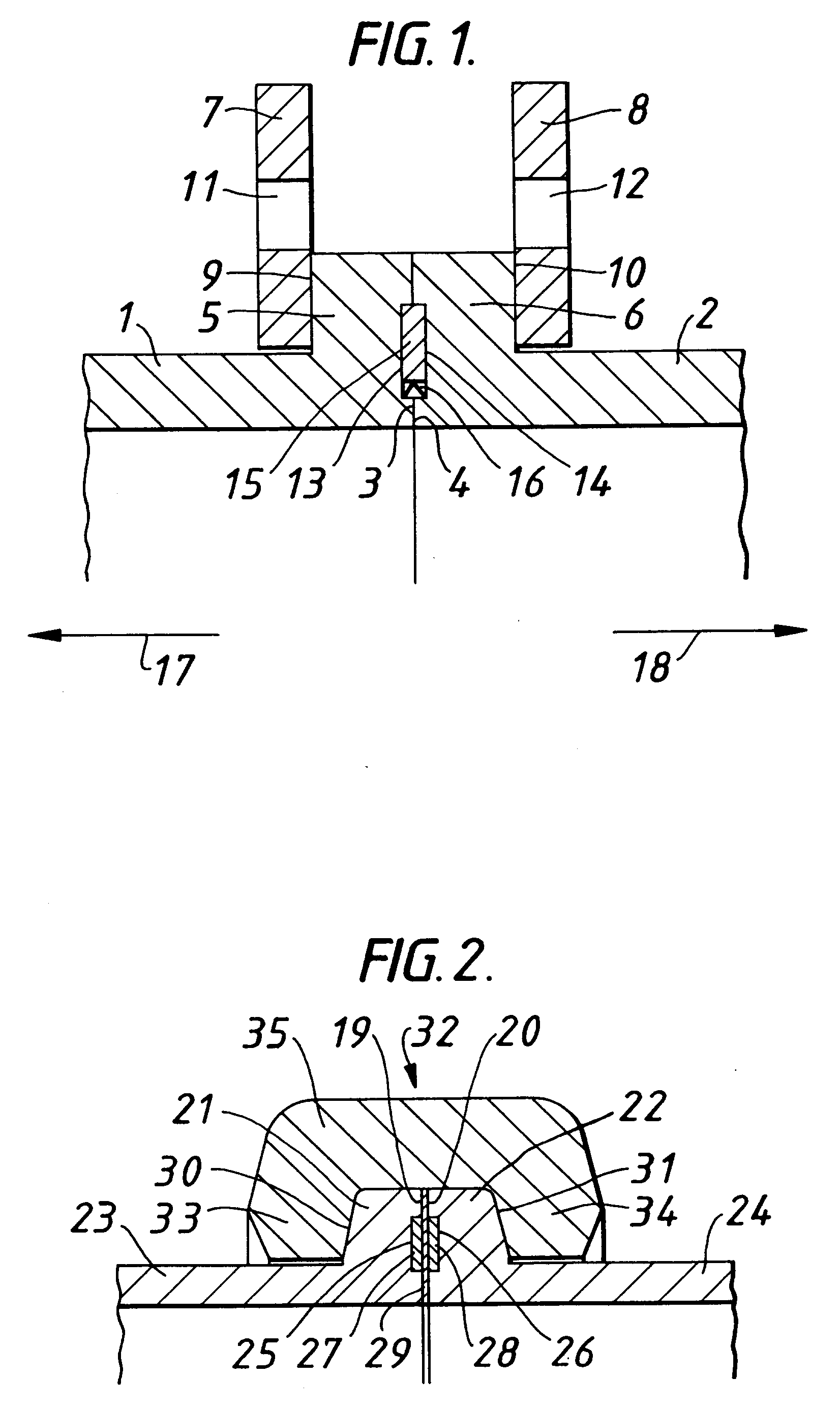
Flansch-Rohrverbindung
Raccord de tuyaux à brides
|
| (84) |
Designated Contracting States: |
|
AT BE CH DE DK ES FR GB GR IT LI LU NL SE |
| (30) |
Priority: |
09.02.1990 GB 9003024
15.03.1990 GB 9005835
|
| (43) |
Date of publication of application: |
|
14.08.1991 Bulletin 1991/33 |
| (73) |
Proprietor: VICTAULIC PLC |
|
Hitchin
Hertfordshire SG4 0AP (GB) |
|
| (72) |
Inventor: |
|
- Headford, Alan Lloyd
Bedford,
Bedfordshire MK40 2BD (GB)
|
| (74) |
Representative: Heath, Peter William Murray |
|
FRY HEATH & SPENCE
The Old College
53 High Street
Horley
Surrey RH6 7BN
Horley
Surrey RH6 7BN (GB) |
| (56) |
References cited: :
EP-A- 0 221 395
DE-A- 2 900 773
|
DE-A- 2 143 766
US-A- 3 082 022
|
|
| |
|
|
|
|
| |
|
| Note: Within nine months from the publication of the mention of the grant of the European
patent, any person may give notice to the European Patent Office of opposition to
the European patent
granted. Notice of opposition shall be filed in a written reasoned statement. It shall
not be deemed to
have been filed until the opposition fee has been paid. (Art. 99(1) European Patent
Convention).
|
[0001] This invention relates to joints and couplings by means of flange interconnection
between pipes for use in a liquid or gas pipe work system, and parts of such joints
and couplings.
[0002] More particularly, the invention relates to such joints and couplings involving at
least one plastics pipe having a stub flange. Such stub flanges may be provided to
enable plain ended plastics pipes to be connected to flange ended pipes, and may be
joined to the plain ended pipes by butt welding for example.
[0003] It is to be understood that by the expression "pipe" as used herein is meant any
pipe-like member such as a pipe as such, and additionally pipe fittings such as "T"
junctions, elbows, bends, reducers, and valve inlets, for example.
[0004] Plastics stub flanged pipes are provided at their free ends with radially outwardly
extending stub flanges adapted to abut against the flanges of other pipes by means
of connecting means disposed radially outside the stub flanges. Thus, stub flanged
pipes are commonly adapted to be connected to other stub flanged pipes by means of
annular backing rings disposed about the pipes behind the stub flanges and connected
together. The backing rings may comprise separate elements drawn together with securing
means such as bolts, or may be formed by parts of surrounding sleeve-like coupling
member. Such plastics pipes, and particularly such plastics stub flanged pipes are
commonly formed of polyethylene.
[0005] Stub flanges on plastics pipes are advantageous over wider flanges arranged to be
interconnected by bolts passing through circumferentially arranged bores therein,
in that there is no circumferential pipe alignment requirement on interconnection,
and sealing problems related to flexibility of the plastics material between the bolts
can be substantially reduced.
[0006] Joints using plastics stub flanges must, for safe usage in the conveyance of liquid
and gases, be capable of adequate resistance to forces along the length of the plastics
pipes tending to "pull out" one or both of the pipes from the coupling. In practice
this presents considerable problems in view of the relatively deformable character
of the material concerned in that inward radial forces induced at the stub flanges
of the pipes by the backing rings during the application of longitudinal forces to
the plastic pipes leads to a radially inward force (toward the pipe axis) on the pipe
stub flanges and movement of the shoulders of the plastics stub flanges, such that
the stub flanges distort excessively and can ultimately pull through their associated
backing rings.
[0007] Reference is hereby made to D-A-2900773. This specification relates to couplings
for and joints of stub flanged pipes, of a generally similar nature to that to which
the invention of the present application relates, and, amongst other things, discloses
a joint between two pipes with means for connecting the two pipes to urge together
the mating surfaces of stub flanges thereof. However it is to be noted that the disclosure
of this citation does not in any way teach or suggest any solution to the problems
hereinabove described.
[0008] It is an object of the present invention to overcome or at least substantially reduce
the above mentioned problems.
[0009] In accordance with one aspect of the present invention there is provided a joint
between two pipes at least one of which is a plastics pipe, the pipes having at their
facing ends outwardly extending annular flanges providing mating surfaces between
the two pipes generally normal to the direction of the pipes; means for connecting
the two pipes to urge together the mating surfaces of the flanges; the flange of the
plastics pipe or at least one of the plastics pipes being a stub flange; characterised
in that the or each stub flange carries an annular supporting hoop of relatively rigid
material whereby to assist the or each stub flanged plastics pipe resisting radially
inward forces, the hoop being disposed in an annular groove in the mating face of
the or each stub flange of the or each plastics pipe.
[0010] In one embodiment of the invention both flanged pipes may be stub flanged pipes formed
of plastics materials, in which case a pair of annular backing rings may be disposed
one about each of the plastics pipes and abutting behind the stub flanges of the plastics
pipes, the backing rings being adapted for connection one with the other, and the
juxtaposed flanges of the plastics pipes containing at least one annular supporting
hoop of relatively rigid material.
[0011] Where the joint is between two such plastics pipes, a single supporting hoop may
be located in juxtaposed annular grooves in the mating surfaces of the stub flanges,
the single hoop bearing against the appropriate radially outer facing surfaces of
the groove in order to provide support and assist both plastics pipe stub flanges
resist radially inward forces. Alternatively, and applicable more generally, the or
each stub flange of a plastics flange pipe may be provided with a separate hoop, disposed
in an annular groove in the mating face of the flange, and the supporting hoop may
in this instance have a surface generally flush with the mating face of the flange.
The supporting hoop may be in the form of a flat faced annular disc. More generally
the hoop may be of any desired configuration appropriate for its purpose, and of any
appropriate material providing significantly greater strength than the pipe stub flange
alone.
[0012] Each backing ring may comprise a separate annular ring provided with bores by means
of which the backing ring may be connected to an associated backing ring located behind
the stub flange of a corresponding plastics flanged pipe by, for example, bolts through
complimentary bores in the backing rings. Alternatively, the backing ring may be connected
to the flange of a steel or iron pipe for example by means of bolts, for example,
passing through the bores in the backing ring and corresponding bores in the juxtaposed
flange of the steel or iron flange pipe.
[0013] Again where the joint is between two plastics stub flanged pipes, the backing rings
may comprise the side walls of a sleeve-like coupling member, such as that sold under
the name "VICTAULIC" (Registered Trade Mark), in which case the axially rear surfaces
of the stub flanges are shaped to conform to the internal configuration of the sleeve
coupling, and the sleeve is placed around the stub flanges of the plastics pipes in
such a manner that the side walls locate firmly one behind each of the two stub flanges
of the plastics pipes.
[0014] Where separate supporting hoops are used with respect to each plastics pipe in a
mating face groove thereof, gasket face seals may be incorporated in the joint between
the mating surfaces of the connected pipes in normal manner. Where however one supporting
hoop is "shared" between two pipes within the juxtaposed grooves thereof, a sealing
gasket may be fitted radially inwardly of the hoop, and may comprise a gasket of known
lipseal characteristics. This may be fitted within the grooves containing the hoop,
and may in some embodiments be combined with the hoop. Such an arrangement has the
added advantage of increasing the isolation of the supporting hoop from the contents
of the pipe during use thereof, which with some applications of pipes, where the supporting
hoop is of an abradable or corrodible material, can be a considerable advantage. The
supporting hoop may be of metal and may be a machined and/or stamped, or laser cut,
steel component for example. To resist corrosion, a galvanised or plastic polymer
coating may be provided for the supporting hoop. Such a coating in practice would,
with the invention, prove durable to a high degree because of negligible abrasive
wear since the component is well away from the main stream of materials flowing through
the pipe.
[0015] Where the supporting hoop lies in the mating face of the stub flange, arrangements
may be provided for holding it captive within its groove. This may be done by means
of a chamfered edge on the radially outer periphery of the supporting hoop inclined
radially outwardly away from the mating face of the flange abutting a similarly inclined
radially outer wall of the groove. Alternatively, the radially outer perimeter of
the supporting hoop may be provided with appropriately configured knurling to engage
the radially outer wall of the groove. It is to be noted that the means for holding
the hoop captive in the groove are on the radially outer perimeter in order that when
subject to joint separation forces, these apply to the outer periphery of the hoop
particularly which remains planar and does not "dish". Supporting hoops of this kind
can be pressed into the appropriate groove, or moulded in during formation of the
stub flange.
[0016] In practice the supporting hoop is set at as large a diameter as possible within
the stub flange of the plastics pipe consistent with the practical needs for plastics
material in the stub flange radially outwardly of the supporting hoop. The provision
of the hoop in the flange ensures that there is no loss of pipe wall thickness as
such, so that weakness potential with such loss in thickness is avoided. Also the
essential slimness of the hoop leads to minimal loss of axial section thickness of
the flange stub and therefore its resistance to radially inward loads.
[0017] A joint between pipes as just described will enable the reduction of certain dimensions
of the coupling assembly, such as backing ring thickness, strength, and outside diameter,
and the dimensions of the bolts used for connecting such backing rings. Again the
pitch circle diameter can be reduced, and the stub pipe flange outside diameter reduced.
In practical terms the reduction of the stub pipe flange outside diameter may be arranged
to be sufficient to allow the provision of backing rings having a pitch circle diameter
capable of allowing connection between iron or steel flange pipes of standard configuration
and stub flanged polyethylene pipe having the same bore. In practical terms this is
of very considerable commercial usefulness.
[0018] In accordance with another aspect of the present invention there is provided a plastics
pipe having at one end an outwardly extending annular stub flange having a mating
surface for abutment, in use, with the corresponding mating surface of another flanged
pipe, said mating surface being generally normal to the direction of the pipe; characterised
in that the stub flange of the plastics pipe carries an annular supporting hoop of
relatively rigid material whereby to assist, in use of the flanged plastics pipe when
connected to another stub flanged pipe, resistance to radially inward forces within
the plastics stub flange, the hoop being disposed in an annular groove in the mating
face of the stub flange of the plastics pipe.
[0019] In order that the present invention may be more readily understood two embodiments
thereof will now be described by way of example with reference to the accompanying
drawings in which:-
Figure 1 is a sectional schematic elevation showing half of a joint between two plastics
stub flanged pipes by means of separate steel backing rings, all in accordance with
the invention; and
Figure 2 is a similar sectional elevation of part of a joint between two plastics
stub flanged pipes by means of a side wall sleeved coupling, again utilizing the invention.
[0020] Referring to Figure 1 it will be seen that two stub flanged polyethylene pipes 1,2
are located with the mating faces 3,4 of their stub flanges 5,6 abutting.
[0021] Steel backing rings 7,8 are located about the pipes, behind and bearing against the
back faces 9,10 of the stub flanges. The rings are rotatable about the pipes and have
bores 11,12 for the receipt of interconnecting bolts (not shown), which with attached
nuts (not shown) firmly secure the joint between the pipes together.
[0022] The stub flanges 5,6, are provided in their mating faces 3,4 with matching juxtaposed
annular grooves 13,14 within which is located a single supporting hoop of mild steel
15, radially inwardly of which, within the grooves 13,14, is disposed a lipseal 16
to prevent any liquid or gas from within the pipes coming into contact with the steel
supporting hoop 15, or escaping from the joint between the two pipes.
[0023] In practice, upon tightening together the two backing rings 7,8 by means of nuts
and bolts between them, the joint between the two pipes is firmly and securely and
sealingly formed.
[0024] Any forces on the pipes along the directions 17,18 of the pipes resulting from tensile
end loading will tend to lead to radially inward forces upon the flanges 5,6 of the
stub pipes, which in turn will tend to urge the pipes radially inwards with the potential
risk of the pipe flanges jumping under one or other of the backing rings 7,8. Such
radially inward forces are strongly resisted by the supporting hoop 15, leading to
a far more secure pipe joint.
[0025] Tests have been carried out on polyethylene stub flanged pipes for pipe of 125 mm
outside diameter, the stub flange mating faces of which have been machined to provide
grooves able to accept 3 mm thick flat mild steel disc supporting hoops. Such an arrangement
is similar to that illustrated in Figure 1 and hereinabove described except that in
this test example, a steel supporting hoop was provided in each juxtaposed groove
in the mating faces of the flanges. This arrangement was used with a flange face gasket
seal of known kind. Tensile end loading to provide "pull-out" tests with this assembly
have proved highly successful.
[0026] Figure 2 illustrates an alternative embodiment of the invention in which the mating
faces 19,20 of the stub flanges 21,22 of polyethylene stub flanged pipes 23,24 have
both been provided with grooves 25,26 within each of which is located an annular planar
supporting hoop 27,28 whose outer surface is flush with the flange mating surfaces
19,20 and between which is located a face gasket seal 29 of known kind. The back faces
30,31 of the stub flanges 21,22 have been machined so as to closely fit a "VICTAULIC"
(Registered Trade Mark) coupling housing 32 fitted about the flanges and capable of
turning therearound before tightening. The housing has a thick walled sleeve 35 and
end walls 33,34 which serve as backing rings which engage upon the back faces 30,31
of each of the two flanges and firmly hold together the joint according to the invention.
[0027] The invention as illustrated and described hereinabove is advantageous in many ways,
including the following:-
(a) Manufacturing is relatively simple and of low cost. Stub flanges are normally
produced by injection moulding or another forming operation and the provision of a
mating surface groove presents no especial difficulty.
(b) The hoop support ring may be emplaced or removed at will. This enables, for example,
the use of a single thick support ring and lip seal between two abutting flange faces,
the ring residing partly, and equally, in the two abutting grooves. Or alternatively,
the use of two separate thin support rings and a conventional flange-face gasket may
be used. Again, most importantly, a single thin support ring and conventional flange-face
gasket may be used, if the opposing flange is a metal flange as in a part of a metal
valve or casting, or metal pipe. By such means, great flexibility of use is available.
In addition, the material of the support ring may be chosen to suit the pipe end use,
e.g. stainless steel for water or mild steel for gas.
(c) The flange integrity is not compromised. This is important for a flange from polyethylene,
where adhesion from polyethylene to metal to polyethylene would be very difficult.
By placing the reinforcement at the flange face this problem is avoided.
(d) The exposed hoop support ring may be of relatively narrow circumferential width,
and cover no more than 50% of the flange face. This allows effective sealing to be
provided by a conventional flange-face gasket seal that covers both the exposed support
ring and surrounding flange. This arrangement ensures an effective seal to both sides
of the support ring.
1. A joint between two pipes (1,2,23,24), at least one of which is a plastics pipe, the
pipes having at their facing ends outwardly extending annular flanges (5,6,21,22)
providing mating surfaces (3,4,19,20) between the two pipes generally normal to the
direction of the pipes; means (7,8,35) for connecting the two pipes to urge together
the mating surfaces of the flanges; the flange (5,6,21,22) of the plastics pipe (1,2,23,24)
or at least one of the plastics pipes being a stub flange; characterised in that the
or each stub flange (5,6,21,22) carries an annular supporting hoop (15,27,28) of relatively
rigid material whereby to assist the or each stub flanged plastics pipe resisting
radially inward forces, the hoop (15,27,28) being disposed in an annular groove (13,14,25,26)
in the mating face (3,4,19,20) of the or each stub flange (5,6,21,22) of the plastics
pipe or pipes (1,2,23,24).
2. A joint as claimed in Claim 1 characterised in that each flanged pipe (1,2,23,24)
is a plastics pipe and each flange (5,6,21,22) is a stub flange carrying an annular
supporting hoop (15,17,28) disposed in an annular groove (13,14,25,26).
3. A joint as claimed in claim 1 or 2 characterised in that the annular groove (13,14)
in the mating surface (19,20) of the or each stub flange (21,22) is provided with
a separate hoop (27,28), one surface of which lies generally flush with the mating
face of the stub flange (21,22).
4. A joint as claimed in claim 2 characterised by a single supporting hoop (15) located
in juxtaposed annular grooves (13,14) in the mating surfaces (3,4) of the two stub
flanges (5,6).
5. A joint as claimed in any one of the preceding claims characterised in that the or
each supporting hoop (5,6,21,22) is in the form of a flat faced annular disc.
6. A joint as claimed in Claim 5 characterised in that sealing means (16,29) are incorporated
in the joint between the mating faces (3,4,19,20) of the connected pipes (1,2,23,26)
radially inwardly of the annular grooves (13,14,25,26).
7. A joint as claimed in any one of the preceding claims characterised in that the or
each hoop (15,27,28) is so dimensioned as to bear against radially outer surfaces
of the or each groove (13,14,25,26).
8. A joint as claimed in Claims 5, 6 or 7 characterised in that the radially outer periphery
of the or each supporting hoop (15,27,28) is provided with a chamfered edge inclined
radially outwardly away from the mating face (3,4,9,20) of the flange (5,6,21,22)
and abuts a similarly inclined radially outer wall of the groove.
9. A joint as claimed in Claims 5, 6 or 7 characterised in that the radially outer perimeter
of the or each supporting hoop (15,27,28) is provided with retaining means to engage
the radially outer wall of the groove (13,14,25,26).
10. A joint as claimed in any one of the preceding claims characterised by an annular
backing ring (7,8,32) disposed about the or each stub flange plastics pipe (1,2,23,24)
and abutting behind the stub flange (5,6,21,22) thereof, the or each backing ring
being adapted for connection with the backing ring of the other stub flange, or the
flange of the other pipe as the case may be.
11. A joint as claimed in Claim 10 characterised in that the or each backing ring (7,8,32)
comprises a separate annular ring (7,8) provided with bores (11,12) for the receipt
of tightening means for drawing the backing ring (7,8) against its associated stub
flange (5,6).
12. A joint as claimed in Claim 10 wherein both pipes (23,24) comprise plastics pipes
with stub flanges (21,22) and utilising a coupling (32) having a sleeve-like member
(35) and radially inwardly directed skirt-like side walls (33,34) characterised in
that the backing rings are comprised by the side walls (33,34) of the sleeve-like
coupling member (35), the axially rear surfaces (31,32) of the stub flanges (21,22)
being shaped to conform to the internal configuration of the sleeve coupling (32),
the sleeve being placed around the stub flanges (21,22) of the plastics pipes (23,24)
in such a manner that the side walls locate firmly one behind each of the two stub
flanges (21,22) of the plastics pipes (23,24).
13. A plastics pipe (1,2,23,24) having at one end an outwardly extending annular stub
flange (5,6,21,22) having a mating surface (3,4,19,20) for abutment, in use, with
the corresponding mating surface of another flanged pipe, said mating surface being
generally normal to the direction of the pipe; characterised in that the stub flange
of the plastics pipe carries an annular supporting hoop (15,27,28) of relatively rigid
material whereby to assist, in use of the stub flanged plastics pipe when connected
to another flanged pipe, resistance to radially inward forces within the plastics
stub flange, the hoop being disposed in an annular groove (13,14,25,26) in the mating
face (3,4,19,20) of the stub flange (5,6,21,27) of the plastics pipe (1,2,23,24).
14. A plastics pipe (1,2,23,24) as claimed in Claim 13 characterized in that there is
provided an annular backing ring (7,8,32) disposed about the stub flanged plastics
pipe and abutting behind the flange thereof, the backing ring (7,8,32) being adapted
for connection with a flange of another pipe or a similar backing ring of another
stub flanged pipe.
1. Verbindung zwischen zwei Rohren (1, 2, 23, 24), von denen mindestens eines ein Kunststoffrohr
ist, wobei die Rohre an ihren einander zugewandten Enden sich nach außen erstreckende
Ringflansche (5, 6, 21, 22), die zur Richtung der Rohre allgemein normale Berührungsflächen
(3, 4, 19, 20) zwischen den Rohren bieten, und Mittel (7, 8, 35) zum Verbinden der
beiden Rohre haben, um die Berührungsflächen der Flansche zusammenzutreiben, wobei
der Flansch (5, 6, 21, 22) des Kunststoffrohrs (1, 2, 23, 24) oder mindestens eines
der Kunststoffrohre ein Stummelflansch ist, dadurch gekennzeichnet, daß der oder jeder
Stummelflansch (5, 6, 21, 22) einen ringförmigen Stützreif (15, 27, 28) aus relativ
starrem Material trägt, um dadurch dem oder jedem Kunststoffrohr mit Stummelflansch
zu helfen, radial nach innen gerichteten Kräften standzuhalten, wobei der Reif (15,
27, 28) in einer Ringnut (13, 14, 25, 26) in der Berührungsfläche (3, 4, 19, 20) des
oder jedes Stummelflansches (5, 6, 21, 22) des Kunststoffrohrs oder der Kunststoffrohre
(1, 2, 23, 24) angeordnet ist.
2. Verbindung gemäß Anspruch 1, dadurch gekennzeichnet, daß jedes Flanschrohr (1, 2,
23, 24) ein Kunststoffrohr und jeder Flansch (5, 6, 21, 22) ein Stummelflansch ist,
der einen in einer Ringnut (13, 14, 25, 26) angeordneten ringförmigen Stützreif (15,
17, 28) trägt.
3. Verbindung gemäß Anspruch 1 oder 2, dadurch gekennzeichnet, daß die Ringnut (13, 14)
in der Berührungsfläche (19, 20) des oder jedes Stummelflansches (21, 22) mit einem
separaten Reif (27, 28) versehen ist, dessen eine Oberfläche mit der Berührungsfläche
des Stummelflansches (21, 22) allgemein bündig ist.
4. Verbindung gemäß Anspruch 2, dadurch gekennzeichnet, daß sich in nebeneinanderliegenden
Ringnuten (13, 14) in den Berührungsflächen der zwei Stummelflansche (5, 6) ein einzelner
Stützreif (15) befindet.
5. Verbindung gemäß einem der vorhergehenden Ansprüche, dadurch gekennzeichnet, daß der
oder jeder Stützreif (5, 6, 21, 22) die Form einer flachseitigen ringförmigen Scheibe
hat.
6. Verbindung gemäß Anspruch 5, dadurch gekennzeichnet, daß in die Verbindung zwischen
den Berührungsflächen (3, 4, 19, 20) der verbundenen Rohre (1, 2, 23, 26) von den
Ringnuten (13, 14, 25, 26) radial nach innen Dichtungsmittel (16, 29) eingebaut sind.
7. Verbindung gemäß einem der vorhergehenden Ansprüche, dadurch gekennzeichnet, daß der
oder jeder Reif (15, 27, 28) so bemessen ist, daß er gegen radial äußere Oberflächen
der oder jeder Nut (13, 14, 25, 26) anliegt.
8. Verbindung gemäß Anspruch 5, 6 oder 7, dadurch gekennzeichnet, daß die radial äußere
Außenfläche des oder jedes Stützreifs (15, 27, 28) mit einer radial nach außen, von
der Berührungsfläche (3, 4, 9, 20) des Flansches (5, 6, 21, 22) weg geneigten abgeschrägten
Kante versehen ist und an eine ähnlich geneigte radial äußere Wand der Nut anstößt.
9. Verbindung gemäß Anspruch 5, 6 oder 7, dadurch gekennzeichnet, daß der radial äußere
Umfang des oder jedes Stützreifs (15, 27, 28) mit Haltemitteln zum Eingriff in die
radial äußere Wand der Nut (13, 14, 25, 26) versehen ist.
10. Verbindung gemäß einem der vorhergehenden Ansprüche, dadurch gekennzeichnet, daß ein
ringförmiger Verstärkungsring (7, 8, 32) um das oder jedes Stummelflansch-Kunststoffrohr
(1, 2, 23, 24) angeordnet ist und hinter dem Stummelflansch (5, 6, 21, 22) davon anstößt,
wobei der oder jeder Verstärkungsring zur Verbindung mit dem Verstärkungsring des
anderen Stummelflansches oder des Flansches des anderen Rohres, je nach dem vorliegenden
Fall, angeglichen wird.
11. Verbindung gemäß Anspruch 10, dadurch gekennzeichnet, daß der oder jeder Verstärkungsring
(7, 8, 32) einen mit Bohrungen (11, 12) zur Aufnahme von Spannmitteln zum Ziehen des
Verstärkungsrings (7, 8) gegen seinen zugehörigen Stummelflansch (5, 6) versehenen
separaten Ring mit kreisförmigem Querschnitt (7, 8) umfaßt.
12. Verbindung gemäß Anspruch 10, wobei beide Rohre (23, 24) Kunststoffrohre mit Stummelflanschen
(21, 22) umfassen und eine Kupplung (32) mit einem hülsenähnlichen Element (35) und
radial nach innen gerichtete kragenähnliche Seitenwände (33, 34) genutzt wird, dadurch
gekennzeichnet, daß die Verstärkungsringe aus den Seitenwänden (33, 34) des hülsenähnlichen
Kupplungselements (35) bestehen, wobei die axial hinteren Oberflächen (31, 32) der
Stummelflansche (21, 22) der inneren Konfiguration der Hülsenkupplung (32) entsprechend
geformt sind und die Hülse so um die Stummelflansche (21, 22) der Kunststoffrohre
(23, 24) gelegt wird, daß je eine der Seitenwände fest hinter jedem der beiden Stummelflansche
(21, 22) der Kunststoffrohre (23, 24) sitzt.
13. Kunststoffrohr (1, 2, 23, 24), das an einem Ende einen sich nach außen erstreckenden
ringförmigen Stummelflansch (5, 6, 21, 22) mit einer Berührungsfläche (3, 4, 19, 20)
zum Anliegen, im Einsatz, an die entsprechende Berührungsfläche eines anderen Flanschrohres
hat, wobei die genannte Berührungsfläche allgemein normal zur Richtung des Rohres
ist, dadurch gekennzeichnet, daß der Stummelflansch des Kunststoffrohres einen ringförmigen
Stützreif (15, 27, 28) aus relativ starrem Material trägt, um dadurch, wenn das Kunststoffrohr
mit Stummelflansch im Einsatz mit einem anderen Flanschrohr verbunden ist, den Widerstand
gegen radial nach innen gerichteten Kräften innerhalb des Kunststoffstummelflansches
zu unterstützen, wobei der Reif in einer Ringnut (13, 14, 25, 26) in der Berührungsfläche
(3, 4, 19, 20) des Stummelflansches (5, 6, 21, 27) des Kunststoffrohrs (1, 2, 23,
24) angeordnet ist.
14. Kunststoffrohr (1, 2, 23, 24) gemäß Anspruch 13, dadurch gekennzeichnet, daß ein um
das Stummelflansch-Kunststoffrohr herum angeordneter und hinter dem Flansch davon
anstoßender Verstärkungsring mit kreisförmigem Querschnitt (7, 8, 32) vorgesehen ist,
wobei der Verstärkungsring zur Verbindung mit dem Flansch eines anderen Rohres oder
einem ähnlichen Verstärkungsring eines anderen Stummelflanschrohres angeglichen wird.
1. Un raccord entre deux tuyaux (1, 2, 23, 24), dont un au moins est un tuyau plastique,
les tuyaux étant munis, sur les extrémités se faisant face, de brides annulaires se
prolongeant vers l'extérieur (5, 6, 21, 22) offrant des surfaces d'accouplement (3,
4, 19, 20) entre les deux tuyaux et généralement normales par rapport à la direction
des tuyaux ; un dispositif (7, 8, 35) pour raccorder les deux tuyaux destiné à rapprocher
les surfaces d'accouplement des brides ; la bride (5, 6, 21, 22) du tuyau plastique
(1, 2, 23, 24) ou de l'un au moins des tuyaux plastique étant une bride tronquée ;
caractérisé en ce que la bride tronquée ou chaque bride tronquée (5, 6, 21, 22) porte
un collier de support annulaire (15, 27, 28) fabriqué en un matériau relativement
rigide destiné à assister le tuyau plastique à bride tronquée, ou chacun des tuyaux,
à résister aux forces s'exerçant vers l'intérieur dans le sens radial, le collier
(15, 27, 28) étant disposé dans une rainure annulaire (13, 14, 25, 26) dans la face
d'accouplement (3, 4, 19, 20) de la bride tronquée ou de chaque bride tronquée (5,
6, 21, 22) du tuyau ou des tuyaux plastique (1, 2, 23, 24).
2. Un raccord, selon les stipulations de la revendication 1, qui se caractérise en ce
que chaque tuyau bridé (1, 2, 23, 24) est un tuyau plastique et chaque bride (5, 6,
21, 22) est une bride tronquée portant un cercle de support annulaire (15, 17, 28)
disposé dans une rainure annulaire (13, 14, 25, 26).
3. Un raccord, selon les stipulations de la revendication 1 ou 2, qui se caractérise
en ce que la rainure annulaire (13, 14) dans la surface d'accouplement (19, 20) de
la bride tronquée ou de chaque bride tronquée (21, 22) est munie d'un collier séparé
(27, 28), dont l'une des surfaces se trouve généralement à ras avec la surface d'accouplement
de la bride tronquée (21, 22).
4. Un raccord, selon les stipulations de la revendication 2, qui se caractérise en ce
qu'un seul collier de support (15) est positionné dans des rainures annulaires juxtaposées
(13, 14) dans les surfaces d'accouplement (3, 4) des deux brides tronquées (5, 6).
5. Un raccord, selon les stipulations de l'une quelconque des revendications précédentes,
qui se caractérise en ce que le collier de support ou chaque collier de support (5,
6, 21, 22) se présente sous la forme d'un disque annulaire à face plate.
6. Un raccord, selon les stipulations de la revendication 5, qui se caractérise en ce
que le dispositif d'étanchéité (16, 29) est incorporé au raccord entre les faces d'accouplement
(3, 4, 19, 20) des tuyaux raccordés (1, 2, 23, 26) dans le sens radial interne des
rainures annulaires (13, 14, 25, 26).
7. Un raccord, selon les stipulations de l'une quelconque des revendications précédentes,
qui se caractérise en ce que le collier de support ou chaque collier de support (15,
27, 28) est dimensionné de telle sorte qu'il s'appuie contre les surfaces radiales
externes de la rainure ou de chaque rainure (13, 14, 25, 26).
8. Un raccord, selon les stipulations des revendications 5, 6 ou 7 qui se caractérise
en ce que la périphérie radiale externe du collier de support ou de chaque collier
de support (15, 27, 28), est munie d'un bord chanfreiné incliné vers l'extérieur dans
le plan radial et s'éloignant de la face d'accouplement (3, 4, 9, 20) de la bride
(5, 6, 21, 22) et vient abouter contre une paroi externe de même inclinaison radiale
dans la rainure.
9. Un raccord, selon les stipulations des revendications 5, 6 ou 7 qui se caractérise
en ce que la périphérie radiale externe du collier de support ou de chaque collier
de support (15, 27, 28), est munie d'un dispositif de retenue destiné à s'engager
dans la paroi radiale externe de la rainure (13, 14, 25, 26).
10. Un raccord, selon les stipulations de l'une quelconque des revendications précédentes,
qui se caractérise en ce qu'une bague d'appui annulaire (7, 8, 32) disposée autour
du tuyau plastique à bride tronquée, ou de chaque tuyau plastique à bride tronquée
(1, 2, 23, 24) et venant abouter derrière la bride tronquée (5, 6, 21, 22) de celui-ci,
la bague d'appui ou chaque bague d'appui étant adaptée à des fins de raccordement
avec la bague d'appui de l'autre bride tronquée, ou la bride de l'autre tuyau, selon
le cas.
11. Un raccord, selon les stipulations de la revendication 10, qui se caractérise en ce
que la bague d'appui, ou chaque bague d'appui (7, 8, 32) comprend une bague annulaire
séparée (7, 8), munie d'orifices (11, 12) pour lui permettre de recevoir un dispositif
de serrage pour tirer la bague d'appui (7, 8) contre la bride tronquée qui lui est
associée (5, 6).
12. Un raccord, selon les stipulations de la revendication 10, dans lequel les deux tuyaux
(23, 24) sont constitués de tuyaux plastique avec des brides tronquées (21, 22) et
utilisent un couplage (32) ayant un élément de type manchon (35) et comportent des
parois dirigées dans le sens radial interne de type jupe (33, 34), qui se caractérisent
en ce que les bagues d'appui sont constituées par les parois latérales (33, 34) de
l'élément de couplage de type manchon (35), les surfaces axiales arrière (31, 32)
des brides tronquées (21, 22) étant façonnées de façon à se conformer à la configuration
interne du couplage à manchon (32), le manchon étant positionné autour des brides
tronquées (21, 22) des tuyaux plastique (23, 24) de telle manière que chacune des
parois latérales vient se positionner fermement derrière chacune des deux brides tronquées
(21, 22) des tuyaux plastique (23, 24).
13. Un tuyau plastique (1, 2, 23, 24), possédant à l'une des extrémités, une bride tronquée
annulaire se prolongeant vers l'extérieur (5, 6, 21, 22) ayant une surface d'accouplement
(3, 4, 19, 20) pour abouter, en utilisation, avec la surface d'accouplement correspondante
d'un autre tuyau bridé, ladite surface d'acccouplement étant généralement normale
par rapport au sens du tuyau ; caractérisé en ce que la bride tronquée du tuyau plastique
porte un collier de support annulaire (15, 27, 28) fabriqué en un matériau relativement
rigide destiné, en utilisation, à offrir au tuyau plastique à bride tronquée quand
il est raccordé à un autre tuyau bridé, une résistance aux forces radiales internes
présentes à l'intérieur de la bride tronquée plastique, le collier étant disposé dans
une rainure annulaire (13, 14, 25, 26) dans la face d'accouplement (3, 4, 19, 20)
de la bride tronquée (5, 6, 21, 27) du tuyau plastique (1, 2, 23, 24).
14. Un tuyau plastique (1, 2, 23, 24), selon les stipulations de la revendication 13,
qui se caractérise en ce qu'une bague d'appui annulaire (7, 8, 32) est disposée autour
du tuyau plastique à bride tronquée, et vient abouter derrière la bride de celui-ci,
la bague d'appui (7, 8, 32) étant adaptée à des fins de raccordement avec la bride
d'un autre tuyau, ou un anneau d'appui similaire d'un autre tuyau à bride tronquée.