|
(11) | EP 0 443 821 B1 |

| (12) | EUROPEAN PATENT SPECIFICATION |
|
|
| (54) |
Sulphur-based stabilizers for 3-isothiazolones Schwefel enthaltende Stabilisatoren für 3-Isothiazolone Stabilisants de 3-isothriazolones à base de soufre |
|
|
|||||||||||||||||||||||||||||||
| Note: Within nine months from the publication of the mention of the grant of the European patent, any person may give notice to the European Patent Office of opposition to the European patent granted. Notice of opposition shall be filed in a written reasoned statement. It shall not be deemed to have been filed until the opposition fee has been paid. (Art. 99(1) European Patent Convention). |
[0001] This invention concerns the stabilization of 3-isothiazolone compounds, particularly in metal working fluid concentrates, by the incorporation with those compounds of certain sulphur-based compounds.
[0002] Isothiazolones have generated high commercial interest as microbicides to prevent spoilage of certain aqueous and non-aqueous products caused by microorganisms. They are highly effective microbicides (as used herein, "microbicides" includes bactericides, fungicides and algicides, and microbicidal activity is intended to include both the elimination of and the inhibition or prevention of growth of microbial organisms such as bacteria, fungi and algae). By suitable choice of functional groups, they are useful in a broad range of applications.
[0003] One significant area of application for isothiazolones is as microbicides in metal working fluids. Metal working fluids are proprietary combinations of chemicals, which may contain, inter alia, ingredients such as alkanolamines, petroleum sulfonate surfactants, oils (naphthenic, paraffinic, etc), chlorinated paraffins and fatty esters, sulfurized fatty compounds, phosphate esters, fatty acids and their amine salts, glycols, polyglycols, boric acid esters and amides. They are utilized in the milling, machining, drilling, and other processing technologies for fabricating metal for the purposes of lubricating, cooling, preventing surface corrosion, and the like. They are sold in the form of active metal working fluid (MWF) concentrates, and are diluted in use to 1-10% active ingredients in water.
[0004] Because metal working fluids are recycled and stored, the growth of microorganisms is favoured. Isothiazolones have been found effective in preventing the growth of such organisms. However, certain components in the metal working fluids tend to destroy the isothiazolone and so remove its microbicidal protective activity. This is a particular problem when the MWFs are in concentrate form. It has been found that even some other microbicides, present in combination with isothiazolones, may attack the isothiazolones. An example of this is the sodium salt of 2-mercapto-pyridine-N-oxide (sodium omadine), which has been found to remove 5-chloro-2-methyl isothiazolone from any system in which the two are present together.
[0005] Indeed, generally, it has long been recognized that either in storage prior to addition to a substrate to be treated or after addition, the efficacy of isothiazolones in many environments may be decreased because they are not stable under practical conditions of long term storage. Means have thus been sought for some time to improve the stability of isothiazolones.
[0006] US-A-3,870,795 and 4,067,878 teach the stabilization of isothiazolones against chemical decomposition by addition of a metal nitrite or metal nitrate, but teach that other common metal salts, including carbonates, sulfates, chlorates, perchlorates, and chlorides are ineffective in stabilizing solutions of isothiazolones, such solutions usually being in water or in an hydroxylic solvent. USA-A-4,150,026 and 4,241,214 teach that metal salt complexes of isothiazolones are useful because they have enhanced thermal stability, while retaining biological activity.
[0007] It is known to use certain organic stabilizers for isothiazolones, generally for use situations where metal salts may create problems, such as corrosion, coagulation of latices, insolubility in non-aqueous media, interaction with the substrate to be stabilized, and the like. Formaldehyde or formaldehyd-releasing chemicals are known as stabilizers, (see US-A-4,165,318 and 4,129,448), as are certain organic chemicals such as orthoesters (EP-A-315,464), epoxides (EP-A-342,852), and carbonyl compounds (copending European Application No.90312417.0).
[0008] We have now discovered a class of compounds which provide considerable and surprising stability to isothiazolones against decomposition, particularly in MWF concentrates. In its broadest aspect therefore the invention provides a method of protecting against chemical degradation an isothiazolone of the formula:
wherein Y is (C₁-C₁₈)alkyl or (C₃-C₁₂)cycloalkyl each optionally substituted with one or more of hydroxy, halo, cyano, alkylamino, dialkylamine, arylamino, carboxy, carbalkoxy, alkoxy, aryloxy, alkylthio, arylthio, haloalkoxy, cycloalkylamino, carbamoxy, or isothiazolonyl; an unsubstituted or halo-substituted (C₂-C₈)alkenyl or alkynyl; a (C₇-C₁₀)aralkyl optionally substituted with one or more of halogen, (C₁-C₄)alkyl or (C₁-C₄)alkoxy; or an aryl optionally substituted with one or more of halogen, nitro, (C₁-C₄)alkyl, (C₁₋C₄)alkyl-acylamino, carb(C₁-C₄)alkoxy or sulfamyl; and R₁ and R are each independently H, halogen, (C₁-C₄)alkyl, (C₄-C₈) cycloalkyl or joined to form a phenyl;
comprising incorporating therewith an effective amount of a sulphur-containing compound or salt thereof, capable of reversibly forming an adduct with said isothiazolone. It is believed that the sulphur-containing compounds of the present invention form hydrolysable adducts with isothiazolones; thus reversal of the adduct formation in such cases is by hydrolysis, usually accomplished through dilution. However, the invention is not limited to such cases.
[0009] The invention provides a particularly advantageous form of protection, or stabilization. These stabilizers can be used to 'lock up' an isothiazolone, in the form of a stable adduct which is resistant to chemical degradation, and then when desired they can be made to 'release' the isothiazolone by reversing the adduct formation - usually simply by dilution of the product. Accordingly another aspect of the invention provides a compound comprising an adduct of an isothiazolone as defined above and a sulphur-containing compound or salt thereof, wherein said adduct is capable of being decomposed to release said isothiazolone. Preferably the adduct may be hydrolysed to release the isothiazolone.
[0010] In another aspect the invention provides a composition comprising an isothiazolone as defined above, a sulphur-containing compound as defined above, and optionally a solvent. In a further aspect the invention comprises the use of a sulphur-containing compound as previously defined to protect an isothiazolone against chemical degradation.
[0011] The stabilization discovered in the present invention is particularly surprising in view of the previously known incompatibility of 5-chloro-2-methyl isothiazolone and the sodium salt of 2-mercaptopyridine-N-oxide (sodium omadine), mentioned above. In the light of the present discovery it is now believed that the reason for the disappearance of the isothiazolone in that instance is because, as in the present invention, the sodium omadine forms an adduct with the isothiazolone. However, the adduct in that case is formed irreversibly so that the isothiazolone cannot be retrieved; the scope of the present invention covers only adducts whose formation is reversible.
[0012] The invention has particular value in the field of metal working fluids, which are commonly stored in concentrate form. Some of the components in MWFs are extremely aggressive towards isothiazolones when in concentrate form, but of little threat when diluted to the normal use dilution. Thus the present invention can be employed by adding a stabilizer to protect the isothiazolones in the concentrate, the isothiazolone then being released automatically upon dilution by hydrolysis of the isothiazolone-stabilizer adduct.
[0013] The isothiazolones which are stabilized include those disclosed in US-A-3,523,121 and 3,761,488 and represented by the formula:
as defined above.
[0014] Preferred substituents for Y are substituted or unsubstituted (C₁-C₁₈) alkyl or (C₃-C₁₂) cycloalkyl; R is preferred to be H, or Me; and R¹ is preferred to be H. Representative of such preferred Y substituents are methyl, ethyl, propyl, isopropyl, butyl, hexyl, octyl, cyclohexyl, benzyl, 3,4-dichlorobenzyl, 4-methoxybenzyl, 4-chlorobenzyl, 3,4-dichlorophenyl, 4-methoxyphenyl, hydroxymethyl, chloromethyl, chloropropyl, hydrogen, and the like.
[0015] Particularly preferred isothiazolones are 2-methyl-3-isothiazolone, and 2-n-octyl-3-isothiazolone.
[0016] Preferred stabilizers include compounds having a sulphur atom attached to a nitrogen-containing aromatic ring, in particular nitrogen-based heterocyclic thiois; especially preferred are: 4-mercaptopyridine, the sodium salt of 2-mercaptopyridine, 2-mercaptobenzothiazole, and 4-methyl-4-H-1,2,4-triazole-3-thiol. Other preferred compounds include: 2-methylthiobenzothiazole, 2-thiohydantoin, methylenebisthiocyanate, L-cystin, and 4-R(thiazolidene-thione-4-carbonic acid).
[0017] In order for protection of the isothiazolone to be effective, the molar ratio of stabilizer to isothiazolone should preferably be at least 0.1:1, and most preferably at least 0.5:1. The minimum ratio generally depends on the aggressiveness of the system in which the isothiazolone is contained. A typical preferred range is from 0.5:1 to 1.5:1. However, some of the compounds which act as stabilizers may find other uses in the systems to which isothiazolones have been added - eg, as microbicides in their own right. In such cases, stabilizer: isothiazolone molar ratios may be greater than 10:1.
[0018] Compositions of isothiazolone and stabilizer may additionally contain solvents. A suitable solvent will be any organic solvent which dissolves the isothiazolone, is compatible with the proposed end use, does not destabilize the isothiazolone, and does not react with the stabilizer to prevent its protective action.
[0019] Hydroxylic solvents, for example, polyols, such as glycols, alcohols and the like, may be used. In certain formulations, hydrocarbons, either aliphatic or aromatic, are useful solvents.
[0020] Preferred solvents are capped polyols, wherein the free hydroxyl group is replaced with an ether or ester function. Especially preferred are 2,5,8,11-tetraoxadodecane, commonly known as triethylene glycol dimethyl ether, and 4,7-dioxaundecanol-1 acetate, commonly known as diethylene glycol butyl ether acetate.
[0021] Water is a solvent for certain of the preferred isothiazolones and, the stabilizer may be employed in aqueous formulations.
[0022] In certain cases the stable adducts formed according to the invention may be in the form of a solid precipitate. This can generally be avoided by standard techniques for increasing the solubility product of a system such as adding emulsifiers, or diluting the system. Those skilled in the art will have little difficulty in altering the conditions to avoid precipitate formation if that should be a problem in any particular case.
[0023] It is known in the art that the performance of microbicides may be enhanced by combination with one or more other microbicides. Thus, other known microbicides may be combined advantageously with the compositions or compounds of this invention.
[0024] Uses of these protected isothiazolones may be at any locus subject to contamination by bacteria, fungi, yeast or algae. Typical loci are in aqueous systems such as water cooling, laundry wash water, oil systems such as cutting oils, oil fields and the like where microorganisms need to be killed or where their growth needs to be controlled. However, they may also be used in all applications for which known microbicidal compositions are useful; preferred utilities of the compositions are to protect wood paint, adhesive, glue, paper, textile, leather, plastics, cardboard, lubricants, cosmetics, food, caulking, feed and industrial cooling water from microorganisms.
[0025] The following Examples are intended to illustrate the present invention. All percentages are by weight unless otherwise specified. Methods for quantitative determination of the isothiazolones in the following Examples in metal working fluids are described in detail in "Kathon® 886 MW Microbicide and Kathon® 893 MW Fungicide: Analysis in Metalworking Fluids by High-Performance Liquid Chromatography", 1988, Rohm and Haas Company.
EXAMPLE 1
[0026] This Example illustrates the protection afforded to isothiazolones by the stabilizers of the present invention.
[0027] Monoethanolamine is known to degrade isothiazolones when in contact with them in concentrated form. It is a component of metal working fluids, and is therefore a particular problem when present with isothiazolones in MWF concentrates.
[0028] In the following Example, a test system was used which comprised a 1:1 water/propylene glycol solvent, 10% monoethanolamine, 900ppm of 2n-octyl-3-isothiazolone, and a stabilizer according to the invention. The system was maintained at 25°C, and the concentration of isothiazolone remaining after 1,2,4,8 and 12 weeks respectively was determined. Isothiazolone concentration was determined by removing an aliquot from the system at the appropriate time, diluting it 50-fold with a 1:1 water/propylene glycol solution, and then analysing for isothiazolone by HPLC.
[0029] Referring to Table 1, it should be noted that the initial concentration of isothiazolone in each case was 900ppm. The subsequent readings are percentages of that value, and are accurate to ±5%.
[0030] Referring to Table 1, it can be seen that with no stabilizer present the isothiazolone is rapidly decomposed by the monoethanolamine, having completely disappeared within two weeks. In the cases of the two comparative examples, it is believed that these are instances where formation of the isothiazolone-stabilizer adduct is irreversible: thus when the aliquot for analysis is diluted 50-fold the isothiazolone is not released by hydrolysis, but instead remains as part of the adduct, therefore being neither detectable nor microbicidally active.
[0031] The present invention is limited to those sulphur-containing compounds which reversibly form adducts with the isothiazolone. As can be seen from the remaining examples in Table 1, these provide exceptional protection for the isothiazolone. As a general rule, it is considered that useful stabilization is achieved if approximately 80% of the isothiazolone remains after 4 weeks, although when compared with the loss of isothiazolone with no stabilizer present, retention of 60% isothiazolone after 4 weeks may be considered to be effective stabilization.
EXAMPLE 2
[0032] Tests were also conducted on samples of two "synthetic" metal working fluid concentrates, two "semi-synthetic" MWF concentrates and one "emulsion" MWF concentrate. In all five cases, the stability of 2n-octyl-3-isothiazolone was compared with no stabilizer present, and with sodium omadine (sodium salt of 2-mercaptopyridine-N-oxide) present.
[0033] MWF concentrates A and B were "synthetic" types, containing in addition to oils and water amines, synthetic esters, solubilisers, coupling agents, anti-corrosion agents and extreme pressure agents. MWF concentrates C and D were "semi-synthetic" types, similar in composition to the synthetic oils but with no synthetic esters, and additionally containing lubricating oils and emulsifiers. MWF concentrate E was an "emulsion" type.
[0034] Analysis of the isothiazolone content in each case was carried out as in Example 1, with an error margin of ±5%. In every case, the amount of isothiazolone present was 1,000 ppm; the amount of sodium omadine present is given.
[0035] This Table clearly shows the dramatic effect of the stabilizer on the isothiazolone presence. In the case of MWF concentrate E, it shows that when the components of a system are less aggressive towards the isothiazolone, a much smaller amount of stabilizer can successfully provide excellent protection.
1. A method of protecting against chemical degradation an isothiazolone of the formula:
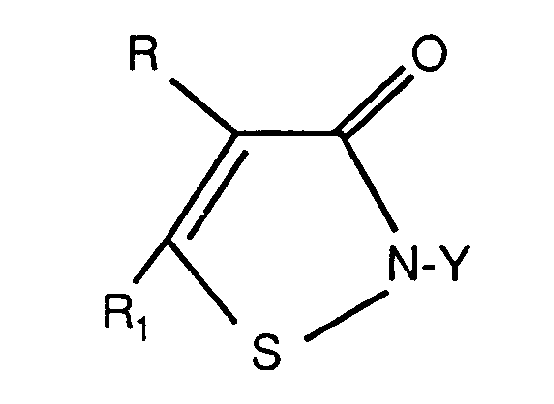
wherein
Y is (C₁-C₁₈)alkyl or (C₃-C₁₂)cycloalkyl each optionally substituted with one or more of hydroxy, halo, cyano, alkylamino, dialkylamine, arylamino, carboxy, carbalkoxy, alkoxy, aryloxy, alkylthio, arylthio, haloalkoxy, cycloaklylamino, carbamoxy, or isothiazolonyl; an unsubstituted or halo-substituted (C₂-C₈) alkenyl or alkynyl; a (C₇-C₁₀)aralkyl optionally substituted with one or more of halogen, (C₁-C₄)alkyl or (C₁-C₄)alkoxy; or an aryl optionally substituted with one or more of halogen, nitro, (C₁-C₄)alkyl, (C₁-C₄)alkyl-acylamino, carb(C₁-C₄)alkoxy or sulfamyl; and
R and R¹ are each independently H, halogen, (C₁-C₄) alkyl, (C₄-C₈) cycloalkyl or joined together to form a phenyl; comprising incorporating therewith an effective amount of a sulphur-containing compound, or salt thereof, capable of reversibly forming an adduct with said isothiazolone.
wherein
Y is (C₁-C₁₈)alkyl or (C₃-C₁₂)cycloalkyl each optionally substituted with one or more of hydroxy, halo, cyano, alkylamino, dialkylamine, arylamino, carboxy, carbalkoxy, alkoxy, aryloxy, alkylthio, arylthio, haloalkoxy, cycloaklylamino, carbamoxy, or isothiazolonyl; an unsubstituted or halo-substituted (C₂-C₈) alkenyl or alkynyl; a (C₇-C₁₀)aralkyl optionally substituted with one or more of halogen, (C₁-C₄)alkyl or (C₁-C₄)alkoxy; or an aryl optionally substituted with one or more of halogen, nitro, (C₁-C₄)alkyl, (C₁-C₄)alkyl-acylamino, carb(C₁-C₄)alkoxy or sulfamyl; and
R and R¹ are each independently H, halogen, (C₁-C₄) alkyl, (C₄-C₈) cycloalkyl or joined together to form a phenyl; comprising incorporating therewith an effective amount of a sulphur-containing compound, or salt thereof, capable of reversibly forming an adduct with said isothiazolone.
2. Method according to claim 1, wherein the protection of the isothiazolone is subsequently
terminated by decomposition of said adduct to release the isothiazolone.
3. Method according to claim 2, wherein termination of said protection is accomplished
by hydrolysis of the product.
4. Method according to claim 3, wherein the isothiazolone is protected whilst in a metal
working fluid concentrate, and released by hydrolysis of the adduct upon dilution
of the concentrate.
5. Method according to any preceding claim, wherein Y is (C₁-C₁₈) alkyl or (C₃-C₁₂) cycloalkyl;
R is H or Me; and R¹ is H.
6. Method according to claim 5 wherein the isothiazolone is 2-methyl-3-isothiazolone
or 2-n-octyl-3-isothiazolone.
7. Method according to any preceding claim wherein R and R¹ are each independently H,
(C₁-C₄)alkyl, (C₄-C₈)cycloalkyl or joined to form a phenyl, and the sulphur-containing
compound is a mercaptan or salt thereof.
8. Method according to claims 1 to 6 wherein the sulphur-containing compound is a sulphur
atom attached to a nitrogen-containing ring.
9. Method according to claim 7 or 8, wherein said sulphur-containing compound is a nitrogen-based
heterocyclic thiol or salt thereof.
10. Method according to any of claims 1 to 6 wherein the sulphur-containing compound is
mercaptobenzothiazole, the sodium salt of 2-mercaptopyridine-N-oxide, 2-mercaptopyridine,
4-mercaptopyridine, benzothiazole, 2-thiohydantoin, L-cystin, methylenebis-thiocyanate,
2-methylthiobenzothiazole, 4-methyl 4-H-1,2,4-triazole-3-thiol, 4-R-(thiazolidinethione)-4-carbonic
acid, or 2-mercaptopyrimidine.
11. Composition comprising an isothiazolone as defined in any preceding claim, a sulphur-containing
compound or salt thereof as defined in any preceding claim, and optionally a solvent.
12. Method or composition according to any preceding claim wherein the molar ratio of
sulphur-containing compound to isothiazolone is at least 0.1:1.
13. Method or composition according to claim 12 wherein the molar ratio of sulphur-containing
compound to isothiazolone is at least 0.5:1.
14. Use of a sulphur-containing compound or salt thereof as defined in any of claims 1
or 7 to 10, and capable of reversibly forming an adduct with an isothiazolone, to
protect said isothiazolone against chemical degradation.
15. An adduct comprising an isothiazolone as defined in any preceding claim, and a sulphur-containing
compound or salt thereof as defined in any preceding claim, which adduct is capable
of being decomposed to release said isothiazolone.
16. Adduct according to claim 15 which is capable of being decomposed by hydrolysis to
release the isothiazolone.
1. Verfahren zum Schützen eines Isothiazolons der Formel
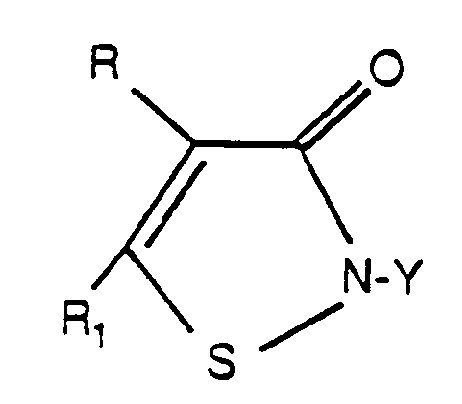
in der Y (C₁-C₁₈)-Alkyl oder (C₃-C₁₂)-Cycloalkyl, jedes gegebenenfalls substituiert mit einer oder mehreren Hydroxy-, Halo-, Cyano-, Alkylamino-, Dialkylamino-, Aryl-, amino-, Carboxy-, Carbalkoxy-, Alkoxy-, Aryloxy-, Alkyl-thio-, Arylthio-, Haloalkoxy-, Cycloalkylamino-, Carbamoxy- oder Isothiazolonylgruppen; ein nicht substituiertes oder mit Halogen substituiertes (C₂-C₈)-Alkenyl oder Alkynyl; eine (C₇-C₁₀)-Aralkylgruppe, gegebenenfalls substituiert mit einer der mehreren Halogen-, (C₁-C₄)- Alkyl- oder (C₁-C₄)-Alkoxygruppen; oder eine Arylgruppe, gegebenenfalls substituiert mit einer oder mehreren Halogen-, Nitro-, (C₁-C₄)-Alkyl, (C₁-C₄)-Alkyl-acylamino-, Carb(C₁-C₄)alkoxy- oder Sulfamylgruppen ist, und R und R¹ jeweils unabhängig Wasserstoff, Halogen, (C₁-C₄)-Alkyl, (C₄-C₈)-Cycloalkyl oder miteinander unter Ausbildung von Phenyl verbunden sind, gegen chemische Zersetzung durch Einbringen einer wirksamen Menge einer schwefelhaltigen Verbindung oder Salzes derselben, die reversibel ein Addukt mit dem Isothiazolon bilden können.
in der Y (C₁-C₁₈)-Alkyl oder (C₃-C₁₂)-Cycloalkyl, jedes gegebenenfalls substituiert mit einer oder mehreren Hydroxy-, Halo-, Cyano-, Alkylamino-, Dialkylamino-, Aryl-, amino-, Carboxy-, Carbalkoxy-, Alkoxy-, Aryloxy-, Alkyl-thio-, Arylthio-, Haloalkoxy-, Cycloalkylamino-, Carbamoxy- oder Isothiazolonylgruppen; ein nicht substituiertes oder mit Halogen substituiertes (C₂-C₈)-Alkenyl oder Alkynyl; eine (C₇-C₁₀)-Aralkylgruppe, gegebenenfalls substituiert mit einer der mehreren Halogen-, (C₁-C₄)- Alkyl- oder (C₁-C₄)-Alkoxygruppen; oder eine Arylgruppe, gegebenenfalls substituiert mit einer oder mehreren Halogen-, Nitro-, (C₁-C₄)-Alkyl, (C₁-C₄)-Alkyl-acylamino-, Carb(C₁-C₄)alkoxy- oder Sulfamylgruppen ist, und R und R¹ jeweils unabhängig Wasserstoff, Halogen, (C₁-C₄)-Alkyl, (C₄-C₈)-Cycloalkyl oder miteinander unter Ausbildung von Phenyl verbunden sind, gegen chemische Zersetzung durch Einbringen einer wirksamen Menge einer schwefelhaltigen Verbindung oder Salzes derselben, die reversibel ein Addukt mit dem Isothiazolon bilden können.
2. Verfahren nach Anspruch 1,
dadurch gekennzeichnet,
daß der Schutz des Isothiazolons anschließend durch Zersetzung des Adduktes beendet wird, um das Isothiazolon freizusetzen.
dadurch gekennzeichnet,
daß der Schutz des Isothiazolons anschließend durch Zersetzung des Adduktes beendet wird, um das Isothiazolon freizusetzen.
3. Verfahren nach Anspruch 2,
dadurch gekennzeichnet,
daß die Beendigung des Schutzes durch Hydrolyse des Produktes ausgeführt wird.
dadurch gekennzeichnet,
daß die Beendigung des Schutzes durch Hydrolyse des Produktes ausgeführt wird.
4. Verfahren nach Anspruch 3,
dadurch gekennzeichnet,
daß das Isothiazolon geschützt ist, während es in einem flüssigen Metallbearbeitungskonzentrat enthalten ist und durch Hydrolyse des Adduktes bei Verdünnen des Konzentrates freigesetzt wird.
dadurch gekennzeichnet,
daß das Isothiazolon geschützt ist, während es in einem flüssigen Metallbearbeitungskonzentrat enthalten ist und durch Hydrolyse des Adduktes bei Verdünnen des Konzentrates freigesetzt wird.
5. Verfahren nach jedem der vorstehenden Ansprüche,
dadurch gekennzeichnet,
daß Y (C₁-C₁₈)-Alkyl oder (C₃-C₁₂)-Cycloalkyl ist, R Wasserstoff oder Methyl ist und R¹ Wasserstoff ist.
dadurch gekennzeichnet,
daß Y (C₁-C₁₈)-Alkyl oder (C₃-C₁₂)-Cycloalkyl ist, R Wasserstoff oder Methyl ist und R¹ Wasserstoff ist.
6. Verfahren nach Anspruch 5,
dadurch gekennzeichnet,
daß das Isothiazolon 2-Methyl-3-isothiazolon oder 2-n-Octyl-3-isothiazolon ist.
dadurch gekennzeichnet,
daß das Isothiazolon 2-Methyl-3-isothiazolon oder 2-n-Octyl-3-isothiazolon ist.
7. Verfahren nach jedem der vorstehenden Ansprüche,
dadurch gekennzeichnet,
daß R und R¹ jeweils unabhängig Wasserstoff, (C₁-C₄)-Alkyl, (C₄-C₈)-Cycloalkyl oder miteinander unter Ausbildung von Phenyl verbunden sind und die schwefelhaltige Verbindung ein Mercaptan oder Salz derselben ist.
dadurch gekennzeichnet,
daß R und R¹ jeweils unabhängig Wasserstoff, (C₁-C₄)-Alkyl, (C₄-C₈)-Cycloalkyl oder miteinander unter Ausbildung von Phenyl verbunden sind und die schwefelhaltige Verbindung ein Mercaptan oder Salz derselben ist.
8. Verfahren nach Ansprüchen 1-6,
dadurch gekennzeichnet,
daß in der schwefelhaltigen Verbindung ein Schwefelatom an einen Stickstoff enthaltenden Ring gebunden ist.
dadurch gekennzeichnet,
daß in der schwefelhaltigen Verbindung ein Schwefelatom an einen Stickstoff enthaltenden Ring gebunden ist.
9. Verfahren nach Anspruch 7 oder 8,
dadurch gekennzeichnet,
daß die schwefelhaltige Verbindung ein auf Stickstoff basierendes heterocyklisches Thiol oder Salz derselben ist.
dadurch gekennzeichnet,
daß die schwefelhaltige Verbindung ein auf Stickstoff basierendes heterocyklisches Thiol oder Salz derselben ist.
10. Verfahren nach jedem der Ansprüche 1-6,
dadurch gekennzeichnet,
daß die schwefelhaltige Verbindung Mercaptobenzothiazol, das Natriumsalz von 2-Mercaptopyridin-N-oxid, 2-Mercaptopyridin, 4-Mercaptopyridin, Benzothiazol, 2-Thiohydantoin, L-Cystin, Methylenbis-thiocyanat, 2-Methylthiobenzothiazol, 4-Methyl-4-H-1,2,4-triazol-3-thiol, 4-R-(Thiazolidinthion)-4-carbonsäure oder 2-Mercaptopyrimidin ist.
dadurch gekennzeichnet,
daß die schwefelhaltige Verbindung Mercaptobenzothiazol, das Natriumsalz von 2-Mercaptopyridin-N-oxid, 2-Mercaptopyridin, 4-Mercaptopyridin, Benzothiazol, 2-Thiohydantoin, L-Cystin, Methylenbis-thiocyanat, 2-Methylthiobenzothiazol, 4-Methyl-4-H-1,2,4-triazol-3-thiol, 4-R-(Thiazolidinthion)-4-carbonsäure oder 2-Mercaptopyrimidin ist.
11. Zusammensetzung, enthaltend ein Isothiazolin, wie in jedem der vorstehenden Ansprüche
angegeben, eine schwefelhaltige Verbindung oder Salz derselben, wie in jedem der vorstehenden
Ansprüche angegeben, und gegebenenfalls ein Lösemittel.
12. Verfahren oder Zusammensetzung nach jedem der vorstehenden Ansprüche,
dadurch gekennzeichnet,
daß das Molverhältnis von schwefelhaltiger Verbindung: Isothiazolon mindestens 0,1:1 ist.
dadurch gekennzeichnet,
daß das Molverhältnis von schwefelhaltiger Verbindung: Isothiazolon mindestens 0,1:1 ist.
13. Verfahren oder Zusammensetzung nach Anspruch 12,
dadurch gekennzeichnet,
daß das Molverhältnis von schwefelhaltiger Verbindung: Isothiazolon mindestens 0,5:1 ist.
dadurch gekennzeichnet,
daß das Molverhältnis von schwefelhaltiger Verbindung: Isothiazolon mindestens 0,5:1 ist.
14. Verwendung einer schwefelhaltigen Verbindung oder Salz derselben, wie in jedem der
Ansprüche 1 oder 7-10 angegeben, und die reversibel ein Addukt mit einem Isothiazolon
bilden können, um das Isothiazolon gegen chemische Zersetzung zu schützen.
15. Addukt, enthaltend ein Isothiazolon, wie in jedem der vorstehenden Ansprüche angegeben,
und eine schwefelhaltige Verbindung oder Salz derselben, wie in jedem der vorstehenden
Ansprüche angegeben, wobei das Addukt zersetzbar ist, um das Isothiazolon freizugeben.
16. Addukt nach Anspruch 15,
dadurch gekennzeichnet,
daß es durch Hydrolyse zersetzbar ist, um das Isothiazolon freizusetzen.
dadurch gekennzeichnet,
daß es durch Hydrolyse zersetzbar ist, um das Isothiazolon freizusetzen.
1. Procédé pour protéger, contre une dégradation chimique, une isothiazolone de formule
:
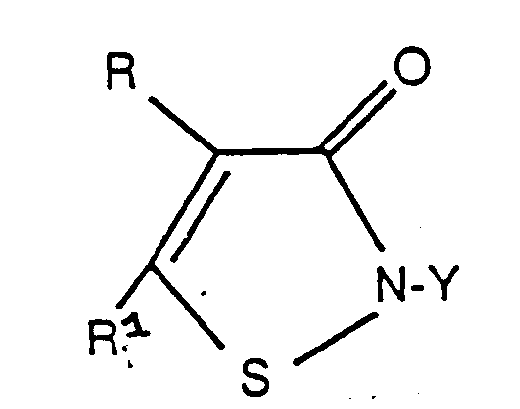
dans laquelle :
Y représente un groupe alkyle (en C₁ à C₁₈) ou cycloalkyle (en C₃ à C₁₂), chacun éventuellement substitué par un ou plusieurs groupes hydroxy, halogéno, cyano, alkylamino, dialkylamino, arylamino, carboxy, carbalcoxy, alcoxy, aryloxy, alkylthio, arylthio, halogénoalcoxy, cycloalkylamino, carbamoxy ou isothiazolonyle ; un groupe alcényle ou alcynyle (en C₂ à C₈), non substitué ou substitué par de l'halogène; un groupe aralkyle (en C₇ à C₁₀), éventuellement substitué par un ou plusieurs groupes halogéno,, alkyle (en C₁ à C₄) ou alcoxy (en C₁ à C₄); ou un groupe aryle éventuellement substitué par un ou plusieurs groupes halogéno, nitro, alkyle (en C₁ à C₄);alkyl(en C₁ à C₄)-acylamino, carbalcoxy (en C₁ à C₄) ou sulfamyle; et
R et R¹ représentent chacun , indépendamment, un atome de H ou d'halogène, un groupe alkyle en C₁ à C₄, cycloalkyle en C₄ à C₈, ou bien ils sont reliés ensemble pour former un noyau phényle), le procédé comprenant l'incorporation d'une quantité efficace d'un composé contenant du soufre, ou d'un sel d'un tel composé, capable de former réversiblement un produit d'addition avec ladite isothiazolone.
dans laquelle :
Y représente un groupe alkyle (en C₁ à C₁₈) ou cycloalkyle (en C₃ à C₁₂), chacun éventuellement substitué par un ou plusieurs groupes hydroxy, halogéno, cyano, alkylamino, dialkylamino, arylamino, carboxy, carbalcoxy, alcoxy, aryloxy, alkylthio, arylthio, halogénoalcoxy, cycloalkylamino, carbamoxy ou isothiazolonyle ; un groupe alcényle ou alcynyle (en C₂ à C₈), non substitué ou substitué par de l'halogène; un groupe aralkyle (en C₇ à C₁₀), éventuellement substitué par un ou plusieurs groupes halogéno,, alkyle (en C₁ à C₄) ou alcoxy (en C₁ à C₄); ou un groupe aryle éventuellement substitué par un ou plusieurs groupes halogéno, nitro, alkyle (en C₁ à C₄);alkyl(en C₁ à C₄)-acylamino, carbalcoxy (en C₁ à C₄) ou sulfamyle; et
R et R¹ représentent chacun , indépendamment, un atome de H ou d'halogène, un groupe alkyle en C₁ à C₄, cycloalkyle en C₄ à C₈, ou bien ils sont reliés ensemble pour former un noyau phényle), le procédé comprenant l'incorporation d'une quantité efficace d'un composé contenant du soufre, ou d'un sel d'un tel composé, capable de former réversiblement un produit d'addition avec ladite isothiazolone.
2. Procédé selon la revendication 1, dans lequel la protection de l'isothiazolone est
arrêtée par la suite, par la décomposition dudit produit d'addition pour libérer l'isothiazolone.
3. Procédé selon la revendication 2, dans lequel l'arrêt de ladite protection est obtenu
par hydrolyse du produit.
4. Procédé selon la revendication 3, dans lequel l'isothiazolone est protégée pendant
qu'elle est dans un concentré de fluide pour travail des métaux, et elle est libérée
par hydrolyse du produit d'addition, lors de la dilution du concentré.
5. Procédé selon l'une quelconque des revendications précédentes, dans lequel Y représente
un groupe alkyle (en C₁ à C₁₈) ou cycloalkyle en C₃ à C₁₂; R représente H ou un groupe
méthyle ; et R¹ représente un atome d'hydrogène.
6. Procédé selon la revendication 5, dans lequel l'isothiazolone est la 2-méthyl-3-isothiazolone
ou la 2-n-octyl-3-isothiazolone.
7. Procédé selon l'une quelconque des revendications précédentes, dans lequel R et R¹
représentent chacun, indépendamment, H, un groupe alkyle en C₁ à C₄, cycloalkyle en
C₄ à C₈, ou bien ils sont reliés pour former un groupe phényle, et le composé contenant
du soufre est un mercaptan ou un sel de mercaptan.
8. Procédé selon les revendications 1 à 6, dans lequel le composé contenant du soufre
est un composé comportant un atome de soufre fixé sur un noyau contenant de l'azote.
9. Procédé selon la revendication 7 ou 8, dans lequel ledit composé contenant du soufre
est un thiol hétérocyclique de base azotée, ou un sel de ce composé.
10. Procédé selon l'une quelconque des revendications 1 à 6, dans lequel le composé contenant
du soufre est du mercaptobenzothiazole, le sel de sodium du N-oxyde de 2-mercaptopyridine,
la 2-mercaptopyridine, la 4-mercapto-pyridine, le benzothiazole,la 2-thiohydantoine
, la L-cystine, du bis-thiocyanate de méthylène, le 2-méthylthiobenzothiazole, le
4-méthyl-4-H-1,2, 4-thiazole-3-thiol, l'acide 4-R-(thiazolidinethione)-4-carbonique,
ou la 2-mercapto pyrimidine.
11. Composition comprenant une isothiazolone, telle que définie dans l'une quelconque
des revendications précédentes, un composé contenant du soufre ou un sel de ce composé
selon la définition donnée dans l'une quelconque des revendications précédentes, et
éventuellement un solvant.
12. Procédé ou composition selon l'une quelconque des revendications précédentes, dans
lequel ou dans laquelle le rapport molaire entre le composé contenant du soufre et
l'isothiazolone est au moins égal à 0,1:1 .
13. Procédé ou composition selon la revendication 12, dans lequel ou dans laquelle le
rapport molaire du composé contenant du soufre à l'isothiazolone est au moins égal
à 0,5 :1.
14. Utilisation d'un composé contenant du soufre, ou d'un sel d'un tel composé selon la
définition donnée dans l'une quelconque des revendications 1 ou 7 à 10, et qui est
capable de former réversiblement un composé d'addition avec une isothiazolone, pour
protéger ladite isothiazolone contre une dégradation chimique.
15. Composé d'addition, comprenant une isothiazolone telle que définie dans l'une quelconque
des revendications précédentes, et un composé contenant du soufre ou un sel de ce
composé selon la définition donnée dans l'une quelconque des revendications précédentes,
ce composé d'addition étant capable de subir une décomposition pour libérer ladite
isothiazolone.
16. Composé d'addition selon la revendication 15, qui est capable d'être décomposé par
hydrolyse pour libérer l'isothiazolone.