|
(11) | EP 0 445 656 B1 |

| (12) | EUROPEAN PATENT SPECIFICATION |
|
|
| (54) |
Novel fungicidal imidazole complexes Neue fungizide Imidazolkomplexe Nouveaux complexes d'imidazole fongicides |
|
|
|||||||||||||||||||||||||||||||
| Note: Within nine months from the publication of the mention of the grant of the European patent, any person may give notice to the European Patent Office of opposition to the European patent granted. Notice of opposition shall be filed in a written reasoned statement. It shall not be deemed to have been filed until the opposition fee has been paid. (Art. 99(1) European Patent Convention). |
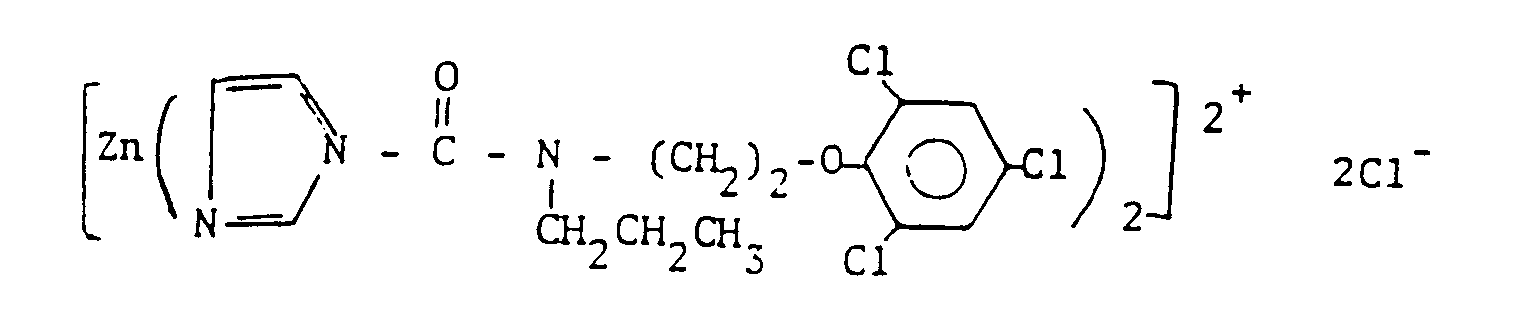
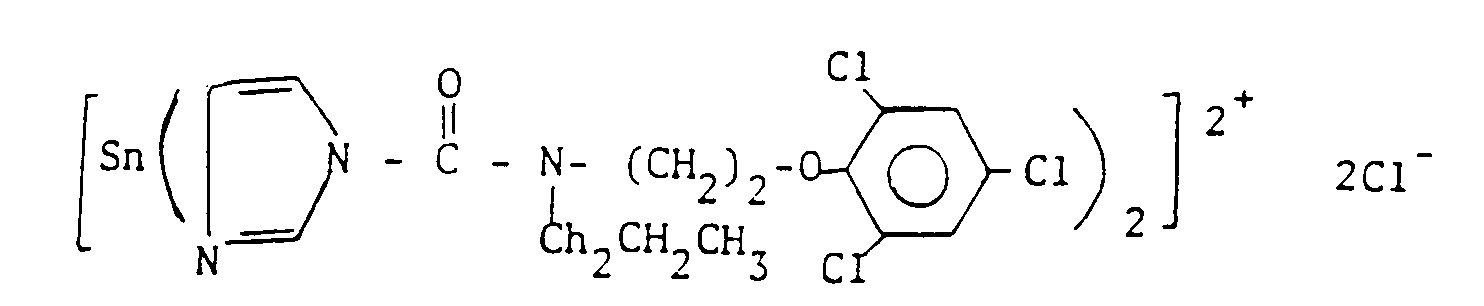
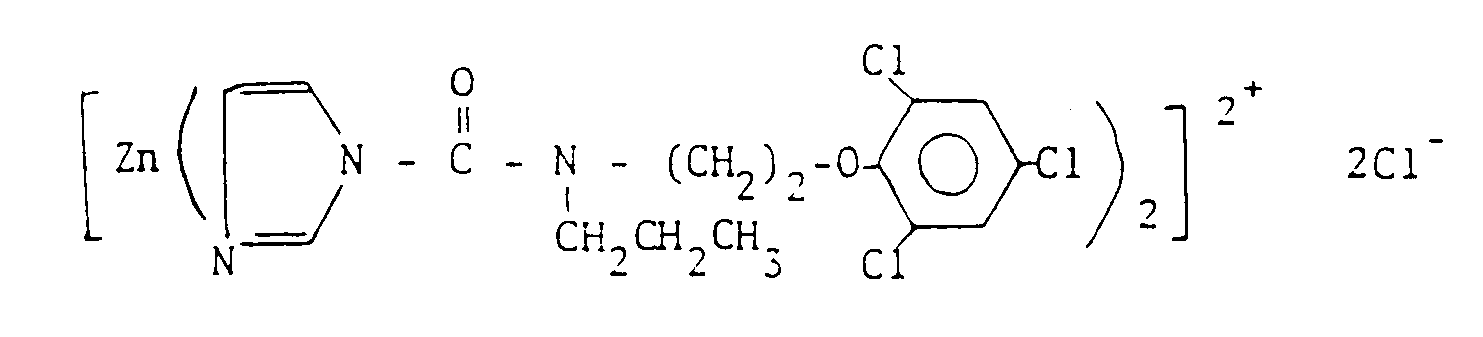
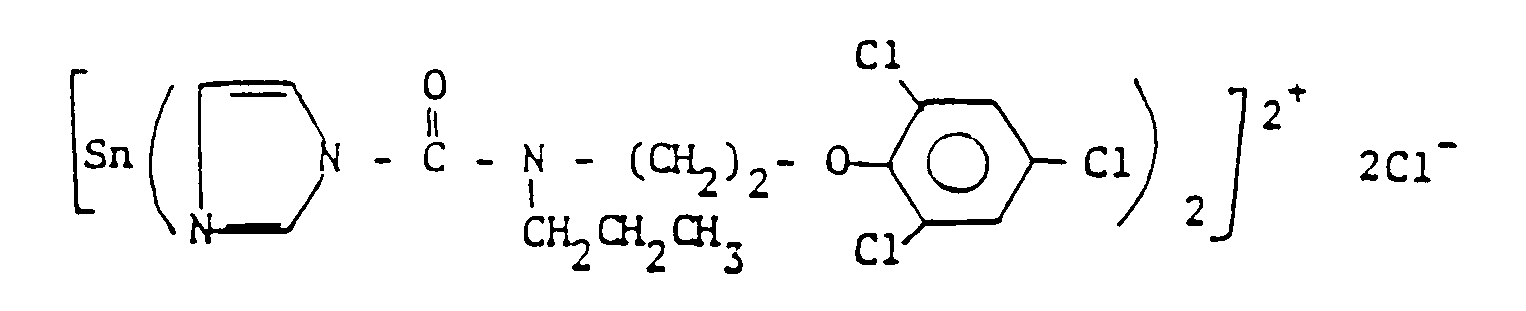
BACKGROUND OF THE INVENTION
[0001] The present invention concerns an improved metal complexes of the fungicide 1-[N-propyl-N-2-(2,4,6-tri-chlorophenoxy)-ethyl-carbamoyl]-imidazole, known by the common name prochloraz, its improved formulations and their use in combating fungi, especially powdery mildew (Sphaerotheca fuliginia) and coffee berry disease (Colletotrichum coffeanum).
[0002] Prochloraz is a protectant and eradicant fungicide, effective against a wide range of diseases affecting field crops, fruit, turf and vegetables. Its use was first reported in GB-A-1,469,772 and GB-A-1,576,277.
[0003] Prochloraz is sold under two different types of formulations. One form is an emulsifiable concentrate, which contains the free compound as active ingredient. The second formulation is a wettable powder where the active ingredient is in the form of a metal complex. The metal complexes of prochloraz were first reported in GB-A-1,567,521. IL-A-54,304).
[0004] The metal complexes of prochloraz were intended to solve two problems found in using the free, non-complexed prochloraz. The first was, that non-complexed prochloraz was found difficult to handle and formulate on a solid powder carrier. It was found necessary to first absorb it on a carrier prior to preparing a powder, causing loss of material, lowering the fungicidal activity and preventing the preparation in a highly concentrated form. The second problem was that free, non-complexed prochloraz was found to be phytotoxic to some crops. However, the metal complexes of prochloraz were found to avoid these problems. Thus the metal complexes of prochloraz, generally were found to be solid, distinctly melting compounds, readily formulated with a solid carrier or concentrate, without the phytotoxic problems found on susceptible crops.
[0005] Patent coverage on the metal complexes of prochloraz was obtained in many countries (i.e. GB-A-1,567,521 and US-A-4,250,179). The metals exemplified or disclosed were divalent metals such as copper, manganese, iron, nickel and cobalt. Nowhere were crystalline sharply melting metal salts of SnCl₂ or ZnCl₂ with prochloraz disclosed or claimed. Indeed, there are indications from the prior art that these specific salts cannot be prepared.
[0006] Thus, the present invention is a selection patent of those patents covering metal complexes of prochloraz.
OBJECTIVES OF THE INVENTION
[0007] It is the objective of the present invention to provide crystalline metal complexes of prochloraz with SnCl₂ or ZnCl₂. It is an objective of the present invention to also provide a formulation of these complexes, which can be readily formulated as a wettable powder. A further objective is the provision of formulations of the complexes having unusual and unexpected fungicidal activity, especially against powdery mildew and coffee berry disease. These and other objectives of the invention will become apparent to those skilled in the art from the following description.
SUMMARY OF THE INVENTION
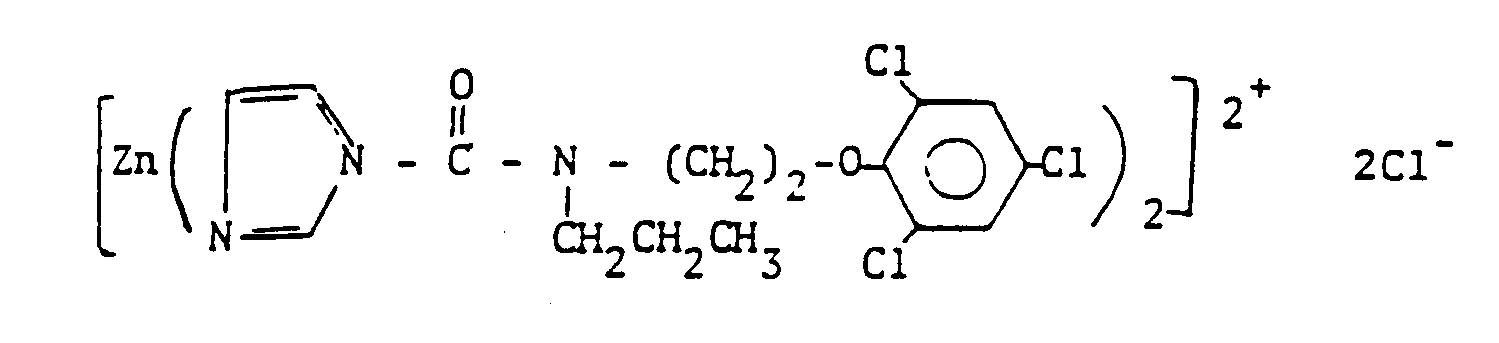
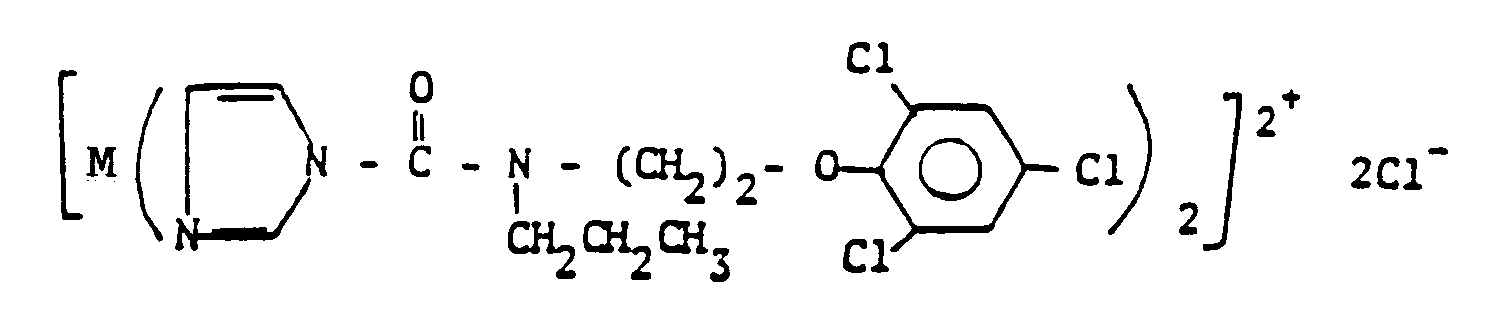
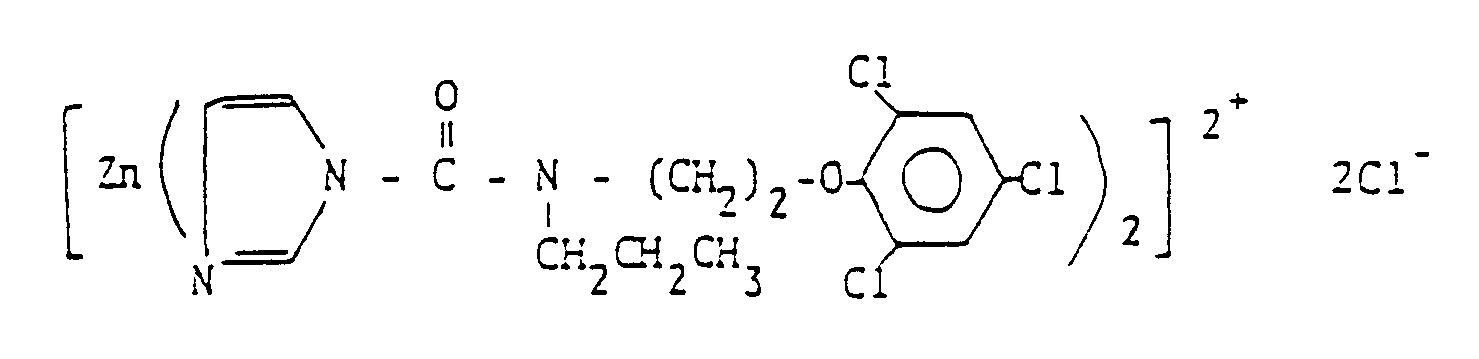
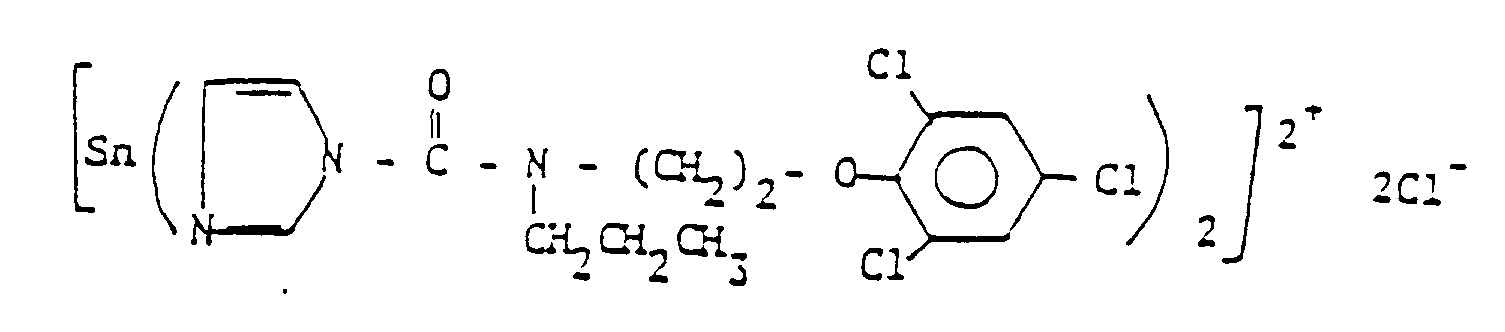
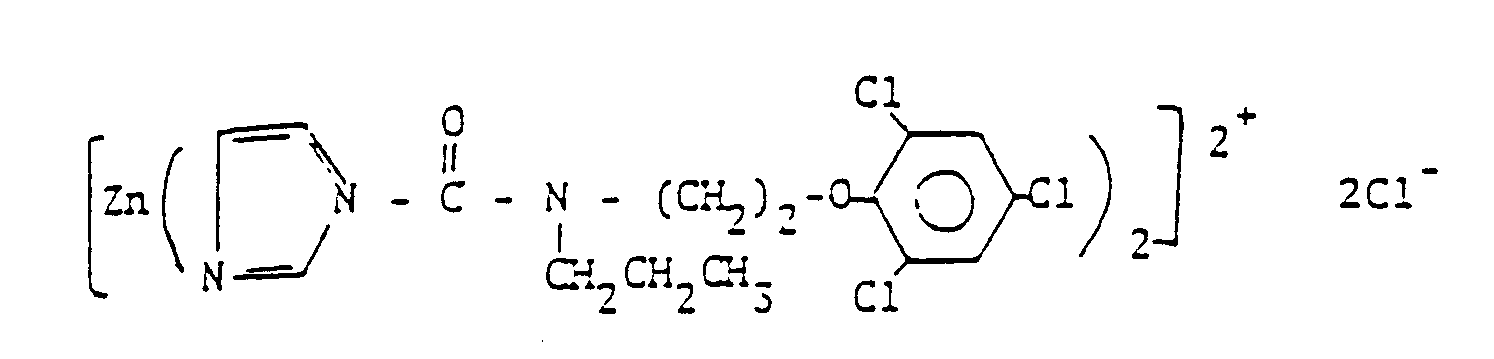
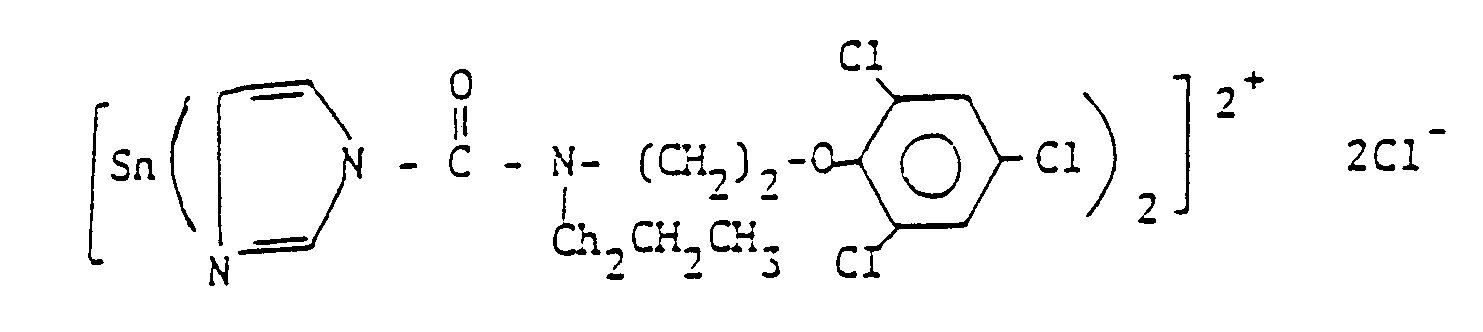
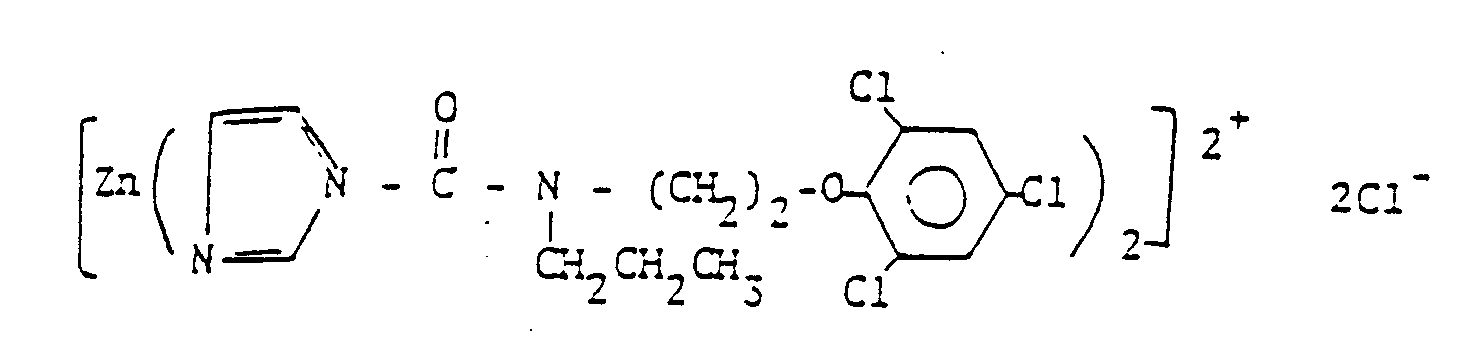
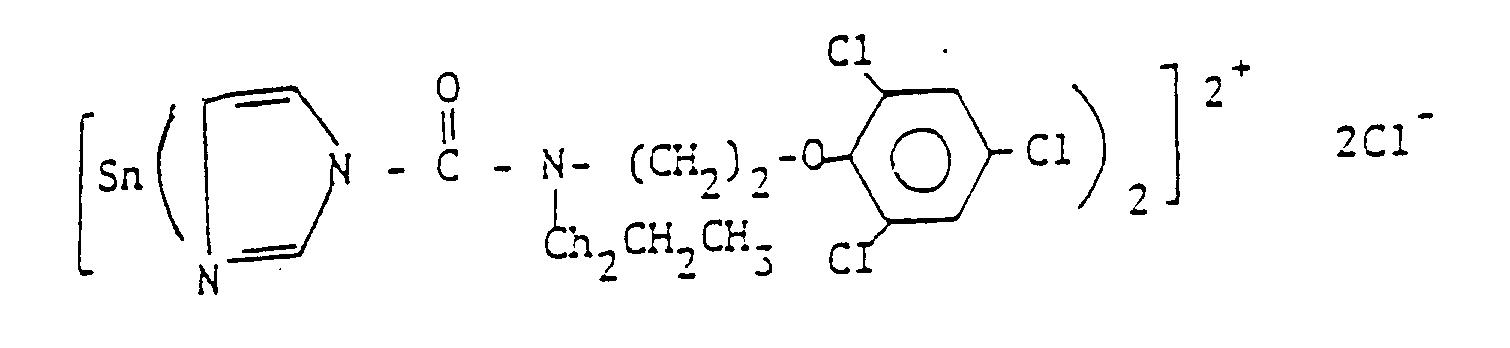
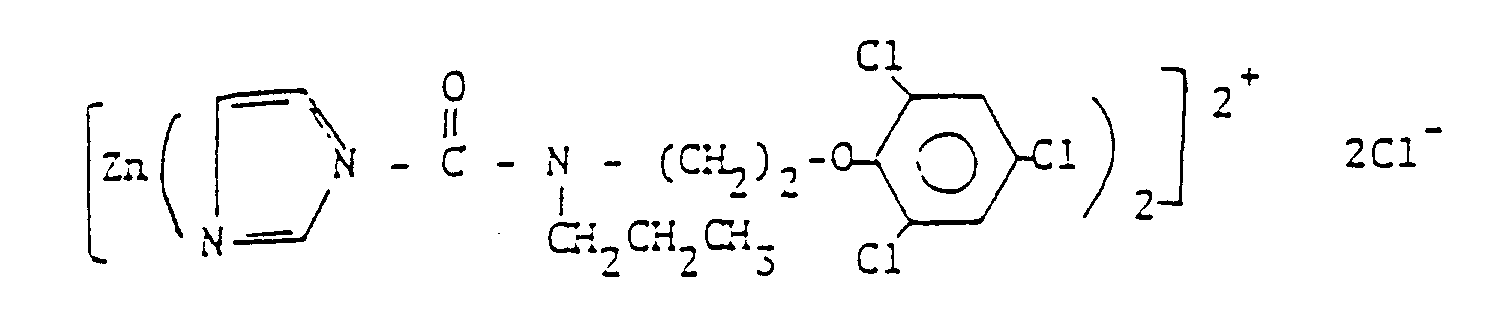
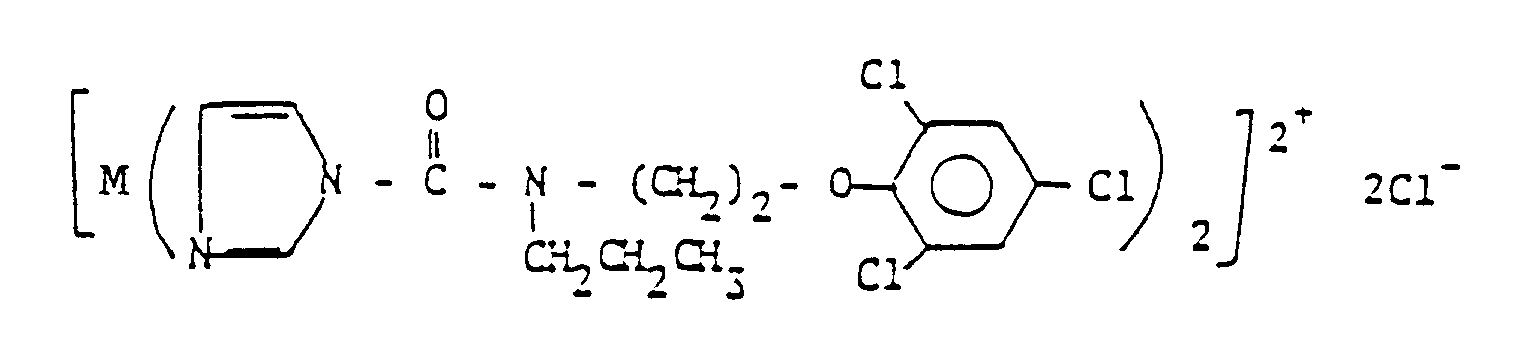
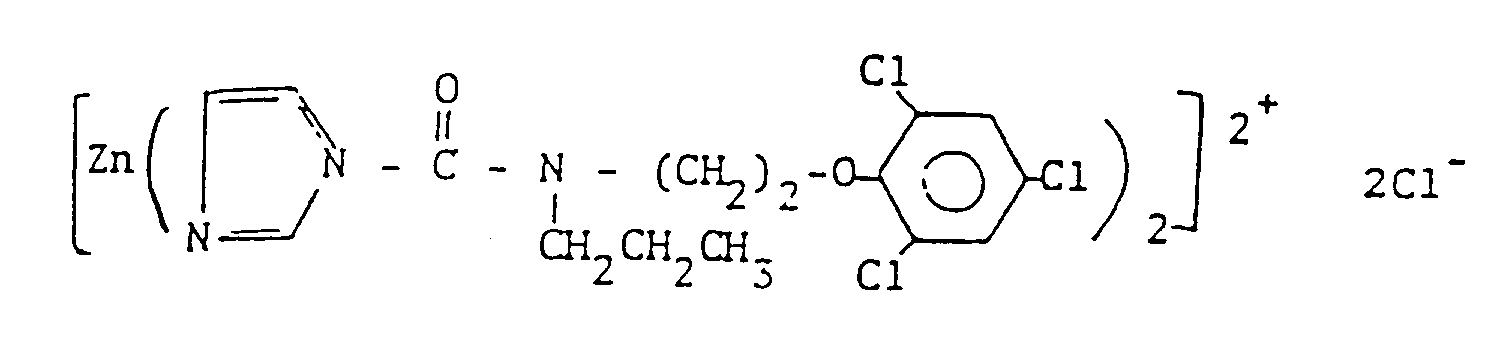
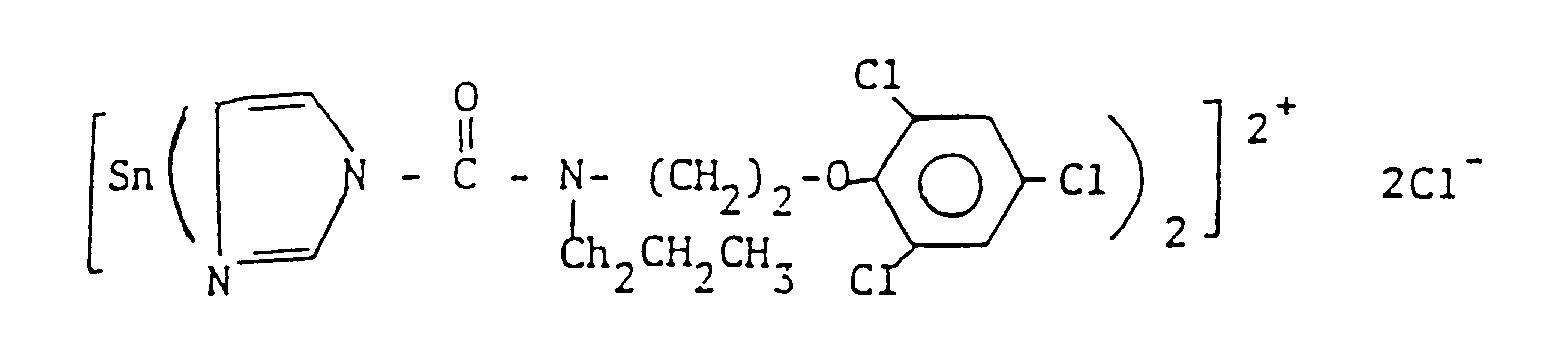
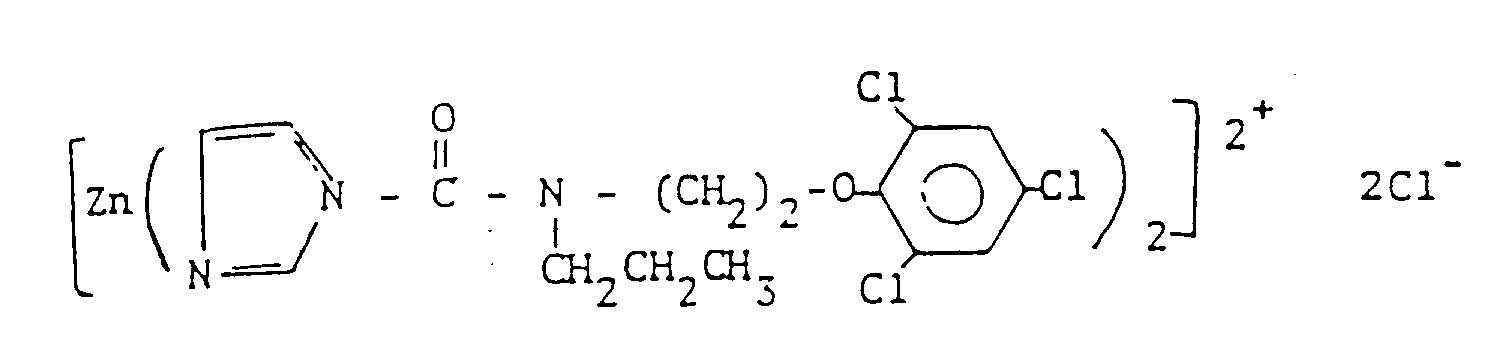
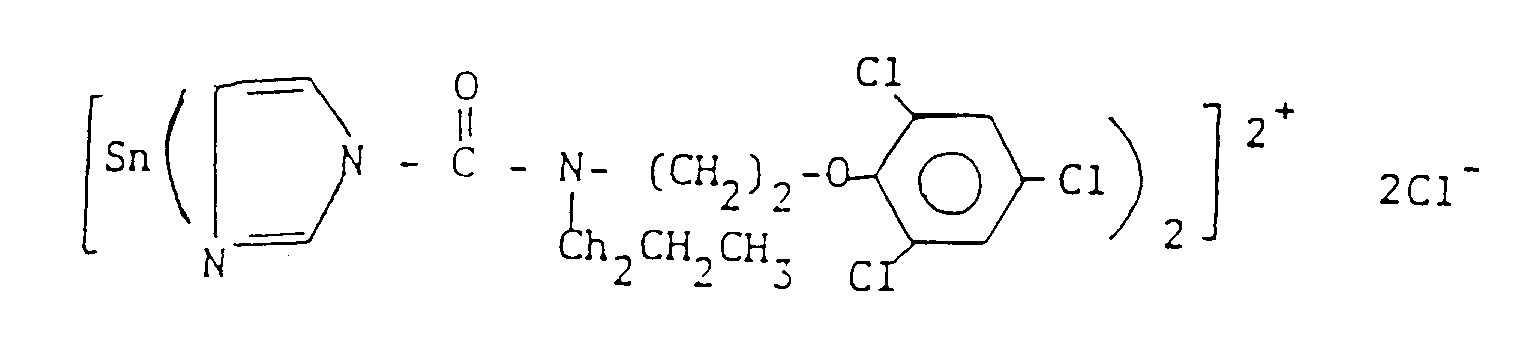
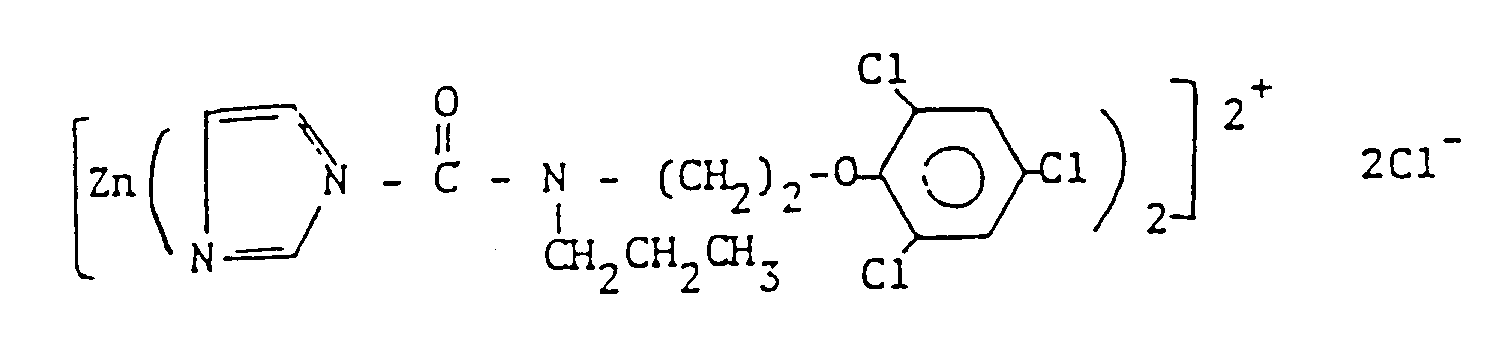
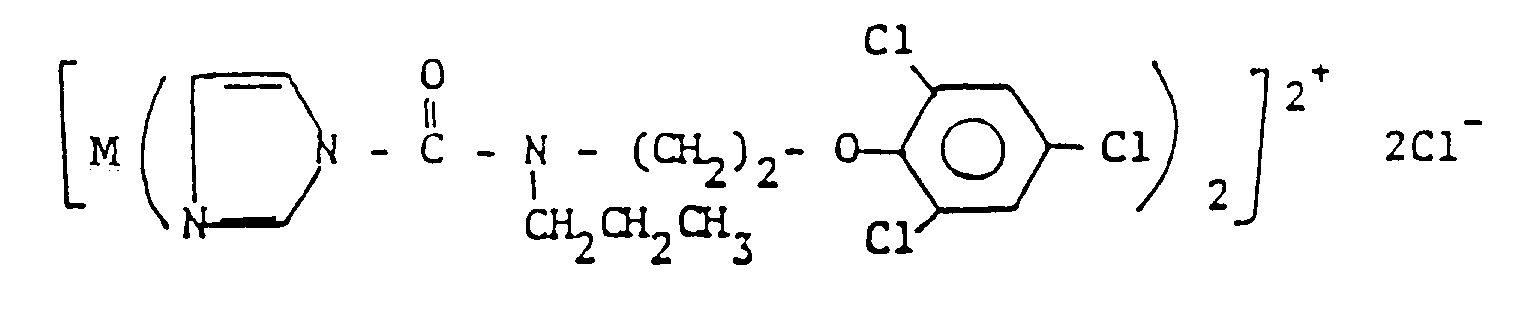
[0008] In accordance with the present invention, there is provided crystalline metal complexes of prochloraz having the formula:
wherein M is zinc or tin.
[0009] The metal complexes produced by this invention are crystalline solids having sharp, definite melting points and defined compositions. This enables them to be easily handled and formulated as wettable powders.
[0010] The present invention also provides an improved method of controlling fungi, especially powdery mildew, applying to the infested material or plant a composition containing an effective amount of one of these metal complexes.
DETAILED DESCRIPTION OF THE INVENTION
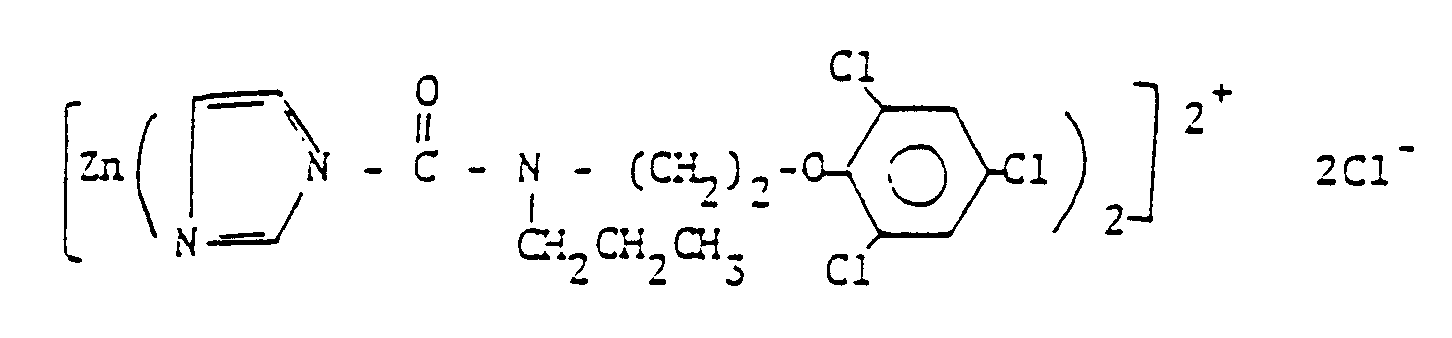
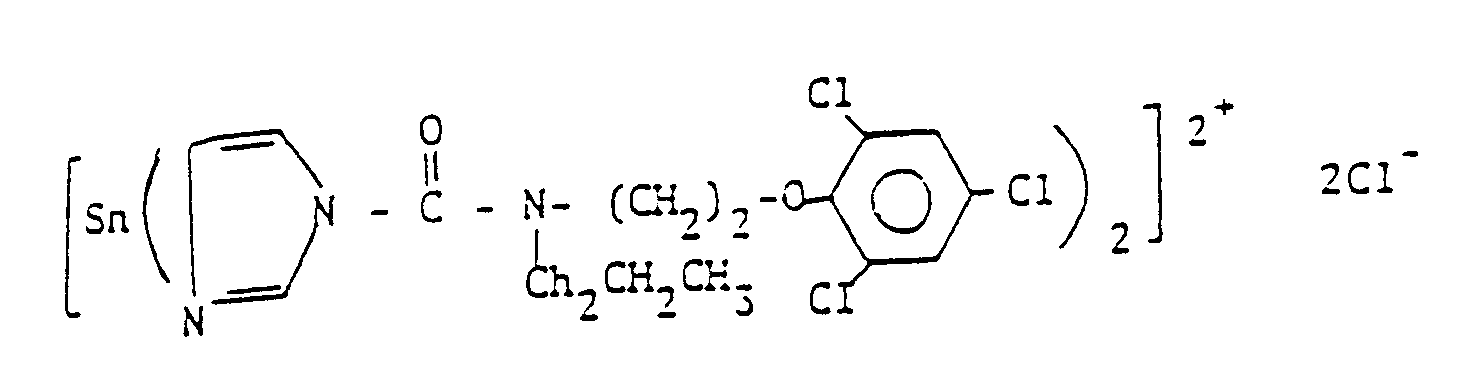
[0011] The complex containing zinc is a white crystalline solid having a melting point or 100°C-102°C. Analysis of its zinc content showed 7.29% zinc compared to a value of 7.35%, which correlates with a complex containing one molecule of ZnCl₂ per molecule of prochloraz. The complex containing tin is a white crystalline solid having a melting point of 95°C. Analysis of its tin content showed 7.99% which correlates with a complex of one molecule of SnCl₂ per two molecules of prochloraz.
[0012] The nuclear magnetic resonance spectrum of these complexes in solution showed a definite shift in the singlet hydrogens belonging to the imidazole group. This shows complexation, and that the complexation takes place on the imidazole group. Details of the spectra of prochloraz and the zinc complex of the present invention are shown in Table 1.
[0013] These complexes are prepared by adding a water solution of SnCl₂ or ZnCl₂ to a clear alcoholic solution of prochloraz in a molar ratio of 1:2 metal salt to prochloraz. While most common alcohols give good results, alcohols such as ethanol or isopropanol were found to be preferred.
[0014] The reaction temperature is conveniently chosen within the range of from 10°C to 60°C, preferably room temperature.
[0015] According to a further feature of the invention, there is provided a fungicidal composition which comprises a compound of the invention together with a carrier. The active compound can be employed in a wide variety of formulations, for example as an aqueous dispersion, a dispersible powder, a seed dressing, granules or dust.
[0016] As a dispersion the composition comprises an active compound together with a dispersing agent dispersed in a liquid medium, preferably water. It can be in the form of a concentrated primary composition which requires dilution with a suitable quantity of water or other diluent before application. Such primary compositions are a convenient way of supplying the consumer and a preferred example is a dispersible powder. A dispersible powder comprises an active compound, a dispersing agent and a solid carrier. The latter can be, for example, kaolin, talc, or diatomaceous earth and, in addition, the dispersible powder can contain a wetting agent.
[0017] Other formulations include seed dressings, granules or dusts, in all of which the active compound is associated with a solid carrier and which are intended for direct application. They can be made by methods well known in the art. Preferably all compositions comprising a solid
carrier are made by mixing the active compound in particulate form with a particulate carrier.
[0018] The concentration of the active compound in the composition of the invention can vary widely. In the case of a primary composition it is preferably from 15% to 95% by weight, more especially from 50% to 80% by weight. A composition intended for direct application to a crop preferably comprises from 0.001% to 10%, more especially from 0.005% to 5% by weight of the active compound. When the aerial spraying of a crop is contemplated compositions having a higher concentration, for example up to 30% by weight may be chosen in preference.
[0019] Also included in the invention is a method for controlling a phytopathogenic fungus which comprises applying to seeds, plants or their habitat a compound of the invention. For convenience and effectiveness it is preferred to apply the active compound in the form of a composition as described above.
[0020] In the method of the invention the compound is applied to seeds, plants or their habitat. Thus the active compound can be applied directly to the plant by, for example, spraying or dusting either at the time when the fungus has begun to appear on the plant or before the appearance of the fungus as a protective measure. In both such cases the preferred mode of application is by foliar spraying. It is generally important to obtain good control of fungi in the early stages of plant growth as this is the time when the plant can be most severely damaged. For cereal crops such as wheat, barley and oats, it is often desirable to spray the plant at or before growth stage 5 (Feeke's Scale) although additional treatments by spraying when the plant is more mature can augment resistance to the growth or spread of fungi.
[0021] Sometimes it is practicable to treat the roots of a plant before or during planting, for example by dipping the roots in a suitable liquid or solid composition. When the active compound is applied directly to the plant, a suitable rate of application is from 0.01 to 10 kilograms per hectare.
[0022] Alternatively, the compound can be applied directly to the soil at the same time as drilling, so that the presence of active compound in the soil controls the growth of fungi which attack the seed. When the soil is treated directly, the active compound can be applied in any manner which allows it to be intimately mixed with the soil by applying the active ingredient at the same time as drilling, inserting it in the same drill as the seed.
[0024] In a further method of the invention, the active compound an be applied to the seed as a dressing in order to combat seed-borne diseases. This method is of particular use in the treatment of cereal grain against attack by, for example, leaf spot of oats and leaf stripe of barley. When the cereal grain is stored in a store-room or container, the store-room or container can be treated with the active compound instead of or in addition to the treatment of the cereal grain itself. A suitable rate of application for a seed dressing is from 0.05 to 5 grams per kilogram, such as for example from 0.1 to 1 grams per kilogram.
[0025] A more particular method of the invention is one for controlling fungal diseases on a cereal crop, such as for example wheat, barley, oats, or rye, which comprises applying to the crop a compound of the invention. For any particular compound it is necessary to choose the most effective method from amongst those described above at a suitable rate of application ensuring fungus control.
[0026] The crystalline metal complexes of prochloraz of the present invention showed particularly good results against powdery mildew and coffee berry disease, especially when compared to the results of known commercial metal complexes of prochloraz.
[0027] While the invention will now be described in connection with certain preferred embodiments in the following examples it will be understood that it is not intended to limit the invention to these particular embodiments. On the contrary, it is intended to cover all alternatives, modifications and equivalents as may be included within the scope of the invention as defined by the appended claims. Thus, the following examples which include preferred embodiments, will serve to illustrate the practice of this invention, it being understood that the particulars shown are by way of example and for purposes of illustrative discussion of preferred embodiments of the present invention only and are presented in the cause of providing what is believed to be the most useful and readily understood description of procedures as well as of the principles and conceptual aspects of the invention.
EXAMPLE 1: PREPARATION OF THE TIN COMPLEX OF PROCHLORAZ
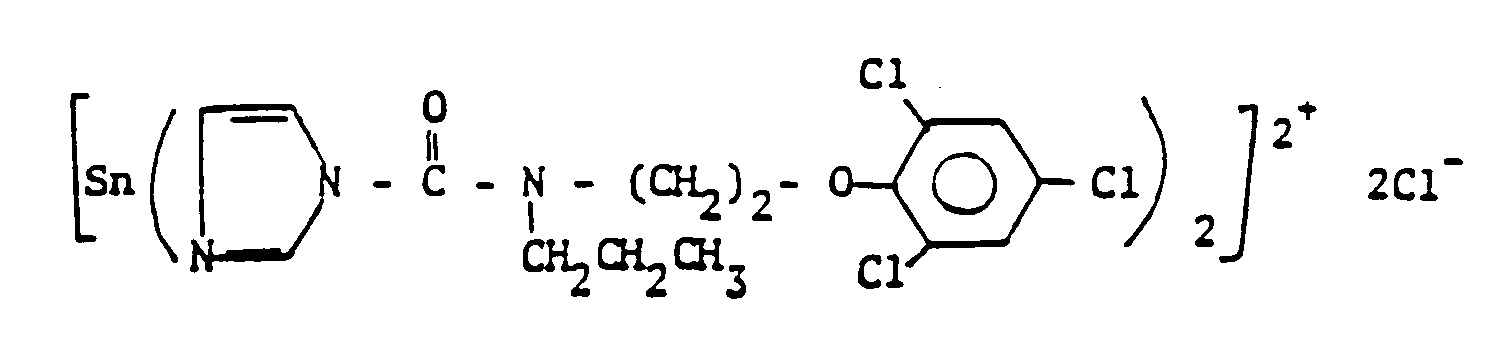
[0028] To a stirred, homogeneous solution of 80 g prochloraz in 500 ml ethanol or isopropanol kept at room temperature was added dropwise over a period of thirty minutes a solution of 225 g SnCl₂ in 100 ml water. The resulting mixture was stirred for a further two hours and the resulting crystals filtered, rinsed with water and ethanol or isopropanol (depending on the solvent originally used) to afford a white crystalline powder having a melting point of 95°C.
EXAMPLE 2: PREPARATION OF THE ZINC COMPLEX OF PROCHLORAZ
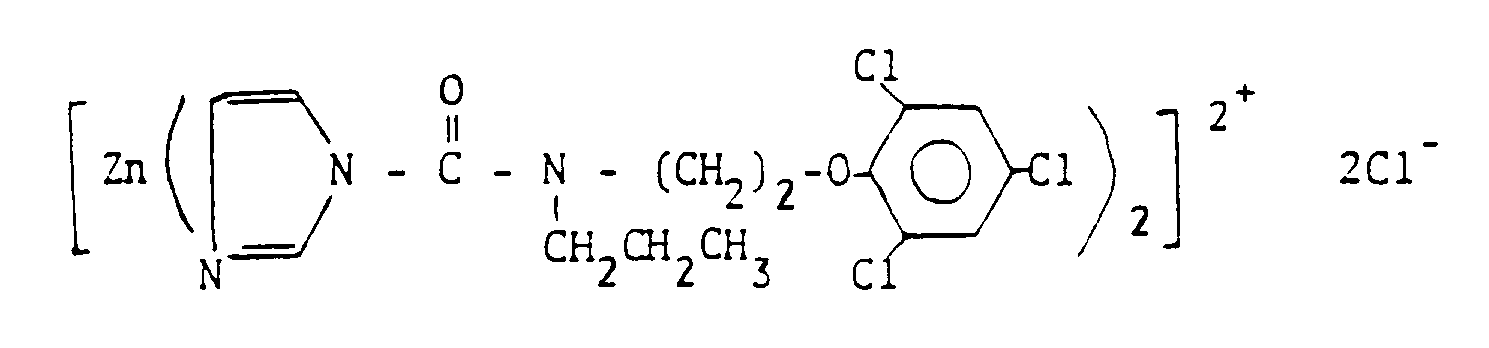
[0029] To a stirred homogeneous solution of 80 g prochloraz in 500 ml ethanol or isopropanol kept at room temperature, was added dropwise over a period of thirty minutes a solution of 13.6 g ZnCl₂ in 20 ml water. The resulting mixture was stirred for a further 2.5 hours and the resulting crystals filtered, washed with water and alcohol to afford a white crystalline powder having a melting point of 100°C-102°C. Elemental analysis:
| Zinc: | 7.35% calculated, | 7.29% found; |
| Chloride: | 7.97% calculated, | 8.02% found. |
EXAMPLE 3: PREPARATION OF A WETTABLE POWDER FORMULATION OF THE ZINC CHLORIDE COMPLEX.
[0030] A wettable powder formulation was prepared by mixing together the following ingredients: -
| Bis-[1-{N-propyl-N-2-(2,4,6-trichlorophenoxy)-ethylcarbamoyl}-imidazole]-zinc chloride complex | 54% |
| Sodium lignosulfonate (as dispersant) | 3% |
| Wettol NT-1 (wetting agent) | 2% |
| Wessalon (precipitated silica carrier) | 5% |
| Kaolin | to complete to 100% by weight |
EXAMPLE 4: PREPARATION OF A WETTABLE POWDER FORMULATION OF THE TIN (II) CHLORIDE COMPLEX
[0031] A wettable powder formulation was prepared by mixing together the following ingredients: -
| Bis-[1-{N-propyl-N-2-(2,4,6-trichlorophenoxy)-ethylcarbamoyl}-imidazole]-tin(II) chloride complex | 54% |
| Sodium lignosulfonate (as dispersant) | 3% |
| Wettol NT-1 (wetting agent) | 2% |
| Wessalon (precipitated silica carrier) | 5% |
| Kaolin | to complete to 100% by weight |
EXAMPLE 5: FUNGICIDAL ACTIVITY OF THE COMPLEXES AGAINST POWDERY MILDEW.
[0032] Cucumbers sensitive to powdery mildew were sprouted in trays and then transferred to pots of 16 cm diameter, two plants per pot. They were kept in a hot-house at 18°C-25°C at a relative humidity of 60%-70%. The cucumber plants were contaminated with powdery mildew collected from pumpkin leaves by passing the contaminated leaf over the leaves of the plants to be tested and the plants then sprayed with water. First treatment was with the first appearance of the disease, by spraying until dripping. All treatments were at a concentration of 0.03%, except for the commercial Myclobutanal (a systemic fungicide of Rohm and Haas Co.), where a concentration of 0.006% was used. The status of the disease was determined by three different people. The experiment was conducted in blocks, at random, with repetitions. Four blocks of four repetitions of ten treatments (total 160 pots) at three evaluation periods. The results appear in Table 2.
TABLE 2
| DISEASE INDEXa OF CUCUMBERS INOCULATED WITH POWDERY MILDEW AND TREATED WITH FORMULATIONS OF VARIOUS METAL COMPLEXES OF PROCHLORAZ. | ||
| Active Compound | Disease Index Days After Treatment | |
| 7 | 14 | |
| Myclobutanol | 1.34 Ad | 0.81 B |
| SnCl₂ complex of Prochloraz | 1.97 AB | 0.78 B |
| ZnCl₂ complex of Prochloraz | 1.63 AB | 0.94 BC |
| Octaveb | 2.69 CD | 1.50 D |
| Controlc | 4.44 E | 4.66 F |
| a = Key: 0=clean; 1=10%-20% sick; 2=20%-30% sick; 3=30%-40% sick; 4=40%-50% sick; 5=over 50% sick. | ||
| b = Trademark for Boots' Mn(II)Cl₂ complex of prochloraz. | ||
| c = All ingredients of formulations except the active one. | ||
| d = Numbers followed by dissimilar letters within columns, are significantly different (P = 0.05). |
EXAMPLE 6: FUNGICIDAL ACTIVITY OF THE ZINC COMPLEX AGAINST COFFEE BERRY DISEASE
[0033] The zinc complex of prochloraz was tested for its activity against coffee berry disease as follows: -
Approximately 3.5 mm sections of colonized branches are washed in a solution of Teepol or similar wetting agent to remove any initial spore load. Sections are laid on moistened cellosine wadding in plastic boxes, 12 sections per box. Three boxes are sprayed with each concentration of the candidate material, closed and incubated for three days. After incubation the spores are removed by vigorous shaking of each of the 12 twigs in 10 ml water and are counted, using a haemocytometer slide the sections of the branch are measured and their volume taken by displacement. The parameters measured were concentration of the formulation and expressed as per cent active ingredient (A.I.) and percent inhibition of sporulation. The inhibition of sporulation was expressed in relation to the sporulation of unsprayed control and folpet as the standard fungicide. Each determination was done in triplicate and repeated at least three times. The dose response curves were analyzed by linear regression and the different formulations were compared at the 80% inhibition point. The results as they appear in Table 3 show the very good activity of the zinc complex of prochloraz, especially as compared to the results of known commercial metal complexes. Thus, the zinc complex shows activity against coffee berry disease more than two times greater than that shown for the commercial "Octave".
Claims for the following Contracting State(s): AT, BE, CH, LI, DE, DK, FR, GB, GR,
IT, LU, NL, SE
1. A crystalline metal complex of prochloraz having the formula:
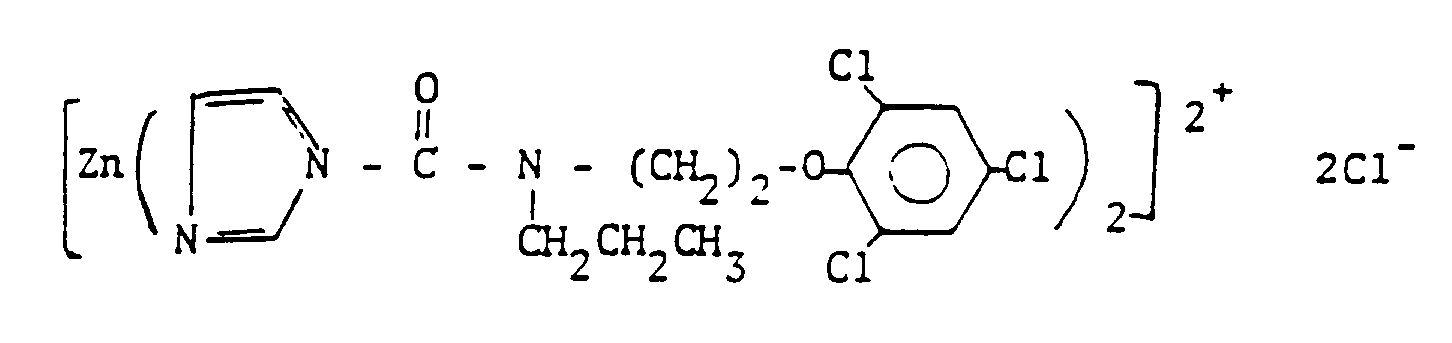
having a melting point of 100°C-102°C.
having a melting point of 100°C-102°C.
2. A crystalline metal complex of prochloraz having the formula:
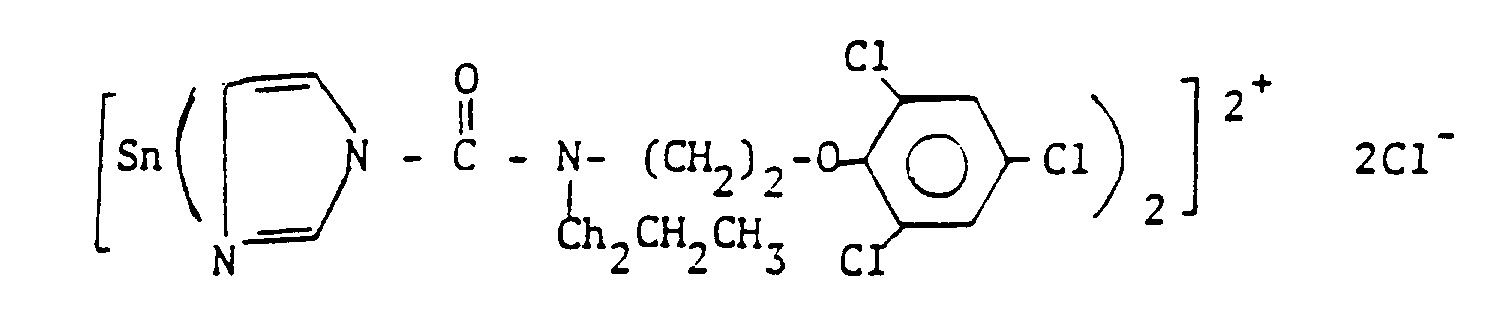
having a melting point of 95°C.
having a melting point of 95°C.
3. Fungicidal compositions containing a solid or liquid diluent or carrier and a fungicidally
effective amount of a crystalline metal complex of prochloraz having the formula
4. Fungicidal compositions containing a solid or liquid diluent or carrier and a fungicidally
effective amount of a crystalline metal complex of prochloraz having the formula:
5. Fungicidal compositions in accordance with any of Claims 3 and 4 in the form of a
wettable powder.
6. A method of controlling fungi which comprises applying to the infected material or
plane a composition containing an effective amount of a crystalline complex or prochloraz
in accordance with any of Claims 1 and 2.
7. A method of controlling powdery mildew which comprises applying to the infected material
or plant a composition containing an effective amount of a crystalline metal complex
of prochloraz in accordance with any Of Claims 1 and 2.
8. A method of controlling coffee berry disease, which comprises applying to the infected
material or plant a composition containing an effective amount of a crystalline zinc
complex of prochloraz in accordance with Claim 1.
Claims for the following Contracting State(s): ES
1. A method of controlling fungi which comprises applying to the infected material or
plant a composition containing an effective amount of a crystalline metal complex
of prochloraz of the formula
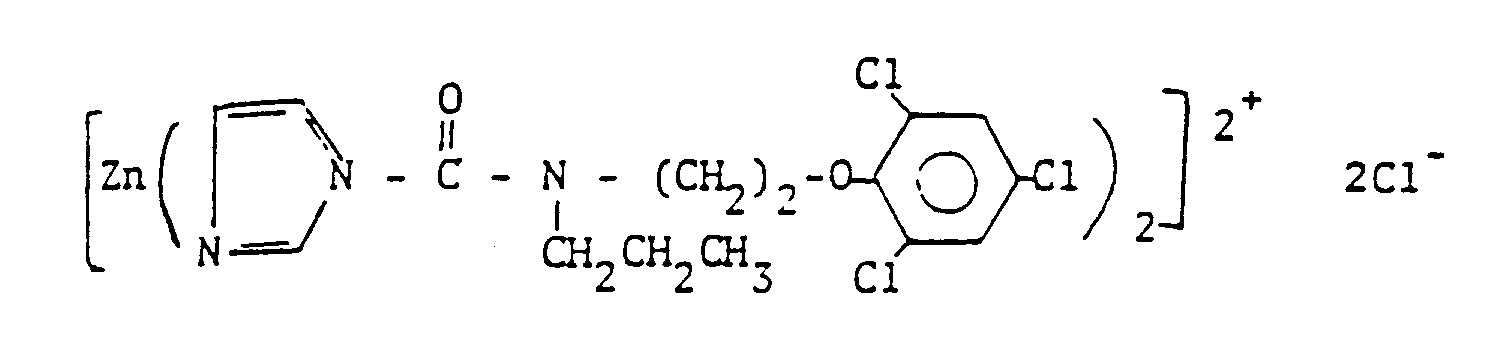
having a melting point of 100°C-102°C or of the formula
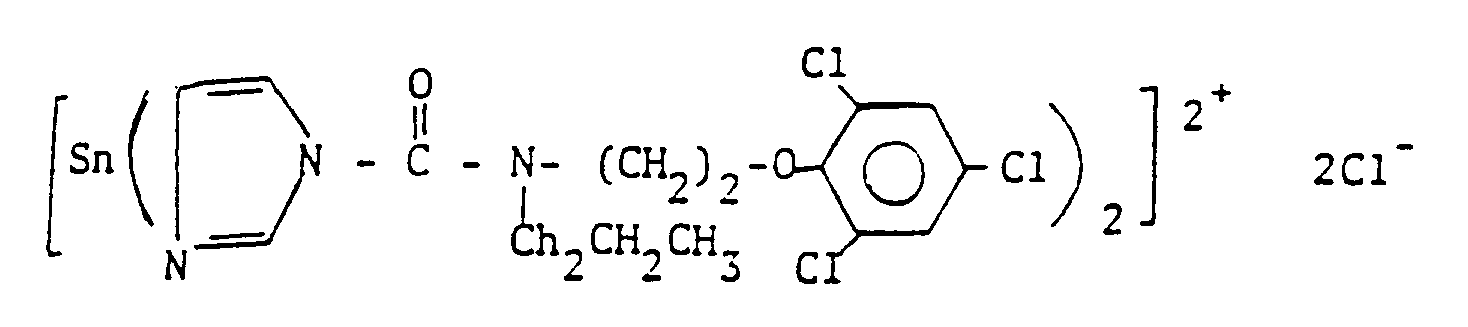
having a melting point of 95°C.
having a melting point of 100°C-102°C or of the formula
having a melting point of 95°C.
2. A method of controlling powdery mildew which comprises applying to the infected material
or plant a composition containing an effective amount of a crystalline metal complex
of prochloraz of the formula
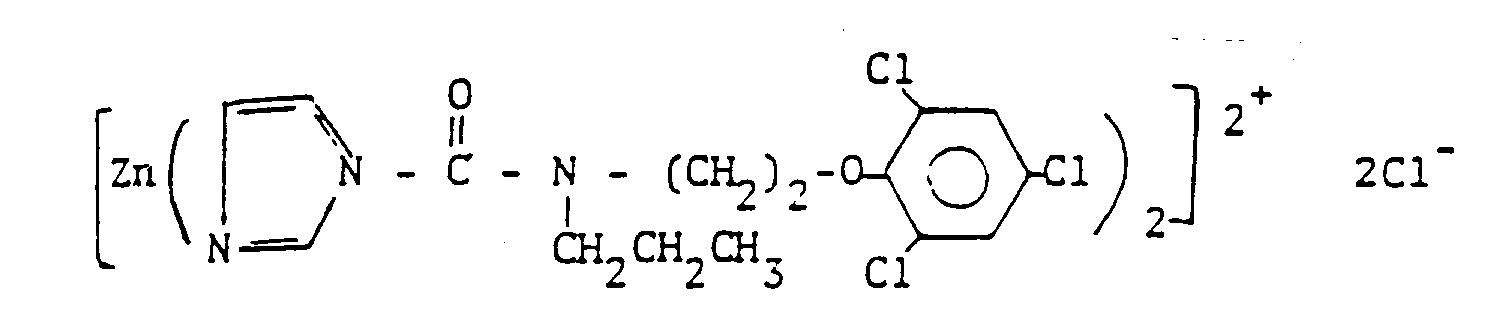
having a melting point of 100°C-102°C or of the formula
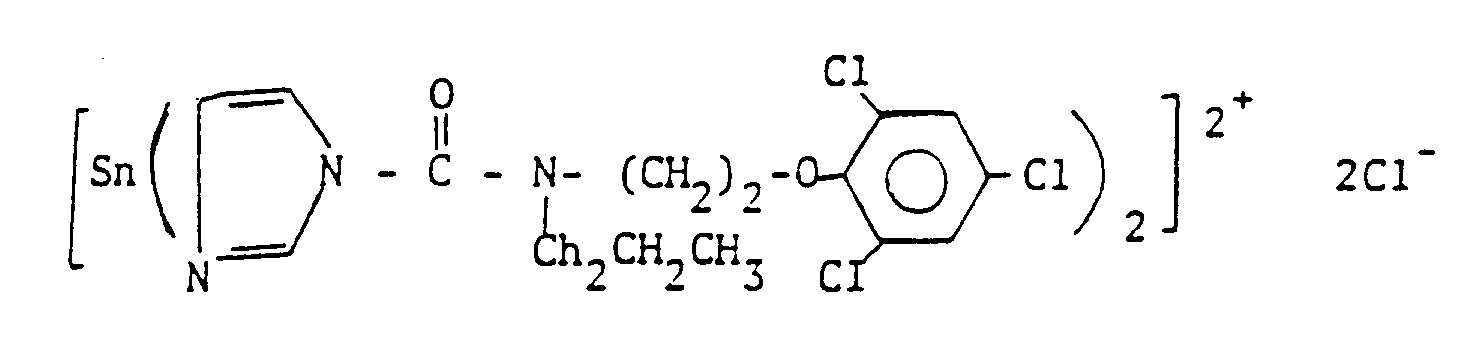
having a melting point of 95°C.
having a melting point of 100°C-102°C or of the formula
having a melting point of 95°C.
3. A method of controlling coffee berry disease, which comprises applying to the infected
material or plant a composition containing an effective amount of a crystalline zinc
complex of prochloraz of the formula
having a melting point of 100°C-102°C.
having a melting point of 100°C-102°C.
4. A process of preparing a crystalline metal complex of prochloraz having the formula
comprising adding a solution of MCl₂ in water wherein M is Sn or Zn to a homogeneous solution of prochloraz dissolved in an alcohol.
comprising adding a solution of MCl₂ in water wherein M is Sn or Zn to a homogeneous solution of prochloraz dissolved in an alcohol.
5. A process in accordance with Claim 4 wherein the alcohol is selected from ethanol
and isopropanol.
Patentansprüche für folgende(n) Vertragsstaat(en): AT, BE, CH, LI, DE, DK FR, GB,
GR, IT, LU, NL, SE
1. Kristalliner Metallkomplex von Prochloraz mit der Formel:
mit einem Schmelzpunkt von 100° C - 102° C.
mit einem Schmelzpunkt von 100° C - 102° C.
2. Kristalliner Metallkomplex von Prochloraz mit der Formel:
mit einem Schmelzpunkt von 95° C.
mit einem Schmelzpunkt von 95° C.
3. Fungizide Zusammensetzungen, die ein festes oder flüssiges Verdünnungsmittel oder
einen Trägerstoff enthalten und die eine fungizid wirksame Menge an kristallinem Metallkomplex
von Prochloraz mit der Formel:
enthalten.
enthalten.
4. Fungizide Zusammensetzungen, die ein festes oder flüssiges Verdünnungsmittel oder
einen Trägerstoff enthalten und die eine fungizid wirksame Menge an kristallinem Metallkomplex
von Prochloraz mit der Formel:
enthalten.
enthalten.
5. Fungizide Zusammensetzungen nach einem der Ansprüche 3 oder 4 in der Form eines benetzbaren
Pulvers.
6. Verfahren zur Bekämpfung von Fungi, welches das Aufbringen auf das befallene Material
oder auf die befallene Pflanze einer Zusammensetzung nach Anspruch 1 oder 2, die eine
wirksame Menge an kristallinem Komplex von Prochloraz enthält, umfaßt.
7. Verfahren zur Bekämpfung von pulvrigem Mehltau (Sphaerotheca fuliginia), welches das
Aufbringen auf das befallene Material oder auf die befallene Pflanze einer Zusammensetzung
nach Anspruch 1 oder 2, die eine wirksame Menge an kristallinem Metallkomplex von
Prochloraz enthält, umfaßt.
8. Verfahren zur Behandlung der Kaffeekirschenkrankheit (Colletotrichum coffeanum), welches
das Aufbringen auf das befallene Material oder auf die befallene Pflanze einer Zusammensetzung
nach Anspruch 1, die eine wirksame Menge an kristallinem Zinkkomplex von Prochloraz
enthält, umfaßt.
Patentansprüche für folgende(n) Vertragsstaat(en): ES
1. Verfahren zur Bekämpfung von Fungi, welches das Aufbringen auf das befallene Material
oder auf die befallene Pflanze einer Zusammensetzung, die eine wirksame Menge an kristallinem
Metallkomplex von Prochloraz der Formel:
mit einem Schmelzpunkt von 100° C - 102° C, oder der Formel:
mit einem Schmelzpunkt von 95° C enthält, umfaßt.
mit einem Schmelzpunkt von 100° C - 102° C, oder der Formel:
mit einem Schmelzpunkt von 95° C enthält, umfaßt.
2. Verfahren zur Bekämpfung von pulvrigem Mehltau (Sphareotheca fuliginia) , welches
das Aufbringen auf das befallene Material oder auf die befallene Pflanze einer Zusammensetzung,
die eine wirksame Menge an kristallinem Metallkomplex von Prochloraz der Formel
mit einem Schmelzpunkt von 100° C - 102° C, oder der Formel:
mit einem Schmelzpunkt von 95° C enthält, umfaßt.
mit einem Schmelzpunkt von 100° C - 102° C, oder der Formel:
mit einem Schmelzpunkt von 95° C enthält, umfaßt.
3. Verfahren zur Bekämpfung von Kaffekirschenkrankheit (Colletotrichum coffeanum), welches
das Aufbringen auf das befallene Material oder auf die befallene Pflanze einer Zusammensetzung,
die eine wirksame Menge an kristallinem Zinkkomplex von Prochloraz der Formel
mit einem Schmelzpunkt von 100° C - 102° C enthält, umfaßt.
mit einem Schmelzpunkt von 100° C - 102° C enthält, umfaßt.
4. Verfahren zur Darstellung eines kristallinen Metallkomplexes von Prochloraz mit der
Formel:
welches die Zugabe einer wässrigen Lösung von MCl₂, wobei M gleich Sn oder Zn ist, zu einer homogenen Lösung von in einem Alkohol gelösten Prochloraz umfaßt.
welches die Zugabe einer wässrigen Lösung von MCl₂, wobei M gleich Sn oder Zn ist, zu einer homogenen Lösung von in einem Alkohol gelösten Prochloraz umfaßt.
5. Verfahren nach Anspruch 4, wobei der Alkohol aus Ethanol und Isopropanol gewählt ist.
Revendications pour l'(les) Etat(s) contractant(s) suivant(s): AT, BE, CH, LI, DE,
DK, FR, GB, GR, IT, LU, NL, SE
1. Complexe métallique cristallin du prochloraz ayant la formule :
ayant un point de fusion de 100 à 102°C.
ayant un point de fusion de 100 à 102°C.
2. Complexe métallique cristallin du prochloraz ayant la formule :
ayant un point de fusion de 95°C.
ayant un point de fusion de 95°C.
3. Composition fongicide contenant un diluant ou un support solide ou liquide et une
quantité efficace du point de vue fongicide d'un complexe métallique cristallin du
prochloraz ayant la formule :
4. Composition fongicide contenant un diluant ou un support solide ou liquide et une
quantité efficace du point de vue fongicide d'un complexe métallique cristallin du
prochloraz ayant la formule :
5. Composition fongicide suivant l'une quelconque des revendications 3 et 4, sous la
forme d'une poudre mouillable.
6. Méthode pour lutter contre des champignons, qui comprend l'application, à la matière
ou à la plante infectée, d'une composition contenant une quantité efficace du point
de vue fongicide d'un complexe métallique cristallin du prochloraz suivant l'une quelconque
des revendications 1 et 2.
7. Méthode pour lutter contre le mildiou pulvérulent, qui comprend l'application, à la
matière ou à la plante infectée, d'une composition contenant une quantité efficace
du point de vue fongicide d'un complexe métallique cristallin du prochloraz suivant
l'une quelconque des revendications 1 et 2.
8. Méthode pour lutter contre la maladie du fruit du caféier, qui comprend l'application,
à la matière ou à la plante infectée, d'une composition contenant une quantité efficace
du point de vue fongicide d'un complexe de zinc cristallin du prochloraz suivant la
revendication 1.
Revendications pour l'(les) Etat(s) contractant(s) suivant(s): ES
1. Méthode pour lutter contre des champignons, qui comprend l'application, sur la matière
ou la plante infectée, d'une composition contenant une quantité efficace d'un complexe
métallique cristallin du prochloraz ayant la formule:
ayant un point de fusion de 100 à 102°C, ou ayant la formule :
ayant un point de fusion de 95°C.
ayant un point de fusion de 100 à 102°C, ou ayant la formule :
ayant un point de fusion de 95°C.
2. Méthode pour lutter contre le mildiou pulvérulent, qui comprend l'application, sur
la matière ou la plante infectée, d'une composition contenant une quantité efficace
d'un complexe métallique cristallin du prochloraz ayant la formule:
ayant un point de fusion de 100 à 102°C, ou ayant la formule:
ayant un point de fusion de 95°C.
ayant un point de fusion de 100 à 102°C, ou ayant la formule:
ayant un point de fusion de 95°C.
3. Méthode pour lutter contre la maladie du fruit du caféier, qui comprend l'application,
sur la matière ou la plante infectée, d'une composition contenant une quantité efficace
d'un complexe du zinc cristallin du prochloraz ayant la formule:
ayant un point de fusion de 100 à 102°C.
ayant un point de fusion de 100 à 102°C.
4. Procédé de préparation d'un complexe métallique cristallin du prochloraz ayant la
formule:
comprenant l'addition d'une solution de MCl₂ dans l'eau, où M est Sn ou Zn, à une solution homogène de prochloraz dissous dans un alcool.
comprenant l'addition d'une solution de MCl₂ dans l'eau, où M est Sn ou Zn, à une solution homogène de prochloraz dissous dans un alcool.
5. Procédé suivant la revendication 4, dans lequel l'alcool est choisi parmi l'éthanol
et l'isopropanol.