|
(11) | EP 0 447 041 B1 |

| (12) | EUROPEAN PATENT SPECIFICATION |
|
|
| (54) |
The use of hexamethylenetetramine as a stabilizer for 3-isothiazolones Verwendung von Hexamethylentetramin als Stabilisator für 3-Isothiazolone Utilisation d'hexaméthylènetétramine comme stabilisateur pour des 3-isothiazolones |
|
|
|||||||||||||||||||||||||||||||
| Note: Within nine months from the publication of the mention of the grant of the European patent, any person may give notice to the European Patent Office of opposition to the European patent granted. Notice of opposition shall be filed in a written reasoned statement. It shall not be deemed to have been filed until the opposition fee has been paid. (Art. 99(1) European Patent Convention). |
[0001] This invention concerns the stabilization of 3-isothiazolone compounds by the incorporation of hexamethylenetetramine with those compounds.
[0002] Isothiazolones have generated high commercial interest as microbicides to prevent spoilage of certain aqueous and non-aqueous products caused by microorganisms. Isothiazolones are highly effective microbicides (as used herein, "microbicides" includes bactericides, fungicides and algicides and microbicidal activity is intended to include both the elimination of and the inhibition or prevention of growth of microbial organisms such as bacteria, fungi and algae); by suitable choice of functional groups, they are useful in a broad range of applications. However, it has been long recognized that either in storage prior to addition to the substrate to be treated or after addition, their efficacy may be decreased because they are not stable under practical conditions of long-term storage. Means have thus been sought for some time to improve the stability of isothiazolones.
[0003] US-A-3,870,795 and 4,067,878 teach the stabilization of isothiazolones against chemical decomposition by addition of a metal nitrite or metal nitrate, but teach that other common metal salts, including carbonates, sulfates, chlorates, perchlorates, and chlorides are ineffective in stabilizing solutions of isothiazolones, such solutions usually being in water or in an hydroxylic solvent.
[0004] US-A-4,150,026 and 4,241,214 teach that metal salt complexes of isothiazolones are useful because they have enhanced thermal stability, while retaining biological activity.
[0005] It is known to use certain organic stabilizers for isothiazolones, generally for use situations where metal salts may create problems, such as corrosion, coagulation of latices, insolubility in non-aqueous media, interaction with the substrate to be stabilized, and the like. Formaldehyde or formaldehyde-releasing chemicals such as quaternary salts of hexamethylenetetramine under basic conditions, are known as stabilizers, (see US-A-4,165,318 and 4,129,448), as are certain organic chemicals such as orthoesters (USSN 118,366) and epoxides (USSN 194,234). Unlike its quaternary salts, hexamethylenetetramine has been shown not to release formaldehyde under basic conditions (H.W. Rossmore and M. Sondossi, "Advances in Applied Microbiology," 33, 230(1988)).
[0006] In certain applications, however, it is desirable to avoid addition of certain organic stabilizers by virtue of their volatility, decomposition under high heat, higher cost, difficulty in handling, potential toxicity, and the like.
[0007] In actual use, copper salts, such as copper sulfate, have proved efficacious in the stabilization of isothiazolones. However, copper salts may be undesirable in effluent streams in such operations as in the manufacture of stabilized isothiazolones or in their blending into a product or the use of that product. Copper salts, especially the chlorides, may contribute to possible corrosion, or in the presence of polymers in aqueous dispersion may lead to coagulation of the dispersion.
[0008] JP-A-54-132203 teaches the use of hexamethylenetetramine within a list of wood preservatives and benzisothiazolone within a list of fungicides, as decorative board fungicidal systems; the Kokai does not disclose nor suggest the use of hexamethylenetetramine as a stabilizer for 3-isothiazolones, nor does it disclose 3-isothiazolones at all.
[0009] HU-A-46721 A2 discloses the use of hexamethylenetetramine as part of a fungicidal formulation for use in paint compositions; it also discloses the use of 2-octyl-3-isothiazolone as part of a primer formulation. The fungicide formulation and primer are applied to a surface separately, typically 24 hours apart. Again, there is no suggestion that hexamethylenetetramine may act as a stabilizer for the isothiazolone.
[0010] It is an object of the invention to provide a stabilization system for isothiazolones which acts at only low levels of stabilizer so as to avoid interference with other components in systems in which isothiazolones are used as microbicides, and also overcomes at least some of the above disadvantages.
[0011] It has been surprisingly found that isothiazolones may be stabilized against decomposition by the addition of hexamethylenetetramine, hereinafter referred to as HMT, to the composition containing the isothiazolone. Accordingly the invention provides in one aspect a method of stabilizing a 3-isothiazolone of the formula (I)
wherein
Y is hydrogen; (C₁-C₁₈)alkyl or (C₃-C₁₂)cycloalkyl each optionally substituted with one or more of hydroxy, halo, cyano, alkylamino, dialkylamine, arylamino, carboxy, carbalkoxy, alkoxy, aryloxy, alkylthio, arylthio, haloalkoxy, cycloaklylamino, carbamoxy, or isothiazolonyl; an unsubstituted or halo-substituted (C₂-C₈)alkenyl or alkynyl; a (C₇-C₁₀)aralkyl optionally substituted with one or more of halogen, (C₁-C₄)alkyl or (C₁-C₄)alkoxy; or an aryl optionally substituted with one or more of halogen, nitro, (C₁-C₄)alkyl, (C₁-C₄)alkyl-acylamino, carb(C₁-C₄)alkoxy or sulfamyl; and
X and X¹ are each hydrogen, halogen, or (C₁-C₄)alkyl; under alkaline conditions; comprising incorporating therewith an effective amount of hexamethylenetetramine (HMT).
[0012] A further aspect of the invention provides a composition comprising an isothiazolone as defined above, and HMT in a alkaline medium. A still further aspect of the invention comprises the use of HMT as a stabilizer for 3-isothiazolones under alkaline conditions.
[0013] In another aspect, the invention comprises a method for inhibiting or preventing the growth of bacteria, fungi, yeast or algae in a locus which is in alkaline conditions and subject or susceptible to contamination by bacteria, fungi, yeast or algae, which comprises incorporating onto or into the locus, in an amount which is effective to adversely affect the growth of bacteria, fungi, yeast, or algae, the aforementioned composition.
[0014] The 3-isothiazolones of interest include those disclosed in US-A-3,523,121 and 3,761,488 as represented by the following formula:
wherein Y is hydrogen, an alkyl or substituted alkyl of 1 to 18 carbon atoms, preferably from 4 to 10 carbon atoms; an unsubstituted or halogen substituted alkenyl or alkynyl of 2 to 8 carbon atoms, preferably from 2 to 4 carbon atoms; a cycloalkyl or substituted cycloalkyl of 3 to 12 carbon atoms, preferably from 5 to 8 carbon atoms; an aralkyl or halogen-, lower alkyl-, or lower alkoxy-substituted aralkyl of up to 10 carbon atoms; or an aryl or halogen-, lower alkyl-, or lower alkoxy-substituted aryl of up to 10 carbon atoms; and X and X¹ are hydrogen, halogen, or a (C₁ - C₄)alkyl.
[0015] Representative Y substituents include methyl, ethyl, propyl, isopropyl, butyl, hexyl, octyl, cyclohexyl, benzyl, 3,4-dichlorophenyl, 4-methoxybenzyl, 4-chlorobenzyl, 4-methoxyphenyl, 4-chlorophenyl, phenethyl, 2-(4-chlorophenyl)ethyl, hydroxymethyl, chloromethyl, chloropropyl, hydrogen, and the like.
[0016] Where the expression "lower" is employed in conjunction with terms, such as alkyl, alkoxy, etc., it is intended to indicate that the alkyl or alkyl portion thereof has 1 to 4 carbon atoms, i.e., (C₁-C₄).
[0017] By a substituted alkyl group is meant an alkyl group having one or more of its hydrogen atoms replaced by another substituted group. Examples of substituted alkyl groups which characterize 3-isothiazolones of this invention include hydroxyalkyl, haloalkyl, cyanoalkyl, alkylaminoalkyl, dialkylaminoalkyl, arylaminoalkyl, carboxyalkyl, carbalkoxyalkyl, alkoxyalkyl, aryloxyalkyl, alkylthioalkyl, arylthioalkyl, haloalkoxyalkyl, cycloalkylaminoalkyl, such as morpholinoalkyl, piperidinoalkyl, pyrrolidonylalkyl, and the like, carbamoxyalkyl, alkenyl, haloalkenyl, alkynyl, haloalkynyl, isothiazolonylalkyl, and the like.
[0018] By a substituted aralkyl group is meant an aralkyl group having one or more of the hydrogen atoms on either the aryl ring or the alkyl chain replaced by another substituent group. Examples of the substituent aralkyl groups which characterize 3-isothiaozlones of this invention include halogen-, lower alkyl-, or lower alkoxy-substituted aralkyl groups, and the like.
[0019] By a substituted aryl group is meant an aryl group, such as benzene, naphthalene, or pyridine, having one or more of the hydrogen atoms on the aryl ring replaced by another substitutent group. Examples of such substitutent groups include halogen, nitro, lower alkyl, lower alkyl-acylamino, lower carbalkoxy, sulfamyl, and the like.
[0020] Particularly preferred isothiazolones are 5-chloro-2-methyl-3-isothiazolone, 2-methyl-3-isothiazolone, 2-n-octyl-3-isothiazolone, 4,5-dichloro-2-cyclohexyl-3-isothiazolone and 4,5-dichloro-2-octyl-3-isothiazolone.
[0021] Most preferred is 5-chloro-2-methyl-3-isothiazolone, either as a sole compound or in admixture with 2-methyl-3-isothiazolone. When in admixture, the preferred ratio of monochlorinated/unchlorinated isothiazolone is from about 70:30 to about 85:15, and an especially preferred ratio is from about 70:30 to about 80:20. A second especially preferred isothiazolone is 2-methyl-3-isothiazolone in combination with low levels of 5-chloro-2-methyl-3-isothiazolone, a preferred ratio being from about 98:2 to about 96:4, and an especially preferred ratio being about 97:3. A third especially preferred isothiazolone is 2-n-octyl-3-isothiazolone.
[0022] The composition may contain from about 0.00001 to about 99 parts of the one or more isothiazolones, and from about 0.00001 to about 99 parts of HMT.
[0023] Generally, the composition of the invention will be in the form of a solution. Typical formulation ranges are illustrated in the following Table (all percentages are parts by weight) for both a concentrated solution of the isothiazolone and a dilute solution. For certain uses, such as shipping of large quantities, more concentrated solutions may also be utilized.
[0024] Solvents may be used to dissolve the isothiazolones and may be any organic solvent which dissolves the isothiazolones, is compatible with the proposed end use, does not destabilize the isothiazolone, and does not react with the HMT to eliminate its stabilizing action.
[0025] Hydroxylic solvents, for example, polyols, such as glycols, alcohols and the like, may be used. Under conditions of high dilution and high ratios of stabilizer to isothiazolone, glycols may be successfully used. In certain formulations, hydrocarbons, either aliphatic or aromatic, are useful solvents.
[0026] Preferred solvents are capped polyols, wherein the free hydroxyl group is replaced with an ether or ester function. Especially preferred are 2,5,8,11-tetraoxadodecane, commonly known as triethylene glycol dimethyl ether, and 4,7-dioxaundecanol-1 acetate, commonly known as diethylene glycol butyl ether acetate.
[0027] Water is a solvent for certain of the preferred isothiazolones and the HMT may be employed in aqueous formulations.
[0028] The amounts of HMT employed will vary depending on use conditions and concentrations of the isothiazolone in the mixture: effective amounts of HMT based on isothiazolone may be ratios in the range of from about 1:100 to about 1000:1 stabilizer to isothiazolone. In concentrated solutions, ratios are generally from about 1:50 to about 50:1. Obviously higher amounts may be used, but at additional cost. At high levels of dilution of the isothiazolone (such as from 1 to 10,000 ppm (0.0001 - 1%) isothiazolone in the solvent), the ratio of stabilizer to isothiazolone can range from about 1:10 to about 20:1. The preferred range is from 1:1 to 20:1.
[0029] The stabilization advantages of the HMT of the present invention are noted even when the isothiazolone contains other salt stabilizers recorded in US-A-3,870,795, 4,067,878, 4,150,026 and 4,241,214.
[0030] Uses of these new organically stabilized microbicides are typically at any locus subject to contamination by bacteria, fungi, yeast or algae. Typically loci are in aqueous systems such as water cooling, laundry wash water, oil systems such as cutting oils, oil fields and the like where microorganisms need to be killed or where their growth needs to be controlled. However these stabilized microbicides may also be used in all applications for which known microbicidal compositions are useful; preferred utilities of the compositions are to protect wood paint, adhesive, glue, paper, textile, leather, plastics, cardboard, lubricants, cosmetics, food, caulking, feed and industrial cooling water from microorganisms.
[0032] Because isothiazolones are so active as microbicides and only low levels of HMT are required to achieve stabilization, the amount of HMT in systems being treated will be very small, and therefore it is not likely to interfere with other components in systems requiring protection or with systems to which the protected systems will be applied. Potential areas of general application include metal-working fluids, paints, cooling water, and air washers.
[0033] One significant area of application for the compositions of the invention is as microbicides in metal working fluids. Metal working fluids are proprietary combinations of chemicals, which may contain, inter alia, ingredients such as alkanolamines, petroleum sulfonate surfactants, oils (naphthenic, paraffinic, etc.), chlorinated paraffins and fatty esters, sulfurized fatty compounds, phosphate esters, fatty acids and their amine salts, glycols, polyglycols, boric acid esters and amides. They are utilized in the milling, machining, drilling, and other processing technologies for fabricating metal for the purposes of lubricating, cooling, preventing surface corrosion, and the like. They are sold in the form of active metal working fluid (MWF) concentrates, and are diluted in use to 1-10% active ingredients in water.
[0034] Because metal working fluids are recycled and stored, the growth of microorganisms is favored. Isothiazolones have been found effective in preventing the growth of such organisms. Certain of the components in the metal working fluids will tend to destroy the isothiazolone and so remove its microbicidal protective activity, so that stabilizers for the isothiazolone against such degradation are desirable.
[0035] It is known in the art that the performance of microbicides may be enhanced by combination with one or more other microbicides. Thus, other known microbicides may be combined advantageously with the composition of this invention.
[0036] The following examples are intended to illustrate the present invention and not to limit it except as it is limited by the claims. All percentages are by weight unless otherwise specified, and all reagents are of good commercial quality unless otherwise specified. Methods for quantitative determination of the isothiazolones in the following examples in metal-working fluids are described in detail in "Kathon® 886 MW Microbicide and Kathon® 893 MW Fungicide: Analysis in Metalworking Fluids by High-Performance Liquid Chromatography", 1988, Rohm and Haas Company.
EXAMPLE 1
[0037] These examples demonstrate the stabilizing effect of HMT for isothiazolones added to a metal working fluid (MWF). MWF concentrate A was a "semi-synthetic" type having about 10 to 15 percent naphthenic/paraffinic oil, about 50 percent water, emulsifying agents, pH adjusting amines, anticorrosive agents, and EP (extreme pressure) agents.
[0038] Into a glass vial in the following order were placed: a) 5 parts by weight of the MWF concentrate solution, b) 5 parts of the stabilizer in solution or dispersion, c) 5 parts water, d) 5 parts of an aqueous solution containing 80 ppm active ingredient (AI), prepared by dilution of a 14.4% aqueous solution of an approximately 75/25 mixture of 5-chloro-2-methyl-3-isothiazolone and 2-methyl-3-isothiazolone; also present was 9.2% magnesium chloride and 15.7% magnesium nitrate. Thus the final mixture contained 3-5% of the MWF concentrate, 20 ppm active ingredient of the isothiazolone, and 0 (control) to 2,000 ppm of the stabilizer.
[0039] The vials were then capped, stored at ambient room temperature in a closed cabinet for a designated time, filtered through a 0.45 micron filter into another vial and analyzed the same day. The relative concentration of the active ingredient was determined by reverse phase high pressure liquid chromatography, utilizing a Varian model 5500 chromatograph and an ultraviolet detector. Results of this study are found in Table 1.
EXAMPLE 2
[0040] This example illustrates the ability of HMT to be used in stabilization of isothiazolones used as mildewcides in paint formulations. The water-based paint formulation was prepared from standard ingredients, utilizing a commercial acrylic-based latex with conventional pigments, dispersants, and the like.
[0041] To two sealable containers were charged 100 parts of the paint formulation. To one was charged twice the desired final stabilizer concentration, and to the other, twice the desired isothiazolone concentration. Both portions were homogenized for 15 minutes each, then blended and re-mixed. The sealed containers were stored at 60°C and samples were removed at 0 and 15 days.
[0042] To 1 part of the sample was added 9 parts propylene glycol, the diluted sample shaken for one hour, centrifuged at 70,000 rpm for 30 minutes, the supernatant diluted with two volumes of methanol, and that solution filtered through a 0.45 micron filter. The filtered sample was injected directly into the HPLC described in Example 1. Appropriate analytical calibrations were made for the 2-octyl-3-isothiazolone studied. The 2-octyl-3-isothiazolone was added as a 45.5 wt. % solution in propylene glycol. The following formulation is a typical paint blend for testing of stabilization against microbial activity. Texanol (R) is trimethyl-1,3-pentanediol monoisobutyrate supplied by Eastman Chemical. "Latex" is a latex of a copolymer of butyl acrylate and methyl methacrylate.
1. Method of stabilizing a 3-isothiazolone of the formula (I)
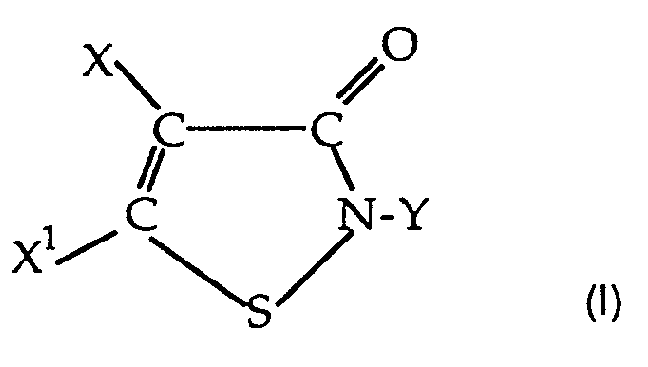
wherein
Y is hydrogen: (C₁-C₁₈)alkyl or (C₃-C₁₂)cycloalkyl each optionally substituted with one or more of hydroxy, halo, cyano, alkylamino, dialkylamine, arylamino, carboxy, carbalkoxy, alkoxy, aryloxy, alkylthio, arylthio, haloalkoxy, cycloaklylamino, carbamoxy, or isothiazolonyl; an unsubstituted or halo-substituted (C₂-C₈)alkenyl or alkynyl; a (C₇- C₁₀)aralkyl optionally substituted with one or more of halogen, (C₁-C₄)alkyl or (C₁-C₄)alkoxy; or an aryl optionally substituted with one or more of halogen, nitro, (C₁-C₄)alkyl, (C₁-C₄)alkyl-acylamino, carb(C₁-C₄)alkoxy or sulfamyl; and X and X¹ are each independently hydrogen, halogen, or (C₁-C₄)alkyl; under alkaline conditions; comprising incorporating therewith an effective amount of hexamethylenetetramine (HMT).
wherein
Y is hydrogen: (C₁-C₁₈)alkyl or (C₃-C₁₂)cycloalkyl each optionally substituted with one or more of hydroxy, halo, cyano, alkylamino, dialkylamine, arylamino, carboxy, carbalkoxy, alkoxy, aryloxy, alkylthio, arylthio, haloalkoxy, cycloaklylamino, carbamoxy, or isothiazolonyl; an unsubstituted or halo-substituted (C₂-C₈)alkenyl or alkynyl; a (C₇- C₁₀)aralkyl optionally substituted with one or more of halogen, (C₁-C₄)alkyl or (C₁-C₄)alkoxy; or an aryl optionally substituted with one or more of halogen, nitro, (C₁-C₄)alkyl, (C₁-C₄)alkyl-acylamino, carb(C₁-C₄)alkoxy or sulfamyl; and X and X¹ are each independently hydrogen, halogen, or (C₁-C₄)alkyl; under alkaline conditions; comprising incorporating therewith an effective amount of hexamethylenetetramine (HMT).
2. Method according to claim 1 wherein said 3-isothiazolone is 5-chloro-2-methyl-3-isothiazolone,
2-methyl-3-isothiazolone, 2-n-octyl-3-isothiazolone, 4,5-dichloro-2-cyclohexyl-3-isothiazolone,
or 4,5-dichloro-2-octyl-3-isothiazolone, preferably 2-n-octyl-3-isothiazolone.
3. Method according to claim 1 wherein said 3-isothiazolone is a mixture of 5-chloro-2-methyl-3-isothiazolone
and 2-methyl-3-isothiazolone.
4. Composition comprising an isothiazolone as defined in any preceding claim and HMT,
in an alkaline medium.
5. Composition according to claim 4 comprising 0.00001 to 99%, preferably 0.00001 to
5% and more preferably 0.0001 to 1% by weight of 3-isothiazolone, 0.00001 to 99%,
preferably 0.00001 to 5% and more preferably 0.0001 to 1% by weight of HMT, and which
further comprises up to 99.99998%, preferably from 90 to 99.99998% and more preferably
from 98 to 99.9998% by weight of solvent.
6. Composition according to claim 5 wherein the solvent is polyol solvent.
7. Method or composition according to any preceding claim wherein the ratio of HMT is
3-isothiazolone is from 1:100 to 1000:1, preferably from 1:50 to 20:1, and more preferably
from 1:1 to 20:1, by weight.
8. Method of inhibiting or preventing the growth of bacteria, fungi or algae in a locus
which is in alkaline conditions and subject or susceptible to contamination thereby,
comprising incorporating into or onto the locus a composition according to any of
claims 4 to 7 in an amount effective to adversely affect the growth of said bacteria,
fungi or algae.
9. The use of HMT as a stabilizer for a 3-isothiazolone as defined in any of claims 1
to 3, under alkaline conditions.
1. Verfahren zur Stabilisierung eines 3-Isothiazolons der Formel (I):
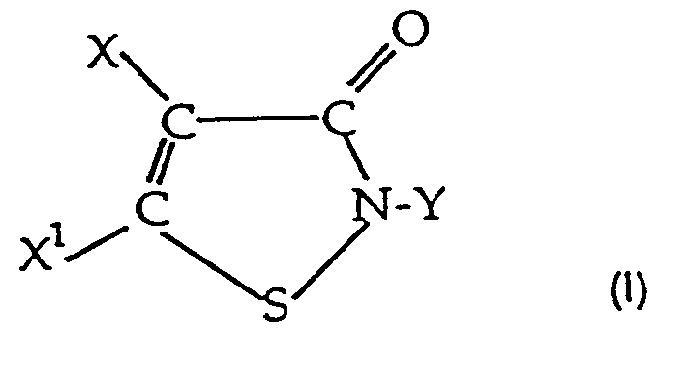
worin
Y Wasserstoff, (C₁-C₁₈)Alkyl oder (C₃-C₁₂)Cycloalkyl, wobei letztere jeweils gegebenenfalls mit ein oder mehr von Hydroxy, Halogen, Cyano, Alkylamino, Dialkylamin, Arylamino, Carboxy, Carbalkoxy, Alkoxy, Aryloxy, Aklkylthio, Arylthio, Halogenalkoxy, Cycloalkylamino, Carbamoxy oder Isothiazolonyl substituiert sind, ein unsubstituiertes oder Halogen-substituiertes (C₂-C₈)Alkenyl oder Alkynyl, ein gegebenenfalls mit ein oder mehr von Halogen, (C₁-C₄)Alkyl oder (C₁-C₄)Alkoxy substituiertes (C₇-C₁₀)Aralkyl, oder ein gegebenenfalls mit ein oder mehr von Halogen, Nitro, (C₁-C₄)Alkyl, (C₁-C₄)Alkylacylamino, Carb(C₁-C₄)alkoxy oder Sulfamyl substituiertes Aryl ist, und X und X¹ jeweils unabhängig davon Wasserstoff, Halogen oder (C₁-C₄)Alkyl sind, unter alkalischen Bedingungen, bei dem damit eine wirksame Menge von Hexamethylentetramin (HMT) eingeführt wird.
worin
Y Wasserstoff, (C₁-C₁₈)Alkyl oder (C₃-C₁₂)Cycloalkyl, wobei letztere jeweils gegebenenfalls mit ein oder mehr von Hydroxy, Halogen, Cyano, Alkylamino, Dialkylamin, Arylamino, Carboxy, Carbalkoxy, Alkoxy, Aryloxy, Aklkylthio, Arylthio, Halogenalkoxy, Cycloalkylamino, Carbamoxy oder Isothiazolonyl substituiert sind, ein unsubstituiertes oder Halogen-substituiertes (C₂-C₈)Alkenyl oder Alkynyl, ein gegebenenfalls mit ein oder mehr von Halogen, (C₁-C₄)Alkyl oder (C₁-C₄)Alkoxy substituiertes (C₇-C₁₀)Aralkyl, oder ein gegebenenfalls mit ein oder mehr von Halogen, Nitro, (C₁-C₄)Alkyl, (C₁-C₄)Alkylacylamino, Carb(C₁-C₄)alkoxy oder Sulfamyl substituiertes Aryl ist, und X und X¹ jeweils unabhängig davon Wasserstoff, Halogen oder (C₁-C₄)Alkyl sind, unter alkalischen Bedingungen, bei dem damit eine wirksame Menge von Hexamethylentetramin (HMT) eingeführt wird.
2. Verfahren nach Anspruch 1, worin das 3-Isothiazolon 5-Chlor-2-methyl-3-isothiazolon,
2-Methyl-3-isothiazolon, 2-n-Octyl-3-isothiazolon, 4,5-Dichlor-2-cyclohexyl-3-isothiazolon
oder 4,5-Dichlor-2-octyl-3-isothiazolon, vorzugsweise 2-n-Octyl-3-isothiazolon ist.
3. Verfahren nach Anspruch 1, worin das 3-Isothiazolon ein Gemisch aus 5-Chlor-2-methyl-3-isothiazolon
und 2-Methyl-3-isothiazolon ist.
4. Zusammensetzung, umfassend ein Isothiazolon nach einem der vorhergehenden Ansprüche
und HMT in einem alkalischen Medium.
5. Zusammensetzung nach Anspruch 4, umfassend 0,00001 bis 99, vorzugsweise 0,00001 bis
5 und besonders bevorzugt 0,0001 bis 1 Gew.-% von 3-Isothiazolon, 0,00001 bis 99,
vorzugsweise 0,00001 bis 5 und besonders bevorzugt 0,0001 bis 1 Gew.-% HMT, und ferner
umfassend bis 99,99998, vorzugsweise 90 bis 99,99998 und besonders bevorzugt 98 bis
99,9998 Gew.-% des Lösungsmittels.
6. Zusammensetzung nach Anspruch 5, worin das Lösungsmittel ein Polyol-Lösungsmittel
ist.
7. Verfahren oder Zusammensetzung nach einem der vorhergehenden Ansprüche, worin das
Gewichtsverhältnis von HMT zu 3-Isothiazolon 1:100 bis 1000:1, vorzugsweise 1:50 bis
20:1 und besonders bevorzugt 1:1 bis 20:1 beträgt.
8. Verfahren zur Inhibierung oder Verhinderung des Wachstums von Bakterien, Pilzen oder
Algen an einem Ort, das unter alkalischen Bedingungen und dadurch Gegenstand einer
oder empfänglich für eine Kontamination ist, bei dem in oder auf den Ort eine Zusammensetzung
nach einem der Ansprüche 4 bis 7 in einer Menge gegeben wird, die das Wachtstum der
Bakterien, Pilze oder Algen negativ beeinflußt.
9. Verwendung von HMT als Stabilisator für ein 3-Isothiazolon nach einem der Ansprüche
1 bis 3 unter alkalischen Bedingungen.
1. Méthode pour stabiliser une 3-isothiazolone de formule (I)
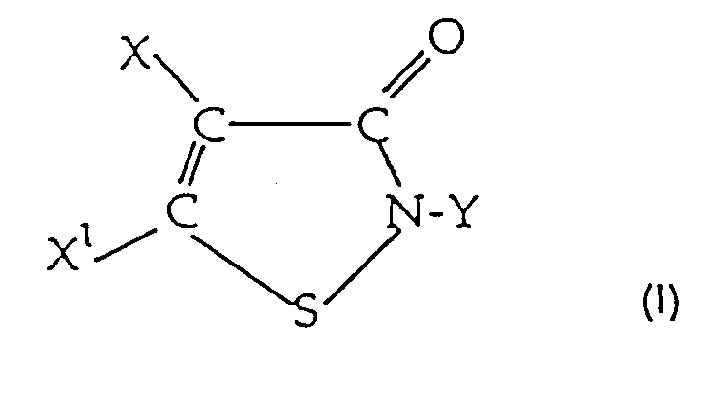
dans laquelle :
Y est : hydrogène ; un alcoyle en C₁-C₁₈ ou cyclo-alcoyle en C₃-C₁₂ , chacun éventuellement substitué au moyen d'un ou plusieurs parmi hydroxy, halo, cyano, alcoylamino, dialcoylamino , arylamino , carboxy, carbalcoxy, alcoxy, aryloxy, alcoylthio, arylthio, haloalcoxy, cycloalcoylamino, carbamoxy ou isothiazolonyl ; un alcényl ou alcoynyl en C₂-C₈ non substitué ou halosubstitué ; un aralcoyl en C₇-C₁₀, éventuellement substitué au moyen d'un ou plusieurs parmi halogène , alcoyle en C₁-C₄ ou alcoxy en C₁-C₄; ou un aryl, éventuellement substitué au moyen d'un ou plusieurs halogène, nitro , alcoyle en C₁-C₄ , alcoyle en (C₁-C₄) - acylamino, carb(en C₁-C₄) alcoxy ou sulfamyl; et
X et X¹ sont chacun, indépendamment, hydrogène , halogène ou alcoyle en C₁-C₄;
sous des conditions alcalines ;
comprenant l'incorporation dans celle-ci- d'une quantité efficace d'hexaméthylènetétramine (HMT).
dans laquelle :
Y est : hydrogène ; un alcoyle en C₁-C₁₈ ou cyclo-alcoyle en C₃-C₁₂ , chacun éventuellement substitué au moyen d'un ou plusieurs parmi hydroxy, halo, cyano, alcoylamino, dialcoylamino , arylamino , carboxy, carbalcoxy, alcoxy, aryloxy, alcoylthio, arylthio, haloalcoxy, cycloalcoylamino, carbamoxy ou isothiazolonyl ; un alcényl ou alcoynyl en C₂-C₈ non substitué ou halosubstitué ; un aralcoyl en C₇-C₁₀, éventuellement substitué au moyen d'un ou plusieurs parmi halogène , alcoyle en C₁-C₄ ou alcoxy en C₁-C₄; ou un aryl, éventuellement substitué au moyen d'un ou plusieurs halogène, nitro , alcoyle en C₁-C₄ , alcoyle en (C₁-C₄) - acylamino, carb(en C₁-C₄) alcoxy ou sulfamyl; et
X et X¹ sont chacun, indépendamment, hydrogène , halogène ou alcoyle en C₁-C₄;
sous des conditions alcalines ;
comprenant l'incorporation dans celle-ci- d'une quantité efficace d'hexaméthylènetétramine (HMT).
2. Méthode selon la revendication 1, dans laquelle ladite 3-isothiazolone est 5-chloro-2-méthyl-3-isothiazolone,
2-méthyl-3-isothiazolone , 2-n-octyl-3-isothiazolone , 4,5-dichloro-2-cyclohexyl-3-isothiazolone,
ou 4,5-dichloro-2-octyl-3-isothiazolone, de préférence 2-n-octyl-3-isothiazolone.
3. Méthode selon la revendication 1, dans laquelle ladite 3-isothiazolone est un mélange
de 5-chloro-2-méthyl-3-isothiazolone et de 2-méthyl-3-isothiazolone.
4. Composition comprenant une isothiazolone, telle que définie dans toute revendication
précédente, et HMT , dans un milieu alcalin.
5. Composition selon la revendication 4, comprenant O,OOOO1 à 99%, de préférence O,OOOO1
à 5%, et plus préférablement O,OOO1 à 1 % , en poids de 3-isothiazolone , O,OOOO1
à 99% , de préférence O,OOOO1 à 5%, et plus préférablement O,OOO1 à 1% , en poids
de HMT, et qui en outre comprend jusqu'à 99,99998 % , de préférence de 9O à 99,99998
%, et plus préférablement de 98 à 99,9998% , en poids de solvant .
6. Composition selon la revendication 5, dans laquelle le solvant est un solvant de type
polyol.
7. Méthode ou composition selon l'une quelconque des revendications précédentes, dans
laquelle le rapport HMT/3-isothiazolone est de 1:100 à 1000:1 , de préférence de 1:50
à 20.1 , et plus préférablement de 1 : 1 à 20:1, en poids .
8. Méthode pour inhiber ou empêcher la croissance de bactéries , champignons ou fungi,
ou algues dans une zone qui se trouve dans des conditions alcalines et est sujette
à être contaminée ou est susceptible de contamination par ceux-ci , comprenant l'incorporation
dans ou sur la zone d'une composition selon l'une quelconque des revendications 4
à 7 en une quantité efficace pour affecter adversement la croissance desdites bactéries
, desdits champignons ou fungi ou desdites algues.
9. Utilisation de HMT en tant que stabilisant pour une 3-isothiazolone , telle que définie
dans l'une quelconque des revendications 1 à 3 , dans des conditions alcalines.