|
(11) | EP 0 447 872 B1 |

| (12) | EUROPEAN PATENT SPECIFICATION |
|
|
| (54) |
Ink, ink-jet recording method, and instrument employing the ink Tinte, Tintenstrahl-Aufzeichnungsverfahren und diese Tinte verwendendes Instrument Encre, procédé d'enregistrement par jet d'encre et instrument faisant usage de cette encre |
|
|
|||||||||||||||||||||||||||||||
| Note: Within nine months from the publication of the mention of the grant of the European patent, any person may give notice to the European Patent Office of opposition to the European patent granted. Notice of opposition shall be filed in a written reasoned statement. It shall not be deemed to have been filed until the opposition fee has been paid. (Art. 99(1) European Patent Convention). |
[0001] The present invention relates to an ink, an ink-jet recording method employing the ink, and an instrument employing the ink. More particularly, the present invention relates to an ink, an ink-jet recording method, an ink-jet recording unit, an ink-jet recording apparatus, and an ink cartridge which allow recording in high resolution and high quality not only on coated paper prepared specially for ink-jet recording but also on non-coated ordinary paper generally used in offices and homes such as copying paper, reporting paper, notebook paper, letter paper, bond paper, continuous business form paper, and the like.
[0002] Various compositions of inks have been reported for ink-jet recording. In recent years, research and development are comprehensively conducted regarding inks from various aspects of compositions and physical properties of inks for the purpose of achieving satisfactory recording on ordinary paper such as copying paper, reporting paper, notebook paper, letter paper, bond paper, continuous business form paper, and the like.
[0003] Conventional inks contains generally a high-boiling organic solvent like glycol for retardation of premature drying and prevention of clogging of ink. If such an ink is used for recording on highly sized ordinary paper, the ink does not readily permeate into interior of paper and does not dry rapidly, which causes insufficient fixation of ink, resulting in inconveniences such as staining of a finger and blurring or scratching of letters on touching to a recorded matter.
[0004] To offset the inconvenience, Japanese Patent Application Laid-Open No. 55-29546 discloses a method of adding a large amount of surfactant to the ink to increase permeability of ink into the interior of paper. In this case, however, troubles are encountered such as frequent occurrence of running or feathering of ink depending on kind of paper; and retardation of ink ejection in ink-jet recording caused by backward movement of ink from the orifice-outlet face, or wetting of entire orifice-outlet face depending on the structure of the head.
[0005] Further, Japanese Patent Application Laid-Open No. 56-57862 discloses a method of making the pH of ink strongly alkaline. Such an ink is disadvantageous in that the ink is dangerous to humans when touched with a finger and the ink is unsatisfactory in occurrence of feathering and insufficiency of drying property on paper employing a certain kind of sizing agent, e.g. neutralized paper.
[0006] JP-A-63 152 680 discloses an ink comprising an organic solvent-soluble dye and a solvent consisting mainly of benzyl alcohol; furthermore a printing system is described, which prints on a recording paper using said ink. Due to the presence of the aforementioned solvent the problem of feathering of said ink in case of the use of normal paper - as already discussed above - is aggrevated.
[0007] In spite of the aforementioned and other improvements, no ink is known which is free from the problems of feathering, lack of drying property, danger to humans, and occurrence of clogging and so forth.
[0008] An object of the present invention is to provide an ink which is free from the problems of feathering of ink and delayed drying of recorded matters, and which gives high quality of printing on non-coated paper or ordinary paper such as copying paper, reporting paper, notebook paper letter paper, bond paper, continuous business form paper, etc. generally used in offices and elsewhere, and an ink-jet recording method and an ink-jet apparatus employing the ink.
[0009] Another object of the present invention is to provide an ink for ink-jet printing which is sufficiently safe on use in offices and homes.
[0010] A further object of the present invention is to provide an ink which does not tend to clog nozzles of ink-jet head and is highly reliable.
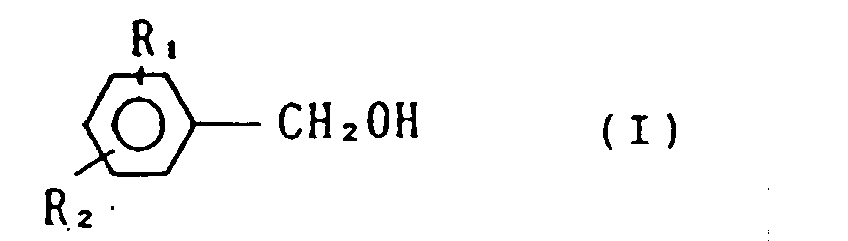
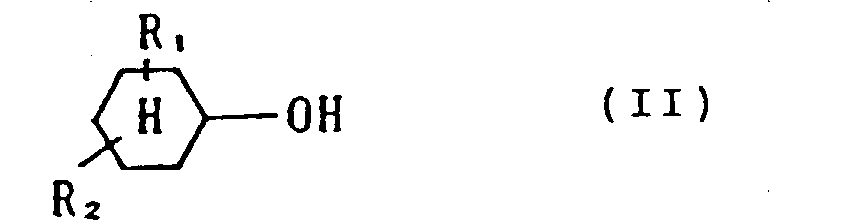
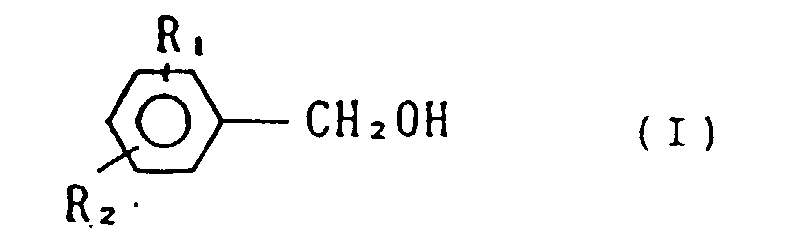
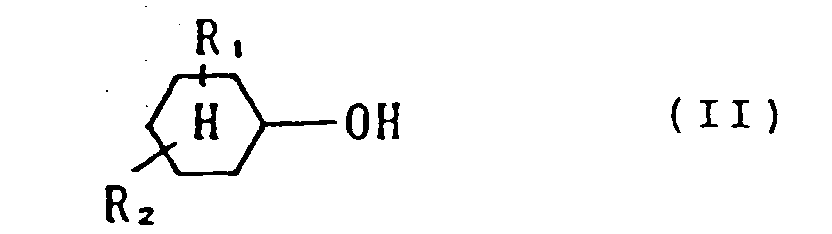
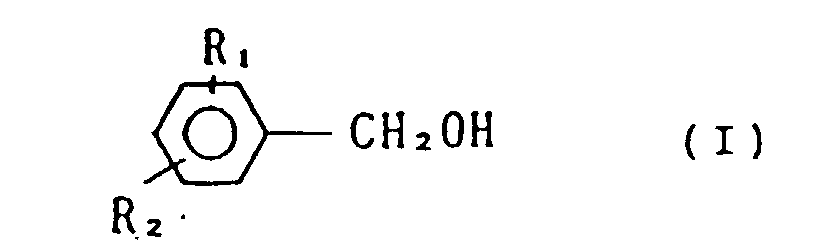
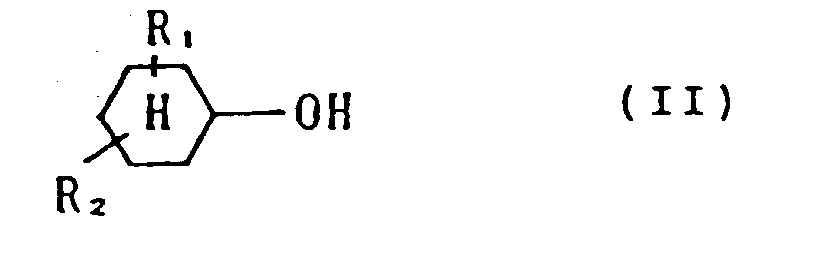
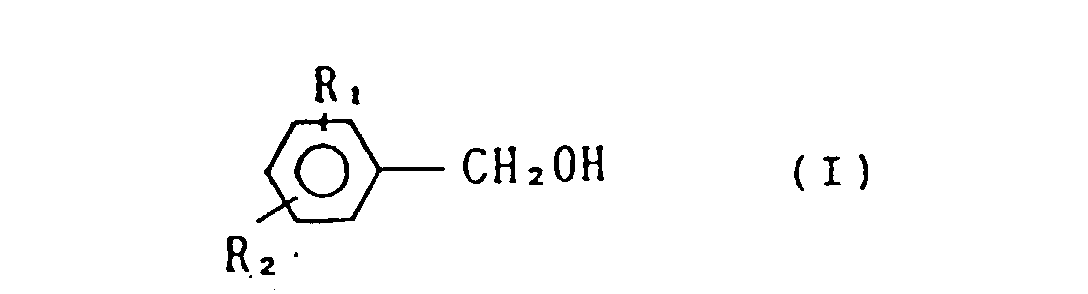
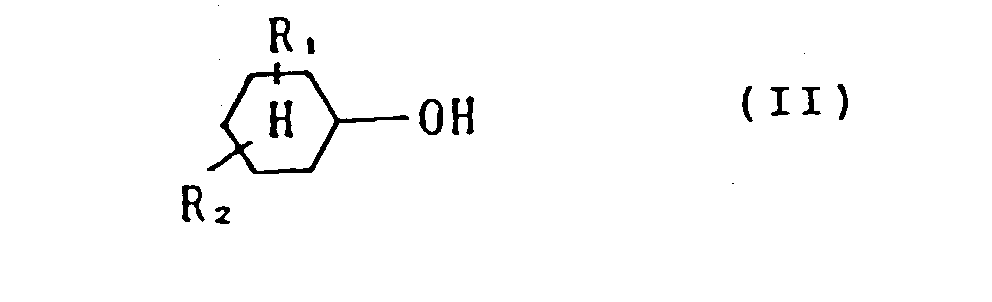
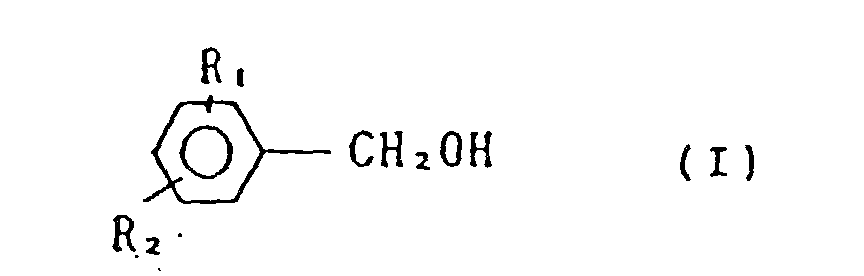
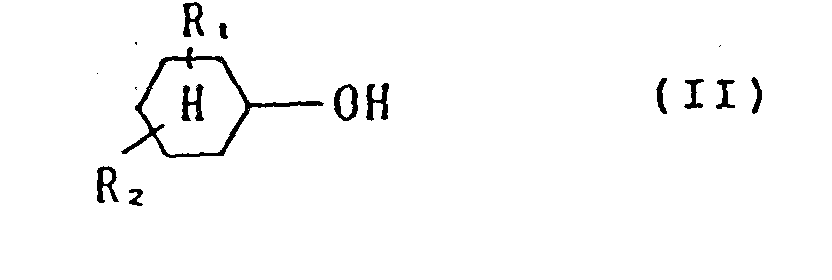
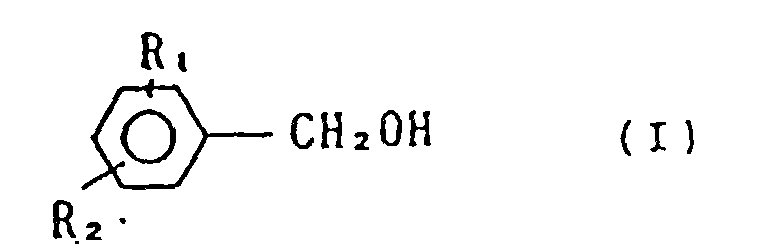
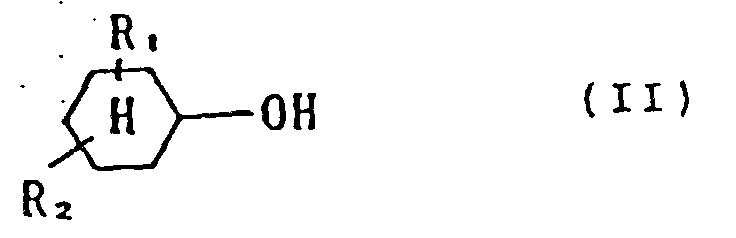
[0011] According to the present invention, there is provided an ink comprising a recording agent and a liquid medium for dissolving or dispersing the recording agent, the ink comprising a compound represented by the general formula (I) or (II):
where R1 and R2 are independently selected from the group consisting of radicals of hydrogen, alkyl or alkoxy having not more than 10 carbons, sulfonic acid and salts thereof, nitro, hydroxyl, carboxyl, and amino or derivatives thereof, and R1 and R2 are not simultaneously hydrogen radical, wherein said compound is contained in an amount in the range of from 0.01 to 30% by weight of the total weight of the ink.
[0012] According to another aspect of the present invention, there is provided an ink-jet recording method of conducting recording by ejecting ink droplets through an orifice onto a recording medium in response to a recording signal, wherein the above-mentioned ink is employed.
[0013] According to still another aspect of the present invention, there is provided a recording unit having an ink container portion for holding an ink and a head portion for ejecting the ink in droplets, wherein the above-mentioned ink is employed.
[0014] According to a further aspect of the present invention, there is provided an ink cartridge having an ink container portion for holding an ink, wherein the above-mentioned ink is employed.
[0015] According to a still further aspect of the present invention, there is provided an ink-jet recording apparatus having an ink container portion for holding an ink and a head portion for ejecting the ink in droplets, wherein the above-mentioned ink is employed.
[0016] According to a still further aspect of the present invention, there is provided an ink-jet recording apparatus having a recording head for ejecting ink in droplets, an ink cartridge having an ink container portion for holding ink, and an ink-supplying portion for supplying ink from the ink cartridge to the recording head, wherein the above-mentioned ink is employed.
[0017] Fig. 1A, and Fig. 1B are respectively a vertical cross-sectional view and a lateral cross-sectional view of a head portion of an ink-jet recording apparatus.
[0022] The inventors of the present invention made comprehensive investigation on composition of inks to prevent feathering of ink and to improve drying property and permeablility of ink on ordinary paper. Consequently, the inventors found that the ink containing the compound represented by the general formula (I) or (II) shown above is well-balanced in feathering and permeation of the ink, being not adversely affected in anti-clogging property, and being reliable without causing a problem in safety, and have accomplished the present invention.
[0023] According to the investigation of the inventors regarding to feathering and permeation of ink on ordinary paper, an ink containing a surfactant as employed in conventional inks does not give invariably stable recording depending on the kind of paper, while an ink containing the compound represented by the general formula (I) or (II) gives highly satisfactorily stable recording independently of the king of paper, if the condition for the percentage of said compound as given in claim 1 is fulfilled.
[0024] The reason is considered that the feathering and permeation of ink is are greatly affected by wetting phenomenon at the interface between an ink droplet and paper. The wetting property of the ink containing a wetting agent at the surface portion of the ink droplet differs from that in interior of the ink droplet, giving unsatisfactory results, while the ink of the present invention does not tends to cause such phenomenon, and moreover, the ink of the present invention has exquisitely well-balanced affinity with a sizing agent added to the surface or interior of paper, as an ink for ink-jet for ordinary paper.
[0026] The compounds represented by the general formula (I) or (II) shown above are derivatives respectively of benzyl alcohol or of cyclohexanol, and are obtainable by known methods.
[0027] Specific examples of R1 and R2 of the compounds represented by the general formula (I) and (II) are shown below. The present invention is not limited to these specific examples. In the following table, R1 is at the para-position and R2 is at an ortho-position relative to the hydroxyl group.
| Compound example No. | R1 | R2 |
| 1 | CH3 | H |
| 2 | C2H5 | H |
| 3 | C3H7 | H |
| 4 | C4H9 | H |
| 5 | C9H19 | H |
| 6 | OCH3 | H |
| 7 | OC2H5 | H |
| 8 | OC3H7 | H |
| 9 | CH3 | CH3 |
| 10 | CH3 | C2H5 |
| 11 | OH | H |
| 12 | NH2 | H |
| 13 | COOH | H |
| 14 | NHCOCH3 | H |
| 15 | OH | CH3 |
| 16 | NO2 | H |
| 17 | SO3Na | H |
| 18 | C2H5 | C2H5 |
[0028] The compounds represented by the above general formula (I) or (II) employed in the present invention are derived as a result of comprehensive study by selecting R1 and R2. The compounds having an alkyl or alkoxy group having 11 or more carbons as R1 or R2, for example, causes problems in feathering although it gives satisfactory permeability, and are remarkably inferior to the compounds of the general formula (I) or (II) in various properties.
[0029] The amount of addition of the compound of the general formula (I) or (II) is within the range of from 0.01% to 30% by weight, preferably from 0.1% to 10% by weight, more preferably from 0.2% to 5% by weight of the ink depending on a coloring matter used and a liquid medium component combinedly used.
[0030] The ink of the present invention is characterized by the compound represented by the general formula (I) or (II) contained therein together with a coloring matter. Additionally the ink of the present invention may contain combinedly water and ordinary organic solvent which are used in known conventional inks. The organic solvent includes alkyl alcohols having 1 to 5 carbons such as methyl alcohol, ethyl alcohol, n-propyl alcohol, isopropyl alcohol, n-butyl alcohol, sec-butyl alcohol, tert-butyl alcohol, isobutyl alcohol, n-pentanol, etc.; amides such as dimethylformamide, dimethylacetamide, etc.; ketones and ketoalcohols such as acetone, diacetone alcohol, etc.; ethers such as tetrahydrofuran, dioxane, etc.; oxyethylene or oxypropylene addition polymers such as diethylene glycol, triethylene glycol, tetraethylene glycol, dipropylene glycol, tripropylene glycol, polyethylene glycol, polypropylene glycol, etc.; alkylene glycols having an alkylene group of 2 to 6 carbons such as ethylene glycol, propylene glycol, trimethylene glycol, butylene glycol, 1,2,6-hexanetriol, hexylene glycol, etc.; thiodiglycol; glycerin; lower alkyl ethers of a polyhydric alcohol such as ethylene glycol monomethyl (or monoethyl) ether, diethylene glycol monomethyl (or monoethyl) ether, triethylene glycol monomethyl (or monoethyl) ether, etc.; lower dialkyl ethers of a polyhydric alcohol such as triethylene glycol dimethyl (or diethyl) ether, tetraethylene glycol dimethyl (or diethyl) ether, etc.; sulfolane, N-methyl-2-pyrrolidone, 1,3-dimethyl-2-imidazolidinone, and the like.
[0031] The content of the water-soluble organic solvent is generally within the range of from 2% to 50% by weight, preferably 2% to 30% by weight based on the total weight of the ink.
[0032] The above mediums may be used singly or mixedly. The preferable composition of the liquid medium is a combination of water and one or more organic solvents, the organic solvents containing at least one water-soluble high-boiling organic solvent, for example, a polyhydric alcohol such as diethylene glycol, triethylene glycol, glycerin, etc., and the like.
[0033] The recording agent constituting the ink of the present invention includes direct dyes, acid dyes, food dyes, basic dyes, reactive dyes, disperse dyes, vat dyes, soluble vat dyes, reactive disperse dyes, oily dyes, and various pigments. Among them, water-soluble dyes are particularly preferable in view of properties of the ink.
[0034] The content of the coloring matter is determined depending on the kind of liquid medium constituent, performances required to the ink, and so forth. Generally the content is in the range of from about 0.2% to 20% by weight, preferably from 0.5% to 10% by weight, more preferably from 1% to 5% by weight of the entire ink.
[0035] The main constituents of the ink of the present invention are as described above.
Supplementarily, a dispersant, a surfactant, a viscosity-adjusting agent, a surface tension-adjusting agent, a fluorescent whitener, or the like may be added as an auxiliary additive to the ink, if necessary, within the range of not adversely affecting the object of the present invention.
[0036] The examples of the auxiliary additives are viscosity-adjusting agent such as polyvinyl alcohol, cellulose derivatives, water-soluble resins, etc.; various surfactants of cationic, anionic, and nonionic type; surface tension-adjusting agents such as diethanolamine, triethanolamine, etc.: pH-adjusting agents of buffer solution; mildewproofing agents, and the like.
[0037] Further, in preparation of an ink for ink-jet recording of an ink-electrification type, there is added a resistivity-adjusting agent such as inorganic salts including lithium chloride, ammonium chloride, sodium chloride, etc.
[0038] The ink of the present invention is particularly suitable for ink-jet recording of the type of ejecting ink by bubbling of ink caused by thermal energy, in which the ink is ejected extremely stably without forming satellite dots. For this use, the thermal properties (such as specific heat, thermal expansion coefficient, thermal conductivity, etc.) may be adjusted.
[0039] Further, the ink of the present invention is adjusted desirably to have, as properties of ink itself, a surface tension in the range of from 30 to 68 mN/m (dyne/cm) at 25°C, and viscosity of not higher than 15 mPa·s (cP) preferably not higher than 10 mPa·s (cP), more preferably not higher than 5 mPa·s (cP) so as to solve the problems of feathering, delayed drying, and insufficient permeation in recording on ordinary paper, as well as to improve matching of the ink with the ink-jet head.
[0040] In order to control the property of the ink as above to solve problems encountered on ordinary paper, the ink of the present invention contains water preferably in an amount of from 50% to 98% by weight, more preferably from 60% to 95% by weight, still more preferably from 75% to 95% by weight.
[0041] The ink of the present invention, which is employed particularly suitably for an ink-jet recording method for recording by ejecting ink droplets by thermal energy, is naturally useful also for general writing utensils.
[0042] The methods and the apparatuses suitable for the use of the ink of the present invention are those which gives thermal energy to ink in a cell in a recording head in correspondence with recording signals to form liquid droplets by the thermal energy.
[0043] An example of the constitution of the heads, which is a main portion of the apparatus, is shown in Fig. 1A, Fig. 1B, and Fig. 2.
[0044] A head 13 is formed by bonding a plate of glass, ceramics, or plastics having a groove 14 for ink passage with a heat-generating head 15. The type of the head is not limited to the one shown in the figure. The heat-generating head 15 is constituted of a protection layer 16 formed of silicon oxide or the like, aluminum electrodes 17-1 and 17-2, a heat-generating resistance layer 18 formed of nichrome or the like, a heat accumulation layer 19, and a substrate plate 20 having good heat-releasing property made of alumina or the like.
[0045] Ink 21 reaches to the ejection orifice 22 (a fine pore), forming a meniscus 23 by action of pressure P not shown in the figure.
[0046] On application of an electric signal to the electrodes 17-1 and 17-2, the region designated by a symbol "n" on the heat-generation head 15 abruptly generates heat to form a bubble in the ink 21 at the position adjacent thereto. The pressure generated by the bubble pushes out the meniscus 23 and ejects the ink 21, as recording droplets 24, and the ink droplets are propelled to a recording medium 25. Fig. 2 illustrates a multi-head constructed by juxtaposing a multitude of heads shown in Fig. 1A. The multi-head is prepared by bonding a glass plate 27 having a multitude of grooves 26 with a heat-generation head 28 similar to the one described in Fig. 1A.
[0047] Incidentally, Fig. 1A is a cross-sectional view of the head 13 along an ink flow path, and Fig. 1B is a cross-sectional view of the head at the line A-B in Fig. 1A.
[0048] Fig. 3 illustrates an example of the ink-jet recording apparatus incorporating such a head mounted therein.
[0049] In Fig. 3, a blade 61 as a wiping member is held at its one end by a blade-holding member, forming a fixed end in a shape of a cantilever. The blade 61 is placed at a position adjacent to the recording region of the recording head, and in this example, is held so as to protrude into the moving path of the recording head. A cap 62 is placed at a home position adjacent to the blade 61, and is constituted such that it moves in the direction perpendicular to the moving direction of the recording head to come into contact with the ejection nozzle face to cap the nozzles. An ink absorption member 63 is provided at a position adjacent to the blade 61, and is held so as to protrude into the moving path of the recording head in a manner similar to that of the blade 61. The aforementioned blade 61, the cap 62, the ink absorption member 63 constitute an ejection-recovery portion 64, the blade 61 and the ink absorption member 63 remove off water, dust, and the like from the ink ejecting nozzle face.
[0050] A recording head 65 has an ejection energy generation means for ejection, and conducts recording by ejecting ink toward a recording medium opposing to the ejection nozzle face having ejection outlets arranged thereon. A carriage 66 is provided for supporting and moving the recording head 65. The carriage 66 is engaged slidably with a guide rod 67. A portion of the carriage 66 is connected (not shown in the figure) to a belt 69 driven by a motor 68, so that the carriage 66 is movable along the guide rod 67 to the recording region of the recording head 65 and the adjacent region thereto.
[0051] The constitution of a paper delivery portion 51 for delivery of a recording medium and a paper delivery roller 52 driven by a motor not shown in the figure delivers the recording medium to the position opposing to the ejecting nozzle face of the recording head, and the recording medium is discharged with the progress of the recording to paper discharge portion provided with paper-discharge rollers 53.
[0052] In the above constitution, the cap 62 of the ejection-recovery portion 64 is out of the moving path of the recording head 65 when the head returns to the home position upon termination of recording, etc, while the blade 61 is made to protrude into the moving path. Therefore, the the ejecting nozzle face of the recording head 65 is wiped therewith. The cap 62 moves to protrude toward the moving path of the recording head when the cap 62 comes into contact for capping with the ejecting nozzle face of the recording head.
[0053] At the time when the recording head 65 moves from the home position to the record-starting position, the cap 62 and the blade 61 are at the same position as in the above-mentioned wiping time, so that the ejection nozzle face of the recording head is wiped also in this movement.
[0054] The recording head moves to the home position not only at the end of the recording and at the time of ejection recovery, but also at a predetermined interval during movement for recording in the recording region. By such movement, the wiping is conducted.
[0055] Fig. 4 illustrates an example of the ink cartridge containing ink to be supplied through an ink supplying member such as a tube. The ink container portion 40, for example an ink bag, contains an ink to be supplied, and has a rubber plug 42 at the tip. By inserting a needle (not shown in the figure) into the plug 42, the ink in the ink container portion 40 is made accessed. An absorption member 44 absorbs waste ink.
[0056] The ink container portion has preferably a liquid-contacting face made of polyolefin, especially polyethylene in the present invention.
[0057] The ink-jet recording apparatus used in the present invention is not limited to the above-mentioned one which has separately a head and an ink cartridge. Integration thereof into one body as shown in Fig. 5 may suitably be used.
[0058] In Fig. 5, a recording unit 70 houses an ink container portion such as an ink absorption member, and the ink in the ink absorption member is ejected from a head 71 having a plurality of orifices. The material for the ink absorption member is preferably polyurethane in the present invention.
[0059] Air-communication opening 72 is provided to communicate interior of the cartridge with the open air.
[0060] The recording unit 70 may be used in place of the recording head shown in Fig. 3, and is readily mountable to and demountable from the carriage 66.
[0061] The present invention is described in more detail referring to examples and comparative examples. The units "part" and "%" in the description are based on weight unless otherwise mentioned.
Examples 1 - 5
[0062] The components below were mixed and stirred for 5 hours. The pH of the mixture was adjusted to 7.5 by adding aqueous 0.1% sodium hydroxide solution, and filtered under pressure through a membrane filter having a pore size of 0.22 µm, thereby the inks A to E of the present invention being prepared.
[0063] The resulting inks A to E were used for recording on a commercial copying paper and bond paper by means of an ink-jet printer BJ-130 (trade name, made by Canon K.K.) which employs heat generating elements as an ink-ejecting energy source. The level of the fixation and occurrence ratio of feathering (feathering ratio) of the recorded matters, occurrence of clogging at restart of printing after intermission of printing, and frequency responsiveness were evaluated. The results are shown in Table 1.
Ink A
| C.I. Direct Yellow 86 | 2 parts |
| Diethylene glycol | 15 parts |
| Compound example 1 of general formula (I) | 1.2 parts |
| Water | 81.8 parts |
Ink B
| C.I. Acid Red 35 | 2 parts |
| Glycerin | 10 parts |
| Compound example 6 of general formula (I) | 1.8 parts |
| Ethylene glycol | 5.5 parts |
| Water | 80.7 parts |
Ink C
| C.I. Food Black 2 | 3 parts |
| Triethylene glycol | 10 parts |
| N-methyl-2-pyrrolidone | 2 parts |
| Compound example 2 of general formula (I) | 1.2 parts |
| Water | 83.8 parts |
Ink D
| C.I. Direct Blue 199 | 2.5 parts |
| Polyethylene glycol (molecular weight 300) | 5 parts |
| Diethylene glycol | 10 parts |
| Triethyelne glycol monomethyl ether | 2 parts |
| Triethanolamine | 0.5 part |
| Compound example 14 of general formula (I) | 3.5 parts |
| Water | 76.5 parts |
Ink E
| C.I. Direct Black 154 | 2 parts |
| Thiodiglycol | 6 parts |
| Diethylene glycol | 9 parts |
| Compound example 9 of general formula (I) | 1.2 parts |
| Water | 81.8 parts |
Comparative examples 1 - 4
[0064] The inks F to I of Comparative examples 1 to 4 were prepared from the components below, and evaluated in the same manner as in Examples 1 to 5. The results are show in Table 1.
Ink F
| C.I. Direct Yellow 86 | 2 parts |
| Diethylene glycol | 15 parts |
| Water | 83 parts |
Ink G
| C.I. Food Black 2 | 3 parts |
| Diethylene glycol | 10 parts |
| Triethylene glycol | 10 parts |
| Nonionic surfactant (trade name: Nissan Nonion P223, made by Nippon Oil and Fats Co, Ltd.) | 0.5 parts |
| Water | 76.5 parts |
Ink H
| C.I. Acid Red 35 | 2 parts |
| Glycerin | 10 parts |
| Compound of general formula (I) (R1=C11H23, R2=H) | 1.8 parts |
| Ethylene glycol | 5.5 parts |
| Water | 80.7 parts |
Ink I
| C.I. Food Black 2 | 3 parts |
| Triethylene glycol | 10 parts |
| N-methyl-2-pyrrolidone | 2 parts |
| Ethanol | 1 part |
| Water | 84 parts |
Table 1
| Example No. | 1 | 2 | 3 | 4 | 5 |
| Ink | A | B | C | D | E |
| Fixation*1 | |||||
| Copying paper | ⓞ | ⓞ | ⓞ | ○ | ○ |
| Bond paper | ⓞ | ⓞ | ⓞ | ⓞ | ⓞ |
| Feathering ratio*2 | |||||
| Copying paper | ○ | ○ | ○ | ○ | ○ |
| Bond paper | ○ | ○ | ○ | ○ | ○ |
| Clogging*3 | ○ | ○ | ○ | ○ | ○ |
| Frequency responsiveness*4 | ⓞ | ⓞ | ⓞ | ⓞ | ⓞ |
| Comparative example No. | 1 | 2 | 3 | 4 | |
| Ink | F | G | H | I | |
| Fixation*1 | |||||
| Copying paper | × | ⓞ | ⓞ | △ | |
| Bond paper | △ | ⓞ | ⓞ | ○ | |
| Feathering ratio*2 | |||||
| Copying paper | ○ | × | × | ○ | |
| Bond paper | ○ | × | × | ○ | |
| Clogging*3 | △ | × | △ | × | |
| Frequency responsiveness*4 | × | × | △ | △ |
| *1 Evaluation of fixation: Ten seconds, and 30 seconds after the printing on commercial copying paper and bond paper, the printed portion was rubbed with filter paper (No. 5C: trade name, made by Toyo Roshi K.K.). The fixation was graded as below. The evaluation was conducted at 25°C and 60 %RH. ⓞ : Not blurred after 10 seconds, ○ : Slightly blurred after 10 seconds, △ : Slightly blurred after 30 seconds, × : Remarkably blurred after 30 seconds. |
|||||
| *2 Feathering ratio: 300 dots were printed discontinuously by a printer on commercial copying paper and bond paper. After one hour or more, the printed dots were examined with a microscope to count the number of dot which exhibited feathering. The ratio of occurrence of feathering was graded as below according to the percentage of the feathering dots relative to the total dots in number. The printing was conducted at the environmental condition of 25°C and 60 %RH. ○ : 10 % or less, △ : 11 to 30 %, × : 31 % or more. |
|||||
| *3 Clogging: "Clogging" means a clogging tendency at restart of printing after intermission of printing. The ink to be tested was filled to the printer, and printing of alphabets and numerals was conducted continuously for 10 minutes. After the printer was left standing for ten minutes without capping the nozzles, the same printing was restarted. The clogging was graded according to the presence or absence of blurring and defects of the printed letters at the restart of the printing. The evaluation was conducted at 25°C and 60 %RH. ○ : The first letter being not defective, △ : The first letter being partially blurred or defective, × : The first letter not being printed out. |
|||||
| *4 Frequency responsiveness: The printed state of the printed matter, namely blurring, white blank, splashing, distortion, or the like of the letters resulting from the failure of the ink-shooting was observed visually, and was graded as below. ⓞ : The response of ink to frequency being satisfactory. No blurring, white blank, nor incorrect shooting being observed in both solid printing and character printing. ○ : The response of ink to frequency being almost satisfactory. No blurring, white blank, nor incorrect shooting being observed in character printing, but slight blurring being observed in solid printing. △ : No blurring nor white blank being observed and partial incorrect ink-shooting being observed in character printing. Blurring and white blank being observed in one-third of the whole solid printing area. × : Blurring and white blank being significant in solid printing, and blurring and incorrect ink-shooting being remarkable. |
Examples 6 - 10, and Comparative example 5
[0065] The inks J to N of the present invention and the ink 0 of Comparative example were prepared from the components below in the same manner as in Example 1. The inks were evaluated in the same manner as in Example 1. The results are shown in Table 2.
Ink J
| C.I. Direct Yellow 86 | 2 parts |
| Diethylene glycol | 15 parts |
| Compound example 1 of general formula (II) | 1 part |
| Water | 86 parts |
Ink K
Ink L
| C.I. Food Black 2 | 3 parts |
| Triethylene glycol | 10 parts |
| N-methyl-2-pyrrolidone | 2 parts |
| Compound example 2 of general formula (II) | 1 parts |
| Water | 84 parts |
Ink M
| C.I. Direct Blue 199 | 2.5 parts |
| Polyethylene glycol (molecular weight 300) | 5 parts |
| Diethylene glycol | 10 parts |
| Triethyelne glycol monomethyl ether | 2 parts |
| Triethanolamine | 0.5 part |
| Compound example 16 of general formula (II) | 3 parts |
| Water | 77 parts |
Ink N
| C.I. Direct Black 154 | 2 parts |
| Thiodiglycol | 6 parts |
| Diethylene glycol | 9 parts |
| Compound example 9 of general formula (II) | 1 parts |
| Water | 82 parts |
Ink O (Comparative example 5)
Table 2
| Example | Comparative example | |||||
| 6 | 7 | 8 | 9 | 10 | 5 | |
| Ink | J | K | L | M | N | O |
| Fixation*1 | ||||||
| Copying paper | ⓞ | ⓞ | ⓞ | ○ | ⓞ | ⓞ |
| Bond paper | ⓞ | ⓞ | ⓞ | ⓞ | ⓞ | ⓞ |
| Feathering ratio*2 | ||||||
| Copying paper | ○ | ○ | ○ | ○ | ○ | × |
| Bond paper | ○ | ○ | ○ | ○ | ○ | × |
| Clogging*3 | ○ | ○ | ○ | ○ | ○ | △ |
| Frequency responsiveness*4 | ⓞ | ⓞ | ⓞ | ⓞ | ⓞ | △ |
[0066] As described above, the ink of the present invention enables recording in high quality without blurring with satisfactory fixation on ordinary paper such as copying paper, reporting paper, notebook paper letter paper, bond paper, continuous business form paper, etc. generally used in offices and elsewhere.
[0067] Further, the present invention gives an ink which is highly safe in use in offices and homes.
Claims for the following Contracting State(s): AT, BE,CH, LI, DE, DK, FR, GB, GR,
IT, LU, NL, SE
1. An ink comprising a recording agent and a liquid medium for dissolving or dispersing
the recording agent, the ink comprising a compound represented by the general formula
(I) or (II):
where R1 and R2 are independently selected from the group consisting of radicals of hydrogen, alkyl or alkoxy having not more than 10 carbons, sulfonic acid or salts thereof, nitro, hydroxyl, carboxyl, and amino or derivatives thereof, and R1 and R2 are not simultaneously hydrogen radical, wherein said compound is contained in an amount in the range of from 0,01 % to 30 % by weight of the total weight of the ink.
where R1 and R2 are independently selected from the group consisting of radicals of hydrogen, alkyl or alkoxy having not more than 10 carbons, sulfonic acid or salts thereof, nitro, hydroxyl, carboxyl, and amino or derivatives thereof, and R1 and R2 are not simultaneously hydrogen radical, wherein said compound is contained in an amount in the range of from 0,01 % to 30 % by weight of the total weight of the ink.
2. The ink of claim 1, wherein the ink contains water and a water-soluble organic solvent
as the liquid medium.
3. The ink of claim 2, wherein the content of water is in the range of from 50 % to 98
% by weight of the total weight of the ink.
4. The ink of claim 2, wherein the content of said water-soluble organic solvent is in
the range of from 2 % to 50 % by weight of the total weight of the ink.
5. An ink-jet recording method of conducting recording by ejecting droplets of the ink
according to any of claims 1 to 4, through an orifice onto a recording medium in response
to a recording signal.
6. The ink-jet recording method of claim 5, wherein said recording medium is non-coated
paper.
7. The ink-jet recording method of claim 5, wherein thermal energy is exerted to the
ink to eject the droplets of the ink.
8. A recording unit having an ink container portion for holding the ink according to
any of claims 1 to 4 and a head portion for ejecting the ink in droplets.
9. The recording unit of claim 8, wherein said ink container portion is formed from polyurethane.
10. The recording unit of claim 8, wherein said head portion comprises a head which ejects
droplets of ink by exerting thermal energy to the ink.
11. An ink cartridge having an ink container portion for holding the ink according to
any of claims 1 to 4.
12. The ink cartridge of claim 11, wherein said ink container portion comprises a liquid-contacting
face formed of polyolefin.
13. An ink-jet recording apparatus having an ink container portion for holding the ink
according to any of claims 1 to 4 and a head portion for ejecting the ink in droplets.
14. The ink-jet recording apparatus of claim 13, wherein said ink container portion is
formed of polyurethane.
15. The ink-jet recording apparatus of claim 13, wherein said head portion comprises a
head which ejects droplets of ink by exerting thermal energy to the ink.
16. An ink-jet recording apparatus having a recording head for ejecting ink in droplets,
an ink cartridge having an ink container portion for holding ink, and an ink-supplying
portion for supplying ink from the ink cartridge to the recording head, wherein the
ink is defined by the features according to any of claims 1 to 4.
17. The ink-jet recording apparatus of claim 16, wherein said ink container portion has
a liquid-contacting face formed of polyolefin.
18. The ink-jet recording apparatus of claim 16, wherein said recording head comprises
a head which ejects droplets of ink by exerting thermal energy to the ink.
19. Use of the ink according to any of claims 1 to 4, for ink-jet recording.
20. Use of the recording unit according to any of claims 8 to 10 for an ink-jet recording
apparatus.
21. Use of the ink cartridge according to any of claims 11 and 12 for an ink-jet recording
apparatus.
Claims for the following Contracting State(s): ES
1. Use of a composition as an ink comprising a recording agent and a liquid medium for
dissolving or dispersing the recording agent, the ink comprising a compound represented
by the general formula (I) or (II):
where R1 and R2 are independently selected from the group consisting of radicals of hydrogen, alkyl or alkoxy having not more than 10 carbons, sulfonic acid or salts thereof, nitro, hydroxyl, carboxyl, and amino or derivatives thereof, and R1 and R2 are not simultaneously hydrogen radical, wherein said compound is contained in an amount in the range of from 0,01 % to 30 % by weight of the total weight of the ink.
where R1 and R2 are independently selected from the group consisting of radicals of hydrogen, alkyl or alkoxy having not more than 10 carbons, sulfonic acid or salts thereof, nitro, hydroxyl, carboxyl, and amino or derivatives thereof, and R1 and R2 are not simultaneously hydrogen radical, wherein said compound is contained in an amount in the range of from 0,01 % to 30 % by weight of the total weight of the ink.
2. Use according to claim 1, wherein the ink contains water and a water-soluble organic
solvent as the liquid medium.
3. Use according to claim 2, wherein the content of water is in the range of from 50
% to 98 % by weight of the total weight of the ink.
4. Use according to claim 2, wherein the content of said water-soluble organic solvent
is in the range of from 2 % to 50 % by weight of the total weight of the ink.
5. An ink-jet recording method of conducting recording by ejecting droplets of the ink
according to any of claims 1 to 4, through an orifice onto a recording medium in response
to a recording signal.
6. The ink-jet recording method of claim 5, wherein said recording medium is non-coated
paper.
7. The ink-jet recording method of claim 5, wherein thermal energy is exerted to the
ink to eject the droplets of the ink.
8. A recording unit having an ink container portion for holding the ink according to
any of claims 1 to 4 and a head portion for ejecting the ink in droplets.
9. The recording unit of claim 8, wherein said ink container portion is formed from polyurethane.
10. The recording unit of claim 8, wherein said head portion comprises a head which ejects
droplets of ink by exerting thermal energy to the ink.
11. An ink cartridge having an ink container portion for holding the ink according to
any of claims 1 to 4.
12. The ink cartridge of claim 11, wherein said ink container portion comprises a liquid-contacting
face formed of polyolefin.
13. An ink-jet recording apparatus having an ink container portion for holding the ink
according to any of claims 1 to 4 and a head portion for ejecting the ink in droplets.
14. The ink-jet recording apparatus of claim 13, wherein said ink container portion is
formed of polyurethane.
15. The ink-jet recording apparatus of claim 13, wherein said head portion comprises a
head which ejects droplets of ink by exerting thermal energy to the ink.
16. An ink-jet recording apparatus having a recording head for ejecting ink in droplets,
an ink cartridge having an ink container portion for holding ink, and an ink-supplying
portion for supplying ink from the ink cartridge to the recording head, wherein the
ink is defined by the features according to any of claims 1 to 4.
17. The ink-jet recording apparatus of claim 16, wherein said ink container portion has
a liquid-contacting face formed of polyolefin.
18. The ink-jet recording apparatus of claim 16, wherein said recording head comprises
a head which ejects droplets of ink by exerting thermal energy to the ink.
19. Use of the ink according to any of claims 1 to 4, for ink-jet recording.
20. Use of the recording unit according to any of claims 8 to 10 for an ink-jet recording
apparatus.
21. Use of the ink cartridge according to any of claims 11 and 12 for an ink-jet recording
apparatus.
Patentansprüche für folgende(n) Vertragsstaat(en): AT, BE, CH, DE, DK, FR, GB, GR,
IT, LI, LU, NL, SE
1. Tinte, umfassend ein Aufzeichnungsagens und ein flüssiges Medium zum Lösen oder Dispergieren
des Aufzeichnungsagens, wobei die Tinte eine Verbindung umfaßt, die durch die nachfolgende
allgemeine Formel (I) oder (II) wiedergegeben ist:
wobei R1 und R2 unabhängig voneinander aus der Gruppe ausgewählt sind, die aus Wasserstoff-, Alkyl- oder Alkoxy-Radikalen mit nicht mehr als 10 Kohlenstoffatomen, Sulfonsäuren oder deren Salzen, Nitro-, Hydroxy-, Carboxy- sowie Aminoverbindungen oder deren Derivaten besteht, und R1 und R2 nicht gleichzeitig ein Wasserstoffradikal sind, wobei die Verbindung in einer Menge im Bereich von 0,01 Gew.-% bis 30 Gew.-%, bezogen auf das Gesamtgewicht der Tinte, enthalten ist.
wobei R1 und R2 unabhängig voneinander aus der Gruppe ausgewählt sind, die aus Wasserstoff-, Alkyl- oder Alkoxy-Radikalen mit nicht mehr als 10 Kohlenstoffatomen, Sulfonsäuren oder deren Salzen, Nitro-, Hydroxy-, Carboxy- sowie Aminoverbindungen oder deren Derivaten besteht, und R1 und R2 nicht gleichzeitig ein Wasserstoffradikal sind, wobei die Verbindung in einer Menge im Bereich von 0,01 Gew.-% bis 30 Gew.-%, bezogen auf das Gesamtgewicht der Tinte, enthalten ist.
2. Tinte nach Anspruch 1, wobei die Tinte Wasser und ein wasserlösliches organisches
Lösungsmittel als Flüssigmedium enthält.
3. Tinte nach Anspruch 2, wobei der Wassergehalt im Bereich von 50 bis 98 Gew.-% bezogen
auf das Gesamtgewicht der Tinte liegt.
4. Tinte nach Anspruch 2, wobei der Gehalt an wasserlöslichem organischen Lösungsmittel
im Bereich von 2 bis 50 Gew.-%, bezogen auf das Gesamtgewicht der Tinte, liegt.
5. Tintenstrahl-Aufzeichnungsverfahren zum Durchführen von Aufzeichnung mittels des Ausspritzens
von Tröpfchen einer Tinte gemäß einem der Ansprüche 1 bis 4, wobei das Ausspritzen
mittels einer Düse auf ein Aufzeichnungsmedium in Reaktion auf ein Aufzeichnungssignal
erfolgt.
6. Tintenstrahl-Aufzeichnungsverfahren nach Anspruch 5, wobei das Aufzeichnungsmedium
ein unbeschichtetes Papier ist.
7. Tintenstrahl-Aufzeichnungsverfahren nach Anspruch 5, wobei die Wärmeenergie auf die
Tinte übertragen wird, so daß die Tröpfchen herausgespritzt werden.
8. Aufzeichnungseinheit mit einem Tintenbehälterbereich zum Aufbewahren der Tinte gemäß
einem der Ansprüche 1 bis 4 sowie einem Kopfbereich zum Ausspritzen der Tinte in Tröpfchen.
9. Aufzeichnungseinheit nach Anspruch 8, wobei der Tintenbehälterbereich aus Polyurethan
gebildet ist.
10. Aufzeichnungseinheit nach Anspruch 8, wobei der Kopfbereich einen Kopf umfaßt, der
die Tintentröpfchen mittels Übertragung von Wärmeenergie auf die Tinte verspritzt.
11. Tintenpatrone mit einem Tintenbehälterbereich zum Aufbewahren der Tinte gemäß einem
der Ansprüche 1 bis 4.
12. Tintenpatrone nach Anspruch 11, wobei der Tintenbehälterbereich eine mit der Flüssigkeit
in Kontakt tretende Seite umfaßt, die aus Polyolefin gebildet ist.
13. Tintenstrahl-Aufzeichnungsvorrichtung mit einem Tintenbehälterbereich zum Aufbewahren
der Tinte gemäß einem der Ansprüche 1 bis 4 und einem Kopfbereich zum Verspritzen
der Tinte in Tröpfchen.
14. Tintenstrahl-Aufzeichnungsvorrichtung nach Anspruch 13, wobei der Tintenbehälterbereich
aus Polyurethan gebildet ist.
15. Tintenstrahl-Aufzeichnungsvorrichtung nach Anspruch 13, wobei der Kopfbereich einen
Kopf umfaßt, der Tintentröpfchen mittels Übertragung von Wärmeenergie auf die Tinte
verspritzt.
16. Tintenstrahl-Aufzeichnungsvorrichtung mit einem Aufzeichnungskopf zum Verspritzen
von Tintentröpfchen, einer Tintenpatrone mit einem Tintenbehälterbereich zum Aufbewahren
der Tinte sowie einem Tintenzuführbereich zum Zuführen der Tinte von der Tintenpatrone
zu dem Aufzeichnungskopf, wobei die Tinte durch die Merkmale gemäß einem der Ansprüche
1 bis 4 definiert ist.
17. Tintenstrahl-Aufzeichnungsvorrichtung nach Anspruch 16, wobei der Tintenbehälterbereich
eine mit der Flüssigkeit in Kontakt tretende Seite aufweist, die aus Polyolefin gebildet
ist.
18. Tintenstrahl-Aufzeichnungsvorrichtung nach Anspruch 16, wobei der Aufzeichnungskopf
einen Kopf umfaßt, der Tintentröpfchen durch Übertragung von Wärmeenergie auf die
Tinte verspritzt.
19. Verwendung der Tinte nach einem der Ansprüche 1 bis 4 zum Tintenstrahlaufzeichnen.
20. Verwendung der Aufzeichnungseinheit gemäß einem der Ansprüche 8 bis 10 in einer Tintenstrahl-Aufzeichnungsvorrichtung.
21. Verwendung der Tintenpatrone gemäß einem der Ansprüche 11 bis 12 in einer Tintenstrahl-Aufzeichnungsvorrichtung.
Patentansprüche für folgende(n) Vertragsstaat(en): ES
1. Verwendung einer Zusammensetzung als Tinte, umfassend ein Aufzeichnungsagens und ein
flüssiges Medium zum Lösen oder Dispergieren des Aufzeichnungsagens, wobei die Tinte
eine Verbindung umfaßt, die durch die nachfolgende allgemeine Formel (I) oder (II)
wiedergegeben ist:
wobei R1 und R2 unabhängig voneinander aus der Gruppe ausgewählt sind, die aus Wasserstoff-, Alkyl- oder Alkoxy-Radikalen mit nicht mehr als 10 Kohlenstoffatomen, Sulfonsäuren oder deren Salzen, Nitro-, Hydroxy-, Carboxy- sowie Aminoverbindungen oder deren Derivaten besteht, und R1 und R2 nicht gleichzeitig ein Wasserstoffradikal sind, wobei die Verbindung in einer Menge im Bereich von 0,01 Gew.-% bis 30 Gew.-%, bezogen auf das Gesamtgewicht der Tinte, enthalten ist.
wobei R1 und R2 unabhängig voneinander aus der Gruppe ausgewählt sind, die aus Wasserstoff-, Alkyl- oder Alkoxy-Radikalen mit nicht mehr als 10 Kohlenstoffatomen, Sulfonsäuren oder deren Salzen, Nitro-, Hydroxy-, Carboxy- sowie Aminoverbindungen oder deren Derivaten besteht, und R1 und R2 nicht gleichzeitig ein Wasserstoffradikal sind, wobei die Verbindung in einer Menge im Bereich von 0,01 Gew.-% bis 30 Gew.-%, bezogen auf das Gesamtgewicht der Tinte, enthalten ist.
2. Verwendung nach Anspruch 1, wobei die Tinte Wasser und ein wasserlösliches organisches
Lösungsmittel als Flüssigmedium enthält.
3. Verwendung nach Anspruch 2, wobei der Wassergehalt im Bereich von 50 bis 98 Gew.-%
bezogen auf das Gesamtgewicht der Tinte liegt.
4. Verwendung nach Anspruch 2, wobei der Gehalt an wasserlöslichem organischen Lösungsmittel
im Bereich von 2 bis 50 Gew.-%, bezogen auf das Gesamtgewicht der Tinte, liegt.
5. Tintenstrahl-Aufzeichnungsverfahren zum Durchführen von Aufzeichnung mittels des Ausspritzens
von Tröpfchen einer Tinte gemäß einem der Ansprüche 1 bis 4, wobei das Ausspritzen
mittels einer Düse auf ein Aufzeichnungsmedium in Reaktion auf ein Aufzeichnungssignal
erfolgt.
6. Tintenstrahl-Aufzeichnungsverfahren nach Anspruch 5, wobei das Aufzeichnungsmedium
ein unbeschichtetes Papier ist.
7. Tintenstrahl-Aufzeichnungsverfahren nach Anspruch 5, wobei die Wärmeenergie auf die
Tinte übertragen wird, so daß die Tröpfchen herausgespritzt werden.
8. Aufzeichnungseinheit mit einem Tintenbehälterbereich zum Aufbewahren der Tinte gemäß
einem der Ansprüche 1 bis 4 sowie einem Kopfbereich zum Ausspritzen der Tinte in Tröpfchen.
9. Aufzeichnungseinheit nach Anspruch 8, wobei der Tintenbehälterbereich aus Polyurethan
gebildet ist.
10. Aufzeichnungseinheit nach Anspruch 8, wobei der Kopfbereich einen Kopf umfaßt, der
die Tintentröpfchen mittels Übertragung von Wärmeenergie auf die Tinte verspritzt.
11. Tintenpatrone mit einem Tintenbehälterbereich zum Aufbewahren der Tinte gemäß einem
der Ansprüche 1 bis 4.
12. Tintenpatrone nach Anspruch 11, wobei der Tintenbehälterbereich eine mit der Flüssigkeit
in Kontakt tretende Seite umfaßt, die aus Polyolefin gebildet ist.
13. Tintenstrahl-Aufzeichnungsvorrichtung mit einem Tintenbehälterbereich zum Aufbewahren
der Tinte gemäß einem der Ansprüche 1 bis 4 und einem Kopfbereich zum Verspritzen
der Tinte in Tröpfchen.
14. Tintenstrahl-Aufzeichnungsvorrichtung nach Anspruch 13, wobei der Tintenbehälterbereich
aus Polyurethan gebildet ist.
15. Tintenstrahl-Aufzeichnungsvorrichtung nach Anspruch 13, wobei der Kopfbereich einen
Kopf umfaßt, der Tintentröpfchen mittels Übertragung von Wärmeenergie auf die Tinte
verspritzt.
16. Tintenstrahl-Aufzeichnungsvorrichtung mit einem Aufzeichnungskopf zum Verspritzen
von Tintentröpfchen, einer Tintenpatrone mit einem Tintenbehälterbereich zum Aufbewahren
der Tinte sowie einem Tintenzuführbereich zum Zuführen der Tinte von der Tintenpatrone
zu dem Aufzeichnungskopf, wobei die Tinte durch die Merkmale gemäß einem der Ansprüche
1 bis 4 definiert ist.
17. Tintenstrahl-Aufzeichnungsvorrichtung nach Anspruch 16, wobei der Tintenbehälterbereich
eine mit der Flüssigkeit in Kontakt tretende Seite aufweist, die aus Polyolefin gebildet
ist.
18. Tintenstrahl-Aufzeichnungsvorrichtung nach Anspruch 16, wobei der Aufzeichnungskopf
einen Kopf umfaßt, der Tintentröpfchen durch Übertragung von Wärmeenergie auf die
Tinte verspritzt.
19. Verwendung der Verwendung nach einem der Ansprüche 1 bis 4 zum Tintenstrahlaufzeichnen.
20. Verwendung der Aufzeichnungseinheit gemäß einem der Ansprüche 8 bis 10 in einer Tintenstrahl-Aufzeichnungsvorrichtung.
21. Verwendung der Tintenpatrone gemäß einem der Ansprüche 11 bis 12 in einer Tintenstrahl-Aufzeichnungsvorrichtung.
Revendications pour l'(les) Etat(s) contractant(s) suivant(s): AT, BE, CH, DE DK,
FR, GB, GR, IT, LI, LU, NL, SE
1. Encre comprenant un agent d'enregistrement et un milieu liquide pour dissoudre ou
disperser l'agent d'enregistrement, cette encre comprenant un composé représenté par
la formule générale (I) ou (II) suivante :
dans laquelle R1 et R2 sont choisis, indépendamment, dans le groupe consistant en radicaux hydrogène, alkyle ou alkoxy n'ayant pas plus de 10 atomes de carbone, acide sulfonique ou ses sels, nitro, hydroxyle, carboxyle et amino ou ses dérivés, et R1 et R2 ne représentent pas simultanément un radical hydrogène, ce composé étant contenu dans l'encre en une quantité comprise dans la plage de 0,01 % à 30 % en poids par rapport au poids total de l'encre.
dans laquelle R1 et R2 sont choisis, indépendamment, dans le groupe consistant en radicaux hydrogène, alkyle ou alkoxy n'ayant pas plus de 10 atomes de carbone, acide sulfonique ou ses sels, nitro, hydroxyle, carboxyle et amino ou ses dérivés, et R1 et R2 ne représentent pas simultanément un radical hydrogène, ce composé étant contenu dans l'encre en une quantité comprise dans la plage de 0,01 % à 30 % en poids par rapport au poids total de l'encre.
2. Encre suivant la revendication 1, qui contient comme milieu liquide de l'eau et un
solvant organique soluble dans l'eau.
3. Encre suivant la revendication 2, dans laquelle la teneur en eau se situe dans la
plage de 50 % à 98 % en poids par rapport au poids total de l'encre.
4. Encre suivant la revendication 2, dans laquelle la teneur en solvant organique soluble
dans l'eau se situe dans la plage de 2 % à 50 % en poids par rapport au poids total
de l'encre.
5. Procédé d'enregistrement par jet d'encre dans lequel l'enregistrement est effectué
par projection par un orifice, sur un support d'enregistrement, de gouttelettes de
l'encre suivant l'une quelconque des revendications 1 à 4 en réponse à un signal d'enregistrement.
6. Procédé d'enregistrement par jet d'encre suivant la revendication 5, dans lequel le
support d'enregistrement est du papier non couché.
7. Procédé d'enregistrement par jet d'encre suivant la revendication 5, dans lequel de
l'énergie thermique est exercée sur l'encre pour éjecter les gouttelettes d'encre.
8. Unité d'enregistrement comprenant une partie récipient à encre servant à contenir
l'encre suivant l'une quelconque des revendications 1 à 4, et une partie tête servant
à éjecter l'encre en gouttelettes.
9. Unité d'enregistrement suivant la revendication 8, dans laquelle la partie récipient
à encre est en polyuréthanne.
10. Unité d'enregistrement suivant la revendication 8, dans laquelle la partie tête comprend
une tête qui éjecte des gouttelettes d'encre sous l'effet d'une énergie thermique
exercée sur l'encre.
11. Cartouche à encre, ayant une partie récipient à encre servant à contenir l'encre suivant
l'une quelconque des revendications 1 à 4.
12. Cartouche à encre suivant la revendication 11, dans laquelle la partie récipient à
encre comprend une surface formée d'une polyoléfine en contact avec le liquide.
13. Appareil d'enregistrement par jet d'encre, comprenant une partie récipient à encre
servant à contenir l'encre suivant l'une quelconque des revendications 1 à 4 et une
partie tête servant à éjecter l'encre en gouttelettes.
14. Appareil d'enregistrement par jet d'encre suivant la revendication 13, dans lequel
la partie récipient à encre est formée de polyuréthanne.
15. Appareil d'enregistrement par jet d'encre suivant la revendication 13, dans lequel
la partie tête comprend une tête qui éjecte des gouttelettes d'encre sous l'effet
de l'énergie thermique exercée sur l'encre.
16. Appareil d'enregistrement par jet d'encre comportant une tête d'enregistrement servant
à éjecter de l'encre en gouttelettes, une cartouche à encre ayant une partie récipient
servant à contenir de l'encre et une partie servant à fournir de l'encre de la cartouche
à la tête d'enregistrement, l'encre étant définie par les particularités suivant l'une
quelconque des revendications 1 à 4.
17. Appareil d'enregistrement par jet d'encre suivant la revendication 16, dans lequel
la partie récipient à encre comprend une surface en polyoléfine au contact du liquide.
18. Appareil d'enregistrement par jet d'encre suivant la revendication 16, dans lequel
la tête d'enregistrement comprend une tête qui éjecte des gouttelettes d'encre sous
l'effet d'une énergie thermique exercée sur l'encre.
19. Utilisation de l'encre suivant l'une quelconque des revendications 1 à 4, pour l'enregistrement
par jet d'encre.
20. Utilisation de l'unité d'enregistrement suivant l'une quelconque des revendications
8 à 10, pour un appareil d'enregistrement par jet d'encre.
21. Utilisation de la cartouche à encre suivant l'une quelconque des revendications 11
et 12 pour un appareil d'enregistrement par jet d'encre.
Revendications pour l'(les) Etat(s) contractant(s) suivant(s): ES
1. Utilisation d'une composition comme une encre comprenant un agent d'enregistrement
et un milieu liquide servant à dissoudre ou à disperser l'agent d'enregistrement,
l'encre comprenant un composé représenté par la formule générale (I) ou (II) :
dans laquelle R1 et R2 sont choisis, indépendamment, dans le groupe consistant en radicaux hydrogène, alkyle ou alkoxy n'ayant pas plus de 10 atomes de carbone, acide sulfonique ou ses sels, nitro, hydroxyle, carboxyle et amino ou ses dérivés, et R1 et R2 ne représentent pas simultanément un radical hydrogène, ce composé étant contenu dans l'encre en une quantité comprise dans la plage de 0,01 % à 30 % en poids par rapport au poids total de l'encre.
dans laquelle R1 et R2 sont choisis, indépendamment, dans le groupe consistant en radicaux hydrogène, alkyle ou alkoxy n'ayant pas plus de 10 atomes de carbone, acide sulfonique ou ses sels, nitro, hydroxyle, carboxyle et amino ou ses dérivés, et R1 et R2 ne représentent pas simultanément un radical hydrogène, ce composé étant contenu dans l'encre en une quantité comprise dans la plage de 0,01 % à 30 % en poids par rapport au poids total de l'encre.
2. Utilisation suivant la revendication 1, dans laquelle l'encre contient, comme milieu
liquide, de l'eau et un solvant organique soluble dans l'eau.
3. Utilisation suivant la revendication 2, dans laquelle la teneur en eau se situe dans
la plage de 50 % à 98 % en poids par rapport au poids total de l'encre.
4. Utilisation suivant la revendication 2, dans laquelle la teneur du solvant organique
soluble dans l'eau se situe dans la plage de 2 % à 50 % en poids par rapport au poids
total de l'encre.
5. Procédé d'enregistrement par jet d'encre dans lequel l'enregistrement est effectué
par projection par un orifice, sur un support d'enregistrement, de gouttelettes de
l'encre suivant l'une quelconque des revendications 1 à 4 en réponse à un signal d'enregistrement.
6. Procédé d'enregistrement par jet d'encre suivant la revendication 5, dans lequel le
support d'enregistrement est du papier non couché.
7. Procédé d'enregistrement par jet d'encre suivant la revendication 5, dans lequel de
l'énergie thermique est exercée sur l'encre pour éjecter les gouttelettes d'encre.
8. Unité d'enregistrement comprenant une partie récipient à encre servant à contenir
l'encre suivant l'une quelconque des revendications 1 à 4, et une partie tête servant
à éjecter l'encre en gouttelettes.
9. Unité d'enregistrement suivant la revendication 8, dans laquelle la partie récipient
à encre est en polyuréthanne.
10. Unité d'enregistrement suivant la revendication 8, dans laquelle la partie tête comprend
une tête qui éjecte des gouttelettes d'encre sous l'effet d'une énergie thermique
exercée sur l'encre.
11. Cartouche à encre, ayant une partie récipient à encre servant à contenir l'encre suivant
l'une quelconque des revendications 1 à 4.
12. Cartouche à encre suivant la revendication 11, dans laquelle la partie récipient à
encre comprend une surface formée d'une polyoléfine en contact avec le liquide.
13. Appareil d'enregistrement par jet d'encre, comprenant une partie récipient à encre
servant à contenir l'encre suivant l'une quelconque des revendications 1 à 4 et une
partie tête servant à éjecter l'encre en gouttelettes.
14. Appareil d'enregistrement par jet d'encre suivant la revendication 13, dans lequel
la partie récipient à encre est formée de polyuréthanne.
15. Appareil d'enregistrement par jet d'encre suivant la revendication 13, dans lequel
la partie tête comprend une tête qui éjecte des gouttelettes d'encre sous l'effet
de l'énergie thermique exercée à l'encre.
16. Appareil d'enregistrement par jet d'encre comportant une tête d'enregistrement servant
à éjecter de l'encre en gouttelettes, une cartouche à encre ayant une partie récipient
servant à contenir de l'encre et une partie servant à fournir de l'encre de la cartouche
à la tête d'enregistrement, l'encre étant définie par les particularités suivant l'une
quelconque des revendications 1 à 4.
17. Appareil d'enregistrement par jet d'encre suivant la revendication 16, dans lequel
la partie récipient à encre comprend une surface en polyoléfine au contact du liquide.
18. Appareil d'enregistrement par jet d'encre suivant la revendication 16, dans lequel
la tête d'enregistrement comprend une tête qui éjecte des gouttelettes d'encre sous
l'effet d'une énergie thermique exercée sur l'encre.
19. Utilisation de l'encre suivant l'une quelconque des revendications 1 à 4, pour l'enregistrement
par jet d'encre.
20. Utilisation de l'unité d'enregistrement suivant l'une quelconque des revendications
8 à 10, pour un appareil d'enregistrement par jet d'encre.
21. Utilisation de la cartouche à encre suivant l'une quelconque des revendications 11
et 12 pour un appareil d'enregistrement par jet d'encre.