|
(11) | EP 0 448 035 B1 |

| (12) | EUROPEAN PATENT SPECIFICATION |
|
|
| (54) |
Oleandomycin oximes, preparation and use thereof Oleandomycin-Oxime, Verfahren zu ihrer Herstellung und ihre Verwendung Oximes d'oléandomycine, leur préparation et usage |
|
|
|||||||||||||||||||||||||||||||
| Note: Within nine months from the publication of the mention of the grant of the European patent, any person may give notice to the European Patent Office of opposition to the European patent granted. Notice of opposition shall be filed in a written reasoned statement. It shall not be deemed to have been filed until the opposition fee has been paid. (Art. 99(1) European Patent Convention). |
[0001] The present invention relates to oleandomycin oximes, to a process for the preparation of oleandomycin oximes and to their use in the obtaining of antimicrobial agents.
[0002] Oleandomycin is a 14-membered macrolide antibiotic possessing an activity spectrum similar to that of erythromycin.
[0003] 6-O-methylerythromycin A 9-oxime, which is described in EP-A-180415, is useful as an antibacterial agent.
[0004] Oleandomycin was described for the first time in U.S. patent 2,757,123. The structural representation of oleandomycin shows a 14-membered lactone ring, comprising a keto group in C-9 position and bearing two sugar moieties (desosamine in C-5 position; and oleandrose in C-3 position) and three -OH groups (cf. formula IIa, hereinafter).
[0005] It differs from other polyoxo macrolides by the presence of an exocyclic epoxide ring on the C-8 atom. Hitherto, there have been described numerous chemical transformations of the above-mentioned functional groups. It has been known that the dehydration of the -OH group in position C-11 under slightly alkaline conditions results in a double bond between the C-10 and C-11 atoms of the aglycone ring, upon formation of the anhydro oleandomycin (J. Am. Chem. Soc., 82, 3225, 1960) (cf. formula IIb, represented hereinafter).
[0006] It has been known as well (U.S. patent 4,069,379) that the epoxide group may be converted into the methylene group by conducting the reaction with CrCl₂ in reaction-inert solvents, yielding a compound of formula IIc (represented hereinafter).
[0007] Furtheron, it has been known that the catalytical reduction of the exocyclic methylene group in position C-8 yields a mixture of 8-methyl-oleandomycin anomers of formulae IId and IIe (W.D. Celmer, Pure Appl. Chem., 28, 413, 1971).
[0008] The currently most suitable technical and preparative method of preparing oximes has been the reacting of aldehydes and ketones with an excess of hydroxylamine hydrochloride in the presence of inorganic or organic bases, e.g. BaCO₃, NaHCO₃, triethylamine and pyridine, in a solvent chosen from alcohols or an excess of an organic base (Methoden der Org. Chem., 4th Ed., Vol. X/4, p. 55).
[0009] Conventional oximation reactions are not applicable to oleandomycin in virtue of the known sensitivity of the oleandomycin molecule. The performance of the reaction in acidic medium and at elevated temperatures results in the breaking up of the epoxide, the elimination of the sugar moieties, and the trans-lactonization, whereas an alkaline medium causes dehydration. On the other hand, somewhat severe oximation conditions, e.g. increased temperature, in some cases increased pressure, strong bases, prolonged reaction times are indicated owing to the steric hindrance of the C-9 keto group (J. Org. Chem., 28, 1557, 1963).
[0010] There was a need to provide oleandomycin oximes and a process which would fulfil all the aforesaid rather contradictory requests and ensure the performance of the reaction in the desired position, leaving the remaining part of the molecule unaltered.
[0011] The present invention provides oleandomycin oximes of formula I
wherein R¹ stands for hydrogen or -CH₃, R stands for -CH₃ or hydrogen or R¹ and R stand together for an epoxide group or for =CH₂, R³ stands for -OH, when
line stands for a single bond, or R³ and
line together represent a double bond.
[0014] As a further feature of the present invention there is provided a process for the preparation of oleandomycin oximes (I), comprising the reaction of oleandomycin of formula (II)
wherein R¹, R, R³ and the line
have the hereinabove mentioned meanings, with an excess of hydroxylamine hydrochloride.
[0015] In particular, the compounds (Ia) - (Ie) as cited hereinabove can be obtained by reacting compounds (IIa) - (IIe):
with an excess of hydroxylamine hydrochloride.
[0016] Said reaction can be carried out with a 4 - 6 molar excess of hydroxylamine hydrochloride, in the presence of an excess of pyridine serving additionally as a solvent, in a nitrogen stream, at ambient temperature, within of 2 - 40 hours.
[0017] The completion of the reaction was determined by thin layer chromatography (TLC) on silicagel plates 60 F₂₅₄ in the following systems:
A) CHCl₃/CH₃OH/conc. NH₄OH (6 : 1 : 0.1)
B) CH₂Cl₂/CH₃OH/conc. NH₄OH (90 : 9 : 1.5)
[0018] The isolation of the products was performed by extraction with halogenated solvents, e.g. chloroform or methylene chloride, within a pH range of 7.0 - 8.5, and finally by evaporation of the organic extract to dryness.
[0019] The preparation of 8-methyl-oleandomycin oximes of formulae (Id) and (Ie) started from a mixture of 8-methyl-oleandomycin anomers of formulae (IId) and (IIe), which was without prior separation directly subjected to the oximation reaction. There was obtained a crude product. comprising a mixture of anomer oximes of formulae (Id) and (Ie), which was separated by chromatography on a silica gel column; elution with a mixture of CH₂Cl₂/CH₃OH (85 : 15).
[0020] The antibacterial in vitro activity was evidenced on a series of standard and clinically isolated strains. The results are expressed as Minimal Inhibitory Concentration (MIC; µg/mL) and represented hereinbelow in Tables 1 and 2.
The invention is illustrated by the following Examples.
Example 1
OLEANDOMYCIN OXIME Ia
[0021] To a solution of oleandomycin phosphate (IIa) (13.4 g, 0.00186 mole) in 19 mL of dry pyridine there was added NH₂OH . HCl (6 g, 0.086 mole) and the reaction mixture was stirred at room temperature in nitrogen stream for 2 hours. Water (400 ml) was added to the reaction mixture and it was extracted with dichloromethane by means of gradient extraction at pH 5 and 7. The organic extract (pH 7.0) was evaporated at reduced pressure to dryness and the residue was dried in high vacuum at 40°C, yielding 9.1 g (70.0%) of the product.
Rf
(A) 0.51
(B) 0.32
M⁺ 702UV (MeOH): the peak at 290 nm disappears (〉C=O)
¹H-NMR (DMSO-d₆) δ, ppm: 2.23 [6H, s, (CH₃)₂N-], 3.33 (3H, s, 3"-OCH₃), 10.82 (=NOH), disappears by exchange with D₂O
¹³C-NMR(CDCl₃)δ,ppm: 175.8 (C-1, lactone), 159.6 (-C=N-), 104.3 (C-1'), 99.3 (C-1"), 51,1 (C-8-CH₂), 40.3 [C-3'-N(CH₃)₂]
MIC (mcg/mL) (clinical isolates)
Strept. pneumoniae 0.5; Strept. serol. group A 0.5
Example 2
ANHYDRO OLEANDOMYCIN OXIME Ib
[0022] Anhydro oleandomycin (IIb) (2.2 g, 0.0033 mole) was dissolved in dry pyridine (4 mL), NH₂OH . HCl (1.2 g, 0.017 mole) was added and the reaction mixture was stirred at room temperature in nitrogen stream for 18 hours. Pyridine was removed by evaporation under reduced pressure and by addition of water. To the water suspension chloroform was added, the pH was adjusted to 8.3 by the addition of NaOH (20% solution in water) and it was extracted with chloroform (3 x 35 ml). The extract was dried (K₂CO₃) and evaporated to dryness, yielding 2.1 g (93.0%) of a white solid.
Rf
(A) 0.52
(B) 0.37
M⁺ 684¹H-NMR (DMSO-d₆) δ, ppm: 2.21 [6H, s, (CH₃)₂N-], 3.34 (3H, s, 3"-OCH₃), 10.97 (1H, s, =NOH), disappears by exchange with D₂O
¹³C-NMR(CDCl₃)δ, ppm: 174.8 (C-1, lactone), 157.3 (-C=N-), 104.6 (C-1'), 99.5 (C-1"), 130.1 (C-11), 135.0 (C-10), 51.2 (C-8-CH₂), 40.3 [C-3'-N(CH₃)₂]
MIC (mcg/mL) (clinical isolates)
Strept. pneumoniae 2.0; Strept. serol. group A 1.0
Example 3
8-METHYLENE-OLEANDOMYCIN OXIME Ic
[0023] 8-methylene-oleandomycin (IIc) (2.7 g, 0.004 mole) was dissolved in dry pyridine (19 mL) and hydroxylamine hydrochloride (1.35 g, 0.019 mole) was added. The reaction mixture was stirred at room temperature in nitrogen stream for 2 hours. After extraction with dichloromethane at pH 5 and 7, the product was isolated by the evaporation of the extract (pH 7.0) to dryness (2.0 g; 73.0%).
Rf
(A) 0.58
(B) 0.35
M⁺ 686¹H-NMR (DMSO-d₆) δ, ppm: 2.29 [6H, s, (CH₃)₂N-], 3.34 (3H, s, 3"-OCH₃), 10.28 (1H, s, =NOH), disappears by exchange with D₂O
¹³C-NMR (CDCl₃)δ, ppm: 176.6 (C-1, lactone), 163.4 (-C=N-), 141.4 (C-8), 116.4 (C-8a), 104.6 (C-1'), 99.2 (C-1"), 40.4 [C-3'-N(CH₃)₂]
MIC (mcg/mL) (clinical isolates)
Strept. pneumoniae 1.0; Strept. serol. group A 1.0
Example 4
8-METHYL-OLEANDOMYCIN OXIMES Id AND Ie
[0024] 8-methyl-oleandomycin (a mixture of anomers IId and IIe) (1.2 g, 0.0018 mole) was dissolved in dry pyridine (4 mL) and NH₂OH . HCl (0.6 g, 0.0086 mole) was added and was stirred at room temperature in nitrogen stream. Thin layer chromatography showed a complete conversion of the compound IId (Rf/A/=0.67) after 5 hours into the product Id (Rf/A/=0.48), while the starting compound IIe (Rf/A/=0.63) afforded the product Ie (Rf/A/=0.57) after 40 hours. By means of gradient extraction with methylene chloride at pH 7.5, there was obtained the product as a mixture of isomers (0.7 g, 57%), which could be separated on a column of silicagel with (CH₂Cl₂/CH₃OH 85:15).
[0025] The isomers had the following physico-chemical characteristics:
Id
Rf
(A) 0.48
(B) 0.34
M⁺ 688¹H-NMR (DMSO-d₆) δ, ppm: 2.42 [6H, s, (CH₃)₂N-], 3.43 (3H, s, 3"-OCH₃), 10.40 (1H, s, =NOH), disappears by exchange with D₂O
¹³C-NMR (CDCl₃)δ,ppm: 176.8 (C-1, lactone), 165.5 (-C=N-), 104.7 (C-1'), 99.5 (C-1") 40.4 [C-3'-N(CH₃)₂]
Ie
Rf (A) 0.57
M⁺ 688
¹H-NMR(DMSO-d₆)δ,ppm: 2.29 [6H,s,(CH₃)₂N-], 3.32 (3H,s,3"-OCH₃), 10.61 (1H,s,=NOH), disappears by exchange with D₂O ¹³C-NMR (CDCl₃)δ, ppm: 176.2 (C-1, lactone), 168.6 (-C=N-), 104.2 (C-1'), 98.5 (C-1"), 40.4 [C-3'-N(CH₃)₂]
Activity: 657 u/mg Sarcina lutea ATCC 9341
1. Oleandomycin oximes of the formula I
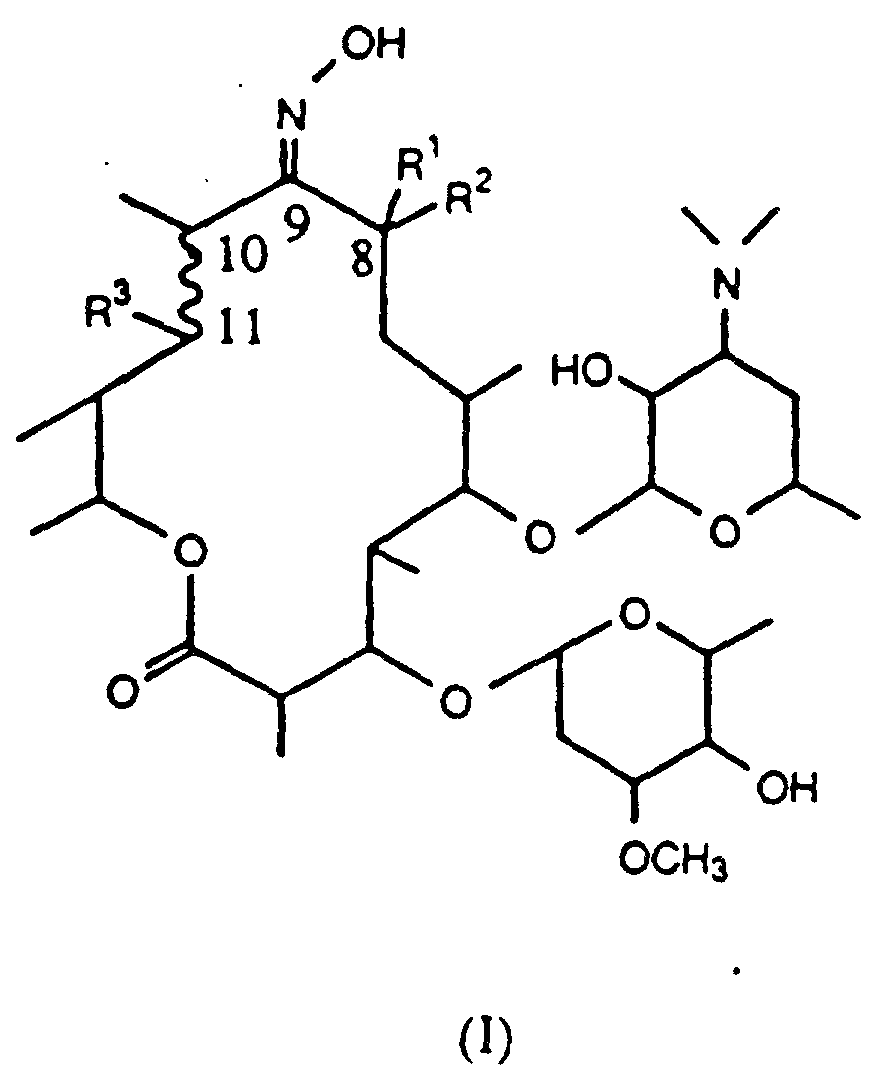
wherein R¹ stands for hydrogen or -CH₃, R stands for -CH₃ or hydrogen or R¹ and R stand together for an epoxide group or for =CH₂, R³ stands for -OH, when
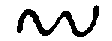
line stands for a single bond, or R³ and
line together represent a double bond.
wherein R¹ stands for hydrogen or -CH₃, R stands for -CH₃ or hydrogen or R¹ and R stand together for an epoxide group or for =CH₂, R³ stands for -OH, when
line stands for a single bond, or R³ and
line together represent a double bond.
2. A compound of the formula I according to claim 1, wherein R¹ and R stand together
for an epoxide group, R³ stands for -OH group and the
line stands for a single bond.
line stands for a single bond.
3. A compound of the formula I according to claim 1, wherein R¹ and R stand together
for an epoxide group and R³ and
line together represent a double bond.
line together represent a double bond.
4. A compound of the formula I according to claim 1, wherein R¹ and R stand together
for =CH₂ group, R³ stands for -OH group and the
line stands for a single bond.
line stands for a single bond.
5. A compound of the formula I according to claim 1, wherein R¹ stands for hydrogen,
R stands for -CH₃ group, R³ stands for -OH group and the
line stands for a single bond.
line stands for a single bond.
6. A compound of the formula I according to claim 1, wherein R¹ stands for -CH₃ group,
R stands for hydrogen, R³ stands for -OH group and the
line stands for a single bond.
line stands for a single bond.
7. A process for the preparation of oleandomycin oximes (I) according to claim 1, comprising
the reaction of oleandomycin derivatives of the formula (II)
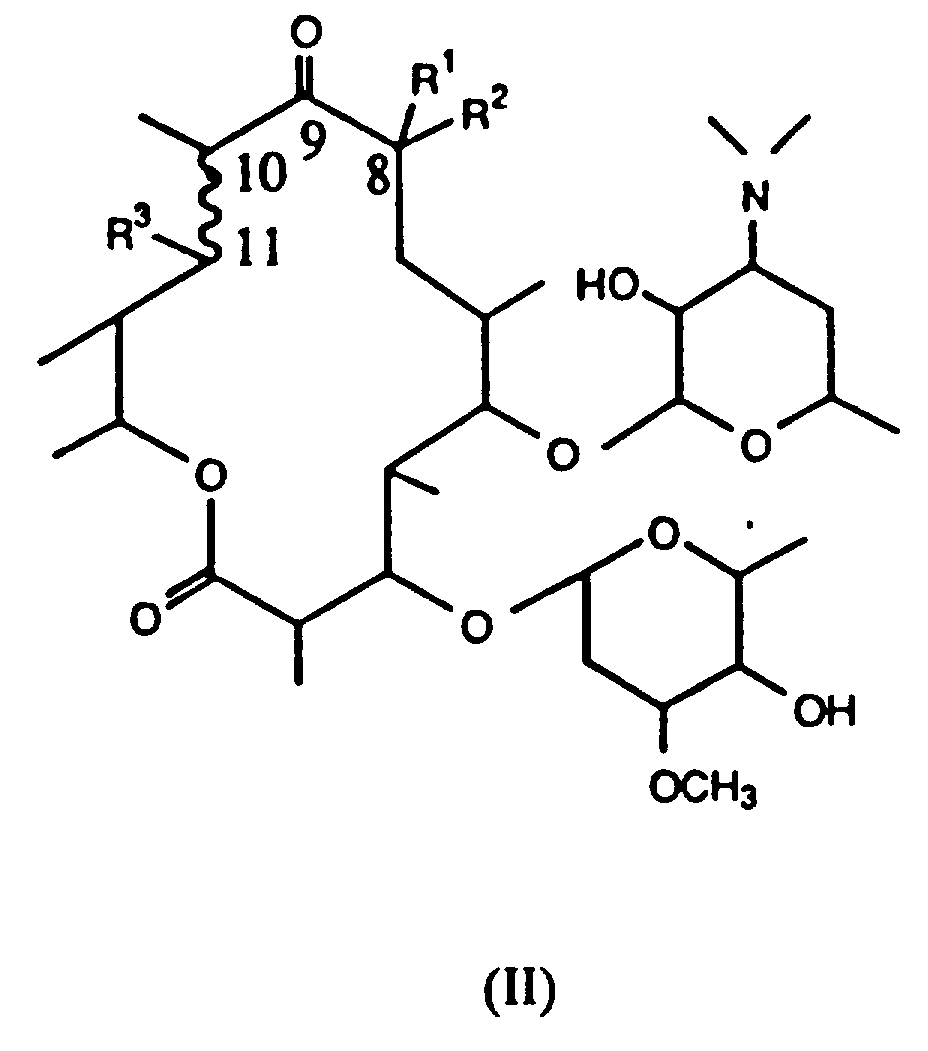
wherein R¹, R, R³ and the
line have the above-mentioned meanings, with a 4 - 6 molar excess of hydroxylamine hydrochloride, in the presence of an excess of pyridine, in a nitrogen stream, at ambient temperature, within of 2 - 40 hours, and a subsequent isolation of the product.
wherein R¹, R, R³ and the
line have the above-mentioned meanings, with a 4 - 6 molar excess of hydroxylamine hydrochloride, in the presence of an excess of pyridine, in a nitrogen stream, at ambient temperature, within of 2 - 40 hours, and a subsequent isolation of the product.
8. Use of oleandomycin oximes of formula (I) of claim 1 in the preparation of antimicrobial
agents.
1. Oleandomycin-Oxime der Formel I
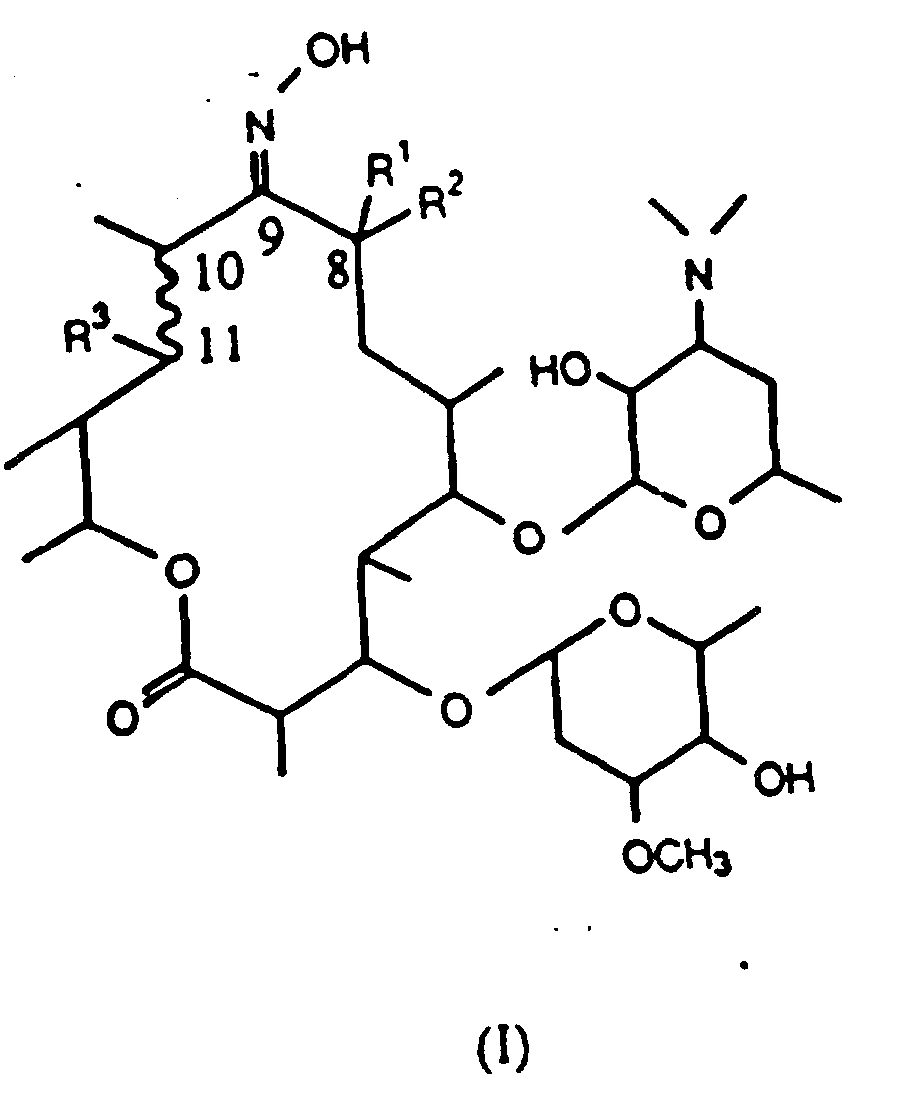
worin R¹ Wasserstoff oder -CH₃ bedeutet, R -CH₃ oder Wasserstoff bedeutet oder R¹ und R zusammen für eine Epoxidgruppe oder für =CH₂ stehen, R³ -OH bedeutet, wenn die Linie
für eine Einfachbindung steht oder R³ und die Linie
zusammen eine Doppelbindung darstellen.
worin R¹ Wasserstoff oder -CH₃ bedeutet, R -CH₃ oder Wasserstoff bedeutet oder R¹ und R zusammen für eine Epoxidgruppe oder für =CH₂ stehen, R³ -OH bedeutet, wenn die Linie
für eine Einfachbindung steht oder R³ und die Linie
zusammen eine Doppelbindung darstellen.
2. Verbindung der Formel I gemäß Anspruch 1, worin R¹ und R zusammen für eine Epoxidgruppe
stehen, R³ die -OH-Gruppe bedeutet und die Linie
für eine Einfachbindung steht.
für eine Einfachbindung steht.
3. Verbindung der Formel I gemäß Anspruch 1, worin R¹ und R zusammen für eine Epoxidgruppe
stehen und R³ und die Linie
zusammen eine Doppelbindung darstellen.
zusammen eine Doppelbindung darstellen.
4. Verbindung der Formel I gemäß Anspruch 1, worin R¹ und R zusammen für =CH₂ stehen,
R³ die -OH-Gruppe bedeutet und die Linie
für eine Einfachbindung steht.
für eine Einfachbindung steht.
5. Verbindung der Formel I gemäß Anspruch 1, worin R¹ Wasserstoff bedeutet, R die -CH₃-Gruppe
bedeutet, R³ die -OH-Gruppe bedeutet und die Linie
für eine Einfachbindung steht.
für eine Einfachbindung steht.
6. Verbindung der Formel I gemäß Anspruch 1, worin R¹ die -CH₃-Gruppe bedeutet, R fur
Wasserstoffsteht und R³ die -OH-Gruppe bedeutet und die Linie
für eine Einfachbindung steht.
für eine Einfachbindung steht.
7. Verfahren zur Herstellung von Oleandomycin-Oximen (I) nach Anspruch 1, dadurch gekennzeichnet,
dass Oleandomycin-Derivate der Formel (II)
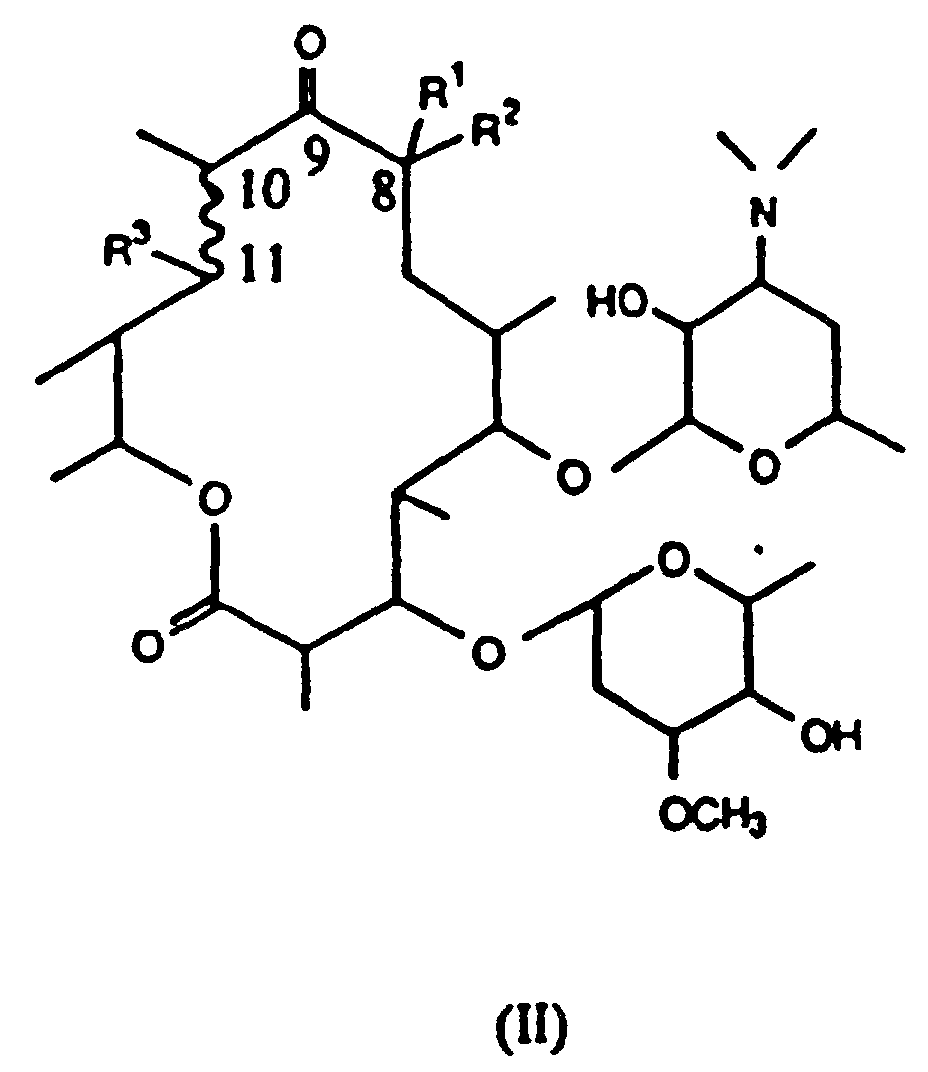
worin R¹, R, R³ und die Linie
die oben genannten Bedeutungen haben, mit einem 4-6-molaren Überschuß von Hydroxylaminhydrochlorid in Anwesenheit von einem Pyridinüberschuß, im Stickstofffluß, bei Raumtemperatur innerhalb von 2-40 Stunden umgesetzt werden und anschließend das Produkt isoliert wird.
worin R¹, R, R³ und die Linie
die oben genannten Bedeutungen haben, mit einem 4-6-molaren Überschuß von Hydroxylaminhydrochlorid in Anwesenheit von einem Pyridinüberschuß, im Stickstofffluß, bei Raumtemperatur innerhalb von 2-40 Stunden umgesetzt werden und anschließend das Produkt isoliert wird.
8. Verwendung von Oleandomycin-Oximen der Formel (I) nach Anspruch 1 in der Herstellung
von bakterienwachstumshemmenden Behandlungsmitteln.
1. Oléandomycinoxymes de la formule I
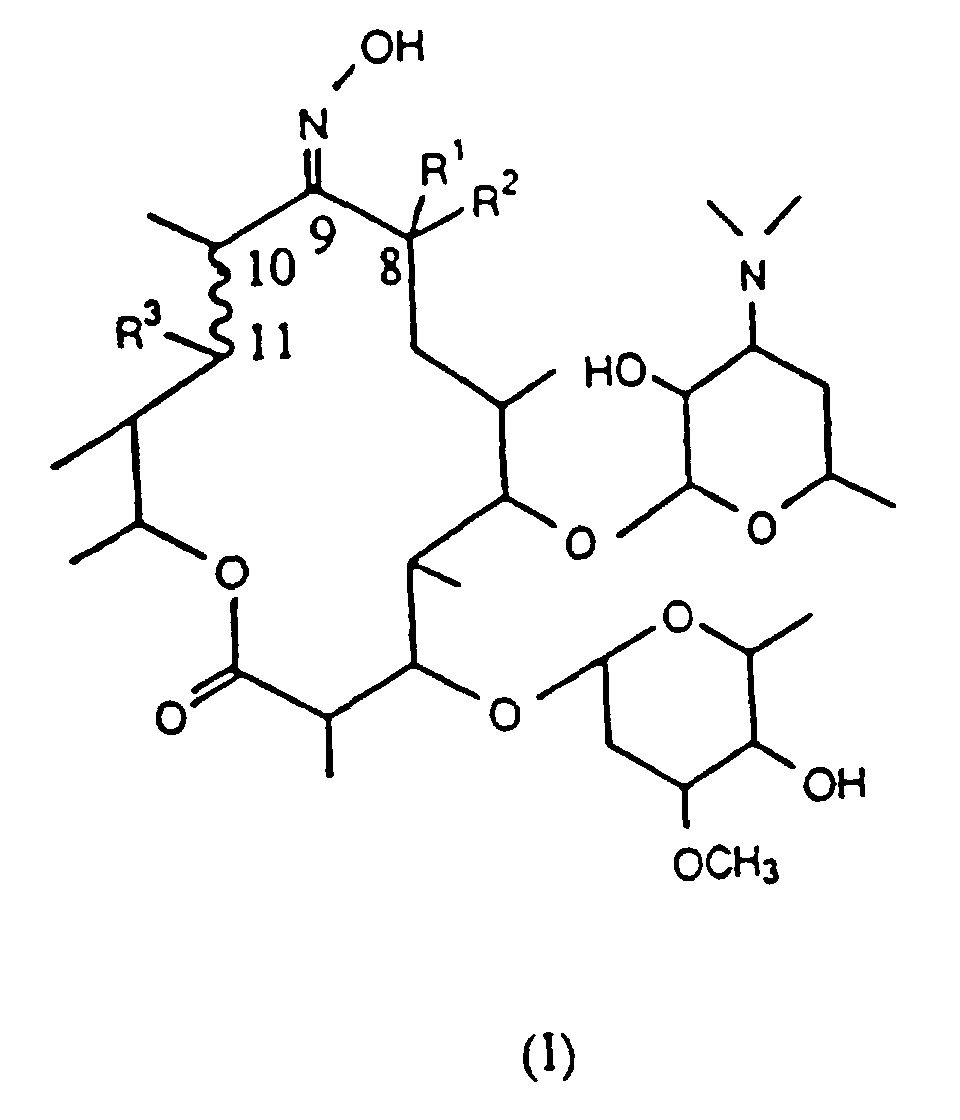
dans laquelle R¹ représente un atome d'hydrogène ou le radical -CH₃, R représente le radical -CH₃ ou un atome d'hydrogène, ou bien R¹ et R forment ensemble un groupe époxyde ou le radical = CH₂, R³ représente le radical -OH lorsque la ligne

représente une simple liaison, ou bien R³ et la ligne
forment ensemble une double liaison.
dans laquelle R¹ représente un atome d'hydrogène ou le radical -CH₃, R représente le radical -CH₃ ou un atome d'hydrogène, ou bien R¹ et R forment ensemble un groupe époxyde ou le radical = CH₂, R³ représente le radical -OH lorsque la ligne
représente une simple liaison, ou bien R³ et la ligne
forment ensemble une double liaison.
2. Composé de la formule I suivant la revendication 1, caractérisé en ce que R¹ et R
forment ensemble un radical époxyde, R³ représente le radical -OH et la ligne
représente une simple liaison.
représente une simple liaison.
3. Composé de la formule I suivant la revendication 1, caractérisé en ce que R¹ et R
forment ensemble un groupe époxyde et R³ et la ligne
forment ensemble une double liaison.
forment ensemble une double liaison.
4. Composé de la formule I suivant la revendication 1, caractérisé en ce que R¹ et R
forment ensemble le radical = CH₂, R³ représente le radical -OH et la ligne
représente une simple liaison.
représente une simple liaison.
5. Composé de la formule I suivant la revendication 1, caractérisé en ce que R¹ représente
un atome d'hydrogène, R représente le radical -CH₃, R³ représente le radical -OH et
la ligne
représente une simple liaison.
représente une simple liaison.
6. Composé de la formule I suivant la revendication 1, caractérisé en ce que R¹ représente
le radical -CH₃, R représente un atome d'hydrogène, R³ représente le radical -OH et
la ligne
représente une simple liaison.
représente une simple liaison.
7. Procédé de préparation d'oléandomycinoxymes (I) suivant la revendication 1, caractérisé
en ce qu'il comprend la réaction de dérivés de l'oléandomycine de la formule (II)
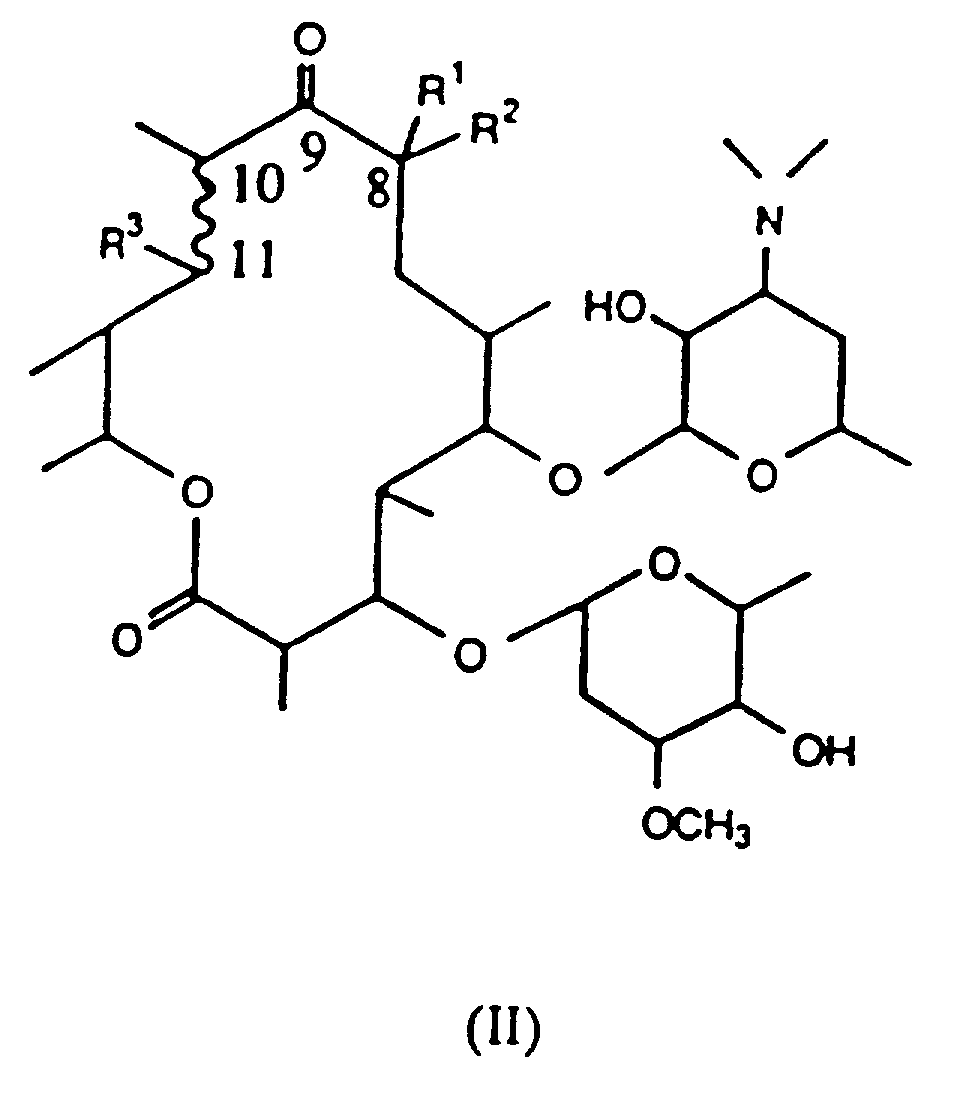
dans laquelle R¹, R, R³ et la ligne possèdent des significations qui leur ont été précédemment attribuées, avec un excès 4 à 6 molaires de chlorhydrate d'hydroxylamine, en présence d'un excès de pyridine, dans un courant d'azote, à la température ambiante, pendant 2 à 40 heures et l'isolement subséquent du produit.
dans laquelle R¹, R, R³ et la ligne possèdent des significations qui leur ont été précédemment attribuées, avec un excès 4 à 6 molaires de chlorhydrate d'hydroxylamine, en présence d'un excès de pyridine, dans un courant d'azote, à la température ambiante, pendant 2 à 40 heures et l'isolement subséquent du produit.
8. Utilisation d'oléandomycinoxymes de la formule I suivant la revendication 1 pour la
préparation d'agents antimicrobiens.