|
(11) | EP 0 449 250 B1 |

| (12) | EUROPEAN PATENT SPECIFICATION |
|
|
| (54) |
Trisazo compounds and use thereof Trisazoverbindungen und deren Verwendung Composés trisazoiques et leur utilisation |
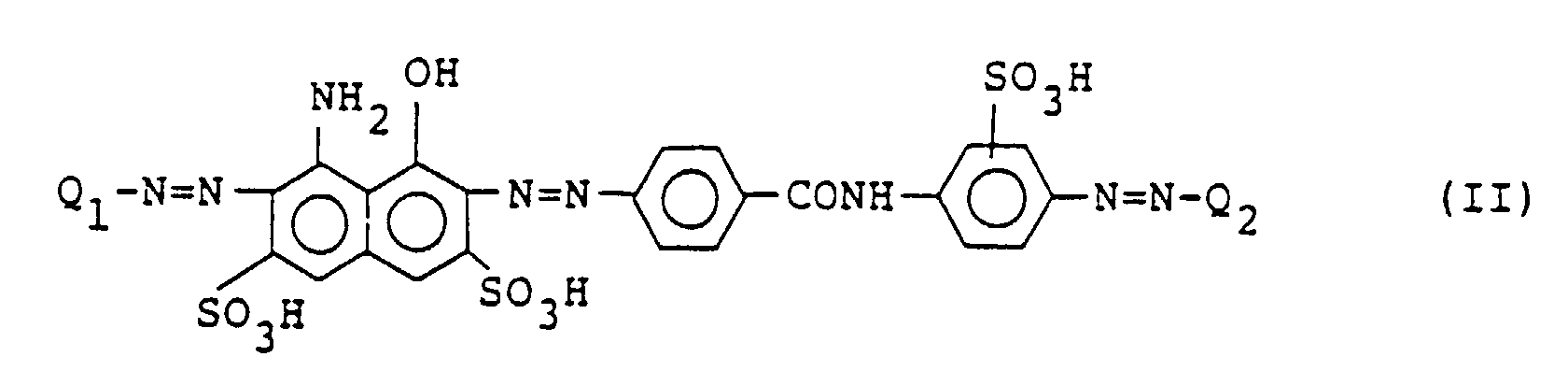
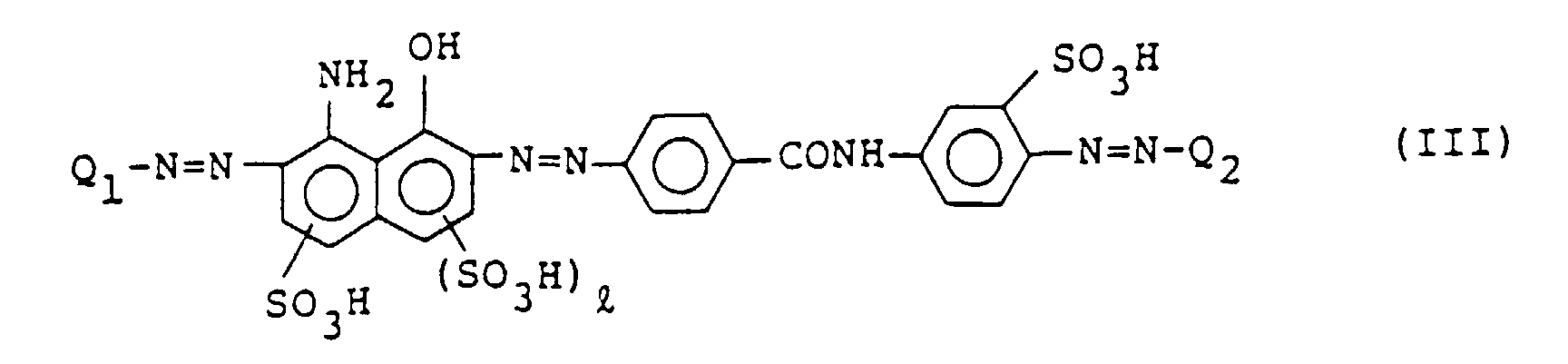
|
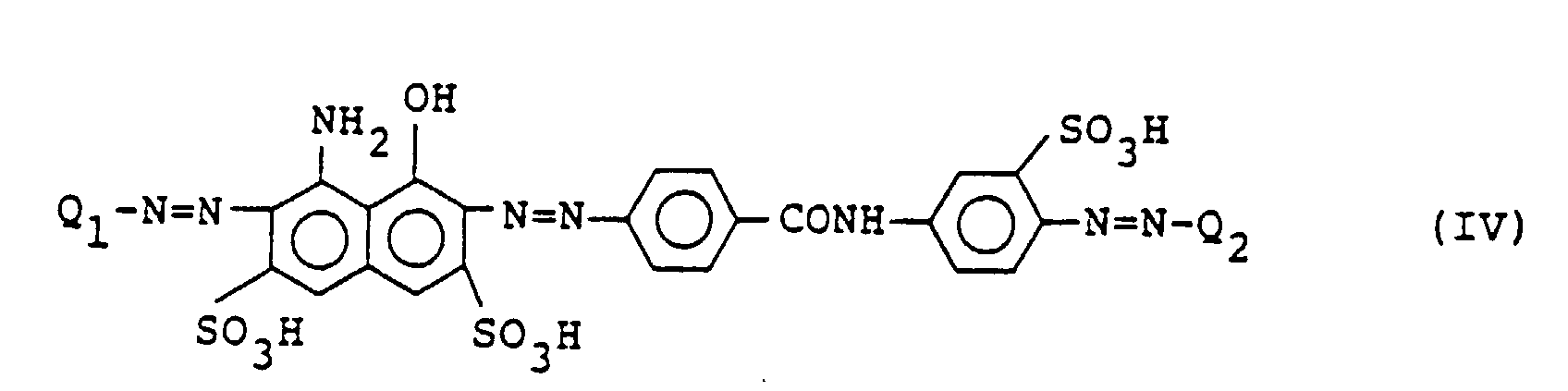
|
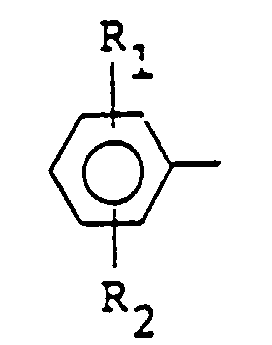
|||||||||||||||||||||||||||||||
|
||||||||||||||||||||||||||||||||
| Note: Within nine months from the publication of the mention of the grant of the European patent, any person may give notice to the European Patent Office of opposition to the European patent granted. Notice of opposition shall be filed in a written reasoned statement. It shall not be deemed to have been filed until the opposition fee has been paid. (Art. 99(1) European Patent Convention). |
[0001] The present invention relates to trisazo compounds. More particularly, the present invention relates to trisazo compounds useful for dyeing or printing fiber, paper, leather and the like having hydroxyl or amido groups, in black color, and for use in an ink used in ink jet printing.
[0002] In JP-A- 61-51064, dyes represented by, for example, the following formula are disclosed:
GB-A-1 327 914 and DE-A-22 55 652 relate to similar compounds, however, the benzanilide skeleton is not substituted by sulfo. Most of the compounds disclosed in DE-A-22 55 652 differ additionally in the coupling position of the benzanilide skeleton and the 1-amino-8-naphthol-3,6-disulfonic acid residue.
[0003] Polyazo direct or acid dye prepared using benzidine or its derivatives have been used for dyeing or printing a fiber having hydroxyl or amido group, or a composition comprising said fiber. However, in many countries, production of benzidine is now prohibited, and benzidine derivatives such as o-tolidine and dianisidine are registered as special chemical substances of which handling is restricted in production and use, because of their toxicity.
[0004] For such a reason, a variety of compounds have been proposed as non-benzidine type dyes. However, they do not reach a level capable of satisfying the requirements of users at the present stage, particularly in the dye abilities. Thus, it is earnestly desired to provide a further improved compound.
[0005] It is the object of the present invention to provide novel compounds capable of fulfilling the necessary conditions of a dye, without using benzidine nor benzidine derivatives.
[0006] The present invention provides trisazo compounds represented by the following formula (I) in the free acid form:
wherein Q1 and Q2 independently of one another are each an unsubstituted or substituted phenyl or naphthyl group and ℓ represents 0 or 1.
[0007] Among the trisazo compounds of the present invention represented by the formula (I), the trisazo compounds represented by the following formulas (II) and (III) in the free acid form are preferred:
wherein Q1 and Q2 are as defined above,
wherein ℓ, Q1 and Q2 are as defined above.
[0008] Among these trisazo compounds, the trisazo compounds represented by the following general formula (IV) in the free acid form are particularly preferred:
wherein Q1 and Q2 are as defined above.
[0009] The unsubstituted or substituted phenyl group represented by Q1 is preferably represented by the following formula:
wherein R1 and R2 independently of one another are hydrogen, a nitro, sulfo, sulfamoyl, alkyl, alkoxy, substituted or unsubstituted amino, carboxy or halogeno group, and particularly preferably a phenyl group unsubstituted or substituted by a nitro, sulfo, sulfamoyl, methyl, ethyl, methoxy, ethoxy, carboxy or chloro group.
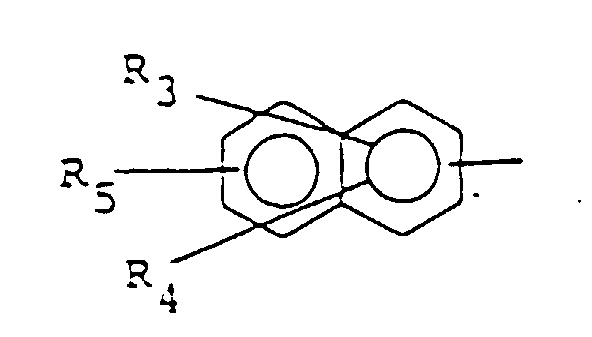
[0010] The unsubstituted or substituted naphthyl group represented by Q1 is preferably represented by the following formula:
wherein R3, R4 and R5 independently of one another are each hydrogen, a hydroxyl or sulfo group.
[0011] The unsubstituted or substituted phenyl group represented by Q2 is preferably a phenyl group substituted once or twice by a substituted or unsubstituted amino group and unsubstituted or substituted by a hydroxyl, sulfo, alkyl, alkoxy or carboxy group, or a phenyl group substituted once, twice or three times by a hydroxyl group and unsubstituted or substituted by a substituted or unsubstituted amino, sulfo, alkyl, alkoxy or carboxy group. As examples of the substituted amino group, amino groups substituted by methyl, ethyl, hydroxyethyl, cyanoethyl, acetyl or carbamoyl groups can be referred to.
[0012] The unsubstituted or substituted naphthyl group represented by Q2 is preferably a naphthyl group substituted once or twice by a hydroxyl group and unsubstituted or substituted by a sulfo, unsubstituted amino, acetyl, phenyl, sulfophenyl, disulfophenyl, benzoyl or methyl-substituted amino group, or a naphthyl group substituted once or twice by an unsubstituted amino group or a methyl-, ethyl-, hydroxyethyl-, cyanoethyl-, acetyl- or carbamoyl-substituted amino group(s) and unsubstituted or substituted by a hydroxyl or sulfo group.
[0013] As used herein the terms "alkyl" and "alkoxv" refer to residues having 1 to 6, preferably 1 to 4 carbon atoms. Specific examples are the methyl, ethyl, methoxy and ethoxy group.
[0014] The compound of the present invention is used in the form of the free acid or preferably in the form of an alkali metal salt, ammonium salt or organic amine salt. For example, it is used in the form of the lithium salt, sodium salt, potassium salt, monoethanolamine salt, diethanolamine salt or triethanolamine salt.
[0015] Such trisazo compounds represented by the formula (I) can be produced, for example, in the following manner.
[0016] A compound represented by the following formula (V):
Q1-NH2 (V)
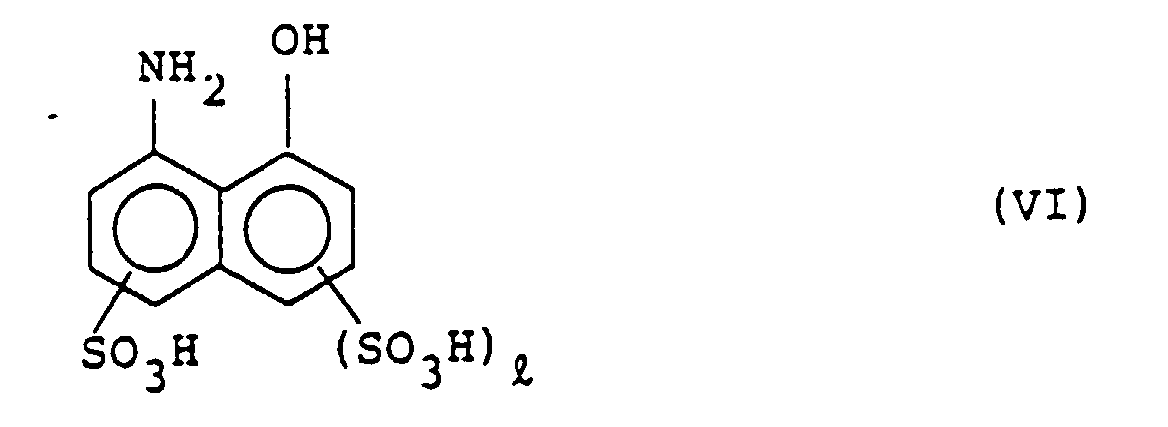
wherein Q1 is as defined above, is diazotized in a conventional manner followed by coupling with a compound represented by the following formula (VI) in the free acid form:
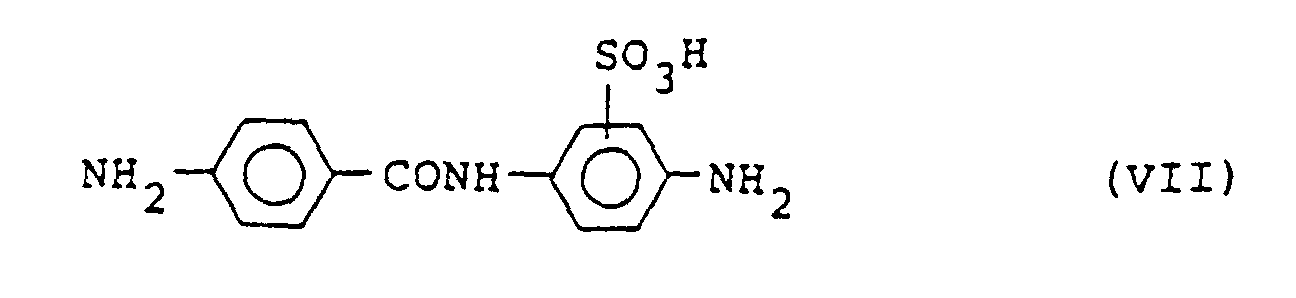
wherein ℓ is as defined above, in an aqueous medium under acidic conditions and then the product of the coupling reaction is further coupled in an acidic or weakly alkaline aqueous medium with a tetrazo compound prepared by tetrazotizing in a conventional manner a compound represented by the following formula (VII):
and the disazo-diazo compound thus obtained is coupled with a compound represented by the following formula (VIII):
Q2-H (VII)
wherein Q2 is as defined above, to form a trisazo compound represented by the formula (I).
[0017] Examples of the compound represented by the formula (V) include 1-aminobenzene, 1-amino-2-, 3- or 4-nitrobenzene, 1-amino-2, 3- or 4-benzenesulfonic acid, 5-aminobenzene-1,3-disulfonic acid, 6-aminobenzene-1,4-disulfonic acid, 4-aminobenzene-1,2-disulfonic acid, 1-amino-2-, 3- or 4-sulfamoylbenzene, 1-amino-2-, 3-or 4-benzoic acid, 1-amino-2-, 3- or 4-chlorobenzene, l-amino-2,5-dichlorobenzene, 1-amino-2-, 3- or 4-bromobenzene, 1-amino-2-, 3- or 4-methylbenzene, 1-amino-2-, 3- or 4-ethylbenzene, 1-amino-2-, 3- or 4-methoxybenzene, 1-amino-2-, 3- or 4-ethoxybenzene, 1,4-diaminobenzene-2-sulfonic acid, 4-di(β-hydroxyethyl)-1-aminobenzene, 1-aminonaphthalene-4-, -4-, 5-, 6-, 7- or 8-sulfonic acid, 2-aminonaphthalene-1-, 8-, 7-, 6- or 5-sulfonic acid, 1-aminonaphthalene-4,7-, 4,6-, 3,7-, 3,8- or 3,6-disulfonic acid, 2-aminonaphthalene-4,8-, 6,8-, 3,6-, 1,5- or 5,7-disulfonic acid, 1-aminonaphthalene-3,6,8-trisulfonic acid and 2-aminonaphthalene-3,6,8- or 4,6,8-trisulfonic acid.
[0018] Examples of the compound represented by the formula (VI) include 1-amino-8-naphthol-4-sulfonic acid and 1-amino-8-naphthol-3,6- or 4,6-disulfonic acid, among which 1-amino-8-naphthol-3,6-disulfonic aicd is particularly preferable.
[0019] Examples of the compound represented by the formula (VII) include 4,4'-diaminobenzanilide-3'-sulfonic acid and 4,4'-diaminobenzanilide-2'-sulfonic acid. Among them, 4,4'-diaminobenzanilide-3'-sulfonic acid is particularly preferable.
[0020] Examples of the compound represented by the formula (VIII) include aniline derivatives, phenol derivatives, aminophenol derivatives, naphthol derivatives, naphthylaminesulfonic acid derivativesand naphtholsulfonic acid derivatives. Among them, 1-hydroxybenzene, 1-hydroxy-2-, 3- or 4-methylbenzene, 1,3-dihydroxybenzene, 1-hydroxy-3-methoxybenzene, 1-hydroxy-3-aminobenzene, 3-di(β-hydroxyethyl)amino-1-hydroxybenzene, 1-di(β-hydroxyethyl) aminobenzene, 1,3-diamino-4-methylbenzene, 1-hydroxy-2-benzoic acid, 1,3-diaminobenzene-6-sulfonic acid, 1-acetylamino-4-methoxy-3-di(β-hydroxyethyl)aminobenzene, 3-diethylamino-1-hydroxybenzene, 1-hydroxynaphthalene, 1-hydroxynaphthalene-4-, 5- or 3-sulfonic acid, 1-hydroxynaphthalene-3,8- or 3,6-disulfonic acid, 1-hydroxynaphthalene-3,6,8-trisulfonic acid, 2-hydroxynaphthalene, 2-hydroxynaphthalene-8-, 7- or 6-sulfonic acid, 2-hydroxynaphthalene-6,8- or 3,6-disulfonic acid, 2-amino-, methylamino-, ethylamino-, acetylamino-, propionylamino-, benzoylamino-, carbamoylamino-, sulfamoylamino or phenylamino-8-hydroxynaphthalene-6-sulfonic acid, 3-amino-, methylamino-, ethylamino-, propionylamino-, acetylamino-, benzoylamino-, carbamoylamino-, sulfamoylamino- or phenylamino-8-hydroxynaphthalene-6-sulfonic acid, 1-amino- or acetylamino-8-hydroxynaphthalene-3,6-disulfonic acid, 1-amino- or acetylamino-8-hydroxynaphthalene-4,6-disulfonic acid, 1-amino-8-hydroxynaphthalene-2,4-disulfonic acid and 1,8-dihydroxynaphthalene-3,6-disulfonic acid are preferred.
[0021] The trisazo compound of the present invention is usable either singly or in the form of a mixture, and useful particularly for dyeing cellulose fibers such as rayon, cotton, paper, leather, silk and synthetic polyamide. The dyeing can be carried out by various dyeing processes and printing processes such as the exhaustion dyeing process.
[0022] In such dyeing processes, the compounds of the present invention exhibit excellent performances and are usually useful as a black-colored dye. Particularly, they have a good solubility and a high fixation property and can give a deep black colored dyed product. Further, they are characterized by their good build-up property and the ability to give a dyed product of excellent fastness.
[0023] Further, the compounds of the present invention can be made into a stable liquid composition. The liquid composition is particularly suitable for dyeing rayon and paper. Further, the liquid composition is successfully usable as an ink which can be applied, for example, by the ink jet process.
[0024] The compounds of the present invention are particularly excellent in solubility. Thus, the ink prepared therefrom has a good storage stability which has so far been an important problem in the field of inks for use in ink jet process. Further, the ink is characterized in that it is free from the problem of clogging of nozzle caused by deposited matter and it can form a deep black-colored image excellent in ink characteristics such as clarity, water resistance and light resistance.
[0025] The present invention will be illustrated in more detail by way of the following examples. In the examples, parts are by weight.
Example 1
[0026] Aniline (9.3 parts) was diazotized in a conventional manner and coupled with 31.9 parts of 1-amino-8-naphthol-3,6-disulfonic acid at 0-5°C under an acidic condition. Then, a tetrazo compound prepared by tetrazotizing 30.7 parts of 4,4'-diaminobenzanilide-3'-sulfonic acid in a conventional manner was poured thereinto and coupled at 0-10°C under a neutral condition. Then, 10.9 parts of 1-hydroxy-3-aminobenzene was added and the reaction was completed, after which the product was salted out and isolated in a conventional manner to obtain a trisazo compound represented by the following formula in the free acid form:
Example 2
[0027] Example 1 was repeated, except that the 1-hydroxy-3-aminobenzene used in Example 1 was replaced with the compounds of the formula (VIII) as shown in the second column of the following table. Thus, the corresponding trisazo compounds were obtained. In the table, λmax denotes the values measured in an aqueous medium.
Example 3
[0028] Example 1 was repeated, except that the aniline used in Example 1 was replaced with the compounds of formula (V) as shown in the second column of the following table. Thus, the corresponding trisazo compounds were obtained. In the table, λmax denotes the values measured in an aqueous medium.
Example 4
[0029] Example 1 can be repeated, except that the aniline and 1-hydroxy-3-aminobenzene used in Example 1 are replaced with the compounds of formula (V) used in Example 3 and the compounds of formula (VIII) used in Example 2, respectively, to obtain the corresponding trisazo compounds.
Example 5
[0030] Example 1 was repeated, except that the 1-amino-8-naphthol-3,6-disulfonic acid and 4,4'-diaminobenzanilide-3'-sulfonic acid used in Example 1 were replaced with 1-amino-8-naphthol-4,6-disulfonic acid and 4,4'-diaminobenzanilide-2'-sulfonic acid, respectively. Thus, trisazo compound represented by the following formula in the free acid form was obtained:
Example 6
[0031] A dyeing bath was prepared by dissolving 0.25 part of the trisazo compound obtained in Example 1 into 200 parts of water. In the dyeing bath was dipped 5.0 parts of viscose rayon staple fiber yarn. After maintaining the bath at 90°C for 10 minutes, 0.25 part ( of anhydrous sodium sulfate was added, and dyeing was carried out at that temperature for 40 minutes. Then, the yarn was washed with water and dried. The dyed product thus obtained had a black color tone and an excellent fastness.
Example 7
[0032] Into 500 parts of an LBKP 20 g/liter pulp dispersion having been beaten up to a degree of beating of CF 400 ml was introduced 0.5 part of the trisazo compound obtained in Example 3 (No. 19). After agitating the mixture for 10 minutes, 0.3 part of Sizepine E (sizing agent manufactured by Arakawa Chemical Industry, Co.) were added. After an additional 10 minutes had passed, 0.3 part of crystalline aluminum sulfate was added, and agitation was continued for 20 minutes to carry out dyeing. Then, the pulp was made into paper and dried. The paper thus prepared had a black color tone and an excellent fastness.
Example 8
[0033] A composition of the following formulation was heated at about 50°C with agitation to form a uniform solution and then filtered through a Teflon filter having a pore diameter of 0.45 µm to prepare an ink.
[0034] Using the ink thus obtained, an ink jet recording was carried out on a commercially available high quality paper by means of a recording apparatus equipped with an On-Demand type recording head discharging an ink by the action of a piezoelectric vibrator. The image thus formed was excellent in water resistance, light resistance, color depth and clarity.
Example 9
[0035] Example 1 was repeated, except that the aniline and 1-hydroxy-3-aminobenzene used in Example 1 were replaced with the compounds as shown in the second column of the following table (compound of formula (V)) and the compounds of the third column of the following table (compound of formula (VIII)), respectively, to synthesize the corresponding trisazo compounds. In the table, λmax denotes the values in an aqueous medium.
Example 10
[0036] An ink was prepared from the following composition by the same procedure as in Example 8.
| Trisazo compound of Example 9 (No. 42) | 3.0 parts |
| Triethylene glycol | 5.5 parts |
| Polyethylene glycol #200 | 10.0 parts |
| Dehydroacetic acid sodium salt | 0.1 part |
| Deionized water | 81.4 parts |
[0037] The ink was sealed into a glass container and left standing at 20°C for 6 months or at 50°C for 2 weeks. After standing, the ink showed no deposition of crystalline matter, demonstrating a high stability of its quality.
Example 11
1. A trisazo compound represented by the following formula (I) in the free acid form:
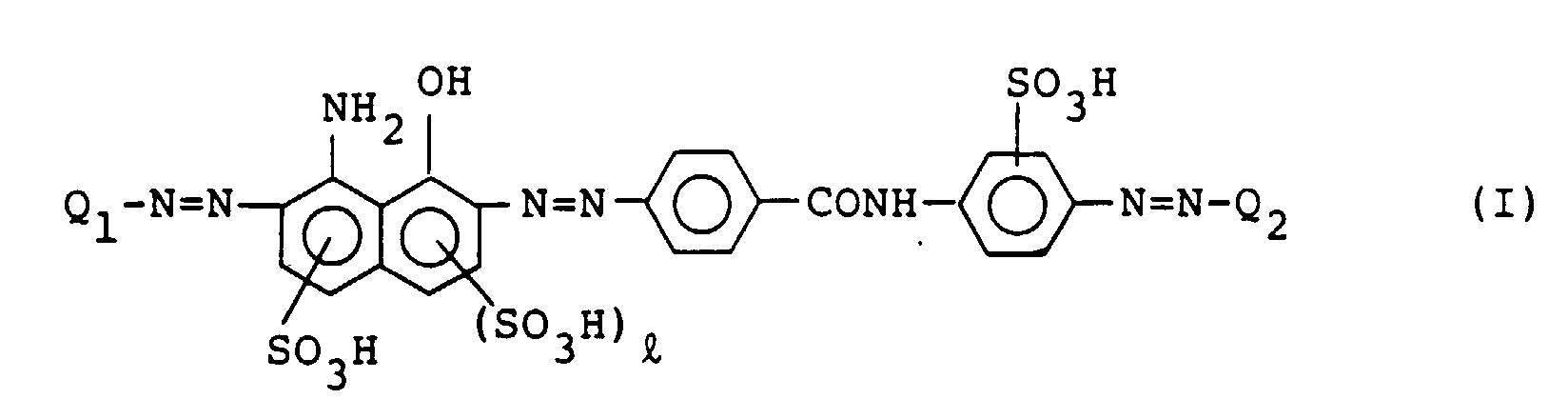
wherein Q1 and Q2 independently of one another are each an unsubstituted or substituted phenyl or naphthyl group and ℓ represents 0 or 1.
wherein Q1 and Q2 independently of one another are each an unsubstituted or substituted phenyl or naphthyl group and ℓ represents 0 or 1.
2. The trisazo compound according to Claim 1 represented by the following formula (II)
in the free acid form:
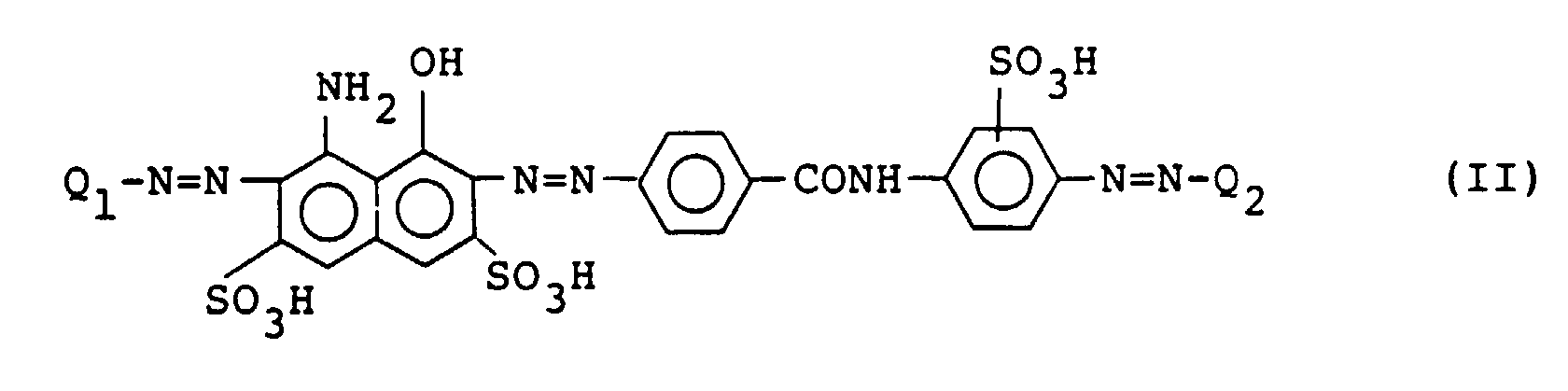
wherein Q1 and Q2 are as defined in Claim 1.
wherein Q1 and Q2 are as defined in Claim 1.
3. The trisazo compound according to Claim 1 represented by the following formula (III)
in the free acid form:
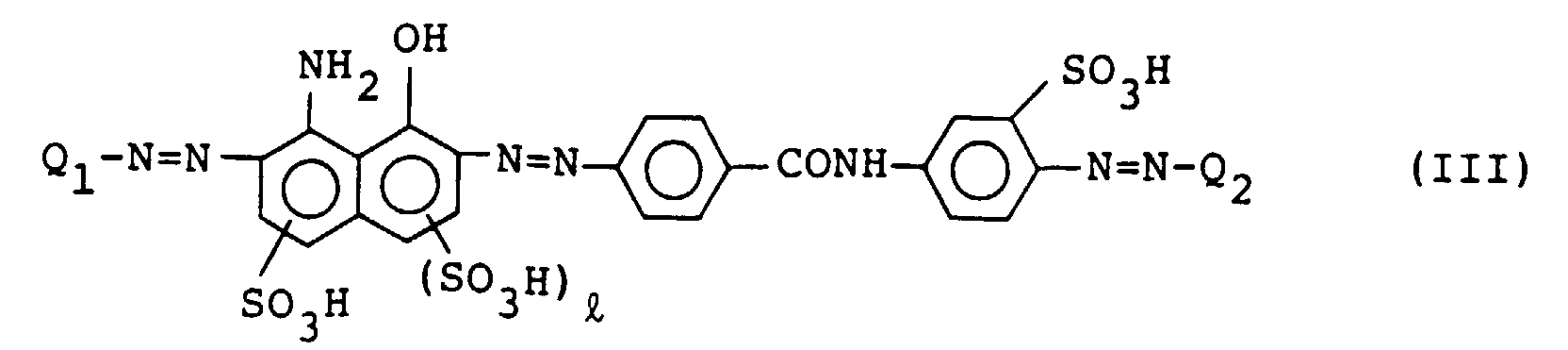
wherein ℓ, Q1 and Q2 are as defined in Claim 1.
wherein ℓ, Q1 and Q2 are as defined in Claim 1.
4. The trisazo compound according to Claim 1 represented by the following formula (IV)
in the free acid form:
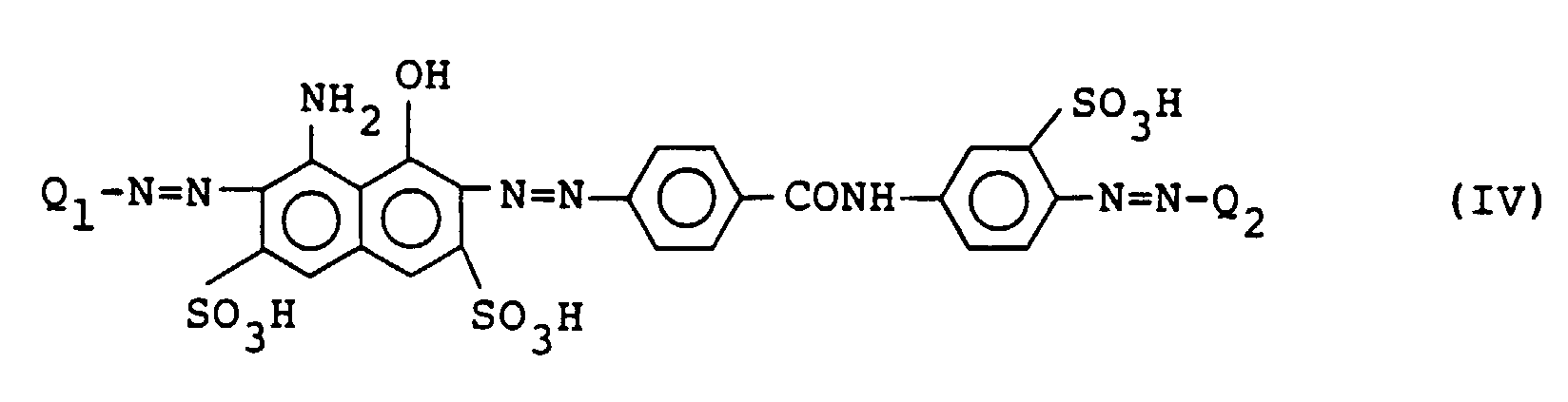
wherein Q1 and Q2 are as defined in Claim 1.
wherein Q1 and Q2 are as defined in Claim 1.
5. The trisazo compound according to any one of Claims 1 to 4, wherein Q1 is a phenyl group represented by the following formula:
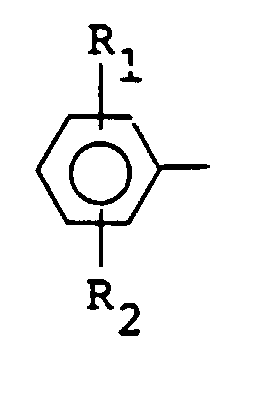
wherein R1 and R2 independently of one another are each hydrogen, a nitro, sulfo, sulfamoyl, alkyl, alkoxy, substituted or unsubstituted amino, carboxy or halogeno group.
wherein R1 and R2 independently of one another are each hydrogen, a nitro, sulfo, sulfamoyl, alkyl, alkoxy, substituted or unsubstituted amino, carboxy or halogeno group.
6. The trisazo compound according to any one of Claims 1 to 4, wherein Q1 is a naphthyl group represented by the following formula:
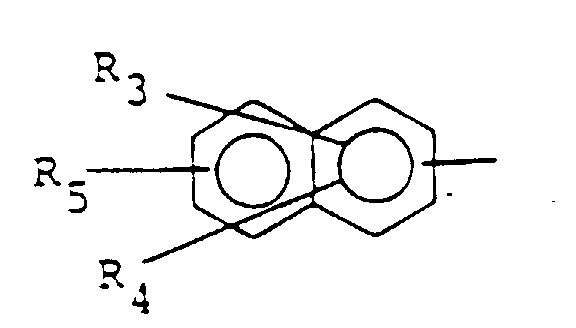
wherein R3, R4 and R5 independently of one another are each hydrogen, a hydroxyl or sulfo group.
wherein R3, R4 and R5 independently of one another are each hydrogen, a hydroxyl or sulfo group.
7. The trisazo compound according to any one of Claims 1 to 6, wherein Q2 is a phenyl group substituted one, twice or three times by a hydroxyl group and unsubstituted
or substituted by a substituted or unsubstituted amino, sulfo, alkyl, alkoxy or carboxy
group.
8. The trisazo compound according to any one of Claims 1 to 6, wherein Q2 is a phenyl group substituted once or twice by a substituted or unsubstituted amino
group and unsubstituted or substituted by a hydroxyl, sulfo, alkyl, alkoxy or carboxy
group.
9. The trisazo compound according to any one of Claims 1 to 6, wherein Q2 is a naphthyl group substituted once or twice by a hydroxyl group and unsubstituted
or substituted by a sulfo, amino, acetyl, phenyl, sulfophenyl, disulfophenyl, benzoyl
or methylamino group.
10. The trisazo compound according to any one of Claims 1 to 6, wherein Q2 is a naphthyl group substituted one or twice by an amino or methyl-, ethyl-, hydroxyethyl-,
cyanoethyl-, acetyl- or carbamoyl-amino group, and unsubstituted or substituted by
a hydroxyl or sulfo group.
11. A process for dyeing or printing fiber or paper, which comprising using the trisazo
compound according to any one of Claims 1 to 10.
12. An ink comprising the trisazo compound according to any one of Claims 1 to 10.
13. A process for producing the trisazo compound according to Claim 1, which is characterized
in that a compound represented by the following formula (V):
Q1-NH2 (V)
wherein Q1 is as defined in Claim 1, is diazotized in a conventional manner followed by coupling with a compcund represented by the following formula (VI) in the free acid form:
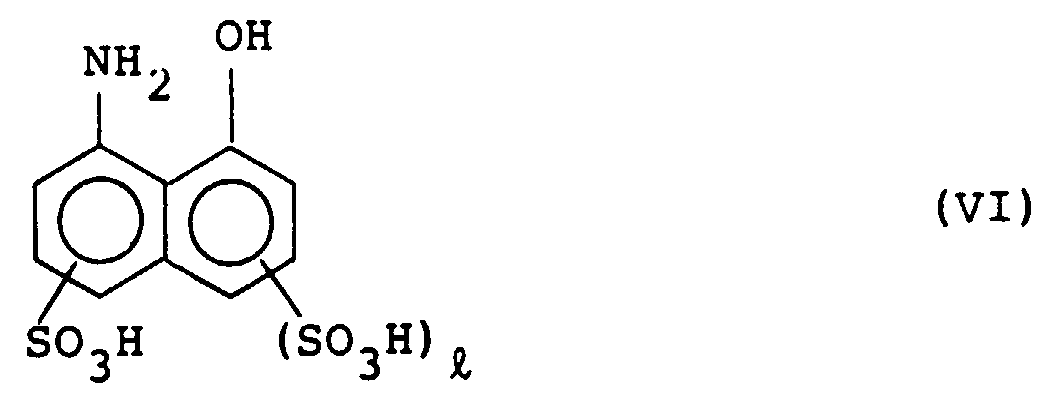
wherein ℓ is as defined above, under acidic conditions, the product of the coupling reaction is coupled in an acidic or weakly alkaline aqueous medium with a tetrazo compound prepared by tetrazotizing in a conventional manner a compound represented by the following formula (VII):
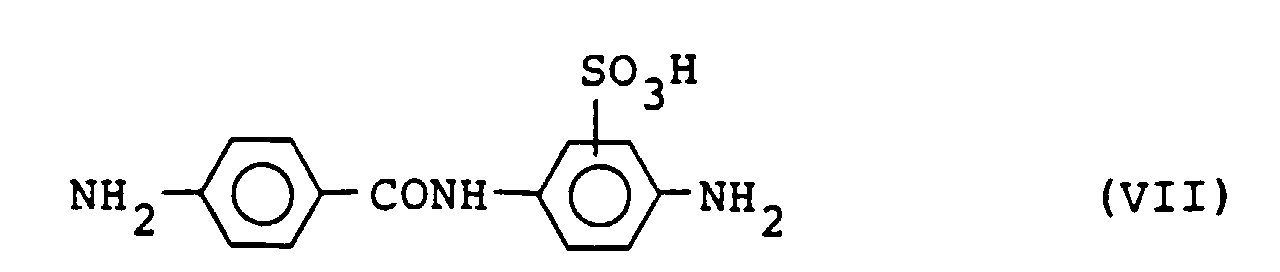
and the disazo-diazo compound thus obtained is coupled with a compound represented by the following formula (VIII):
Q2-H (VIII)
wherein Q2 is as defined in Claim 1.
Q1-NH2 (V)
wherein Q1 is as defined in Claim 1, is diazotized in a conventional manner followed by coupling with a compcund represented by the following formula (VI) in the free acid form:
wherein ℓ is as defined above, under acidic conditions, the product of the coupling reaction is coupled in an acidic or weakly alkaline aqueous medium with a tetrazo compound prepared by tetrazotizing in a conventional manner a compound represented by the following formula (VII):
and the disazo-diazo compound thus obtained is coupled with a compound represented by the following formula (VIII):
Q2-H (VIII)
wherein Q2 is as defined in Claim 1.
1. Trisazoverbindung der folgenden Formel (I)
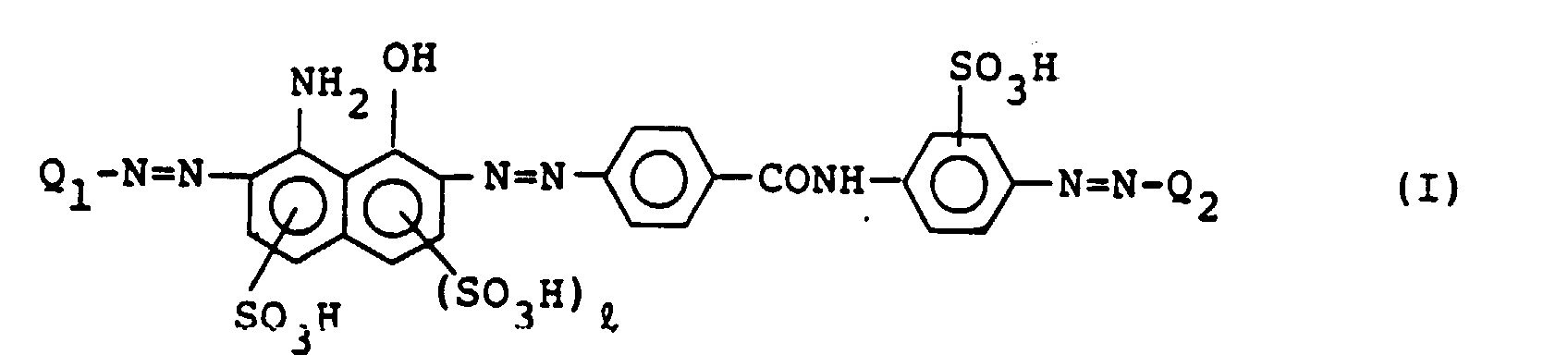
wobei Q1 und Q2 unabhängig voneinander jeweils eine unsubstituierte oder substituierte Phenyl- oder Naphthylgruppe bedeuten, und ℓ für 0 oder 1 steht,
in Form der freien Säure.
wobei Q1 und Q2 unabhängig voneinander jeweils eine unsubstituierte oder substituierte Phenyl- oder Naphthylgruppe bedeuten, und ℓ für 0 oder 1 steht,
in Form der freien Säure.
2. Trisazoverbindung nach Anspruch 1 der folgenden Formel (II)
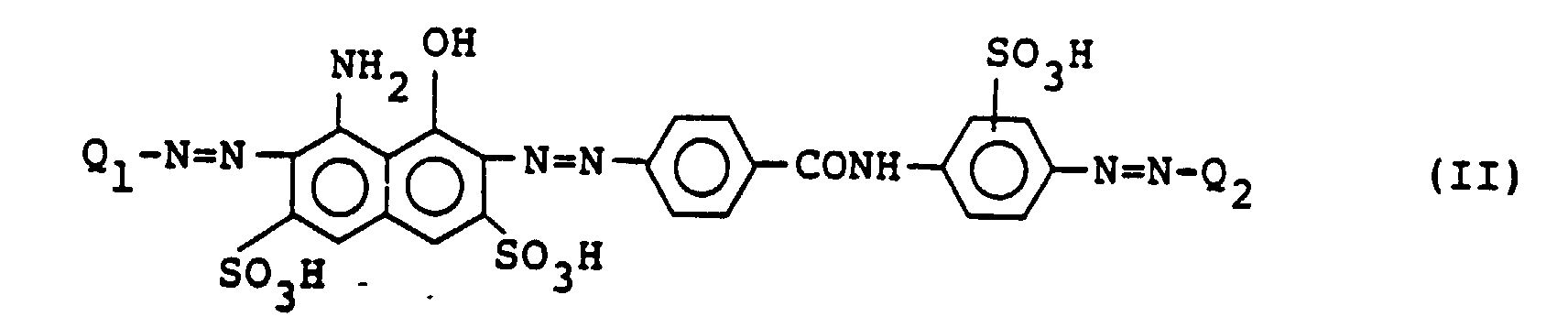
wobei Q1 und Q2 wie in Anspruch 1 definiert sind,
in Form der freien Säure.
wobei Q1 und Q2 wie in Anspruch 1 definiert sind,
in Form der freien Säure.
3. Trisazoverbindung nach Anspruch 1 der folgenden Formel (III)
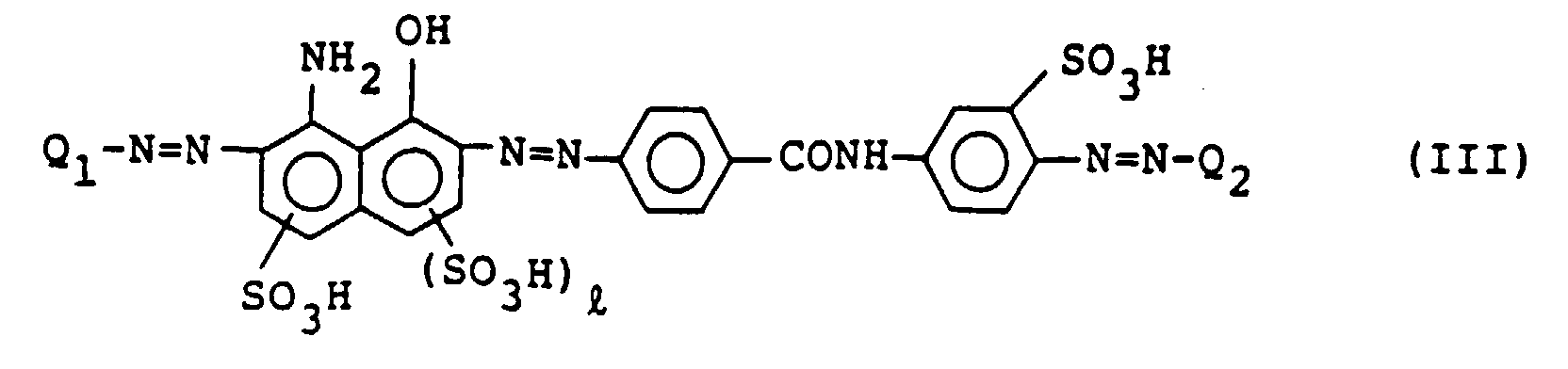
wobei ℓ, Q1 und Q2 wie in Anspruch 1 definiert sind,
in Form der freien Säure.
wobei ℓ, Q1 und Q2 wie in Anspruch 1 definiert sind,
in Form der freien Säure.
4. Trisazoverbindung nach Anspruch 1 der folgenden Formel (IV)
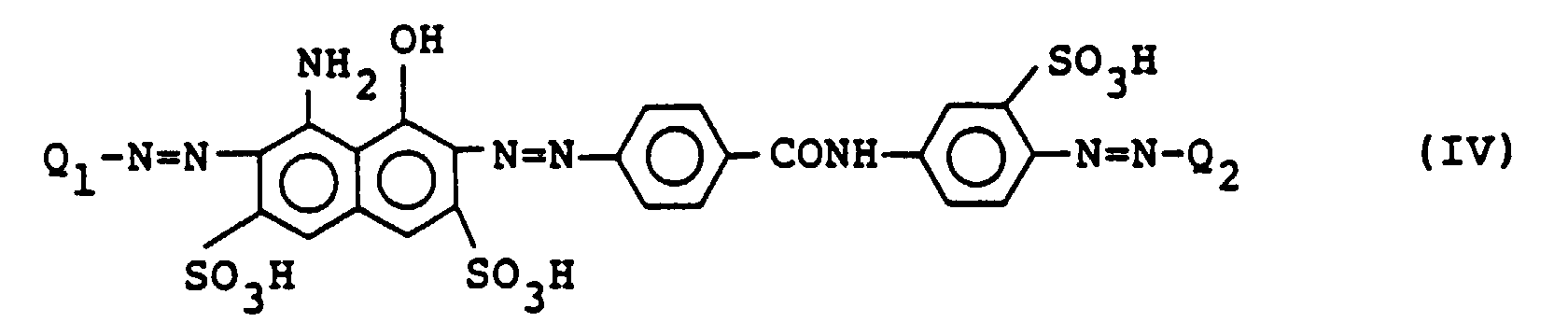
wobei Q1 und Q2 wie in Anspruch 1 definiert sind,
in Form der freien Säure.
wobei Q1 und Q2 wie in Anspruch 1 definiert sind,
in Form der freien Säure.
5. Trisazoverbindung nach einem der Ansprüche 1 bis 4, wobei Q1 eine Phenylgruppe der folgenden Formel
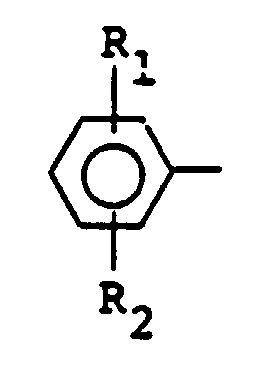
wobei R1 und R2 unabhängig voneinander jeweils ein Wasserstoffatom, eine Nitro-, Sulfo-, Sulfamoylgruppe, einen Alkyl-, Alkoxyrest, eine substituierte oder unsubstituierte Amino-, Carboxygruppe oder ein Halogenatom bedeuten,
darstellt.
wobei R1 und R2 unabhängig voneinander jeweils ein Wasserstoffatom, eine Nitro-, Sulfo-, Sulfamoylgruppe, einen Alkyl-, Alkoxyrest, eine substituierte oder unsubstituierte Amino-, Carboxygruppe oder ein Halogenatom bedeuten,
darstellt.
6. Trisazoverbindung nach einem der Ansprüche 1 bis 4, wobei Q1 eine Naphthylgruppe der folgenden Formel
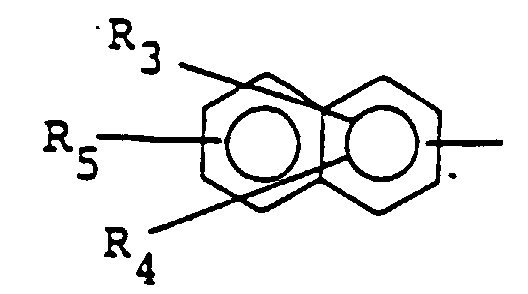
wobei R3, R4 und R5 unabhängig voneinander jeweils ein Wasserstoffatom, eine Hydroxyl- oder Sulfogruppe bedeuten,
darstellt.
wobei R3, R4 und R5 unabhängig voneinander jeweils ein Wasserstoffatom, eine Hydroxyl- oder Sulfogruppe bedeuten,
darstellt.
7. Trisazoverbindung nach einem der Ansprüche 1 bis 6, wobei Q2 eine Phenylgruppe darstellt, die ein-, zwei- oder dreimal durch eine Hydroxylgruppe
substituiert ist, und durch eine substituierte oder unsubstituierte Amino-, Sulfogruppe,
einen Alkyl-, Alkoxyrest oder eine Carboxygruppe substituiert oder unsubstituiert
ist.
8. Trisazoverbindung nach einem der Ansprüche 1 bis 6, wobei Q2 eine Phenylgruppe darstellt, die ein- oder zweimal durch eine substituierte oder
unsubstituierte Aminogruppe substituiert ist, und durch eine Hydroxyl-, Sulfogruppe,
einen Alkyl-, Alkoxyrest oder eine Carboxygruppe substituiert oder unsubstituert ist.
9. Trisazoverbindung nach einem der Ansprüche 1 bis 6, wobei Q2 eine Naphthylgruppe darstellt, die ein- oder zweimal durch eine Hydroxylgruppe substituiert
ist, und durch eine Sulfo-, Amino-, Acetyl-, Phenyl-, Sulfophenyl-, Disulfophenyl-,
Benzoyl- oder Methylaminogruppe substituiert oder unsubstituiert ist.
10. Trisazoverbindung nach einem der Ansprüche 1 bis 6, wobei Q2 eine Naphthylgruppe darstellt, die ein- oder zweimal durch eine Aminogruppe oder
durch eine Methyl-, Ethyl-, Hydroxyethyl-, Cyanethyl-, Acetyl- oder Carbamoyl-aminogruppe
substituiert ist, und durch eine Hydroxyl- oder Sulfogruppe substituiert oder unsubstituiert
ist.
11. Verfahren zum Färben oder Bedrucken von Fasern oder Papier, umfassend Verwenden der
Trisazoverbindung nach einem der Ansprüche 1 bis 10.
12. Farbe, umfassend die Trisazoverbindung nach einem der Ansprüche 1 bis 10.
13. Verfahren zur Herstellung der Trisazoverbindung nach Anspruch 1, dadurch gekennzeichnet,
daß eine Verbindung der folgenden Formel (V)
Q1-NH2 (V)
wobei Q1 wie in Anspruch 1 definiert ist
in herkömmlicher Weise diazotiert wird, gefolgt von Kuppeln mit einer Verbindung der folgenden Formel (VI)
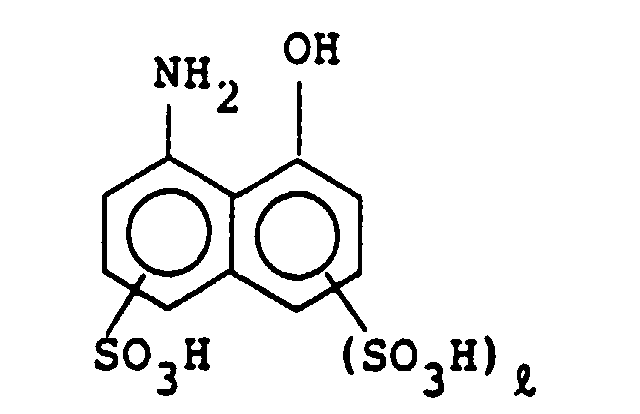
wobei ℓ wie vorstehend definiert ist,
in Form der freien Säure unter sauren Bedingungen, wobei das Kupplungsprodukt in einem sauren oder schwach alkalischen wäßrigen Medium mit einer Tetrazoverbindung, die durch herkömmliches Tetrazotieren einer Verbindung der folgenden Formel (VII)

hergestellt wurde, gekuppelt wird, und die so erhaltene Diazo-Diazo-Verbindung mit einer Verbindung der folgenden Formel (VIII)
Q2-H (VIII)
wobei Q2 wie in Anspruch 1 definiert ist,
gekuppelt wird.
Q1-NH2 (V)
wobei Q1 wie in Anspruch 1 definiert ist
in herkömmlicher Weise diazotiert wird, gefolgt von Kuppeln mit einer Verbindung der folgenden Formel (VI)
wobei ℓ wie vorstehend definiert ist,
in Form der freien Säure unter sauren Bedingungen, wobei das Kupplungsprodukt in einem sauren oder schwach alkalischen wäßrigen Medium mit einer Tetrazoverbindung, die durch herkömmliches Tetrazotieren einer Verbindung der folgenden Formel (VII)
hergestellt wurde, gekuppelt wird, und die so erhaltene Diazo-Diazo-Verbindung mit einer Verbindung der folgenden Formel (VIII)
Q2-H (VIII)
wobei Q2 wie in Anspruch 1 definiert ist,
gekuppelt wird.
1. Composé trisazoïque représenté par la formule (I) suivante sous la forme d'acide libre:
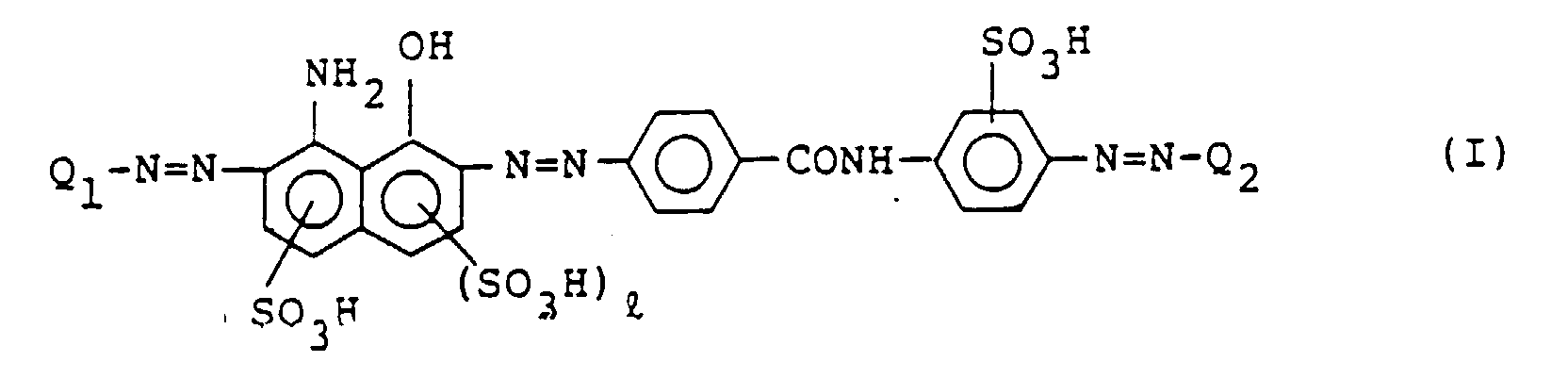
dans laquelle Q1 et Q2 sont chacun, indépendamment l'un de l'autre, un groupement phényle ou naphtyle non substitué ou substitué et ℓ est mis pour 0 ou 1.
dans laquelle Q1 et Q2 sont chacun, indépendamment l'un de l'autre, un groupement phényle ou naphtyle non substitué ou substitué et ℓ est mis pour 0 ou 1.
2. Composé trisazoïque selon la revendication 1, représenté par la formule (II) suivante
sous la forme d'acide libre
dans laquelle Q1 et Q2 sont tels que définis dans la revendication 1.
dans laquelle Q1 et Q2 sont tels que définis dans la revendication 1.
3. Composé trisazoïque selon la revendication 1, représenté par la formule (III) suivante
sous la forme d'acide libre
dans laquelle ℓ , Q1 et Q2 sont tels que définis dans la revendication 1.
dans laquelle ℓ , Q1 et Q2 sont tels que définis dans la revendication 1.
4. Composé trisazoïque selon la revendication 1, représenté par la formule (IV) suivante
sous la forme d'acide libre
dans laquelle Q1 et Q2 sont tels que définis dans la revendication 1.
dans laquelle Q1 et Q2 sont tels que définis dans la revendication 1.
5. Composé trisazoïque seion l'une quelconque des revendications 1 à 4, dans lequel Q1 est un groupement phényle représenté par la formule suivante:
dans laquelle R1 et R2 sont chacun, indépendamment l'un de l'autre, un atome d'hydrogène. un groupement nitro, sulfo, sulfamoyle, alkyle, alcoxy, amino substitué ou non substitué, carboxy ou un atome d'halogène.
dans laquelle R1 et R2 sont chacun, indépendamment l'un de l'autre, un atome d'hydrogène. un groupement nitro, sulfo, sulfamoyle, alkyle, alcoxy, amino substitué ou non substitué, carboxy ou un atome d'halogène.
6. Composé trisazoïque selon l'une quelconque des revendications 1 à 4, dans lequel Q1 est un groupement naphtyle représenté par la formule suivante:
dans laquelle R3, R4 et R5 sont chacun, indépendamment les uns des autres, un atome d'hydrogène ou un groupement hydroxyle ou sulfo.
dans laquelle R3, R4 et R5 sont chacun, indépendamment les uns des autres, un atome d'hydrogène ou un groupement hydroxyle ou sulfo.
7. Composé trisazoïque selon l'une quelconque des revendications 1 à 6, dans lequel Q2 est un groupement phényle substitué une fois, deux fois ou trois fois par un groupement
hydroxyle et non substitué ou substitué par un groupement amino substitué ou non substitué,
sulfo, alkyle, alcoxy ou carboxy.
8. Composé trisazoïque selon l'une quelconque des revendications 1 à 6, dans lequel Q2 est un groupement phényle substitué une fois ou deux fois par un groupement amino
substitué ou non substitué et non substitué ou substitué par un groupement hydroxyle,
sulfo, alkyle, alcoxy ou carboxy.
9. Composé trisazoïque selon l'une quelconque des revendications 1 à 6, dans lequel Q2 est un groupement naphtyle substitué une fois ou deux fois par un groupement hydroxyle
et non substitué ou substitué par un groupement sulfo, amino, acétyle, phényle, sulfophényle,
disulfophényle, benzoyle ou méthylamino.
10. Composé trisazoïque selon l'une quelconque des revendications 1 à 6, dans lequel Q2 est un groupement naphtyie substitué une fois ou deux fois par un groupement amino
ou méthyl-, éthyl-, hydroxyéthyl-, cyanoéthyl-, acétyl- ou carbamoylamino et non substitué
ou substitué par un groupement hydroxyle ou sulfo.
11. Procédé de teinture ou d'impression de fibres ou de papier, comprenant l'utilisation
du composé trisazoïque selon l'une quelconque des revendications 1 à 10.
12. Encre, contenant le composé trisazoïque selon l'une quelconque des revendications
1 à 10.
13. Procédé de préparation du composé trisazoïque selon la revendication 1, caractérisé
en ce qu'un composé représenté par la formule (V) suivante:
Q1-NH2 (V)
dans laquelle Q1 est tel que défini dans la revendication 1, est diazoté de façon classique, puis copulé avec un composé représenté par la formule (VI) suivante sous la forme d'acide libre
dans laquelle ℓ est tel que défini précédemment, dans des conditions acides, le produit de la réaction de copulation est copulé, dans un milieu aqueux acide ou faiblement alcalin, avec un composé tétrazoïque préparé en tétra-azotant de façon classique un composé représenté par la formule (VII) suivante:
et le composé disazo-diazoïque ainsi obtenu est copulé avec un composé représenté par la formule (VIII) suivante:
Q2-H (VIII)
dans laquelle Q2 est tel que défini dans la revendication 1.
Q1-NH2 (V)
dans laquelle Q1 est tel que défini dans la revendication 1, est diazoté de façon classique, puis copulé avec un composé représenté par la formule (VI) suivante sous la forme d'acide libre
dans laquelle ℓ est tel que défini précédemment, dans des conditions acides, le produit de la réaction de copulation est copulé, dans un milieu aqueux acide ou faiblement alcalin, avec un composé tétrazoïque préparé en tétra-azotant de façon classique un composé représenté par la formule (VII) suivante:
et le composé disazo-diazoïque ainsi obtenu est copulé avec un composé représenté par la formule (VIII) suivante:
Q2-H (VIII)
dans laquelle Q2 est tel que défini dans la revendication 1.