| (19) |
 |
|
(11) |
EP 0 449 891 B1 |
| (12) |
EUROPEAN PATENT SPECIFICATION |
| (45) |
Mention of the grant of the patent: |
|
30.10.1996 Bulletin 1996/44 |
| (22) |
Date of filing: 20.12.1989 |
|
| (51) |
International Patent Classification (IPC)6: C21B 13/14 |
| (86) |
International application number: |
|
PCT/AU8900/544 |
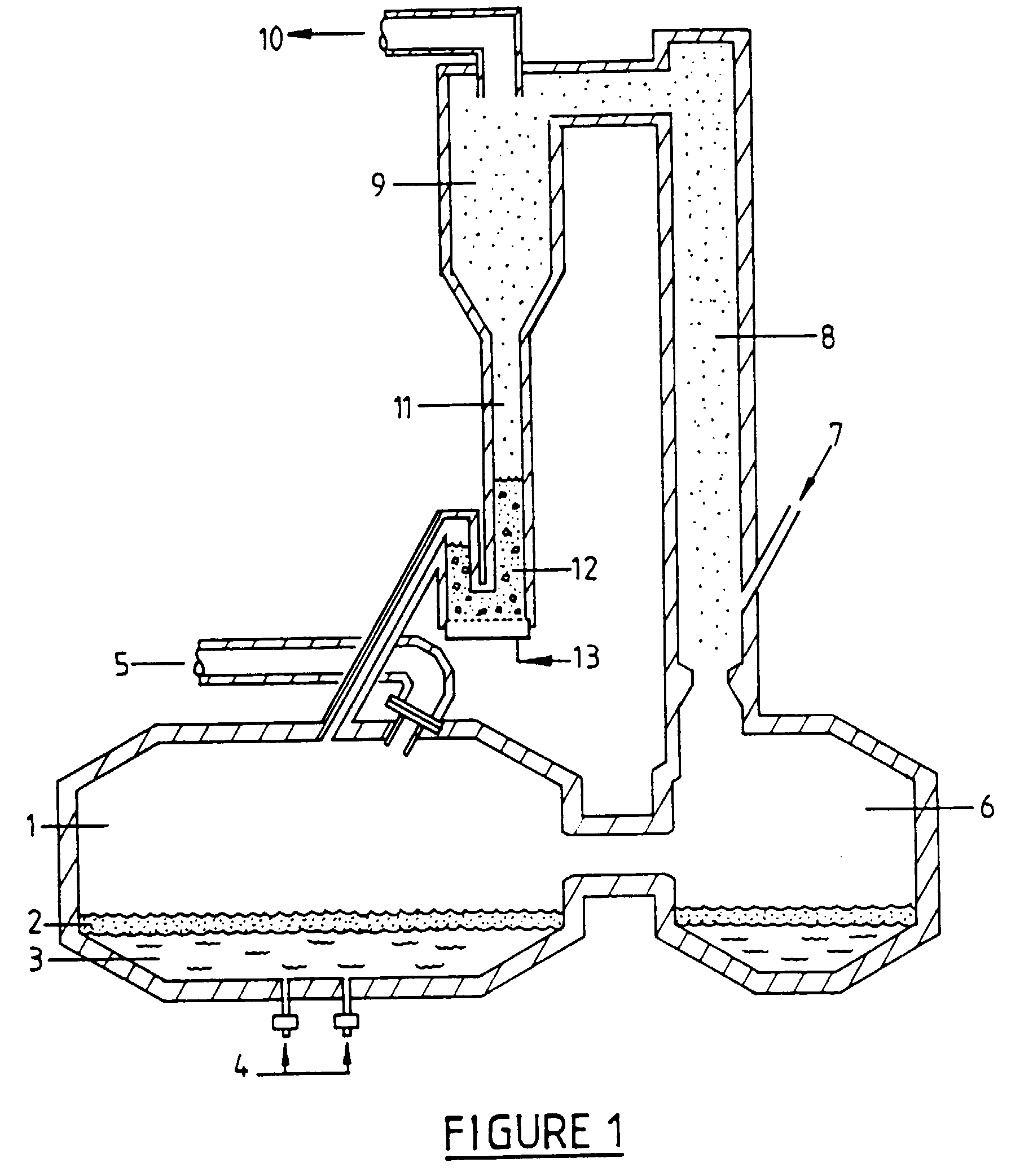
| (87) |
International publication number: |
|
WO 9007/010 (28.06.1990 Gazette 1990/15) |
|
| (54) |
MANUFACTURE OF IRON AND STEEL IN A DUPLEX SMELTER AND SOLID STATE OXIDE SUSPENSION
PREREDUCER
HERSTELLUNG VON EISEN UND STAHL IN EINER DUPLEX-VERHÜTTUNGSANLAGE UND ANLAGE ZUR VORREDUZIERUNG
VON OXIDFESTKÖRPERN IN DER SCHWEBE
FABRICATION DE FER ET D'ACIER DANS UN CREUSET DE FUSION DUPLEX ET PREREDUCTEUR DE
SUSPENSION D'OXYDE A L'ETAT SOLIDE
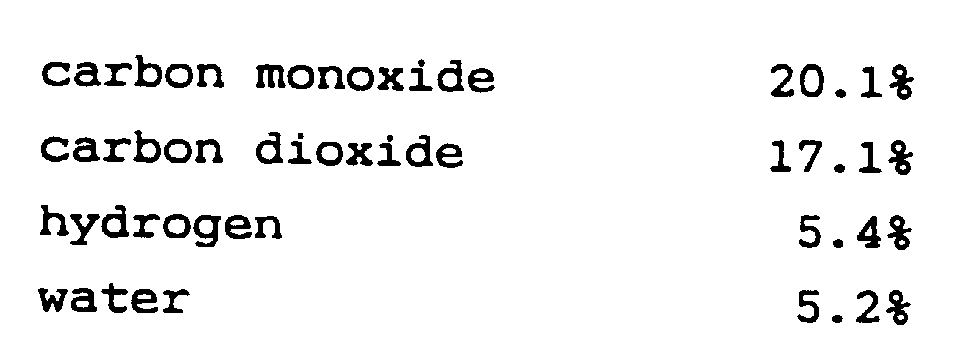
|
| (84) |
Designated Contracting States: |
|
AT BE CH DE ES FR GB IT LI LU NL SE |
| (30) |
Priority: |
20.12.1988 AU 2047/88
|
| (43) |
Date of publication of application: |
|
09.10.1991 Bulletin 1991/41 |
| (73) |
Proprietor: CRA SERVICES LIMITED |
|
Melbourne, VIC 3000 (AU) |
|
| (72) |
Inventors: |
|
- DRY, Rodney, James
Glen Waverley, VIC 3150 (AU)
- LA NAUZE, Robert, David
Camberwell, VIC 3124 (AU)
|
| (74) |
Representative: Orr, William McLean |
|
URQUHART-DYKES & LORD
5th Floor, Tower House
Merrion Way
Leeds
West Yorkshire, LS2 8PA
Leeds
West Yorkshire, LS2 8PA (GB) |
| (56) |
References cited: :
EP-A- 0 012 363
AU-A- 2 474 288
AU-A- 2 683 188
AU-A- 5 003 685
AU-B- 0 534 088
GB-A- 827 957
US-A- 3 235 374
|
EP-A- 0 236 801
AU-A- 2 491 688
AU-A- 3 105 177
AU-B- 0 463 981
DE-B- 1 086 256
US-A- 2 750 277
|
|
| |
|
|
|
|
| |
|
| Note: Within nine months from the publication of the mention of the grant of the European
patent, any person may give notice to the European Patent Office of opposition to
the European patent
granted. Notice of opposition shall be filed in a written reasoned statement. It shall
not be deemed to
have been filed until the opposition fee has been paid. (Art. 99(1) European Patent
Convention).
|
Technical Field
[0001] The present invention relates to the production of iron and/or iron alloys from iron
oxides which have been partially reduced using offgas from the smelting vessel which
has been subjected to post-combustion.
[0002] In one aspect, the invention is particularly concerned with a process for the production
of iron and/or iron-alloys from iron oxides which are partially reduced using offgas
from a smelting vessel which offgas has been subjected to at least partial post-combustion,
comprising entraining the iron oxides in the offgas prior to substantial cooling of
the offgas, separating the partially reduced iron oxides from the offgas and feeding
separated, partially reduced iron oxides to the smelting vessel for in-bath smelting
by reaction with carbon-containing fuel and optionally oxygen-containing gas.
[0003] In another aspect, the invention is particularly concerned with apparatus for the
production of iron and/or iron alloys from partially reduced iron oxides, the apparatus
comprising a smelting vessel having means for introducing carbon-containing fuel and
optionally oxygen-containing gas directly into a liquid phase in the vessel for smelting
the iron oxides and means for introducing an oxygen-containing gas into a space above
the liquid phase in the vessel for the post-combustion of offgas from the smelting
reaction, an outlet for the post-combusted offgas from the vessel, means for introducing
iron oxide containing material to the post-combusted offgas downstream of the outlet
to cool the offgas and to simultaneously partially reduce the material as it is conveyed
by the offgas, means for separating the partially reduced material from the offgas
and means for introducing the partially reduced material into the smelting vessel.
Background
[0004] Ferrous bath-smelting processes with direct injection of ore and reducing agents
are attractive from a commercial point of view. This arises from the fact that ore
fines can be fed directly, obviating the need for lump feed as required by the blast
furnace. Further, steaming coal can be used as reducing agent without prior removal
of volatile matter in coke ovens.
[0005] Reducing agent (usually coal) consumption on such a system can be excessive, however,
and the key to efficient operation of the smelting vessel is post-combustion of smelter
offgas. In one embodiment of this concept, an oxygen-containing gas is admitted into
the space above the bath and some of the carbon monoxide and hydrogen present is oxidised
to carbon dioxide and water. The heat thus liberated is transferred back to the bath,
and this reduces the amount of reducing agent needed in the process. Such a system
is described in Australian Patent Specification 74409/81.
[0006] The smelter offgas from such a process contains appreciable amounts of carbon monoxide
and hydrogen, and leaves the main vessel at relatively high temperature (eg. 1600°C).
To further reduce the amount of reductant consumed in the overall process, it is beneficial
to pre-reduce incoming iron ore feed with this offgas prior to admitting it to the
smelting vessel. One such proposal is described in Australian Patent Specification
28044/84, in which the pre-reduction occurs in a shaft furnace.
[0007] Stickiness of particles under pre-reduction conditions is a potential problem. At
temperatures above about 1000°C, particles begin to cling to surfaces and thus create
serious difficulties in plant operation. To avoid this, it is necessary to arrange
the process in such a way as to maintain pre-reduction temperatures in the range 800
- 1000°C. At temperatures much below 800°C, pre-reduction rates slow appreciably and
excessive residence-times are needed.
[0008] The proposal in the aforementioned AU-28044/84 aims to avoid this difficulty by cooling
the offgas in a pre-conditioning chamber in which the offgas is additionally reduced
by an intensive mixing action between the gas and coal dust caused by a special grid
or lattice-lining over which the gas is passed. A cyclone is then required to separate
the coal dust from the reduced, cooled offgas, prior to passing the gas to a shaft
furnace to reduce the iron ore. However, it would be anticipated that a build-up of
the sticky particles would occur on the special grid or lattice-lining and other surfaces
of the pre-conditioning chamber.
[0009] EP-A-0236801 discloses process and apparatus of the type described above. In particular
it proposes an alternative arrangement for pre-reducing the ore in which fine ore
is introduced directly into the hot reducing gas immediately downstream of the offgas
outlet from the smelting vessel. The ore is introduced to the offgas in a gas cooling
tank through which the gas travels substantially horizontally to a cyclone in which
the reduced ore is separated from the offgas. The gas is cooled to below 1000°C in
the tank and the arrangement is such that molten material carried over from the smelting
vessel with the offgas is solidified in the gas cooling tank rather than depositng
in the passage connecting the tank to the vessel. The ore used in this arrangement
is restricted to a maximum particle size of 0.1 mm.
[0010] It is an object of the present invention to alleviate the disadvantages of the aforementioned
proposals and particularly to facilitate the partial reduction of particulate iron
oxide containing material in the smelter offgas in an improved range of particle sizes.
Summary of the Invention
[0011] According to the one aspect of the present invention there is provided a process
of the type described above characterized in that the hot at least partially post-combusted
offgas is introduced without substantial cooling into a vertical riser duct and conveyed
upwardly therethrough and particulate iron oxides are entrained in the hot offgas
as it is conveyed upwardly to be partially reduced and to simultaneously cool the
offgas.
[0012] According to the other aspect of the present invention there is provided apparatus
of the type described above characterized in that a vertical riser duct is connected
to the offgas outlet and the introducing means opens into the duct, the duct and introducing
means being arranged whereby the material is introduced to the offgas prior to the
offgas being cooled substantially from the vessel, and in that the separating means
is connected to the duct at or adjacent the top of the duct.
[0013] By the present invention there is provided a process and an apparatus for supplying
pre-reduced iron oxides to a smelting vessel. This system comprises conducting hot
smelter offgas (without substantial prior cooling) into a vertical riser duct into
which particulate iron oxide material is fed. The offgas is cooled in the duct, and
at the same time pre-reduction of the iron oxide material takes place. The duct is
conveniently maintained in the gas velocity range 3-15 m/s with the entrained solids
having a top size of not greater than 8 mm. The preferred maximum particle size is
in the range of 0.1 to 6mm. Advantageously the feed material comprises iron ore but
other iron oxide containing materials may be suitable.
[0014] The temperature of the hot offgas entering the vertical riser duct is substantially
at the temperature of the smelting vessel, for example in the range 1300°C to 1800°C
and the introduction of the particulate material to the riser duct, primarily the
iron oxide containing material but possibly also one or more of slag-forming agents
such as limestone, anti-sticking agents and reducing agents, is adapted to quench
the gas in the duct to within the range 800 to 1000°C, advantageously about 900°C,
so as to alleviate the stickiness problems.
[0015] At or adjacent the top of the riser duct the separating means for separation of gas
and solid is conveniently a cyclone or combination of cyclones. The partially reduced
material which is removed from the gas in the separating means may be taken directly
as pre-reduction product for feeding to the smelting vessel, or may be split and a
portion, advantageously a major portion, returned to the lower region of the riser
duct via a suitable return leg. The latter version requires a device for transferring
hot solid against a pressure gradient in order to allow continuous re-injection into
the riser duct. A loopseal (as used in circulating fluidized bed combustion units)
is one device which would be suitable for this service.
[0016] The case which involves recirculation of solid from the separating means to the lower
reaches of the riser duct amounts to circulating fluidized bed (CFB) pre-reduction.
This is a most advantageous mode of operation, since by solids recirculation it is
possible to maintain a larger inventory of solid in the riser duct and hence a longer
solids residence-time in the pre-reduction environment. More effective quenching of
the smelter offgas is obtained and particle stickiness is controlled more effectively.
CFB operation also has the advantage of greater temperature uniformity along the riser
duct axis, thus providing a more favourable chemical driving force for pre-reduction.
[0017] In the CFB mode the amount of material recirculated may be significantly greater
than that fed (and removed as pre-reduction product). Under these conditions the exact
location of feed and product removal points in the riser - return leg loop is not
critical due to the dilution effect of the recirculating load.
[0018] Heat removal from the system may be needed in some form. Waste heat recovery is possible
in a number of places, one example being steam tubes in an expanded loopseal as proposed
for use with the CFB system. However, it is useful to be able to operate the pre-reduction
apparatus as an offgas cooler (without solid, eg. during start-up) and for this reason
it may be desirable to position heat recovery surfaces along the main gas flow path.
This may include providing cooling surfaces on the walls of the riser duct and/or
on walls of the separating means. As an alternative, it may be desirable to split
the smelter offgas into two streams and only admit to the riser duct that proportion
required to meet the heat demand of the pre-reduction process. In this case there
would be no need for internal heat recovery surfaces in the pre-reduction system.
[0019] The pre-reduction chemistry will generally not require or allow metallization (ie.
greater than 30% pre-reduction) of fresh iron ore used as the iron oxide containing
material.
Brief Description of the Drawings
[0020] Two embodiments of a process and apparatus in accordance with the present invention
will now be described by way of example only with reference to the accompanying drawings
in which:
Figure 1 illustrates a system for supplying pre-reduced material to a furnace by a
once-through system; and
Figure 2 illustrates a system for supplying pre-reduced material to a furnace by a
recirculating system.
Detailed Description of the Drawings
[0021] Figure 1 shows a refractory-lined smelting vessel which contains a gas space 1 and
a melt comprising molten slag 2 and molten iron 3 with dissolved and dissolving carbon
at a temperature of 1300 to 1800°C. Coal 4, optionally with oxygen-containing gas,
is injected into the vessel below the melt and reacts with oxygen in the liquid phases
to form mainly carbon monoxide and hydrogen. An oxygen-containing gas 5 is injected
into the gas space, and partial combustion of carbon monoxide and hydrogen occurs.
Heat from this post-combustion step is transferred back to the melt and the hot, dirty
gas stream leaves the vessel at a temperature in the range 1300 to 1800°C. Australian
Patent Specification 74409/81 describes this process in greater detail.
[0022] Once the gas leaves the main smelting vessel, it enters a secondary chamber 6. The
function of the secondary chamber 6 is to disengage the gas from molten slag and iron
by expansion of the gas and it is important that the gas does not cool significantly
in the chamber 6. The chamber 6 may be replaced by a series of such chambers and possibly
a cyclone to extract as much slag and molten material as possible, or may be omitted
altogether.
[0023] Smelter offgas, still at a temperature close to that of the main smelting vessel
and laden with liquid (and some solid) droplets, is ducted directly into the bottom
portion of a vertical riser duct 8. Fresh iron oxide-rich material with a particle
size up to 6mm is introduced at 7, optionally mixed in minor proportions with slag-forming
agents, anti-sticking agents and/or reducing agents. The inlet 7 opens immediately
downstream of a restricted neck in the riser duct 8 which acts to accelerate the gas
flow and increase admixing of the particulate matter with the gas. Hot gas cooling
and solids pre-reduction takes place in the riser duct 8, which is designed to operate
at a gas velocity in the range 3 to 15 m/s and to give an average suspension density
of between 2 and 50 kg per cubic metre. The solids are reduced no further than wustite
(FeO). Temperatures in the riser are generally between 800 to 1000°C, and cooling
surfaces (not shown) are arranged on the walls of the riser duct to remove the requisite
amount of heat. Such cooling surfaces are designed to minimise obstructing the flow
of gas through the duct.
[0024] At the top of the riser duct 8 the mixture enters a cyclone 9. Solids are collected
from the underflow 11 and are introduced to the main smelting vessel by an appropriate
means. The gas stream 10 may be ducted to further waste heat recovery and particulate
removal units (not shown).
[0025] The currently preferred illustrated means for transferring the partly reduced material
from the low pressure underflow 11 to the main smelting vessel comprises a fluidized
loopseal 12. A sealing bed of the partly reduced material is maintained in a fluidized
state by feeding a suitable gas stream 13 such as nitrogen or any other gas not containing
appreciable amounts of oxygen, via a distributor at the base of the loopseal. Pre-reduced
solids overflow directly into a duct connected to the main smelting vessel.
[0026] It is recognized that the transfer means comprising the loopseal 12 may not be entirely
satisfactory due to particulate build-up at the inlet to the smelting vessel, and
it is possible that a system (not shown) by which the partly reduced material is injected
into the smelting vessel may be advantageous.
[0027] Referring now to Figure 2, the operation of the circulating fluidised bed (CFB) version
of the pre-reduction system differs from its non-recirculating counterpart described
with reference to Figure 1 in one principal sense only: fresh particulate iron oxide
containing material is given the opportunity to pass through the riser duct 8 a plurality
of times before leaving the pre-reduction environment. As shown in Figure 2, a recycle
conduit 14, 15 is provided and this allows multiple passes up the riser duct 8. This
conduit is in the form of a loopseal similar to loopseal 12 which is also fluidized
by the aeration gas 13. The conduit 15 opens into the riser duct 8 immediately downstream
of the restricted necking in the duct.
[0028] Feed solids may be introduced into the CFB system (i.e. 8, 9, 11, 14 and 15) at any
convenient location, the preferred point being by way of inlet 16 opening into conduit
15. The recirculated solids may be at a temperature in the range 700 to 900°C.
[0029] Suspension densities in the riser are higher than those in the once-through system,
with average densities in the range 10 to 300 kg per cubic metres. Gas-solids contact
times are increased by this means, and more effective particle stickiness control
is achieved. The increased flow of particulate material around the CFB loop acts to
even out temperatures, and this leads to a stronger and more uniform chemical driving
force for the pre-reduction reactions.
EXAMPLES
Non-Recirculating Pre-Reduction
[0030] A pilot-plant riser reactor is held at a (riser) top temperature of 800°C and is
fed with gas at a rate of 44.6 normal cubic metres per hour. The composition of this
gas (volume percent) is as follows:
| carbon monoxide |
18.2% |
| carbon dioxide |
16.4% |
| hydrogen |
3.9% |
| water |
6.5% |
| nitrogen |
55.3% |
[0031] Gas velocity in the riser is set at 6.2 m/s and iron ore with a top size of 1mm is
fed at a rate of 37 kg per hour. A pre-reduction level of 12 percent is achieved.
Recirculating Pre-Reduction
[0032] A pilot-plant CFB pre-reduction reactor is maintained at a riser top temperature
of 900°C and is fed with gas at a rate of 44.6 normal cubic metres per hour. The composition
of this gas is as follows:

[0033] Gas velocity in the riser is set at 6 m/s and iron ore with a top size of lmm is
fed at a rate of 14.3 kg per hour. A solids circulation rate of 1200 kg per hour is
maintained, and average suspension density in the riser is held at 190 kg per cubic
metre.
[0034] Average solids residence-time in the riser is 29 minutes and a pre-reduction level
of 24.1 percent is achieved.
Recirculating Pre-Reduction with Lime Addition
[0035] A pilot-plant CFB pre-reduction reactor is maintained at a riser top temperature
of 975°C and is fed with gas at a rate of 44.6 normal cubic metres per hour. The composition
of this gas is as follows:
| carbon monoxide |
19.1% |
| carbon dioxide |
17.6% |
| hydrogen |
4.5% |
| water |
5.6% |
| nitrogen |
53.1% |
[0036] Gas velocity in the riser is set at 6.1 m/s and iron ore with a top size of 1 mm
is fed at a rate of 17.1 kg per hour. In addition to the iron ore, lime is fed into
the CFB reactor at a rate of 0.9 kg per hour. A solids circulation rate of 500 kg
per hour is maintained, and average suspension density in the riser is held at 89
kg per cubic metre.
[0037] Average solids residence-time in the riser is 10 minutes and a pre-reduction level
of 23.7 percent is achieved.
1. A process for the production of iron and/or iron-alloys from iron oxides which are
partially reduced using offgas from a smelting vessel (1) which offgas has been subjected
to at least partial post-combustion, comprising entraining (7, 15, 16) the iron oxides
in the offgas prior to substantial cooling of the offgas, separating (9) the partially
reduced iron oxides from the offgas and feeding (12) separated, partially reduced
iron oxides to the smelting vessel for in-bath smelting by reaction with carbon-containing
fuel and optionally oxygen-containing gas, characterised in that the hot at least
partially post-combusted offgas is introduced without substantial cooling into a vertical
riser duct (8) and conveyed upwardly therethrough and particulate iron oxides are
entrained in the hot offgas as it is conveyed upwardly to be partially reduced and
to simultaneously cool the offgas.
2. A process according to Claim 1 wherein offgas flow through the vertical riser duct
(8) is maintained in the range 3 to 15 m/s.
3. A process according to Claim 1 wherein the particulate material entrained in the offgas
has a maximum particulate size of not greater than 8mm, preferably not greater than
6mm.
4. A process according to Claim 3 wherein the maximum particulate size is in the range
of 0.1 to 6mm.
5. A process according to Claim 1 wherein prior to entering the vertical riser duct (8)
the hot offgas passes through a separation step (6) in which solid or molten material
carried over from the smelting vessel (1) in the offgas is separated from the offgas
without substantial cooling of the offgas.
6. A process according to Claim 1 wherein the hot reducing offgas enters the vertical
riser duct (8) at a maximum temperature of 1800°C.
7. A process according to Claim 1 wherein temperature in the vertical riser duct (8)
after entrainment of particulate material in the offgas is maintained in the range
800 to 1000°C.
8. A process according to Claim 1 wherein one or more additives selected from the group
of slag-forming agents, anti-sticking agents and reducing agents are also entrained
in the offgas in the vertical riser duct (8).
9. A process according to Claim 1 wherein the at least partially reduced material is
separated from the offgas in one or more cyclones (9).
10. A process according to Claim 1 wherein some of said separated reduced material is
recycled (14, 15) to the vertical riser duct (8) for entrainment in hot reducing offgas.
11. A process according to Claim 10 wherein said particulate iron oxide containing material
is mixed (16) with said separated reduced material to be recycled, prior to entrainment
in the offgas in the vertical riser duct (8).
12. Apparatus for the production of iron and / or iron alloys from partially reduced iron
oxides, the apparatus comprising a smelting vessel (1) having means (4) for introducing
carbon-containing fuel and optionally oxygen-containing gas directly into a liquid
phase in the vessel (1) for smelting the iron oxides and means (5) for introducing
an oxygen-containing gas into a space above the liquid phase in the vessel (1) for
the post-combustion of offgas from the smelting reaction, an outlet for the post-combusted
offgas from the vessel (1), means (7, 15, 16) for introducing iron oxide containing
material to the post-combusted offgas downstream of the outlet to cool the offgas
and to simultaneously partially reduce the material as it is conveyed by the offgas,
means (9) for separating the partially reduced material from the offgas and means
(11, 12) for introducing the partially reduced material into the smelting vessel,
characterised in that a vertical riser duct (8) is connected to the offgas outlet
and the introducing means (7, 15, 16) opens into the duct (8), the duct (8) and introducing
means (7, 15, 16) being arranged whereby the material is introduced to the offgas
prior to the offgas being cooled substantially from the vessel (1), and in that the
separating means (9) is connected to the duct (8) at or adjacent the top of the duct
(8).
13. Apparatus according to Claim 12 wherein means (6) is provided between the offgas outlet
from the smelting vessel (1) and the vertical riser duct (8) for the separation of
solid or molten material carried over from the smelting vessel from the offgas without
substantial cooling of the offgas.
14. Apparatus according to Claim 13 wherein said means (6) for the separation of solid
or molten material comprises an expansion chamber.
15. Apparatus according to Claim 12 wherein the vertical riser duct (8) includes means
for accelerating the offgas flow, said means being located immediately upstream of
the iron oxide containing material introducing means (7, 15, 16).
16. Apparatus according to Claim 12 wherein the means (9) for separating the at least
partially reduced material from the offgas comprises one or more cyclones.
17. Apparatus according to Claim 12 wherein a return branch (14) is provided between the
means (9) for separating the at least partially reduced material and the means (15,
16) for introducing said reduced material into the smelting vessel (1), for recycling
part of the at least partially reduced material back to the vertical riser duct (8).
18. Apparatus according to Claim 17 wherein the means (16) for introducing iron oxide
containing material has an outlet into said return branch (14).
1. Verfahren für die Produktion von Eisen und/oder Eisenlegierungen aus Eisenoxiden,
die unter Verwendung eines Abgases aus einem Schmelzgefäß (1) teilweise reduziert
werden, wobei das Abgas einer mindestens teilweisen Nachverbrennung unterworfen wurde,
enthaltend die Mitnahme (7, 15, 16) der Eisenoxide in dem Abgas vor dem wesentlichen
Kühlen des Abgases, das Trennen (9) der teilweise reduzierten Eisenoxide aus dem Abgas
und das Zuführen (12) der getrennten, teilweise reduzierten Eisenoxide in das Schmelzgefäß
zum Schmelzen in dem Bad durch Reaktion mit Kohle enthaltendem Brennstoff und ggf.
Sauerstoff enthaltendem Gas, dadurch gekennzeichnet, daß das heiße, mindestens teilweise
nachverbrannte Abgas ohne wesentliche Kühlung in eine senkrechte Steigleitung (8)
eingeführt und durch diese nach oben gefördert wird und daß partikelförmige Eisenoxide
in dem heißen Abgas mitgenommen werden, wenn dieses nach oben gefördert wird, um teilweise
reduziert zu werden und gleichzeitig das Abgas zu kühlen.
2. Verfahren nach Anspruch 1, bei dem die Abgasströmung durch die senkrechte Steigleitung
(8) im Bereich von 3 bis 15 m/s aufrechterhalten wird.
3. Verfahren nach Anspruch 1, bei dem das in dem Abgas mitgenommene partikelförmige Material
eine maximale Partikelgröße von nicht mehr als 8 mm aufweist, vorzugsweise nicht mehr
als 6 mm.
4. Verfahren nach Anspruch 3, bei dem die maximale Partikelgröße im Bereich von 0,1 bis
6 mm liegt.
5. Verfahren nach Anspruch 1, bei dem das heiße Abgas vor dem Eintreten in die senkrechte
Steigleitung (8) durch einen Trennschritt (6) hindurchgeht, in dem festes oder geschmolzenes
Material, das von dem Schmelzgefäß (1) in das Abgas übertragen wird, von dem Abgas
getrennt wird, ohne dieses wesentlich zu kühlen.
6. Verfahren nach Anspruch 1, bei dem das heiße reduzierende Abgas in die senkrechte
Steigleitung (8) bei einer Maximaltemperatur von 1800 °C gelangt.
7. Verfahren nach Anspruch 1, bei dem die Temperatur in der senkrechten Steigleitung
(8) nach Mitnahme des partikelförmigen Materials in dem Abgas im Bereich von 800 bis
1000 °C gehalten wird.
8. Verfahren nach Anspruch 1, bei dem einer oder mehr Zuschlagstoffe, ausgewählt aus
der Gruppe der Schlackenbildungsmittel, der Antihaftmittel und der Reduziermittel,
ebenfalls in dem Abgas in der senkrechten Steigleitung (8) mitgenommen werden.
9. Verfahren nach Anspruch 1, bei dem das mindestens teilweise reduzierte Material aus
dem Abgas in einem oder mehreren Zyklonen (9) getrennt wird.
10. Verfahren nach Anspruch 1, bei dem ein Teil des abgetrennten reduzierten Materials
zur Mitnahme in dem heißen reduzierenden Abgas in die senkrechte Steigleitung (8)
zurückgeführt wird.
11. Verfahren nach Anspruch 10, bei dem das das partikelförmige Eisenoxid enthaltende
Material mit dem getrennten zurückzuführenden reduzierten Material gemischt wird,
bevor es in dem Abgas in der senkrechten Steigleitung (8) mitgenommen wird.
12. Vorrichtung für die Produktion von Eisen und/oder Eisenlegierungen aus teilweise reduzierten
Eisenoxiden, wobei die Vorrichtung ein Schmelzgefäß (1) mit Mitteln (4) zum Einbringen
von Kohle enthaltendem Brennstoff und ggf. Sauerstoff enthaltendem Gas direkt in eine
flüssige Phase in das Gefäß (1) zum Schmelzen der Eisenoxide und Mittel (5) zum Einführen
eines Sauerstoff enthaltenden Gases in einen Raum oberhalb der flüssigen Phase in
dem Gefäß für die Nachverbennung des Abgases aus der Schmelzreaktion, einen Auslaß
für das nachverbrannte Abgas aus dem Gefäß (1), Mittel (7, 15, 16) zum Einführen von
Eisenoxid enthaltendem Material in das nachverbrannte Abgas stromab des Auslasses
zum Kühlen des Abgases und gleichzeitig zum teilweisen Reduzieren des Materials, wenn
dieses von dem Abgas gefördert wird, Mittel (9) zum Trennen des teilweise reduzierten
Materials aus dem Abgas sowie Mittel (11, 12) zum Einbringen des teilweise reduzierten
Materials in das Schmelzgefäß aufweist, dadurch gekennzeichnet, daß eine senkrechte
Steigleitung (8) mit dem Abgasauslaß verbunden ist und die Einführmittel (7, 15, 16)
sich in die Leitung (8) öffnen, daß die Leitung (8) und die Einführmittel (7, 15,
16) so angeordnet sind, daß das Material in das Abgas vor dessen Gekühltwerden im
wesentlichen aus dem Gefäß (1) eingeführt wird, und daß die Trennmittel (9) mit der
Leitung (8) bei oder im Bereich des oberen Endes der Leitung (8) verbunden sind.
13. Vorrichtung nach Anspruch 12, bei der Mittel (6) zwischen dem Abgasauslaß aus dem
Schmelzgefäß (1) und der senkrechten Steigleitung (8) für die Trennung von festem
oder geschmolzenem Material vorgesehen sind, das aus dem Schmelzgefäß von dem Abgas
übertragen wird, ohne wesentliches Kühlen des Abgases.
14. Vorrichtung nach Anspruch 13, bei der die Mittel (6) für die Trennung des festen oder
geschmolzenen Materials eine Expansionskammer umfassen.
15. Vorrichtung nach Anspruch 12, bei der die senkrechte Steigleitung (8) Mittel zum Beschleunigen
der Strömung des Abgases aufweist, die unmittelbar stromauf der Einführmittel (7,
15, 16) für das Eisenoxid enthaltende Material angeordnet sind.
16. Vorrichtung nach Anspruch 12, bei der die Mittel (9) zum Trennen des mindestens teilweise
reduzierten Materials von dem Abgas einen oder mehrere Zyklone umfaßt.
17. Vorrichtung nach Anspruch 12, bei der eine Rückkehrabzweigung (14) zwischen den Mitteln
(9) zum Trennen des mindestens teilweise reduzierten Materials und den Mitteln (15,
16) zum Einbringen des reduzierten Materials in das Schmelzgefäß (11) vorgesehen ist,
zum teilweisen Zurückführen des mindestens teilweise reduzierten Materials zurück
in die senkrechte Steigleitung (8).
18. Vorrichtung nach Anspruch 17, bei der die Mittel (16) zum Einbringen des Eisenoxid
enthaltenden Materials einen Auslaß in die Rückkehrabzweigung (14) enthalten.
1. Procédé de production de fer et/ou d'alliages de fer à partir d'oxydes de fer qui
sont partiellement réduits en utilisant des effluents gazeux provenant d'un récipient
de fusion (1), lesquels effluents gazeux ont été soumis à une postcombustion au moins
partielle, consistant à entraîner (7, 15, 16) les oxydes de fer dans les effluents
gazeux avant un refroidissement important des effluents gazeux, séparer (9) les oxydes
de fer partiellement réduits des effluents gazeux et acheminer (12) les oxydes de
fer partiellement réduits, séparés, vers le récipient de fusion pour les faire fondre
dans un bain par réaction avec du combustible contenant du carbone et en option du
gaz contenant de l'oxygène, caractérisé en ce que les effluents gazeux chauds ayant
subi au moins partiellement une postcombustion sont introduits sans refroidissement
important dans une conduite montante verticale (8) et transportés vers le haut à travers
celle-ci et les oxydes de fer particulaires sont entraînés dans les effluents gazeux
chauds lorsqu'ils sont transportés vers le haut pour être partiellement réduits et
pour refroidir simultanément les effluents gazeux.
2. Procédé selon la revendication 1, dans lequel l'écoulement d'effluents gazeux à travers
la conduite montante verticale (8) est maintenu dans la plage allant de 3 à 15 m/s.
3. Procédé selon la revendication 1, dans lequel la matière particulaire entraînée dans
les effluents gazeux a une dimension particulaire maximale inférieure à 8 mm, de préférence
inférieure à 6 mm.
4. Procédé selon la revendication 3, dans lequel la dimension particulaire maximale est
dans la plage allant de 0,1 à 6 mm.
5. Procédé selon la revendication 1, dans lequel avant de pénétrer dans la conduite montante
verticale (8), les effluents gazeux chauds passent par une étape de séparation (6)
dans laquelle la matière solide ou la matière fondue transportée depuis le réservoir
de fusion (1) dans les effluents gazeux est séparée des effluents gazeux sans refroidissement
important des effluents gazeux.
6. Procédé selon la revendication 1, dans lequel les effluents gazeux réducteurs chauds
pénètrent dans la conduite montante verticale (8) à une température maximale de 1800°C.
7. Procédé selon la revendication 1, dans lequel la température dans la conduite montante
verticale (8) après entraînement de la matière particulaire dans les effluents gazeux
est maintenue dans la plage allant de 800 à 1000°C.
8. Procédé selon la revendication 1, dans lequel un ou plusieurs additifs choisis parmi
le groupe constitué d'agents de formation de scories, d'agents anti-adhésifs et d'agents
de réduction sont aussi entraînés dans les effluents gazeux dans la conduite montante
verticale (8).
9. Procédé selon la revendication 1, dans lequel la matière au moins partiellement réduite
est séparée des effluents gazeux dans un ou plusieurs cyclones (9).
10. Procédé selon la revendication 1, dans lequel une certaine partie de ladite matière
réduite séparée est recyclée (14, 15) vers la conduite montante verticale (8) pour
être entraînée dans les effluents gazeux réducteurs chauds.
11. Procédé selon la revendication 10, dans lequel ladite matière particulaire contenant
des oxydes de fer est mélangée (16) avec ladite matière réduite séparée pour être
recyclée, avant d'être entraînée dans les effluents gazeux dans la conduite montante
verticale (8).
12. Dispositif pour la production de fer et/ou d'alliages de fer à partir d'oxydes de
fer partiellement réduits, le dispositif comportant un récipient de fusion (1) ayant
des moyens (4) pour introduire du combustible contenant du carbone et en option un
gaz contenant de l'oxygène directement dans une phase liquide existant dans le récipient
(1) pour faire fondre les oxydes de fer et des moyens (5) pour introduire un gaz contenant
de l'oxygène à l'intérieur d'un espace situé au-dessus de la phase liquide existant
dans le récipient (1) pour la postcombustion des effluents gazeux provenant de la
réaction de fusion, une sortie pour les effluents gazeux ayant subi une postcombustion
à partir du récipient (1), des moyens (7, 15, 16) pour introduire une matière contenant
des oxydes de fer vers les effluents gazeux ayant subi une postcombustion en aval
de la sortie pour refroidir les effluents gazeux et simultanément réduire partiellement
la matière lorsqu'elle est transportée par les effluents gazeux, des moyens (9) pour
séparer la matière partiellement réduite des effluents gazeux et des moyens (11, 12)
pour introduire la matière partiellement réduite dans le récipient de fusion, caractérisé
en ce qu'une conduite montante verticale (8) est connectée à la sortie des effluents
gazeux et les moyens d'introduction (7, 15, 16) débouchent à l'intérieur de la conduite
(8), la conduite (8) et les moyens d'introduction (7, 15, 16) étant agencés de telle
sorte que la matière est introduite dans les effluents gazeux avant que les effluents
gazeux ne soient nettement refroidis à partir du récipient (1), et en ce que les moyens
de séparation (9) sont reliés à la conduite (8) à la partie supérieure de la conduite
(8) ou au voisinage de cette dernière.
13. Dispositif selon la revendication 12, dans lequel des moyens (6) sont agencés entre
la sortie des effluents gazeux provenant du récipient de fusion (1) et la conduite
montante verticale (8) destinés à la séparation à partir des effluents gazeux, de
la matière solide ou de la matière fondue transportée depuis le récipient de fusion,
sans refroidissement important des effluents gazeux.
14. Dispositif selon la revendication 13, dans lequel lesdits moyens (6) destinés à la
séparation de la matière solide ou de la matière fondue comportent une chambre d'expansion.
15. Dispositif selon la revendication 12, dans lequel la conduite montante verticale (8)
comporte des moyens pour accélérer l'écoulement des effluents gazeux, lesdits moyens
étant situés immédiatement en amont des moyens d'introduction de matière contenant
des oxydes de fer (7, 15, 16).
16. Dispositif selon la revendication 12, dans lequel les moyens (9) pour séparer la matière
au moins partiellement réduite des effluents gazeux comportent un ou plusieurs cyclones.
17. Dispositif selon la revendication 12, dans lequel un branchement de retour (14) est
agencé entre les moyens (9) pour séparer la matière au moins partiellement réduite
et les moyens (15, 16) pour introduire ladite matière réduite à l'intérieur du récipient
de fusion (1), pour recycler une partie de la matière au moins partiellement réduite
en retour vers la conduite montante verticale (8).
18. Dispositif selon la revendication 17, dans lequel les moyens (16) pour introduire
la matière contenant des oxydes de fer a une sortie dans ledit branchement de retour
(14).