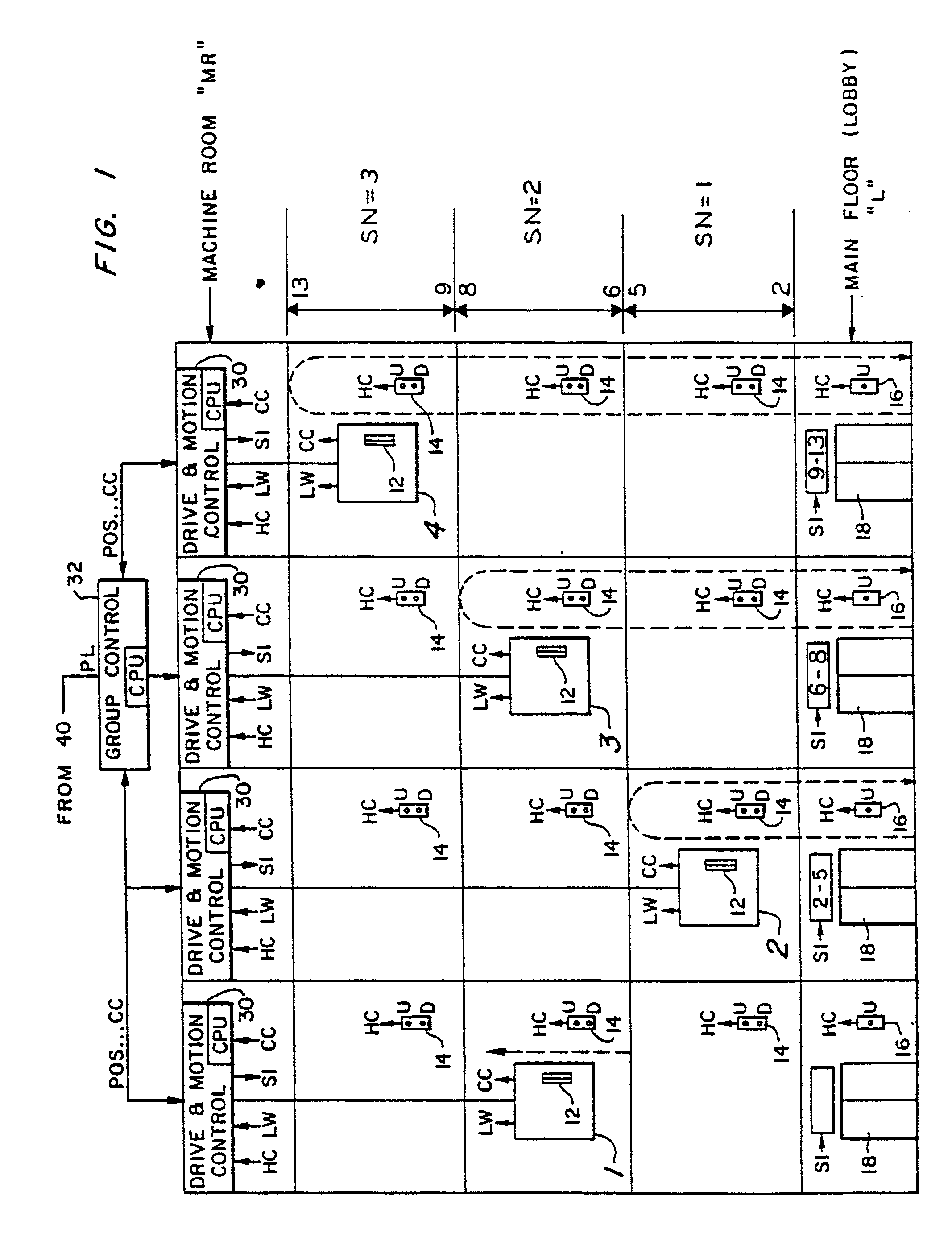
(57) The present invention is directed to the grouping of contiguous floors in a building
into sectors. According to the present invention, historical information regarding
the number of passengers arriving at each floor is obtained and used to predict the
number of passengers to be arriving at each of the floors. By summing the predicted
traffic per floor and dividing by the number of sectors to be formed, average traffic
per sector can be determined. In the preferred embodiment, sectors are formed, starting
from the first floor above the lobby and continuing through to the top floor in the
building, by selecting a set of contiguous floors for each sector such that the predicted
traffic for each sector is less than a predetermined threshold. Specifically, if the
predicted traffic for a selectable next contiguous floor, added to the predicted traffic
for all contiguous floors already selected for the sector, is less than the predetermined
threshold, the selectable floor is included in the sector. Otherwise, another sector
is begun with the selectable floor as the bottom floor in the other sector. In the
preferred embodiment, the predetermined threshold is based on the determined average
traffic per sector. In another aspect of the present invention, the frequency of service
elevator cars to each sector is variable. The traffic volume for each formed sector
is determined and compared with the determined average traffic per sector. The frequency
of service of elevator cars to each sector is variable, based on this comparison.
Thus, sectors having a larger traffic volume are serviced more often, relative to
sectors having a smaller traffic volume.
|
|
