|
(11) | EP 0 451 750 B1 |

| (12) | EUROPEAN PATENT SPECIFICATION |
|
|
| (54) |
Use of short chain fatty acid containing lipids to maintain gastrointestinal integrity and function in patients Verwendung von kurzkettige Fettsäuren enthaltenden Lipiden zur Aufrechterhaltung der Integrität und der Funktion des Magen-Darm-Kanals Utilisation de lipides contenant des acides gras à courte chaîne, pour maintenir l'intégrité et le fonctionnement gastro-intestinal chez des patients |
|
|
|||||||||||||||||||||||||||||||
| Note: Within nine months from the publication of the mention of the grant of the European patent, any person may give notice to the European Patent Office of opposition to the European patent granted. Notice of opposition shall be filed in a written reasoned statement. It shall not be deemed to have been filed until the opposition fee has been paid. (Art. 99(1) European Patent Convention). |
[0001] The present invention relates to the use of short chain fatty acids containing lipids in clinical nutrition, specifically for the preparation of a medicament for maintaining gastrointestinal integrity and function in patients.
[0002] Lipids containing fatty acids having 2 to 6 carbon atoms, (short chain fatty acids - SCFA), are known to be produced in the gastrointestinal tract, in particular in the colon. Short chain fatty acids include acetic, propionic, butyric, isobutyric, pentanoic, isopentenoic and caproic. Typically, the short chain fatty acids are produced by bacterial fermentation. The substrates for the production of short chain fatty acids by bacterial fermentation are carbohydrates that are generally fibrous in nature.
[0003] The short chain fatty acids are used by the gastrointestinal mucosa as an energy substrate to maintain integrity and function. One method of providing gastrointestinal mucosa with short chain fatty acids is to utilise a dietary fiber which is converted by luminal microorganism digestion to fatty acids. Due to a variety of clinical reasons, the ability of the gastrointestinal mucosa to use short chain fatty acids as an energy source can be impaired.
[0004] When in the course of human disease, or therapy for disease, the bacterial flora of the gut is modified, reduced, or eliminated, its ability to provide short chain fatty acids as an energy substrate is impaired. There are a number of procedures, specifically with respect to hospitalised individuals that can greatly alter or eliminate the microflora of the gut. This can occur, for example, due to antibiotics, chemotherapy, or radiation. Furthermore, when the fiber intake of the patient is restricted, such as with some current elemental diets, there is no substrate for microorganism digestion even if the microflora are viable.
[0005] Because, in the above-identified conditions, short chain fatty acids cannot be used by the gastrointestinal tract as an energy substrate, gastrointestinal integrity and function cannot be maintained.
[0006] WO 90/12080 discloses structured triglycerides which have at least one short chain fatty acid on a glycerol backbone and at least one medium or long chain fatty acid on the glycerol backbone. The structured triglycerides may be used as parenteral nutrition and dietary supplements.
[0007] This invention provides the use of a lipid containing short chain fatty acids selected from fatty acids having 2 to 5 carbon atoms for the preparation of a medicament for maintaining gastrointestinal integrity and function in patients, the lipid upon hydrolysis yielding only short chain fatty acids. The medicament maintains gastrointestinal integrity and function in conditions where normal short chain fatty acid (SCFA) substrates, provided by bacterial fermentation of carbohydrates, are inadequate due to the clinical condition of the patient. By providing the short chain fatty acid in a lipid form of free fatty acid, triglyceride, phospholipid, or cholesterol ester one is able to avoid the clinical defect and allow the gastrointestinal tract to continue to maintain its integrity and function. This is essential to good nutritional status, disease resistance, immune competence, and rapid recovery from the disease state.
[0008] The lipids containing the short chain fatty acids of this invention can be provided either in enteral preparations administered by mouth, nasogastric, gastric or jejunostomy tube. Additionally, the lipids containing the short chain fatty acids of this invention can also be administered as a parenteral preparation by peripheral or central venous infusions. Additionally, the lipids containing the short chain fatty acids can be administered directly into the colon by enema. The medicament may be in the form of an emulsion.
[0009] The short chain fatty acids can be provided by hydrolysis of a triglyceride, diglyceride, or monoglyceride. For example, the short chain fatty acids can be provided by hydrolysis of a structure such as:
wherein R-COO-, R'-COO- and R''-COO- represent either the same or different short chain fatty acid residues.
[0010] The short chain fatty acid can contain from two to five carbon atoms, for example, acetic, propionic, butyric, valeric and isovaleric acid.
[0011] In an embodiment, the short chain fatty acids are provided in compositions including a fat content having a range of from approximately 12% to about 45% of the total caloric content (19 grams to 53 grams per 500 ml) of the composition. In an embodiment of the present invention, the short chains fatty acids comprise approximately 10% to about 50% of the total caloric percent of the fat content of the composition (1.9 grams to 26.5 grams per 500 ml). Hence the short chain fatty acids may supply 1.2% to 22.5% of the total caloric content of the composition. The remainder of the lipids can be made up of medium chain triglycerides and long chain triglycerides.
[0012] Additional features and advantages of the present invention are described in, and will be apparent from, the detailed description of the presently preferred embodiments.
[0013] The short chain fatty acids can be administered with a nutritional source including carbohydrates, vitamins, minerals, pectins, amino acids and lipids.
[0014] The short chains fatty acids of the present invention can be administered either parenterally or enterally. As an enteral preparation, the short chain fatty acid composition can be administered by mouth, nasogastric, gastric, or jejunostomy tube. As a parenteral preparation, the short chain fatty acids of the present invention can be administered by peripheral or central venous infusions. The short chain fatty acids can also be administered directly into the colon by enema.
[0015] By way of example, formulations of the present invention including short chain fatty acids will now be given.
Example 1
[0016] A medicament in the form of an enteral formulation for tube feeding or oral feeding can have the composition set forth below. The formulation provides a complete liquid nutrition formula suitable for various clinical indications. The composition provides complete and balanced nutrients and therefore can be used as a supplement or a total feeding. The formulation is isotonic and has a low renal solute load, making it an ideal standard tube-feeding formula.
| NUTRIENT COMPOSITION | per 250 ml AMOUNT |
| CALORIES kcal | 250 |
| PROTEIN g (% of calories) | 10 (16%) |
| CARBOHYDRATE g (% of calories) | 31.8 (51%) |
| FAT g (% of calories) | 9.5 (33%) |
| SCFA g | 1.9 |
| MCT g | 3.6 |
| LCT g | 4.0 |
| VITAMINS | |
| VITAMIN A IU | 940 |
| VITAMIN D IU | 50 |
| VITAMIN E IU | 5 |
| VITAMIN K µg | 31 |
| VITAMIN C mg | 25 |
| THIAMINE (B1) mg | 0.38 |
| RIBOFLAVIN (B2) mg | 0.43 |
| NIACIN mg | 5 |
| VITAMIN B6 mg | 0.75 |
| FOLIC ACID µg | 100 |
| PANTOTHENIC ACID mg | 2.5 |
| VITAMIN B12 µg | 1.5 |
| BIOTIN µg | 75 |
| CHOLINE mg | 110 |
| MINERALS | |
| SODIUM mg | 125 |
| POTASSIUM mg | 313 |
| CHLORIDE mg | 250 |
| CALCIUM mg | 125 |
| PHOSPHORUS mg | 125 |
| MAGNESIUM mg | 62.5 |
| IRON mg | 2.3 |
| IODINE µg | 19 |
| COPPER mg | 0.25 |
| ZINC mg | 2.5 |
| MANGANESE mg | 0.5 |
Example 2
[0017] A medicament formulated for tube feeding or oral feeding, pursuant to the present invention, can have the formulation set forth below. The formulation provides a nutritionally complete and high caloric liquid nutrition composition, indicated when increased calories are needed in a concentrated form. Low osmolality allows the formulation to be used as a tube feeding.
| NUTRIENT COMPOSITION | per 250 ml AMOUNT |
| CALORIES kcal | 375 |
| PROTEIN g (% of calories) | 15 (16%) |
| CARBOHYDRATE g (% of calories) | 42.5 (45%) |
| FAT g (% of calories) | 16.9 (39%) |
| SCFA g | 5.0 |
| MCT g | 5.9 |
| LCT g | 6.0 |
| VITAMINS | |
| VITAMIN A IU | 1400 |
| VITAMIN D IU | 75 |
| VITAMIN E IU | 7.5 |
| VITAMIN K µg | 47 |
| VITAMIN C mg | 38 |
| THIAMINE (B1) mg | 0.56 |
| RIBOFLAVIN (B2) mg | 0.64 |
| NIACIN mg | 7.5 |
| VITAMIN B6 mg | 1.1 |
| FOLIC ACID µg | 150 |
| PANTOTHENIC ACID mg | 3.8 |
| VITAMIN B12 mcg | 2.3 |
| BIOTIN µg | 110 |
| CHOLINE mg | 170 |
| MINERALS | |
| SODIUM mg | 188 |
| POTASSIUM mg | 470 |
| CHLORIDE mg | 375 |
| CALCIUM mg | 188 |
| PHOSPHORUS mg | 188 |
| MAGNESIUM mg | 94 |
| IRON mg | 3.4 |
| IODINE µg | 28 |
| COPPER mg | 0.38 |
| ZINC mg | 3.8 |
| MANGANESE mg | 0.75 |
Example 3
[0018] A medicament, an enteral formulation for tube feeding or oral feeding, pursuant to the present invention, can have the formulation set forth below. The formulation provides a complete and balanced enteral formula that can be used as a tube or oral feeding and is indicated for severe fluid restriction or extremely high caloric requirements.
| NUTRIENT COMPOSITION | per 250 ml AMOUNT |
| CALORIES kcal | 500 |
| PROTEIN g (% of calories) | 20 (16%) |
| CARBOHYDRATE g (% of calories) | 49 (39%) |
| FAT g (% of calories) | 26.5 (45%) |
| SCFA g | 13.0 |
| MCT g | 6.0 |
| LCT g | 7.5 |
| VITAMINS | |
| VITAMIN A IU | 1900 |
| VITAMIN D IU | 100 |
| VITAMIN E IU | 10 |
| VITAMIN K µg | 63 |
| VITAMIN C mg | 50 |
| THIAMINE (B1) mg | 0.75 |
| RIBOFLAVIN (B2) mg | 0.85 |
| NIACIN mg | 10 |
| VITAMIN B6 mg | 1.5 |
| FOLIC ACID mcg | 200 |
| PANTOTHENIC ACID mg | 5 |
| VITAMIN B12 µg | 3 |
| BIOTIN µg | 150 |
| CHOLINE mg | 230 |
| MINERALS | |
| SODIUM mg | 250 |
| POTASSIUM mg | 625 |
| CHLORIDE mg | 500 |
| CALCIUM mg | 250 |
| PHOSPHORUS mg | 250 |
| MAGNESIUM mg | 125 |
| IRON mg | 4.5 |
| IODINE µg | 38 |
| COPPER mg | 0.5 |
| ZINC mg | 5 |
| MANGANESE mg | 1 |
Example 4
[0019] A liquid, isotonic, medicament including short chain fatty acids, pursuant to the present invention, can have the following composition. The composition provides an easily digested formula.
| NUTRIENT COMPOSITION | per 250 ml AMOUNT |
| CALORIES kcal | 500 |
| PROTEIN g | 20.0 |
| CARBOHYDRATE g | 63.5 |
| FAT*** g | 19.5 |
| SCFA g | 6.5 |
| MCT g | 7.0 |
| LCT g | 6.0 |
| VITAMINS | |
| VITAMIN A IU | 1875 |
| VITAMIN D IU | 100 |
| VITAMIN E IU | 10 |
| VITAMIN K µg | 62.5 |
| VITAMIN C mg | 50 |
| THIAMINE (B1) mg | 0.75 |
| RIBOFLAVIN (B2) mg | 0.85 |
| NIACIN mg | 10 |
| VITAMIN B6 mg | 1.5 |
| FOLIC ACID µg | 200 |
| PANTOTHENIC ACID mg | 5 |
| VITAMIN B12 µg | 3 |
| BIOTIN µg | 150 |
| CHOLINE mg | 225 |
| MINERALS | |
| SODIUM mg | 250 |
| POTASSIUM mg | 625 |
| CHLORIDE mg | 500 |
| CALCIUM mg | 300 |
| PHOSPHORUS mg | 250 |
| MAGNESIUM mg | 150 |
| IRON mg | 4.5 |
| IODINE µg | 37.5 |
| COPPER mg | 0.5 |
| ZINC mg | 5.0 |
| MANGANESE mg | 1.0 |
1. Use of a lipid containing short chain fatty acids selected from fatty acids having
2 to 5 carbon atoms for the preparation of a medicament for maintaining gastrointestinal
integrity and function in patients, the lipid upon hydrolysis yielding only short
chain fatty acids.
2. Use according to claim 1 wherein the lipid comprises at least one mono-, di- or triglyceride
which yields only short chain fatty acids on hydrolysis.
3. Use according to claim 1 in which the lipid has the formula
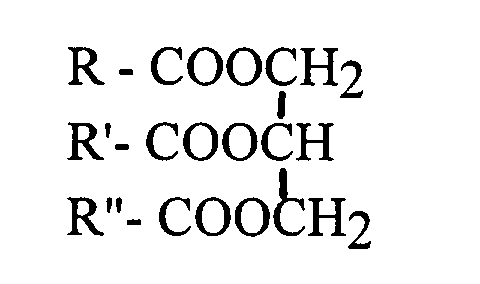
in which R-COO-, R'-COO- and R''-COO- each represent the same or different short chain fatty acid residue having 2 to 5 carbon atoms.
in which R-COO-, R'-COO- and R''-COO- each represent the same or different short chain fatty acid residue having 2 to 5 carbon atoms.
4. Use according to any preceding claim in which the short chain fatty acid is at least
one of acetic, propionic, butyric, valeric or isovaleric acid.
5. Use according to any preceding claim in which the medicament is adapted for enteral
or parenteral administration.
6. Use according to any preceding claim wherein the short chain fatty acids supply 1.2
to 22.5% of the total caloric content of the medicament.
7. Use according to any preceding claim wherein the medicament is in the form of an emulsion.
8. Use according to any preceding claim wherein the lipids containing the short chain
fatty acids form part of a lipid source which provides 12 to 45% of the caloric content
of the medicament.
1. Verwendung eines Lipids, das kurzkettige Fettsäuren enthält, die aus Fettsäuren mit
von 2 bis 5 Kohlenstoffatomen ausgewählt sind, zur Herstellung eines Medikaments zur
Aufrechterhaltung der gastrointestinalen Integrität und Funktion bei Patienten, wobei
das Lipid bei seiner Hydrolyse nur kurzkettige Fettsäuren liefert.
2. Verwendung nach Anspruch 1, bei der das Lipid wenigstens ein Mono-, Di- oder Triglycerid
aufweist, das bei der Hydrolyse nur kurzkettige Fettsäuren liefert.
3. Verwendung nach Anspruch 1, bei der das Lipid die Formel aufweist
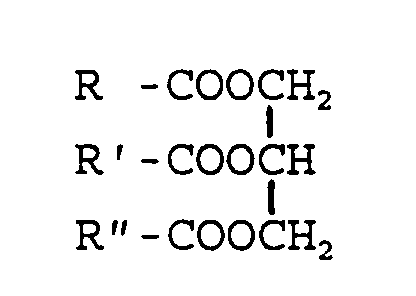
worin R-COO-, R'-COO- und R''-COO- jeweils den gleichen oder einen unterschiedlichen kurzen Fettsäurerest mit von 2 bis 5 Kohlenstoffatomen bedeutet.
worin R-COO-, R'-COO- und R''-COO- jeweils den gleichen oder einen unterschiedlichen kurzen Fettsäurerest mit von 2 bis 5 Kohlenstoffatomen bedeutet.
4. Verwendung nach irgend einem vorausgehenden Anspruch, bei der die kurzkettige Fettsäure
wenigstens eine von Essigsäure, Propionsäure, Buttersäure, Valeriansäure oder Isovaleriansäure
ist.
5. Verwendung nach irgend einem vorausgehenden Anspruch, bei der das Medikament für eine
enterale oder parenterale Verabreichung bestimmt ist.
6. Verwendung nach irgend einem vorausgehenden Anspruch, bei der die kurzkettigen Fettsäuren
von 1,2 bis 22% des gesamten Brennwertgehalts des Medikaments liefern.
7. Verwendung nach irgend einem vorausgehenden Anspruch, bei der das Medikament in Form
einer Emulsion vorliegt.
8. Verwendung nach irgend einem vorausgehenden Anspruch, bei der die Lipide, die die
kurzkettigen Fettsäuren enthalten, Teil einer Lipidquelle bilden, die 12 bis 45% des
Brennwertgehalts des Medikaments liefert.
1. Utilisation d'un lipide contenant des acides gras à chaîne courte choisis parmi des
acides gras ayant 2 à 5 atomes de carbone pour la préparation d'un médicament destiné
au maintien de l'intégrité et du fonctionnement du tractus gastro-intestinal chez
des patients, le lipide, par hydrolyse, donnant seulement des acides gras à chaîne
courte.
2. Utilisation suivant la revendication 1, dans laquelle le lipide comprend au moins
un mono-, di- ou triglycéride qui donne seulement, par hydrolyse, des acides gras
à chaîne courte.
3. Utilisation suivant la revendication 1, dans laquelle le lipide répond à la formule
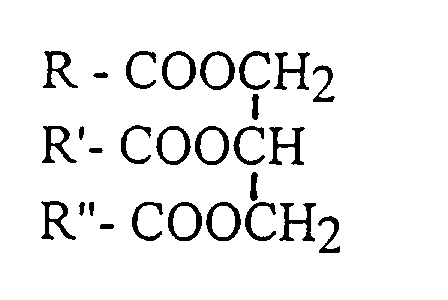
dans laquelle R-COO-, R'-COO- et R''-COO- représentent chacun des résidus d'acides gras à chaîne courte identiques ou différents ayant 2 à 5 atomes de carbone.
dans laquelle R-COO-, R'-COO- et R''-COO- représentent chacun des résidus d'acides gras à chaîne courte identiques ou différents ayant 2 à 5 atomes de carbone.
4. Utilisation suivant l'une quelconque des revendications précédentes, dans laquelle
l'acide gras à chaîne courte consiste en au moins un des acides acétique, propionique,
butyrique, valérique et isovalérique.
5. Utilisation suivant l'une quelconque des revendications précédentes, dans laquelle
le médicament est apte à l'administration entérale ou parentérale.
6. Utilisation suivant l'une quelconque des revendications précédentes, dans laquelle
les acides gras à chaîne courte fournissent 1,2 à 22,5 % de la teneur totale en calories
du médicament.
7. Utilisation suivant l'une quelconque des revendications précédentes, dans laquelle
le médicament est sous forme d'une émulsion.
8. Utilisation suivant l'une quelconque des revendications précédentes, dans laquelle
les lipides contenant les acides gras à chaîne courte font partie d'une source de
lipides qui fournit 12 à 45 % de la teneur en calories du médicament.