| (19) |
 |
|
(11) |
EP 0 451 937 B1 |
| (12) |
EUROPEAN PATENT SPECIFICATION |
| (45) |
Mention of the grant of the patent: |
|
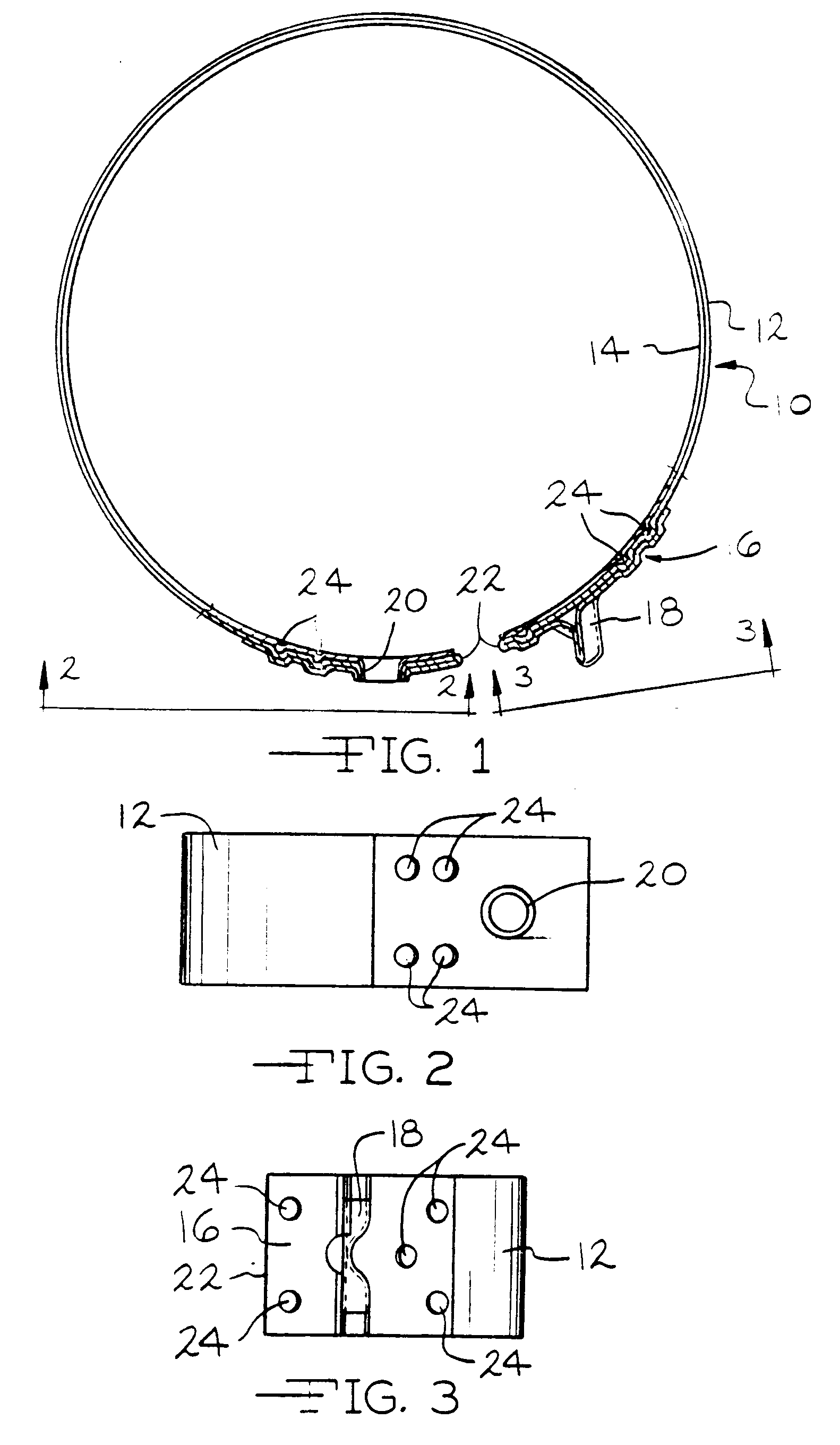
21.09.1994 Bulletin 1994/38 |
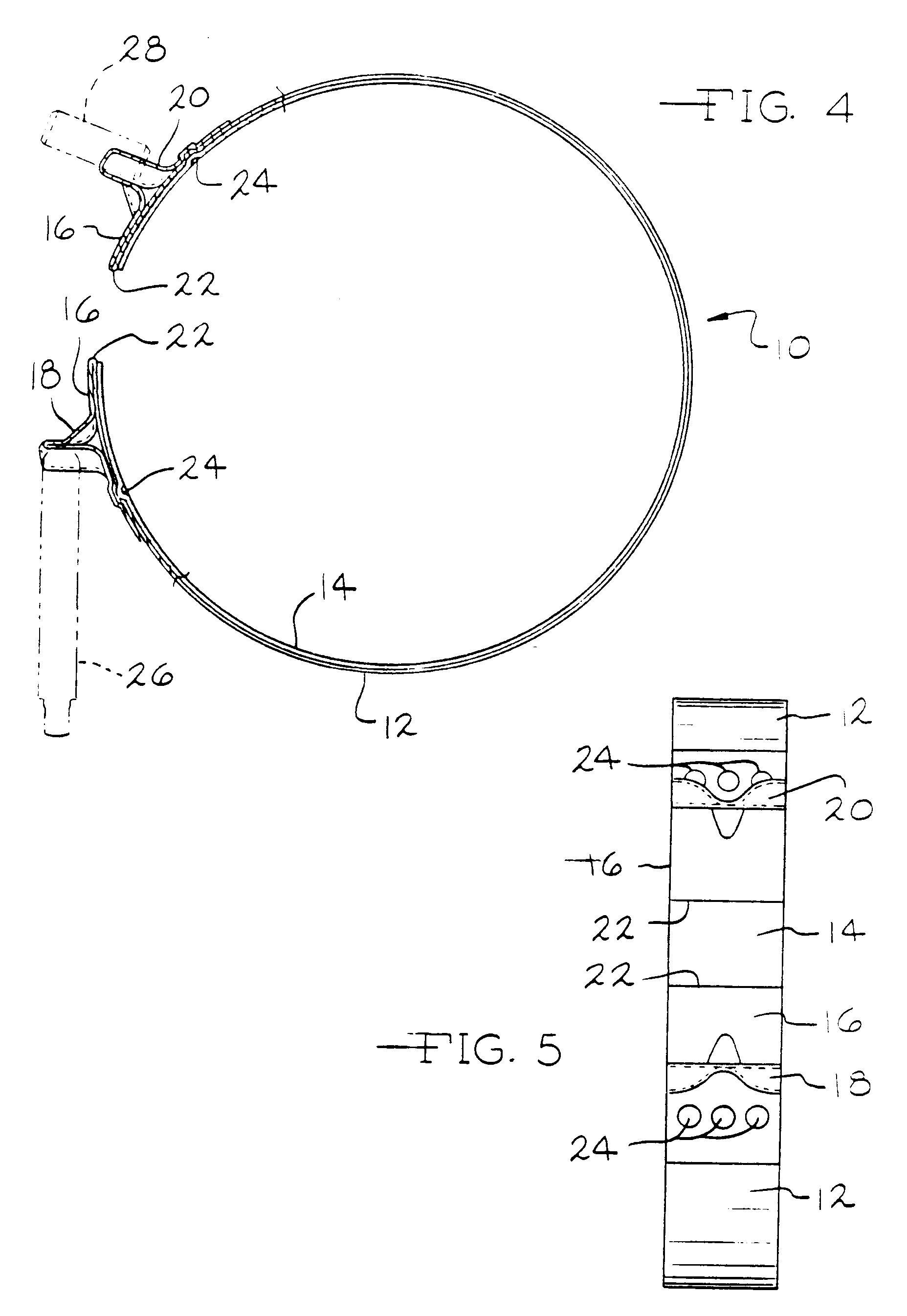
| (22) |
Date of filing: 15.02.1991 |
|
| (51) |
International Patent Classification (IPC)5: F16D 49/08 |
|
| (54) |
One-piece transmission band having the apply and reaction members integrally formed
in the base material
Einstückiges Bremsband mit im Basismaterial integralen Betätigungs- und Reaktionsgliedern
Bande de frein en une pièce ayant des éléments d'actionnement et de réaction intégrés
au matériau de base
|
| (84) |
Designated Contracting States: |
|
DE ES FR GB IT NL SE |
| (30) |
Priority: |
12.04.1990 US 508864
|
| (43) |
Date of publication of application: |
|
16.10.1991 Bulletin 1991/42 |
| (73) |
Proprietor: BORG-WARNER AUTOMOTIVE
TRANSMISSION AND ENGINE
COMPONENTS CORPORATION |
|
Sterling Heights, Michigan 48311-8022 (US) |
|
| (72) |
Inventor: |
|
- Puchalla, Christopher P.
Lombard,
Illinois 60148 (US)
|
| (74) |
Representative: Allden, Thomas Stanley et al |
|
A.A. THORNTON & CO.
Northumberland House
303-306 High Holborn
London WC1V 7LE
London WC1V 7LE (GB) |
| (56) |
References cited: :
DE-B- 1 253 965
|
US-A- 2 692 663
|
|
| |
|
|
|
|
| |
|
| Note: Within nine months from the publication of the mention of the grant of the European
patent, any person may give notice to the European Patent Office of opposition to
the European patent
granted. Notice of opposition shall be filed in a written reasoned statement. It shall
not be deemed to
have been filed until the opposition fee has been paid. (Art. 99(1) European Patent
Convention).
|
[0001] The present invention relates to a band for use with a transmission assembly which
is disposed to control movement of transmission members.
[0002] Transmission bands are commonly used to act as a brake or clutch. The interior circumference
of the bands is lined with a friction material. The ends of the bands generally have
brackets or lugs known as apply and reaction members which usually anchor the band
member and engage pin members within the transmission. The pin members work with the
apply and reaction members to push the band ends together to decrease the circumference
of the band and cause the band to frictionally engage rotating members within the
transmission, thereby braking those members to a stop. With the advent of lighter
weight transmissions and demands for fuel efficiency, research has centered around
producing transmission bands of lighter weight materials and thinner cross-sections.
These attempts to produce lighter weight bands have produced certain problems with
the overall quality of the transmission bands.
[0003] Generally, typical single wrap transmission bands include a strap member having a
friction lining about the interior circumference with separate apply and reaction
members attached to the ends of the strap member. The apply and reaction members are
usually lugs or brackets which generally attached to the strap by an appropriate means
such as a tab lance, extrusion, spot weld, or structural adhesive. The newer, lighter,
thinner bands have encountered problems with this type of construction due to the
fact that apply and reaction members which are attached to the strap have a thick
cross-section. As a result, the band does not have the desired flexibility at the
location where the apply and reaction members are attached and the band sometimes
does not engage with uniformity around the rotating transmission pieces. Therefore,
there is an enhanced possibility of uneven wear of the transmission band.
[0004] Further, problems have been encountered in the manufacture of common transmission
bands wherein the apply and reaction members are not always correctly aligned with
the strap when they are attached to the strap. If an unaligned band is utilized in
a transmission, there is again an enhanced possibility of uneven wear and future breakdown
of the transmission member.
[0005] One example of such prior art transmission bands is shown in US-A-2692663 which generally
discloses a band member for use as a circumferential friction brake or clutch about
a rotating member, comprising a strap member of a determined cross-sectional thickness
and extending in a generally circular configuration to form an inner strap circumference
and an outer strap circumference, a friction lining disposed about the inner strap
circumference of the strap member, the strap member having two end portions which
are folded back over the outer strap circumference of the strap member, an apply member
at one of the end portions of the strap member, and a reaction member at the other
end portion of the strap member.
[0006] In accordance with the present invention as claimed the aforesaid generally disclosed
band member is characterised in that the end portions are configured to be double
said cross-sectional thickness of the strap member and formed by folding a single
thickness portion of the strap member flat back over the outer strap circumference
of the strap member, the apply and reaction members being formed from the respective
end portions of the strap member and spaced from the respective fold area.
[0007] By integrally forming the apply and reaction members from the strap material a one
piece transmission band is provided which achieves the proper alignment of the apply
and reaction members with the strap and further enables the transmission band to more
uniformly engage the rotating member, thereby reducing uneven wear of the transmission
band.
[0008] In order that the invention may be well understood there will now be described two
embodiments thereof, given by way of example, reference being made to the accompanying
drawings, in which:
Fig. 1 is a side view of a transmission band embodying the present invention having
a formed apply member and volcano-type reaction member;
Fig. 2 is a detailed view of the reaction member of the band of Fig. 1 taken along
line 2-2 of Fig. 1;
Fig. 3 is a detailed view of the apply member of the band of Fig. 1 taken along line
3-3 of Fig. 1;
Fig. 4 is a side view of an alternative embodiment of the transmission band of the
present invention also showing the apply pin and reaction pin in ghost detail; and
Fig. 5 is a front view of the transmission band of Fig. 4.
[0009] In the drawings, band assembles 10 constructed in accordance with the present invention
are generally shown. A strap member 12 is arranged in a circular configuration so
as to be placed around the circular transmission members (not shown). The strap member
12 includes a friction member 14 adhered to the inner circumference of the strap member
12. The end portions 16 of the strap member 12 are formed by any suitable process
into the appropriate and desired apply member 18 and reaction member 20.
[0010] Referring now to Figs. 1-3, a preferred embodiment of the band member 10 is shown.
The band member includes a strap member 12 having a friction member 14 adhered to
the inner circumference of the strap member 12. The apply member 18, shown in detail
in Fig. 3, is formed on the inner circumference of an end portion 16. The end portion
16 with the integrally formed apply member 18 is then folded 22 flat back over the
outer circumference of the strap member 12 to form a double thickness of the strap
member and adhered 24 to its outer circumference by welding or any other suitable
mechanical fastening means. The remaining end portion 16 is folded 22 similarly flat
back over and also adhered 24 to the outer circumference of the strap member 12. As
shown in detail in Fig. 2, the reaction member 20 is then integrally formed by stamping
through the combined strap member 12 and folded over end portion 16. As shown in Fig.
2, the reaction member 20 is a volcano-type member. Both the apply (18) and reaction
(20) members are proximate to but spaced from the respective fold area 22.
[0011] Referring now to Figs. 4 and 5, an alternative embodiment of the band member 10 includes
a strap member 12 having a friction member 14 adhered to the inner circumference.
The apply member 18 and the reaction member 20 are integrally formed on the end portions
16 on the inner circumference of the strap member 12. After forming the apply member
18 and reaction member 20, the end portions 16 of the strap member are folded flat
back as before over the outer circumference of the strap member 12 so that the apply
member 18 and reaction member 20 are located the outer circumference of the strap
member 12 proximate to but spaced from the fold area 22. The folded over end portions
16 are then attached to the strap member by an appropriate means of adhesion 24 such
as extrusion, tab lance, spot welding or the application of a structural adhesive.
Shown in Fig. 4, in ghost, is the proximate locations for the push pin 26 as it is
engaged with the apply member 18 and an anchor pin 28 as it is engaged with the reaction
member 20.
[0012] In a further alternative embodiment of the band member (not shown), the apply member
and the reaction member are formed after the end portions are folded flat back over
said strap member.
1. A band member for use as a circumferential friction brake or clutch about a rotating
member, comprising a strap member (12) of a determined cross-sectional thickness and
extending in a generally circular configuration to form an inner strap circumference
and an outer strap circumference, a friction lining (14) disposed about the inner
strap circumference of the strap member (12), the strap member (12) having two end
portions (16) which are folded (22) back over the outer strap circumference of the
strap member (12), an apply member (18) at one of the end portions (16) of the strap
member (12), and a reaction member (20) at the other end portion (16) of the strap
member (12), characterised in that the end portions (16) are configured to be double
said cross-sectional thickness of the strap member (12) and formed by folding a single
thickness portion of the strap member (12) flat (22) back over the outer strap circumference
of the strap member (12), the apply (18) and reaction (20) members being formed from
the respective end portions (16) of the strap member (12) and spaced from the respective
fold area (22).
2. A band member as claimed in claim 1, wherein the apply member (18) and the reaction
member (20) are formed prior to the end portions (16) being folded (22) back over
the strap member (12), wherein the apply member (18) is formed on the inner circumference
of the single thickness strap member (12) and the single thickness apply member (18)
is folded flat (22) back over the outer strap circumference to double said cross-sectional
thickness at the end portion (16), and wherein the other end portion (16) has the
reaction member (20) formed on the inner circumference of the single thickness strap
member (12) and the single thickness reaction member (20) is folded flat (22) back
over the outer strap circumference to double said cross-sectional thickness at the
other end portion (16).
3. A band member as claimed in claim 1, wherein the apply member (18) and the reaction
member (20) are formed after the end portions (16) are folded (22) back over the strap
member (12).
4. A band member as claimed in claim 1, wherein the apply member (18) is formed prior
to one end portion (16) being folded (22) back over the strap member (12) and the
reaction member (20) is formed after the other end portion (16) is folded (22) back
over the strap member (12), wherein the apply member (18) is formed in the single
thickness strap member (12) and the single thickness apply member (18) is folded flat
(22) back over the outer strap circumference to double said cross-sectional thickness
at the end portion (16), the other end portion (16) being configured to be double
said cross-sectional thickness by folding a single thickness portion of the strap
member (12) flat (22) back over the outer circumference and having the reaction member
(20) formed thereon.
1. Band zur Verwendung als Umschlingungs-Reibbremse oder -Kupplung für ein umlaufendes
Teil, mit einem Bandglied (12), das eine vorgegebene Querschnittsdicke und eine ungefähr
kreisförmige Konfiguration hat, um einen inneren Bandumfang und einen äußeren Bandumfang
zu bilden, einem Reibbelag (14), der um den inneren Bandumfang des Bandgliedes (12)
herum angeordnet ist, wobei das Bandglied (12) zwei Endabschnitte (16) aufweist, die
über den äußeren Bandumfang des Bandgliedes (12) zurückgefaltet (22) sind, einem Betätigungsglied
an einem der Endabschnitte (16) des Bandgliedes (12) und einem Reaktionsglied (20)
an dem anderen Endabschnitt (16) des Bandgliedes (12), dadurch gekennzeichnet, daß
die Endabschnitte (16) eine solche Konfiguration haben, daß sie die Querschnittsdicke
des Bandgliedes (12) verdoppeln und dadurch gebildet sind, daß ein Abschnitt des Bandgliedes
(12) einfacher Dicke auf den äußeren Bandumfang des Bandgliedes (12) eben zurückgefaltet
ist, wobei das Betätigungsglied (18) und das Reaktionsglied (20) aus den entsprechenden
Endabschnitten (16) des Bandgliedes (12) gebildet und zu dem entsprechenden Faltabschnitt
(22) beabstandet sind.
2. Band nach Anspruch 1, bei dem das Betätigungsglied (18) und das Reaktionsglied (20)
gebildet sind, ehe die Endabschnitte (16) auf das Bandglied (12) zurückgefaltet werden,
wobei das Betätigungsglied (18) an dem inneren Umfang des Bandgliedes (12) einfacher
Dicke gebildet ist und das Betätigungsglied (18) einfacher Dicke auf den äußeren Bandumfang
eben zurückgefaltet (22) ist, um die Querschnittsdicke an dem Endabschnitt (16) zu
verdoppeln und bei dem der andere Endabschnitt (16) das Reaktionsglied (20) an dem
inneren Umfang des Bandgliedes (12) einfacher Dicke bildet und das Reaktionsglied
(20) einfacher Dicke auf den äußeren Bandumfang eben zurückgefaltet (22) ist, um die
Querschnittsdicke an dem anderen Endabschnitt (16) zu verdoppeln.
3. Band nach Anspruch 1, bei dem das Betätigungsglied (18) und das Reaktionsglied (20)
gebildet sind, nachdem die Endabschnitte (16) auf das Bandglied (12) zurückgefaltet
(22) wurden.
4. Band nach Anspruch 1, bei dem das Betätigungsglied (18) gebildet ist, ehe ein Endabschnitt
(16) auf das Bandglied (12) zurückgefaltet (22) wurde, und das Reaktionsglied (20)
gebildet ist, nachdem der andere Endabschnitt (16) auf das Bandglied (12) zurückgefaltet
(22) wurde, bei dem das Betätigungsglied (18) in dem Bandglied (12) einfacher Dicke
gebildet ist und das Betätigungsglied (18) einfacher Dicke auf den äußeren Bandumfang
eben zurückgefaltet (22) ist, um die Querschnittsdicke an dem Endabschnitt (16) zu
verdoppeln, wobei der andere Endabschnitt (16) eine solche Konfiguration hat, daß
die Querschnittsdicke dadurch verdoppelt wird, daß ein Bandgliedabschnitt einfacher
Dicke auf den äußeren Umfang eben zurückgefaltet (22) wird und das Reaktionsglied
(20) daran gebildet ist.
1. Elément de ruban pour emploi comme frein ou embrayage circonférentiel à friction autour
d'un élément tournant, comprenant un élément de bande (12) ayant une épaisseur déterminée
en section transversale et s'étendant dans une configuration généralement circulaire
pour former la circonférence intérieure d'une bande et la circonférence extérieure
d'une bande, une garniture de friction (14) disposée autour de la circonférence intérieure
de l'élément de bande (12), l'élément de bande (12) ayant deux parties extrêmes (16)
qui sont rabattues (22) sur la circonférence extérieure de l'élément de bande (12),
un élément d'application (18) à l'une des parties extrêmes (16) de l'élément de bande
(12), et un élément de réaction (20) à l'autre partie extrême (16) de l'élément de
bande (12), caractérisé en ce que les parties extrêmes (16) sont réalisées de façon
à doubler ladite épaisseur de la section transversale de l'élément de bande (12) et
sont formées en pliant une partie à une seule épaisseur de l'élément de bande (12)
en la rabattant à plat (22) sur la circonférence extérieure de l'élément de bande
(12), les éléments d'application (18) et de réaction (20) étant formés à partir des
parties extrêmes respectives (16) de l'élément de bande (12) et étant distantes de
la zone de pliage respective (22).
2. Elément de ruban selon la revendication 1, dans lequel l'élément d'application (18)
et l'élément de réaction (20) sont formés avant que les parties extrêmes (16) ne soient
rabattues (22) sur l'élément de bande (12), où l'élément d'application (18) est formé
sur la circonférence intérieure de l'élément de bande à une seule épaisseur (12),
et l'élément d'application à une seule épaisseur (18) est rabattu à plat (22) sur
la circonférence extérieure de la bande pour doubler ladite épaisseur de la section
transversale à la partie extrême (16), et où l'autre partie extrême (16) a l'élément
de réaction (20) formé sur la circonférence intérieure de l'élément de bande à une
seule épaisseur (12) et l'élément de réaction à une seule épaisseur (20) est rabattu
à plat (22) sur la circonférence extérieure de la bande pour doubler ladite épaisseur
de la section transversale à l'autre partie extrême (16).
3. Elément de ruban selon la revendication 1, dans lequel l'élément d'application (18)
et l'élément de réaction (20) sont formés après que les parties extrêmes (16) aient
été rabattues (22) sur l'élément de bande (12).
4. Elément de ruban selon la revendication 1, dans lequel l'élément d'application (18)
est formé avant qu'une partie extrême (16) soit rabattue (22) sur l'élément de bande
(12), et l'élément de réaction (20) est formé après que l'autre partie extrême (16)
a été rabattue (22) sur l'élément de bande (12), où l'élément d'application (18) est
formé dans l'élément de bande à une seule épaisseur (12) et l'élément d'application
à une seule épaisseur (18) est rabattu à plat (22) sur la circonférence extérieure
de la bande pour doubler ladite épaisseur de la section transversale à la partie extrême
(16), l'autre partie extrême (16) étant réalisée de façon à doubler ladite épaisseur
de la section transversale en pliant une partie à une seule épaisseur de l'élément
de bande (12) à plat (22) sur la circonférence extérieure et ayant l'élément de réaction
(20) formé sur son dessus.