|
(11) | EP 0 453 604 B1 |

| (12) | EUROPEAN PATENT SPECIFICATION |
|
|
| (54) |
Process for the chromatographic determination of ions Verfahren zur chromatographischen Bestimmung von Ionen Procédé pour la détermination d'ions par chromatographie |
|
|
||||||||||||||||||||||||||||
| Note: Within nine months from the publication of the mention of the grant of the European patent, any person may give notice to the European Patent Office of opposition to the European patent granted. Notice of opposition shall be filed in a written reasoned statement. It shall not be deemed to have been filed until the opposition fee has been paid. (Art. 99(1) European Patent Convention). |
[0001] The invention relates to a process for the chromatographic determination of ions, particularly anions on a reversed-phase column in which sample ions are introduced into a mobile phase containing a modifier and a counterion, the mobile phase with the modifier, conterion and sample ion is passed through the column and, after the separation with the aid of a suitable detection method the individual sample ions are quantitatively determined via the decrease in the concentration of the counterion in the eluate and in which the mobile phase is a mixture of water and an organic solvent and the modifier is constituted by a quaternary ammonium hydroxide of formula
in which the rests R₁, R₂, R₃ and R₄ are alkyl chains, which are the same or different and have 1 to 20 C-atoms and in which at least one rest is a straight-chain or branched alkyl rest with at least 8 and up to 20, particularly 12 to 18 C-atoms.
[0002] Ever since the arrival of ion chromatography there have been constant improvements to the quantitative analysis of organic and inorganic ions, particularly anions. Due to the poorer column or separation efficiency and the high price, as well as the instability of ion exchange columns, so-called reversed-phase columns have been investigated. In addition, the ions to be determined have been determined by indirect detection methods, such as e.g. indirect identification in the UV-spectral range. However, the chromatograms obtained with reversed-phase columns and indirect identification methods frequently have additional peaks (so-called system peaks) or poorly formed peaks, which make the detection and quantitative determination of the individual ions difficult or even impossible.
[0003] The publication by Frank G. P. Mullins (Analyst, May 1987, Vol. 112, pp. 665 to 671) describes an ion chromatographic process for the determination of inorganic anions by an indirect UV-detection method. The column used is dynamically loaded with hexadecyl trimethyl ammonium bromide. Although the chromatogram has no system peaks, not all inorganic anions can be determined, (as e.g. defined by DIN or EPA standards). Thus, it is not possible to detect fluoride and sulphate ions. In LC-GC, 1987, Vol. 4, No. 10, p. 1026 ff, B. E. Andrew describes the use of quaternary ammonium compounds for the ion chromatography of anions. Tetraalkyl ammonium hydroxides are used as ammonium compounds and the straight-chain alkyl radical can contain 1 to 5 C-atoms. In the ion chromatographic determination according to Andrew, system peaks occur in the chromatogram and it is not possible to analyse the anions in one chromatographic run. Andrew also pointed out that a variation in the chain length of the alkyl chains led to no advantages regarding the performance of the process.
[0004] Journal of Chromatography, Vol. 402, 1987, pp. 115-126 by B.B. Wheals discloses two isocratic eluent systems suitable for the high-performance liquid chromatography of inorganic anions on a polystyrene-divinyl benzene packing material. These eluents contain citric acid, hexadecyl trimethyl ammonium hydroxide in an acetonitrile-water solvent adjusted to pH 11.0. With the two eluent systems it is not possible to separate and detect all ions of interest in a single chromatographic run.
[0005] The problem of the present invention is to make an ion chromatographic process available, which permits a quantitative determination of ions with a high selectivity. There must be no disturbing system peaks or peak deformations in the chromatogram. The particular problem of the invention is to develop a process for the chromatographic determination of anions and preferably inorganic anions, in which the anions can be simultaneously quantified in a single chromatographic run.
[0006] This problem is solved by an ion chromatographic process with the features of the main claim. In the process above-mentioned the phthalate ion is used as the counterion and the mobile phase has a pH-value between 7 and 9. Preferably the concentration of the ions to be quantitatively determined in the sample is no greater than 500 ppm.
[0007] Compared with known processes, the process according to the invention has the advantages that, by using an inexpensive, stable column and with low overall costs, it is possible to separate in a single chromatographic operation all the ions to be determined and in particular anions and can be quantitatively determined with high sensitivity, without disturbing peaks or peak deformations occuring. Thus, it is possible to establish the presence of and the quantity of fluoride, chloride, bromide, nitrite, nitrate, phosphate and sulphate ions in a single operation, i.e. a single chromatographic run. According to the invention standard columns and standard HPLC equipment can be used, so that chromatographic determination is possible in a short time with easy handling. Due to the fact that the modifier is used in the hydroxide form, apart from the counterions, no further impurity ions are present, which could disturb the detection of the sample ions.
[0008] The inventive process can be carried out on known reversed-phase columns, particularly those conventionally having carbon chains with 8 to below 20 C-atoms and in particular reversed-phase columns with C₈, C₁₂ and C₁₈-chains are commercially available. Particularly reversed-phase columns with a C₁₈-chain can be used in the inventive process. The number of carbon atoms of the reversed-phase column need not coincide with the number of carbon atoms of the modifier, i.e. the alkyl rest of the packing material of the column need not be the same as the alkyl rest of the modifier. According to the invention other standard reversed-phase column types can be used. These can be columns based on polyacrylamide, which have a C₁₈-chain, or a column based on carbon, whose behaviour largely corresponds to a conventional reversed-phase column. Preference is given to the use of columns based on silica. It is possible to use spherical material with a diameter of e.g. 5µm, but also irregular material.
[0009] The length of the column used in the inventive process is more than 2 and is normally less than 20 cm, preference being given to a range of 10 to 15 cm. A length below 2 cm is not advantageous, because with such small column length no complete separation of the ions to be determined is possible. A preferred column length is e.g. 12.5 cm.
[0010] The flow rate of the mobile phase through the column is not critical. In the case of a 4 mm column diameter, the flow rate is e.g. 0.2 to 5 ml/min, a range of 1 to 3 ml/min being preferred. The detection limit of the inventive process without enrichment is in the lower ppb (parts per billion) range, so that the process is also suitable for the highest demands.
[0011] In the case of the inventive process the mobile phase is preferably allowed to be recycled. Thus, the column can be brought into equilibrium, stable conditions are created and solvent consumption is reduced.
[0012] According to the invention the reversed-phase column can be brought into equilibrium with the modifier, particularly the modifier and the counterion, prior to the passing through of the mobile phase containing the sample ions. Preferably the equilibrium setting is performed with a mobile phase which, apart from the sample ion content, has the same composition as the mobile phase used for determining the sample ions.
[0013] A preferred embodiment of the inventive process occurs if a quaternary ammonium hydroxide is used, in which the rests R₁, R₂ and R₃ are the same or different and have 1 to 10 C-atoms and the rest R₄ has between 8 and up to 20, and in particular 12 to 18 C-atoms. Preferably the rests R₁, R₂ and R₃ are the same and have 1 to 5 C-atoms and the R₄ rest has a straight-chain form and has between 14 and 18, in particular 16 C-atoms. The process performed using said quaternary ammonium hydroxides leads to chromatograms, which permit a particularly good quantitative determination of anions in a single chromatographic run. Particular preference is given to a process in which trimethyl hexadecyl ammonium hydroxide is used as the quaternary ammonium hydroxide.
[0014] The modifier quantity contained in the mobile phase can be varied within a wide range and is only dependent on a favourable performance of the process. Preferably the modifier is contained in the mobile phase in a concentration of 0.05 to 1.5 mmole.
[0015] An indirect detection method can be used for the detection of the sample ions and the latter can be quantitatively determined via the decrease of the counterion concentration in the eluate. Conductivity, indirect fluoresence and electrochemical measurements are also possible and for the two former methods the increase in the conductivity or the decrease in the fluorescence of the counterion is determined, whilst in the latter method oxidizable or reduceable sample ions are measured. It is also possible, by modifying the inventive process, to e.g. quantitatively determine anions with the aid of a direct UV-method revealing an absorption in the ultraviolet range of the spectrum. This is preferably the nitrate and nitrite ion. It is particularly advantageous if the indirect detection method is constituted by an indirect determination of the sample ions in the ultraviolet range of the spectrum.
[0016] Due to its absorption in the ultraviolet range of the spectrum, the phthalate ion is particularly suitable for performing the inventive process, in conjunction with the indirect determination of the sample ions in the UV-spectral range. The counterion concentration in the mobile phase can be varied over a wide range. A too high concentration increase leads to a sensitivity loss and to a poorer separation of the indiviual ions. If the concentration is excessively reduced, the column capacity may be low. A preferred concentration range for the counterion in the mobile phase is between 6 x 10⁻³ to 1 x 10⁻⁴ and in particular 6 x 10⁻³ to 4 x 10⁻⁴ mole.
[0017] The mobile phase containing the modifier and the counterion comprises a mixture of water and an organic solvent. It is possible to use various organic solvents, such as e.g. acetonitrile, methanol, dimethyl formamide and dimethyl sulphoxide. The use of less polar organic solvents is possible, the first-mentioned polar, organic solvents and more especially acetonitrile being preferred. Particularly good results are obtained when using a mobile phase comprising a mixture of 65 to 95 and in particular approximately 80 vol % of water and 5 to 35 and in particular approximately 20 vol % of organic solvent.
[0018] In the process according to the invention, the mobile phase has a pH-value between 7 and 9. If the pH-value is in the alkaline range, it can be adjusted with the aid of a base, particularly sodium hydroxide solution. Through the choice of the pH-value, it is possible to control the inventive process in such a way that under all circumstances the simultaneous detection of all the ions to be determined in a single chromatographic operation is possible.
[0019] The process according to the invention can be performed at elevated temperature, at ambient temperature and also at lower than ambient temperatures. Preferably the temperature is between 0 and 80°C, particularly between 20 and 50°C. Thermostatic control can e.g. take place at higher than ambient temperatures by placing the column in a thermostatically controlled area (oven). It is advantageous if the chosen temperature is kept constant during the process, preferably with a variation of max. ± 1°C. This temperature constancy is necessary if the chromatogram has a different appearance at different temperatures. Thus, it is possible that the time intervals with which the anions are eluted by the column will vary with the temperature, or for there even to be a peak sequence reversal. This phenomenon can be attributed to the temperature dependence of the phase equilibria between the stationary and mobile phase. Preferably the temperature is kept constant with a variation of max. ± 0.5°C and in particular ± 0.2°C. If e.g. the precision with regards to the reproducibility of the times at which the individual ions are eluted by the column is to be better than 1%, then the set temperature is kept constant with a temperature fluctuation of max. ± 0,5°C. If several chromatographic operations are performed successively, the temperature at which the process is performed is not only kept constant during the individual analyses, but also between said analyses, so that reproducible and comparable results are obtained. The embodiments of the inventive process, in which the temperature is kept constant, are particularly suitable for use in an automated and in particular a computer-controlled operation, evaluated with the aid of a computer.
[0020] The hydraulic pressure under which the mobile phase is passed through the column is dependent on the packing material and can be varied within wide limits. If spherical packing materials are used as the column material, a hydraulic pressure of 50 to 200 bar is preferred at a particle diameter of e.g. 5 µm. If smaller diameter particles, e.g. 3 µm are used, it can be appropriate to use a higher pressure, the pressure rising quadratically with decreasing particle diameter.
[0021] The invention inter alia relates to the quantitative determinatin of ions, particularly anions, in water, such as e.g. in waste or drinking water, in food stuffs, such as e.g. beer, wine, juices or vegetables, as well as in biotechnological and physiological substances, such as blood and urine, or in liquids used in the electrical industry, such as e.g. plating baths. The invention relates more particularly to the determination of inorganic ions in a single chromatographic operation and preferably at least fluoride, chloride, bromide, nitrite, nitrate, phosphate and sulphate are simultaneously quantified.
[0022] The following examples and drawings serve to illustrate the invention. In the examples and drawings the individual features can be realized either singly, or in the form of random combinations. In the drawings show:
- Fig. 1:
- a flow chart of an apparatus suitable for performing the inventive process.
- Fig. 2a:
- the detection of the nitrate ion according to an embodiment of the inventive process.
- Fig. 2b:
- the detection of the nitrate ion according to a prior art comparison process.
- Fig. 3:
- the detection of 17 anions according to an embodiment of the inventive process.
- Fig. 4:
- the temperature dependence of the chromatogram.
- Fig. 5:
- the temperature dependence of the chromatogram according to another embodiment of the inventive process.
- Fig. 6:
- the comparison of the chromatograms of embodiments of the inventive process, in which the ions are detected with the aid of the indirect UV-method and with the aid of the conductivity method.
[0023] Fig. 1 is the flow chart of an apparatus for performing an embodiment of the process according to the invention. By means of a pump, the mobile phase is pumped through the chromatrographic column and the counterions contained in the mobile phase are visible by a UV-detector. There is also a sample injection enabling the sample ions to be introduced into the mobile phase. The inventive process is normally performed as follows. A mobile phase of a mixture of water and an organic solvent is prepared, which contains a modifier and a counterion in a concentrate of 0.05 to 1.5 mmole or 6 x 10⁻³ to 1 x 10⁻⁴ mole and which has a pH-value of more than 5. This mobile phase is pumped through the chromatograhic column using a liquid pressure pump at a pressure of 50 to 200 bar, the column being kept at a temperature between 20 and 80°C with a variation of max. ± 1°C by means of a suitable thermostating device. After approximately 2 to 4 hours an equilibrium has established between the stationary and mobile phase. By means of sample injection, the sample ions to be determined are then applied to the chromatographic column and are successivley eluted by the latter, accompanied by a further continuous passage of the mobile phase. The individual ions are quantiatively determined via the concentration decrease of the counterion in the eluate.
Example 1
[0024] A 200 mm long and diameter 4.6 mm chromatographic column is filled with Hypersil ODS, of 5µm spherical particles. This column is conditioned with a mobile phase of 73% water and 27% acetonitrile, which contains 0.8 mmole of a hexadecyl trimethyl ammonium ion and 2 mmole of phthalic acid and is set to a pH-value of 7.2 with a sodium hydroxide solution. The mobile phase flow rate is 2 ml/min. The phthalate counterion is detected at 254 nm. After the equilibrium has been established between the stationary and mobile phase a sample solution, which contains the nitrate ions, is introduced into the mobile phase and the elution of the nitrate ions by the column is observed.
[0025] Fig. 2a shows the chromatogram when using hexadecyl trimethyl ammonium hydroxide as the modifier. Roughly 2 minutes after the application of the sample solution, a symmetrical peak appears from which the content of nitrate ions can be quantitatively determined.
[0026] Fig. 2b shows the chromatogram when hexadecyl trimethyl ammonium bromide is used as the modifier. After roughly 3 minutes a disturbing system peak appears, which does not occur when performing the inventive process.
Example 2
[0027] The column described in example 1 is conditioned with the mobile phase containing hexadecyl trimethyl ammonium hydroxide as the modifier. The other conditions are as in example 1. After establishing the equilibrium, a sample solution containing 17 anions is introduced into the mobile phase. The chromatogram shown in fig. 3 is obtained within 15 minutes. Thus, in a single chromatographic operation all 17 anions are separated from one another and can be quantitatively determined.
Example 3
[0028] A 100 mm long, diameter 4.6 mm column is filled with Hypersil ODS. This column is then conditioned with a mobile phase of 82% water and 18% acetonitrile for 3 hours for obtaining an equilibrium. The mobile phase contained 0.8 mmole of hexadecyl trimethyl ammonium hydroxide and 2 mmole of phthalic acid and is set to a pH-value of 8.4 with a sodium hydroxide solution. The flow rate of the mobile phase is 2 ml/min. The phthalic counterions are detected at a wavelength of 266 nm. In three different tests, the chromatographic column is thermostated to 3 different temperatures, namely 19°C, 30°C and 40°C, the temperature being kept constant with an accuracy of ± 0.5°C or less. After setting the equilibrium, 50 µl of sample solution containing 8 different anions are injected. These anions are eluted by the column through the mobile phase and determined with the aid of the indirect UV-method.
[0029] Fig. 4 shows the results of 3 chromatographic determinations at the 3 different temperatures. At 19°C there is a complete separation of all the anions, so that a separate quantitative determination of the anions is possible. At 30°C the bromide and phosphate ions are not completely separated from one another, but the other six anions can be quantified. At 40°C the nitrate and phosphate ions are not completely separated from one another, but the other six anions can be quantified.
[0030] Fig. 4 shows that through the choice of suitable conditions and in particular the temperature setting, it is possible to achieve a simultaneous determination of all the anions in a single chromatographic step.
Example 4
[0031] A 125 mm long, diameter 4.0 mm chromatographic column is filled with Lichrospher 100 RP-18 and is conditioned with a mobile phase of 82% water and 18% acetonitrile, which contains 0.8 mmole of hexadecyl trimethyl ammonium hydroxide and 2 mmole of phthalic acid and is adjusted to a pH-value of 8.6 with a sodium hydroxide solution. The flow rate is 2.0 ml/min. Conditioning takes place for approximately 2 to 4 hours and is performed in three different passages at 38°C, 40°C and 46°C. The temperature is kept constant with an accuracy of ± 1°C by a suitable thermostat (oven). After setting the equilibrium, 50 µl of a sample solution containing 8 different anions is introduced into the mobile phase. The counterions are detected at a wavelength of 266 nm.
[0032] Fig. 5 shows the results of the determinations performed at said 3 temperatures. It can be seen that all 3 temperatures there is a complete separation of the individual anions and a quantitative determination of the individual ions is possible.
Example 5
[0033] A column filled with Hypersil ODS according to example 2 is conditioned as in the latter. A sample solution containing 11 different anions is then introduced into the mobile phase. The individual ions are eluted by the column and detected once with the indirect UV-method and on a further occasion with the conductivity method. The results of these two determinations are given in fig. 6. The latter shows that both with the conductivity method and with the indirect UV-method, a determination of the anions contained in the sample solution is possible in one chromatographic run.
1. Process for the chromatographic determination of ions, particularly anions, on a reversed-phase
column, in which sample ions are introduced into a mobile phase containing a modifier
and a counterion, the mobile phase with the modifier, counterion and sample ion is
passed through the column and, after the separation with the aid of a suitable detection
method, the individual sample ions are quantitatively determined via the decrease
in the concentration of the counterion in the eluate and in which the mobile phase
is a mixture of water and an organic solvent and the modifier is constituted by a
quaternary ammonium hydroxide of formula
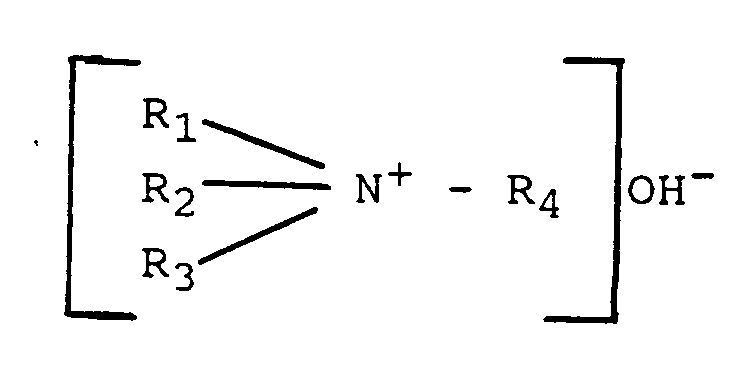
in which the rests R₁, R₂, R₃ and R₄ are alkyl chains, which are the same or different and have 1 to 20 C-atoms and in which at least one rest is a straight-chain or branched alkyl rest with at least 8 and up to 20, particularly 12 to 18 C-atoms, characterized in that the phthalate ion is used as the counterion and that the mobile phase has a pH-value between 7 and 9.
in which the rests R₁, R₂, R₃ and R₄ are alkyl chains, which are the same or different and have 1 to 20 C-atoms and in which at least one rest is a straight-chain or branched alkyl rest with at least 8 and up to 20, particularly 12 to 18 C-atoms, characterized in that the phthalate ion is used as the counterion and that the mobile phase has a pH-value between 7 and 9.
2. Process according to claim 1, characterized in that, prior to the passing through
of the mobile phase containing the sample ions, the reversed-phase column is brought
into equilibrium with the modifier, particularly the modifier and the counterion.
3. Process according to claim 2, characterized in that the equilibrium setting is performed
with a mobile phase which, apart from the sample ion content, has the same composition
as the mobile phase used for determining the sample ions.
4. Process according to one of the preceding claims, characterized in that a quaternary
ammonium hydroxide is used, in which the rests R₁, R₂ and R₃ are the same or different
and have 1 to 10 C-atoms and the rest R₄ has between 8 and 20 and in particular 12
and 18 C-atoms.
5. Process according to one of the preceding claims, characterized in that the rests
R₁, R₂ and R₃ are the same and have 1 to 5 C-atoms and the rest R₄ has a straight-chain
form and has between 14 and 18, more particularly 16 C-atoms.
6. Process according to one of the preceding claims, characterized in that trimethyl
hexadecyl ammonium hydroxide is used as the quaternary ammonium hydroxide.
7. Process according to one of the preceding claims, characterized in that the modifier
is contained in the mobile phase in a concentration of 0.05 x 10⁻³ to 1.5 x 10⁻³ mole.
8. Process according to one of the preceding claims, characterized in that the sample
ions are determined with the aid of an indirect UV-detection method.
9. Process according to one of the preceding claims, characterized in that the counterion
is contained in the mobile phase in a concentration of 6 x 10⁻³ to 1 x 10⁻⁴ mole and
in particular 6 x 10⁻³ to 4 x 10⁻⁴ mole.
10. Process according to one of the preceding claims, characterized in that a polar organic
solvent, particularly acetonitrile is used as the organic solvent in the mobile phase.
11. Process according to one of the preceding claims, characterized in that the mobile
phase consists of a mixture of 65 to 95 and preferably 80 vol. % water and 5 to 35,
particularly 20 vol. % organic solvent.
12. Process according to one of the preceding claims, characterized in that it is performed
at a temperature between 0 and 80°C, particularly between 20 and 50°C.
13. Process according to one of the preceding claims, characterized in that the temperature
is kept constant during the process, with a variation of max. ± 0.5°C and more particularly
± 0.2°C.
14. Process according to one of the preceding claims for determining fluoride, chloride,
bromide, nitrite, nitrate, phosphate and sulphate in a single chromatographic run.
1. Verfahren zur chromatographischen Bestimmung von Ionen, insbesondere Anionen an einer
reversed-phase-Säule, bei dem Probeionen in eine mobile Phase, die einen Modifier
und ein Gegenion enthält, eingebracht werden, die mobile Phase mit Modifier, Gegenion
und Probeion durch die Säule geleitet wird und die einzelnen Probeionen nach der Auftrennung
mit Hilfe einer geeigneten Detektionsmethode über die Abnahme der Konzentration des
Gegenions im Eluat quantitativ bestimmt werden, und bei dem die mobile Phase eine
Mischung aus Wasser und einem organischen Lösungsmittel ist, und als Modifier ein
quartäres Ammoniumhydroxid der Formel
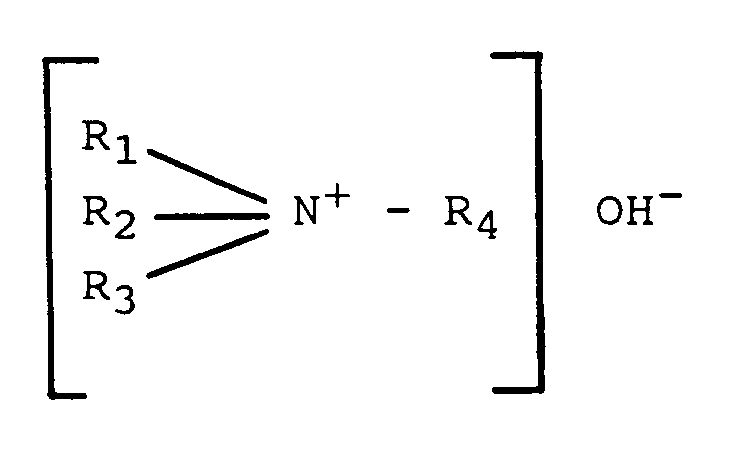
eingesetzt wird, bei welchem die Reste R₁, R₂, R₃ und R₄ Alkylreste sind, die gleich oder verschieden sind und 1 bis 20 C-Atome besitzen, wobei mindestens ein Rest ein geradkettiger oder verzweigter Alkylrest mit mindestens 8 bis zu 20, insbesondere 12 bis 18 C-Atomen ist, dadurch gekennzeichnet, daß das Phthalat-Ion als Gegenion verwendet wird und daß die mobile Phase einen pH-Wert zwischen 7 und 9 besitzt.
eingesetzt wird, bei welchem die Reste R₁, R₂, R₃ und R₄ Alkylreste sind, die gleich oder verschieden sind und 1 bis 20 C-Atome besitzen, wobei mindestens ein Rest ein geradkettiger oder verzweigter Alkylrest mit mindestens 8 bis zu 20, insbesondere 12 bis 18 C-Atomen ist, dadurch gekennzeichnet, daß das Phthalat-Ion als Gegenion verwendet wird und daß die mobile Phase einen pH-Wert zwischen 7 und 9 besitzt.
2. Verfahren nach Anspruch 1, dadurch gekennzeichnet, daß die reversed-phase-Säule vor
dem Hindurchleiten der die Probeionen enthaltenden mobilen Phase mit dem Modifier,
insbesondere mit dem Modifier und dem Gegenion, ins Gleichgewicht gebracht wird.
3. Verfahren nach Anspruch 2, dadurch gekennzeichnet, daß die Gleichgewichtseinstellung
mit einer mobilen Phase durchgeführt wird, die bis auf den Gehalt an Probeionen die
gleiche Zusammensetzung besitzt wie die zur Bestimmung der Probeionen verwendete mobile
Phase.
4. Verfahren nach einem der vorhergehenden Ansprüche, dadurch gekennzeichnet, daß ein
quartäres Ammoniumhydroxid eingesetzt wird, bei dem die Reste R₁, R₂ und R₃ gleich
oder verschieden sind und 1 bis 10 C-Atome aufweisen und der Rest R₄ zwischen 8 bis
20, insbesondere 12 bis 18 C-Atome aufweist.
5. Verfahren nach einem der vorhergehenden Ansprüche, dadurch gekennzeichnet, daß die
Reste R₁, R₂ und R₃ gleich sind und zwischen 1 bis 5 C-Atome aufweisen und der Rest
R₄ geradkettig ist und zwischen 14 und 18, insbesondere 16 C-Atome aufweist.
6. Verfahren nach einem der vorhergehenden Ansprüche, dadurch gekennzeichnet, daß als
quartäres Ammoniumhydroxid Trimethylhexadecylammoniumhydroxid eingesetzt wird.
7. Verfahren nach einem der vorhergehenden Ansprüche, dadurch gekennzeichnet, daß der
Modifier in der mobilen Phase in einer Konzentration von 0,05 x 10⁻³ Mol bis 1,5 x
10⁻³ Mol enthalten ist.
8. Verfahren nach einem der vorhergehenden Ansprüche, dadurch gekennzeichnet, daß die
Probeionen mit Hilfe einer indirekten UV-Detektionsmethode bestimmt werden.
9. Verfahren nach einem der vorhergehenden Ansprüche, dadurch gekennzeichnet, daß das
Gegenion in der mobilen Phase in einer Konzentration von 6 x 10⁻³ Mol bis 1 x 10⁻⁴
Mol, insbesondere 6 x 10⁻³ Mol bis 4 x 10⁻⁴ Mol enthalten ist.
10. Verfahren nach einem der vorhergehenden Ansprüche, dadurch gekennzeichnet, daß als
organisches Lösungsmittel in der mobilen Phase ein polares organisches Lösungsmittel,
insbesondere Acetonitril eingesetzt wird.
11. Verfahren nach einem der vorhergehenden Ansprüche, dadurch gekennzeichnet, daß als
mobile Phase eine Mischung aus 65 bis 95 Vol.-%, vorzugsweise 80 Vol.-% Wasser und
5 bis 35 Vol.-%, insbesondere 20 Vol.-% organischem Lösungsmittel eingesetzt wird.
12. Verfahren nach einem der vorhergehenden Ansprüche, dadurch gekennzeichnet, daß es
bei einer Temperatur zwischen 0 °C und 80 °C, insbesondere zwischen 20 °C und 50 °C
durchgeführt wird.
13. Verfahren nach einem der vorhergehenden Ansprüche, dadurch gekennzeichnet, daß die
Temperatur während des Verfahrens mit einer Abweichung von höchstens ± 0,5 °C, insbesondere
± 0,2 °C konstant gehalten wird.
14. Verfahren nach einem der vorhergehenden Ansprüche zur Bestimmung von Fluorid, Chlorid,
Bromid, Nitrit, Nitrat, Phosphat und Sulfat in einem einzigen chromatographischen
Arbeitsgang.
1. Un procédé pour l'analyse chromatographique des ions, particulièrement des anions,
sur une colonne en phase inversée, dans lequel les ions de l'échantillon sont introduits
à l'intérieur d'une phase mobile contenant un agent modificateur et un contre-ion,
dans lequel la phase mobile accompagnée de l'agent modificateur, du contre-ion et
de l'ion-échantillon passe à travers la colonne dans lequel, après séparation à l'aide
d'une méthode de détection adaptée, on analyse de façon quantitative les ions de l'échantillon
isolés grâce à la décroissance de la concentration du contre-ion à l'intérieur du
produit élué et dans lequel la phase mobile est un mélange constitué d'eau et d'un
solvant organique et où l'agent modificateur est constitué d'un hydroxyde d'ammonium
quaternaire de formule
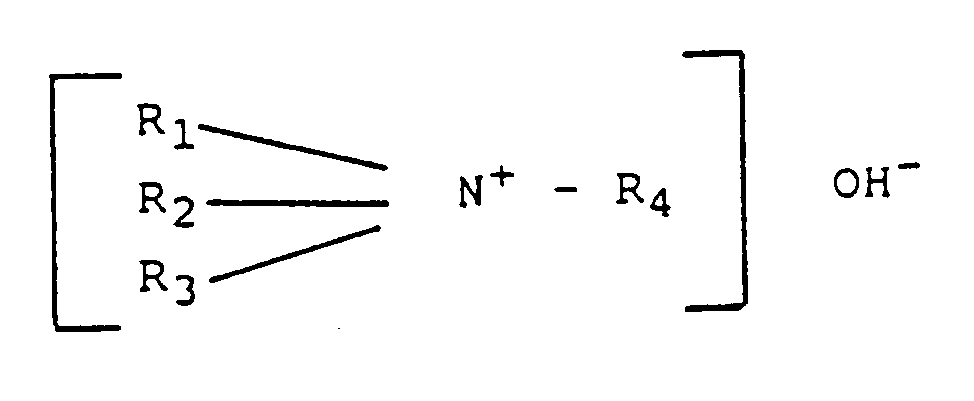
dans laquelle les restes R₁, R₂, R₃ et R₄ sont des chaînes alkyles, lesquelles sont identiques ou différentes et possèdent de 1 à 20 atomes de carbone et dans lesquelles au moins un reste est une chaîne linéaire ou un reste alkyle ramifié avec au moins de 8 à 20, en particulier de 12 à 18 atomes de carbone, caractérisé en ce que l'ion phtalate est utilisé en tant que contre-ion et en ce que la phase mobile présente une valeur de pH située entre 7 et 9.
dans laquelle les restes R₁, R₂, R₃ et R₄ sont des chaînes alkyles, lesquelles sont identiques ou différentes et possèdent de 1 à 20 atomes de carbone et dans lesquelles au moins un reste est une chaîne linéaire ou un reste alkyle ramifié avec au moins de 8 à 20, en particulier de 12 à 18 atomes de carbone, caractérisé en ce que l'ion phtalate est utilisé en tant que contre-ion et en ce que la phase mobile présente une valeur de pH située entre 7 et 9.
2. Procédé selon la revendication 1, caractérisé en ce que, avant le passage à travers
la phase mobile qui contient les ions de l'échantillon, la colonne en phase inversée
est amenée à un état d'équilibre à l'aide de l'agent modificateur, en particulier,
à l'aide de l'agent modificateur et du contre-ion.
3. Procédé selon la revendication 2, caractérisé en ce que, l'établissement de l'équilibre
est réalisé avec une phase mobile qui, mis à part la teneur en ions de l'échantillon,
présente la même composition que la phase mobile utilisée pour analyser les ions de
l'échantillon.
4. Procédé selon l'une des revendications précédentes, caractérisé en ce qu'on utilise
un hydroxyde d'ammonium quaternaire, dans lequel les restes R₁, R₂ et R₃ sont identiques
ou différents et possèdent de 1 à 10 atomes de carbone et dans lequel le reste R₄
possède de 8 à 20 atomes de carbone et plus particulièrement de 12 à 18 atomes de
carbone.
5. Procédé selon l'une des revendications précédentes, caractérisé en ce que les restes
R₁, R₂ et R₃ sont identiques et possèdent de 1 à 5 atomes de carbone et en ce que
le reste R₄ présente une forme de chaîne linéaire et possède de 14 à 18 atomes de
carbone et plus particulièrement 16 atomes de carbone.
6. Procédé selon l'une des revendications précédentes, caractérisé en ce que l'on emploie
de l'hydroxyde de tri-méthyle hexadécyle ammonium en tant qu'hydroxyde d'ammonium
quaternaire.
7. Procédé selon l'une des revendications précédentes, caractérisé en ce que l'agent
modificateur est contenu dans la phase mobile en une concentration allant de 0,05
× 10⁻³ à 1,5 × 10⁻³ mole.
8. Procédé selon l'une des revendications précédentes, caractérisé en ce que les ions
de l'échantillon sont analysés à l'aide d'une méthode indirecte par détection dans
le spectre de l'ultraviolet.
9. Procédé selon l'une des revendications précédentes, caractérisé en ce que le contre-ion
est contenu dans la phase mobile suivant une concentration allant de 6 × 10⁻³ à 1
× 10⁻⁴ mole et plus particulièrement de 6 × 10⁻³ à 4 × 10⁻⁴ mole.
10. Procédé selon l'une des revendications précédentes, caractérisé en ce que l'on emploie
un solvant organique polaire, en particulier de l'acétonitrile, en tant que solvant
organique à l'intérieur de la phase mobile.
11. Procédé selon l'une des revendications précédentes, caractérisé en ce que la phase
mobile consiste en un mélange qui comprend de 65 % à 95 % et de préférence 80 % en
volume d'eau et de 5 % à 35 %, plus particulièrement, 20 % en volume de solvant organique.
12. Procédé selon l'une des revendications précédentes, caractérisé en ce qu'il est réalisé
à une température allant de 0 à 80 °C, en particulier, de 20 à 50 °C.
13. Procédé selon l'une des revendications précédentes, caractérisé en ce que la température
est maintenue constante pendant la durée de l'opération, avec une variation maximum
de ± 0,5 °C et plus particulièrement, de ± 0,2 °C.
14. Procédé selon l'une des revendications précédentes pour l'analyse des fluorures, chlorures,
bromures, nitrites, nitrates, phosphates et sulfates en un seul passage chromatographique.