|
(11) | EP 0 456 799 B1 |

| (12) | EUROPEAN PATENT SPECIFICATION |
|
|
| (54) |
IMPROVED METHOD OF PREPARING AN INTERMEDIATE FOR THE MANUFACTURE OF BAMBUTEROL VERBESSERTE METHODE ZUR HERSTELLUNG VON EINEM ZWISCHENPRODUKT ZUR BEREITUNG VON BAMBUTEROL AMELIORATION APPORTEE A LA METHODE DE PREPARATION D'UN INTERMEDIAIRE POUR LA FABRICATION DU BAMBUTEROL |
|
|
|||||||||||||||||||||||||||||||
| Note: Within nine months from the publication of the mention of the grant of the European patent, any person may give notice to the European Patent Office of opposition to the European patent granted. Notice of opposition shall be filed in a written reasoned statement. It shall not be deemed to have been filed until the opposition fee has been paid. (Art. 99(1) European Patent Convention). |
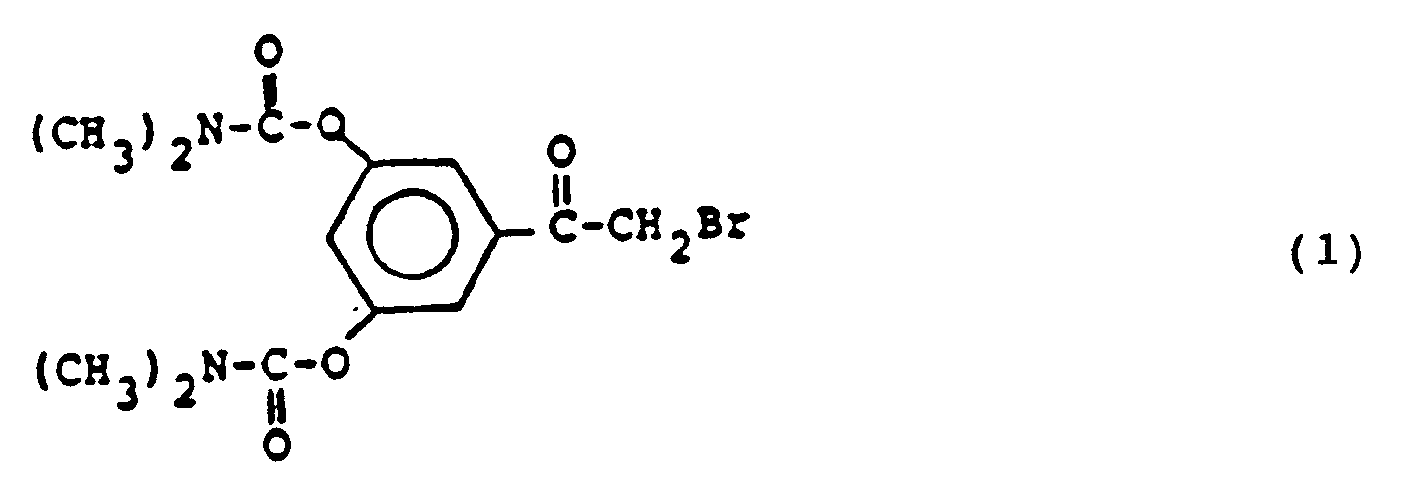
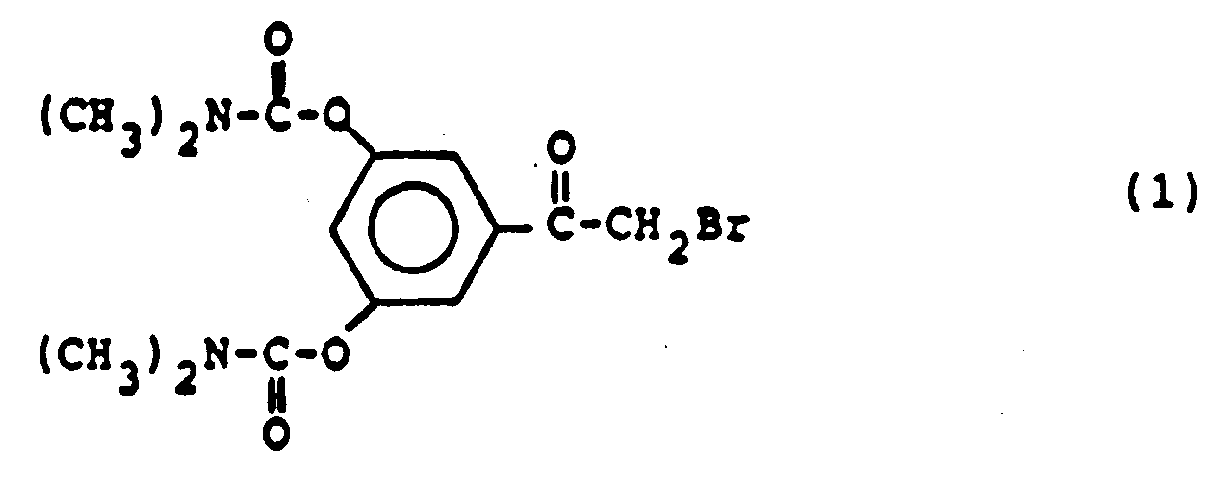
[0001] The present invention relates to an improved method for the preparation of an intermediate for bambuterol, i.e. for the preparation of 2′-bromo-3,5-di[N,N-dimethylcarbamoyloxy]acetophenone, having the formula
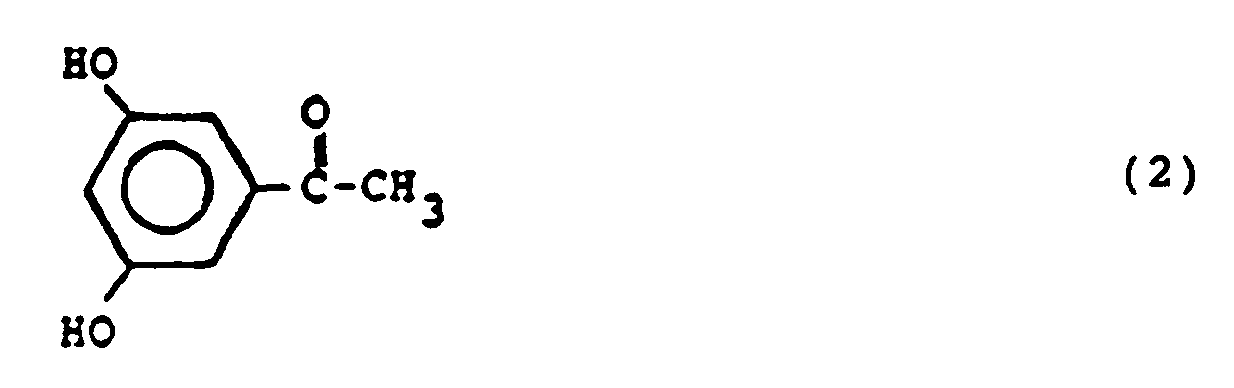
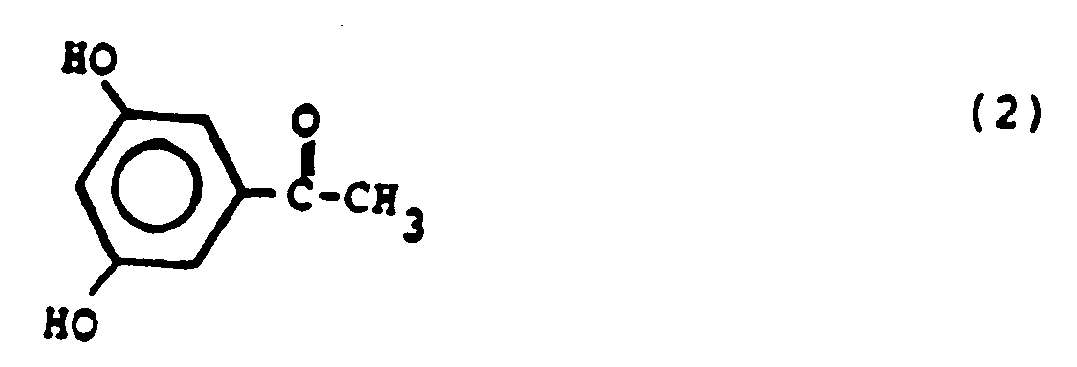
[0002] In US-A-4 451 663 a method of manufacturing the intermediate 2′-bromo-3,5-di[N,N-dimethylcarbamoyloxy]acetophenone of the formula (1) is disclosed, called route A2 therein, according to which 3,5-dihydroxyacetophenone, having the formula
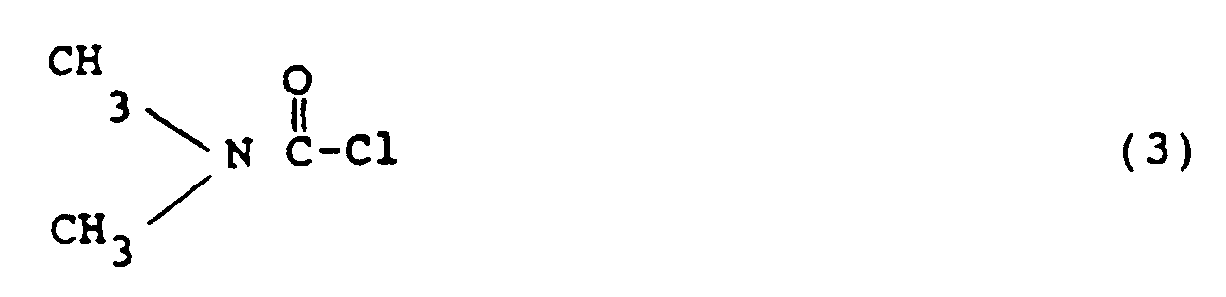
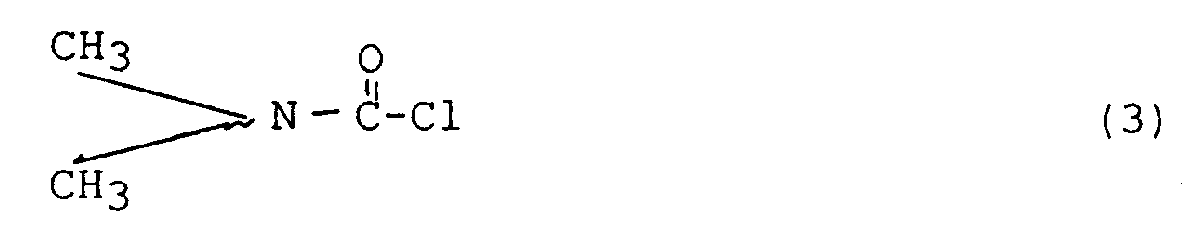
is reacted with N,N-dimethylcarbamoylchloride (DMCC) having the formula
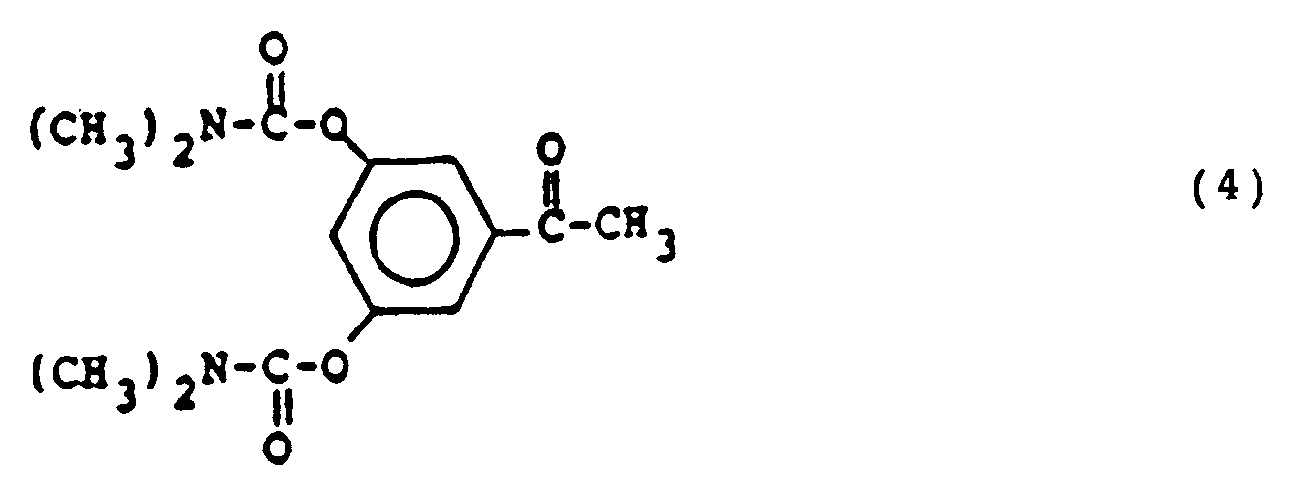
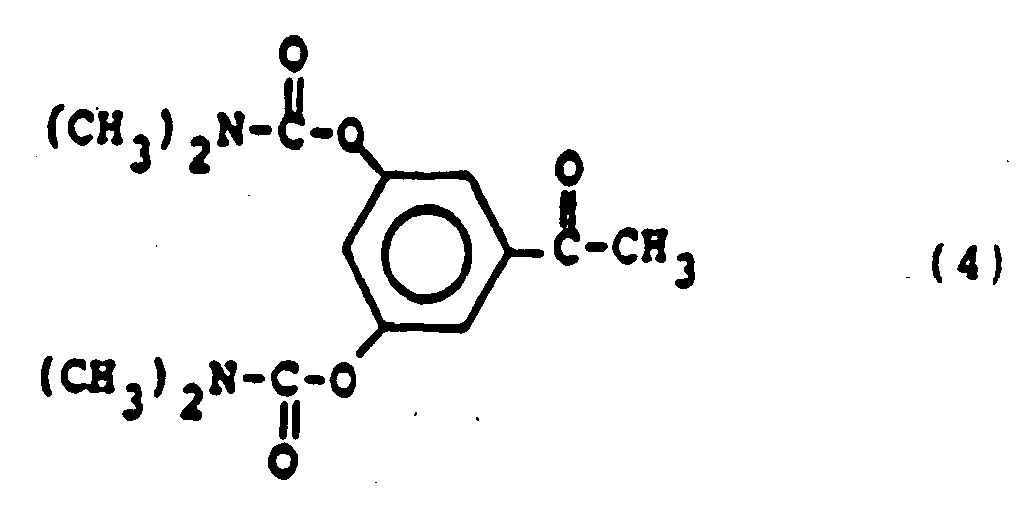
using pyridine as solvent and base for the uptake of hydrochloric acid formed during the reaction. The resulting compound, 3,5-di-[N,N-dimethylcarbamoyloxylacetophenone having the formula
is not isolated but further reacted with bromine in dioxan solvent resulting in the formation of 2′-bromo-3,5-di[N,N-dimethylcarbamoyloxy]acetophenone (1).
[0003] There is a great desire to avoid working with pyridine as a solvent. One method was tested in order to avoid using pyridine as a solvent, according to which the reaction was performed in methylene chloride with potassium carbonate as a base with a catalytical amount of pyridine present. The drawbacks with this process was a long reaction time for N,N-dimethylcarbamoylchloride (DMCC), > 24 hours, and a long quenching time for DMCC, > 24 hours, and separation problems in the work-up step (emulsion and small density difference). Methylene chloride is not a preferred solvent either, because of its toxicity.
[0004] The object of the invention is to provide an improved method for the preparation of the intermediate 2′-bromo-3,5-di-[N,N-dimethylcarbamoyloxy]acetophenone (1) for the production of bambuterol avoiding the use of pyridine and methylene chloride as solvents and eliminating the separation problems in the work-up step.
[0005] This is attained according to the present invention by reacting 3,5-dihydroxyacetophenone
with N,N-dimethylcarbamoylchloride, (CH₃)₂NCOCl, in a solvent, quenching with water, removing the solvent and dissolving of the resulting 3,5-di-[N,N-dimethylcarbamoyloxylacetophenone
in ethyl acetate, to which is added dissolved hydrogen bromide and then bromine, whereupon the resulting intermediate (1) is collected in the form of crystals, wherein the reaction between said 3,5-dihydroxyacetophenone (2) and N,N-dimethylcarbamoylchloride (3) is carried out in ethylacetate, isopropylacetate, butylacetate, ethylmethylketone or isobutylmethylketone as the solvent with a small amount of pyridine as a catalyst using a base comprising crystallized potassium carbonate.
[0006] According to a preferred embodiment of the invention potassium carbonate having a crystal water content of 11 - 13 % is used. This might be achieved by using a mixture of crystallized and calcinated potassium carbonate, resulting in a easily stirred two-phase system.
[0007] Calcinated potassium carbonate (completely dry) gives a slow and non-complete reaction, and the addition of water to the calcinated potassium carbonate results in a sticky mass which is difficult to stir. Further, free water should not be present in the reaction mixture because of the risk of hydrolysis of the reactants.
[0008] The bromination step which according to the invention first involves the addition of HBr, preferably dissolved in ethanol, and a second step charging with bromine, Br₂, has the advantage that the bromination will proceed calmly. When bromination is performed directly with bromine, the reaction will start very slowly and at a certain point it will proceed vigorously and will be hard to control.
[0010] In the first step of the process the base, potassium carbonate, will take care of hydrochloric acid formed. According to the prior art process pyridine will act both as base and solvent. In the process according to the invention however, pyridine will only be present in catalytic amounts. Here the pyridine will initially take up the hydrochloric acid formed, which then will be transferred to the potassium carbonate, which is consumed.
[0011] Dry, that is calcinated, potassium carbonate, does not work very well as a base, and the reason is believed to be that it forms a separate phase which is non-miscible with the other phases. If calcinated potassium carbonate and water is used, the water will hydrolyze the N,N-dimethylcarbamoylchloride (DMCC).
[0012] According to the invention crystallized potassium carbonate is used as the base. The water will released slowly and the base will be slowly consumed by the hydrochloric acid, which is first taken up and then transferred from the catalytic amount of pyridine present in the reaction mixture.
[0013] The crystallized potassium carbonate contains about 1.5 moles of H₂O which corresponds to about 16 %. The optimum water content is 11 - 13 %, and this content is obtained using a mixture of calcinated potassium carbonate and crystallized potassium carbonate.
Flowsheet diagram of synthetic route
Step 1
Chemicals
Procedure
[0018] Into a 500 litre enamelled reactor, connected to a scrubber containing ammonia/ethanol, is charged:
- 24 kg
- 3,5-dihydroxyacetophenone
- 41 kg
- potassium carbonate x 1,5 H₂O
- 9.4 kg
- potassium carbonate calcinated
- 96 kg (150 l)
- ethyl acetate
- 1.0 kg
- pyridine
- 50 kg
- dimethylcarbamoylchloride
[0019] This mixture is stirred and heated to 70 ± 2°C, and after stirring for 2 hours at this temperature 120 kg water is charged at 70°C and the mixture is stirred for 1,5 hours at 70 ± 2°C. After cooling to 20-30°C the reaction mixture is separated and the lower water phase is discarded.
[0020] To the organic phase is charged 60 kg water and pH is adjusted to 2 - 3 with about 1 kg sulphuric acid.
[0021] The phases are separated and the lower water phase is discarded. Ethyl acetate and water are removed by evaporation in the reactor at a jacket temperature of 60°C and vacuum (< 100 mbar). The evaporation residue is dissolved in 40 kg (50 l) ethyl acetate and is used directly in the bromination step.
Step 2
Chemicals
Procedure
[0024] Into a 100 ml three necked flask is charged 21.8 g 3,5-di[N,N-dimethylcarbamoyloxy]acetophenone dissolved in ethylacetate and 3.2 g hydrogen bromide dissolved in 12.8 g (16 ml) ethanol.
[0026] After stirring for further 10 minutes at 12 ± 2°C 36 ml (36 g) water is charged in about 15 minutes.
1. Process for the preparation of an intermediate for bamuterol, i.e. for the preparation
of 2′-bromo-3,5-di-[N,N-dimethylcarbamoyloxy]acetophenone, having the formula
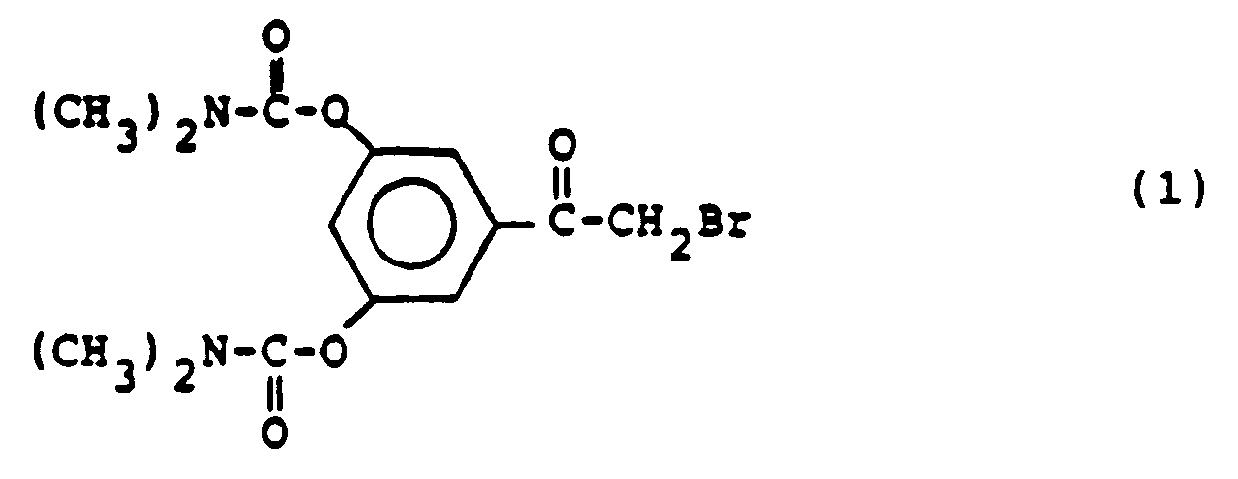
by reacting 3,5-dihydroxyacetophenone
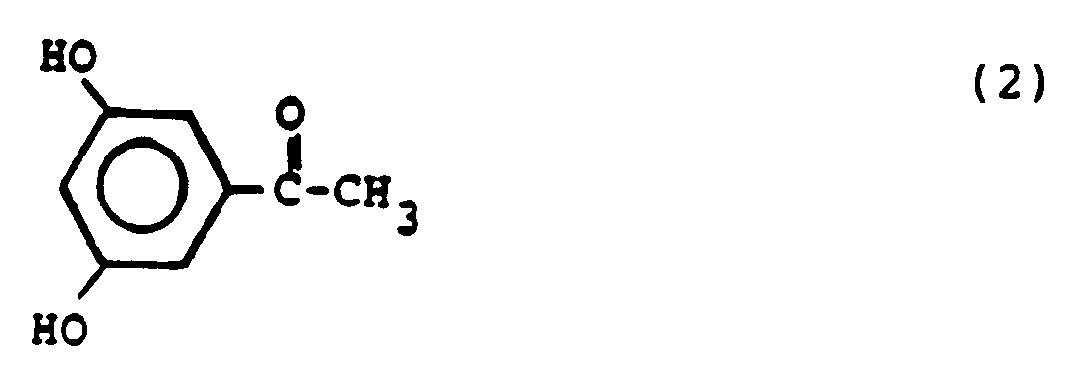
with N,N-dimethylcarbamoylchloride,
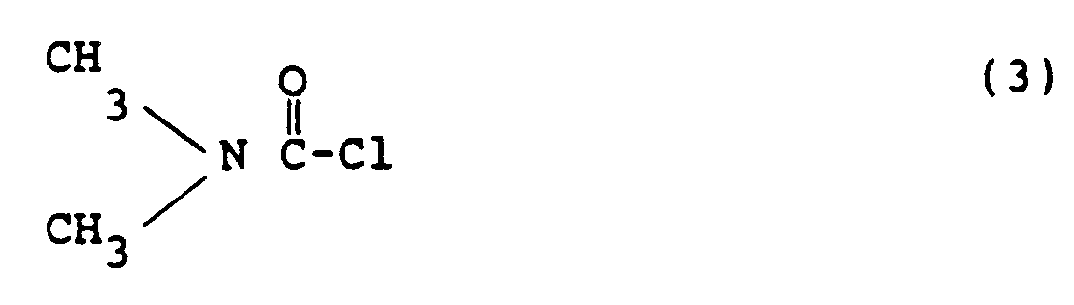
in a solvent, quenching with water, removing the solvent and dissolving of the resulting 3,5-di-[N,N-dimethylcarbamoyloxy]acetophenone
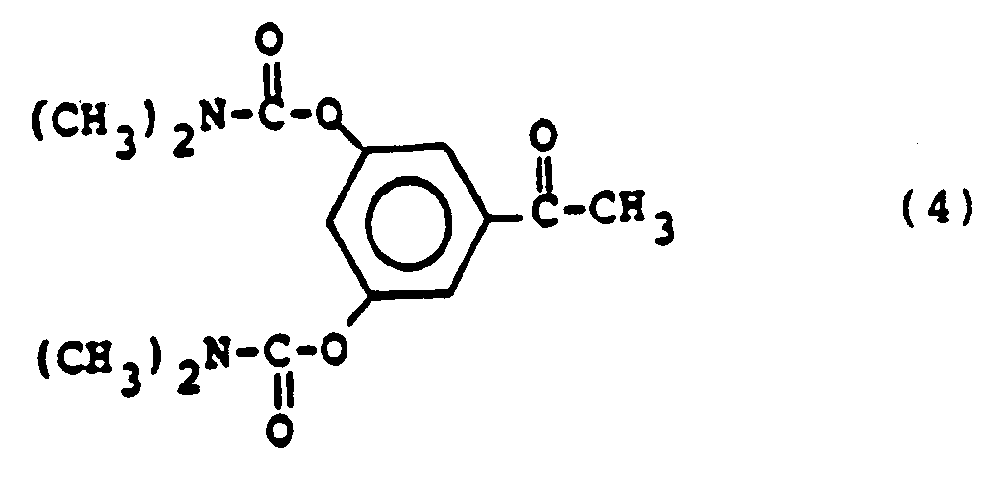
in ethyl acetate, to which dissolved hydrogen bromide is added and then bromine, whereupon the resulting intermediate (1) is collected in the form of crystals, characterized in that the reaction between said 3,5-dihydroxyacetophenone (2) and N,N-dimethylcarbamoylchloride (3) is carried out in ethylacetate, isopropylacetate, butylacetate, ethylmethylketone or isobutylmethylketone as the solvent with a small amount of pyridine as a catalyst using a base comprising crystallized potassium carbonate.
by reacting 3,5-dihydroxyacetophenone
with N,N-dimethylcarbamoylchloride,
in a solvent, quenching with water, removing the solvent and dissolving of the resulting 3,5-di-[N,N-dimethylcarbamoyloxy]acetophenone
in ethyl acetate, to which dissolved hydrogen bromide is added and then bromine, whereupon the resulting intermediate (1) is collected in the form of crystals, characterized in that the reaction between said 3,5-dihydroxyacetophenone (2) and N,N-dimethylcarbamoylchloride (3) is carried out in ethylacetate, isopropylacetate, butylacetate, ethylmethylketone or isobutylmethylketone as the solvent with a small amount of pyridine as a catalyst using a base comprising crystallized potassium carbonate.
2. Process according to claim 1, characterized in that the base is in the form of a mixture of crystallized and calcinated potassium
carbonate having a total crystal water content of 11-13 %.
1. Verfahren zur Herstellung einer Zwischenverbindung für Bamuterol, d.h. zur Herstellung
von 2′-Brom-3,5-di-[N,N-dimethylcarbamoyloxy]-acetophenon, der Formel
durch das Umsetzen von 3,5-Dihydroxyacetophenon
mit N,N-Dimethylcarbamoylchlorid
in einem Lösungsmittel, Abschrecken mit Wasser, Entfernen des Lösungsmittels und Lösen des erhaltenen 3,5-Di-[N,N-dimethylcarbamoyloxy]-acetophenons
in Ethylacetat, dem gelöster Bromwasserstoff zugesetzt wird, und dann Brom, worauf die erhaltene Zwischenverbindung (1) in Form von Kristallen gesammelt wird, dadurch gekennzeichnet, daß die Reaktion zwischen 3,5-Dihydroxyacetophenon (2) und N,N-Dimethylcarbamoylchlorid (3) in Ethylacetat, Isopropylacetat, Butylacetat, Ethylmethylketon oder Isobutylmethylketon als Lösungsmittel mit einer geringen Menge an Pyridin als Katalysator unter Verwendung einer kristallisiertes Kaliumcarbonat umfassenden Base durchgeführt wird.
durch das Umsetzen von 3,5-Dihydroxyacetophenon
mit N,N-Dimethylcarbamoylchlorid
in einem Lösungsmittel, Abschrecken mit Wasser, Entfernen des Lösungsmittels und Lösen des erhaltenen 3,5-Di-[N,N-dimethylcarbamoyloxy]-acetophenons
in Ethylacetat, dem gelöster Bromwasserstoff zugesetzt wird, und dann Brom, worauf die erhaltene Zwischenverbindung (1) in Form von Kristallen gesammelt wird, dadurch gekennzeichnet, daß die Reaktion zwischen 3,5-Dihydroxyacetophenon (2) und N,N-Dimethylcarbamoylchlorid (3) in Ethylacetat, Isopropylacetat, Butylacetat, Ethylmethylketon oder Isobutylmethylketon als Lösungsmittel mit einer geringen Menge an Pyridin als Katalysator unter Verwendung einer kristallisiertes Kaliumcarbonat umfassenden Base durchgeführt wird.
2. Verfahren nach Anspruch 1, dadurch gekennzeichnet, daß die Base in Form einer Mischung
von kristallisiertem und calciniertem Kaliumcarbonat mit einem gesamten Kristallwassergehalt
von 11 bis 13 % vorliegt.
1. Procédé pour la préparation d′un intermédiaire pour la production du bamutérol, c'est-à-dire
pour la préparation de la 2′-bromo-3,5-di-[N,N-diméthylcarbamoyloxy]-acétophénone,
répondant à la formule :
par la réaction de la 3,5-dihydroxyacétophénone
avec le chlorure de N,N-diméthylcarbamoyle
dans un solvant, refroidissement et arrêt de la réaction à l'aide d'eau, enlèvement du solvant et dissolution de la 3,5-di-[N,N-diméthylcarbamoyloxy]acétophénone résultante
dans de l'acétate d'éthyle à laquelle on ajoute du bromure d'hydrogène dissous puis du brome, après quoi on collecte sous forme de cristaux l'intermédiaire (1) résultant, procédé caractérisé en ce qu'on effectue la réaction entre ladite 3,5-dihydroxyacétophénone (2) et le chlorure de N,N-diméthylcarbamoyle (3) dans de l'acétate d'éthyle, de l'acétate d'isopropyle, de l'acétate de butyle, de la méthyléthylcétone ou de l'isobutylméthylcétone comme solvant, avec une faible quantité de pyridine comme catalyseur, en utilisant une base comprenant du carbonate de potassium cristallisé.
par la réaction de la 3,5-dihydroxyacétophénone
avec le chlorure de N,N-diméthylcarbamoyle
dans un solvant, refroidissement et arrêt de la réaction à l'aide d'eau, enlèvement du solvant et dissolution de la 3,5-di-[N,N-diméthylcarbamoyloxy]acétophénone résultante
dans de l'acétate d'éthyle à laquelle on ajoute du bromure d'hydrogène dissous puis du brome, après quoi on collecte sous forme de cristaux l'intermédiaire (1) résultant, procédé caractérisé en ce qu'on effectue la réaction entre ladite 3,5-dihydroxyacétophénone (2) et le chlorure de N,N-diméthylcarbamoyle (3) dans de l'acétate d'éthyle, de l'acétate d'isopropyle, de l'acétate de butyle, de la méthyléthylcétone ou de l'isobutylméthylcétone comme solvant, avec une faible quantité de pyridine comme catalyseur, en utilisant une base comprenant du carbonate de potassium cristallisé.
2. Procédé selon la revendication 1, caractérisé en ce que la base est sous la forme
d'un mélange de carbonate de potassium cristallisé et de carbonate de potassium calciné
ayant une teneur en eau totale de cristallisation de 11 à 13 %.