| (19) |
 |
|
(11) |
EP 0 458 950 B1 |
| (12) |
EUROPÄISCHE PATENTSCHRIFT |
| (45) |
Hinweis auf die Patenterteilung: |
|
15.09.1993 Patentblatt 1993/37 |
| (22) |
Anmeldetag: 19.12.1990 |
|
| (86) |
Internationale Anmeldenummer: |
|
PCT/EP9002/250 |
| (87) |
Internationale Veröffentlichungsnummer: |
|
WO 9108/765 (27.06.1991 Gazette 1991/14) |
|
| (54) |
K2P PRO-STABILISIERUNG
STABILIZATION OF K2P PRO
STABILISATION DE K2P PRO
|
| (84) |
Benannte Vertragsstaaten: |
|
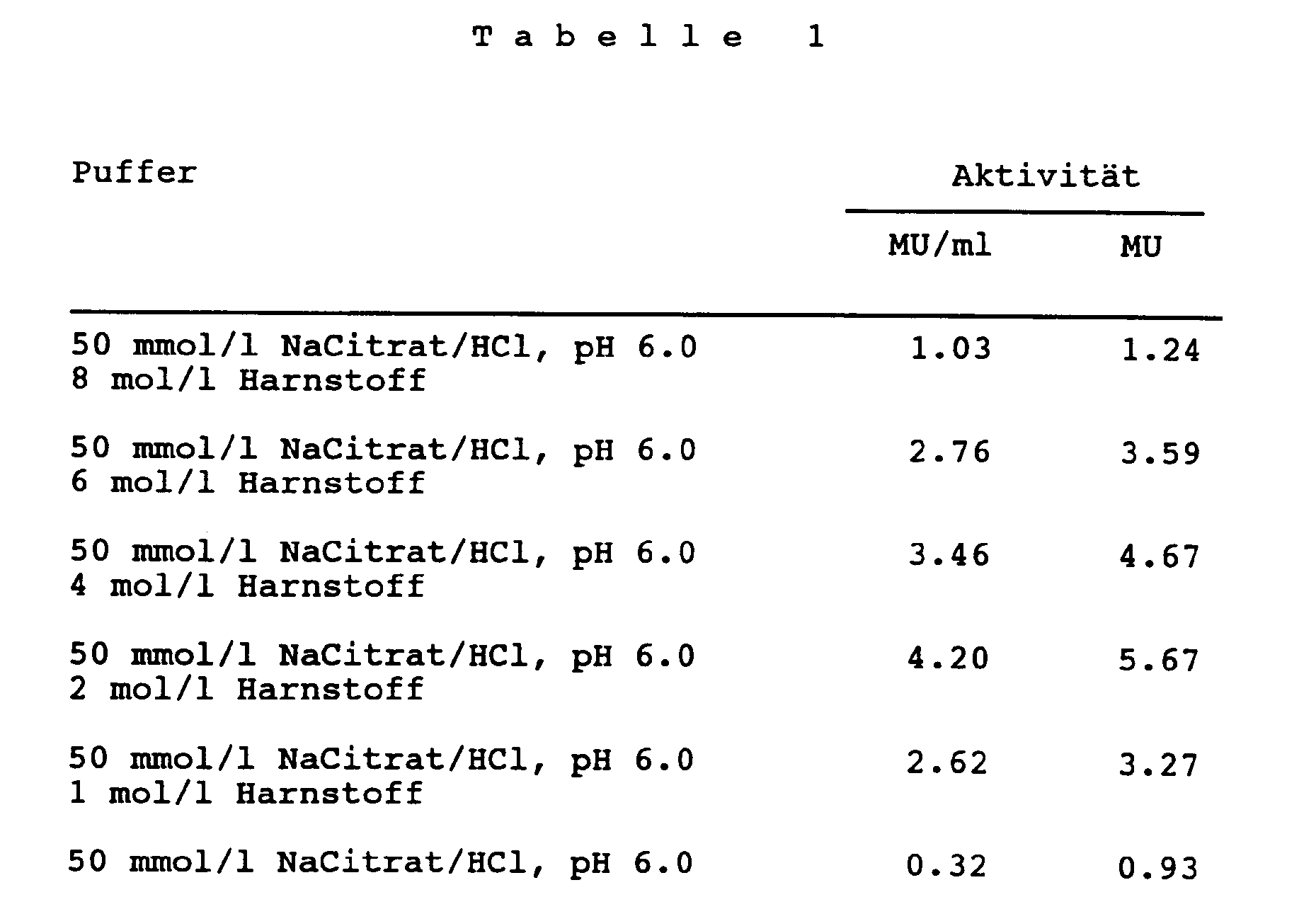
AT BE CH DE DK ES FR GB GR IT LI LU NL SE |
| (30) |
Priorität: |
20.12.1989 DE 3942141
|
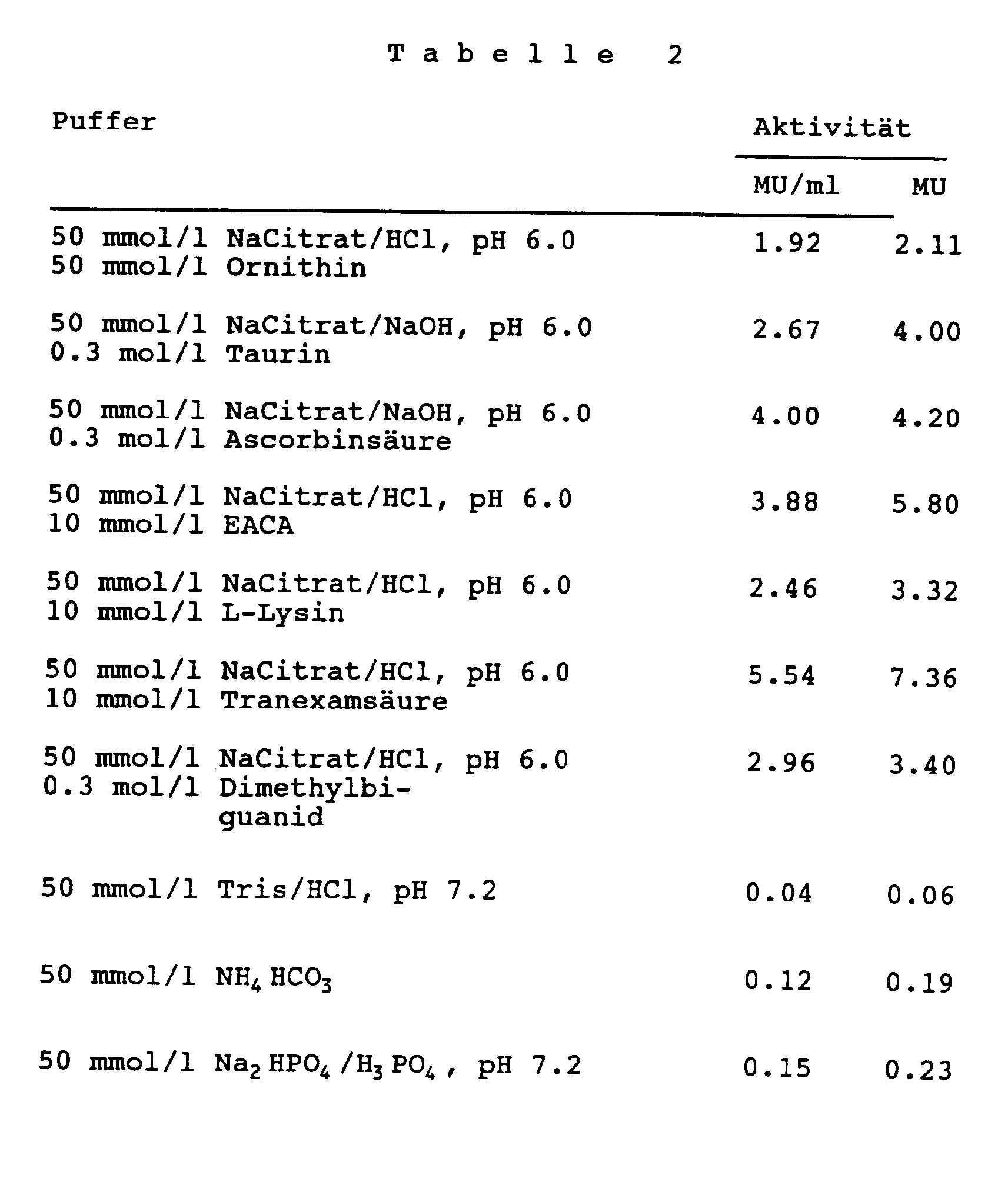
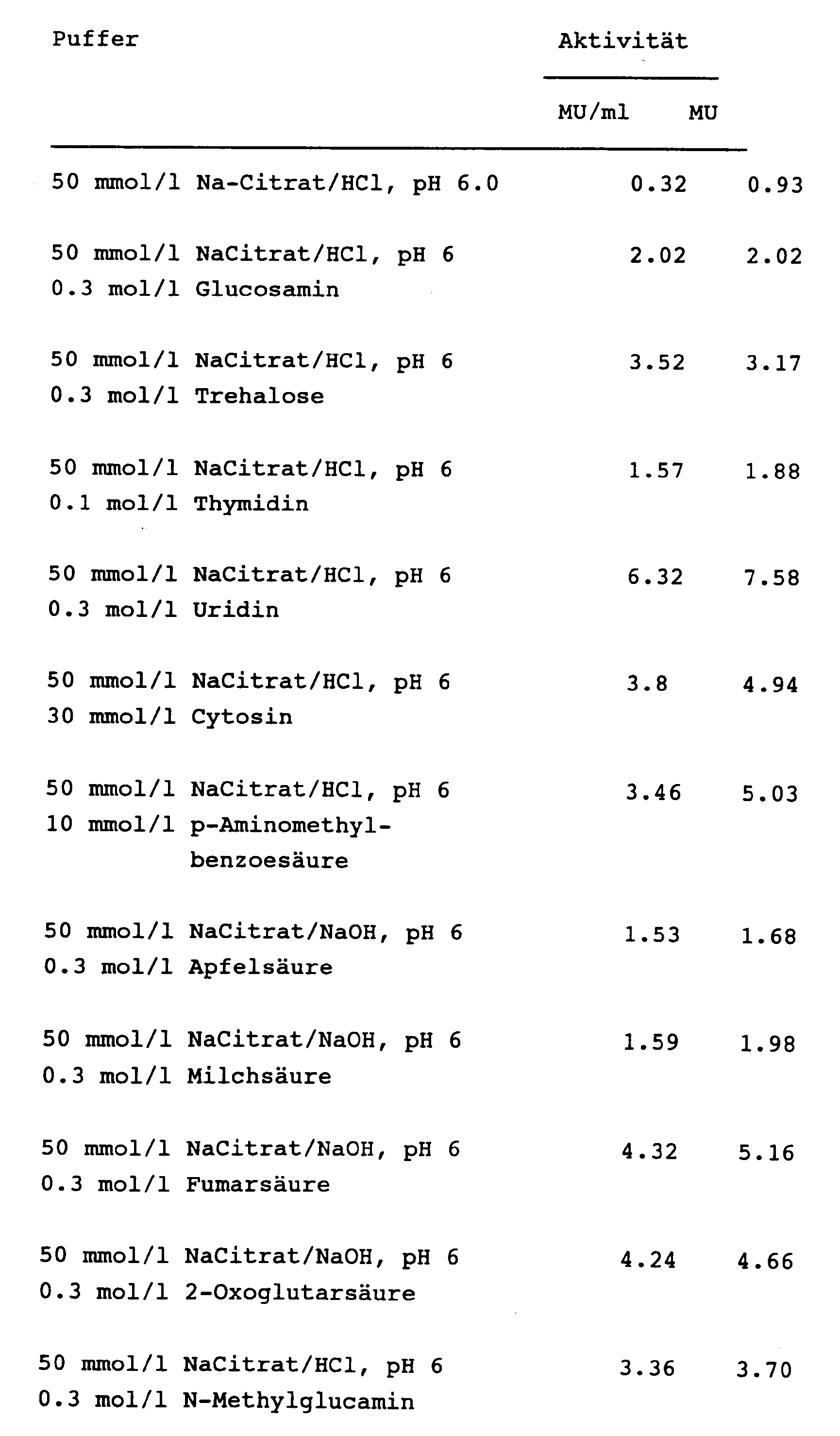
| (43) |
Veröffentlichungstag der Anmeldung: |
|
04.12.1991 Patentblatt 1991/49 |
| (73) |
Patentinhaber: BOEHRINGER MANNHEIM GMBH |
|
68298 Mannheim (DE) |
|
| (72) |
Erfinder: |
|
- KOHNERT, Ulrich, Dr.rer.nat.
W-8121 Habach (DE)
- RUDOLPH, Rainer, Dr.rer.nat.
W-8120 Weilheim (DE)
|
| (74) |
Vertreter: Prechtel, Jörg, Dipl.-Phys. Dr. et al |
|
Patentanwälte
H. Weickmann, Dr. K. Fincke
F.A. Weickmann, B. Huber
Dr. H. Liska, Dr. J. Prechtel, Dr. B. Böhm
Postfach 86 08 20
81635 München
81635 München (DE) |
| (56) |
Entgegenhaltungen: :
EP-A- 0 211 592
EP-A- 0 297 294
WO-A-90/08557
|
EP-A- 0 228 862
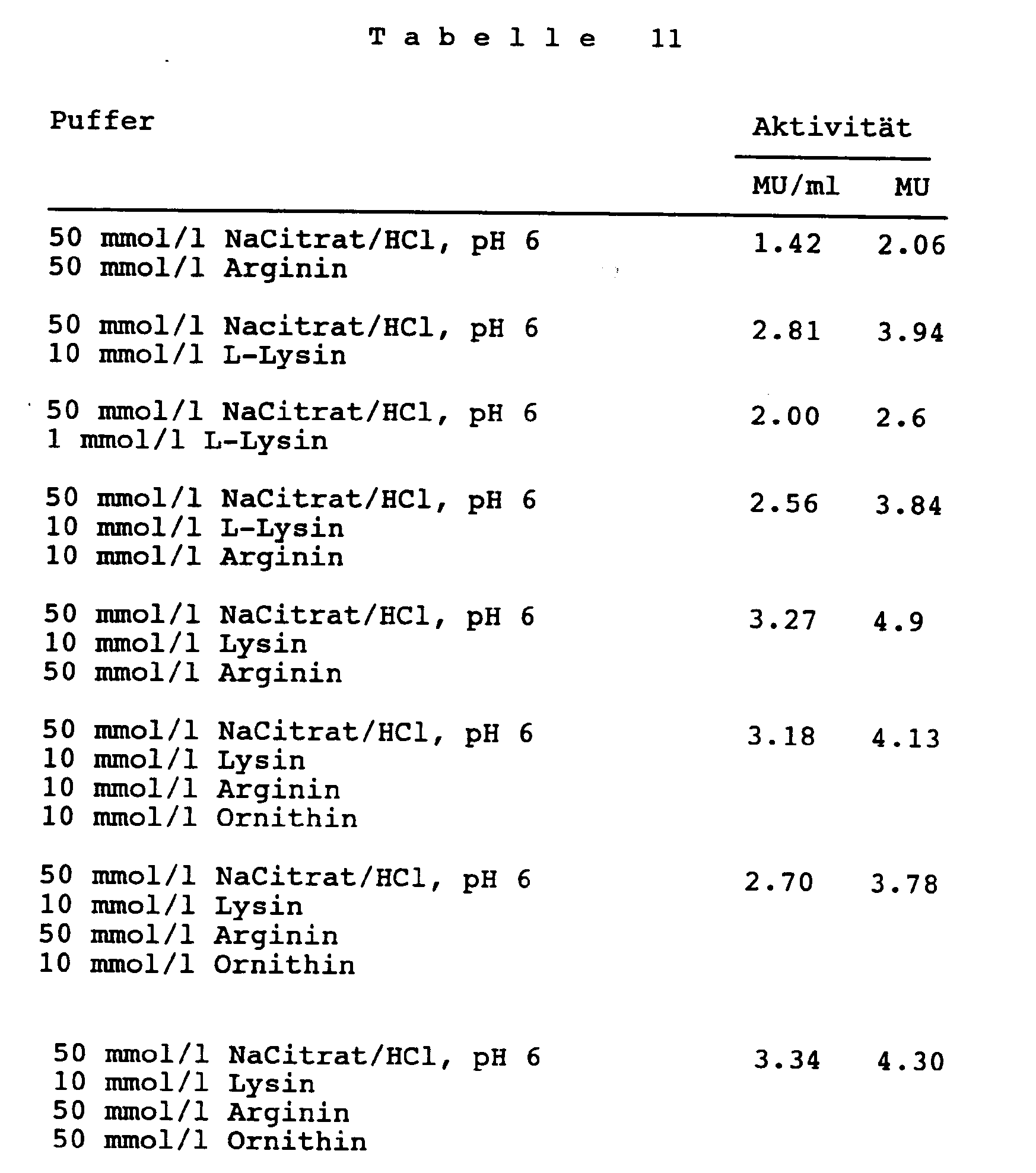
WO-A-90/01333
|
|
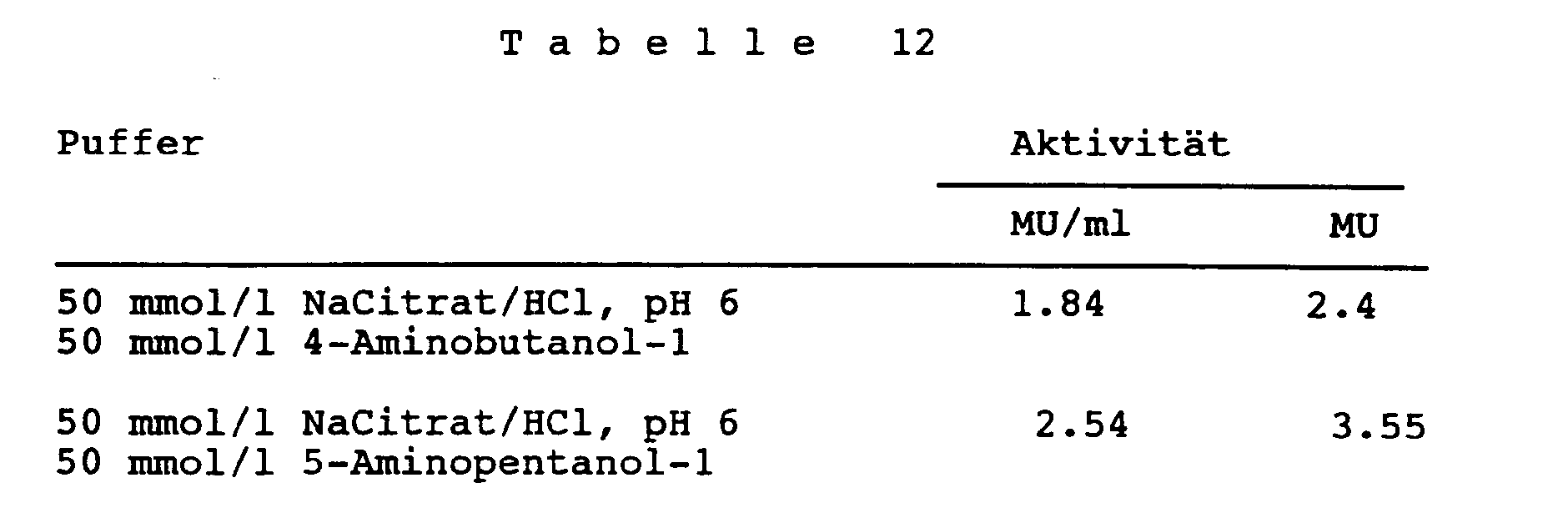
| |
|
|
- Biochemistry, vol. 28, 1989, Am. Chemical Soc., R.F. Kelley et al., pp. 4047-4054
|
|
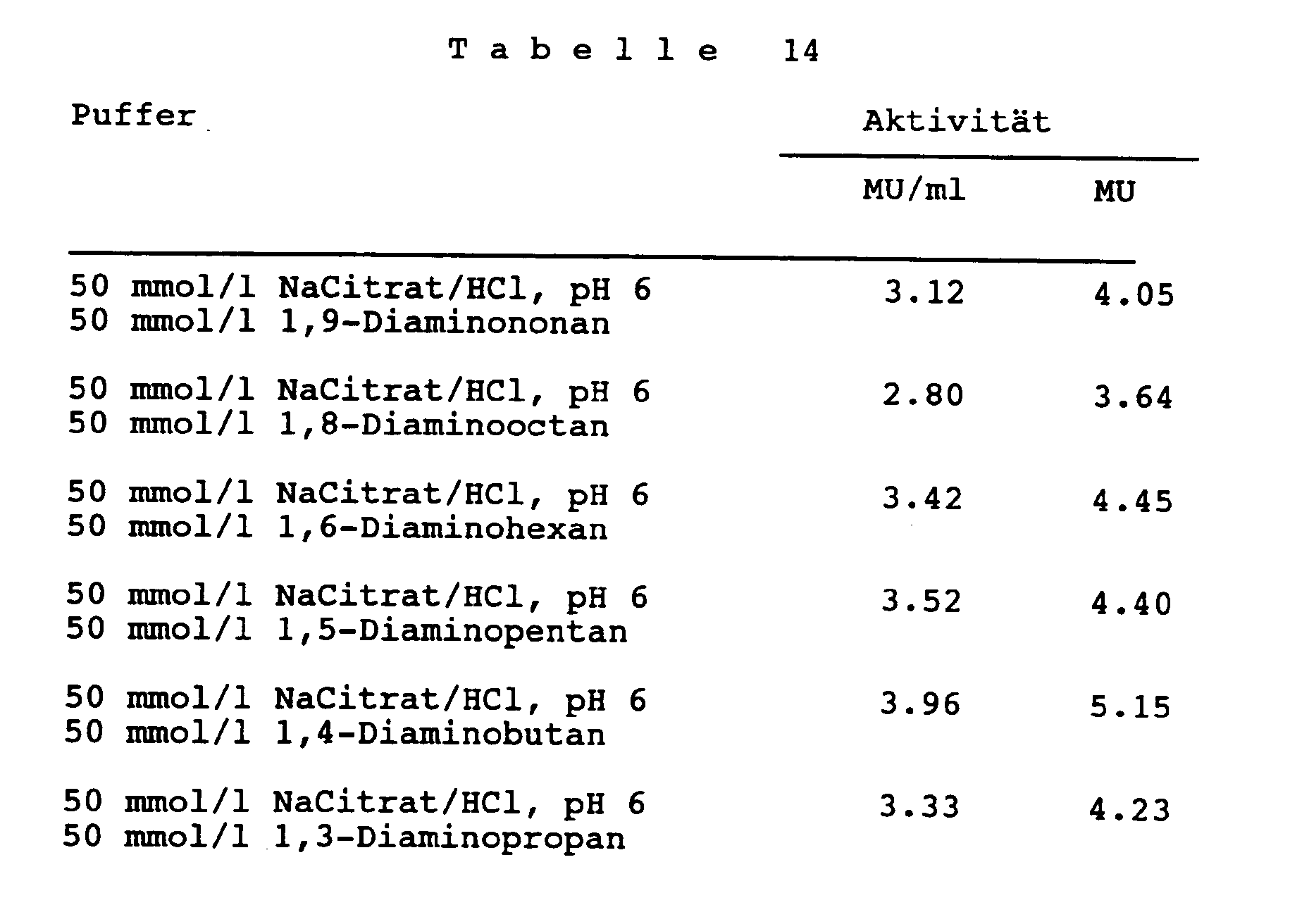
| |
|
| Anmerkung: Innerhalb von neun Monaten nach der Bekanntmachung des Hinweises auf die
Erteilung des europäischen Patents kann jedermann beim Europäischen Patentamt gegen
das erteilte europäischen Patent Einspruch einlegen. Der Einspruch ist schriftlich
einzureichen und zu begründen. Er gilt erst als eingelegt, wenn die Einspruchsgebühr
entrichtet worden ist. (Art. 99(1) Europäisches Patentübereinkommen). |
[0001] Der menschliche Gewebe-Plasminogen-Aktivator (t-PA) besitzt eine große therapeutische
Bedeutung bei der Auflösung von Blutgerinnseln, z.B. bei Herzinfarkten. t-PA bewirkt
die Auflösung von Blutgerinnseln durch die Aktivierung von Plasminogen zu Plasmin.
Plasmin wiederum löst Fibrin, die Hauptkomponente der Proteinmatrix von geronnenem
Blut.
[0002] Natürlicher t-PA ist aus mehreren funktionellen Domänen F, E, K1, K2 und P zusammengesetzt.
Die Domäne P beinhaltet das proteolytisch aktive Zentrum, das die Spaltung von Plasminogen
zu Plasmin bewirkt. Die gentechnologische Herstellung von t-PA oder verschiedenen
t-PA-Muteinen, bei denen einige der Domänen F, E, K1 und K2 deletiert sind, in eukaryontischen
und prokaryontischen Zellen ist bereits bekannt. Dabei werden t-PA-Derivate aus Prokaryonten
im Gegensatz zu natürlichem t-PA in nicht glykosylierter Form synthetisiert.
[0003] Weiterhin ist bekannt, daß der Zuckeranteil einen erheblichen Einfluß auf die Löslichkeit
und Aggregation von Proteinen hat (J. Biol. Chem. 263 (1988), 8832-8837). Es wurde
nun festgestellt, daß ein nicht glykosyliertes t-PA-Mutein mit der Domänen-Zusammensetzung
K2P eine wesentlich schlechtere Löslichkeit besitzt als etwa glykosylierte t-PA-Derivate.
Diese nicht glykosylierte t-PA-Variante löst sich nur in geringem Ausmaß in den üblicherweise
zur Solubilisierung von Proteinen verwendeten Puffern, wie z.B. 50 mmol/l Na-Citrat
pH 6, 50 mmol/l Phosphat-Puffer oder physiologischer NaCl-Lösung . Für den Einsatz
als therapeutischer Wirkstoff sollte jedoch das nicht glykosylierte t-PA-Derivat K2P
pro mit einer deutlich höheren enzymatischen Aktivität von mindestens 1,4 MU/ml, vorzugsweise
1,4 MU/ml bis 10 MU/ml vorliegen.
[0004] Aus der EP-A-0 217 379 ist bekannt, die Löslichkeit von t-PA aus Prokaryonten (t-PA
pro) durch neutrale oder leicht alkalische Arginin-Formulierungen zu erhöhen. Ein
Nachteil dieses Verfahrens ist jedoch, daß gute Löslichkeiten von t-PA pro nur mit
sehr hohen Argininkonzentrationen erreicht werden können. Außerdem ist die Stabilität
des hochkonzentrierten t-PA-Derivats K2P pro unter neutralen oder leicht alkalischen
Bedingungen gering.
[0005] Aufgabe der Erfindung ist es demnach, Formulierungen zu entwickeln, die das nicht
glykosylierte t-PA-Derivat K2P pro mit einer enzymatischen Aktivität von mindestens
1,4 MU/ml enthalten, wobei die Stabilität des t-PA-Derivats über einen längeren Zeitraum
hinweg erhalten bleiben soll.
[0006] Die erfindungsgemäße Aufgabe wird gelöst durch ein pharmazeutisches Präparat eines
nicht glykosylierten t-PA-Derivats welches aus der Kringel 2-Domäne und der Proteasedomäne
besteht und mit einer der Aminosäuren 174 - 180 beginnt und mit der Aminosäure 527
endet und außerdem die Aminosäuren -3 (Gly) bis +5 (Ile) ganz oder teilweise enthalten
kann (K2P pro) mit einer enzymatischen Aktivität von mindestens 1,4 MU/ml und einem
pH-Wert von 4,5 bis 6,5, wobei diese Zusammensetzung Citrat und mindestens eine Verbindung
aus der aus
a) Ascorbinsäure,
b) EDTA,
c) Aminoverbindungen der Formel
R¹R²N - R - X
wobei X = SO₃H, CH (NH₂)-CO₂H, CO₂H, H, NH₂ oder OH ist, R = C₁-C₉-Alkylen, vorzugsweise
C₄-C₇-Alkylen, C₃-C₆-Cycloalkylen oder Benzyliden ist und R¹ und R² voneinander unabhängig
H oder C₁-C₃-Alkyl sind,
d) Guanidin-analoge Verbindungen der Formel
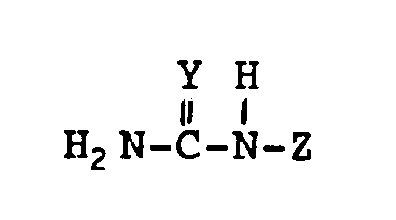
wobei
- Y
- = H₂N⁺ oder 0 ist,
- Z
- = H oder (CH₂)m V, (CH₂)mCH(NH₂)-CO₂H, CH(CO₂H)-(CH₂)mCO₂H ist,
- V
- = NH₂ oder CO₂H und
- m
- = 1 bis 4 ist
e) mit einer oder mehreren Hydroxyl-, Keto- oder/und weiteren Carboxylgruppen substituierten
Carbonsäuren,
f) Dimethylbiguanid,
g) Pyrimidinnukleosiden und Pyridinnukleotiden,
h) Trehalose, Glucosamin, N-Methylglucamin bestehenden Gruppe enthält.
[0007] Unter K2P pro gemäß vorliegender Erfindung versteht man ein t-PA-Derivat, welches
aus der Kringel 2- und der Proteasedomäne besteht und damit bei einer der Aminosäuren
174-180 beginnt und mit der Aminosäure 527 endet. K2P pro kann zusätzlich noch teilweise
oder ganz die Aminosäuren -3 (Gly) bis +5 (Ile) enthalten. Dabei ist ein Protein bevorzugt,
das bei Aminosäure 176 beginnt und ggf. aus dem Bereich -3 bis +5 noch die Aminosäuren
Ser, Tyr, Gln vorgeschaltet enthält. Diese Bezeichnung folgt der in T. J. R. Harris,
Protein Engineering, Band 1 (1987) 449-458 für t-PA angegebenen Nomenklatur. Die Herstellung
derartiger t-PA-Derivate K2P pro ist in der EP-A 0 382 174 beschrieben. Die enzymatische
Aktivität für K2P pro ist als Standardeinheit U gemäß der Definition der WHO für t-PA
angegeben. Die Bestimmung der Aktivität erfolgt nach H. Lill, ZGIMAL 42 (1987), 478-486.
[0008] Für die Solubilisierung von K2P pro hat sich ein Citratpuffer als besonders geeignet
erwiesen. Die Citratkonzentration z.B. soll mindestens 5 mmol/l, vorzugsweise 5 bis
100 mmol/l, besonders bevorzugt 50 mmol/l betragen. Der pH-Wert wird nach Basizität
der zugesetzten Verbindung vorzugsweise mit HCl oder einer Base wie z.B. NaOH oder
KOH eingestellt.
[0009] Überraschenderweise wurde festgestellt, daß die Löslichkeit von nicht glykosyliertem
K2P pro in anderen Puffersystemen, z.B. Phosphatpuffer, bei gleicher Ionenstärke und
gleichem pH-Wert wesentlich geringer ist. Es hat sich als geeignet erwiesen, den pH-Wert
von alkalischen Citrat-Lösungen mit HCl einzustellen, d.h. daß die Zusammensetzung
zusätzlich noch Chloridionen enthält. In Gegenwart von Chloridionen sind nämlich überraschenderweise
hochkonzentrierte Lösungen von nicht glykosyliertem K2P pro wesentlich stabiler als
z.B. in Gegenwart von Phosphationen. Der pH-Wert von sauren Citrat-Lösungen wird üblicherweise
mit NaOH eingestellt.
[0010] Geeignet für ein erfindungsgemäßes pharmazeutisches Präparat ist ein pH-Wert zwischen
4,5 und 6,5, bevorzugt ist ein pH-Wert von 5 bis 6. Überraschenderweise nimmt bei
den üblicherweise für natives t-PA verwendeten Formulierungen mit einem pH-Wert von
> 7 die Stabilität des nicht glykosylierten t-PA-Derivats K2P pro in der Lösung erheblich
ab. So ist die einkettige Form von K2P pro bei pH 7,2 und pH 8 in Arginin-gepufferten
Lösungen nur wenige Tage bei Raumtemperatur oder höheren Temperaturen stabil.
[0011] Ein erfindungsgemäßes pharmazeutisches Präparat enthält Ascorbinsäure, vorzugsweise
von 0,1 bis 1 mol/l, besonders bevorzugt von 0,2 bis 0,3 mol/l.
[0012] Die Konzentration von EDTA sollte vorzugsweise 1 bis 200 mol/l, besonders bevorzugt
10 bis 100 mmol/l betragen.
[0013] Vorzugsweise werden für eine erfindungsgemäße Zusammensetzung als Aminoverbindungen
Taurin, ε-Aminocapronsäure, Tranexamsäure, Lysin, Ornithin, δ-Aminovaleriansäure,
p-Aminomethylbenzoesäure, 8-Aminooctansäure oder/und 7-Aminoheptansäure verwendet.
Besonders bevorzugt ist die Verwendung von ε-Aminocapronsäure, p-Aminomethylbenzoesäure,
7-Aminoheptansäure, 8-Aminooctansäure, Tranexansäure oder/und Lysin. Die bevorzugten
Konzentrationen betragen 0,5 bis 20 mmol/l, besonders bevorzugt 1 bis 10 mmol/l.
[0014] Ebenso geeignet sind 4-Aminobutanol-1, 5-Aminopentanol-1, 6-Aminohexanol-1, 1,9-Diaminononan,
1,8-Diaminooctan, 1,7-Diaminoheptan, 1,6-Diaminohexan, 1,5-Diaminopentan, 1,4-Diaminobutan
oder/und 1,3-Diaminopropan. Die Konzentrationen der für ein erfindungsgemäßes Präparat
geeigneten α,ω-Diamine und α,ω-Aminoalkohole betragen vorzugsweise 10 bis 100 mmol/l.
[0015] Taurin und analoge Verbindungen werden vorzugsweise mit 0,1 bis 0,5 mol/l, besonders
bevorzugt mit 0,1 bis 0,3 mol/l verwendet.
[0016] Weiterhin werden für eine erfindungsgemäße Zusammensetzung als Guanidin-analoge Verbindungen
vorzugsweise Harnstoff, Guanidinobuttersäure oder/und Arginin verwendet. Die Konzentration
von Harnstoff beträgt vorzugsweise 0,1 bis 4 mol/l, besonders bevorzugt 0,5 bis 2
mol/l. Für andere Guanidin-analoge Verbindungen beträgt die Konzentration vorzugsweise
10 bis 200 mmol/l, besonders bevorzugt 50 bis 100 mmol/l.
[0017] Als Carbonsäuren, die mit Hydroxy-, Keto- oder/und weiteren Carboxylgruppen substituiert
sind, sind z.B. Apfelsäure, Milchsäure, Fumarsäure oder/und 2-Oxoglutarsäure geeignet.
Ihre Konzentration beträgt vorzugsweise 0,001 bis 1 mol/l, besonders bevorzugt 0,01
bis 0,5 mol/l.
[0018] Dimethylbiguanid wird bevorzugt in Konzentrationen von 50 bis 400 mmol/l, besonders
bevorzugt mit 100 bis 300 mmol/l eingesetzt.
[0019] Als Pyrimidinnukleosid oder Pyrimidinnukleotid sind z.B. Thymidin, Cytosin und Uridin
bzw. die entsprechenden Nukleotide geeignet. Diese Substanzen werden bevorzugt in
Konzentrationen von 1 bis 300 mmol/l, besonders bevorzugt von 10 bis 300 mmol/l eingesetzt.
[0020] Trehalose, Glucosamin und N-Methylglucamin werden bevorzugt in Konzentrationen von
1 bis 500 mmol/l, besonders bevorzugt mit 10 bis 300 mmol/l eingesetzt.
[0021] Weiterhin ein Gegenstand der Erfindung ist eine erfindungsgemäße Zusammensetzung,
die zusätzlich eine oder mehrere α-Aminocarbonsäuren, insbesondere Histidin enthält.
[0022] Im folgenden ist eine Reihe besonders bevorzugter Präparate gemäß vorliegender Erfindung
aufgeführt. Eine Formulierung enthält 50 mmol/l Na-Citrat/HCl, pH 6, 2 mol/l Harnstoff.
Eine weitere Formulierung enthält 50 mmol/l Na-Citrat, pH 6 und 0,5 mol/l bis 1 mol/l
Guanidin. Wiederum eine weitere Formulierung enthält 50 mmol/l Na-Citrat, pH 6 und
0,3 mol/l Taurin. Wiederum eine weitere Formulierung enthält 50 mmol/l Na-Citrat,
pH 6 und 0,2 mol/l bis 0,3 mol/l Ascorbinsäure. Wiederum eine weitere Formulierung
enthält 50 mmol/l Na-Citrat/ HCl, pH 6 und 300 mmol/l Dimethylbiguanid. Eine weitere
Formulierung enthält 50 mmol/l NaCitrat/HCl, pH 6 und 10 bis 300 mmol/l Thymidin,
Uridin oder Cytosin bzw. 10 bis 100 mmol/l eines der obengenannten α,ω-Diamine oder
einen der obengenannten α,ω-Aminoalkohole. Eine weitere Formulierung enthält 50 mmol/l
NaCitrat/HCl, pH 6 und 10 bis 300 mmol/l Trehalose, Glucosamin oder N-Methylglucamin.
[0023] Wiederum eine besonders bevorzugte erfindungsgemäße Formulierung enthält 50 mmol/l
Na-Citrat/HCl, pH 6 und 1 mmol/l bis 10 mmol/l ε-Aminocapronsäure, δ-Aminovaleriansäure,
7-Aminoheptansäure, 8-Aminooctansäure, p-Aminomethylbenzoesäure, L-Lysin, Ornithin
oder Tranexamsäure. Diese Substanzen bewirken überraschenderweise bereits in geringem
molaren Überschuß (10- bis 40fach) eine hervorragende Löslichkeit von K2P pro.
[0024] Weiterhin bevorzugt sind auch Formulierungen, die 50 mmol/l Na-Citrat/HCl, pH 6 und
eine Guanidin-analoge Verbindung, insbesondere Arginin und Guanidinobuttersäure in
einer Konzentration von 50 bis 100 mmol/l enthalten. Eine weitere Formulierung enthält
50 mmol/l NaCitrat, pH 6 und 10 bis 500 mmol/l Apfelsäure, Milchsäure, Fumarsäure
oder 2-Oxoglutarsäure. Wiederum eine weitere Formulierung enthält 50 mmol/l Na-Citrat,
pH 6 und 10 bis 100 mmol/l EDTA.
[0025] Wie aus den Beispielen ersichtlich ist, bewirken auch Kombinationen aus mehreren
der obengenannten Verbindungen mit Citrat eine sehr gute Löslichkeit von K2P pro.
Geeignet sind z.B. Kombinationen von Lysin mit Arginin, Ornithin, Glucosamin oder/und
Thymidin oder von EDTA mit ε-Aminocapronsäure, Lysin, Arginin, Glucosamin oder/und
Thymidin. Ebenso geeignet sind jedoch auch andere Kombinationen von mindestens 2 der
obengenannten Verbindungen mit Citrat.
[0026] Ein Gegenstand der Erfindung ist schließlich auch ein Arzneimittel auf Basis von
K2P pro als Wirkstoff in Lösung oder als Lyophilisat mit den angegebenen Substanzen
und gegebenenfalls noch weiteren pharmazeutisch verträglichen Zusatz-, Hilfs-, Träger-
und Füllstoffen.
[0027] Die erfindungsgemäßen pharmazeutischen Präparate kommen vorzugsweise als Injektions-
und Infusionslösungen zum Einsatz. Dies kann dadurch geschehen, daß eine bereits spritzfertige
Lösung zur Verfügung gestellt wird, die die erfindungsgemäße Zusammensetzung besitzt.
Es ist jedoch auch möglich, die pharmazeutischen Präparate in Form von Lyophilisaten
zur Verfügung zu stellen. Diese werden dann mit an sich bekannten, zu Injektionszwecken
geeigneten Mitteln oder Lösungen rekonstituiert. Als Injektionsmedium kommt vorzugsweise
Wasser zur Anwendung, welches die bei Injektionslösungen üblichen Zusätze wie Stabilisierungsmittel,
Lösungsvermittler, Puffer und isotonische Zusätze, beispielsweise eine physiologische
NaCl-Konzentration, enthält. Derartige Zusätze sind beispielsweise Mannit, Tartrat-
oder Citrat-Puffer, Ethanol, Komplexbildner wie z.B. Ethylendiamintetraessigsäure
und deren nicht-toxischen Salze, sowie hochmolekulare Polymere, wie flüssiges Polyethylenoxid
zur Viskositätsregulierung. Flüssige Trägerstoffe für Injektionslösungen müssen steril
sein und werden vorzugsweise in Ampullen abgefüllt.
[0028] Schließlich beinhaltet die vorliegende Erfindung auch die Verwendung von K2P pro
zur Herstellung von erfindungsgemäßen pharmazeutischen Präparaten.
[0029] Die folgenden Beispiele sollen konkrete Ausführungsformen der Erfindung weiter erläutern.
Beispiel 1
[0030] Einfluß von Harnstoff auf die Löslichkeit eines nicht glykosylierten t-PA-Muteins
mit der Domänen-Zusammensetzung K2P
[0031] In diesem Beispiel wird der Einfluß von Harnstoff auf die Löslichkeit von K2P pro
(Herstellung nach EP-A 0 382 174) in Citrat-gepufferten Lösungen bei pH 6.0 beschrieben.
Wie aus Tabelle 1 zu entnehmen ist, ist K2P pro in 50 mmol/l Citrat-Puffer bei pH
6.0 nur bedingt löslich. Durch Zusatz von Harnstoff kann die Löslichkeit erheblich
verbessert werden. Das Optimum liegt dabei etwa bei 2 mol/l Harnstoff.
Durchführung
[0032] 170 ml gereinigtes K2P pro (gelöst in 0,5 mol/l Arginin/H₃PO₄, pH 7,2) werden durch
Ultrafiltration über eine Amicon YM 10-Membran konzentriert. Jeweils 1 ml des Konzentrats
(Aktivität 5,8 MU/ml) wird gegen die in Tabelle 1 aufgeführten Puffer dialysiert.
Nach Zentrifugation der Proben wird im klaren Überstand die enzymatische Aktivität
gemessen.
[0033] Die enzymatische Aktivität ist als Volumenaktivität in MU/ml und als Gesamtaktivität
in MU angegeben.
[0034] Die Messung der K2P-Aktivität kann dabei auf übliche Weise durch Spaltung eines chromogenen
Substrats bestimmt werden (H. Lill, ZGIMAL 42 (1987), 478-486). Die Einheit U ist
eine Einheit der Aktivität für t-PA nach Definition der WHO, National Institute for
Biological Standards and Control.
Beispiel 2
[0035] Einfluß von verschiedenen Substanzen auf die Löslichkeit von K2P pro
[0036] In diesem Beispiel wird der Einfluß von verschiedenen Substanzen auf die Löslichkeit
von K2P pro in Citrat-gepufferten Lösungen bei pH 6 beschrieben. Hervorragende Löslichkeiten
(> 2 MU/ml) wurden mit Taurin, Ascorbinsäure, Lysin, EACA, Tranexamsäure, Dimethylbiguanid,
Glucosamin, Trehalose, N-Methylglucamin, Uridin, Cytidin, p-Aminomethylbenzoesäure,
Fumarsäure und Oxoglutarsäure erzielt. Weiterhin ist ersichtlich, daß der Citratpuffer
bei gleicher molarer Konzentration eine bessere Löslichkeit des t-PA-Derivats als
ein NH₄HCO₃-, Tris- oder Phosphatpuffer bewirkt.
Durchführung:
Konzentrat:
[0038] Aktivität: 5.8 MU/ml
Beispiel 3
[0039] Einfluß von ε-Aminocapronsäure (EACA) auf die Löslichkeit von K2P pro
Durchführung:
Konzentrat:
[0041] Aktivität: 6.3 MU/ml
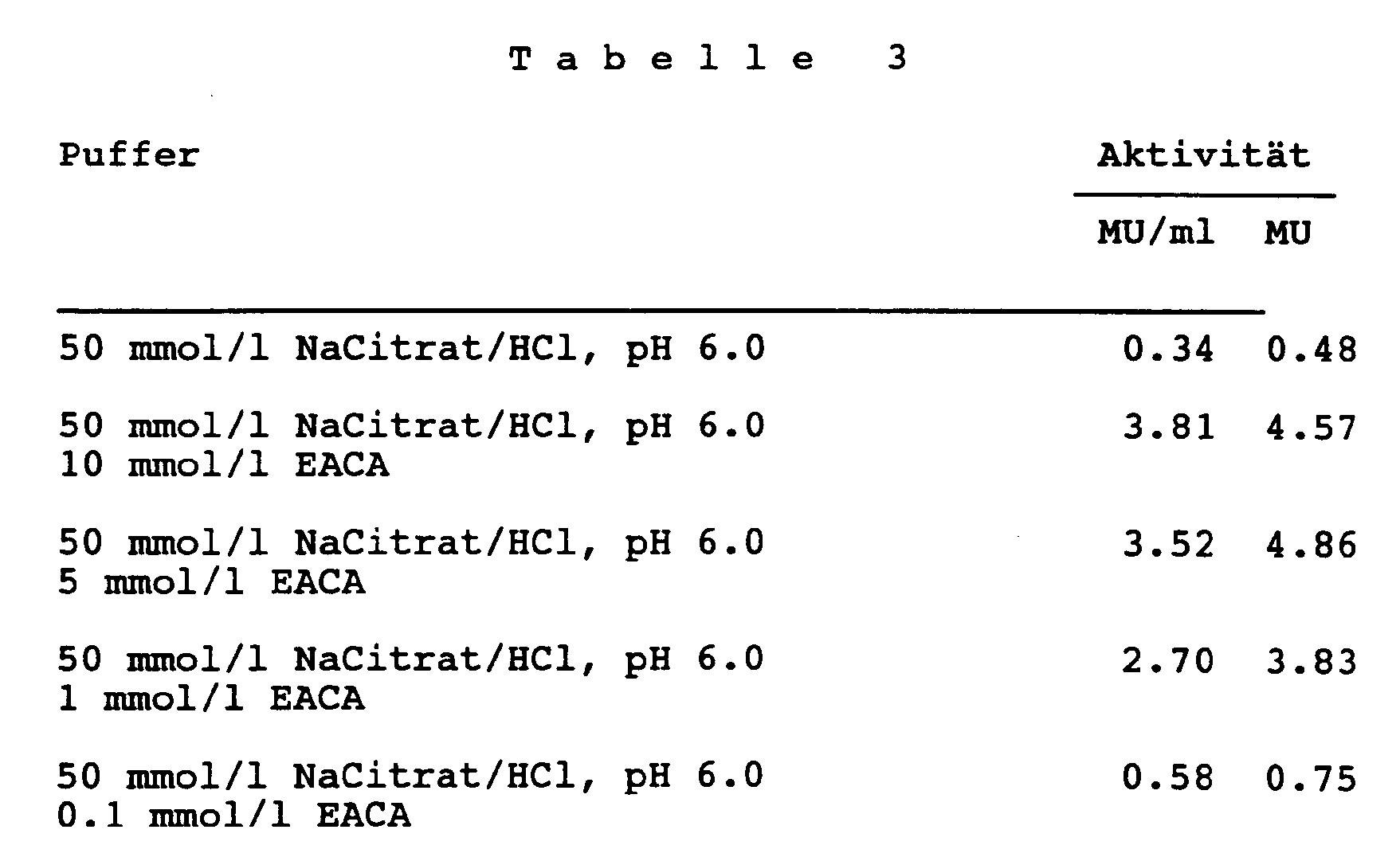
[0042] Tabelle 3 zeigt, daß EACA schon in einer Konzentration von 1 - 10 mmol/l (10 - 40facher
molarer Überschuß im Vergleich zu K2P pro) eine erhebliche Verbesserung der Löslichkeit
in Citrat-gepufferten Lösungen bei pH 6.0 bewirkt.
Beispiel 4
[0043] Einfluß von Ascorbinsäure auf die Löslichkeit von K2P pro
Durchführung:
Konzentrat:
[0045] Aktivität: 6.3 MU/ml
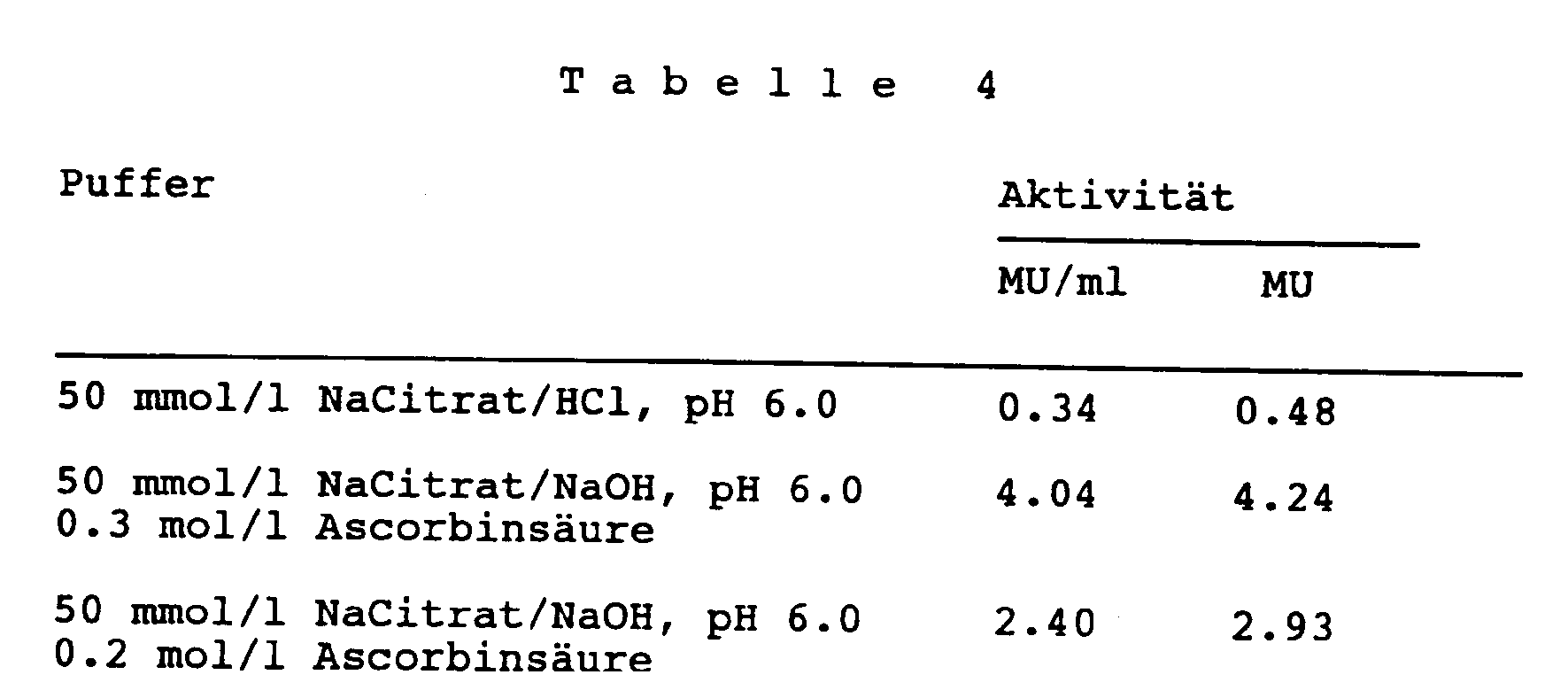
[0046] Die Ergebnisse von Tabelle 4 zeigen, daß in Citrat-gepufferten Lösungen die Löslichkeit
von K2P pro durch Zusatz von Ascorbinsäure weiter erhöht wird.
Beispiel 5
[0047] pH-Abhängigkeit der Stabilität von K2P pro in Argininhaltigen Lösungen
[0048] Gereinigtes K2P pro wird gegen die in Tabelle 5 aufgeführten 0.5 mol/l Arg/H₃PO₄-Puffer
dialysiert und portioniert bei - 20, 25 und 37°C gelagert. Nach 3, 7, 14 und 21 Tagen
wird jeweils 1 Probe auf Aktivität und Stimulierbarkeit durch Zugabe von Fibrin getestet
und SDS-elektrophoretisch analysiert (Ausgangswerte: Aktivität: 1,3 MU/ml, Stimulierbarkeit:
28). Die in Tabelle 5 zusammengefaßten Daten zeigen, daß die bei pH 8 und pH 7.2 gelagerten
Proben nach 3 bzw. 7 Tagen Lagerung bei 37 °C eine deutliche Erhöhung der Aktivität
unter gleichzeitiger Abnahme der Stimulierbarkeit aufweisen. Bei 25 °C kommt es, allerdings
zeitlich verzögert, ebenfalls zu einem Anstieg der Aktivität und Abnahme der Stimulierbarkeit.
Nach 14 bis 21 Tagen wird dann auch eine Verringerung der Aktivität beobachtet.
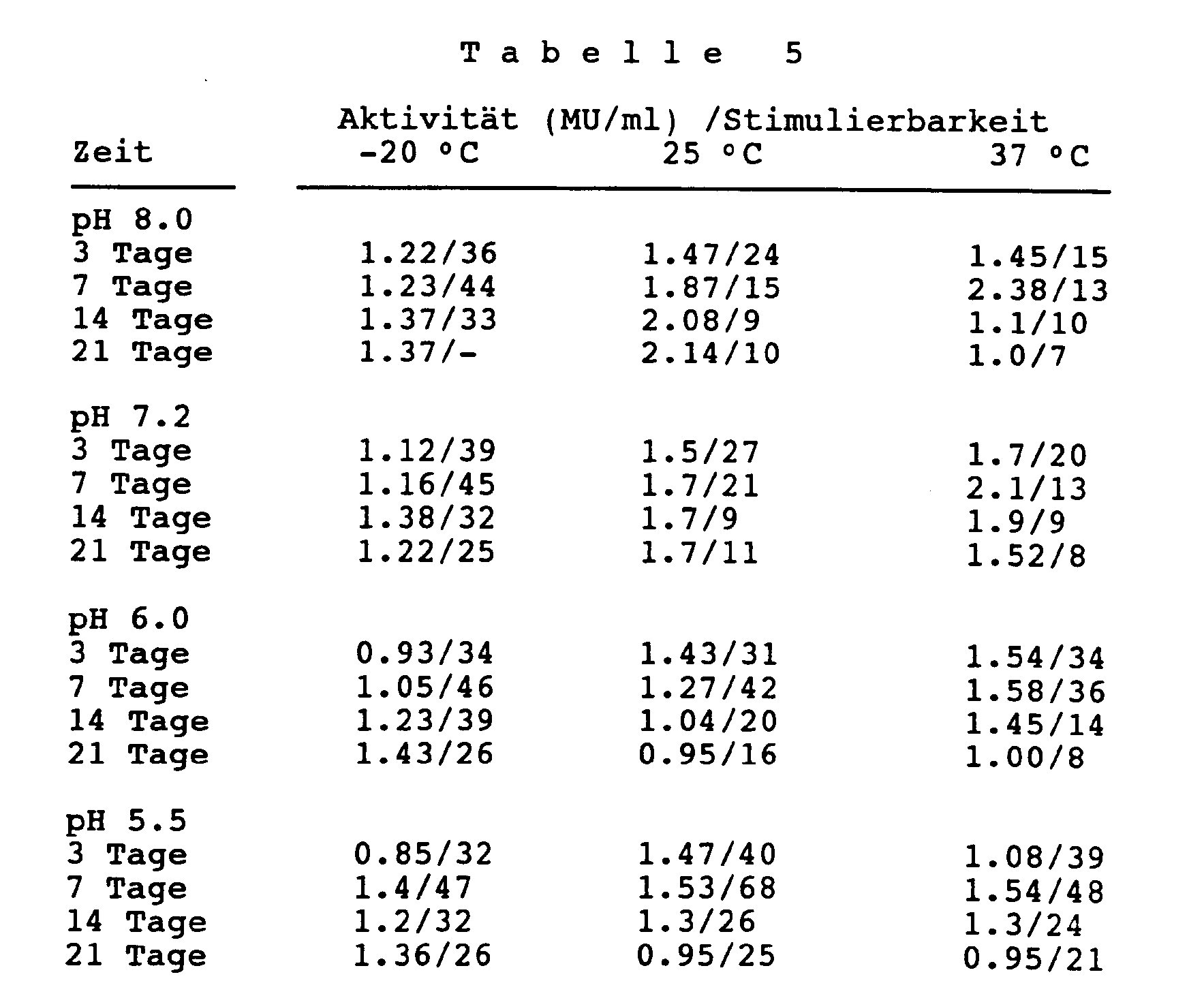
[0049] Parallel zu diesen Veränderungen wird eine Abnahme des Molekulargewichts von K2P
pro (Elektrophorese mit SDS-PAGE) beobachtet.
Beispiel 6
[0050] Einfluß von Chlorid- und Phosphat-Ionen auf die Stabilität von K2P pro in Arginin
(Arg)-haltigen Lösungen
[0051] Gereinigtes K2P pro wird gegen die unten aufgeführten Arginin-haltigen Puffer dialysiert
und portioniert bei -20, 25 und 37 °C gelagert. Nach 2, 7 und 14 Tagen wird jeweils
1 Probe SDS-elektrophoretisch analysiert. Es zeigt sich, daß in Gegenwart von Chlorid-Ionen
die einkettige Form wesentlich stabiler ist als in Gegenwart von Phosphat-Ionen. Während
in Chloridionen-haltigen Lösungen nach 7 Tagen Lagerung bei 37 °C bei pH 7.2 und 8
erst 10 % bis 20 % der Probe gespalten sind, beträgt in den Phosphat-gepufferten Lösungen
der Anteil des gespaltenen Materials 60 % bis 90 %.
Puffer:
[0052] 0.5 mol/l Arg/H₃PO₄, pH 8.0
0.5 mol/l Arg/HCl, pH 8.0
0.5 mol/l Arg/H₃PO₄, pH 7.2
0.5 mol/l Arg/HCl, pH 7.2
Beispiel 7
[0053] Einfluß von ε-Aminocapronsäure auf die Löslichkeit von K2P pro in Citrat- und Phosphat-gepufferten
Lösungen
[0054] Gereinigtes K2P pro wird durch Ultrafiltration auf 4.2 MU/ml konzentriert und gegen
die in Tabelle 8 angegebenen Puffer dialysiert und zentrifugiert. Nach Zentrifugation
der Proben wird im klaren Überstand die Aktivität gemessen.
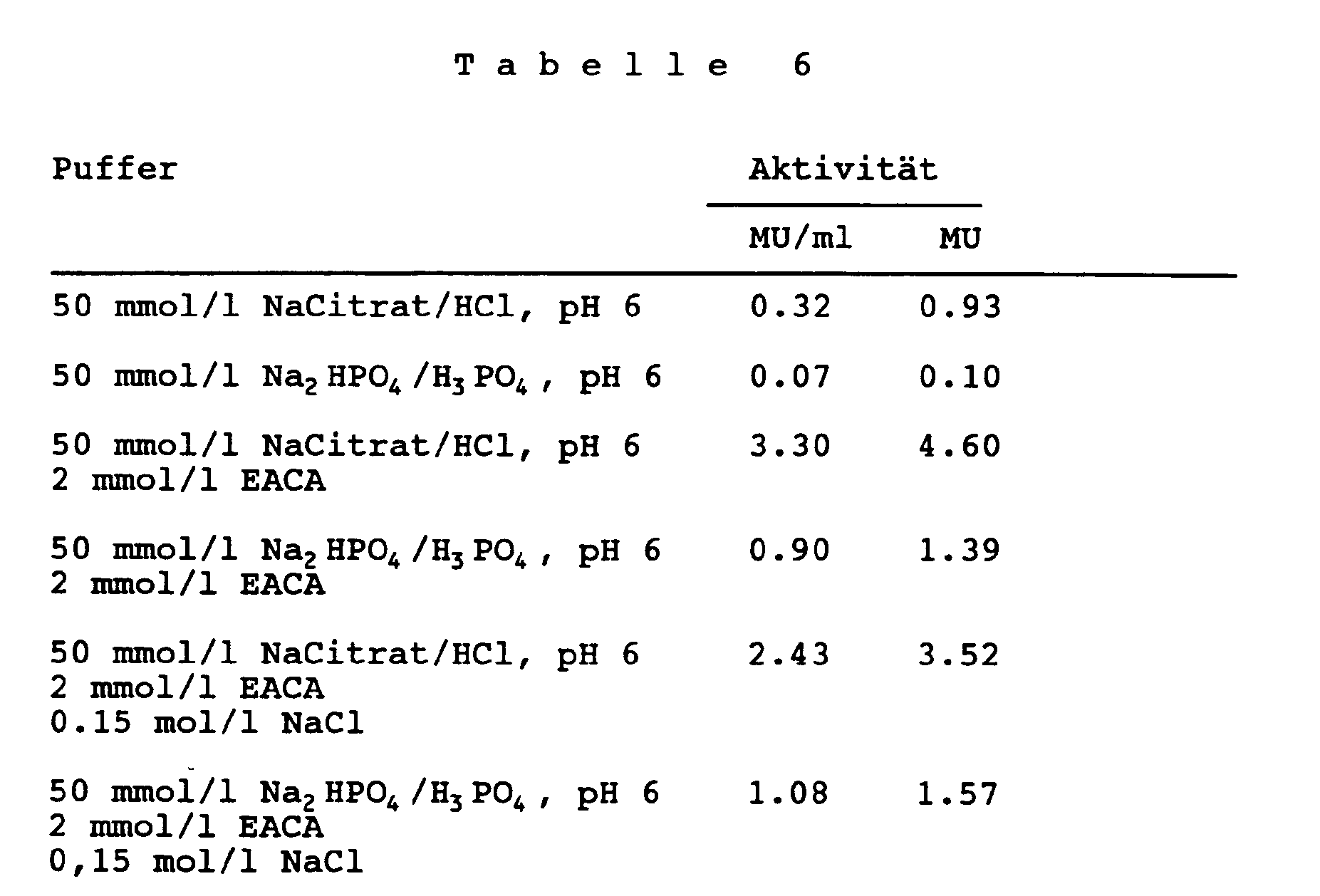
[0055] Tabelle 6 zeigt, daß die Verbesserung der Löslichkeit durch EACA in Citrat-gepufferten
Lösungen wesentlich besser ist als in Phosphat-Puffern.
Beispiel 8
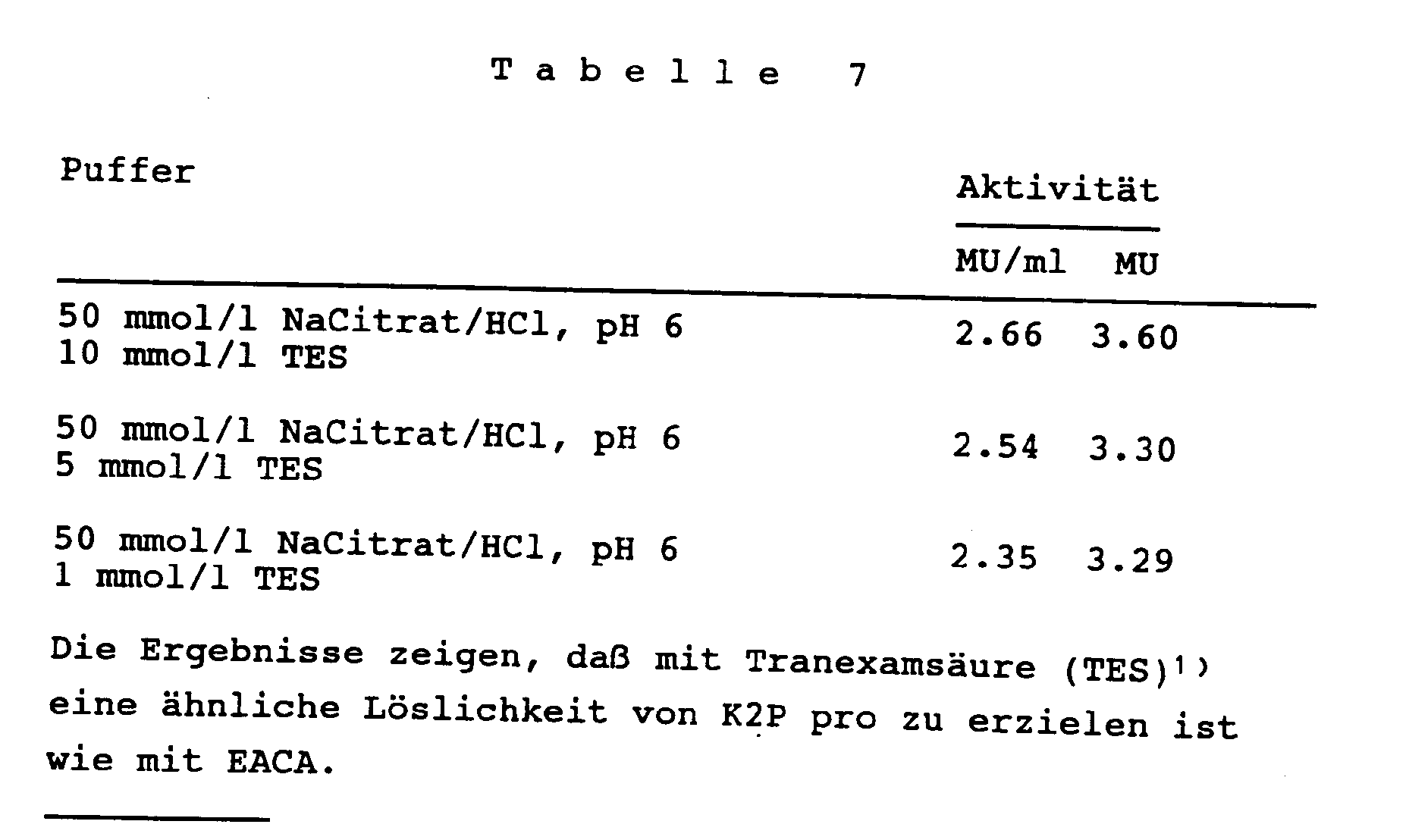
[0056] Einfluß von Tranexamsäure (TES) auf die Löslichkeit von K2P pro
Durchführung:
Konzentrat:
[0058] Aktivität: 4.2 MU/ml
Beispiel 9
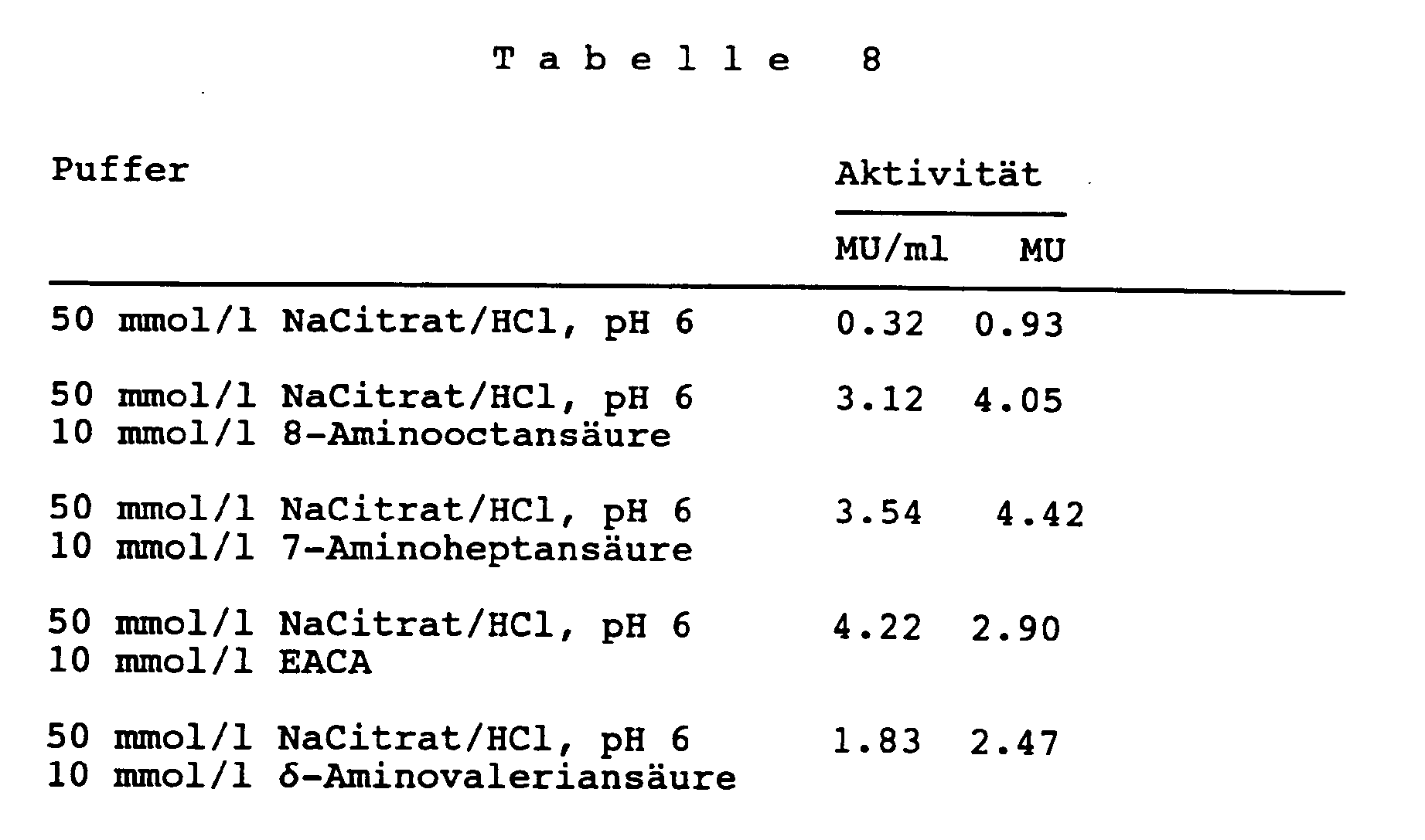
[0059] Einfluß von ω-Aminocarbonsäuren auf die Löslichkeit von K2P pro
Durchführung:
Konzentrat:
[0061] Aktivität: 4.2 MU/ml
Beispiel 10
[0062] Einfluß von Guanidin-Analoga auf die Löslichkeit von K2P pro
Durchführung:
Konzentrat:
[0064] Aktivität: 4.2 MU/ml
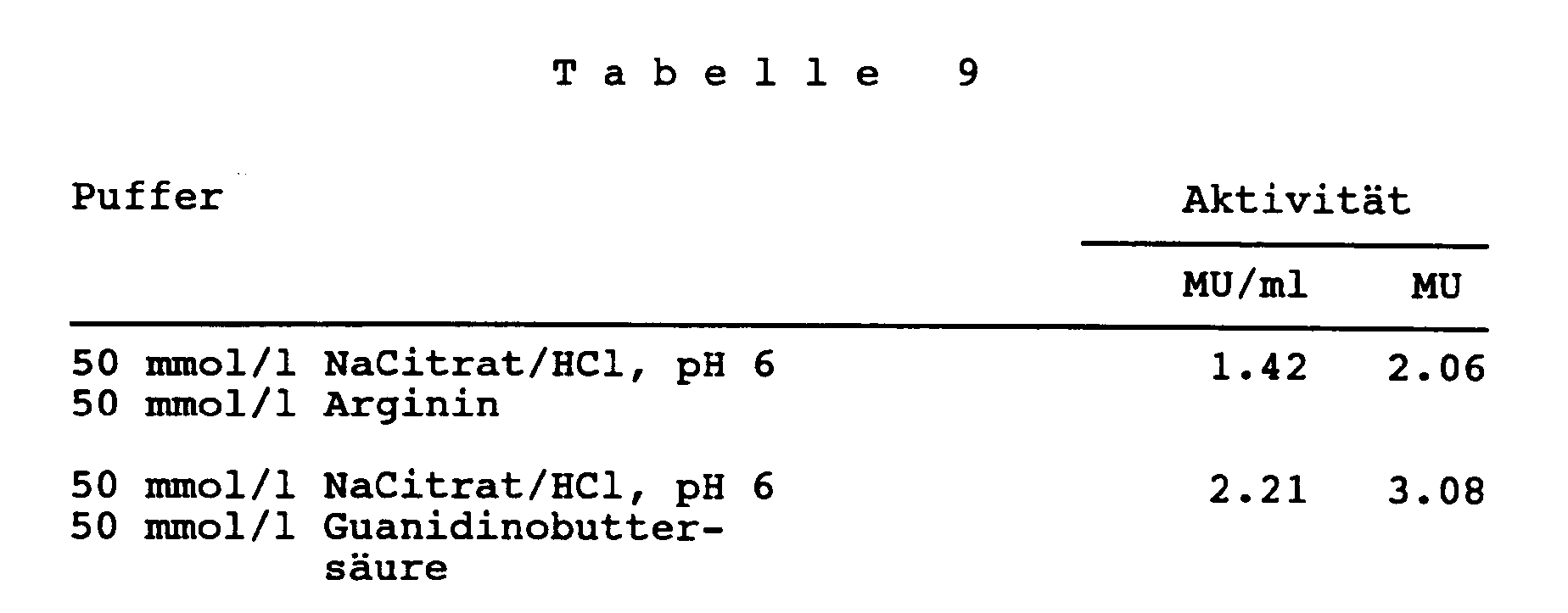
[0065] Die Ergebnisse zeigen, daß mit einer Guanidinogruppe die Löslichkeit von K2P pro
deutlich verbessert wird.
Beispiel 11
[0066] Einfluß von EDTA auf das Löslichkeitsverhalten von K2P pro
Durchführung:
Konzentrat:
[0068] Aktivität: 4.2 MU/ml
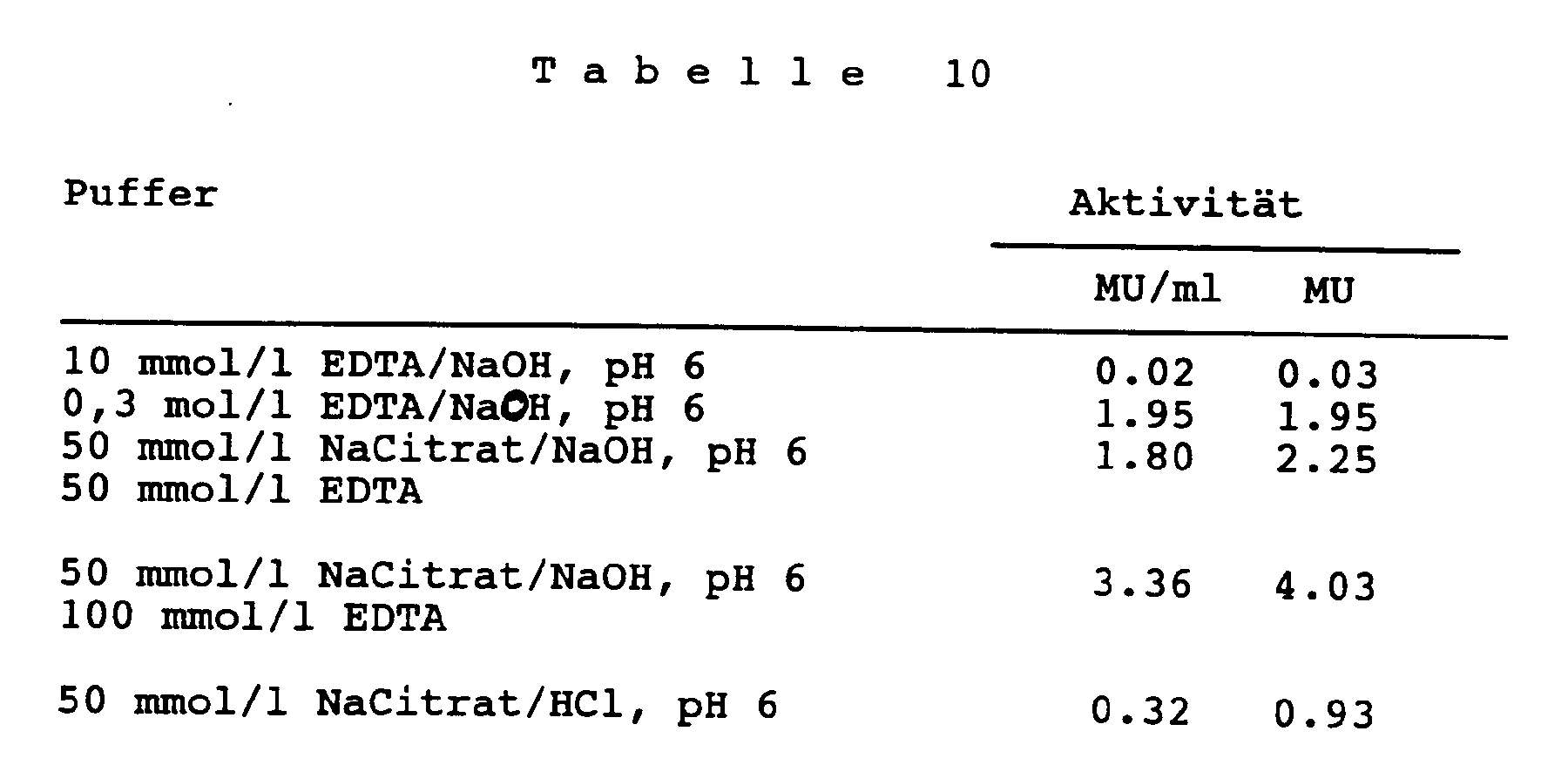
[0069] Tabelle 10 zeigt, daß die Kombination von EDTA mit Citrat einen mehr als additiven
Effekt auf die Löslichkeit von K2P pro hat.
Beispiel 12
[0070] Einfluß von Aminosäuren alleine oder in Kombination auf die Löslichkeit von K2P pro
Durchführung:
Konzentrat:
[0072] Aktivität: 4.2 MU/ml
Beispiel 13
[0073] Einfluß von ω-Aminoalkoholen auf die Löslichkeit von K2P pro
Durchführung:
Konzentrat:
[0075] Aktivität: 4.9 MU/ml
Beispiel 14
[0076] Einfluß von verschiedenen Substanzen in Kombination auf die Löslichkeit von K2P pro
Durchführung:
Konzentrat:
Beispiel 15
[0079] Einfluß von α,ω-Diaminen auf die Löslichkeit von K2P pro
Durchführung:
Konzentrat:
[0081] Aktivität: 4.9 MU/ml
Patentansprüche für folgende(n) Vertragsstaat(en): AT, BE, CH, DE, DK, FR, GB, IT,
LI, LU, NL, SE
1. Pharmazeutisches Präparat eines nicht glykosylierten t-PA-Derivats welches aus der
Kringel 2-Domäne und der Proteasedomäne besteht und mit einer der Aminosäuren 174
- 180 beginnt und mit der Aminosäure 527 endet und außerdem die Aminosäuren -3 (Gly)
bis +5 (Ile) ganz oder teilweise enthalten kann (K2P pro) mit einer enzymatischen
Aktivität von mindestens 1,4 MU/ml und einem pH-Wert von 4,5 bis 6,5,
dadurch gekennzeichnet, daß es Citrat und mindestens eine Verbindung aus der aus
a) Ascorbinsäure,
b) EDTA,
c) Aminoverbindungen der Formel
R¹R²N - R - X
wobei X = SO₃H, CH(NH₂)-CO₂H, CO₂H, H, NH₂ oder OH ist, R = C₁-C₉-Alkylen, vorzugsweise
C₄-C₇-Alkylen, C₃-C₆-Cycloalkylen oder Benzyliden ist und R¹ und R² voneinander unabhängig
H oder C₁-C₃-Alkyl sind,
d) Guanidin-analoge Verbindungen der Formel
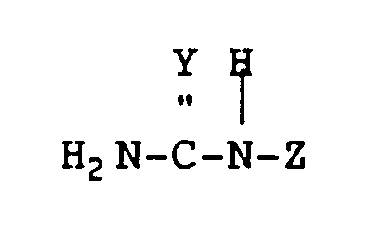
wobei
Y = H₂N⁺ oder 0 ist,
Z = H oder (CH₂)m V, (CH₂)mCH(NH₂)-CO₂H, CH(CO₂H)-(CH₂)mCO₂H
ist,
V = NH₂ oder CO₂H und
m = 1 bis 4 ist
e) mit einer oder mehreren Hydroxyl-, Keto- oder/und weiteren Carboxylgruppen substituierten
Carbonsäuren,
f) Dimethylbiguanid,
g) Pyrimidinnukleosiden und Pyrimidinnukleotiden,
h) Trehalose, Glucosamin, N-Methylglucamin bestehenden Gruppe enthält.
2. Pharmazeutisches Präparat nach Anspruch 1, dadurch gekennzeichnet, daß die Aminoverbindung Taurin, ε-Aminocapronsäure, Tranexamsäure, Lysin, Ornithin,
δ-Aminovaleriansäure, p-Aminomethylbenzoesäure, 4-Aminobutanol-1, 5-Aminopentanol-1,
6-Aminohexanol-1, 1,9-Diaminononan, 1,8-Diaminooctan, 1,7-Diaminoheptan, 1,6-Diaminohexan,
1,5-Diaminopentan, 1,4-Diaminobutan, 1,3-Diaminopropan, 8-Aminooctansäure oder/und
7-Aminoheptansäure ist.
3. Pharmazeutisches Präparat nach Anspruch 1, dadurch gekennzeichnet, daß die Guanidin-analoge Verbindung Harnstoff, Guanidinobuttersäure oder/und Arginin
ist.
4. Pharmazeutisches Präparat nach Anspruch 1, dadurch gekennzeichnet, daß die substituierte Carbonsäure Apfelsäure, Milchsäure, Fumarsäure oder/und 2-Oxoglutarsäure
ist.
5. Pharmazeutisches Präparat nach Anspruch 1, dadurch gekennzeichnet, daß es zusätzlich eine oder mehrere α-Aminocarbonsäuren, vorzugsweise Histidin enthält.
6. Pharmazeutisches Präparat nach einem der Ansprüche 1 bis 5, dadurch gekennzeichnet, daß die Konzentration von Citrat 5 bis 100 mmol/l, vorzugsweise 50 mmol/l beträgt.
7. Pharmazeutisches Präparat nach einem der Ansprüche 1 bis 6, dadurch gekennzeichnet, daß es zusätzlich Chlorid-Ionen enthält.
8. Pharmazeutisches Präparat nach Anspruch 1, dadurch gekennzeichnet, daß es 50 mmol/l NaCitrat, pH 6, und 0,1 bis 1 mol/l, vorzugsweise 0,2 bis 0,3 mol/l
Ascorbinsäure enthält.
9. Pharmazeutisches Präparat nach Anspruch 1, dadurch gekennzeichnet, daß es 50 mmol/l NaCitrat, pH 6, und 1 bis 200 mmol/l, vorzugsweise 10 bis 100 mmol/l
EDTA enthält.
10. Pharmazeutisches Präparat nach Anspruch 1, dadurch gekennzeichnet, daß es 50 mmol/l Nacitrat, pH 6, und 0,1 bis 0,5 mol/l, vorzugsweise 0,1 bis 0,3
mol/l Taurin enthält.
11. Pharmazeutisches Präparat nach Anspruch 1, dadurch gekennzeichnet, daß es 50 mmol/l NaCitrat/HCl, pH 6, und 0,5 bis 20 mmol/l, vorzugsweise 1 bis 10
mmol/l ε-Aminocapronsäure, δ-Aminovaleriansäure, Lysin, Ornithin, Tranexamsäure, p-Aminomethylbenzoesäure,
7-Aminoheptansäure oder 8-Aminooctansäure enthält.
12. Pharmazeutisches Präparat nach Anspruch 1, dadurch gekennzeichnet, daß es 50 mmol/l NaCitrat/HCl, pH 6, und 10 bis 100 mmol/l 4-Aminobutanol-1, 5-Aminopentanol-1,
6-Aminohexanol-1, 1,9-Diaminononan, 1,8-Diaminooctan, 1,7-Diaminoheptan, 1,6-Diaminohexan,
1,5-Diaminopentan, 1,4-Diaminobutan oder 1,3-Diaminopropan enthält.
13. Pharmazeutisches Präparat nach Anspruch 1, dadurch gekennzeichnet, daß es 50 mmol/l NaCitrat/HCl, pH 6, und 0,1 bis 4 mol/l, vorzugsweise 0,5 bis 2
mol/l Harnstoff enthält.
14. Pharmazeutisches Präparat nach Anspruch 1, dadurch gekennzeichnet, daß es 50 mmol/l NaCitrat/HCl, pH 6, 10 bis 200 mmol/l, vorzugsweise 50 bis 100 mmol/l
Guanidinobuttersäure oder Arginin enthält.
15. Pharmazeutisches Präparat nach Anspruch 1, dadurch gekennzeichnet, daß es 50 mmol/l NaCitrat, pH 6 und 0,001 bis 1 mol/l, vorzugsweise 0,01 bis 0,5
mol/l Apfelsäure, Milchsäure, Fumarsäure oder 2-Oxoglutarsäure enthält.
16. Pharmazeutisches Präparat nach Anspruch 1, dadurch gekennzeichnet, daß es 50 mmol/l NaCitrat/HCl, pH 6, und 50 bis 400 mmol/l, vorzugsweise 100 bis
300 mmol/l Dimethylbiguanid enthält.
17. Pharmazeutisches Präparat nach Anspruch 1, dadurch gekennzeichnet, daß es 50 mmol/l NaCitrat/HCl, pH 6, 1 bis 300 mmol/l, vorzugsweise 10 bis 300 mmol/l
Thymidin, Cytosin oder Uridin enthält.
18. Pharzameutisches Präparat nach Anspruch 1, dadurch gekennzeichnet, daß es 50 mmol/l NaCitrat/HCl, pH 6, und 1 bis 500 mmol/l, vorzugsweise 10 bis 300
mmol/l Trehalose, Glucosamin oder N-Methylglucamin enthält.
19. Pharmazeutisches Präparat nach Anspruch 1, dadurch gekennzeichnet, daß es 50 mmol/l NaCitrat, pH 6, und eine Kombination von Verbindungen aus der Gruppe
a) bis h) nach Anspruch 1 enthält.
20. Pharmazeutisches Präparat auf Basis des t-PA-Derivats K2P pro als Wirkstoff, dadurch gekennzeichnet, die Zusammensetzung nach einem der vorhergehenden Ansprüche, gegebenenfalls zusammen
mit üblichen pharmazeutischen Zusatz-, Hilfs- oder/und Trägerstoffen.
21. Verfahren zur Herstellung eines pharmazeutischen Präparats nach einem der Ansprüche
1 bis 20, dadurch gekennzeichnet, daß man das t-PA-Derivat K2P pro zusammen mit mindestens einer Substanz aus der Gruppe
a) bis h) nach Anspruch 1 in eine geeignete pharmazeutische Darreichungsform überführt.
22. Verfahren nach Anspruch 21, dadurch gekennzeichnet, daß die pharmazeutische Darreichungsform eine Injektionslösung oder ein Lyophilisat
ist.
23. Verwendung des t-PA-Derivats K2P pro zur Herstellung von pharmazeutischen Präparaten
nach einem der Ansprüche 1 bis 20.
Patentansprüche für folgende(n) Vertragsstaat(en): ES, GR
1. Verfahren zur Herstellung eines pharmazeutischen Präparats eines nicht glykosylierten
t-PA-Derivats-welches aus der-Kringel 2-Domäne und der Proteasedomäne besteht und,mit
einer der Aminosäuren 174 - 180 beginnt und mit der Aminosäure 527 endet und außerdem
die Aminosäuren -3 (Gly) bis +5 (Ile) ganz oder teilweise enthalten kann (K2P pro)
mit einer enzymatischen Aktivität von mindestens 1,4 MU/ml und einem pH-Wert von 4,5
bis 6,5,
dadurch gekennzeichnet, daß man das t-PA-Derivat K2P pro zusammen mit Citrat und mindestens ein er Verbindung
aus der aus
a) Ascorbinsäure,
b) EDTA,
c) Aminoverbindungen der Formel
R¹R²N - R - X
wobei X = SO₃H, CH(NH₂)-CO₂H, CO₂H, H, NH₂ oder OH ist, R = C₁-C₉-Alkylen, vorzugsweise
C₄-C₇-Alkylen, C₃-C₆-Cycloalkylen oder Benzyliden ist und R¹ und R² voneinander unabhängig
H oder C₁-C₃-Alkyl sind,
d) Guanidin-analoge Verbindungen der Formel
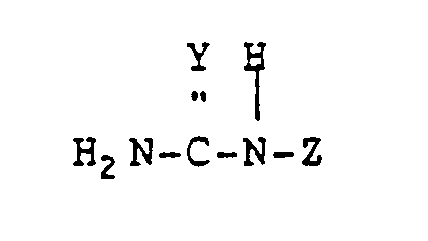
wobei
Y = H₂N⁺ oder 0 ist,
Z = H oder (CH₂)m V, (CH₂)mCH(NH₂)-CO₂H, CH(CO₂H)-(CH₂)mCO₂H
ist,
V = NH₂ oder CO₂H und
m = 1 bis 4 ist
e) mit einer oder mehreren Hydroxyl-, Keto- oder/und weiteren Carboxylgruppen substituierten
Carbonsäuren,
f) Dimethylbiguanid,
g) Pyrimidinnukleosiden und Pyrimidinnukleotiden,
h) Trehalose, Glucosamin, N-Methylglucamin bestehenden Gruppein eine geeignete pharmazeutische
Darreichungsform überführt.
2. Verfahren nach Anspruch 1, dadurch gekennzeichnet, daß die Aminoverbindung Taurin, ε-Aminocapronsäure, Tranexamsäure, Lysin, Ornithin,
δ-Aminovaleriansäure, p-Aminomethylbenzoesäure, 4-Aminobutanol-1, 5-Aminopentanol-1,
6-Aminohexanol-1, 1,9-Diaminononan, 1,8-Diaminooctan, 1,7-Diaminoheptan, 1,6-Diaminohexan,
1,5-Diaminopentan, 1,4-Diaminobutan, 1,3-Diaminopropan, 8-Aminooctansäure oder/und
7-Aminoheptansäure ist.
3. Verfahren nach Anspruch 1, dadurch gekennzeichnet, daß die Guanidin-analoge Verbindung Harnstoff, Guanidinobuttersäure oder/und Arginin
ist.
4. Verfahren nach Anspruch 1, dadurch gekennzeichnet, daß die substituierte Carbonsäure Apfelsäure, Milchsäure, Fumarsäure oder/und 2-oxoglutarsäure
ist.
5. Verfahren nach Anspruch 1, dadurch gekennzeichnet, daß man zusätzlich eine oder mehrere α-Aminocarbonsäuren, vorzugsweise Histidin hinzufügt.
6. Verfahren nach einem der Ansprüche 1 bis 5, dadurch gekennzeichnet, daß die Konzentration von Citrat 5 bis 100 mmol/l, vorzugsweise 50 mmol/l beträgt.
7. Verfahren nach einem der Ansprüche 1 bis 6, dadurch gekennzeichnet, daß man zusätzlich Chlorid-Ionen hinzufügt.
8. Verfahren nach Anspruch 1, dadurch gekennzeichnet, daß man 50 mmol/l NaCitrat, pH 6, und 0,1 bis 1 mol/l, vorzugsweise 0,2 bis 0,3 mol/l
Ascorbinsäure verwendet.
9. Verfahren nach Anspruch 1, dadurch gekennzeichnet, daß man 50 mmol/l NaCitrat, pH 6, und 1 bis 200 mmol/l, vorzugsweise 10 bis 100 mmol/l
EDTA verwendet.
10. Verfahren nach Anspruch 1, dadurch gekennzeichnet, daß man 50 mmol/l NaCitrat, pH 6, und 0,1 bis 0,5 mol/l, vorzugsweise 0,1 bis 0,3
mol/l Taurin verwendet.
11. Verfahren nach Anspruch 1, dadurch gekennzeichnet, daß man 50 mmol/l NaCitrat/HCl, pH 6, und 0,5 bis 20 mmol/l, vorzugsweise 1 bis 10
mmol/l ε-Aminocapronsäure, δ-Aminovaleriansäure, Lysin Ornithin, Tranexamsäure, p-Aminomethylbenzoesäure
7-Aminoheptansäure oder 8-Aminooctansäure verwendet.
12. Verfahren nach Anspruch 1, dadurch gekennzeichnet, daß man 50 mmol/l NaCitrat/HCl, pH 6, und 10 bis 100 mmol/l 4-Aminobutanol-1, 5-Aminopentanol-1,
6-Aminohexanol-1, 1,9-Diaminononan, 1,8-Diaminooctan, 1,7-Diaminoheptan, 1,6-Diaminohexan,
1,5-Diaminopentan, 1,4-Diaminobutan oder 1,3-Diaminopropan verwendet.
13. Verfahren nach Anspruch 1, dadurch gekennzeichnet, daß man 50 mmol/l NaCitrat/HCl, pH 6, und 0,1 bis 4 mol/l, vorzugsweise 0,5 bis 2
mol/l Harnstoff verwendet.
14. Verfahren nach Anspruch 1, dadurch gekennzeichnet, daß man 50 mmol/l NaCitrat/HCl, pH 6, 10 bis 200 mmol/l, vorzugsweise 50 bis 100
mmol/l Guanidinobuttersäure oder Arginin verwendet.
15. Verfahren nach Anspruch 1, dadurch gekennzeichnet, daß man 50 mmol/l NaCitrat, pH 6 und 0,001 bis 1 mol/l, vorzugsweise 0,01 bis 0,5
mol/l Apfelsäure, Milchsäure, Fumarsäure oder 2-Oxoglutarsäure verwendet.
16. Verfahren nach Anspruch 1, dadurch gekennzeichnet, daß man 50 mmol/l NaCitrat/HCl, pH 6, und 50 bis 400 mmol/l, vorzugsweise 100 bis
300 mmol/l Dimethylbiguanid verwendet.
17. Verfahren nach Anspruch 1, dadurch gekennzeichnet, daß man 50 mmol/l NaCitrat/HCl, pH 6, 1 bis 300 mmol/l, vorzugsweise 10 bis 300 mmol/l
Thymidin, Cytosin oder Uridin verwendet.
18. Verfahren nach Anspruch 1, dadurch gekennzeichnet, daß man 50 mmol/l NaCitrat/HCl, pH 6, und 1 bis 500 mmol/l, vorzugsweise 10 bis 300
mmol/l Trehalose, Glucosamin oder N-Methylglucamin verwendet.
19. Verfahren nach Anspruch 1, dadurch gekennzeichnet, daß man 50 mmol/l NaCitrat, pH 6, und eine Kombination von Verbindungen aus der Gruppe
a) bis h) nach Anspruch 1 verwendet.
20. Verfahren nach einem der vorhergehenden Ansprüche, dadurch gekennzeichnet, daß man außerdem übliche pharmazeutische Zusatz-, Hilfs- oder/und Trägerstoffe zusetzt.
21. Verfahren nach Anspruch 1, dadurch gekennzeichnet, daß die pharmazeutische Darreichungsform eine Injektionslösung oder ein Lyophilisat
ist.
22. Verwendung des t-PA-Derivats K2P pro zur Herstellung von pharmazeutischen Präparaten
nach einem der Ansprüche 1 bis 21.
Claims for the following Contracting State(s): AT, BE, CH, DE, DK, FR, GB, IT, LI,
LU, NL, SE
1. Pharmaceutical preparation of a non-glycosylated t-PA derivative which consists of
the kringle 2 domain and of the protease domain and begins with one of the amino acids
174 - 180 and ends with the amino acid 527 and, furthermore, can contain the amino
acids -3(Gly) to +5(Ile) wholly or partly (K2P pro) with an enzymatic activity of
at least 1.4 MU/ml and a pH value of 4.5 to 6.5, characterised in that it contains
citrate and at least one compound from the group consisting of
a) ascorbic acid,
b) EDTA,
c) amino compounds of the formula
R¹R²N-R-X
whereby X = SO₃H, CH(NH₂)-CO₂H, CO₂H, H, NH₂ or OH, R = C₁-C₉-alkylene, preferably
C₄-C₇-alkylene, C₃-C₆-cycloalkylene or benzylidene, and R¹ and R², independently of
one another, are H or C₁-C₃-alkyl,
d) guanidine analogous compounds of the formula
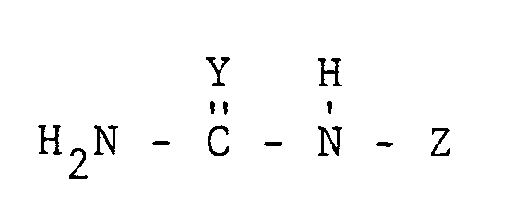
whereby Y = H₂N⁺ or 0, Z = H or (CH₂)mV, (CH₂)mCH(NH₂)-CO₂H, CH(CO₂H)-(CH₂)mCO₂H, V = NH₂ or CO₂H and m = 1 to 4,
e) carboxylic acids substituted with one or more hydroxyl, keto and/or further carboxyl
groups,
f) dimethylbiguanide,
g) pyrimidine nucleosides and pyrimidine nucleotides,
h) trehalose, glucosamine, N-methylglucamine.
2. Pharmaceutical preparation according to claim 1, characterised in that the amino compound
is taurine, ε-aminocaproic acid, tranexamic acid, lysine, ornithine, δ-aminovaleric
acid, p-aminomethylbenzoic acid, 4-aminobutanol-1, 5-aminopentanol-1, 6-aminohexanol-1,
1,9-diaminononane, 1,8-diaminooctane, 1,7-diaminoheptane, 1,6-diaminohexane, 1,5-diaminopentane,
1,4-diaminobutane, 1,3-diaminopropane, 8-aminooctanoic acid and/or 7-aminoheptanoic
acid.
3. Pharmaceutical preparation according to claim 1, characterised in that the guanidine-analogous
compound is urea, guanidinobutyric acid and/or arginine.
4. Pharmaceutical preparation according to claim 1, characterised in that the substituted
carboxylic acid is malic acid, lactic acid, fumaric acid and/or 2-oxoglutaric acid.
5. Pharmaceutical preparation according to claim 1, characterised in that it additionally
contains one or more α-aminocarboxylic acids, preferably histidine.
6. Pharmaceutical preparation according to one of claims 1 to 5, characterised in that
the concentration of citrate amounts to 5 to 100 mmol/l, preferably 50 mmol/l.
7. Pharmaceutical preparation according to one of claims 1 to 6, characterised in that
it additionally contains chloride ions.
8. Pharmaceutical preparation according to claim 1, characterised in that it contains
50 mmol/l Na citrate, pH 6, and 0.1 to 1 mol/l, preferably 0.2 to 0.3 mol/ of ascorbic
acid.
9. Pharmaceutical preparation according to claim 1, characterised in that it contains
50 mmol/l of Na citrate, pH 6, and 1 to 200 mmol/l, preferably 10 to 100 mmol/l of
EDTA.
10. Pharmaceutical preparation according to claim 1, characterised in that it contains
50 mmol/l of Na citrate, pH 6, and 0.1 to 0.5 mol/l, preferably 0.1 to 0.3 mol/l of
taurine.
11. Pharmaceutical preparation according to claim 1, characterised in that it contains
50 mmol/l of Na citrate, pH 6, and 0.5 to 20 mmol/l, preferably 1 to 10 mmol/l of
ε-aminocaproic acid, δ-aminovaleric acid, lysine, ornithine, tranexamic acid, p-aminomethylbenzoic
acid, 7-aminoheptanoic acid or 8-aminooctanoic acid.
12. Pharmaceutical preparation according to claim 1, characterised in that it contains
50 mmol/l of Na citrate/HCl, pH 6, and 10 to 100 mmol/l of 4-aminobutanol-1, 5-aminopentanol-1,
6-aminohexanol-1, 1,9-diaminononane, 1,8-diaminooctane, 1,7-diaminoheptane, 1,6-diaminohexane,
1,5-diaminopentane, 1,4-diaminobutane or 1,3-diaminopropane.
13. Pharmaceutical preparation according to claim 1, characterised in that it contains
50 mmol/l of Na citrate/HCl, pH 6, and 0.1 to 4 mol/l, preferably 0.5 to 2 mol/l of
urea.
14. Pharmaceutical preparation according to claim 1, characterised in that it contains
50 mmol/l of Na citrate/HCl, pH 6, 10 to 200 mmol/l, preferably 50 to 100 mmol/l of
guanidinobutyric acid or arginine.
15. Pharmaceutical preparation according to claim 1, characterised in that it contains
50 mmol/l of Na citrate, pH 6, and 0.001 to 1 mol/l, preferably 0.01 to 5 mol/l of
malic acid, lactic acid, fumaric acid or 2-oxoglutaric acid.
16. Pharmaceutical preparation according to claim 1, characterised in that it contains
50 mmol/l of Na citrate/HCl, pH 6, and 50 to 400 mmol/l, preferably 100 to 300 mmol/l
of dimethylbiguanide.
17. Pharmaceutical preparation according to claim 1, characterised in that it contains
50 mmol/l of Na citrate/HCl, pH 6, 1 to 300 mmol/l, preferably 10 to 300 mmol/l of
thymidine, cytosine or uridine.
18. Pharmaceutical preparation according to claim 1, characterised in that it contains
50 mmol/l of Na citrate/.HCl, pH 6, and 1 to 500 mmol/l, preferably 10 to 300 mmol/l
of trehalose, glucosamine or N-methylglucamine.
19. Pharmaceutical preparation according to claim 1, characterised in that it contains
50 mmol/l of Na citrate, pH 6, and a combination of compounds from the group a) to
h) according to claim 1.
20. Pharmaceutical preparation based on the t-PA derivative K2P pro as active material,
characterised by the composition according to one of the preceding claims, possibly
together with usual pharmaceutical additive, adjuvant and/or carrier materials.
21. Process for the preparation of a pharmaceutical preparation according to one of claims
1 to 20, characterised in that one converts the t-PA derivative K2P pro, together
with at least one substance from the groups a) to h) according to claim 1, into a
suitable pharmaceutical form of administration.
22. Process according to claim 21, characterised in that the pharmaceutical form of administration
is an injection solution or a lyophilisate.
23. Use of the t-PA derivative K2P pro for the production of pharmaceutical preparations
according to one of claims 1 to 20.
Claims for the following Contracting State(s): ES, GR
1. Process for the production of a pharmaceutical preparation of a non-glycosylated t-PA
derivative which consists of the kringle 2 domain and of the protease domain and begins
with one of the amino acids 174 - 180 and ends with the amino acid 527 and, furthermore,
can contain the amino acids -3(Gly) to +5(Ile) wholly or partly (K2P pro) with an
enzymatic activity of at least 1.4 MU/ml and a pH value of 4.5 to 6.5, characterised
in that one converts the t-PA derivative, together with citrate and at least one compound
from the group consisting of
a) ascorbic acid,
b) EDTA,
c) amino compounds of the formula
R¹R²N-R-X
whereby X = SO₃H, CH(NH₂)-CO₂H, CO₂H, H, NH₂ or OH, R = C₁-C₉-alkylene, preferably
C₄-C₇-alkylene, C₃-C₆-cycloalkylene or benzylidene and R¹ and R², independently of
one another, are H or C₁-C₃-alkyl,
d) guanidine analogous compounds of the formula
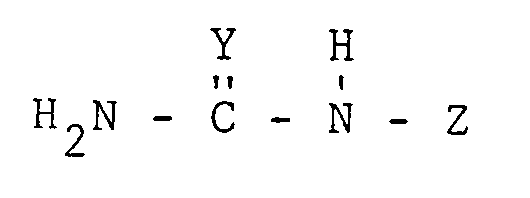
whereby Y = H₂N⁺ or 0, Z = H or (CH₂)mV, (CH₂)mCH(NH₂)-CO₂H, CH(CO₂H)-(CH₂)mCO₂H, V = NH₂ or CO₂H and m = 1 to 4,
e) carboxylic acids substituted with one or more hydroxyl, keto and/or further carboxyl
groups,
f) dimethylbiguanide,
g) pyrimidine nucleosides and pyrmidine nucleotides,
h) trehalose, glucosamine, N-methylglucamine, into a suitable pharmaceutical form
of administration.
2. Process according to claim 1, characterised in that the amino compound is taurine,
ε-aminocaproic acid, tranexamic acid, lysine, ornithine, δ-aminovaleric acid, p-aminomethylbenzoic
acid, 4-aminobutanol-1, 5-aminopentanol-1, 6-aminohexanol-1, 1,9-diaminononane, 1,8-diaminooctane,
1,7-diaminoheptane, 1,6-diaminohexane, 1,5-diaminopentane, 1,4-diaminobutane, 1,3-diaminopropane,
8-aminooctanoic acid and/or 7-aminoheptanoic acid.
3. Process according to claim 1, characterised in that the guanidine-analogous compound
is urea, guanidinobutyric acid and/or arginine.
4. Process according to claim 1, characterised in that the substituted carboxylic acid
is malic acid, lactic acid, fumaric acid and/or 2-oxoglutaric acid.
5. Process according to claim 1, characterised in that one additionally adds thereto
one or more α-aminocarboxylic acids, preferably histidine.
6. Process according to one of claims 1 to 5, characterised in that the concentration
of citrate amounts to 5 to 100 mmol/l, preferably 50 mmol/l.
7. Process according to one of claims 1 to 6, characterised in that one additionally
adds chloride ions thereto.
8. Process according to claim 1, characterised in that one uses 50 mmol/l of Na citrate,
pH 6, and 0.1 to 1 mol/l, preferably 0.2 to 0.3 mol/ of ascorbic acid.
9. Process according to claim 1, characterised in that one uses 50 mmol/l of Na citrate,
pH 6, and 1 to 200 mmol/l, preferably 10 to 100 mmol/l of EDTA.
10. Process according to claim 1, characterised in that one uses 50 mmol/l of Na citrate,
pH 6, and 0.1 to 0.5 mol/l, preferably 0.1 to 0.3 mol/l of taurine.
11. Process according to claim 1, characterised in that one uses 50 mmol/l of Na citrate,
pH 6, and 0.5 to 20 mmol/l, preferably 1 to 10 mmol/l of ε-aminocaproic acid, δ-aminovaleric
acid, lysine, ornithine, tranexamic acid, p-aminomethylbenzoic acid, 7-aminoheptanoic
acid or 8-aminooctanoic acid.
12. Process according to claim 1, characterised in that one uses 50 mmol/l of Na citrate/HCl,
pH 6, and 10 to 100 mmol/l of 4-aminobutanol-1, 5-aminopentanol-1, 6-aminohexanol-1,
1,9-diaminononane, 1,8-diaminooctane, 1,7-diaminoheptane, 1,6-diaminohexane, 1,5-diaminopentane,
1,4-diaminobutane or 1,3-diaminopropane.
13. Process according to claim 1, characterised in that one uses 50 mmol/l of Na citrate/HCl,
pH 6, and 0.1 to 4 mol/l, preferably 0.5 to 2 mol/l of urea.
14. Process according to claim 1, characterised in that one uses 50 mmol/l of Na citrate/HCl,
pH 6, 10 to 200 mmol/l, preferably 50 to 100 mmol/l of guanidinobutric acid or arginine.
15. Process according to claim 1, characterised in that one uses 50 mmol/l of Na citrate,
pH 6, and 0.001 to 1 mol/l, preferably 0.01 to 5 mol/l of malic acid, lactic acid,
fumaric acid or 2-oxoglutaric acid.
16. Process according to claim 1, characterised in that one uses 50 mmol/l of Na citrate/HCl,
pH 6, and 50 to 400 mmol/l, preferably 100 to 300 mmol/l of dimethylbiguanide.
17. Process according to claim 1, characterised in that one uses 50 mmol/l of Na citrate/HCl,
pH 6, 1 to 300 mmol/l, preferably 10 to 300 mmol/l of thymidine, cytosine or uridine.
18. Process according to claim 1, characterised in that one uses 50 mmol/l of Na citrate/HCl,
pH 6, and 1 to 500 mmol/l, preferably 10 to 300 mmol/l of trehalose, glucosamine or
N-methylglucamine.
19. Process according to claim 1, characterised in that one uses 50 mmol/l of Na citrate,
pH 6, and a combination of compounds from the group a) to h) according to claim 1.
20. Process according to one of the preceding claims, characterised in that one also adds
usual pharmaceutical additive, adjuvant and/or carrier materials.
21. Process according to claim 1, characterised in that the pharmaceutical form of administration
is an injection solution or a lyophilisate.
22. Use of the t-PA derivative K2P pro for the production of pharmaceutical preparations
according to one of claims 1 to 21.
Revendications pour l'(les) Etat(s) contractant(s) suivant(s): AT, BE, CH, DE, DK,
FR, GB, IT, LI, LU, NL, SE
1. Préparation pharmaceutique d'un dérivé non glycosylé du t-PA qui consiste en le domine
de boucle 2 et en le domaine de protéase, qui commence par l'un des acides aminés
174 - 180 et qui se termine par l'acide aminé 527, et qui peut contenir en outre totalement
ou partiellement les acides aminés - 3 (Gly) à + 5 (Ile), (K2P pro), présentant une
activité enzymatique d'au moins 1,4 MU/ml et un pH de 4,5 à 6,5, caractérisée en ce
qu'elle contient du citrate et au moins un composé du groupe formé par
a) l'acide ascorbique,
b) l'EDTA
c) un composé aminé de formule
R¹R²N - R - X
dans laquelle X = SO₃H, CH(NH₂)-CO₂H, CO₂H, H, NH₂ ou OH, R = alkylène en C₁ - C₉,
de préférence alkylène en C₄ - C₇, cycloalkylène en C₃ - C₆ ou benzylidène et R¹ et
R² sont indépendamment l'un de l'autre H ou alkyle en C₁ - C₃,
d) des composés analogues à la guanidine de formule
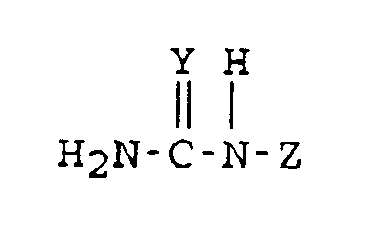
dans laquelle Y = H₂N⁺ ou O,
Z = H ou (CH₂)mV, (CH₂)mCH(NH₂)-CO₂H, CH(CO₂H)-(CH₂)mCO₂H, V = NH₂ ou CO₂H et
m = 1 à 4
e) des acides carboxyliques substitués par un ou plusieurs groupes hydroxyle, cétone
et/ou groupes carboxyliques supplémentaires,
f) le diméthylbiguanide,
g) des nucléosides pyrimidiques et des nucléotides pyrimidiques,
h) le tréhalose, la glucosamine, la N-méthylglucamine.
2. Préparation pharmaceutique selon la revendication 1, caractérisée en ce que le composé
aminé est la taurine, l'acide ε-aminocaproïque, l'acide tranexamique, la lysine, l'ornithine,
l'acide δ-aminovalérique, l'acide p-aminométhylbenzoïque, le 4-aminobutanol-1, le
5-aminopentanol-1, le 6-aminohexanol-1, le 1,9-diaminononane, le 1,8-diaminooctane,
le 1,7-diaminoheptane, le 1,6-diaminohexane, le 1,5-diaminopentane, le 1,4-diaminobutane,
le 1,3-diaminopropane, l'acide 8-aminooctanoïque et/ou l'acide 7-aminoheptanoïque.
3. Préparation pharmaceutique selon la revendication 1, caractérisée en ce que le composé
analogue à la guanidine est l'urée, l'acide guanidinobutyrique et/ou l'arginine.
4. Préparation pharmaceutique selon la revendication 1, caractérisée en ce que l'acide
carboxylique substitué est l'acide malique, l'acide lactique, l'acide fumarique et/ou
l'acide 2-oxoglutarique.
5. Préparation pharmaceutique selon la revendication 1, caractérisée en ce qu'elle contient
en outre un ou plusieurs acides α-aminocarboxyliques, de préférence l'histidine.
6. Préparation pharmaceutique selon l'une des revendications 1 à 5, caractérisée en ce
que la concentration du citrate est de 5 à 100 mmol/l, de préférence de 50 mmol/l.
7. Préparation pharmaceutique selon l'une des revendications 1 à 6, caractérisée en ce
qu'elle contient en outre des ions chlorure.
8. Préparation pharmaceutique selon la revendication 1, caractérisée en ce qu'elle contient
50 mmol/l de citrate de Na, pH 6, et 0,1 à 1 mol/l, de préférence 0,2 à 0,3 mol/l
d'acide ascorbique.
9. Préparation pharmaceutique selon la revendication 1, caractérisée en ce qu'elle contient
50 mmol/l de citrate de Na, pH 6, et 1 à 200 mmol/l, de préférence 10 à 100 mmol/l
de EDTA.
10. Préparation pharmaceutique selon la revendication 1, caractérisée en ce qu'elle contient
50 mmol/l de citrate de Na, pH 6, et 0,1 à 0,5 mol/l, de préférence 0,1 à 0,3 mol/l
de taurine.
11. Préparation pharmaceutique selon la revendication 1, caractérisée en ce qu'elle contient
50 mmol/l de citrate de Na/HCl, pH 6, et 0,5 à 20 mmol/l, de préférence 1 à 10 mmol/l
d'acide ε-aminocaproïque, d'acide δ-aminovalérique, de lysine, d'ornithine, d'acide
tranexamique, d'acide p-aminométhylbenzoïque, d'acide 7-aminoheptanoïque ou d'acide
8-aminooctanoïque.
12. Préparation pharmaceutique selon la revendication 1, caractérisée en ce qu'elle contient
50 mmol/l de citrate de Na/HCl, pH 6, et 10 à 100 mmol/l de 4-aminobutanol-1, de 5-aminopentanol-1,
de 6-aminohexanol-1, de 1,9-diaminononane, de 1,8-diaminooctane, de 1,7-diaminoheptane,
de 1,6-diaminohexane, de 1,5-diaminopentane, de 1,4-diaminobutane ou de 1,3-diaminopropane.
13. Préparation pharmaceutique selon la revendication 1, caractérisée en ce qu'elle contient
50 mmol/l de citrate de Na/HCl, pH 6, et 0,1 à 4 mol/l, de préférence 0,5 à 2 mol/l
d'urée.
14. Préparation pharmaceutique selon la revendication 1, caractérisée en ce qu'elle contient
50 mmol/l de citrate de Na/HCl, pH 6, 10 à 200 mmol/l, de préférence 50 à 100 mmol/l
d'acide guanidinobutyrique ou d'arginine.
15. Préparation pharmaceutique selon la revendication 1, caractérisée en ce qu'elle contient
50 mmol/l de citrate de Na, pH 6, et 0,001 à 1 mol/l, de préférence 0,01 à 0,5 mol/l
d'acide malique, d'acide lactique, d'acide fumarique ou d'acide 2-oxoglutarique.
16. Préparation pharmaceutique selon la revendication 1, caractérisée en ce qu'elle contient
50 mmol/l de citrate de Na/HCl, pH 6, et 50 à 400 mmol/l, de préférence 100 à 300
mmol/l de diméthylbiguanide.
17. Préparation pharmaceutique selon la revendication 1, caractérisée en ce qu'elle contient
50 mmol/l de citrate de Na/HCl, pH 6, 1 à 300 mmol/l, de préférence 10 à 300 mmol/l
de thymidine, de cytosine ou d'uridine.
18. Préparation pharmaceutique selon la revendication 1, caractérisée en ce qu'elle contient
50 mmol/l de citrate de Na/HCl, pH 6, et 1 à 500 mmol/l, de préférence 10 à 300 mmol/l
de tréhalose, de glucosamine ou de N-méthylglucamine.
19. Préparation pharmaceutique selon la revendication 1, caractérisée en ce qu'elle contient
50 mmol/l de citrate de Na, pH 6, et une combinaison de composés du groupe a) à h)
selon la revendication 1.
20. Préparation pharmaceutique à base de dérivé K2P pro du t-PA en tant que principe actif,
caractérisée par la composition selon l'une des revendications précédentes, éventuellement
avec des additifs, adjuvants et/ou véhicules pharmaceutiques habituels.
21. Procédé d'obtention d'une préparation pharmaceutique selon l'une des revendications
1 à 20, caractérisé en ce que l'on convertit en une forme d'administration pharmaceutique
appropriée le dérivé K2P pro du t-PA et au moins une substance du groupe a) à h) selon
la revendication 1.
22. Procédé selon la revendication 21, caractérisé en ce que la forme d'administration
pharmaceutique est une solution pour injection ou un lyophilisat.
23. Utilisation du dérivé K2P pro du t-PA pour l'obtention de préparations pharmaceutiques
selon l'une des revendications 1 à 20.
Revendications pour l'(les) Etat(s) contractant(s) suivant(s): ES, GR
1. Procédé d'obtention d'une préparation pharmaceutique d'un dérivé non glycosylé du
t-PA qui consiste en le domaine de boucle 2 et en le domaine de protéase, qui commence
par l'un des acides aminés 174 - 180 et qui se termine par l'acide aminé 527, et qui
peut contenir en outre totalement ou partiellement les acides aminés - 3 (Gly) à +
5 (Ile), (K2P pro), présentant une activité enzymatique d'au moins 1,4 MU/ml et un
pH de 4,5 à 6,5, caractérisé en ce que l'on convertit en une forme d'administration
pharmaceutique appropriée le dérivé K2P pro du t-PA avec du citrate et au moins un
composé du groupe formé par
a) l'acide ascorbique,
b) l'EDTA
c) un composé aminé de formule
R¹R²N - R - X
dans laquelle X = SO₃H, CH(NH₂)-CO₂H, CO₂H, H, NH₂ ou OH, R = alkylène en C₁ - C₉,
de préférence alkylène en C₄ - C₇, cycloalkylène en C₃ - C₆ ou benzylidène et R¹ et
R² sont indépendamment l'un de l'autre H ou alkyle en C₁ - C₃,
d) des composés analogues à la guanidine de formule
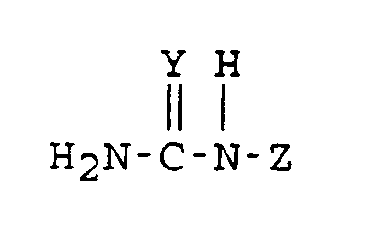
dans laquelle Y = H₂N⁺ ou O,
Z = H ou (CH₂)mV, (CH₂)mCH(NH₂) -CO₂H, CH(CO₂H) - (CH₂)mCO₂H, V = NH₂ ou CO₂H et
m=1 à 4
e) des acides carboxyliques substitués par un ou plusieurs groupes hydroxyle, cétone
et/ou groupes carboxyliques supplémentaires,
f) le diméthylbiguanide,
g) des nucléosides pyrimidiques et des nucléotides pyrimidiques,
h) le tréhalose, la glucosamine, la N-méthylglucamine.
2. Procédé selon la revendication 1, caractérisé en ce que le composé aminé est la taurine,
l'acide ε-aminocaproïque, l'acide tranexamique, la lysine, l'ornithine, l'acide δ-aminovalérique,
l'acide p-aminométhylbenzoïque, le 4-aminobutanol-1, le 5-aminopentanol-1, le 6-aminohexanol-1,
le 1,9-diaminononane, le 1,8-diaminooctane, le 1,7-diaminoheptane, le 1,6-diaminohexane,
le 1,5-diaminopentane, le 1,4-diaminobutane, le 1,3-diaminopropane, l'acide 8-aminooctanoïque
et/ou l'acide 7-aminoheptanoïque.
3. Procédé selon la revendication 1, caractérisé en ce que le composé analogue à la guanidine
est l'urée, l'acide guanidinobutyrique et/ou l'arginine.
4. Procédé selon la revendication 1, caractérisé en ce que l'acide carboxylique substitué
est l'acide malique, l'acide lactique, l'acide fumarique et/ou l'acide 2-oxoglutarique.
5. Procédé selon la revendication 1, caractérisé en ce que l'on ajoute en outre un ou
plusieurs acides α-aminocarboxyliques; de préférence l'histidine.
6. Procédé selon l'une des revendications 1 à 5, caractérisé en ce que la concentration
du citrate est de 5 à 100 mmol/l, de préférence de 50 mmol/l.
7. Procédé selon l'une des revendications 1 à 6, caractérisé en ce que l'on ajoute en
outre des ions chlorure.
8. Procédé selon la revendication 1, caractérisé en ce que l'on utilise 50 mmol/l de
citrate de Na, pH 6, et 0,1 à 1 mol/l, de préférence 0,2 à 0,3 mol/l d'acide ascorbique.
9. Procédé selon la revendication 1, caractérisé en ce que l'on utilise 50 mmol/l de
citrate de Na, pH 6, et 1 à 200 mmol/l, de préférence 10 à 100 mmol/l de EDTA.
10. Procédé selon la revendication 1, caractérisé en ce que l'on utilise 50 mmol/l de
citrate de Na, pH 6, et 0,1 à 0,5 mol/l, de préférence 0,1 à 0,3 mol/l de taurine.
11. Procédé selon la revendication 1, caractérisé en ce que l'on utilise 50 mmol/l de
citrate de Na/HCl, pH 6, et 0,5 à 20 mmol/l, de préférence 1 à 10 mmol/l d'acide ε-aminocaproïque,
d'acide δ-aminovalérique, de lysine, d'ornithine, d'acide tranexamique, d'acide p-aminométhylbenzoïque,
d'acide 7-aminoheptanoïque ou d'acide 8-aminooctanoïque.
12. Procédé selon la revendication 1, caractérisé en ce que l'on utilise 50 mmol/l de
citrate de Na/HCl, pH 6, et 10 à 100 mmol/l de 4-aminobutanol-1, de 5-aminopentanol-1,
de 6-aminohexanol-1, de 1,9-diamino-nonane, de 1,8-diaminooctane, de 1,7-diaminoheptane,
de 1,6-diaminohexane, de 1,5-diaminopentane, de 1,4-diaminobutane ou de 1,3-diaminopropane.
13. Procédé selon la revendication 1, caractérisé en ce que l'on utilise 50 mmol/l de
citrate de Na/HCl, pH 6, et 0,1 à 4 mol/l, de préférence 0,5 à 2 mol/l d'urée.
14. Procédé selon la revendication 1, caractérisé en ce que l'on utilise 50 mmol/l de
citrate de Na/HCl, pH 6, 10 à 200 mmol/l, de préférence 50 à 100 mmol/l d'acide guanidinobutyrique
ou d'arginine.
15. Procédé selon la revendication 1, caractérisé en ce que l'on utilise 50 mmol/l de
citrate de Na, pH 6, et 0,001 à 1 mol/l, de préférence 0,01 à 0,5 mol/l d'acide malique,
d'acide lactique, d'acide fumarique ou d'acide 2-oxoglutarique.
16. Procédé selon la revendication 1, caractérisé en ce que l'on utilise 50 mmol/l de
citrate de Na/HCl, pH 6, et 50 à 400 mmol/l, de préférence 100 à 300 mmol/l de diméthylbiguanide.
17. Procédé selon la revendication 1, caractérisé en ce que l'on utilise 50 mmol/l de
citrate de Na/HCl, pH 6, 1 à 300 mmol/l, de préférence 10 à 300 mmol/l de thymidine,
de cytosine ou d'uridine.
18. Procédé selon la revendication 1, caractérisé en ce que l'on utilise 50 mmol/l de
citrate de Na/HCl, pH 6, et 1 à 500 mmol/l, de préférence 10 à 300 mmol/l de tréhalose,
de glucosamine ou de N-méthylglucamine.
19. Procédé selon la revendication 1, caractérisé en ce que l'on utilise 50 mmol/l de
citrate de Na, pH 6, et une combinaison de composés du groupe a) à h) selon la revendication
1.
20. Procédé selon l'une des revendications précédentes, caractérisé en ce que l'on ajoute
en outre des additifs, adjuvants et/ou véhicules pharmaceutiques habituels.
21. Procédé selon la revendication 1, caractérisé en ce que la forme d'administration
pharmaceutique est une solution pour injection ou un lyophilisat.
22. Utilisation du dérivé K2P pro du t-PA pour l'obtention de préparations pharmaceutiques
selon l'une des revendications 1 à 21.