|
(11) | EP 0 458 965 B1 |

| (12) | EUROPEAN PATENT SPECIFICATION |
|
|
| (54) |
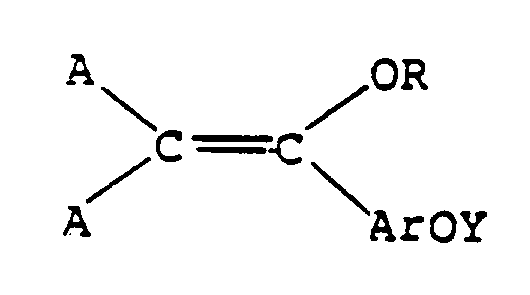
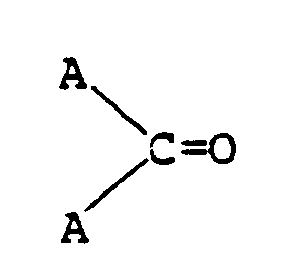
PROCESS FOR THE PREPARATION OF VINYL ETHERS VERFAHREN ZUR HERSTELLUNG VON VINYLETHERN PROCEDE DE PREPARATION D'ETHERS VINYLIQUES |
|
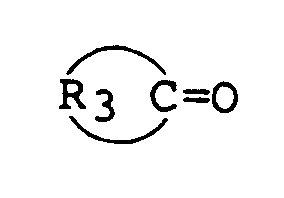
|
|||||||||||||||||||||||||||||||
| Note: Within nine months from the publication of the mention of the grant of the European patent, any person may give notice to the European Patent Office of opposition to the European patent granted. Notice of opposition shall be filed in a written reasoned statement. It shall not be deemed to have been filed until the opposition fee has been paid. (Art. 99(1) European Patent Convention). |
Cross-Reference to Related Application
[0001] This application is a continuation-in-part of my pending U.S. patent application Serial No. 887,139, filed July 17, 1986.
BACKGROUND OF THE INVENTION
[0002] The present invention relates to an improved process for the preparation of vinyl ethers by coupling of a ketone with an aryl ester bearing a hydroxyl (OH) group or an OP group wherein P is a typical protecting group for an OH group. In particular, the present invention relates to a coupling reaction which is conducted in an organic solvent, preferably an ether, using a titanium salt, preferably TiCl₃ or TiCl₄, and a metallic reducing agent, preferably zinc metal, in the presence of an amine, preferably triethylamine.
PRIOR ART
[0003] The use of various reducing agents such as lithium aluminum hydride (LAH), Zn-Cu couple and Li, K, Zn or Mg metals in combination with TiCl₃ or TiCl₄ to synthesize alkyl and aryl substituted alkenes by a coupling of ketones has been described in the literature. These reactions are described by McMurry et al. Acc. Chem. Res. 16, 405-411 (1983); Dams et al, J. Org. Chem. 47, 248-259 (1982); McMurry et al, J. Org. Chem. 43, 3255-3266 (1978); Mukaiyama et al, Chem. Lett. 1041-1044 (1973); McMurry et al JACS 96, 4708-4709 (1974); Tyrlik et al, Bull. Soc. Chim. Fr. 6, No. 2147-2148 (1973). US-A-4 857 652 shows the reaction of the same compounds as in the present application in the presence of an organic solvent, lithium aluminium hydride, a transition metal salt and a tertiary amine. My U.S. Patent Application No. 887,139 specifically shows the use of lithium aluminum hydride as a reducing agent for the previously unknown preparation of vinyl ethers. This process can be difficult to control and, therefore, somewhat dangerous in large scale reactions.
[0004] The vinyl ethers are used to produce triggerable 1,2-dioxetanes which produce light. These compounds are particularly useful in various biological assays for detecting materials.
OBJECTS
[0005] It is therefore an object of the present invention to provide an improved process which uses an ester and a ketone in a coupling reaction to produce a vinyl ether bearing an aryl group with either a hydroxyl (OH) group or an OP group wherein P is a protecting group. These and other objects will become increasingly apparent by reference to the following description.
GENERAL DESCRIPTION
[0006] The present invention relates to a process for producing a vinyl ether of the formula
wherein A and R are passive organic groups, wherein ArOY is an aryl group having an aryl ring substituted with OY as a substituent selected from the group consisting of hydroxyl and OP, wherein P is a protecting group which comprises:
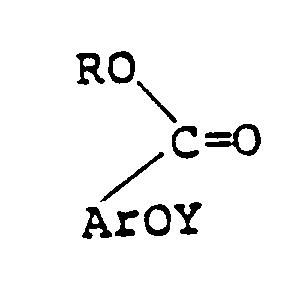
reacting a carbonyl containing compound of the formula:
with an ester compound of the formula:
an organic solvent in the presence of a metallic reducing agent such as zinc metal, a titanium salt and an amine base to produce the vinyl ether.
[0007] Thus A and R can be any essentially passive organic group such as for instance alkyl, aryl, or polycyclic alkyl.
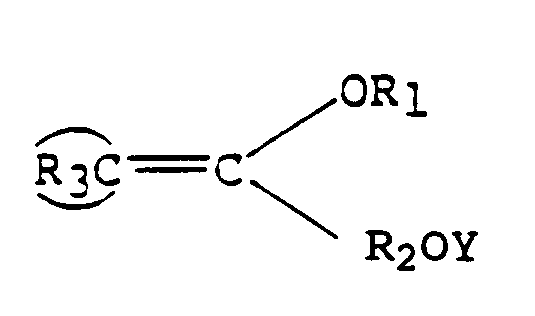
[0008] Further, the present invention relates to a process for producing a vinyl ether of the formula
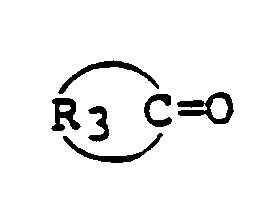
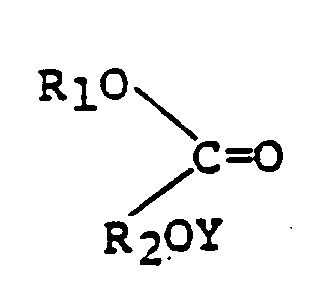
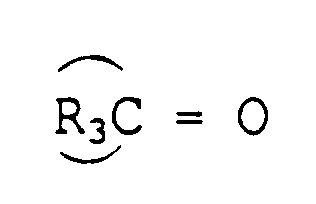
wherein R₁ is selected from alkyl, aryl, and aralkyl containing 1 to 20 carbon atoms and optionally including oxygen, sulfur, nitrogen, phosphorus and halogens (chlorine, bromine, iodine), R₂ is selected from aryl, biaryl and fused ring polycyclic aryl groups which can be substituted or unsubstituted, wherein R₁ and R₂ can be linked together by a member selected from carbon, oxygen and nitrogen containing groups and R₃C- is selected from polycyclic alkyl groups containing 6 to 30 carbon atoms, wherein OY is a substituent selected from hydroxyl and OP and wherein P is a protecting group which comprises:
reacting a carbonyl containing compound of the formula:
with an ester compound of the formula:
in an organic solvent in the presence of a metallic reducing agent such as zinc metal, a titanium salt, and an amine base to produce the vinyl ether.
[0009] Preferably the metallic reducing agent and titanium salt are provided with the amine base at temperatures between about -25 and +25°C. The amine is added slowly to the reducing agent and titanium salt in a reaction mixture to prevent the exothermic reaction from becoming uncontrollable. The ketone and ester are added in a solvent and the reaction conducted between about 25 and 150°C. The vinyl ether is then separated from the reaction mixture using conventional techniques.
[0010] The metallic reducing agent is preferably essentially pure zinc. Zinc can be used as the metal alone or in admixture with other metals such as copper. Other pure metals such as Li, K, and Mg can be used. Zinc alone is preferred. The metallic reducing agent is preferably finely divided.
[0011] The titanium salt is preferably in the form of a chloride. Either titanium trichloride or titanium tetrachloride can be used.
[0012] The amine can be triethylamine which is preferred. Other amine acid acceptors which do not interfere with the reaction to form the vinyl ether can be used. Such amine bases are well known to those skilled in the art.
[0013] The organic solvent is preferably an ether. The most preferred solvent is tetrahyrofuran. Other solvents are, for instance, dimethoxyethane or dioxane.
[0014] The preferred vinyl ethers for instance are made from 2-adamantanone and esters as shown below, where R is, for instance, CH₃(Me)CH₂CH₃, CH₂CH₂Cl, CH₂CH₂CH₂Cl, (CH₂)₁₅CH₃, CH₂Ph, or Ph.
Additional preferred vinyl ethers are made from 2-adamantanone and esters of 3-hydroxybenzoate as shown below, where R is, for instance, CH₃(Me)CH₂CH₃, CH₂CH₂Cl, CH₂CH₂CH₂Cl, (CH₂)₁₅CH₃, CH₂Ph, or Ph.
The preferred vinyl ethers are also made by the following process from 2-adamantanone and the corresponding methyl 3-silyloxy or 3-hydroxybenzoate where Y = H, Si(t-Bu)Me₂, Si(t-Bu)Ph₂, or SiPh₃ and where Ph is phenyl, Bu is t-butyl and Me is methyl. Other protecting groups well known in the literature can also be used.
The following vinyl ethers are made by this general process from 2-adamantanone and the corresponding esters including lactones, where Y is hydrogen or a protecting group.
The following vinyl ether is made by this general process from the ketone, bicyclo[3.3.1]nonan-9-one, and methyl 3-tert-butyldimethylsilyloxybenzoate.
The hydroxyl vinyl ether is prepared either by direct reaction of a ketone and a hydroxy ester or by reaction of a ketone and ester bearing an OY group with subsequent conversion of OY to OH by removal of the protecting group P in a known manner. The hydroxyl-substituted vinyl ethers such as the preferred example, [(3-hydroxyphenyl)methoxymethylene]adamantane (1) shown below, are converted to other derivatives by standard chemical processes well known to those skilled in the art of organic synthesis. Such derivatives are, for instance, esters of inorganic oxy acids or their salts (e.g. phosphates, sulfates) oxygen-pyranosides (e.g., beta-D-galactosides) and aryl or alkyl carboxyl esters. The vinyl ethers are then converted to dioxetanes, as shown below, which are triggerable by corresponding enzymes, (phosphatase, sulfatase, beta-D-galactosidase, esterase and the like) to produce light in biological assays. The dioxetanes can also be chemically triggered.
[0015] Thus the vinyl ether can be directly photooxidized in the presence of a sensitizer, light and oxygen to yield the desired dioxetane. Alternatively, the hydroxy vinyl ether, such as 1 shown below, is photooxidized to give the hydroxy substituted dioxetane and it is subsequently treated with chemical reagents to form the X-substituted dioxetane as described in U.S. application Serial No. 887,139.
SPECIFIC DESCRIPTION
[0016] The following Examples show the preferred processes of the present invention for producing the vinyl ethers.
Example 1
[0018] [((3-Hydroxyphenyl)methoxymethylene]adamantane (1). To a four-necked round-bottom flask equipped with a refluxing condenser and mechanical stirrer was added 1.5 L of dry THF under argon. Titanium trichloride (TiCl₃, 200 g, 1.29 mol) was then added to the flask with stirring. After 15 minutes of stirring, powdered zinc (130 g, 2.0 mol) was added in portions and the flask was heated in hot water for 25 minutes. The reaction flask was then cooled in an ice-salt bath and the temperature of the mixture maintained at 5 to 7°C. Triethylamine (2.0 mL) was added to the suspension with caution (the reaction is extremely exothermic). The reaction started in approximately 5 to 10 minutes. After the reaction subsided, an additional amount of triethylamine (200 mL) was added and the mixture heated under reflux for 3 hours. After this period, a solution of methyl 3-hydroxybenzoate (100 g, 0.66 mol) and 2-adamantanone (60.0 g, 0.40 mol) in 400 mL of dry THF was added dropwise to the refluxing mixture over 5 hours. The reaction mixture was then cooled to room temperature and was diluted with hexane (4 L) and the stirring continued. The suspended solids were then allowed to settle and the organic layer decanted. The black solid was washed with diethyl ether (2 L), followed by 1 L of water and the organic layer was removed. The aqueous layer was washed a second time with 2 x 2 L of ether. The combined ether layers were then gravity filtered and the resulting solution was dried over anhydrous magnesium sulfate. Evaporation of the solvent under reduced pressure and chromatography over silica gel with 25% ethyl acetate/hexane gave 55.0 g of l as white crystals: mp 133.4°C; ¹H NMR (CDCl₃) δ 1.64-1.96 (m, 12H), 2.65 (s, 1H), 3.24 (s. 1H), 3.32 (s. 3H), 5.25 (s, 1H, OH exchange with D₂O) 6.76-6.92 (m, 3H) 7.26 (t, 1H, 7.8 Hz); ¹³C NMR (CDCl₃) δ 28.45, 30.36, 32.36, 37.30, 39.18, 39.33, 57.82, 114.60, 116.16, 122.19, 129.24, 137.24, 155.62; MS m/e (rel. intensity) 271 (M+l, 20), 270 (M⁺, 100), 253 (7.3), 213 (35.1), 121 (41.7), 93 (9.4); Exact mass: calcd. 270.1619, found 270.1616; Anal Calcd. for C₁₈H₂₂O: C, 80.00; H, 8.15. Found: C, 79.85; H 8.34.
[0019] This procedure has also been conducted using TiCl₄ and Zn and found to give alkene l in comparable yields.
Example 2
[0021] [(3-tert-Butyldimethylsilyloxyphenyl)methoxymethylene]adamantane (2). To a four-necked round-bottom flask equipped with a refluxing condenser and mechanical stirrer was added 1.5 L of dry THF under argon. Titanium trichloride (TiCl₃, 200 g, 1.29 mol) was then added to the flask with stirring. After 15 minutes of stirring, powdered zinc (130 g, 2.0 mol) was added in portions and the flask was heated in hot water for 25 minutes. The reaction flask was then cooled in an ice-salt bath and the temperature of the mixture maintained at 5 to 7°C. Triethylamine (2.0 mL) was added to the suspension with caution (the reaction is extremely exothermic). The reaction started in approximately 5 to 10 minutes. After the reaction subsided, an additional amount of triethylamine (200 mL) was added and the mixture heated under reflux for 3 hours. After this period, a solution of methyl 3-tert-butyldimethylsiloxybenzoate (100 g, 0.37 mol) and 2-adamantanone (85.0 g, 0.57 mol) in 400 mL of dry THF was added dropwise to the refluxing mixture over 5 hours. The reaction mixture was then cooled to room temperature and was diluted with hexane (4 L) and the stirring continued. The suspended solids were then allowed to settle and the organic layer decanted. The black solid was washed with diethyl ether (2 x 1 L). Hexane (1L) was added to the black material, followed by 1L of water and the organic layer was removed. The aqueous layer was washed a second time with 1.5 L of hexane. The combined hexane and ether layers were then gravity filtered and the resulting solution was dried over anhydrous magnesium sulfate. Evaporation of the solvent under reduced pressure and chromatography over silica gel with 5% ethyl acetate/hexane gave 117 g (81% yield) of 2 as a clear oil.
[0022] This procedure has also been conducted using TiCl₄ and Zn and found to give alkene 2 in comparable yields. ¹H and ¹³C NMR spectra of 2 were found to be identical to those of the same alkene prepared by the process of U.S. Patent Application Serial No. 887,139, filed July 17, 1986 which utilizes lithium aluminum hydride instead of zinc.
1. A process for producing a compound of the formula
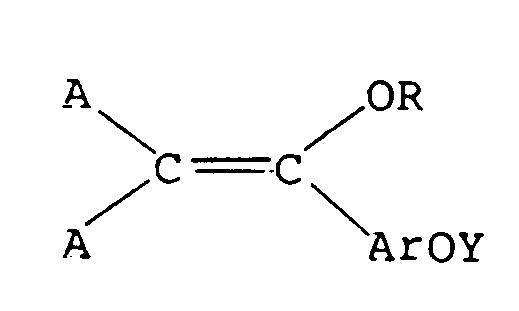
wherein A and R are passive organic groups, wherein ArOY is an aryl group having an aryl ring substituted with OY as a substituent selected from hydroxyl and OP, wherein P is a protecting group which comprises:
reacting a carbonyl containing compound of the formula:
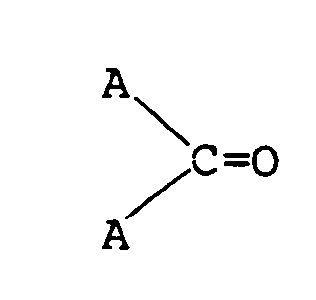
with an ester compound of the formula:
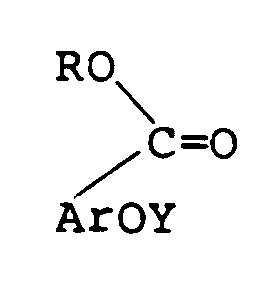
group in an organic solvent in the presence of a metallic reducing agent, a titanium salt and an amine base to produce the vinyl ether.
wherein A and R are passive organic groups, wherein ArOY is an aryl group having an aryl ring substituted with OY as a substituent selected from hydroxyl and OP, wherein P is a protecting group which comprises:
reacting a carbonyl containing compound of the formula:
with an ester compound of the formula:
group in an organic solvent in the presence of a metallic reducing agent, a titanium salt and an amine base to produce the vinyl ether.
2. The process of Claim 1 wherein the metallic reducing agent is zinc.
3. The process of Claim 2 wherein the titanium salt is selected from the group consisting
of titanium trichloride and titanium tetrachloride.
4. The process of Claim 3 wherein the amine base is triethylamine and the organic solvent
is tetrahydrofuran.
5. The process of Claim 1 wherein OY is selected from the group consisting of trialkylsilyoxy,
dialkylarylsilyoxy, diarylalkylsilyloxy and triarylsilyoxy.
6. The process of Claim 1 where OY is a hydroxyl group.
7. A process for producing a vinyl ether of the formula
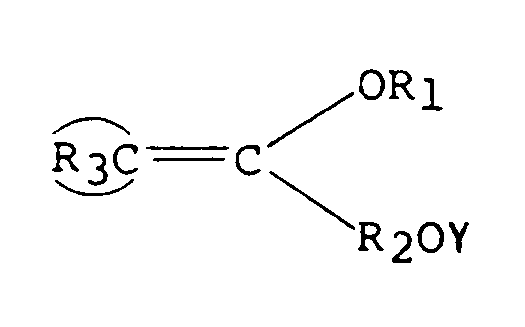
wherein R₁ is selected from the group consisting of alkyl, aryl and aralkyl containing 1 to 20 carbon atoms and optionally including oxygen, sulfur, nitrogen, phosphorus and halogens, R₂ is selected from aryl, biaryl and fused ring polycyclic aryl groups which can be substituted or unsubstituted, wherein R₁ and R₂ can be linked together by a member selected from carbon, oxygen or nitrogen containing groups and R₃C- is selected from polycyclic alkyl groups containing 6 to 30 carbon atoms, wherein OY is a substituent selected from hydroxyl and OP and wherein P is a protecting group which comprises:
reacting a carbonyl containing compound of the formula:
with an ester compound of the formula:
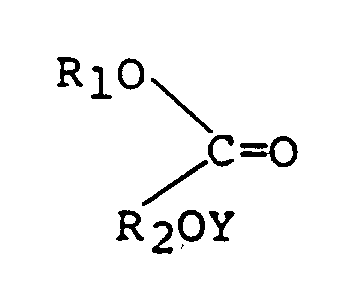
in an organic solvent in the presence of (a) metal(s) as reducing agent, a titanium metal salt, and an amine base to produce the vinyl ether.
wherein R₁ is selected from the group consisting of alkyl, aryl and aralkyl containing 1 to 20 carbon atoms and optionally including oxygen, sulfur, nitrogen, phosphorus and halogens, R₂ is selected from aryl, biaryl and fused ring polycyclic aryl groups which can be substituted or unsubstituted, wherein R₁ and R₂ can be linked together by a member selected from carbon, oxygen or nitrogen containing groups and R₃C- is selected from polycyclic alkyl groups containing 6 to 30 carbon atoms, wherein OY is a substituent selected from hydroxyl and OP and wherein P is a protecting group which comprises:
reacting a carbonyl containing compound of the formula:
with an ester compound of the formula:
in an organic solvent in the presence of (a) metal(s) as reducing agent, a titanium metal salt, and an amine base to produce the vinyl ether.
8. The process of Claim 7 wherein the metallic reducing agent is zinc.
9. The process of Claim 8 wherein the titanium salt is selected from the group consisting
of titanium trichloride and titanium tetrachlroide.
10. The process of Claim 9 wherein the amine base is triethylamine and the organic solvent
is tetrahydrofuran.
11. The process of Claim 7 wherein OY is selected from the group consisting of trialkylsilyoxy,
dialkylarylsilyoxy, diarylalkylsilyloxy and triarylsilyoxy.
12. The process of Claim 7 wherein OY is a hydroxyl group.
13. The process of Claim 7 wherein in addition the OY in the vinyl ether is replaced subsequently
with another group to provide an OX group wherein the OX group is selected from the
group consisting of inorganic oxy acid salt, phosphate salt, oxygen-pyranoside, aryl
and alkyl carboxyl esters.
14. The process of Claim 1 wherein the amine is added slowly to the metallic reducing
agent and titanium salt in admixture prior to reacting the carbonyl containing compound
and the ester compound.
15. The process of Claim 14 wherein the titanium salt is a chloride.
16. The process of Claim 15 wherein the metallic reducing agent is finely divided.
1. Verfahren zur Herstellung einer Verbindung der Formel
worin A und R passive organische Gruppen sind, worin ArOY eine Arylgruppe mit einem Arylring ist, der mit OY als Substituent substituiert ist, wobei OY ausgewählt ist aus einer Hydroxylgruppe und OP, worin P eine Schutzgruppe ist, wobei das Verfahren umfaßt:
Umsetzen einer Verbindung mit einer Carbonylgruppe der Formel:
mit einer Esterverbindung der Formel:
in einem organischen Lösungsmittel in Gegenwart eines metallischen Reduktionsmittels, eines Titansalzes und einer Amin-Base, um den Vinylether herzustellen.
worin A und R passive organische Gruppen sind, worin ArOY eine Arylgruppe mit einem Arylring ist, der mit OY als Substituent substituiert ist, wobei OY ausgewählt ist aus einer Hydroxylgruppe und OP, worin P eine Schutzgruppe ist, wobei das Verfahren umfaßt:
Umsetzen einer Verbindung mit einer Carbonylgruppe der Formel:
mit einer Esterverbindung der Formel:
in einem organischen Lösungsmittel in Gegenwart eines metallischen Reduktionsmittels, eines Titansalzes und einer Amin-Base, um den Vinylether herzustellen.
2. Verfahren nach Anspruch 1, worin das metallische Reduktionsmittel Zink ist.
3. Verfahren nach Anspruch 2, worin das Titansalz ausgewählt ist aus der Gruppe, bestehend
aus Titantrichlorid und Titantetrachlorid.
4. Verfahren nach Anspruch 3, worin die Amin-Base Triethylamin und das organische Lösungsmittel
Tetrahydrofuran ist.
5. Verfahren nach Anspruch 1, worin OY ausgewählt ist aus der Gruppe, bestehend aus Trialkylsilyloxy,
Dialkylarylsilyloxy, Diarylalkylsilyloxy und Triarylsilyloxy.
6. Verfahren nach Anspruch 1, worin OY eine Hydroxylgruppe ist.
7. Verfahren zur Herstellung eines Vinylethers der Formel
worin R₁ ausgewählt ist aus der Gruppe, bestehend aus Alkylgruppe, Arylgruppen und Aralkylgruppen, die 1 bis 20 Kohlenstoffatome enthalten, und die wahlweise Sauerstoff, Schwefel, Stickstoff, Phosphor und Halogene umfassen, R₂ ist ausgewählt aus Arylgruppen, Biarylgruppen und polycyclischen Arylgruppen mit kondensierten Ringen, wobei diese Gruppen substituiert oder unsubstituiert sein können, wobei R₁ und R₂ über Kohlenstoff, Sauerstoff oder Stickstoff enthaltende Gruppen miteinander verbunden sein können, und R₃C- ist ausgewählt aus polycyclischen Alkylgruppen, die 6 bis 30 Kohlenstoffatome enthalten, worin OY ein Substituent ist, ausgewählt aus einer Hydroxylgruppe und OP, und worin P eine Schutzgruppe ist, wobei das Verfahren umfaßt:
Umsetzen einer Verbindung mit einer Carbonylgruppe der Formel:
mit einer Esterverbindung der Formel:
in einem organischen Lösungsmittel in Gegenwart mindestens eines Metalls als Reduktionsmittel, eines Titansalzes und einer Amin-Base, um den Vinylether herzustellen.
worin R₁ ausgewählt ist aus der Gruppe, bestehend aus Alkylgruppe, Arylgruppen und Aralkylgruppen, die 1 bis 20 Kohlenstoffatome enthalten, und die wahlweise Sauerstoff, Schwefel, Stickstoff, Phosphor und Halogene umfassen, R₂ ist ausgewählt aus Arylgruppen, Biarylgruppen und polycyclischen Arylgruppen mit kondensierten Ringen, wobei diese Gruppen substituiert oder unsubstituiert sein können, wobei R₁ und R₂ über Kohlenstoff, Sauerstoff oder Stickstoff enthaltende Gruppen miteinander verbunden sein können, und R₃C- ist ausgewählt aus polycyclischen Alkylgruppen, die 6 bis 30 Kohlenstoffatome enthalten, worin OY ein Substituent ist, ausgewählt aus einer Hydroxylgruppe und OP, und worin P eine Schutzgruppe ist, wobei das Verfahren umfaßt:
Umsetzen einer Verbindung mit einer Carbonylgruppe der Formel:
mit einer Esterverbindung der Formel:
in einem organischen Lösungsmittel in Gegenwart mindestens eines Metalls als Reduktionsmittel, eines Titansalzes und einer Amin-Base, um den Vinylether herzustellen.
8. Verfahren nach Anspruch 7, worin das metallische Reduktionsmittel Zink ist.
9. Verfahren nach Anspruch 8, worin das Titansalz ausgewählt ist aus der Gruppe, bestehend
aus Titantrichlorid und Titantetrachlorid.
10. Verfahren nach Anspruch 9, worin die Amin-Base Triethylamin und das organische Lösungsmittel
Tetrahydrofuran ist.
11. Verfahren nach Anspruch 7, worin OY ausgewählt ist aus der Gruppe, bestehend aus Trialkylsilyloxy,
Dialkylarylsilyloxy, Diarylalkylsilyloxy und Triarylsilyloxy.
12. Verfahren nach Anspruch 7, worin OY eine Hydroxylgruppe ist.
13. Verfahren nach Anspruch 7, worin die Gruppe OY in dem Vinylether zusätzlich nachträglich
durch eine andere Gruppe ersetzt wird, um eine OX-Gruppe zu erhalten, worin die OX-Gruppe
ausgewählt ist aus der Gruppe, bestehend aus einem anorganischen Oxysäuresalz, einem
Phosphatsalz, Sauerstoff-Pyranosid, Aryl- und Alkylcarbonsäureestern.
14. Verfahren nach Anspruch 1, worin das Amin langsam zu dem Gemisch aus dem metallischen
Reduktionsmittel und dem Titansalz zugegeben wird, bevor die Verbindung mit der Carbonylgruppe
und die Esterverbindung umgesetzt werden.
15. Verfahren nach Anspruch 14, worin das Titansalz ein Chlorid ist.
16. Verfahren nach Anspruch 15, worin das metallische Reduktionsmittel fein zerteilt ist.
1. Procéde pour préparer un composé de formule
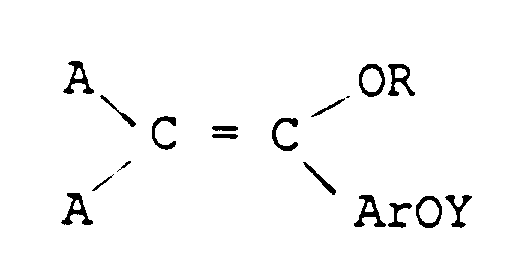
où A et R sont des groupes organiques passifs, où ArOY est un groupe aryle ayant un cycle aryle substitué par OY en tant que substituant choisi parmi un groupe hydroxyle et OP, où P est un groupe protecteur, qui comprend :
la réaction d'un composé contenant un groupe carbonyle, de formule :
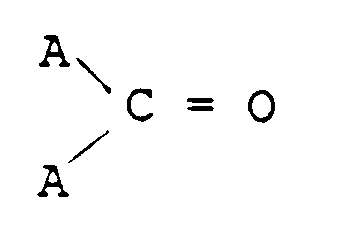
avec un composé ester de formule :
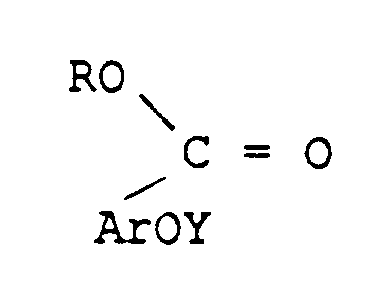
dans un solvant organique en présence d'un agent réducteur métallique, d'un sel de titane et d'une base aminée pour obtenir l'ether vinylique.
où A et R sont des groupes organiques passifs, où ArOY est un groupe aryle ayant un cycle aryle substitué par OY en tant que substituant choisi parmi un groupe hydroxyle et OP, où P est un groupe protecteur, qui comprend :
la réaction d'un composé contenant un groupe carbonyle, de formule :
avec un composé ester de formule :
dans un solvant organique en présence d'un agent réducteur métallique, d'un sel de titane et d'une base aminée pour obtenir l'ether vinylique.
2. Procédé selon la revendication 1, dans lequel l'agent réducteur métallique est le
zinc.
3. Procédé selon la revendication 2, dans lequel le sel de titane est choisi dans le
groupe constitué du trichlorure de titane et du tétrachlorure de titane.
4. Procédé selon la revendication 3, dans lequel la base aminée est la triéthylamine
et le solvant organique est le tétrahydrofuranne.
5. Procédé selon la revendication 1, dans lequel OY est choisi dans le groupe constitué
des groupes trialkylsilyloxy, dialkylarylsilyloxy, diaryl-alkylsilyloxy et triarylsilyloxy.
6. Procédé selon la revendication 1, où OY est un groupe hydroxyle.
7. Procédé pour préparer un éther vinylique de formule
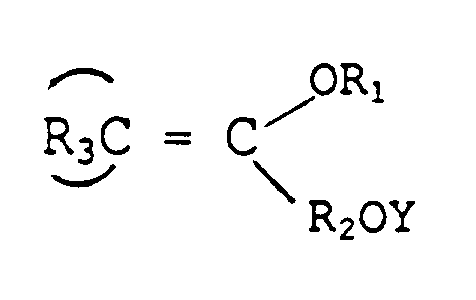
où R₁ est choisi dans le groupe constitué d'un radical alkyle, aryle et aralkyle contenant 1 à 20 atomes de carbone et incluant éventuellement de l'oxygène, du soufre, de l'azote, du phosphore et des halogènes, R₂ est choisi parmi les groupes aryles, biaryles et aryles polycycliques à cycles fusionnés qui peuvent être substitués ou non substitués, où R₁ et R₂ peuvent être liés ensemble par un élément choisi parmi les groupes contenant du carbone, de l'oxygène ou de l'azote, et R₃C- est choisi parmi les groupes alkyles polycycliques contenant 6 à 30 atomes de carbone, où OY est un substituant choisi parmi un groupe hydroxyle et OP et où P est un groupe protecteur, qui comprend :
la réaction d'un composé contenant un groupe carbonyle, de formule :
avec un composé ester de formule :
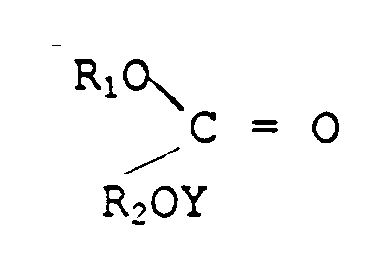
dans un solvant organique en présence d'un (de) métal (métaux) en tant qu'agent réducteur, d'un sel de titane métallique et d'une base aminée pour obtenir l'éther vinylique.
où R₁ est choisi dans le groupe constitué d'un radical alkyle, aryle et aralkyle contenant 1 à 20 atomes de carbone et incluant éventuellement de l'oxygène, du soufre, de l'azote, du phosphore et des halogènes, R₂ est choisi parmi les groupes aryles, biaryles et aryles polycycliques à cycles fusionnés qui peuvent être substitués ou non substitués, où R₁ et R₂ peuvent être liés ensemble par un élément choisi parmi les groupes contenant du carbone, de l'oxygène ou de l'azote, et R₃C- est choisi parmi les groupes alkyles polycycliques contenant 6 à 30 atomes de carbone, où OY est un substituant choisi parmi un groupe hydroxyle et OP et où P est un groupe protecteur, qui comprend :
la réaction d'un composé contenant un groupe carbonyle, de formule :
avec un composé ester de formule :
dans un solvant organique en présence d'un (de) métal (métaux) en tant qu'agent réducteur, d'un sel de titane métallique et d'une base aminée pour obtenir l'éther vinylique.
8. Procédé selon la revendication 7, dans lequel l'agent réducteur métallique est le
zinc.
9. Procédé selon la revendication 8, dans lequel le sel de titane est choisi dans le
groupe constitue du trichlorure de titane et du tétrachlorure de titane.
10. Procédé selon la revendication 9, dans lequel la base aminée est la triéthylamine
et le solvant organique est le tétrahydrofuranne.
11. Procédé selon la revendication 7, dans lequel OY est choisi dans le groupe constitué
des groupes trialkylsilyloxy, dialkylarylsilyloxy, diarylalkylsilyloxy et triarylsilyloxy.
12. Procédé selon la revendication 7, dans lequel OY est un groupe hydroxyle.
13. Procédé selon la revendication 7, dans lequel, en plus, OY dans l'éther vinylique
est ensuite remplacé par un autre groupe pour fournir un groupe OX, où le groupe OX
est choisi dans le groupe constitué d'un sel d'oxyacide inorganique, d'un sel phosphate,
de l'oxygène-pyranoside, des esters aryliques et alkyliques d'acides carboxyliques.
14. Procédé selon la revendication 1, dans lequel l'amine est ajoutée lentement à l'agent
réducteur métallique et au sel de titane mélangés, avant de faire réagir le composé
contenant un groupe carbonyle et le composé ester.
15. Procédé selon la revendication 14, dans lequel le sel de titane est un chlorure.
16. Procédé selon la revendication 15, dans lequel l'agent réducteur métallique est finement
divisé.