|
(11) | EP 0 459 056 B1 |

| (12) | EUROPEAN PATENT SPECIFICATION |
|
|
| (54) |
Aromatic polyamide and process for producing same Aromatisches Polyamid und Verfahren zur Herstellung Polyamide aromatique et son procédé de préparation |
|
|
|||||||||||||||||||||||||||||||
| Note: Within nine months from the publication of the mention of the grant of the European patent, any person may give notice to the European Patent Office of opposition to the European patent granted. Notice of opposition shall be filed in a written reasoned statement. It shall not be deemed to have been filed until the opposition fee has been paid. (Art. 99(1) European Patent Convention). |
[0001] The present invention relates to a solvent-soluble aromatic polyamide and a process for producing it.
[0002] More particularly, it relates to a novel aromatic polyamide which is soluble in various solvents and is excellent in processabilities such as spinning and film-forming and has excellent properties such as high glass transition temperature, high heat resistance, high strength and high elasticity and a process for producing it.
[0003] The aromatic polyamide of the present invention is soluble in various organic solvents with retaining excellent properties such as high glass transition point, so it can be solution-molded and can be easily processed into fibers and films.
[0004] Therefore, the aromatic polyamide of the present invention can be utilized for various uses in the form of fibers, films, and solvent-soluble compositions such as industrial materials, electrical insulating materials, laminate constructions, varnish, adhesives, tire cords, resins, reinforcing materials for concrete, filter cloths, and synthetic papers.
[0005] Aromatic polyamides are known to have various excellent chemical and physical properties such as high melting point, high glass transition temperature, heat resistance and chemical resistance, and fibers comprising aromatic polyamide and having excellent heat resistance are useful as heat resistant fibers and fibers having excellent mechanical properties such as high initial Young's modulus and strength are useful as composite materials such as reinforcing materials for tire cords and plastics.
[0006] Above all, aromatic homopolyamides or copolyamides in which bonding chains extend in coaxial or parallel direction from respective aromatic rings such as poly(p-phenyleneterephthalamide) and poly(m-phenyleneisophthalamide) are known to provide fibers having high Young's modulus. However, while polyamides having such large stiffness and high symmetry generally have excellent mechanical properties, they are inferior in solubility in solvents and cannot be easily molded.
[0007] For example, poly(p-phenyleneterephthalamide) is limited to solvents which can dissolve it, namely, the solvents are limited to strong acids such as sulfuric acid or the solvent systems comprising mixed solvent of hexamethylphosphoramide and N-methylpyrrolidone or tetramethylurea to which inorganic salt such as lithium chloride is added. Moreover, when molding is carried out in industrial scale, strong acids such as sulfuric acid have problems in corrosion, danger in handling and disposal of waste liquor. Furthermore, dissolution in the organic mixed solvent above requires troublesome operations and thus it is not easy.
[0008] Furthermore, it is known to introduce m-phenylene moiety or a moiety of
(X is -O-, -S-, -CH₂-, etc) into aromatic homopolyamides or copolyamides having stiffness and symmetry where bonding chains extend in coaxial direction or in parallel direction to axis from aromatic rings for improving solubility thereof. However, even if m-phenylene moiety is introduced, solubility of the resulting copolyamide can be improved to some extent, but fibers obtained from such copolyamide tend to decrease much in mechanical properties, especially initial Young's modulus with increase of proportion of m-phenylene moiety. Moreover, even if the moiety of
(X is -O-, -S-, -CH₂-, etc.) is introduced, solubility of the resulting copolyamide can be improved to some extent, but mechanical properties, especially initial Young's modulus of fiber obtained therefrom also tend to much decrease with increase of proportion of the moiety
[0009] The aromatic polyamides of the present invention are those which comprise 2,7-dicarboxynaphthalene group and aromatic diamino group and in more detail, one of them is an aromatic polyamide, characterized by substantially comprising dicarboxylic acid recurring unit represented by the formula:
and diamine recurring unit represented by the formula:
-NH-Ar₁-NH- (II)
(wherein Ar₁ represents a phenylene group, a naphthylene group or a group represented by the formula:
wherein Y₁ represents a lower alkylidene group selected from methylene, ethylene or isopropylidene group, an oxygen atom, a sulfur atom, a carbonyl group or a sulfonyl group and m is 0 or 1).
[0010] This aromatic polyamide can be produced by reacting (a) a naphthalene-2,7-dicarboxylic acid or dihalide thereof with (b) an aromatic diamine represented by the formula: H₂N-Ar₁-NH₂ (wherein Ar₁ is the same as defined above).
[0011] Another one of the aromatic polyamides of the present invention is an aromatic copolyamide which comprises substantially 10-90 mol% of recurring unit represented by the formula (IV):
and 10-90 mol% of recurring unit represented by the formula (V):
(wherein Ar₁ and Ar₂ each represents a phenylene group, a naphthylene group or a group represented by the formula :
Ar₃ represents a phenylene group, a naphthylene group or a group represented by the formula
:
which have bonding chains extending in coaxial direction or in parallel direction to axis, wherein Y₁ and Y₂ each represents a direct linkage, a lower alkylidene group selected from methylene, ethylene or isopropylidene group, an oxygen atom, a sulfur atom, a carbonyl group or a sulfonyl group and m and n each represents 0 or 1).
[0012] This aromatic copolyamide can be produced by reacting 10-90 mol% of (c) aromatic dicarboxylic acids represented by XOC-Ar₃-COX and (b) diamines represented by H₂N-Ar₁-NH₂ and H₂N-Ar₂-NH₂ with (a) 90-10 mol% of naphthalene-2,7-dicarboxylic acids or dihalides thereof (in these formulas, Ar₁, Ar₂ and Ar₃ are the same as defined above and X represents a hydroxyl group or a halogen atom).
[0013] The naphthalene-2,7-dicarboxylic acid dihalide of the component (a) include dichloride, difluoride, and dibromide.
[0014] As diamines of component (b) represented by H₂N-Ar₁-NH₂ and H₂N-Ar₂-NH₂, mention may be made of m-phenylenediamine, p-phenylenediamine, 4,4'-diaminobiphenyl, 3,3'-methylenedianiline, 4,4'-methylenedianiline, 4,4'-ethylenedianiline, 4,4'-isopropylidenedianiline, 3,4'-oxydianiline, 4,4'-oxydianiline, 4,4'-thiodianiline, 3,3'-carbonyldianiline, 4,4'-carbonyldianiline, 3,3'-sulfonyldianiline, 4,4'-sulfonyldianiline, 1,4-naphthalenediamine, 1,5-naphthalenediamine, 2,6-naphthalenediamine, and 2,7-naphthalenediamine. These may be used singly or in admixture.
[0015] Examples of aromatic dicarboxylic acids represented by the formula (c): XOC-Ar₃-COX are those in which Ar₃ is 1,4-phenylene, 2,6-naphthylene or 4,4-biphenylene and X is OH, Cl, F or Br.
[0016] The aromatic polyamides of the present invention have preferably 10 or more in degree of polymerization. When the degree of polymerization above is more than 200, the polyamides gradually tend to lower in solubility in solvents.
[0017] Reaction of dicarboxylic acids or dihalides thereof with diamines can be performed by known polycondensation processes such as melt polycondensation, solid phase polycondensation, interfacial polycondensation, and solution polycondensation.
[0018] In the process of the present invention, when a halide is used as component (a) or component (c), it is preferred to carry out reaction at -20°C - 200 °C for several minutes - several days in an organic solvent, if necessary, in the presence of an acid-acceptor.
[0019] In this case, suitably the reaction is carried out in the presence of halides of metals belonging to Group 1 and Group 2 of the Mendelejeff's periodic table or hydrogen halides. These halides of metals and hydrogen halides act as solubilization aids for aromatic polyamides produced.
[0020] The organic solvents mentioned above include, for example, amide solvents such as N,N-dimethylacetamide and N-methyl-2-pyrrolidone, aromatic solvents such as benzene, anisole, diphenyl ether, nitrobenzene, and benzonitrile, and halogen solvents such as chloroform, dichloromethane, 1,2-dichloroethane, and 1,1,2,2-tetrachloroethane. Amide solvents are especially preferred. Preferred examples of such amide solvents are tetramethylurea, hexamethylphosphoramide, N,N-dimethylacetamide, N,N'-dimethylformamide, N-methylpyrrolidone-2, N-methylpiperidone-2, N,N-dimethylethyleneurea, N,N,N',N'-tetramethylmalonic acid amide, N-methylcaprolactam, N-acetylpyrrolidine, N,N-diethylacetamide, N-ethylpyrrolidone-2, N,N-dimethylpropionic acid amide, N,N-dimethylisobutylamide, N-methylformamide, N,N'-dimethylpropyleneurea and mixtures thereof. Among them, especially advantageous are N-methylpyrrolidone-2, hexamethylphosphoramide, N,N-dimethylacetamide, N,N'-dimethylformamide and mixtures thereof.
[0021] Suitable polycondensation method is as follows. At least two diamines of the formulas (I), (II), (IV), and (V) or hydrohalides thereof are dissolved in the above amide solvents and then to this solution is added the above dicarboxylic acid halides, especially dicarboxylic acid dichloride under stirring. After addition of the compounds, depending on the kind of the compounds used, in some case, viscosity rapidly increases and in some case, it increases slowly and the polymerization reaction substantially terminates after 24 hours at longest. In this case, the amide solvents acts also as an acid-acceptor for hydrohalides such as hydrochloride released by the above reaction.
[0023] In such solution polycondensation, concentrations of monomers affect viscosity of polymer solution obtained and polymerization degree of polymer obtained. Concentrations of monomers for increasing polymerization degree and/or obtaining proper viscosity of polymer solution obtained also change depending on kind and amount of monomers selected and reaction temperature and can be determined by a series of experiments and are preferably 2-30% by weight, more preferably 4-20% by weight.
[0024] In polymerization, it is preferred to add the above-mentioned solubilizing aid for aromatic polyamide produced to polymerization reaction mixture before, during and/or after polymerization.
[0025] Such solubilizing aid has been referred to above and lithium chloride, calcium chloride and hydrogen chloride are especially preferred.
[0026] Furthermore, if alkaline metal compounds such as lithium hydroxide, lithium carbonate, calcium hydroxide, calcium oxide, calcium carbonate, lithium hydride, and calcium hydride are added to the polymerization reaction mixture before, during and/or after polymerization, these metal compounds act as an acid-acceptor or a neutralizing agent for polymerization reaction mixture and besides, salts of the metals produced from the neutralization reaction also act as solubilizing aid for aromatic polyamide produced.
[0027] Solution of aromatic polyamide obtained by the above solution polymerization (polymer solution) can be used, as it is, as solution for molding, for example, a spinning solution(dope). Such polymer solution may contain the metal salts mentioned above, but polymer solution containing no such metal salts is preferred. If necessary, a chain terminating agent can further be added to the polymer solution and suitable chain terminating agent is a compound having only one group which reacts with amino group and haloformyl group.
[0028] Furthermore, in the present invention, it is also possible that the solution obtained by the above polymerization reaction is mixed with water or the like, the resulting precipitate is collected by filtration, washed and dried and the resulting polymer is again dissolved in a solvent to obtain a spinning dope.
[0029] When component (a) or component (c) is used as dicarboxylic acid in the present process, reaction is preferably carried out in an organic solvent in the presence of aromatic phosphite ester and pyridine.
[0030] As aromatic phosphite esters used in the present invention, mention may be made of triphenyl phosphite, diphenyl phosphite, tri-o-tolyl phosphite, di-o-tolyl phosphite, tri-m-tolyl phosphite, di-m-tolyl phosphite, tri-p-tolyl phosphite, di-p-tolyl phosphite, tri-o-chlorophenyl phosphite, di-o-chlorophenyl phosphite, tri-p-chlorophenyl phosphite, and di-p-chlorophenyl phosphite.
[0031] As pyridine derivatives used in the present invention, mention may be made of pyridine, 2-picoline, 3-picoline, 4-picoline, 2,4-lutidine, 2,6-lutidine and 3,5-lutidine.
[0032] In order to obtain polyamide resins of high polymerization degree, it is also possible to add inorganic salts such as lithium chloride and calcium chloride and organic salts such as triethylamine hydrochloride, tetrabutylammonium chloride, and cethyltrimethylammonium chloride to the reaction system.
[0033] It is possible to use dicarboxylic acids and diamines other than those specified in the present invention as far as the features of the aromatic polyamides of the present invention that they are solvent-soluble with keeping characteristics of aromatic polyamides are not lost. Examples of the other dicarboxylic acids and diamines are aliphatic diamines and naphthalenedicarboxylic acids excluding those specified in the present invention.
Inherent viscosity η inh:
[0036] 0.1 g of polymer was dissolved in 20 ml of sulfuric acid and 10 ml of the solution was taken in Ostwald's viscometer. The viscometer was put in a thermostatic bath of 30°C and time (t) required for falling was measured. Then, similarly measurement of the falling time (to) was conducted on only the solvent. Inherent viscosity η inh was obtained from these values using the following formula:
(Note): As a measure for to, a viscometer of about 120 seconds was used.
Glass transition temperature (Tg), melting point (Tm):
[0037] A differential scanning calorimeter (DSC-20) manufactured by Seiko Denshi Kogyo Co. was used for measurement. About 10 mg of the resulting polymer was accurately weighed and put in an aluminum pan and heated from 50°C to 400°C at 10°C/min. Peak of the first inflection point was taken as Tg and endothermic peak point was taken as Tm.
Heat decomposition temperature:
[0038] Thermogravimetric analyzer (Tg/DTA-20) manufactured by Seiko Denshi Kogyo Co. was used for measurement. About 10 mg of polymer was accurately weighed and put in a platinum pan and heated at 10°C/min and 10 % weight reduction point was taken as heat decomposition temperature.
Solubility:
[0039] Solvent to be measured was taken in a test tube and 1-3% of polymer was added thereto. This was left to stand for 24 hours at room temperature and solubility was visually evaluated. After leaving for 24 hours, when a polymer was dissolved with heat and did not precipitate after cooling, this polymer was regarded to have been dissolved.
Tensile strength, elongation and tensile modulus of elasticity:
[0040] Measurement was conducted in accordance with ASTM D-822-83 using RTM-25rtm manufactured by Toyo Baldwin Co. Film was cut to 120 mm in length and 100 mm width and the portions of 10 mm from both ends thereof, were covered with paper and allowed to adhere to the paper so that the test piece did not slip off from grip. Thicknesses of this test piece were measured at five points by a thickness meter and average value thereof was regarded to be thickness of the test piece. The test piece was nipped by grip and distance between the grips was adjusted to 100 mm. Load-elongation curve was recorded under a maximum load of 10 kg and at a pulling rate of 50 m/min and tensile strength and elongation were calculated by the following formula.
The film was cut to 270 mm in length and 10 mm in width and the portions of 10 mm from both ends were covered with paper and allowed to adhere to the paper to obtain a test piece. Thicknesses were measured at five points by a thickness meter and average value thereof was taken as thickness of the test piece. The test piece was nipped by grips and distance between the grips was adjusted to 250 mm. Load-elongation curve was recorded under a maximum load of 10 kg and at a pulling rate of 25 mm/min and tensile modulus of elasticity was calculated by the following formula.
Examples 1-7
[0041] Each diamine (10 mmol) shown in Table 1 was dissolved in N-methyl-2-pyrrolidone and the solution was completely frozen over dry ice-acetone bath. To the resulting solid was added naphthalene-2,7-dicarboxylic acid dichloride (2.530 g, 10 mmol), followed by stirring in nitrogen atmosphere at 0°C for 3 hours. After completion of the reaction, the polymer solution was introduced into methanol to obtain a polymer.
[0042] The resulting polymer (3 g) was completely dissolved in N-methyl-2-pyrrolidone (20 ml) and this solution was cast by a glass rod on a glass plate the surface of which had been washed. This glass plate was horizontally placed in a vacuum dryer and dried for 12 hours at room temperature, further for 12 hours at 80°C, for 12 hours at 150°C and for 12 hours at 200°C to make a film.
[0043] Inherent viscosity η inh, glass transition temperature Tg, melting point Tm, heat decomposition temperature Td, and solubility of polymer are shown in Table 2 and tensile strength, elongation and tensile modulus of elasticity are shown in Table 3.
Example 8
[0044] Naphthalene-2,7-dicarboxylic acid (2.164 g, 10 mmol), 4,4'-oxydianiline (2.000 g, 10 mmol), triphenyl phosphite (6.20 g, 20 mmol), pyridine (5 ml), calcium chloride (2.00 g), and N-methyl-2-pyrrolidone (20 ml) were stirred in nitrogen atmosphere at 100°C for 3 hours. After completion of reaction, polymer solution was introduced into methanol to obtain a polymer.
Examples 9-10 and Comparative Examples 1-2
[0046] Each of the diamines shown in Table 4 was dissolved in N-methyl-2-pyrrolidone and the solution was completely frozen over dry ice-acetone bath. To the resulting solid was added the following dicarboxylic acid, followed by stirring in nitrogen atmosphere at 0°C for 3 hours. After completion of reaction, the polymer solution was introduced into methanol to obtain a polymer.
[0047] The resulting polymer (3 g) was completely dissolved in N-methyl-2-pyrrolidone (20 ml) and this solution was cast by a glass rod on a glass plate the surface of which had been washed. This glass plate was horizontally placed in a vacuum dryer and dried for 12 hours at room temperature, furthermore for 12 hours at 80°C, for 12 hours at 150°C and for 12 hours at 200°C to make a film.
[0048] Inherent viscosity η inh, glass transition temperature Tg, melting point Tm, heat decomposition temperature Td, and solubility are shown in Table 5 and tensile strength, elongation and tensile modulus of elasticity are shown in Table 6.
Example 11
[0049] Naphthalene-2,7-dicarboxylic acid (50 mol%) (1.082 g, 5 mmol), naphthalene-2,6-dicarboxylic acid (50 mol%) (1.082 g, 5 mmol), m-phenylenediamine (100 mol%) (1.082 g, 10 mmol), triphenyl phosphite (6.20 g, 20 mmol), pyridine (5 ml), calcium chloride (2.00 g), and N-methyl-2-pyrrolidone (20 ml) were stirred in nitrogen atmosphere at 100°C for 3 hours. After completion of the reaction, the polymer solution was introduced into methanol to obtain a polymer.
1. An aromatic polyamide which comprises a dicarboxylic acid recurring unit represented
by the formula (I):
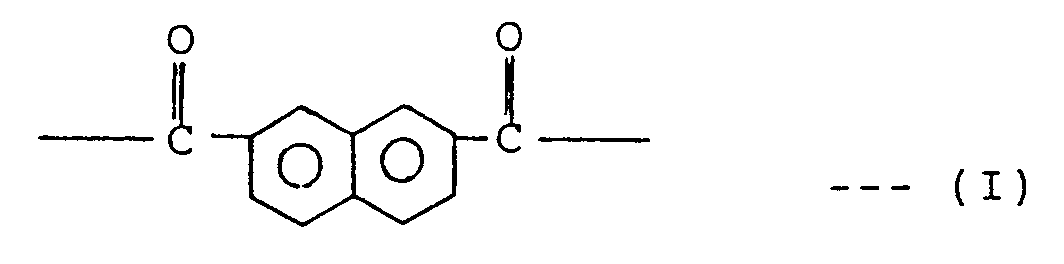
and a diamine recurring unit represented by the formula (II):
-NH-Ar₁-NH- (II)
wherein Ar₁ represents a phenylene group, a naphthylene group or a group represented by the formula (III):

wherein Y₁ represents a lower alkylidene group selected from methylene, ethylene or isopropylidene group, an oxygen atom, a sulfur atom, a carbonyl group, or a sulfonyl group and m is 0 or 1.
and a diamine recurring unit represented by the formula (II):
-NH-Ar₁-NH- (II)
wherein Ar₁ represents a phenylene group, a naphthylene group or a group represented by the formula (III):
wherein Y₁ represents a lower alkylidene group selected from methylene, ethylene or isopropylidene group, an oxygen atom, a sulfur atom, a carbonyl group, or a sulfonyl group and m is 0 or 1.
2. An aromatic polyamide according to claim 1, wherein Ar₁ in the formula (II) is a group
represented by the formula (III) and Y₁ is a methylene group, an oxygen atom, a carbonyl
group, or a sulfonyl group.
3. A process for producing the aromatic polyamide of claim 1 which comprises reacting
(a) a naphthalene-2,7-dicarboxylic acid or a dihalide thereof with (b) an aromatic
diamine represented by the formula: H₂N-Ar₁-NH₂ wherein Ar₁ represents a phenylene
group, a naphthylene group or a group represented by the formula (III):

4. An aromatic copolyamide which comprises 10-90 mol% of recurring unit represented by
the formula (IV):

and 90-10 mol% of recurring unit represented by the formula (V):
⁅NH-Ar₂-NHCO-Ar₃-CO⁆ (V)
wherein Ar₁ and Ar₂ each represents a phenylene group, a naphthylene group or a group represented by the formula (III):
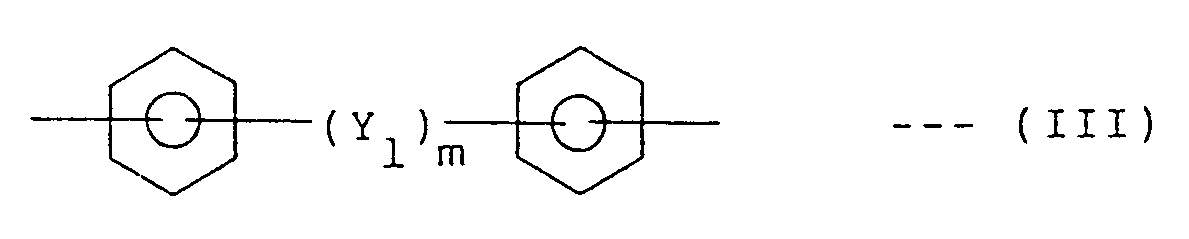
and Ar₁ and Ar₂ may be identical or different and Ar₃ represents a phenylene group, a naphthylene group or a group represented by the formula (VI):

in which both the bonding chains extend in coaxial direction or in parallel direction to axis, Y₁ and Y₂ each represents a lower alkylidene group selected from methylene, ethylene or isopropylidene group, an oxygen atom, a sulfur atom, a carbonyl group, or a sulfonyl group and m and n each represents 0 or 1.
and 90-10 mol% of recurring unit represented by the formula (V):
⁅NH-Ar₂-NHCO-Ar₃-CO⁆ (V)
wherein Ar₁ and Ar₂ each represents a phenylene group, a naphthylene group or a group represented by the formula (III):
and Ar₁ and Ar₂ may be identical or different and Ar₃ represents a phenylene group, a naphthylene group or a group represented by the formula (VI):
in which both the bonding chains extend in coaxial direction or in parallel direction to axis, Y₁ and Y₂ each represents a lower alkylidene group selected from methylene, ethylene or isopropylidene group, an oxygen atom, a sulfur atom, a carbonyl group, or a sulfonyl group and m and n each represents 0 or 1.
5. An aromatic polyamide according to claim 4, wherein Ar₁ and Ar₂ are phenylene groups
and Ar₃ is 2,6-naphthylene group.
6. A process for producing the aromatic polyamide of a claim 4, which comprises reacting
totally 10 - 90 mol% of a diamine represented by H₂N-Ar₁-NH₂ and 2,7-naphthalenedicarboxylic
acid or a dihalide thereof with totally 90 - 10 mol% of a diamine represented by H₂N-Ar₂-NH₂
and an aromatic dicarboxylic acid or dihalide thereof represented by XOC-Ar₃-COX;
wherein Ar₁ and Ar₂ each represent a phenylene group, a naphthalene group or a group
represented by the formula (III):

and Ar₁ and Ar₂ may be identical or different and Ar₃ represents a phenylene group, a naphthalene or a group represented by the formula (VI):

in which both the bonding chains extend in coaxial directions or in parallel direction to axis, Y₁ and Y₂ each represents a lower alkylidene group, an oxygen atom, a sulfur atom, a carbonyl group, or a sulfonyl group, and m and n each represents 0 or 1, and X represents a halogen atom.
and Ar₁ and Ar₂ may be identical or different and Ar₃ represents a phenylene group, a naphthalene or a group represented by the formula (VI):
in which both the bonding chains extend in coaxial directions or in parallel direction to axis, Y₁ and Y₂ each represents a lower alkylidene group, an oxygen atom, a sulfur atom, a carbonyl group, or a sulfonyl group, and m and n each represents 0 or 1, and X represents a halogen atom.
1. Ein aromatisches Polyamid, welches eine durch die folgende Formel (I) wiedergegebene,
sich wiederholende Dicarbonsäureeinheit
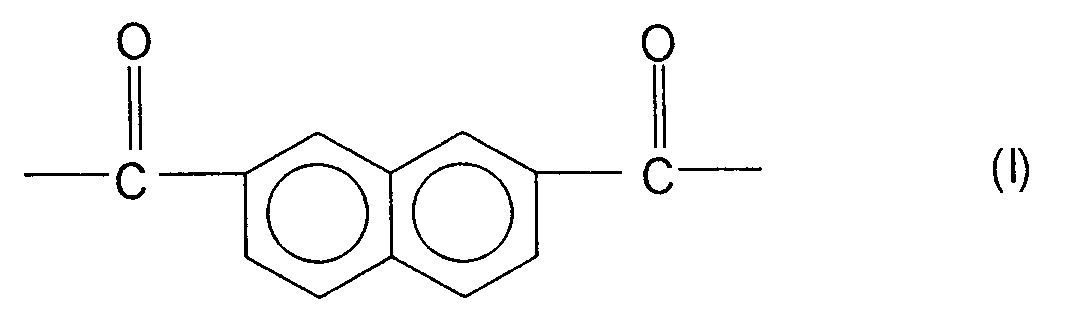
und eine Diamin-Wiederholungseinheit, die durch die folgende Formel (II) dargestellt wird umfasst:
-NH-Ar₁-NH- (II),
worin Ar₁ einer Phenylengruppe, einer Naphthylengruppe oder einer durch die folgende Formel (III) dargestellten Gruppe entspricht:
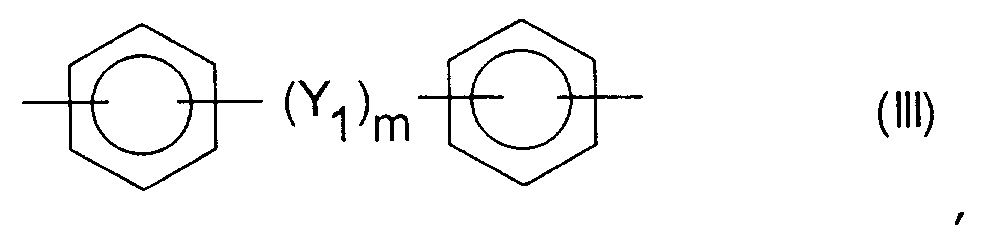
worin Y₁ eine niedrige Alkylidengruppe, die aus der Gruppe ausgewählt wird, welche die Methylen-, die Ethylen- oder die Isopropylidengruppe umfaßt, ein Sauerstoffatom, ein Schwefelatom, eine Carbonylgruppe oder eine Sulfonylgruppe darstellt und m gleich 0 oder 1 ist.
und eine Diamin-Wiederholungseinheit, die durch die folgende Formel (II) dargestellt wird umfasst:
-NH-Ar₁-NH- (II),
worin Ar₁ einer Phenylengruppe, einer Naphthylengruppe oder einer durch die folgende Formel (III) dargestellten Gruppe entspricht:
worin Y₁ eine niedrige Alkylidengruppe, die aus der Gruppe ausgewählt wird, welche die Methylen-, die Ethylen- oder die Isopropylidengruppe umfaßt, ein Sauerstoffatom, ein Schwefelatom, eine Carbonylgruppe oder eine Sulfonylgruppe darstellt und m gleich 0 oder 1 ist.
2. Ein aromatisches Polyamid gemäß Anspruch 1, worin Ar₁ in der Formel (II) eine durch
die Formel (III) wiedergegebene Gruppe darstellt und Y₁ eine Methylengruppe, ein Sauerstoffatom,
eine Carbonylgruppe oder eine Sulfonylgruppe darstellt.
3. Ein Verfahren zum Herstellen des aromatischen Polyamids nach Anspruch 1, welches die
Umsetzung von (a) einer Naphthalin-2,7-dicarbonsäure oder einem Dihalogenid davon
mit (b) einem durch die folgende Formel dargestellten, aromatischen Diamin einschließt:
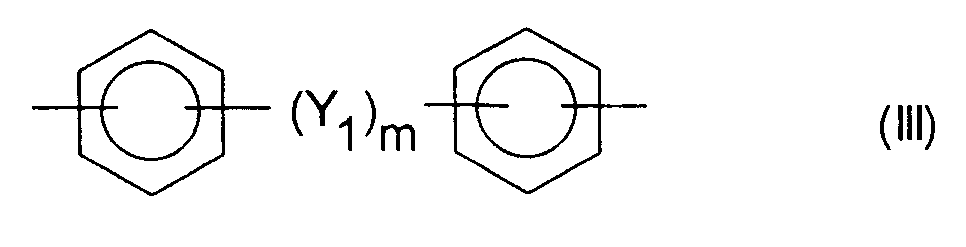
H₂N-Ar₁-NH₂, worin Ar₁ einer Phenylengruppe, einer Naphthylengruppe oder einer durch
die folgende Formel (III) dargestellten Gruppe entspricht:
4. Ein aromatisches Copolyamid, welches 10 bis 90 Mol-% an durch die folgende Formel
(IV) dargestellten, sich wiederholenden Einheiten

und 90 bis 10 Mol-% der sich wiederholenden Einheiten, dargestellt durch die folgende Formel (V), umfasst
-[-NH-Ar₂-NHCO-Ar₃-CO-]- (V)
worin Ar₁ und Ar₂ jeweils eine Phenylengruppe, eine Naphthylengruppe oder eine durch die folgende Formel (III) dargestellte Gruppe bedeuten:
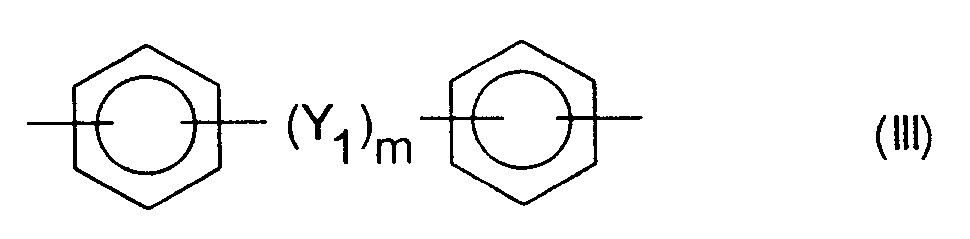
und wobei Ar₁ und Ar₂ identisch oder verschieden sein können und Ar₃ eine Phenylengruppe, eine Naphthylengruppe oder eine durch die folgende Formel (VI) wiedergegebene Gruppe darstellt:
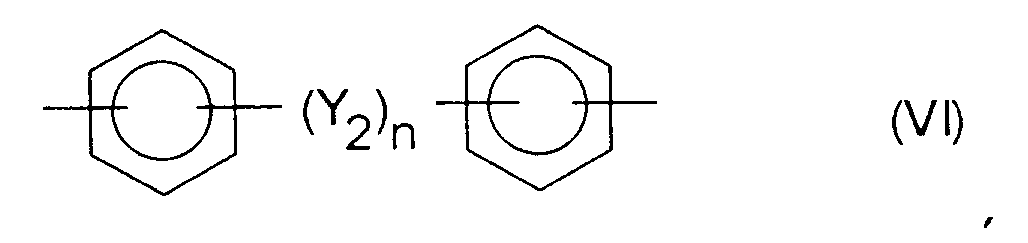
in welchen Gruppen sich die beiden Brücken bildenden Ketten in koaxialer Richtung oder in paralleler Richtung zur Achse erstrecken, worin Y₁ und Y₂ jeweils eine niedrige Alkylidengruppe, die aus der Gruppe ausgewählt wird, welche die Methylen-, die Ethylen- oder die Isopropylidengruppe umfaßt, ein Sauerstoffatom, ein Schwefelatom, eine Carbonylgruppe oder eine Sulfonylgruppe darstellen und m und n jeweils 0 oder 1 entsprechen.
und 90 bis 10 Mol-% der sich wiederholenden Einheiten, dargestellt durch die folgende Formel (V), umfasst
-[-NH-Ar₂-NHCO-Ar₃-CO-]- (V)
worin Ar₁ und Ar₂ jeweils eine Phenylengruppe, eine Naphthylengruppe oder eine durch die folgende Formel (III) dargestellte Gruppe bedeuten:
und wobei Ar₁ und Ar₂ identisch oder verschieden sein können und Ar₃ eine Phenylengruppe, eine Naphthylengruppe oder eine durch die folgende Formel (VI) wiedergegebene Gruppe darstellt:
in welchen Gruppen sich die beiden Brücken bildenden Ketten in koaxialer Richtung oder in paralleler Richtung zur Achse erstrecken, worin Y₁ und Y₂ jeweils eine niedrige Alkylidengruppe, die aus der Gruppe ausgewählt wird, welche die Methylen-, die Ethylen- oder die Isopropylidengruppe umfaßt, ein Sauerstoffatom, ein Schwefelatom, eine Carbonylgruppe oder eine Sulfonylgruppe darstellen und m und n jeweils 0 oder 1 entsprechen.
5. Ein aromatisches Polyamid gemäß Anspruch 4, worin Ar₁ und Ar₂ Phenylengruppen darstellen
und Ar₃ einer 2,6-Naphthylengruppe entspricht.
6. Ein Verfahren zum Herstellen des aromatischen Polyamids nach Anspruch 4, welches die
Umsetzung von 10 bis 90 Mol-% eines durch die allgemeine Formel H₂N-Ar₁-NH₂ dargestellten
Diamins und 2,7-Naphthalindicarbonsäure oder eines Dihalogenids davon mit insgesamt
90 bis 10 Mol-% eines durch die allgemeine Formel H₂N-Ar₂-NH₂ dargestellten Diamins
und einer aromatischen Dicarbonsäure, dargestellt durch die allgemeine Formel XOC-Ar₃-COX,
oder eines Dihalogenids davon einschließt; worin Ar₁ und Ar₂ jeweils eine Phenylengruppe,
eine Naphthylengruppe oder eine durch die folgende Formel (III) dargestellte Gruppe
bedeuten:
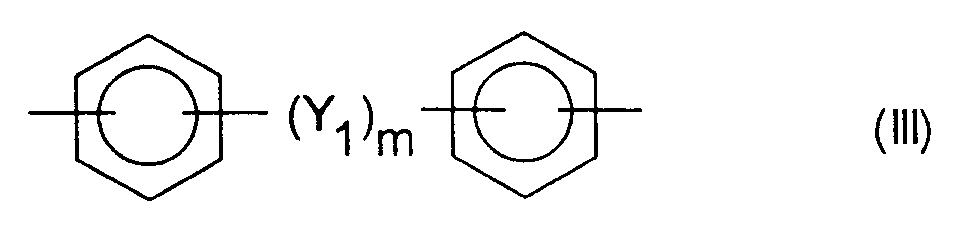
und wobei Ar₁ und Ar₂ identisch oder verschieden sein können und Ar₃ eine Phenylengruppe, eine Naphthylengruppe oder eine durch die folgende Formel (VI) wiedergegebene Gruppe darstellt:
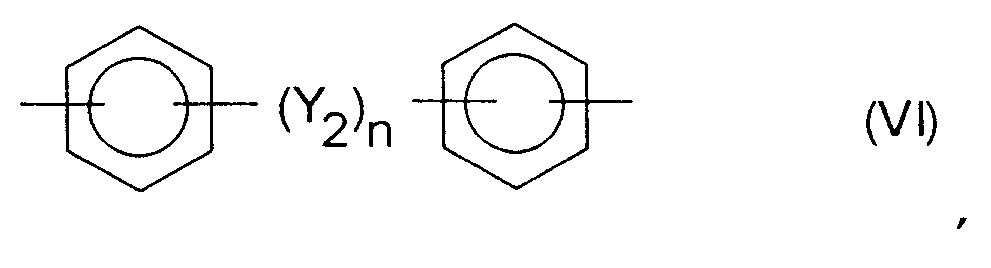
in welchen Gruppen sich die beiden Brücken bildenden Ketten in koaxialer Richtung oder in paralleler Richtung zur Achse erstrecken, worin Y₁ und Y₂ jeweils eine niedrige Alkylidengruppe, ein Sauerstoffatom, ein Schwefelatom, eine Carbonylgruppe oder eine Sulfonylgruppe darstellen, m und n jeweils 0 oder 1 entsprechen und X ein Halogenatom darstellt.
und wobei Ar₁ und Ar₂ identisch oder verschieden sein können und Ar₃ eine Phenylengruppe, eine Naphthylengruppe oder eine durch die folgende Formel (VI) wiedergegebene Gruppe darstellt:
in welchen Gruppen sich die beiden Brücken bildenden Ketten in koaxialer Richtung oder in paralleler Richtung zur Achse erstrecken, worin Y₁ und Y₂ jeweils eine niedrige Alkylidengruppe, ein Sauerstoffatom, ein Schwefelatom, eine Carbonylgruppe oder eine Sulfonylgruppe darstellen, m und n jeweils 0 oder 1 entsprechen und X ein Halogenatom darstellt.
1. Polyamide aromatique qui comprend un motif répétitif d'acide dicarboxylique représenté
par la formule (I) :
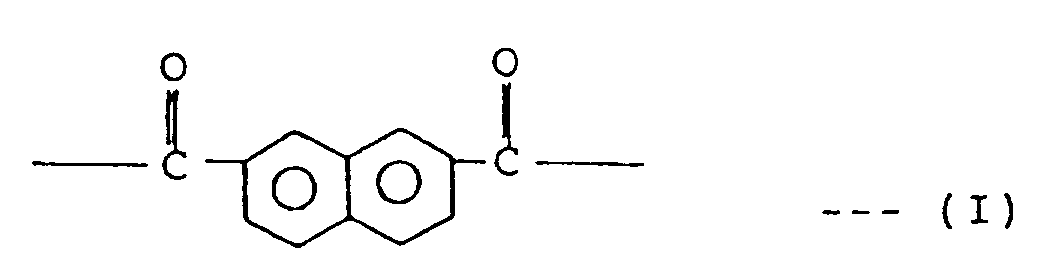
et un motif répétitif de diamine représenté par la formule (II) :
-NH-Ar1-NH- (II)
dans laquelle Ar₁ représente un groupe phénylène, un groupe naphthylène ou un groupe représenté par la formule (III) :
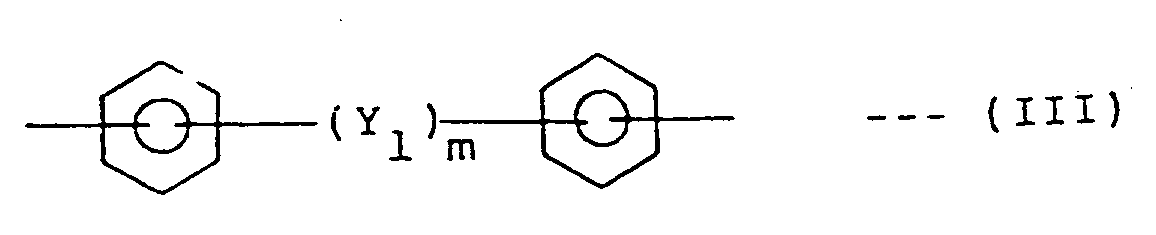
Y₁ représentant un groupe alcoylidène inférieur choisi par les groupes méthylène, éthylène ou isopropylidène, un atome d'oxygène, un atome de souffre, un groupe carbonyle ou un groupe sulfonyle et m est 0 ou 1.
et un motif répétitif de diamine représenté par la formule (II) :
-NH-Ar1-NH- (II)
dans laquelle Ar₁ représente un groupe phénylène, un groupe naphthylène ou un groupe représenté par la formule (III) :
Y₁ représentant un groupe alcoylidène inférieur choisi par les groupes méthylène, éthylène ou isopropylidène, un atome d'oxygène, un atome de souffre, un groupe carbonyle ou un groupe sulfonyle et m est 0 ou 1.
2. Polyamide aromatique suivant la revendication 1, dans lequel Ar₁ à la formule (II)
est un groupereprésenté par la formule (III) et Y₁ est un groupe méthylène, un atome
d'oxygène, un groupe carbonyle ou un groupe sulfonyle.
3. Procédé de préparation du polyamide aromatique de la revendication 1 qui consiste
à mettre à réagir (a) un acide naphtalène-2,7-dicarboxylique ou l'un de ses dihalogénures
sur (b) une diamine aromatique représentée par la formule : H₂N-Ar₁-NH₂ dans laquelle
Ar₁ représente un groupe phénylène, un groupe naphthylène ou un groupe représenté
par la formule (III) :

4. Copolyamide aromatique qui comprend de 10 à 90% en moles de motif répétitif représenté
par la formule (IV) :
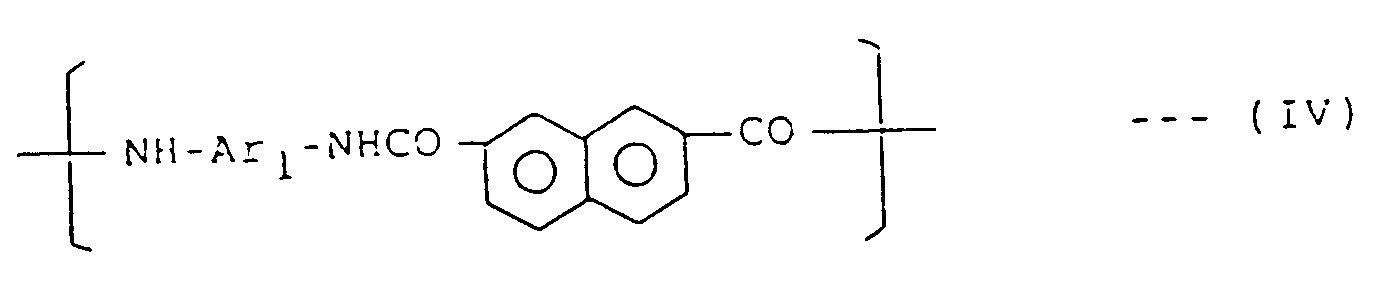
et 90 à 10% en moles de motif répétitif représenté par formule (V) :

dans lesquelles Ar₁ et Ar₂ représentent chacun un groupe phénylène, un groupe naphthylène ou un groupe représenté par la formule (III) :

et Ar₁ et Ar₂ qui peuvent être identiques ou différents et Ar₃ représente un groupe phénylène, un groupe naphthylène ou un groupe représenté par la formule (VI) :

dans laquelle les deux chaînes de liaison s'étendent en direction coaxiale ou en direction parallèle à l'axe, Y₁ et Y₂ représentent chacun un groupe alcoylidène inférieur choisi parmi les groupes méthylène, éthylène ou isopropylidène, un atome d'oxygène, un atome de souffre, un groupe carbonyle ou un groupe sulfonyle et m et n représentent chacun 0 ou 1.
et 90 à 10% en moles de motif répétitif représenté par formule (V) :
dans lesquelles Ar₁ et Ar₂ représentent chacun un groupe phénylène, un groupe naphthylène ou un groupe représenté par la formule (III) :
et Ar₁ et Ar₂ qui peuvent être identiques ou différents et Ar₃ représente un groupe phénylène, un groupe naphthylène ou un groupe représenté par la formule (VI) :
dans laquelle les deux chaînes de liaison s'étendent en direction coaxiale ou en direction parallèle à l'axe, Y₁ et Y₂ représentent chacun un groupe alcoylidène inférieur choisi parmi les groupes méthylène, éthylène ou isopropylidène, un atome d'oxygène, un atome de souffre, un groupe carbonyle ou un groupe sulfonyle et m et n représentent chacun 0 ou 1.
5. Polyamide aromatique suivant la revendication 4 dans lequel Ar₁ et Ar₂ sont des groupes
phénylène, et Ar₃ est un groupe 2,6-naphthylène.
6. Procédé de préparation du polyamide aromatique de la revendication 4, qui consiste
à mettre à réagir en tout 10 à 90 en mole % d'une diamine représentée par H₂N-Ar₁-NH₂
et de l'acide 2,7-naphtalène dicarboxylique ou l'un de ses dihalogénures sur en tout
90 à 10% en mole d'une diamine représentée par H₂H-Ar₂-NH₂ et un acide dicarboxylique
aromatique ou l'un de ses dihalogénures représenté par XOC-Ar₃-COX ; Ar₁ et Ar₂ représentant
chacun un groupe phénylène, un groupe naphtalène ou un groupe représenté par la formule
(III) :

et Ar₁ et Ar₂ qui peuvent être identiques ou différents et Ar₃ représente un groupe phénylène, un groupe naphtalène ou un groupe représenté par la formule (VI) :

dans laquelle les deux chaînes de liaison s'étendent en direction coaxiale ou en direction parallèle à l'axe, Y₁ et Y₂ représentent chacun un groupe alcoylidène inférieur choisi parmi les groupes méthylène, éthylène ou isopropylidène, un atome d'oxygène, un atome de souffre, un groupe carbonyle ou un groupe sulfonyle et m et n représentent chacun 0 ou 1, et X représente un atome d'halogène.
et Ar₁ et Ar₂ qui peuvent être identiques ou différents et Ar₃ représente un groupe phénylène, un groupe naphtalène ou un groupe représenté par la formule (VI) :
dans laquelle les deux chaînes de liaison s'étendent en direction coaxiale ou en direction parallèle à l'axe, Y₁ et Y₂ représentent chacun un groupe alcoylidène inférieur choisi parmi les groupes méthylène, éthylène ou isopropylidène, un atome d'oxygène, un atome de souffre, un groupe carbonyle ou un groupe sulfonyle et m et n représentent chacun 0 ou 1, et X représente un atome d'halogène.