|
(11) | EP 0 461 403 A1 |

| (12) | EUROPEAN PATENT APPLICATION |
|
|
|
|
|||||||||||||||||||||||||||
| (54) | Process for the preparation of dialkyl pyridine-2,3-dicarboxylate and derivatives thereof from dialkyl dichlorosucciante |
| (57) There is provided a process for the preparation of substituted and unsubstituted-2,3-pyridinedicarboxylate
compounds by reacting a dialkyl dichlorosuccinate with a dehydrohalogenating agent,
an ammonia source and an appropriately substituted α,β-unsaturated aldehyde or ketone. |
[0001] It is an object of this invention to provide an efficient and effective method for the preparation of substituted and unsubstituted-2,3-pyridinedicarboxylates utilizing dialkyl dichlorosuccinate, a dehydrohalogenating agent, an ammonia source and an appropriately substituted-α,β-unsaturated aldehyde or ketone.
[0002] The invention herein described relates to a novel method for the preparation of substituted and unsubstituted 2,3-pyridinedicarboxylates of formula I
wherein R is C₁-C₆ alkyl; X and Z are independently hydrogen, halogen, c₁-c₄ alkyl, C₁-C₄ alkoxy or C₂-C₅ alkenyl and Y is hydrogen, halogen, c₁-C₆ alkyl optionally substituted with one to three halogens, hydroxy groups, c₁-c₄ alkoxy groups or c₁-C₄ alkylthio groups, C₁-C₄ alkoxycarbonyl, aminocarbonyl, phenyl, substituted phenyl, phenoxy, substituted phenoxy, phenylthio or substituted phenylthio. Compounds of formula I are useful as intermediates in the preparation of herbicidal 2-(2-imidazolin-2-yl)nicotinates. Among the methods of preparation of said herbicidal nicotinates is that described in U.S. Patent 4,758,667 and illustrated below.
wherein R₁ is hydrogen or C₁-C₄ alkyl; R₂ is hydrogen, halogen, C₁-C₄ alkyl, C₃-C₆ cycloalkyl or R₁ and R₂ may be taken together to form a C₃-C₆ cycloalkyl optionally substituted with methyl and X, Y and Z are as described for formula I.
[0003] It has now been found that pyridine-2,3-dicarboxylates of formula I can be efficiently and effectively prepared from dialkyl dichlorosuccinates of formula II by reacting said succinate with at least one molar equivalent of a dehydrohalogenating agent such as ammonium acetate or trialkylamine in the presence of a solvent such as a lower alkylalcohol to form an intermediate, reacting said intermediate with a source of ammonia, optionally at elevated temperatures to form a second intermediate and reacting said second intermediate with at least one molar equivalent of an α,β-unsaturated aldehyde or ketone of formula III wherein X, Y and Z are as described above for formula I in the presence of an acid such as formic acid or acetic acid or the like. The process is shown below.
[0004]
Dehydrohalogenating agents suitable for use in the process of the invention are those which may also serve as an ammonia source such as ammonium acetate, ammonium carbonates, ammonium carbamates, ammonium sulfamates and the like. Also suitable are reagents such as trialkylamines, pyridines, picolines, quaternary amine salts such as tetraalkylammonium halides and the like. Of course, in addition to the above-mentioned ammonia sources, ammonia itself may be employed in the process of the invention.
[0005] In one embodiment of the invention the solvent utilized may be a polar solvent such as an alcohol, a nitrile such as acetonitrile, a carboxylic acid amide such as N,N-dimethylformamide, N-methylpyrrolidone, a sulfoxide such as dimethylsulfoxide, a sulfone and the like.
[0006] Among the α,β-unsaturated aldehydes or ketones of formula III which can be used in the process of the invention are acrolein, methacrolein, ethacrolein, crotonaldehyde, methyl vinyl ketone, α-n-butylacrolein, 4-methyl-2-hexanal, α-methoxymethacrolein, α-chloromethacrolein, α-trifluoromethacrolein, cinnamaldehyde, α-ethoxyacrolein, methyl α-formylacrylate, α-(2-cyanoethyl)acrolein and the like.
[0007] In a further embodiment of the invention, the reaction mixture comprising the above-formed second intermediate and the α,β-unsaturated aldehyde or ketone of formula III may be treated with a dehydrogenation catalyst such as that which is conventional in the art including metals or compounds of platinum, palladium, ruthenium, iridium, nickel, iron, copper, antimony, cobalt, rhodium and the like. The dehydrogenation catalyst is commonly used in the form of the dehydrogenation metal or compound thereof deposited on a suitable support such as alumina, carbon, clay, zeolite, chromia, zirconia and the like.
[0008] Utilizing the process of the invention, pyridine-2,3-dicarboxylates containing substituents in the 4,5 and 6 positions may be conveniently prepared by admixing a formula II dialkyl dichlorosuccinate with at least one molar equivalent of a dehydrohalogenating agent in a suitable solvent, optionally filtering off insolubles, treating the filtrate or unfiltered reaction mixture with anhydrous ammonia, optionally heating said reaction mixture until the formation of the enamine intermediate is complete, optionally filtering off insolubles, adding to the filtrate or to the unfiltered reaction mixture an acid such as a mineral acid, sulfuric acid, phosphoric acid, an organic acid such as formic acid, acetic acid or propionic acid and the like, and treating with at least one molar equivalent of an α,β-unsaturated aldehyde or ketone of formula III optionally adding a dehydrogenation catalyst, optionally heating the resulting reaction mixture until the formation of the formula I pyridinedicarboxylate is complete.
[0009] After completion of the reaction, the desired pyridine-2,3-dicarboxylate can be isolated and purified using conventional methods such as extraction, distillation, recrystallization, chromatography and the like.
[0010] The rate of formation of the enamine second intermediate and the formula I product is temperature dependent, thus, reaction time can be effectively reduced by heating the reaction mixtures at temperatures of about 45oC or greater.
[0011] In order to facilitate a further understanding of the invention, the following examples are presented primarily for the purpose of illustrating certain more specific details thereof and the invention is not to be deemed limited thereby. The terms ¹HNMR and IR designate proton nuclear magnetic resonance and infrared, respectively. Unless otherwise noted, all parts are parts by weight.
EXAMPLE 1
Preparation of diethyl 5-ethyl-2,3-pyridinedicarboxylate from diethyl dichlorosuccinate using ammonium acetate
[0012] A stirred mixture of diethyl dichlorosuccinate (12.2 g, 0.05 mole) and ammonium acetate (15.4 g, 0.20 mole) in absolute ethanol is heated at 60oC for 6 hours, cooled to 20oC, treated with excess anhydrous ammonia (5.0 g, 0.29 mole), heated at 60oC for 4 1/2 hours, partially distilled to remove excess ammonia, cooled to 30oC and filtered. The filter cake is washed with ethanol and the filtrates are combined and concentrated in vacuo. The thus-concentrated reaction solution is treated with acetic acid, treated dropwise with an ethanolic solution of 2-ethacrolein at 70oC over a 1 1/2 hour period, continued heating at 70oC for 4 hours (until reaction is complete by gas chromatographic analysis) and concentrated in vacuo to give a crude oil residue. The oil residue is distilled to afford the title product as a tan oil, bp 151-152oC at 2mm Hg.
EXAMPLE 2
Preparation of diethyl 5-ethyl-2,3-pyridinedicarboxylate from diethyl dichlorosuccinate using triethylamine
[0013] A solution of diethyl dichlorosuccinate (24.6 g, 0.10 mole) in ethanol is treated with triethylamine (12.2 g, 0.12 mole) over a 5 minute period, allowed to stir at ambient temperatures for 12 hours, treated with anhydrous ammonia (7.3 g, 0.43 mol) at 20oC, heated at 45-50oC for 3 hours and filtered. The filter cake is washed with ethanol and the filtrates are combined and concentrated in vacuo to remove the solvent and excess ammonia. The resultant viscous oil is diluted with ethanol and acetic acid, treated with 2-ethacrolein (19.5 g, 0.232 mol), heated at 70oC for 6 hours and vacuum distilled at 60oC to remove solvent. The resultant pot liquor is taken up in toluene, washed with water and concentrated in vacuo to afford a crude oil residue. Vacuum distillation of the oil residue affords the title product as a tan oil, bp 151-152oC at 2mm Hg.
EXAMPLE 3
Preparation of dialkyl substituted-2,3-pyridinedicarboxylate from dialkyl dichlorosuccinate
1. A process for the preparation of a compound characterized by formula I
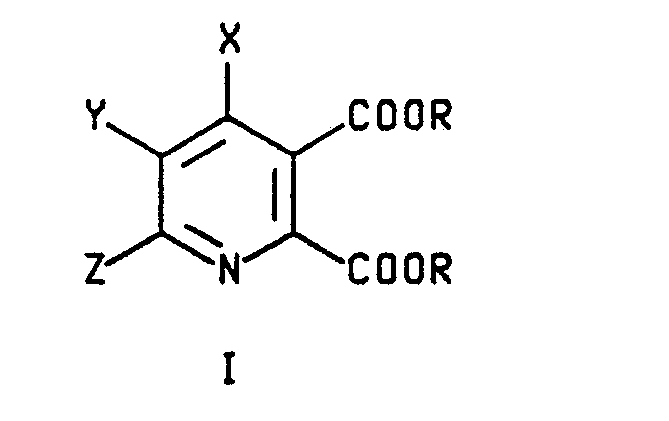
wherein R is C₁-C₆ alkyl; X and Z are independently hydrogen, halogen, C₁-C₄ alkyl, C₁-C₄ alkoxy or C₂-C₅ alkenyl and Y is hydrogen, halogen, C₁-C₆ alkyl optionally substituted with one to three halogens, hydroxy groups, C₁-C₄ alkoxy groups or C₁-C₄ alkylthio groups, C₁-C₄ alkoxycarbonyl, aminocarbonyl, phenylthio, substituted phenylthio, phenoxy, substituted phenoxy, phenyl or substituted phenyl which comprises reacting a dialkyl dichlorosuccinate of formula II
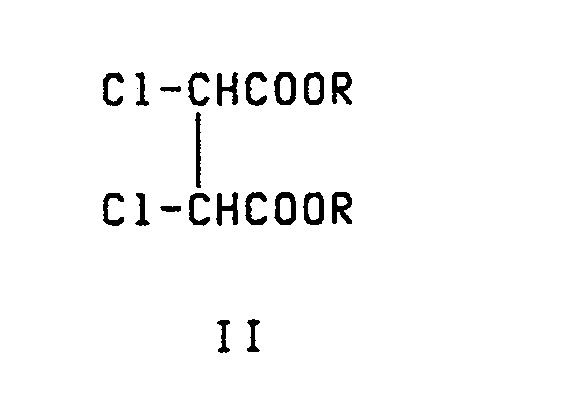
wherein R is C₁-C₆ alkyl with a dehydrohalogenating agent in the presence of a solvent to form a first intermediate, reacting said first intermediate with an ammonia source to form a second intermediate, reacting said second intermediate with an α,β-unsaturated aldehyde or ketone of formula III
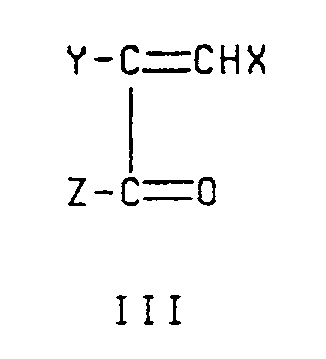
wherein X, Y and Z are as described above and an acid in the presence of the solvent, to form the formula I pyridinedicarboxylate compound.
wherein R is C₁-C₆ alkyl; X and Z are independently hydrogen, halogen, C₁-C₄ alkyl, C₁-C₄ alkoxy or C₂-C₅ alkenyl and Y is hydrogen, halogen, C₁-C₆ alkyl optionally substituted with one to three halogens, hydroxy groups, C₁-C₄ alkoxy groups or C₁-C₄ alkylthio groups, C₁-C₄ alkoxycarbonyl, aminocarbonyl, phenylthio, substituted phenylthio, phenoxy, substituted phenoxy, phenyl or substituted phenyl which comprises reacting a dialkyl dichlorosuccinate of formula II
wherein R is C₁-C₆ alkyl with a dehydrohalogenating agent in the presence of a solvent to form a first intermediate, reacting said first intermediate with an ammonia source to form a second intermediate, reacting said second intermediate with an α,β-unsaturated aldehyde or ketone of formula III
wherein X, Y and Z are as described above and an acid in the presence of the solvent, to form the formula I pyridinedicarboxylate compound.
2. The process according to claim 1 for the preparation of a pyridinedicarboxylate compound
characterized by formula I wherein X and Z are hydrogen and Y is hydrogen, halogen
or C₁-C₄ alkyl optionally substituted with one to three halogens, C₁-C₄ alkoxy groups
or C₁-C₄ alkylthio groups.
3. The process according to claim 1 wherein the dehydrohalogenating agent is an ammonium
salt, the solvent is a polar solvent, the acid is acetic acid and the second intermediate
is formed at a temperature of 45oC or greater.
4. The process according to claim 1 wherein the formula I pyridinedicarboxylate compound
is formed at a temperature of 45oC or greater.
5. The process according to claim 1 wherein the α,β-unsaturated aldehyde or ketone of
formula III is present in the amount of at least one molar equivalent.
6. The process according to claim 2 wherein the formula I compound prepared is selected
from the group consisting of dialkyl pyridine-2,3-dicarboxylate, dialkyl 5-methyl-2,3-pyridinedicarboxylate,
dialkyl 5-ethyl-2,3-pyridinedicarboxylate, dialkyl 5-(methoxymethyl)-2,3-pyridinedicarboxylate,
and dialkyl 5-(chloromethyl)-2,3-pyridinedicarboxylate.
7. The process according to claim 6 wherein the formula I compound prepared is selected
from the group consisting of diethyl pyridine-2,3-dicarboxylate, diethyl 5-methyl-2,3-pyridinedicarboxylate,
diethyl 5-ethyl-2,3-pyridinedicarboxylate, diethyl 5-(methoxymethyl)-2,3-pyridinedicarboxylate,
and diethyl 5-(chloromethyl)-2,3-pyridinedicarboxylate.
8. A pyridinedicarboxylate compound characterized by formula I prepared by the process
according to claim 1.
9. A pyridinedicarboxylate compound characterized by formula I, diethyl 5-ethyl-2,3-pyridinedicarboxylate
prepared by the process according to claim 1.
10. A pyridinedicarboxylate compound characterized by formula I, diethyl 5-(methoxymethyl)-2,3-pyridinedicarboxylate
prepared by the process according to claim 1.