|
(11) | EP 0 464 178 B1 |

| (12) | EUROPEAN PATENT SPECIFICATION |
|
|
| (54) |
PROCESS FOR PREPARING ERGOLINE DERIVATIVES VERFAHREN ZUR HERSTELLUNG VON ERGOLINDERIVATEN PROCEDE POUR LA PREPARATION DE DERIVES DE L'ERGOLINE |
|
|
|||||||||||||||||||||||||||||||
| Note: Within nine months from the publication of the mention of the grant of the European patent, any person may give notice to the European Patent Office of opposition to the European patent granted. Notice of opposition shall be filed in a written reasoned statement. It shall not be deemed to have been filed until the opposition fee has been paid. (Art. 99(1) European Patent Convention). |
[0001] The present invention provides a process for the preparation of known ergoline derivatives having the formula I:
wherein R represents a hydrogen atom or a C₁-C₃ alkyl group; R₁ represents a hydrogen, chlorine or bromine atom or a methyl group; either R₂ and R₃ represent hydrogen atoms or R₂ and R₃ together represent a chemical bond; R₄ represents a hydrocarbon group having from 1 to 4 carbon atoms selected from alkyl, cycloalkyl ethylenically unsaturated and acetylenically unsaturated groups; each of R₅, R₆, R₈ and R₉ independently represents a hydrogen atom or an alkyl group having from 1 to 4 carbon atoms; R₇ represents a hydrogen atom, an alkyl group having from 1 to 4 carbon atoms, a phenyl group or a cycloalkyl group having from 3 to 7 carbon atoms and n is 0, 1 or 2.
[0002] Representative moieties for R₄ include methyl, ethyl, n-propyl, isopropyl, butyl, t-butyl, isobutyl, methylcyclopropyl, allyl and propargyl.
[0003] The invention provides a process comprising (i) reacting, in an organic solvent in the presence of an acid scavenger, an ergoline of the formula II with an α-halogen derivative of formula III to afford an ergoline derivative of formula IV
wherein n, R, R₁, R₂, R₃, R₅, R₆, R₈ and R₉ have the above given meanings, R₁₀ and R₁₁ are independently C₁-C₄ alkoxy group or an amino group NH-R₇ wherein R₇ is as above defined, X is a halogen atom; and R'₄ represents a said hydrocarbon group having from 1 to 4 carbon atoms or an N-protecting group;
(ii) if R'₄ is an N-protecting group in the resultant compound of the formula IV, converting the said compound by deprotection using a base, formic acid or Zn/dust and alkylation with a halide derivative R₄-Hal in the presence of an acid scavenger into a corresponding compound of the formula IV in which R'₄ is a said C₁-C₄ hydrocarbon group;
(iii) if R₁₀ and R₁₁ both represent alkoxy groups in the resultant compound of formula IV, converting the said compound by ammonolysis into a corresponding compound of formula IV in which R₁₀ and R₁₁ are both amino groups; and
(iv) cyclising a said compound of formula IV, either (a) in which R₁₀ and R₁₁ both represent amino groups NHR₇, wherein R₇ is as defined above, by heating in a solvent at a temperature of 100°C to 200°C, or (b) in which R₁₀ is an alkoxy group and R¹¹ represents an amino group NHR₇ wherein R₇ is as defined above, by heating in vacuo at the melting point of the compound of formula IV or by hydrolysis of the COR₁₀ carboxylate group and subsequent treatment with a condensing agent in a solvent at a temperature of from 50°C to 150°C.
[0004] A C₁-C₄ alkoxy group may be, for example, an ethoxy or methoxy group. A halogen may be chlorine or bromine. An N-protecting group may, for example, be an acetyl, tertbutoxycarbonyl or trichloroethyloxycarbonyl group.
[0005] The wavy line (
) in formulae I, II and IV indicates that the substituent in the 8-position may be in the α-configuration, i.e. below the plane of the ring, in the β-configuration, i.e. above the plane of the ring, or in both, i.e. a mixture of derivatives of formula I, II or IV is present with some having the substituent in the 8-position in the α-configuration and the rest having the substituent in the 8-position in the β-configuration (a diastereoisomeric mixture).
[0006] The condensation process (i) is carried out in an organic solvent such as toluene, acetonitrile, or dimethylformamide in presence of an acid scavenger such as an inorganic carbonate or triethylamine. When the reaction is complete the solvent is removed and the residue is purified by crystallization or chromatography according to well known techniques.
[0007] The compounds of formula IV in which R'₄ is a N-protecting group are preferred starting compounds when n is 1 and the substituent in the 8-position is in the α-configuration.
[0008] If necessary, a compound of formula IV in which R₁₀ and R₁₁ are both alkoxy groups may be converted into another compound of the formula IV in which R₁₀ and R₁₁ are both amino groups by ammonolysis in a suitable solvent such as methanol, ethanol or dimethylformamide.
[0009] According to the present invention, the intermediate derivatives of formula IV are then cyclized to give the derivatives of formula I. In particular, when R₁₀ and R₁₁ are both amino groups the cyclization may suitably be accomplished by heating in a solvent such as phenol, xylenol or cresol.
[0010] When R₁₀ is an alkyloxy group and R₁₁ is an amino group NH-R₇ the cyclization to give an ergoline derivative of the formula I is carried out by heating in vacuo at the melting point of the compound of formula IV or by the hydrolysis of the COR₁₀ group and subsequent treatment with a suitable condensing agent such as acetic anhydride, alkylchlorocarbonate or diimidazolcarbonyl in a solvent such as tetrahydrofuran, 1,4-dioxane or dimethylformamide within the range of temperature of from 50°-150°C.
[0011] The starting compounds of formulae II and III which are employed in the process according to the invention are known compounds or may be prepared by established procedures starting from known compounds. For example, the compounds of the formula II and their preparation are described in our EP-A-0126968.
[0012] The compounds of formula I and their pharmaceutically acceptable salts are useful anxiolytic, antipsychotic and anti Parkinson agents, as described in EP-A-197,241, US-A-4,847,253 and WO 90/04396. The ergoline derivatives of formula I prepared by the present process may therefore be formulated as a pharmaceutical composition. The composition also comprises a pharmaceutically acceptable carrier or diluent.
[0013] The preparation of compounds of general formula I is described in the above cited EP-A-0197,241. Although the process there described is capable of producing derivatives of the general formula I, the process here described is more versatile allowing the synthesis of a higher number of derivatives of general formula I especially when R₂ and R₃ together represent a chemical bond.
EXAMPLE 1
1-Phenyl-4-(6-methyl-9,10-ergolen-8β-yl)-methylpiperazin-2, 6-dione.
[0015] A solution of 5.08 g (0.015 m) of N-[(6-methyl-9,10-ergolen-8β-yl)methyl]-glycine ethyl ester and 1.03 g (0.0075 m) of potassium carbonate and 3.85 g (0.018 m) of N-phenylbromoacetamide in 200 ml of dimethylformamide was stirred at 50°C for 4 hours.
[0016] The resulting solution was poured into brine and the precipitate was extracted with ethyl acetate. Removal of the solvent and crystallization from ethanol afforded 6.5 g of N-phenylcarbamoylmethyl-N-[(6-methyl-9,10-ergolen-8β-yl)-methyl]-glycine ethyl ester m.p. 196°-197°C.
[0017] A solution of 6.5 g (0.013 m) of this ester in 50 ml of ethanol was tested with 17.9 ml of sodium hydroxide 1M and the resulting solution was heated at 80°C for 30 minutes. After acidification with 179 ml of hydrochloric acid 1M, the resulting solution was poured into ice water. The precipitate was filtered off and then washed with water, acetone and dried giving 5.1 g of N-phenylcarbamoylmethyl-N-[(6-methyl-9,10-ergolen-8β-yl)methyl]-glycine. m.p. 252°-255°C. To a suspension of 5 g (0.011 m) of N-phenylcarbamoylmethyl-N-[(6-methyl-9,10-ergolen-8β- yl)methyl]-glycine in 50 ml of anhydrous dioxane was added portionwise 1.96 g (0.121 m) of N,N'-diimidazole carbonyl. The resulting solution was refluxed for 3 hours. After removal of the solvent, the residue was poured into chloroform and extracted with a 10% ammonium hydroxide solution. The organic phase was washed with brine and after drying evaporated to dryness. After crystallization from acetone, 4.1 g of the title compounds were obtained m.p. 240°-245°C.
EXAMPLE 2
4-(6-Methyl-9,10-ergolen-8β-yl)methylpiperazin-2,6-dione
[0018] Operating as in Example 1, but employing bromoacetamide in place of N-phenylbromoacetamide, N-carbamoylmethyl-N-[(6-methyl-9,10-ergolen-8β-yl)methyl]-glycine ethyl ester was obtained m.p. 172°-174°C. From this N-carbamoylmethyl-N-[(6-methyl-9,10-ergolen-8β-yl)methyl]-glycine was obtained m.p. 242°-243°C. Finally the title compound was obtained in 75% yield m.p. 224°-225°C.
EXAMPLE 3
4-(1,6-Dimethyl-9,10-ergolen-8β-yl)methylpiperazin-2,6-dione
[0019] Operating as in Example 2, but employing N-[(1,6-dimethyl-9,10-ergolen-8β-yl)methyl]-glycine ethyl ester in the place of N-[(6-methyl-9,10-ergolen-8β-yl)methyl)-glycine ethyl ester, N-carbamoylmethyl-N-[(1,6-dimethyl-9,10-ergolen-8β-yl)methyl)-glycine ethyl ester was obtained m.p. 180°-183°C. From this N-carbamoylmethyl-N-[(1,6-dimethyl-9,10-ergolen-8β-yl)methyl]-glycine was obtained. m.p. and finally the title compound was obtained in 55% yield m.p. 216°-218°C.
EXAMPLE 4
4-(2-Bromo-6-methyl-9,10-ergolen-8β-yl)methylpiperazin-2,6-dione
[0021] Operating as in Example 1, but employing ethyl bromoacetate in place of N-phenylbromoacetamide, and N-[(2-bromo-6-methyl-9,10-ergolen-8β-yl)methyl]-glycine ethyl ester in place of N-[(6-methyl-9,10-ergolen-8β-yl)methyl]-glycine ethyl ester, N-ethoxycarbonylmethyl-N-[(2-bromo-6-methyl-9,10-ergolen-8β-yl)methyl]-glycine ethyl ester was obtained m.p. 93°-96°C.
[0022] A solution of 10 g of this ester in 100 ml of methanol saturated with gaseous ammonia was aged at room temperature for 24 hours. Concentration mixture afforded N-carbamoyl methyl-N-[(2-bromo-6-methyl-9,10-ergolen-8β-yl)methyl]-glycine amide in 85% yield m.p. 218°-221°C.
[0023] A mixture of 5 g of N-carbamoylmethyl-N-[(2-bromo-6-methyl-9,10-ergolen-8β-yl)methyl]glycinamide and 30 g of phenol was heated under nitrogen at 160°C for 30 minutes. After cooling, the reaction mixture was taken up in diethyl ether and the precipitate was crystallized twice from acetone affording 3.9 g of the title compound m.p. 242°-245°C.
1. A process for preparing an ergoline derivative of the formula I;
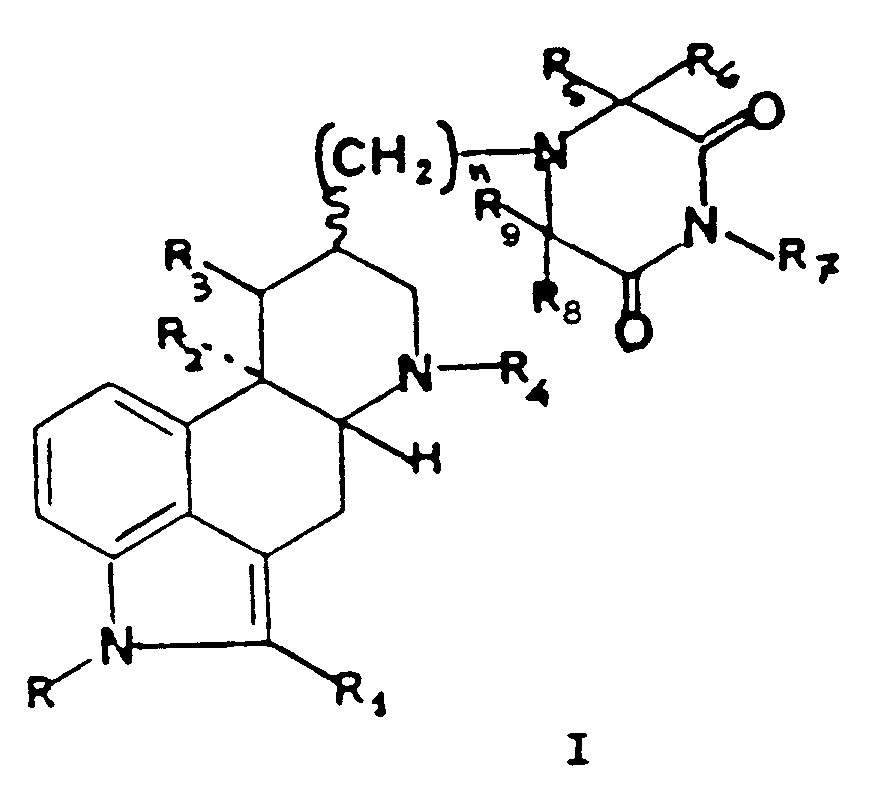
wherein R represents a hydrogen atom or a C₁-C₃ alkyl group; R₁ represents a hydrogen atom, chlorine, bromine atom or a methyl group; either R₂ and R₃ represent hydrogen atoms or R₂ and R₃ together represent a chemical bond; R₄ represents a hydrocarbon group having from 1 to 4 carbon atoms selected from alkyl, cycloalkyl, ethylenically unsaturated and acetylenically unsaturated groups; each of R₅, R₆, R₈ and R₉ independently represents a hydrogen atom or an alkyl group having from 1 to 4 carbon atoms; R₇ represents a hydrogen atom, an alkyl group having from 1 to 4 carbon atoms, a phenyl group or a cycloalkyl group having from 3 to 7 carbon atoms and n is 0, 1 or 2, which process comprising reacting, in an organic solvent in the presence of an acid scavenger, an ergoline of the formula II with an α-halogen derivative of formula III:
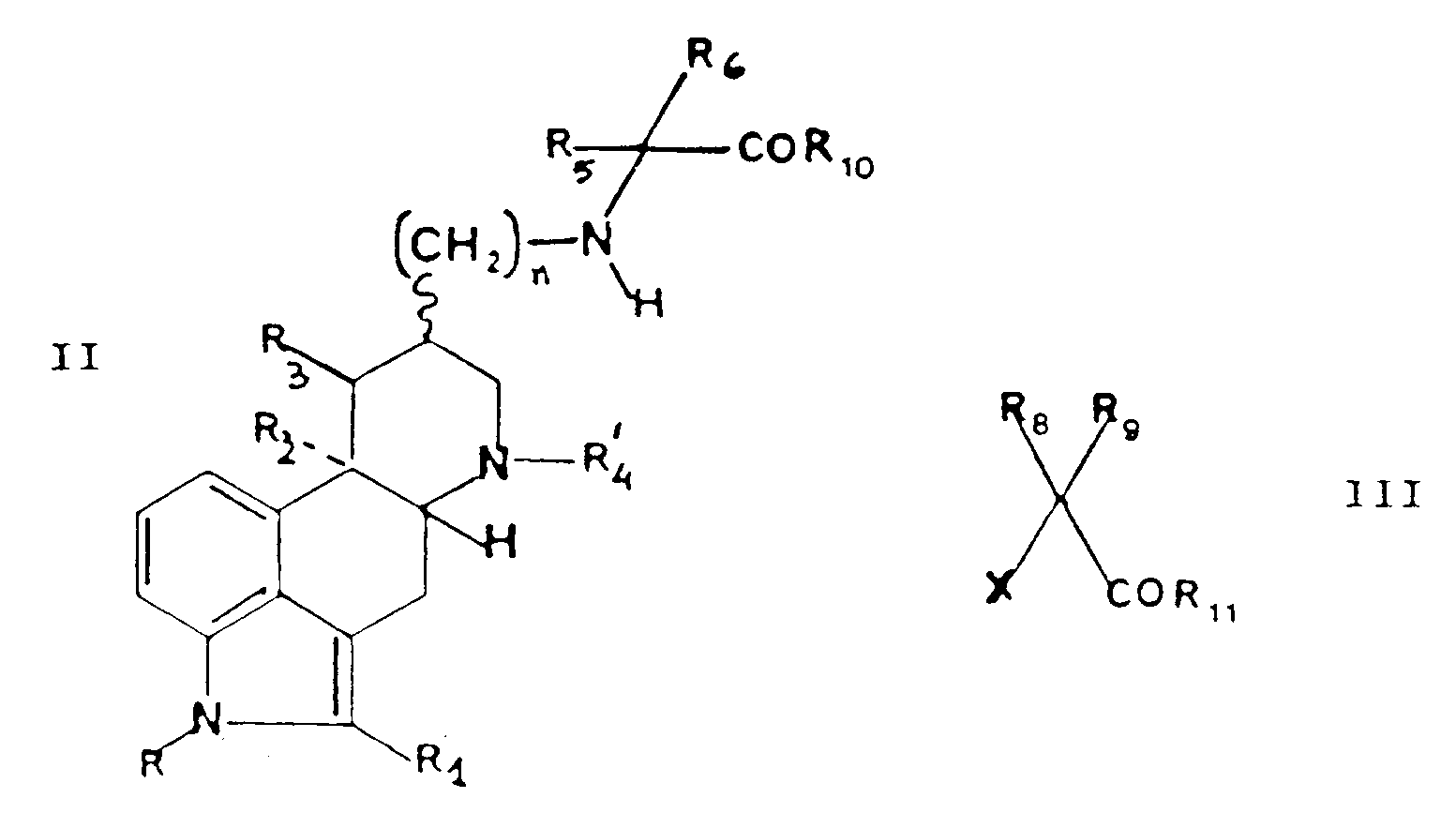
wherein n, R, R₁, R₂, R₃, R₅, R₆, R₈ and R₉ have the above given meanings, R₁₀ and R₁₁ independently represent a C₁-C₄ alkoxy group or an amino group NHR₇ wherein R₇ is as defined above, X represents a halogen atom, R'₄ represents a said hydrocarbon group having from 1 to 4 carbon atoms or a N-protecting group and, if necessary, converting the resultant compound of the formula IV:
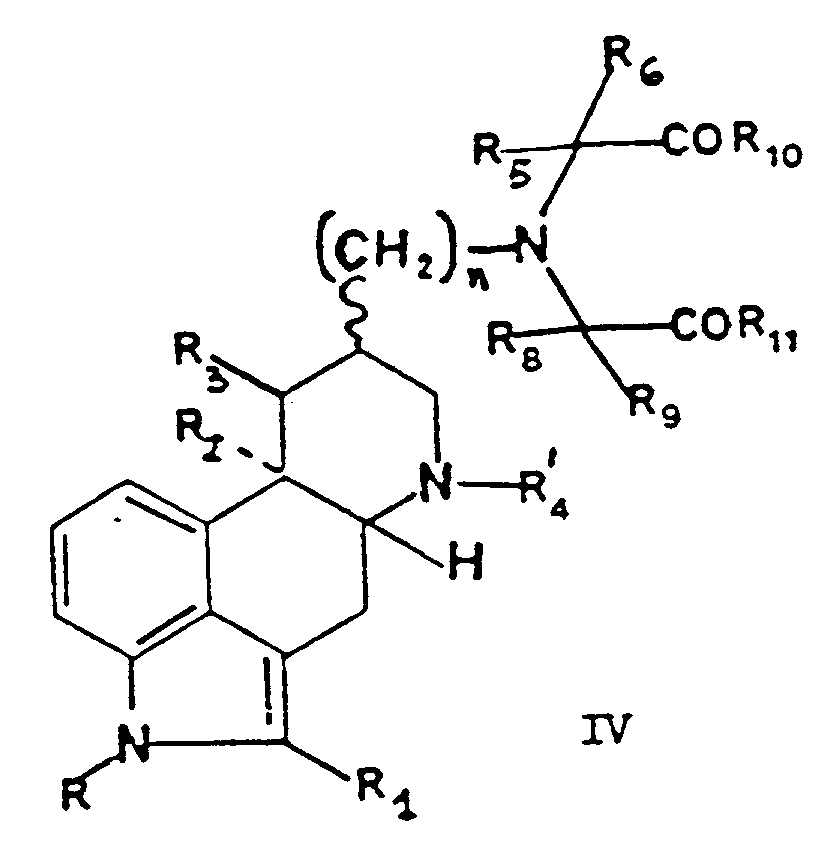
wherein R, R₁, R₂, R₃, R₅, R₆, R₈, R₉ and n are as defined above and R'₄ is a N-protecting group into a compound of the formula IV in which R'₄ is a said C₁-C₄ hydrocarbon group by deprotection using a base, formic acid or Zn/dust and alkylation with a halide derivative R₄-Hal in the presence of an acid scavenger, if necessary converting the compound of formula IV in which R₁₀ and R₁₁ both represent an alkoxy group into a compound of the formula IV in which R₁₀ and R₁₁ are both amino groups by ammonolysis; and cyclizing a said compound of the formula IV, either (a) in which R₁₀ and R₁₁ both represent amino groups NHR₇, wherein R₇ is as defined above, by heating in a solvent at a temperature of 100°C to 200°C, or (b) in which R₁₀ is an alkoxy group and R₁₁ represents an amino group NHR₇ wherein R₇ is as defined above, by heating in vacuo at the melting point of the compound of formula IV or by hydrolysis of the COR₁₀ carboxylate group and subsequent treatment with a condensing agent in a solvent at a temperature of from 50°C to 150°C.
wherein R represents a hydrogen atom or a C₁-C₃ alkyl group; R₁ represents a hydrogen atom, chlorine, bromine atom or a methyl group; either R₂ and R₃ represent hydrogen atoms or R₂ and R₃ together represent a chemical bond; R₄ represents a hydrocarbon group having from 1 to 4 carbon atoms selected from alkyl, cycloalkyl, ethylenically unsaturated and acetylenically unsaturated groups; each of R₅, R₆, R₈ and R₉ independently represents a hydrogen atom or an alkyl group having from 1 to 4 carbon atoms; R₇ represents a hydrogen atom, an alkyl group having from 1 to 4 carbon atoms, a phenyl group or a cycloalkyl group having from 3 to 7 carbon atoms and n is 0, 1 or 2, which process comprising reacting, in an organic solvent in the presence of an acid scavenger, an ergoline of the formula II with an α-halogen derivative of formula III:
wherein n, R, R₁, R₂, R₃, R₅, R₆, R₈ and R₉ have the above given meanings, R₁₀ and R₁₁ independently represent a C₁-C₄ alkoxy group or an amino group NHR₇ wherein R₇ is as defined above, X represents a halogen atom, R'₄ represents a said hydrocarbon group having from 1 to 4 carbon atoms or a N-protecting group and, if necessary, converting the resultant compound of the formula IV:
wherein R, R₁, R₂, R₃, R₅, R₆, R₈, R₉ and n are as defined above and R'₄ is a N-protecting group into a compound of the formula IV in which R'₄ is a said C₁-C₄ hydrocarbon group by deprotection using a base, formic acid or Zn/dust and alkylation with a halide derivative R₄-Hal in the presence of an acid scavenger, if necessary converting the compound of formula IV in which R₁₀ and R₁₁ both represent an alkoxy group into a compound of the formula IV in which R₁₀ and R₁₁ are both amino groups by ammonolysis; and cyclizing a said compound of the formula IV, either (a) in which R₁₀ and R₁₁ both represent amino groups NHR₇, wherein R₇ is as defined above, by heating in a solvent at a temperature of 100°C to 200°C, or (b) in which R₁₀ is an alkoxy group and R₁₁ represents an amino group NHR₇ wherein R₇ is as defined above, by heating in vacuo at the melting point of the compound of formula IV or by hydrolysis of the COR₁₀ carboxylate group and subsequent treatment with a condensing agent in a solvent at a temperature of from 50°C to 150°C.
2. A process according to claim 1 wherein, in the reaction between the compounds of formulae
II and III, the organic solvent is toluene, acetonitrile or dimethylformamide and
the acid scavenger is an inorganic carbonate or triethylamine.
3. A process according to claim 1 or 2 in which the solvent used in the step of cyclizing
a compound of formula IV in which R₁₀ and R₁₁ both represent amino groups is phenol,
xylenol or cresol.
4. A process according to claim 1 or 2 in which the condensing agent used in the step
of cyclizing a compound of formula IV in which R₁₀ is an alkoxy group and R₁₁ is an
amino group NHR₇ is acetic anhydride, alkylchlorocarbonate or diimidazolcarbonyl and
the solvent is tetrahydrofuran, 1,4-dioxane or dimethylformamide.
1. Verfahren zur Herstellung eines Ergolinderivats der Formel I,
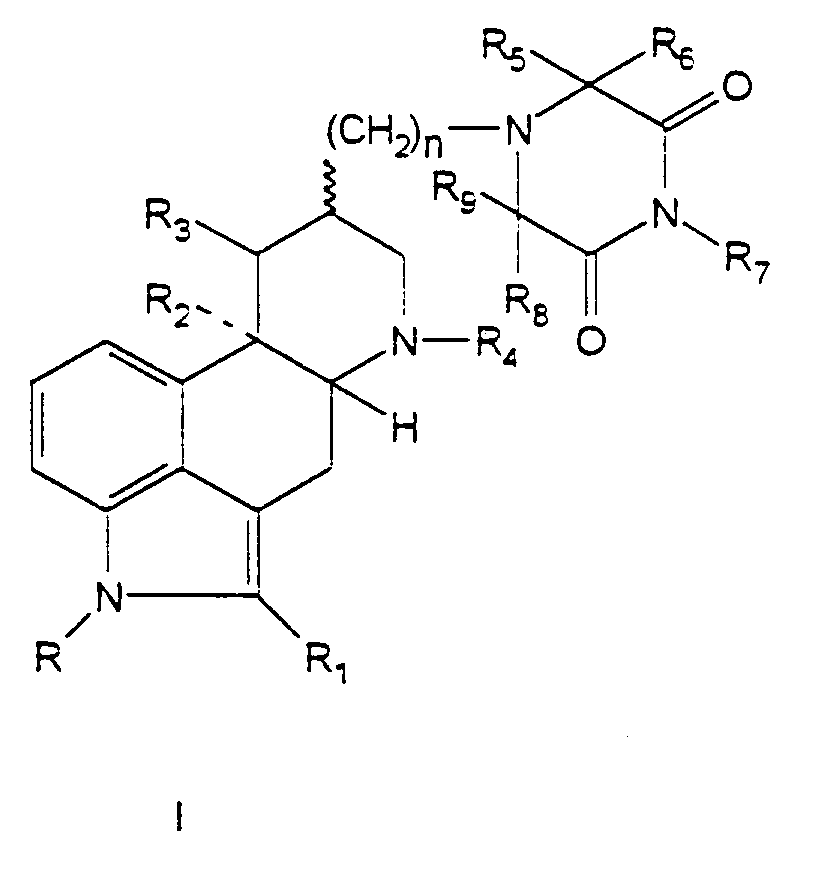
in der R ein Wasserstoffatom oder eine C₁-C₃-Alkylgruppe darstellt; R₁ ein Wasserstoffatom, Chloratom, Bromatom oder eine Methylgruppe darstellt; R₂ und R₃ entweder Wasserstoffatome darstellen oder R₂ und R₃ zusammen eine chemische Bindung darstellen; R₄ eine Kohlenwasserstoffgruppe mit 1 bis 4 Kohlenstoffatomen, ausgewählt unter Alkyl-, Cycloalkyl-, ethylenartig ungesättigten und acetylenartig ungesättigten Gruppen, darstellt; R₅, R₆, R₈ und R₉ jeweils unabhängig voneinander ein Wasserstoffatom oder eine Alkylgruppe mit 1 bis 4 Kohlenstoffatomen darstellen; R₇ ein Wasserstoffatom, eine Alkylgruppe mit 1 bis 4 Kohlenstoffatomen, eine Phenylgruppe oder eine Cycloalkylgruppe mit 3 bis 7 Kohlenstoffatomen darstellt; und n 0, 1 oder 2 ist; wobei das Verfahren Umsetzen eines Ergolinderivats der Formel II in einem organischen Lösungsmittel in Gegenwart eines Säure-Abfangmittels mit einem α-Halogenderivat der Formel III
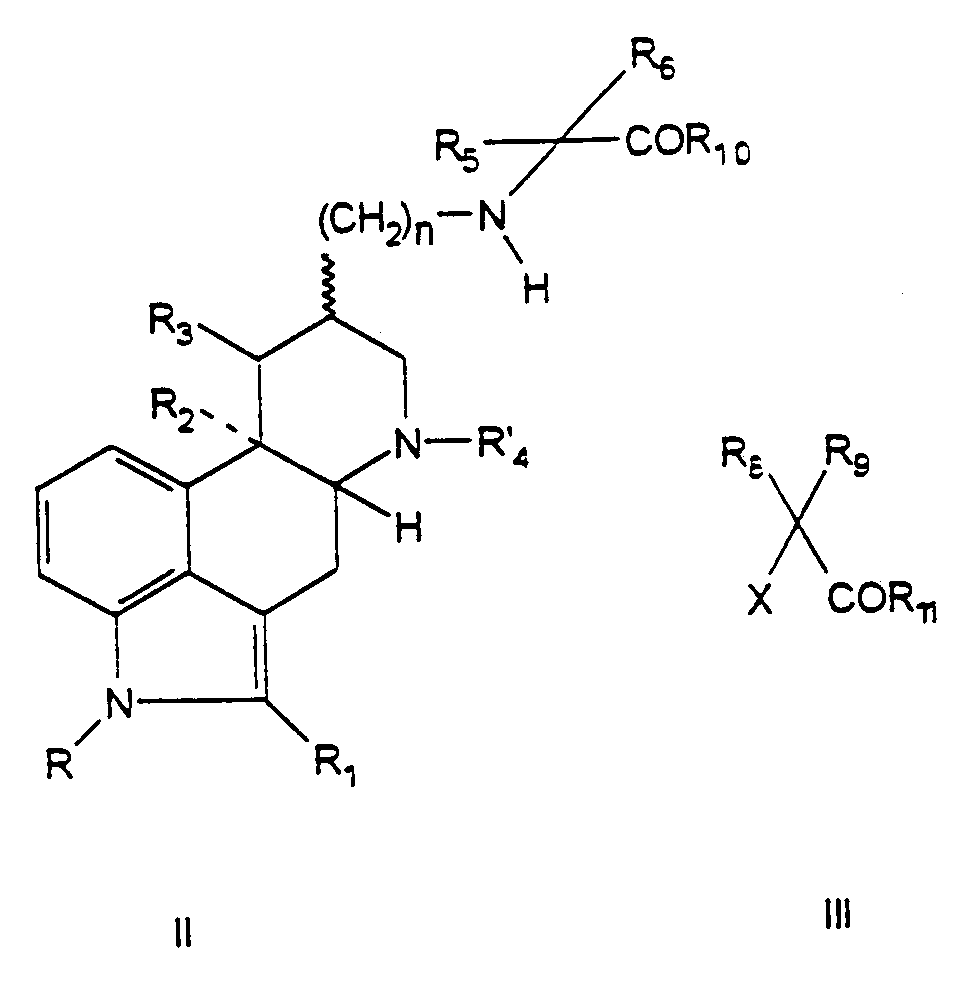
worin n, R, R₁, R₂, R₃, R₅, R₆, R₈, R₉ die oben angegebenen Bedeutungen haben; R₁₀ und R₁₁ unabhängig voneinander eine C₁-C₄-Alkoxygruppe oder eine Aminogruppe NHR₇, in der R₇ wie oben definiert ist, darstellen; X ein Halogenatom darstellt; R'₄ eine genannte Kohlenwasserstoffgruppe mit 1 bis 4 Kohlenstoffatomen oder eine N-schützende Gruppe darstellt; und wenn notwendig, Umwandeln der resultierenden Verbindung der Formel IV
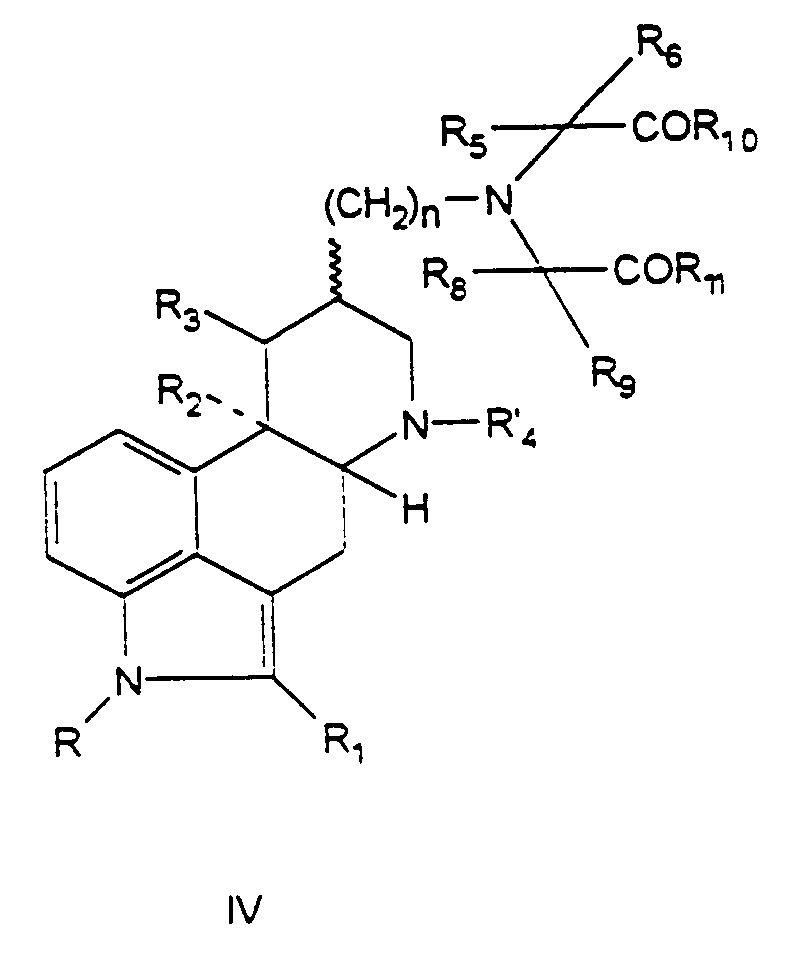
in der R, R₁, R₂, R₃, R₅, R₆, R₈, R₉ und n wie oben definiert sind; und R'₄ eine N-schützende Gruppe ist, in eine Verbindung der Formel IV, in der R'₄ eine genannte Kohlenwasserstoffgruppe ist; durch Entfernen der Schutzgruppe unter Verwendung einer Base, Amteisensäure oder ZN-Staub und Alkylierung mit einem Halogenidderivat R₄-Hal in Gegenwart eines sauren Spülmittels; wenn notwendig, Umwandeln der Verbindung der Formel IV, in der R₁₀ und R₁₁ beide eine Alkoxygruppe darstellen, in eine Verbindung der Formel IV, in der R₁₀ und R₁₁ beide Aminogruppe sind, durch Ammonolyse; und
Zyklisieren einer Verbindung der Formel IV, entweder wenn (a) R₁₀ und R₁₁ beide Aminogruppen NHR₇, worin R₇ wie oben definiert ist, darstellen, durch Erhitzen in einem Lösungsmittel auf eine Temperatur von 100 bis 200°C, oder wenn (b) R₁₀ eine Alkoxygruppe ist, und R₁₁ eine Aminogruppe NHR₇, worin R₇ wie oben definiert ist, darstellt, durch Erhitzen im Vakuum bei der Temperatur des Schmelzpunktes der Verbindung der Formel IV oder durch Hydrolyse der COR₁₀-Carboxylatgruppe und anschließende Behandlung mit einem kondensierenden Agens in einem Lösungsmittel bei einer Temperatur von 50°C bis 150°C;
umfaßt.
in der R ein Wasserstoffatom oder eine C₁-C₃-Alkylgruppe darstellt; R₁ ein Wasserstoffatom, Chloratom, Bromatom oder eine Methylgruppe darstellt; R₂ und R₃ entweder Wasserstoffatome darstellen oder R₂ und R₃ zusammen eine chemische Bindung darstellen; R₄ eine Kohlenwasserstoffgruppe mit 1 bis 4 Kohlenstoffatomen, ausgewählt unter Alkyl-, Cycloalkyl-, ethylenartig ungesättigten und acetylenartig ungesättigten Gruppen, darstellt; R₅, R₆, R₈ und R₉ jeweils unabhängig voneinander ein Wasserstoffatom oder eine Alkylgruppe mit 1 bis 4 Kohlenstoffatomen darstellen; R₇ ein Wasserstoffatom, eine Alkylgruppe mit 1 bis 4 Kohlenstoffatomen, eine Phenylgruppe oder eine Cycloalkylgruppe mit 3 bis 7 Kohlenstoffatomen darstellt; und n 0, 1 oder 2 ist; wobei das Verfahren Umsetzen eines Ergolinderivats der Formel II in einem organischen Lösungsmittel in Gegenwart eines Säure-Abfangmittels mit einem α-Halogenderivat der Formel III
worin n, R, R₁, R₂, R₃, R₅, R₆, R₈, R₉ die oben angegebenen Bedeutungen haben; R₁₀ und R₁₁ unabhängig voneinander eine C₁-C₄-Alkoxygruppe oder eine Aminogruppe NHR₇, in der R₇ wie oben definiert ist, darstellen; X ein Halogenatom darstellt; R'₄ eine genannte Kohlenwasserstoffgruppe mit 1 bis 4 Kohlenstoffatomen oder eine N-schützende Gruppe darstellt; und wenn notwendig, Umwandeln der resultierenden Verbindung der Formel IV
in der R, R₁, R₂, R₃, R₅, R₆, R₈, R₉ und n wie oben definiert sind; und R'₄ eine N-schützende Gruppe ist, in eine Verbindung der Formel IV, in der R'₄ eine genannte Kohlenwasserstoffgruppe ist; durch Entfernen der Schutzgruppe unter Verwendung einer Base, Amteisensäure oder ZN-Staub und Alkylierung mit einem Halogenidderivat R₄-Hal in Gegenwart eines sauren Spülmittels; wenn notwendig, Umwandeln der Verbindung der Formel IV, in der R₁₀ und R₁₁ beide eine Alkoxygruppe darstellen, in eine Verbindung der Formel IV, in der R₁₀ und R₁₁ beide Aminogruppe sind, durch Ammonolyse; und
Zyklisieren einer Verbindung der Formel IV, entweder wenn (a) R₁₀ und R₁₁ beide Aminogruppen NHR₇, worin R₇ wie oben definiert ist, darstellen, durch Erhitzen in einem Lösungsmittel auf eine Temperatur von 100 bis 200°C, oder wenn (b) R₁₀ eine Alkoxygruppe ist, und R₁₁ eine Aminogruppe NHR₇, worin R₇ wie oben definiert ist, darstellt, durch Erhitzen im Vakuum bei der Temperatur des Schmelzpunktes der Verbindung der Formel IV oder durch Hydrolyse der COR₁₀-Carboxylatgruppe und anschließende Behandlung mit einem kondensierenden Agens in einem Lösungsmittel bei einer Temperatur von 50°C bis 150°C;
umfaßt.
2. Verfahren nach Anspruch 1, wobei das Lösungsmittel in der Recktion zwischen den Verbindungen
der Formeln II und III Toluol, Acetonitril oder Dimethylformamid ist, und das Säure-Abfangmittel
ein anorganisches Carbonat oder Triethylamin ist.
3. Verfahren nach Anspruch 1 oder 2, in dem das Lösungsmittel, das im Schritt der Zyklisierung
einer Verbindung der Formel IV, in der R₁₀ und R₁₁ beide Aminogruppen darstellen,
verwendet wird, Phenol, Xylenol oder Kresol ist.
4. Verfahren nach Anspruch 1 oder 2, in dem das kondensierende Agens, das im Zyklisierungsschritt
einer Verbindung der Formel IV, in der R₁₀ eine Alkoxygruppe oder R₁₁ eine Aminogruppe
NHR₇ ist, verwendet wird, Essigsäureanhydrid, Alkylchlorcarbonat oder Diimidazolcarbonyl
ist, und das Lösungsmittel Tetrahydrofuran, 1,4-Dioxan oder Dimethylformamid ist.
1. Procédé pour préparer un dérivé de l'ergoline ayant la formule I :

dans laquelle R représente un atome d'hydrogène ou un groupe alkyle en C₁-C₃ ; R₁ représente un hydrogène ou un atome de chlore ou de brome ou un groupe méthyle ; R₂ et R₃ représentent un atome d'hydrogène, ou encore R₂ et R₃ représentent ensemble une liaison chimique ; R₄ représente un groupe hydrocarboné ayant de 1 à 4 atomes de carbone, choisi parmi les groupes alkyle, les groupes cycloalkyle, les groupes à insaturation éthylénique et les groupes à insaturation acétylénique ; R₅, R₆, R₈ et R₉ représentent chacun indépendamment un atome d'hydrogène ou un groupe alkyle ayant de 1 à 4 atomes de carbone ; R₇ représente un atome d'hydrogène, un groupe alkyle ayant de 1 à 4 atomes de carbone, un groupe phényle ou un groupe cycloalkyle ayant de 3 à 7 atomes de carbone et n vaut 0, 1 ou 2, lequel procédé comprend la réaction, dans un solvant organique en présence d'un fixateur d'acide, d'une ergoline de formule II avec un dérivé α-halogéné de formule III :
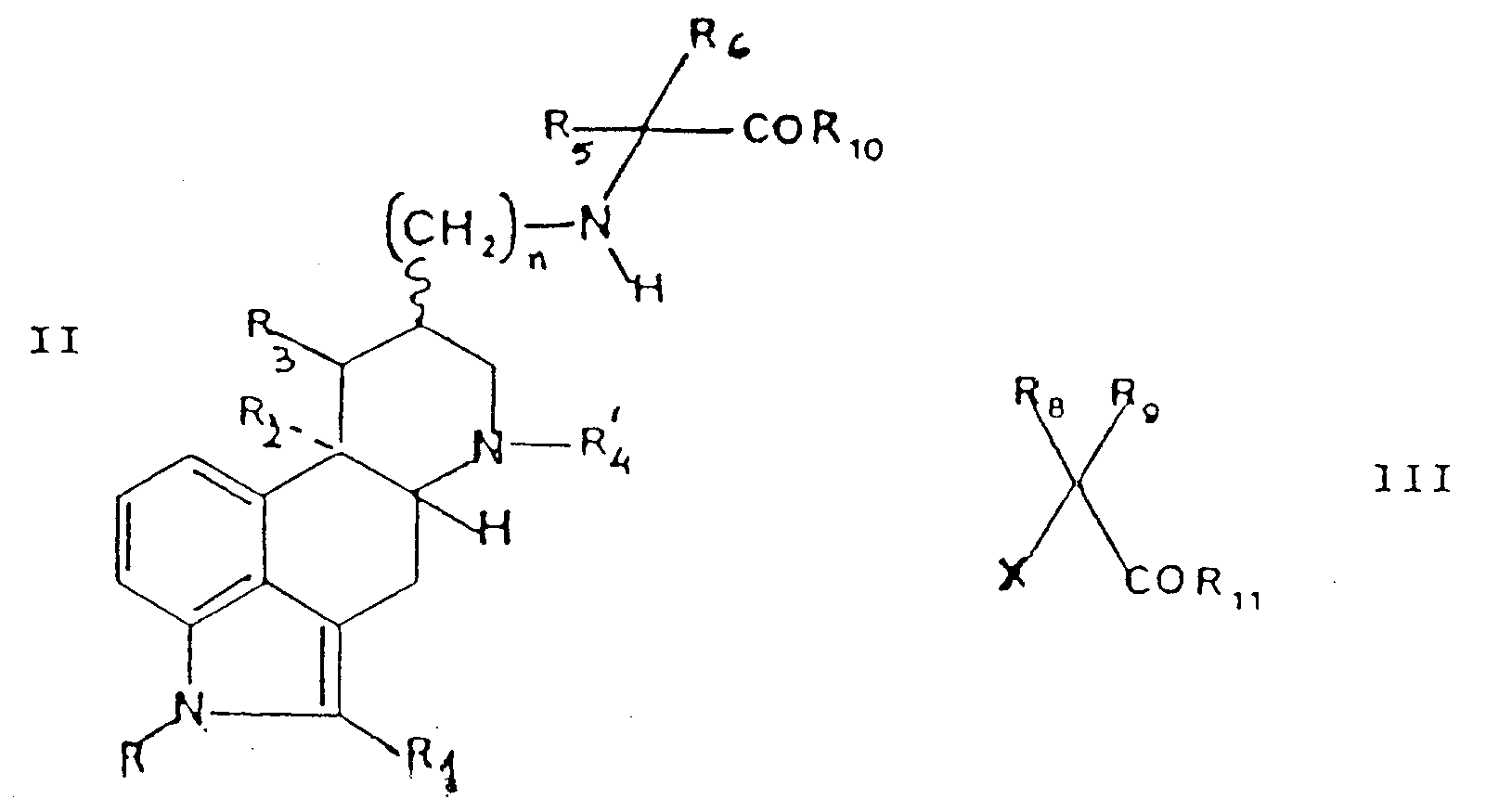
où n, R, R₁, R₂, R₃, R₅, R₆, R₈ et R₉ ont les significations données ci-dessus, R₁₀ et R₁₁ représentent indépendamment un groupe alcoxy en C₁ à C₄ ou un groupe amino NH-R₇ où R₇ est tel que défini ci-dessus, X est un atome d'halogène et R'₄ représente un groupe hydrocarboné tel que ci-dessus ayant de 1 à 4 atomes de carbone, ou un groupe N-protecteur, et, si nécessaire, la conversion du composé obtenu de formule IV :
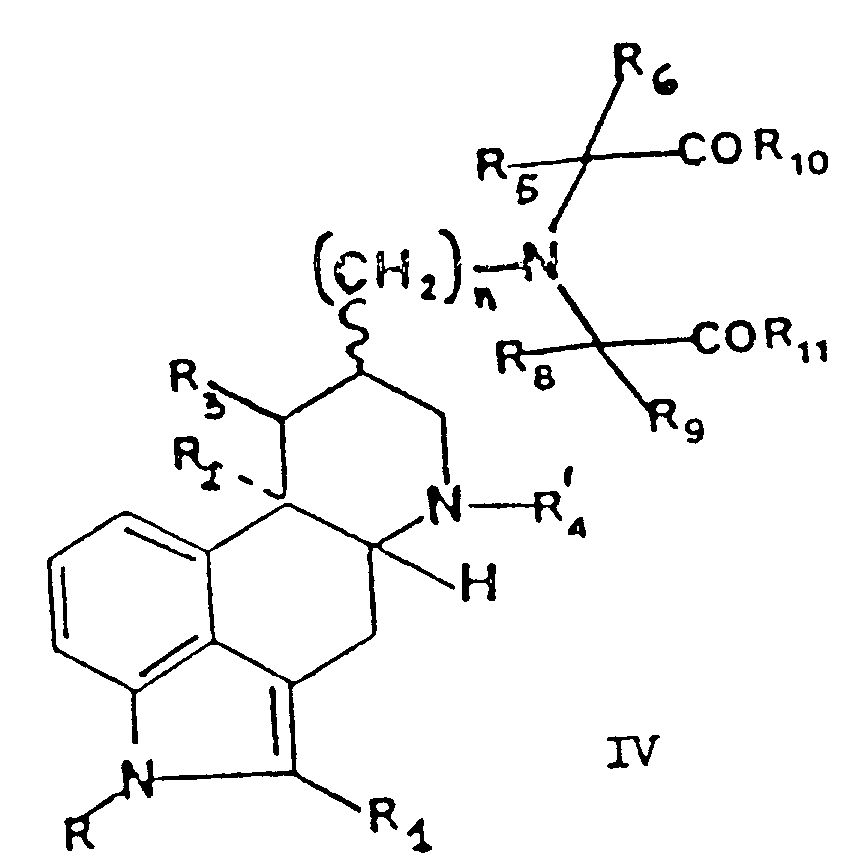
dans laquelle R, R₁, R₂, R₃, R₅, R₆, R₈, R₉ et n sont tels que définis ci-dessus, et R'₄ est un groupe N-protecteur, en un composé de formule IV dans laquelle R'₄ est un groupe hydrocarboné en C₁-C₄ tel que ci-dessus, par déprotection à l'aide d'une base, d'acide formique ou de poussière de zinc, et alkylation avec un dérivé halogénure R₄-Hal, en présence d'un fixateur d'acide, si nécessaire la conversion du composé de formule IV, dans laquelle R₁₀ et R₁₁ représentent tous les deux un groupe alcoxy, en un composé de formule IV dans laquelle R₁₀ et R₁₁ sont tous les deux des groupes amino, et ce par ammonolyse; et la cyclisation dudit composé de formule IV tel que ci-dessus, soit (a) quand R₁₀ et R₁₁ représentent tous les deux des groupes amino NHR₇, où R₇ est tel que défini ci-dessus, par chauffage dans un solvant à une température de 100 à 200°C, soit (b) quand R₁₀ est un groupe alcoxy et R₁₁ représente un groupe amino NHR₇, où R₇ est tel que défini ci-dessus, par chauffage sous vide au point de fusion du composé de formule IV, ou par hydrolyse du groupe carboxylate COR₁₀, puis traitement avec un agent de condensation dans un solvant à une température de 50 à 150°C.
dans laquelle R représente un atome d'hydrogène ou un groupe alkyle en C₁-C₃ ; R₁ représente un hydrogène ou un atome de chlore ou de brome ou un groupe méthyle ; R₂ et R₃ représentent un atome d'hydrogène, ou encore R₂ et R₃ représentent ensemble une liaison chimique ; R₄ représente un groupe hydrocarboné ayant de 1 à 4 atomes de carbone, choisi parmi les groupes alkyle, les groupes cycloalkyle, les groupes à insaturation éthylénique et les groupes à insaturation acétylénique ; R₅, R₆, R₈ et R₉ représentent chacun indépendamment un atome d'hydrogène ou un groupe alkyle ayant de 1 à 4 atomes de carbone ; R₇ représente un atome d'hydrogène, un groupe alkyle ayant de 1 à 4 atomes de carbone, un groupe phényle ou un groupe cycloalkyle ayant de 3 à 7 atomes de carbone et n vaut 0, 1 ou 2, lequel procédé comprend la réaction, dans un solvant organique en présence d'un fixateur d'acide, d'une ergoline de formule II avec un dérivé α-halogéné de formule III :
où n, R, R₁, R₂, R₃, R₅, R₆, R₈ et R₉ ont les significations données ci-dessus, R₁₀ et R₁₁ représentent indépendamment un groupe alcoxy en C₁ à C₄ ou un groupe amino NH-R₇ où R₇ est tel que défini ci-dessus, X est un atome d'halogène et R'₄ représente un groupe hydrocarboné tel que ci-dessus ayant de 1 à 4 atomes de carbone, ou un groupe N-protecteur, et, si nécessaire, la conversion du composé obtenu de formule IV :
dans laquelle R, R₁, R₂, R₃, R₅, R₆, R₈, R₉ et n sont tels que définis ci-dessus, et R'₄ est un groupe N-protecteur, en un composé de formule IV dans laquelle R'₄ est un groupe hydrocarboné en C₁-C₄ tel que ci-dessus, par déprotection à l'aide d'une base, d'acide formique ou de poussière de zinc, et alkylation avec un dérivé halogénure R₄-Hal, en présence d'un fixateur d'acide, si nécessaire la conversion du composé de formule IV, dans laquelle R₁₀ et R₁₁ représentent tous les deux un groupe alcoxy, en un composé de formule IV dans laquelle R₁₀ et R₁₁ sont tous les deux des groupes amino, et ce par ammonolyse; et la cyclisation dudit composé de formule IV tel que ci-dessus, soit (a) quand R₁₀ et R₁₁ représentent tous les deux des groupes amino NHR₇, où R₇ est tel que défini ci-dessus, par chauffage dans un solvant à une température de 100 à 200°C, soit (b) quand R₁₀ est un groupe alcoxy et R₁₁ représente un groupe amino NHR₇, où R₇ est tel que défini ci-dessus, par chauffage sous vide au point de fusion du composé de formule IV, ou par hydrolyse du groupe carboxylate COR₁₀, puis traitement avec un agent de condensation dans un solvant à une température de 50 à 150°C.
2. Procédé selon la revendication 1, dans lequel, dans la réaction entre les composés
de formules II et III, le solvant organique est le toluène, l'acétonitrile ou le diméthylformamide
et le fixateur d'acide est un carbonate minéral ou la triéthylamine.
3. Procédé selon la revendication 1 ou 2, dans lequel le solvant utilisé dans l'étape
de cyclisation d'un composé de formule IV dans laquelle R₁₀ et R₁₁ représentent tous
les deux des groupes amino est le phénol, le xylénol ou le crésol.
4. Procédé selon la revendication 1 ou 2, dans lequel l'agent de condensation utilisé
dans l'étape de cyclisation d'un composé de formule IV dans laquelle
R₁₀ est un groupe alcoxy et R₁₁ est un groupe amino NHR₇ est l'anhydride acétique, un chlorocarbonate d'alkyle ou le diimidazolcarbonyle, et le solvant est le tétrahydrofuranne, le 1,4-dioxanne ou le diméthylformamide.
R₁₀ est un groupe alcoxy et R₁₁ est un groupe amino NHR₇ est l'anhydride acétique, un chlorocarbonate d'alkyle ou le diimidazolcarbonyle, et le solvant est le tétrahydrofuranne, le 1,4-dioxanne ou le diméthylformamide.