|
(11) | EP 0 465 191 B1 |

| (12) | EUROPEAN PATENT SPECIFICATION |
|
|
| (54) |
Bicyclic sulfur-containing compounds Schwefel enthaltende bizyklische Verbindungen Composés bicycliques contenant du soufre |
|
|
|||||||||||||||||||||||||||||||
| Note: Within nine months from the publication of the mention of the grant of the European patent, any person may give notice to the European Patent Office of opposition to the European patent granted. Notice of opposition shall be filed in a written reasoned statement. It shall not be deemed to have been filed until the opposition fee has been paid. (Art. 99(1) European Patent Convention). |
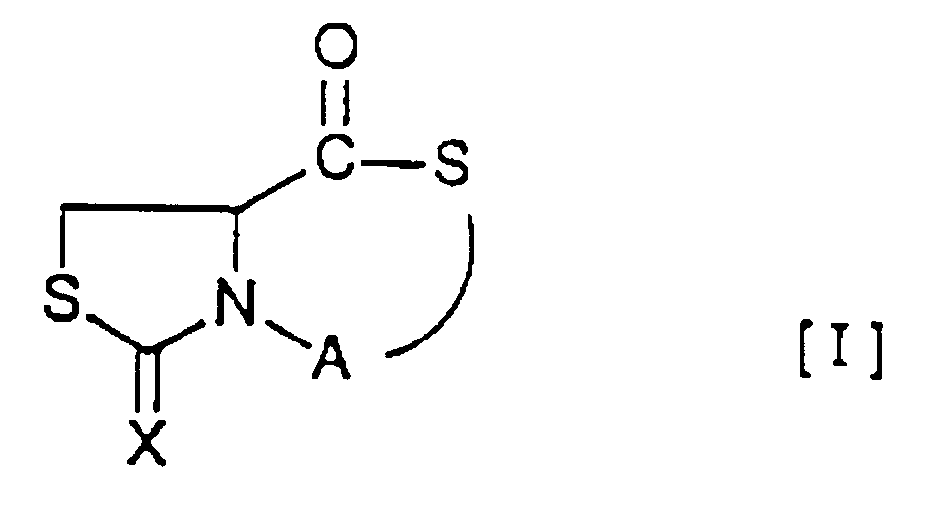
[0001] This invention relates to the compounds of the formula [I] and salts thereof (hereinafter referred to as the "Compound"), which are useful for treatment of liver disorders.
wherein
- X
- is oxygen or sulfur; and
- A
- is straight C₂ - C₄ alkylene which can be substituted by one or more lower alkyl.
[0003] The term "lower alkyl" intends to designate straight or branched C₁ - C₆ alkyl exemplified by methyl, ethyl, propyl, isopropyl and hexyl.
[0004] The Compound can be converted into pharmaceutically acceptable salts. Examples of the salts are hydrochloric acid salt, sulfuric acid salt, phosphoric acid salt and maleic acid salt.
[0005] There are few studies on bicyclic compounds in which thiazolidine-2-thione or -2-one is condensed with a heterocycle having a sulfur atom. Only Borgulya J. et al. reported such bicyclic compounds (Helv. Chim. Acta, 67, 84 (1984)). They studied the conversion reaction from 1,3-dithian-5-amine derivatives to bicylic-2-thiazolidine derivatives and synthesized 7,7a-dihydro-1H,3H,5H-thiazoro[3,4-c]-thiazole-3-one derivatives.
[0006] Synthetic studies of such bicyclic compounds are very important to find novel compounds having an unique ring system. Thereupon, we studied synthetic methods of bicyclic sulfur-containing compounds and have succeeded in obtaining various novel compounds. Furthermore, we studied applications of the Compound to drugs and found that the Compound, which has novel chemical structures condensed by thiazolidine-2-thione or -2-one with heterocycle having a sulfur atom, a nitrogen atom and a carbonyl group, would be useful for treatment of liver disorders.
[0007] The Compound can be prepared by such methods as the follows.
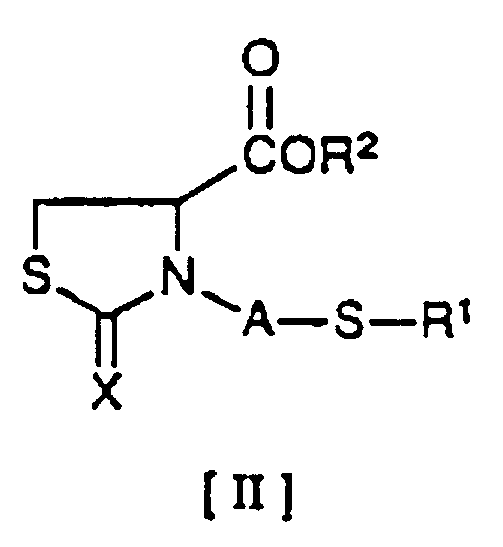
Wherein,
- R¹
- is a protective group of thiol such as p-methoxybenzyl; and
- R²
- is hydrogen or lower alkyl.
[0008] The compound of the formula [I] can be prepared by a cyclization reaction of the compound of the formula [IV] using strong acid such as trifluoromethanesulfonic acid in trifluoroacetic acid etc. The compound of the formula [IV] can be prepared by a reaction of the compound of the formula [II] with the compound of the formula [III].
[0009] No specific conditions are necessary for the above reaction but the known methods generally used for such reaction are applicable.
[0010] The Compound has stereoisomers because of the existence of one or more asymmetric carbon atom, and these isomers are included in this invention.
[0011] The Compound, a novel bicyclic compound, is useful as a medical substance, especially for treatment of liver disorders such as acute hepatic failure, acute hepatitis, chronic hepatitis and liver cirrhosis.
[0012] The acute hepatic failure model reported by Feruluga J. et al., (Agent and Actions, 9, 566 (1979)) is well known as an animal model to examine effects of a drug on liver disorders. We examined effects of the Compound on liver disorders using this model. As the result of our experiment, we found that the mortality of the animal group treated with the Compound was lower than that of the control group. The result proves that the Compound is useful for treatment of liver disorders.
[0013] The Compound can be administered either orally or parenterally. Examples of dosage forms are tablet, capsule, powders, granules, injection and the percutaneous. The dosage is adjusted depending on symptom, dosage form, etc., but usual daily dosage is 1 to 5000mg in one or a few divided doses.
1) Tablet
2) capsule
[0017] By changing the ratio of the Compound and lactose, capsules which contains 10mg, 30mg, 50mg or 100mg of the Compound, can be prepared.
3) granules
EXAMPLE
Example 1
(6S)-1-Aza-3,3-dimethyl-4,8-dithiabicyclo[4,3,0]nonan-5-on-9-thione
[0020] To a solution of N-[2-(4-methoxybenzylthio)-2-methylpropyl]-L-cysteine methyl ester (5.0g) in chloroform (90ml), thio-carbonyldiimidazole (3.0g) was added and the mixture was stirred for 1.5hr at room temperature. The reaction mixture was washed with 3N hydrochloric acid, water and then saturated sodium chloride solution, dried over anhydrous magnesium sulfate, and concentrated in vacuo. The oily residue was purified by a silica gel column chromatography to give 5.10g(91%) of (4R)-3-[2-(4-methoxy-benzylthio)-2-methylpropyl]-4-methoxycarbonyl-thiazolidine-2-thione.
[0021] To a solution of the above product (2.5g) in trifluoroacetic acid (10ml), thioanisole (1.52ml) and trifluoromethanesulfonic acid (2.29ml) were added and the mixture was stirred for 30 minutes at room temperature. The reaction mixture was neutralized with sodium bicarbonate and extracted with ethyl acetate. The organic layer was washed with water and saturated sodium chloride solution, dried over anhydrous magnesium sulfate, and concentrated in vacuo. The oily residue was purified by a silica gel column chromatography. The crude product was recrystallized from n-hexane - ethyl acetate to give 0.42g (27.8%) of the titled compound.
m.p. 126 - 128°C ( n-hexane - ethyl acetate )
[α]
-24.6° ( c=1.0, chloroform )
IR (KBr, cm⁻¹) 2936, 1664, 1423, 1350, 1280, 1206, 1169, 1130, 1056, 1011, 690
By the similar method as Example 1, following compounds were obtained.
(6S)-1-Aza-3-methyl-4,8-dithiabicyclo[4,3,0]nonan-5-on-9-thione
[0022] m.p. 124 - 125°C ( n-hexane - ethyl acetate )
IR (KBr, cm⁻¹) 2980, 2932, 2844, 1675, 1419, 1282, 1211, 1203, 1154, 1058, 982, 958, 705
(7S)-1-Aza-3,3-dimethyl-5,9-dithiabicyclo[5,3,0]decan-6-on-10-thione
[0023]
m.p. 184 - 186°C ( chloroform )
[α]
+93.5° ( c=1.0, chloroform )
IR (KBr, cm⁻¹) 1659, 1449, 1402, 1264, 1199, 1166, 1050, 1039
(6S)-1-Aza-4,8-dithiabicyclo[4,3,0]nonan-5-on-9-thione
[0024] m.p. 146 - 159°C ( n-hexane - ethyl acetate )
[α]
+26.8° ( c=0.35, chloroform )
IR (KBr, cm⁻¹) 2990, 2855, 1675, 1437, 1420, 1350, 1310, 1263, 1225, 1054, 1006, 972, 879, 716
(6S)-1-Aza-3,3-diethyl-4,8-dithiabicyclo[4,3,0]nonan-5-on-9-thione
[0025] m.p. 106 - 107°C ( diisopropylether )
[α]
-1.8° ( c=0.2, chloroform )
IR (KBr, cm⁻¹) 2959, 1676, 1460, 1418, 1273, 1228, 1167, 1060, 1030, 1002, 887, 686
Example 2
(6S)-1-Aza-3,3-dimethyl-4,8-dithiabicyclo[4,3,0]nonan-5,9-dione
[0026] To a solution of N-[2-(4-methoxybenzylthio)-2-methylpropyl]-L-cysteine methyl ester (0.6g) in dimethylformamide (DMF,10ml), carbonyldiimidazole (0.34g) was added and the mixture was stirred for 2.5hr at 110 - 120°C. After the addition of hydrochloric acid to the reaction mixture, the mixture was extracted with ethyl acetate. The organic layer was washed with 1N hydrochloric acid, water and then saturated sodium chloride solution, dried over anhydrous magnesium sulfate, and concentrated in vacuo. The oily residue was purified by a silica gel column chromatography to give 0.35g of (4R)-3-[2-(4-methoxybenzylthio)-2-methylpropyl]-4-methoxycarbonylthiazolidine-2-one.
[0027] To a solution of the above product (0.33g) in trifluoroacetic acid (2ml), thioanisole (0.21ml) was added, and then trifluoromethanesulfonic acid (0.16ml) was added dropwise under ice-cooling and the mixture was stirred for 15 minutes under ice-cooling. The reaction mixture was neutralized with sodium bicarbonate and extracted with ethyl acetate. The organic layer was washed with saturated sodium bicarbonate solution, water and then saturated sodium chloride solution, dried over anhydrous magnesium sulfate, and concentrated in vacuo. The oily residue was purified by a silica gel column chromatography. The crude product was recrystallized from n-hexane - ethyl acetate to give 0.14g (63.6%) of the titled compound.
m.p. 137 - 138°C ( n-hexane - ethyl acetate )
[α]
-124.1° ( c=1.0, chloroform )
IR (KBr, cm⁻¹) 2972, 1685, 1386, 1355, 1306, 1275, 1212, 1123, 1082, 819
PHARMACOLOGICAL TEST
[0028] The acute hepatic failure model reported by Feruluga J. et al., (Agent and Actions, 9, 566 (1979)) is well known as an animal model to examine effects of a drug on liver disorders. We examined effects of the Compound on liver disorders using this model.
Experimental Method:
[0029] According to the method described in the literature, 0.7mg/mouse of Propionibacterium acnes was injected intravenously into male BALB/c strain mice ( 8 weeks old ). Seven days later, the Compound suspended in 1% methylcellulose solution was administered orally at a dose of 100mg/kg. To a control group, 1% methylcellulose solution alone was administered. One hour later, 25»g of lipopolysaccharide was injected intravenously, and then the mortality was recorded during 48 hours.
Result:
1. A compound of the formula [I]
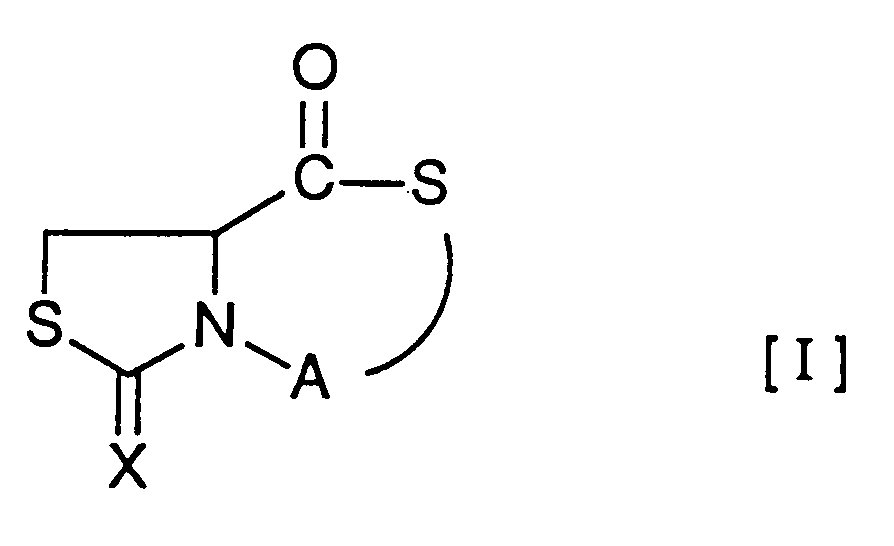
wherein
X is oxygen or sulfur; and
A is straight C₂ - C₄ alkylene which is optionally substituted by one or more C₁ - C₆ alkyl groups;
or a salt of such a compound.
wherein
X is oxygen or sulfur; and
A is straight C₂ - C₄ alkylene which is optionally substituted by one or more C₁ - C₆ alkyl groups;
or a salt of such a compound.
2. A compound as claimed in claim 1, wherein A is C₂ alkylene which is optionally substituted
by methyl or ethyl.
3. (6S)-1-Aza-3,3-dimethyl-4,8-dithiabicyclo[4,3,0]nonan-5-on-9-thione or a salt thereof.
4. (6S)-1-Aza-3-methyl-4,8-dithiabicyclo[4,3,0]nonan-5-on-9-thione or a salt thereof.
5. (7S)-1-Aza-3,3-dimethyl-5,9-dithiabicyclo[5,3,0]decan-6-on-10-thione or a salt thereof.
6. (6S)-1-Aza-4,8-dithiabicyclo[4,3,0]nonan-5-on-9-thione or a salt thereof.
7. (6S)-1-Aza-3,3-diethyl-4,8-dithiabicyclo[4,3,0]nonan-5-on-9-thione or a salt thereof.
8. (6S)-1-Aza-3,3-dimethyl-4,8-dithiabicyclo[4,3,0]nonan-5,9-dione or a salt thereof.
9. A pharmaceutical composition comprising a compound of the formula [I] as defined in
any preceding claim, or a pharmaceutically acceptable salt thereof, and a pharmaceutically
acceptable carrier therefor.
10. A process for preparing a compound of the formula [I] or salt thereof as defined in
claim 1, which comprises cyclizing a compound of the formula [II],
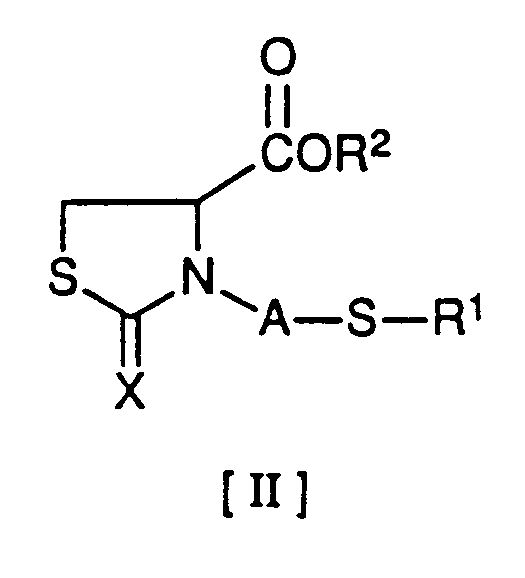
wherein
X is oxygen or sulfur;
A is straight C₂ - C₄ alkylene which is optionally
substituted by one or more C₁ - C₆ alkyl groups;
R¹ is a thiol protecting group; and
R² is hydrogen or C₁ - C₆ alkyl.
wherein
X is oxygen or sulfur;
A is straight C₂ - C₄ alkylene which is optionally
substituted by one or more C₁ - C₆ alkyl groups;
R¹ is a thiol protecting group; and
R² is hydrogen or C₁ - C₆ alkyl.
11. A method as claimed in claim 10, wherein R¹ is p-methoxybenzyl.
12. The use of a compound as claimed in any one of claims 1 to 8 for the manufacture of
a medicament for the treatment of liver disorders.
1. Verbindung mit der Formel
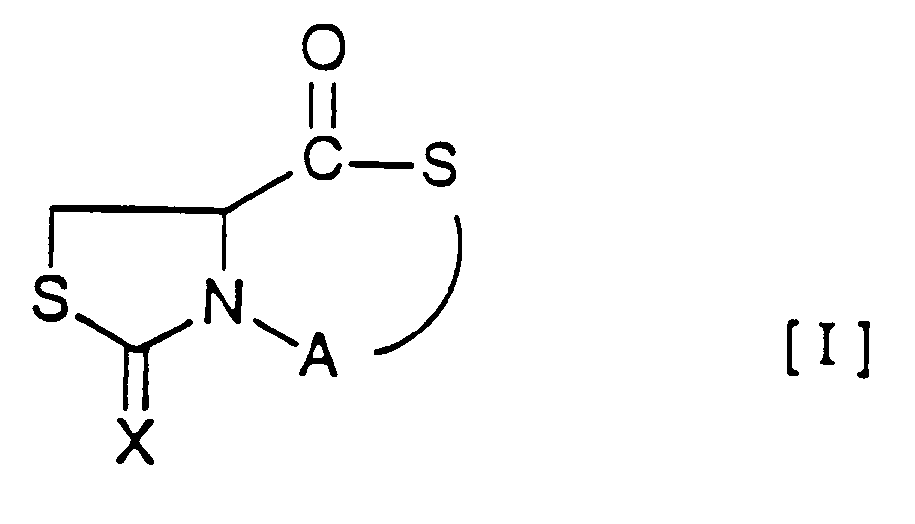
wobei
X Sauerstoff oder Schwefel ist; und
A ein geradkettiges C₂ - C₄ - Alkylen ist, das wahlweise durch eine
oder mehrere C₁ - C₆ - Alkylgruppen substituiert werden kann; oder ein Salz einer solchen Verbindung.
wobei
X Sauerstoff oder Schwefel ist; und
A ein geradkettiges C₂ - C₄ - Alkylen ist, das wahlweise durch eine
oder mehrere C₁ - C₆ - Alkylgruppen substituiert werden kann; oder ein Salz einer solchen Verbindung.
2. Verbindung nach Anspruch 1, wobei A ein C₂-Alkylen ist, das wahlweise durch Methyl
oder Ethyl substituiert werden kann.
3. (6S)-1-Aza-3,3-dimethyl-4,8-dithiabicyclo[4,3,0]nonan-5-on-9-thion oder ein Salz davon.
4. (6S)-1-Aza-3-methyl-4,8-dithiabicyclo[4,3,0]nonan-5-on-9-thion oder ein Salz davon.
5. (7S)-1-Aza-3,3-dimethyl-5,9-dithiabicyclo[5,3,0]decan-6-on-10-thion oder ein Salz
davon.
6. (6S)-1-Aza-4,8-dithiabicyclo[4,3,0]nonan-5-on-9-thion oder ein Salz davon.
7. (6S)-1-Aza-3,3-diethyl-4,8-dithiabicyclo[4,3,0]nonan-5-on-9-thion oder ein Salz davon.
8. (6S)-1-Aza-3,3-dimethyl-4,8-dithiabicyclo[4,3,0]nonan-5,9-dion oder ein Salz davon.
9. Pharmazeutische Zusammensetzung, die eine Verbindung der Formel [I] gemäß der Definition
in irgendeinem der vorstehenden Ansprüche aufweist, oder ein pharmazeutisch annehmbares
Salz davon, und ein pharmazeutisch annehmbarer Träger für diese Zusammensetzung.
10. Verfahren zur Herstellung einer Verbindung der Formel [I] oder eines Salzes der Verbindung
gemäß der Definition in Anspruch 1, wobei das Verfahren die Zyklisierung einer Verbindung
der Formel [II] aufweist,
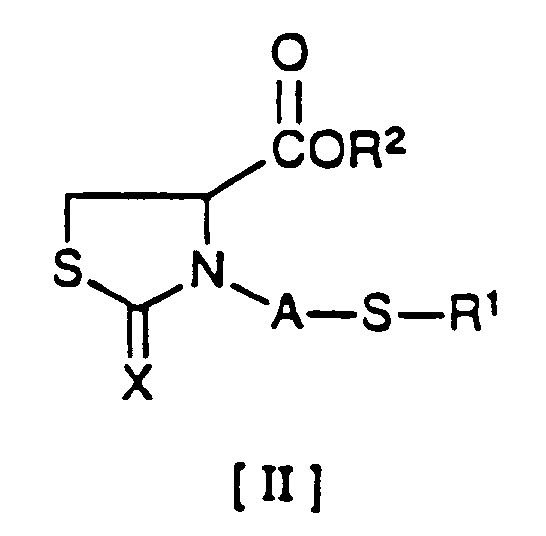
wobei
X Sauerstoff oder Schwefel;
A ein geradkettiges C₂ - C₄ - Alkylen, das wahlweise durch eine oder mehrere C₁ - C₆ - Alkylgruppen substituiert werden kann;
R¹ eine Thiol-Schutzgruppe; und
R² Wasserstoff oder ein C₁ - C₆ - Alkyl ist.
wobei
X Sauerstoff oder Schwefel;
A ein geradkettiges C₂ - C₄ - Alkylen, das wahlweise durch eine oder mehrere C₁ - C₆ - Alkylgruppen substituiert werden kann;
R¹ eine Thiol-Schutzgruppe; und
R² Wasserstoff oder ein C₁ - C₆ - Alkyl ist.
11. Verfahren nach Anspruch 10, wobei R¹ p-Methoxybenzyl ist.
12. Verwendung einer Verbindung nach einem der Ansprüche 1 bis 8 für die Herstellung eines
Medikaments zur Behandlung von Leberkrankheiten.
1. Composé de la formule [I]
dans laquelle
X est de l'oxygène ou du soufre; et
A est un alkylène à chaîne droite en C₂ - C₄ qui est facultativement;
substitué par un ou plusieurs groupes alkyle en C₁-C₆; ou un sel d'un tel composé.
dans laquelle
X est de l'oxygène ou du soufre; et
A est un alkylène à chaîne droite en C₂ - C₄ qui est facultativement;
substitué par un ou plusieurs groupes alkyle en C₁-C₆; ou un sel d'un tel composé.
2. Composé tel que revendiqué dans la revendication 1, dans lequel A est un alkylène
en C₂ qui est facultativement substitué par méthyle ou éthyle.
3. (6S)-1-Aza-3,3-diméthyl-4,8-dithiabicyclo[4,3,0]nonan-5-on-9-thione ou un de ses sels.
4. (6S)-1-Aza-3-méthyl-4,8-dithiabicyclo[4,3,0]nonan-5-on-9-thione ou un de ses sels.
5. (7S)-1-Aza-3,3-diméthyl-5,9-dithiabicyclo[5,3,0]décan-6-on-10-thione ou un de ses
sels.
6. (6S)-1-Aza-4,8-dithiabicyclo[4,3,0]nonan-5-on-9-thione ou un de ses sels.
7. (6S)-1-Aza-3,3-diéthyl-4,8-dithiabicyclo[4,3,0]nonan-5-on-9-thione ou un de ses sels.
8. (6S)-1-Aza-3,3-diméthyl-4,8-dithiabicyclo[4,3,0]nonan-5,9-dione ou un de ses sels.
9. Composition pharmaceutique comprenant un composé de la formule [I] telle qu'elle est
définie dans l'une quelconque des revendications précédentes ou un de ses sels pharmaceutiquement
acceptables et un véhicule pharmaceutiquement acceptable pour celui-ci.
10. Procédé pour préparer un composé de la formule [I] ou un de ses sels comme cela est
défini dans la revendication 1, qui comprend la cyclisation d'un composé de la formule
[II]
dans laquelle
X est de l'oxygène ou du soufre;
A est un alkylène à chaîne droite en C₂ - C₄ qui est facultativement substitué par un ou plusieurs groupes alkyle en C₁ - C₆;
R¹ est un groupe protecteur de thiol; et
R² est de l'hydrogène ou un alkyle en C₁ - C₆.
dans laquelle
X est de l'oxygène ou du soufre;
A est un alkylène à chaîne droite en C₂ - C₄ qui est facultativement substitué par un ou plusieurs groupes alkyle en C₁ - C₆;
R¹ est un groupe protecteur de thiol; et
R² est de l'hydrogène ou un alkyle en C₁ - C₆.
11. Procédé tel que revendiqué dans la revendication 10, dans lequel R¹ est p-méthoxybenzyle.
12. Utilisation d'un composé tel que revendiqué dans l'une quelconque des revendications
1 à 8 pour la fabrication d'un médicament pour le traitement de désordres hépatiques.