|
(11) | EP 0 465 263 B1 |

| (12) | EUROPEAN PATENT SPECIFICATION |
|
|
| (54) |
Polysilethylenesiloxane Polysilethylensiloxan Polysiléthylènesiloxane |
|
|
|||||||||||||||||||||||||||||||
|
||||||||||||||||||||||||||||||||
| Note: Within nine months from the publication of the mention of the grant of the European patent, any person may give notice to the European Patent Office of opposition to the European patent granted. Notice of opposition shall be filed in a written reasoned statement. It shall not be deemed to have been filed until the opposition fee has been paid. (Art. 99(1) European Patent Convention). |
Background of the Invention
1. Field of the Invention
2. Description of the Prior Art
[0002] Dimethylpolysiloxanes are excellent in heat resistance, cold resistance, and weather resistance and also excellent in properties such as elastomeric properties, release properties, and electrical properties and are used in wide fields as a major component, for example, in various rubber materials and coating materials for building materials, transport equipment, household electrical appliances, business and office machines, etc. These properties of dimethylpolysiloxanes are ascribed to the facts that the bond energy of the siloxane linkage constituting the backbone chain is high, the siloxane linkage is ionic, and the intermolecular cohesive force of the siloxane molecule is small.
[0003] However, dimethylpolysiloxanes have such defects as that the backbone chain is liable to be cleaved by an ionic agent such acids and alkalis and the mechanical strength properties are not satisfactory.
Summary of the Invention
[0004] Therefore, an object of the present invention is to provide a novel polysiloxane compound which obviates the above defects possessed by dimethylpolysiloxanes.
[0005] The present polysilethylenesiloxane is represented by the following general formula [I]:
wherein R1 and R2, which may be the same or different, each represent a hydrocarbon group having 1 to 10 carbon atoms, R3 and R4, which may be the same or different, each represent a hydrocarbon group having 1 to 10 carbon atoms or a perfluoroalkylethyl group, represented by the formula -CH2CH2CmF2m+1, wherein m is a positive integer of from 4 to 10 and at least one of R3 and R4 represents the perfluoroalkylethyl group, and n is an integer of 10 to 1,000.
[0006] That is, by introducing silethylene linkages in the siloxane backbone chain, the present invention has succeeded in obviating the above defects possessed by dimethylpolysiloxanes.
Brief Description of the Drawings
[0008] Fig. 2 is a diagram showing the infrared absorption spectrum of the polymer synthesized in Example 1.
[0010] Fig. 4 is a diagram showing the infrared absorption spectrum of the polymer synthesized in Example 2.
Detailed Description of the Invention
[0011] In the above general formula [I], R1 and R2 each represent a hydrocarbon group having 1 to 10 carbon atoms, for example, a lower alkyl group having up to 8 carbon atoms such as a methyl group, an ethyl group, and a propyl group, a cycloalkyl group such as a cyclohexyl group, an alkenyl group such as a vinyl group, an allyl group, and an isopropenoxy group, an aryl group such as a phenyl group, a tolyl group, and a naphthyl group, and an aralkyl group such as a benzyl group and a 2-phenylethyl group. R1 and R2 may be the same or different. The most preferable group in the present invention is a lower alkyl group, particularly a methyl group.
[0012] R3 and R4 each represent a hydrocarbon group having 1 to 10 carbon atoms or a perfluoroalkylethyl group. The hydrocarbon group includes those exemplified for R1 and R2 and, among them, a preferable hydrocarbon group is a lower alkyl group having up to 8 carbon atoms and the most preferable hydrocarbon group is a methyl group. The perfluoroalkylethyl group is one represented by the following formula:
-CH2CH2CmF2m+1,
wherein m is a positive integer of 4 to 10 such as C4F9CH2CH2-, C6F13CH2CH2-, C8F17CH2CH2-, and C10F21CH2CH2-.
[0013] In the general formula [I], n is an integer of 10 to 1,000, and due to such a value of n the present polysilethylenesiloxane has a viscosity at 25 °C in the range of 25 to 500,000 cSt, preferably 1,000 to 100,000 cSt.
Preparation
[0014] Although the present polysilethylenesiloxane can be synthesized in various manners, typically it can be synthesized by the ring opening polymerization of a 5-membered cyclic silethylenesiloxane represented by the following general formula [III]:
wherein R1 to R4 have the meanings defined above, obtained by hydrolyzing a dichlorosilane represented by the following general formula [II]:
wherein R1 to R4 have the meanings defined above.
[0015] The ring open polymerization is generally carried out by heating in the presence of a polymerization catalyst. The heating temperature is suitably 10 to 200 °C. As a polymerization catalyst, a hydroxide and a silanolate of an alkali metal such as lithium, potassium, and sodium is suitably used and also an acid catalyst, an alkali catalyst, and the like used in the conventional ring open polymerization of dimethylpolysiloxanes may be used. It is preferable that such a polymerization catalyst is used generally in an amount of 0.001 to 1 part by weight per 100 parts by weight of the 5-membered cyclic silethylenesiloxane although the amount varies depending on the type of the polymerization catalyst.
[0016] The present polysilethylenesiloxane prepared in this way is a liquid polymer quite useful as a major component of an elastomer composition excellent in properties such as chemical resistance, water repellency, and electrical properties and high in strength and elongation. For example, by curing the polysilethylenesiloxane by the crosslinking reaction applied to common silicone compounds, a rubber cured product having the above properties can be obtained. Particularly, the polysilethylenesiloxane of the present invention can provide a rubber cured product low in swelling in organic solvents and machine oils and improved in releasability, water repellency, and oil repellency.
[0017] The present polysilethylenesiloxane is expected to be used as a raw material for coating materials or rubber materials which are highly functional.
Examples
Example 1
[0018] 124.8 g (0.2 mol) of a cyclic siloxane having the following formula:
12 g of acetonitrile, and 28.8 mg (0.016 mol) of pure water were charged into a 1-l four-necked flask equipped with a condenser, agitating blades, and a thermometer and were heated to 90 °C with stirring.
[0019] Then a lithium silanolate in such an amount that the Si/Li ratio (atomic ratio) might be 4,000 was added to the mixture liquid. 5 min after the addition, the mixture liberated heat and the internal temperature rose to 105 °C to cause violent reflux of the acetonitrile and thereafter the viscosity rose gradually. Then after maturing was effected for 3 hours at 90 °C, 1 g of tetrachloroethane as a neutralization agent was added and further maturing was effected for 3 hours at 90 °C.
[0020] Then the reaction mixture was cooled to room temperature and was filtered under pressure and the filtrate was stripped by an evaporator at 100 °C for 2 hours under a pressure for 3 mmHg to obtain 116 g of a viscous oil.
[0021] With respect to this oil, the GPC analysis, the OH-group quantitative analysis, the infrared absorption spectral analysis, and the analysis by 1H-NMR and 19F-NMR were carried out and the following results were obtained. GPC:
[0023] Measuring conditions:
- Column:
- G2500 + G4000 (one each)
- Solvent:
- Fron-113
- Flow rate:
- 1 ml/min
- Detector:
- differential refractometer
- Temperature:
- 35 °C
[0025] As apparent from the chart, a monodisperse pattern was indicated.
OH-group quantitative analysis:
1H-NMR: in CCl4, the internal standard being CHCl3.
δ (ppm)
0.23 (s, Si-CH3, 6H)
0.61 (s, Si-CH2-CH2-Si, 4H)
0.91 (t, Si-CH2, 4H)
2.12 (t, CF2-CH2, 4H)
Infrared absorption spectrum:[0027] C-F: 1,000 to 1,100 cm-1
19F-NMR: CF3COOH was the internal standard.
a: -49.56 ppm
b: -47.80 ppm
c: -39.70 ppm
d: -5.37 ppm
Example 2
[0029] 118.4 g (0.2 mol) of a cyclic siloxane having the following formula:
10 g of acetonitrile, and 36 mg (0.002 mol) of pure water were charged into a 300-ml four-necked flask equipped with a condenser, agitating blades, and a thermometer and were heated to 90 °C with stirring.
[0030] Then a lithium silanolate in such an amount that the Si/Li ratio (atomic ratio) might be 4,000 was added to the mixture liquid. 3 min after the addition, the mixture liberated heat and the internal temperature rose to 110 °C to cause violent reflux of the acetonitrile and thereafter the viscosity rose gradually. The, after maturing was effected for 3 hours at 90 °C, 1 g of tetrachloroethane as a neutralization agent was added, followed by further maturing for 3 hours at 90 °C.
[0031] Then the reaction mixture was cooled to room temperature and was filtered under pressure and the filtrate was stripped by an evaporator at 100 °C for 2 hours under a pressure of 3 mmHg to obtain 108 g of a viscous oil.
[0032] With respect to this oil, the GPC analysis, the OH-group quantitative analysis, the infrared absorption spectral analysis, and the analysis by 1H-NMR and 19F-NMR were carried out and the following results were obtained. GPC:
[0034] Measuring conditions:
- Column:
- G2500 + G4000 (one each)
- Solvent:
- Fron-113
- Flow rate:
- 1 ml/min
- Detector:
- differential refractometer
- Temperature:
- 35 °C
[0036] As apparent from the chart, a monodisperse pattern was indicated.
OH-group quantitative analysis:
1H-NMR: in CCl4, the internal standard being CHCl3.
δ (ppm)
0.22 (s, Si-CH2, 9H)
0.63 (s, Si-CH2-CH2-Si, 4H)
0.88 (t, Si-CH2, 2H)
2.12 (t, CF2-CH2, 2H)
Infrared absorption spectrum:1. A polysilethylenesiloxane represented by the following general formula [I]:
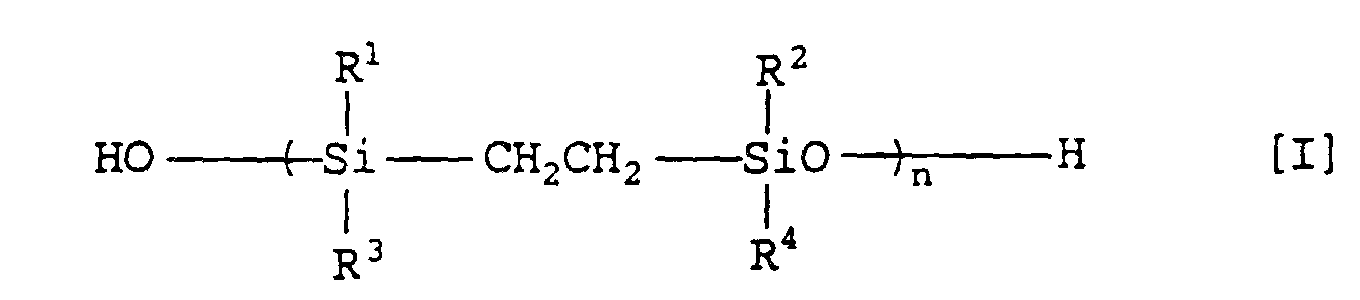
wherein R1 and R2, which may be the same or different, each represent a hydrocarbon group having 1 to 10 carbon atoms, R3 and R4, which may be the same or different, each represent a hydrocarbon group having 1 to 10 carbon atoms or a perfluoroalkylethyl group represented by the formulae -CH2CH2CmF2m+1, wherein m is a positive integer of from 4 to 10 and at least one of R3 and R4 represents the perfluoroalkylethyl group,and n is an integer of 10 to 1,000.
wherein R1 and R2, which may be the same or different, each represent a hydrocarbon group having 1 to 10 carbon atoms, R3 and R4, which may be the same or different, each represent a hydrocarbon group having 1 to 10 carbon atoms or a perfluoroalkylethyl group represented by the formulae -CH2CH2CmF2m+1, wherein m is a positive integer of from 4 to 10 and at least one of R3 and R4 represents the perfluoroalkylethyl group,and n is an integer of 10 to 1,000.
2. A polysilethylenesiloxane as claimed in claim 1, wherein said hydrocarbon group is
a lower alkyl group having up to 8 carbon atoms.
3. A polysilethylenesiloxane as claimed in claim 2, wherein said hydrocarbon group is
a methyl group.
4. A polysilethylenesiloxane as claimed in claim 1, wherein, in said general formula
[I], R3 and R4 each represent a perfluoroalkylethyl group.
5. A polysilethylenesiloxane as claimed in any of claims 1 to 4 wherein said perfluoroalkylethyl
group is selected from the group consisting of C4F9CH2CH2-, C6F13CH2CH2-, C8F17CH2CH2-, and C10F21CH2CH2-.
1. Polysilethylensiloxan der folgenden allgemeinen Formel (1):
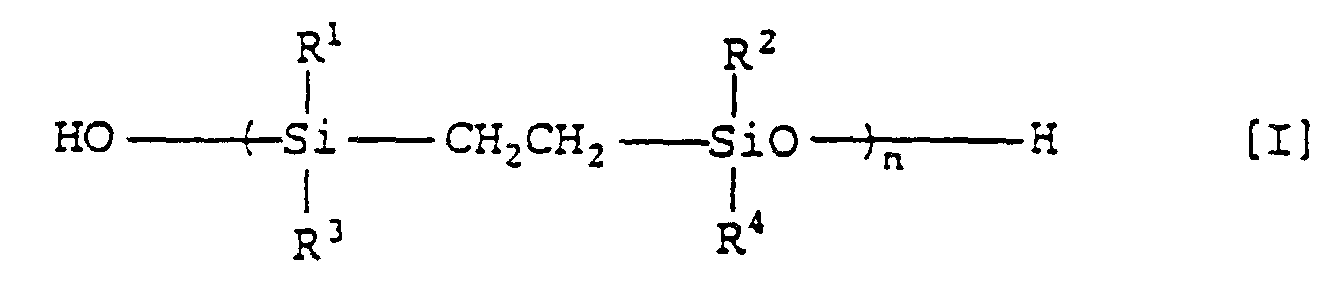
worin R1 und R2, die gleich oder verschieden sein können, jeweils eine Kohlenwaserstoffgruppe mit 1 bis 10 Kohlenstoffatomen darstellen, R3 und R4, die gleich oder verschieden sein können, jeweils eine Kohlenwasserstoffgruppe mit jeweils 1 bis 10 Kohlenstoffatomen oder eine Perfluoralkylethylgruppe darstellen, welche durch die Formel -CH2CH2CmF2m+1 dargestellt ist, worin m eine positive ganze Zahl von 4 bis 10 ist und wenigstens einer der Reste R3 und R4 die Perfluoralkylethylgruppe darstellt und n eine ganze Zahl von 10 bis 1.000 ist.
worin R1 und R2, die gleich oder verschieden sein können, jeweils eine Kohlenwaserstoffgruppe mit 1 bis 10 Kohlenstoffatomen darstellen, R3 und R4, die gleich oder verschieden sein können, jeweils eine Kohlenwasserstoffgruppe mit jeweils 1 bis 10 Kohlenstoffatomen oder eine Perfluoralkylethylgruppe darstellen, welche durch die Formel -CH2CH2CmF2m+1 dargestellt ist, worin m eine positive ganze Zahl von 4 bis 10 ist und wenigstens einer der Reste R3 und R4 die Perfluoralkylethylgruppe darstellt und n eine ganze Zahl von 10 bis 1.000 ist.
2. Polysilethylensiloxan nach Anspruch 1, dadurch gekennzeichnet, daß die Kohlenwasserstoffgruppe
eine niedere Alkylgruppe mit bis zu 8 Kohlenstoffatomen ist.
3. Polysilethylensiloxan nach Anspruch 2, dadurch gekennzeichnet, daß die Kohlenwasserstoffgruppe
eine Methylgruppe ist.
4. Polysilethylensiloxan nach Anspruch 1, dadurch gekennzeichnet, daß in der allgemeinen
Formel (I) R3 und R4 jeweils eine Perfluoralkylethylgruppe darstellen.
5. Polysilethylensiloxan nach irgendeinem der Ansprüche 1 bis 4, dadurch gekennzeichnet,
daß die Perfluoralkylethylgruppe ausgewählt ist aus der Gruppe, bestehend aus C4F9CH2CH2-, C8F13CH2CH2-, C8F17CH2CH2- und C10F21CH2CH2-.
1. Polysiléthylènesiloxane représenté par la formule générale (I) ci-dessous:
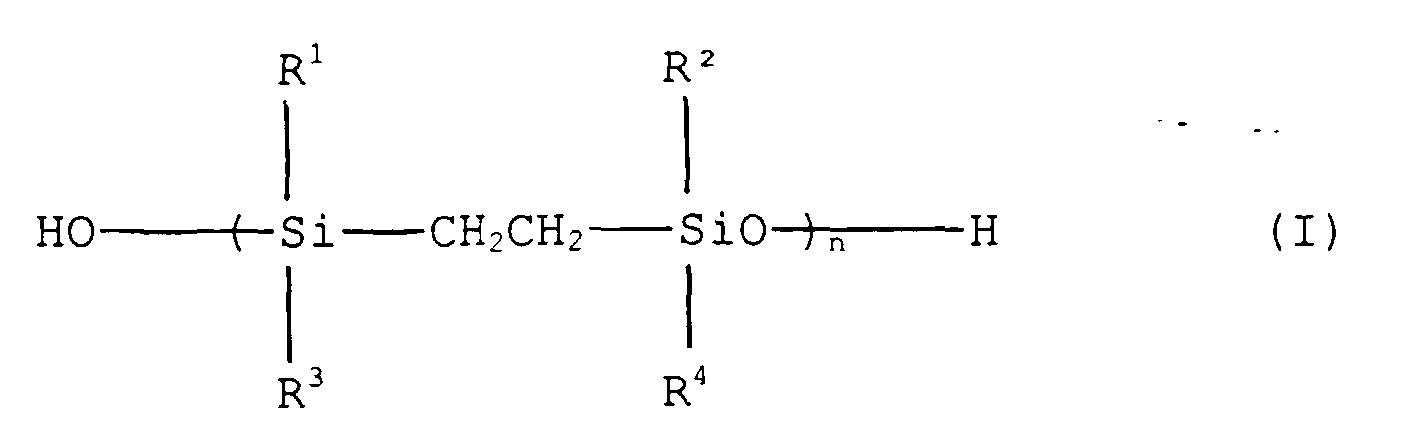
dans laquelle R1 et R2, qui peuvent être identiques ou différents, représentent chacun un groupe hydrocarboné ayant de 1 à 10 atomes de carbone, R3 et R4, qui peuvent être identiques ou différents, représentent chacun un groupe hydrocarboné ayant de 1 à 10 atomes de carbone ou un groupe perfluoroalkyléthyle représenté par les formules -CH2CH2CmF2m+1, où m est un nombre entier positif choisi de 4 à 10 et au moins un des radicaux R3 et R4 représente le groupe perfluoroalkyléthyle, et n est un nombre entier choisi de 10 à 1000.
dans laquelle R1 et R2, qui peuvent être identiques ou différents, représentent chacun un groupe hydrocarboné ayant de 1 à 10 atomes de carbone, R3 et R4, qui peuvent être identiques ou différents, représentent chacun un groupe hydrocarboné ayant de 1 à 10 atomes de carbone ou un groupe perfluoroalkyléthyle représenté par les formules -CH2CH2CmF2m+1, où m est un nombre entier positif choisi de 4 à 10 et au moins un des radicaux R3 et R4 représente le groupe perfluoroalkyléthyle, et n est un nombre entier choisi de 10 à 1000.
2. Polysiléthylènesiloxane tel que revendiqué dans la revendication 1, dans lequel ledit
groupe hydrocarboné est un groupe alkyle inférieur comportant jusqu'à 8 atomes de
carbone.
3. Polysiléthylènesiloxane tel que revendiqué dans la revendication 2, dans lequel ledit
groupe hydrocarboné est un groupe méthyle.
4. Polysiléthylènesiloxane tel que revendiqué dans la revendication 1, dans lequel, dans
ladite formule générale (I), R3 et R4 représentent chacun un groupe perfluoroalkyléthyle.
5. Polysiléthylènesiloxane tel que revendiqué dans l'une quelconque des revendications
1 à 4 dans lequel ledit groupe perfluoroalkyléthyle est choisi dans le groupe constitué
par C4F9CH2CH2-, C6F13CH2CH2-, C8F17CH2CH2- et C10F21CH2CH2-.