| (19) |
 |
|
(11) |
EP 0 468 560 B1 |
| (12) |
EUROPEAN PATENT SPECIFICATION |
| (45) |
Mention of the grant of the patent: |
|
07.12.1994 Bulletin 1994/49 |
| (22) |
Date of filing: 26.06.1991 |
|
|
| (54) |
Protein dispersions in food products
Protein-Dispersionen in Nahrungsmitteln
Dispersion de protéines dans les produits alimentaires
|
| (84) |
Designated Contracting States: |
|
AT BE CH DE DK ES FR GB GR IT LI NL SE |
| (30) |
Priority: |
23.07.1990 EP 90201987
09.08.1990 EP 90202164
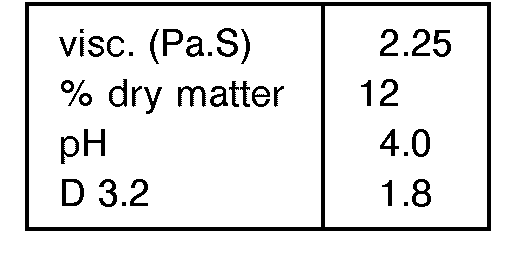
|
| (43) |
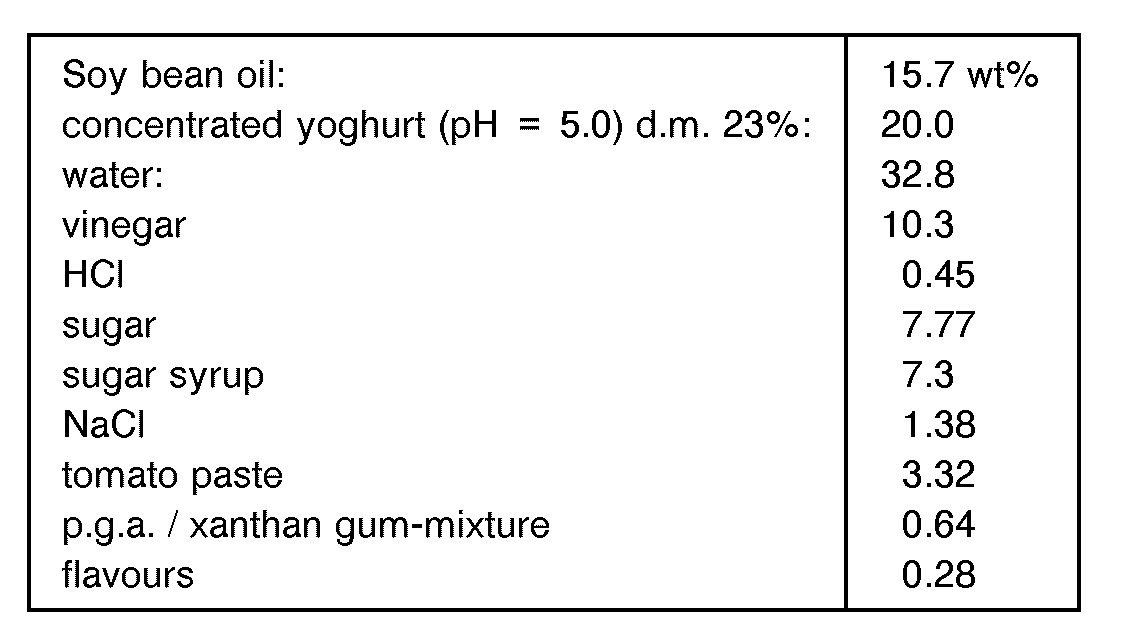
Date of publication of application: |
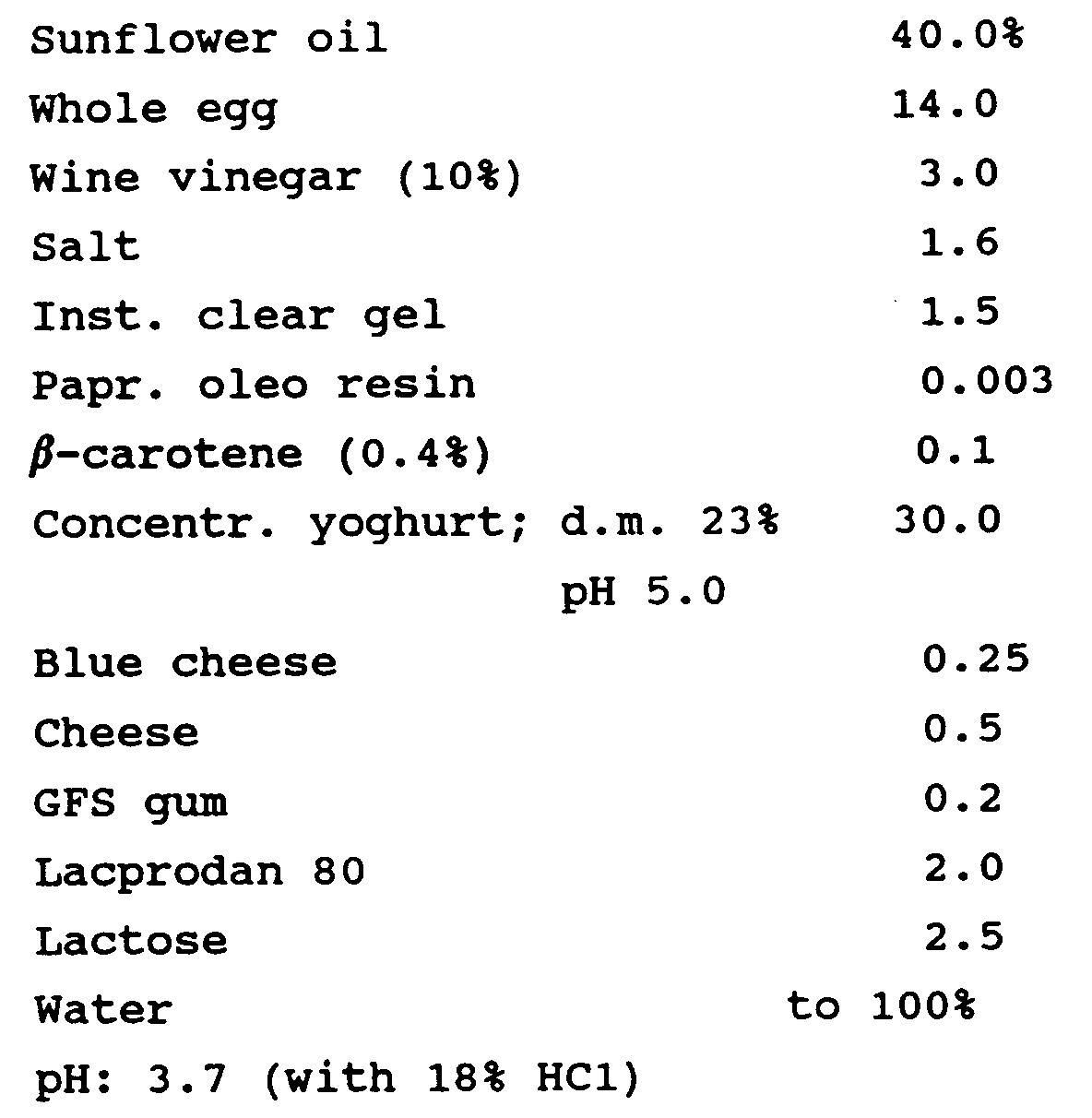
|
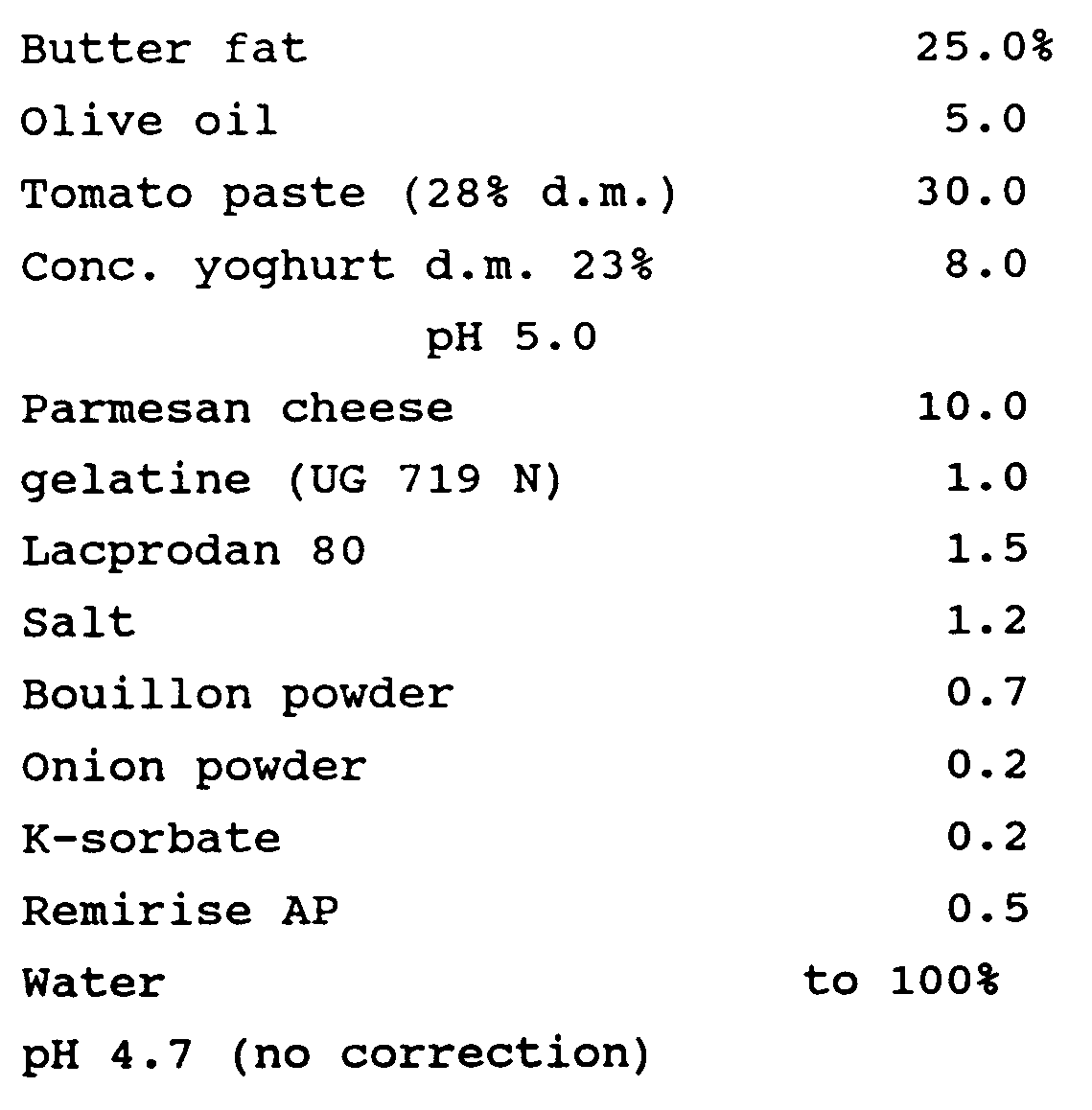
29.01.1992 Bulletin 1992/05 |
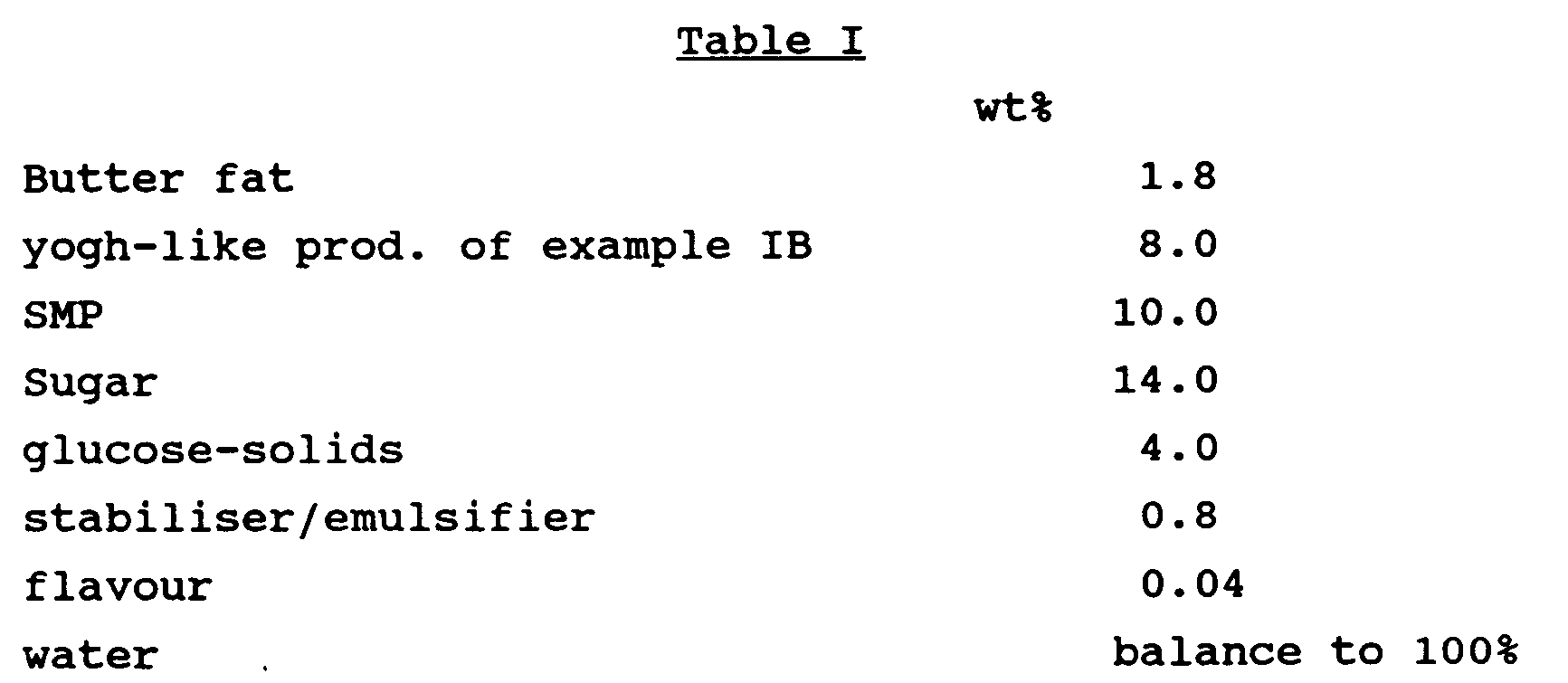
| (73) |
Proprietors: |
|
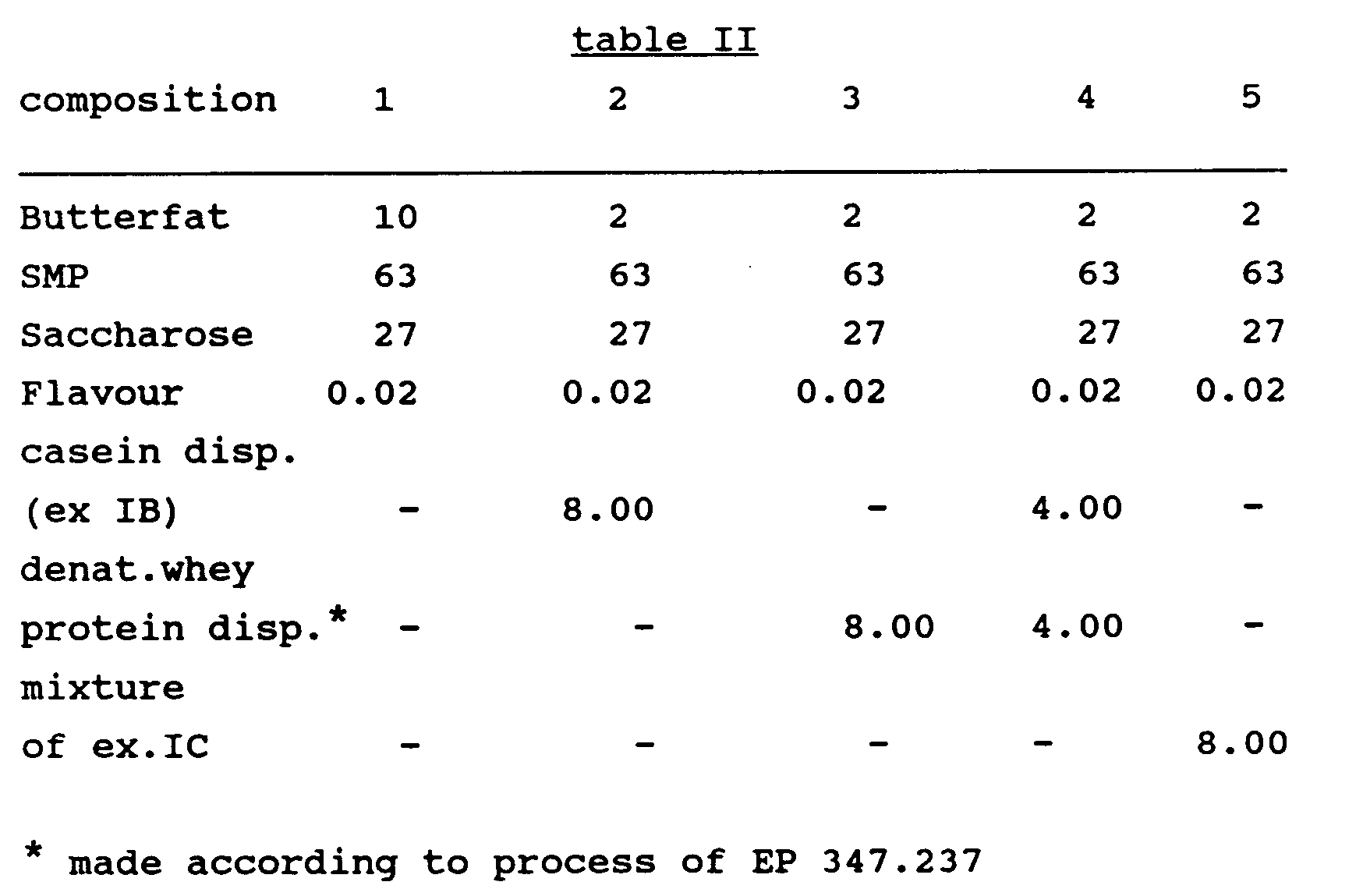
- UNILEVER N.V.
3013 AL Rotterdam (NL)
Designated Contracting States:
BE CH DE DK ES FR GR IT LI NL SE AT
- UNILEVER PLC
London EC4P 4BQ (GB)
Designated Contracting States:
GB
|
|
| (72) |
Inventors: |
|
- Cain, Frederick William
Vlaardingen (NL)
- Decio, Maurizio
Vlaardingen (NL)
- van Bodegem, Bertus Marinus
Vlaardingen (NL)
- van Gastel, Hubertus Cornelis
Vlaardingen (NL)
- Visser, Johannes
Vlaardingen (NL)
|
| (74) |
Representative: Eke, Philippa Dianne et al |
|
Unilever plc
Patent Division
Colworth House
Sharnbrook
Bedford MK44 1LQ
Bedford MK44 1LQ (GB) |
| (56) |
References cited: :
EP-A- 0 344 651
FR-A- 2 224 096
GB-A- 2 050 797
US-A- 4 307 123
|
EP-A- 0 345 226
FR-A- 2 247 168
GB-A- 2 063 273
|
|
| |
|
|
- FSTA, no. 86036276, 86-06-P0029; S. DAGHER et al.: "Effect of pasteurization,centrifugation
and additives on quality of concentrated yoghurt (Labneh)",& JOURNAL OF FOOD PROTECTION,
vol.48, no. 4, p. 300-302, 13 ref. 1985
- M.E. SCHULZ: "Enzyclopedia of Quark Specialities", 1985, VolkswirtschaftlicherVerlag,
Munich, DE
- FSTA, no. 88048136 (88-09-P0084); S.A. SALEM et al.: "Improvement of chemical,rheological
and organoleptic properties for local-low fat processed cheese",& EGYPTIAN JOURNAL
OF DAIRY SCIENCE,vol. 15, no. 2, p. 263-271, 19 ref. 1987
|
|
| |
|
| Note: Within nine months from the publication of the mention of the grant of the European
patent, any person may give notice to the European Patent Office of opposition to
the European patent
granted. Notice of opposition shall be filed in a written reasoned statement. It shall
not be deemed to
have been filed until the opposition fee has been paid. (Art. 99(1) European Patent
Convention).
|
[0001] In the last years it has become common practice to use low amounts of fats in food
products. Therefore quite a lot of fat replacers have been developed, which can be
used in food products in order to replace at least part of the fat, normally present
in the food product. These fat replacers must give a fatty mouthfeel, whereas they
also must take over the fat functionality of the fat in the food products.
[0002] Compounds from which it is stated in the prior art to meet these requirements are
e.g. polyol fatty acid polyesters and non-aggregated denatured proteins with a specific
particle size distribution. Recently the use of substantially non-aggregated casein
micelles as fat replacer in food products has been described (EP 345 226). These casein
containing products are obtained from skim milk, preferably from ultrafiltered skim
milk. Through the ultra filtration most of the lactose is removed from the casein
product. In order to obtain non-aggregated casein micelles it is essential that the
pH remains above 5.6. Below pH 5.6 aggregation of the micelles occurs.
[0003] In this EP application nothing is said about the use of aggregated casein micelles
obtained from yoghurt or quark.
[0004] In EP 344 651 a method is disclosed for the preparation of edible products, in particular
breadspreads, in which a mixture of a dewatered quark or yoghurt and an unsaturated
oil is used. In this application, however, nothing is said about the ratio of protein:
lactose in the dewatered product. As the yoghurt or quark is not heated the dewatered
product will contain live microorganisms, which will cause that the pH of the product
is always about 4.0. Moreover nothing is disclosed about the use of this dewatered
product in frozen dessert.
[0005] In Food Microstructure vol. 2 (1983) pages 51-66 a yoghurt product is described with
a dry matter content of 10-15% and a pH = 4.0. This product is obtained by centrifuging
a yoghurt. The product shows a casein to non-casein protein ratio of about 4.6:1 to
1.1:1.
[0006] FR 2,224,096 discloses yoghurt products prepared by concentrating a pasteurized milk
product followed by addition of live fermenting bacteria FSTA, no 86036272, 86-06-P0029
(Dagher et al) describes the preparation of concentrated yoghurt by pasteurization
followed by concentration.
[0007] From EP 240 326 soft ice compositions are known, wherein a dried natural yoghurt
powder, containing live bacilli, is present. The dried natural yoghurt powder can
be obtained by known methods. Nothing is disclosed about the pH of such a composition.
As these yoghurt powders are obtained from natural yoghurt with a pH = 4.1-4.6, the
pH of the dried powder will most probably be in the same range. Another consequence
of the use of dried, natural yoghurt will be that the lactose: casein ratio in the
dried product will be the same as in the natural yoghurt. Therefore the use of these
dried products in food products, e.g. in frozen dessert will automatically lead to
the introduction of quite a lot of lactose in the frozen dessert, with all the known
disadvantageous effects.
[0008] From US 4 307 123 it is known to prepare dry freezer mixes, which are preparable
with water. In these mixes 1,5-20% of a protein source is present. This protein source
can be yoghurt solids prepared by fermentation of a milkcompound. These proteins do
not necessary contain live active cultures and can have a bland taste. However in
this specification only the use of a yoghurt-like protein source, in the form of a
dried yoghurt solid, mixed with corn syrup solids, as available from Stauffer Chemical
Company, is disclosed.
[0009] We have now found new casein containing products, that show very good properties
as a fat replacer, e.g. the fatty mouthfeel of these products is excellent. These
products can be used in a number of food products wherein it can replace at least
part of the fat normally present in the food product.
[0010] The product according to this invention therefore comprises a concentrated casein
containing dispersion of substantially aggregated casein, preferably obtained from
yoghurt and/or quark, which dispersion has a dry matter content of 10-80, preferably
of 10-40 wt%, a pH of 4.8-5.2, whereas the weight ratio protein : lactose in the dispersion
varies from 2:1 to 10:1, and the dispersion is free from live, milk fermenting bacteria.
Preferred dry matter contents are 12 to 20 wt%. A useful product is obtained, when
the pH of the dispersion is 4.9-5.1. This product does not show an acidic taste.
Although the weight ratio protein : lactose can vary between 2:1 and 10:1, we prefer
to use weight ratios of 2.5:1 to 6:1, most preferably 3:1 to 5:1.
[0011] Another product according to the invention comprises a mixture of a concentrated
casein containing dispersion especially obtained from yoghurt or quark of substantially
aggregated casein, which dispersion has a dry matter content of 10-80 wt%, preferably
10-40 wt%, a pH of 4.8 - 5.2, whereas the weight ratio protein : lactose in the dispersion
varies from 2:1 to 10:1 which dispersion is free from live, milk fermenting bacteria
and a denatured protein particles containing aqueous dispersion that contains particles
with a mean particle size, when measured dry of more than 0.6 am. More preferably
the mean particle size of the denatured protein is more than 1.5 am, in particular
2.0-20 am, when measured according to the technique described in EP 250 623 or EP
323 529.
[0012] Although in the yoghurt or quark dispersion the weight ratio protein : lactose can
vary between 2:1 and 10:1, we prefer to use weight ratios of 2.5:1 to 6:1, most preferably
3:1 to 5:1.
[0013] The taste of the denatured, nonaggregated protein particles with a particle size,
that is unsuitable for organoleptic purposes according to EP 250 623, because of the
large particle size, is improved by mixing those particles with the concentrated yoghurt
or quark.
Therefore good results are obtained, when the concentrated yoghurt or quark and the
denatured protein product are first made separately, after which the fractions are
mixed.
The mixing of the two fractions should be done in such a way that the dry matter content
of the mixed product is 10-30 wt%. This can be achieved by a) mixing of a concentrated
yoghurt or quark with a high dry matter content (40-80 wt%) with a denatured protein
containing dispersion with a relatively low dry matter content (5-20 wt%) or b) mixing
of a concentrated yoghurt or quark with a relatively low dry matter content (10-25
wt%) with a nearly dry denatured protein containing product, as can be obtained from
the protein dispersion as is described in our patent application EP 412 590. Of course
it is also possible to mix two fractions with dry matter contents in accordance with
that of the desired end product.
[0014] Another way to come to the desired product is by mixing first of natural yoghurt
or quark with the denatured protein containing dispersion and than removing a part,
preferably at least 40% of the water, until in the end product the required ratio
lactose: casein for the yoghurt or quark fraction is obtained.
[0015] However, the best results are obtained when the denatured protein dispersion is added
to the milk product before it is fermented, then adding the bacteria culture and fermenting
the mixture. After separation of part of the waterlayer, e.g. by centrifugation a
mixture according to the invention is obtained, consisting mainly of concentrated
casein and denatured protein.
The ratio in which the two fractions can be mixed can vary considerably. As long as
the ratio of casein to non-casein protein in the end product is between 0.3 and 3.0
a useful end product is obtained.
[0016] The product according to the invention cannot be made by first mixing a yoghurt or
quark fraction into an undenatured protein containing solution and than heating the
mixture to denature the protein.
[0017] In addition to the components present in our dispersions we prefer to use a gelling
agent in our casein- containing dispersions. Preferred gelling or stabilising agents
are kappa- and iota carrageenan, gelatin, gelling starch, xanthangum, alginate, agar,
gellan, pectin, guargum, locust bean gum, microcrystalline cellulose or cellulose
powder. The gelling agent is preferably added to the fermented product before it is
heated in order to stop the fermentation.
[0018] The mixtures can be used in several food products. Excellent frozen desserts, toppings,
dressings, cheese-products, mayonnaises, low fat spreads and zero fat spreads are
obtained by incorporating into the products of 2 to 90 wt% of the casein, or casein
and denatured protein containing dispersions.
[0019] Especially by incorporation of 2 - 60 wt% of the casein dispersions in toppings,
toppings with excellent properties are obtained. Similarly the dressings contain preferably
5 to 50 wt% of the dispersion, the mayonnaises 5 to 60 wt%, the low fat spreads 5
to 80 wt% and the zero fat spreads 5 to 90 wt%. The frozen dessert can contain 2-85
wt% of this dispersion.
[0020] The dispersions of concentrated, substantially aggregated casein micelles can easily
be obtained from milkproducts by adding milk fermenting bacteria, e.g. Lactobacillus
bulgaricus, Lactobacillus acidophilus, Bifido bacteria Langem, Bifido bacteria breve,
S. cremoris, S. diacetylactus, S. lactus, Leuconostoc cremoris, or S. thermophilus,
to the milkproduct, fermenting the milk at normal temperature conditions (32-42 °C)
until the pH = 4.8-5.2, stopping the fermentation by heating the fermented milk above
70
° C and removing 45 to 75% on weight basis of the water layer of the fermented product.
This last step can be performed by centrifugation or ultra filtration of the fermented
product. The fermentation is preferably stopped at pH = 4.9-5.1. As fermenting agent
also mixtures of yeasts and the above mentioned bacteria can be used. As has been
disclosed above the fermentation can also be performed in the presence of denatured
(whey) protein particles.
[0021] For the centrifugation an MSE-coolspin centrifuge can be used. Centrifugation times
being 10 - 45 minutes at 3,500 - 7,000 rpm (RCF: about 5000 g).
[0022] When ultra filtration is applied, this should be carried out using a membrane that
passes lactose, water and other soluble milk products, whereas the casein micelles
are retained. A membrane with a rating of 8,000 - 15,000 Daltons is very suitable.
[0023] In this separation process at least 40 wt% of the lactose originally present in the
yoghurt or quark is removed via the water layer.
[0024] It is also possible to prepare a casein dispersion with a pH = 4.8-5.2 by the following
process:
1) wash a casein dispersion with pH 4.0-4.6 with skimmed milk
2) concentrate it by centrifugation to 20 - 60% of its original weight
3) wash it with water
4) concentrate it to 15 - 80% of its original weight.
[0025] In this way a product can be obtained that does not show the particular acidic taste
of yoghurt, when the pH of the yoghurt or quark is adjusted to 4.8 - 5.2 before the
centrifugation takes place. However, the pH decreases again, because of a fermentation
that can perform as live bacteria are still present in the product.
[0026] The invention also concerns the use of aggregated casein containing dispersions in
food products wherein the casein dispersions according to the invention are used as
fat replacer in toppings, dressings, mayonnaise, low fat spreads, zero fat spreads,
cheese products, or frozen desserts.
[0027] The processing for the manufacturing of the different products is illustrated with
the following examples:
Example I
Preparation of casein-dispersion:
[0028] A. Fat free yoghurt was centrifuged in a MSE coolspin centrifuge for 30 min. at 4200
rpm. 50% whey was decanted from the yoghurt. This led to a product with the following
characteristic:
[0029] The pH of this product was adjusted by adding skim milk « 1 % fat) in an amount that
was about equal to the amount of concentrated yoghurt. The pH of this product was
4.9. The mixture obtained was centrifuged again to a d.m. content of 15%. The product
was stored at 0.5 °C. The product displayed a sweet/cheesy taste. After storage for
1 week at 0.5 °C the pH of the product was 4.4, whereas the viscosity was now at 20
° C : 160 (Haake VT 02). This product still had a sweet/cheesy taste, however the mouthfeel
was quite dry/chalky. Some noticeable lumps were present in the product.
IB: To skimmed milk a culture of Lactobacillus bulgaricus was added. The milk was
fermented at 40 °C. During the fermentation the pH was measured. The moment a pH of
5.0 was reached, 0.1 wt% of xanthan gum was added to the mixture and the partially
fermented milkproduct was heated to a temperature of 75°C for 15 secs. The heated
product, that no longer contained live bacteria, was centrifuged in a MSE coolspin
centrifuge for 30 min at 4200 rpm. 50% of the whey was decanted from the product.
In this way a concentrated, yoghurt-like product with a dry matter content of 23%
and a pH = 5.0 was obtained.
After 1 week storage at 0.5 ° C the product displayed the following characteristics:
d.m. content 23%
pH 5.0
viscosity at 20 ° C : 15 (Haake VT 02)
The product tasted quite neutral, had a pleasant, smooth mouthfeel, although it was
a bit slimy. IC A mixture of skimmed milk and 15 wt% of centrifuged denatured whey
protein with a mean particle size, when measured dry, of 0.8 µm, prepared according
to the process described in EP 347 237, was made. This mixture was fermented and treated
in the same way as described in IB. In this way a product was obtained that displayed
the following characteristics:
d.m. content : 20%
pH = 4.9
pH, after storage at 0.5 ° C for 1 week : 4.8
viscosity at 20 ° C: 47 (Haake VT 02)
The taste of this product was the same as that of product IB. However, the typical
after taste, that is connected with the denatured whey protein, was almost completely
masked.
Example 11
Preparation of French Dressing
[0030] A water phase (ambient T) containing water, sugar, cider, vinegar, fructose, brine,
flavour and tomato paste is mixed with an oil phase, containing oil, xanthan gum,
prop.glyc.alg., EDTA and onion powder using a ultra turrax mixer. After 10 min. mixing
a second oil phase is added, containing oil, mustard flower, paprika oleoresin, garlic
concentrate and another mixing for 5 min. with the ultra turrax is carried out. The
obtained mixture is homogenized, using a Prestomill: setting 8 slit width 0°. This
way an emulsion is obtained with a droplet size of 10-12 µm.
At this stage the product of example IB is brought into the mixture and mixing is
performed (5 min Ultra Turrax). The pH is adjusted to 3.1-3.3 and another homogenisation
takes place with the Prestomill: setting 3 slit width 400 °.
This way the following french dressing is obtained, which has excellent taste properties.
Example III
Preparation of spreadable mayonnaise
[0031] In a way similar to the method described in example II a mayonnaise with the following
composition is produced:
Example IV
Preparation of a topping (for spaghetti).
[0032] A topping was made in a way similar to the methods of examples II and III, which
had the following composition:
Example V
Preparation of ice-cream
[0033] A water continuous emulsion was made of the ingredients mentioned in table I in the
given amounts.
[0034] The emulsion was homogenised at 20°C using a single stage Rannie (P = 150-180 bar)
homogeniser. The homogenised product was pasteurised at 85
° C for 20 secs. The pasteurised product was cooled in a heat-exchanger to 8 °C. The
cooled product was left overnight at this temperature. The mixture so obtained was
fed to a continuous ice-cream freezer (MFSO-Technoho), while air was introduced, to
cool the product to -5 °C.
[0035] This way an excellent ice-cream was obtained, that showed an overrun of 100%, an
acceptable texture and an excellent taste (not acidic, no after taste). The melt down
of this product was slightly better than the melt down of an ice-cream that contained
1.5 wt% butterfat and 8.5 wt% denatured whey protein.
Example VI
Preparation of frozen desert
[0036] Five different water continuous emulsions were prepared with the compositions, mentioned
in table II.
[0037] From these compositions ice creams were made in the usual way (cf. ex V). The taste
of these products were tested by a panel.
[0038] The results being:
mixt 1 = mixt 2 = mixt 5 > mixt 4 » mixt 3.
[0039] The product of composition 5 did not show an after taste, whereas the creaminess
was improved, compared with the products of composition 4 or of composition 3. Therefore
it is advantageous to add denatured whey protein to the milk before the fermentation
is performed.
1. Concentrated casein containing dispersion characterised by a substantially aggregated
casein containing dispersion, which has a dry matter content of 10-80 wt%, a pH of
4.8 - 5.2, whereas the weight ratio protein: lactose in the dispersion varies from
2:1 to 10:1 and the dispersion is free from live, milk fermenting bacteria.
2. Concentrated casein containing dispersion according to claim 1, wherein the dry
matter content varies from 12 to 20 wt%.
3. Concentrated casein containing dispersion according to claims 1 and 2, wherein
the pH = 4.9 - 5.1.
4. Concentrated casein containing dispersion according to claims 1 - 3, wherein the
weight ratio protein: lactose is 2.5:1 to 6:1, whereas the dispersion optionally contains
a gelling agent.
5. A mixture of a concentrated casein containing dispersion, according to claim 1
and a denatured protein particles containing agueous dispersion, that contains particles
with a mean particle size, when measured dry, of more than 0.6 I.Lm.
6. Mixture according to claim 5, wherein the dry matter content varies from 10 to
30 wt%.
7. Mixture according to claims 5 and 6, wherein the pH of the concentrated casein
containing dispersion is 4.8 - 5.2.
8. Mixture according to claims 5 - 7, wherein the weight ratio protein: lactose in
the concentrated casein containing dispersion is 2.5:1 to 6:1, whereas the mixture
optionally contains a gelling agent.
9. Mixture according to claims 5-8, wherein the weight ratio casein protein: non-casein
protein is 0.3-3.0.
10. Topping characterised by the presence of 2 to 60 wt% of at least one of the products
of claims 1 - 9.
11. Topping according to claim 10, wherein the pH of the topping is 3.0 to 5.6 and
at least part of the fat normally present is replaced by the mixture.
12. Dressing, characterised by the presence of 5 to 50 wt% of at least one of the
products of claims 1 - 9.
13. Dressing according to claim 12, wherein the pH of the dressing is 2.5 to 5.0 and
at least part of the fat normally present is replaced by the mixture.
14. Mayonnaise characterised by the presence of 5 to 60 wt% of at least one of the
products of claims 1 - 9.
15. Mayonnaise according to claim 14, wherein the pH of the mayonnaise is 2.5 to 5.6
and at least part of the fat normally present is replaced by the mixture.
16. Low fat spreads characterised by the presence of 5 to 80 wt% of at least one of
the products of claims 1 -9.
17. Low fat spreads according to claim 16, wherein the pH of the spread is 4.5 to
5.6 and at least part of the fat normally present is replaced by the mixture.
18. Zero fat spreads characterised by the presence of 5 to 90 wt% of at least one
of the products of claims 1 -9.
19. Frozen dessert characterised by the presence of 2-85 wt% of at least one of the
products of claims 1 - 9.
20. Topping, dressing, mayonnaise, frozen dessert, low fat spread or zero fat spreads
according to the claims 10 - 19, wherein in addition to the mixture of claims 1 -
9 also a gelling agent is present.
21. Food products according to claim 20, wherein the gelling agent is chosen from
the group: Kappa- and iota carrageenen, gelatin,- gelling starch, xanthan gum, agar,
alginate, gellan, pectin and microcrystalline cellulose.
22. Process for the manufacture of a concentrated, substantially aggregated casein
containing dispersion according to claim 1 characterised by adding to a milkproduct
milkfermenting bacteria, fermenting the milk until the pH = 4.8-5.2, stopping the
fermentation by heating the fermented milk above 70 ° C and removing 45 to 75% on weight basis of the water layer of the fermented product.
23. Process according to claim 22, wherein the removal of the waterlayer is performed
by centrifugation or ultrafiltration.
24. Process according to claims 22 and 23 wherein at least 40 wt% of the lactose originally
present in the yoghurt or the quark is removed via the water layer.
25. Process for the manufacture of a protein containing mixture according to claim
5 wherein a concentrated, substantially aggregated casein containing dispersion and
a denatured protein containing dispersion in which the particles have a mean particle
size of more than 0.6 I.Lm are mixed.
26. Process according to claim 25, wherein the casein containing dispersion and the
denatured protein containing dispersion are mixed in a ratio such, that in the end
mixture the weight ratio casein protein : non-casein proteins 0.3 - 3.0.
27. Process according to claim 22, wherein the fermentation is stopped at pH = 4.9-5.1.
28. Process according to claim 22, wherein the fermentation is carried out with Lactobacillus
bulgaricus, Lactobacillus acidophilus or S.thermophilus.
29. Process for the preparation of a protein containing mixture according to claim
5, wherein a milk product is fermented by a milk fermenting compound in the presence
of denatured protein particles with a mean particle size of at least 0.6 am, whereupon
at least 40% of the waterlayer is removed in such a way that most of the lactose,
present in the product is separated from the remaining casein/denatured protein dispersion.
30. Use of aggregated casein containing dispersions in food products, wherein the
dispersions of claims 1-4 are used as fat replacer in toppings, frozen desserts, dressings,
mayonnaises, low fat spreads or zero fat spreads.
31. Use of a mixture of aggregated casein and denatured protein containing dispersions
in food products, wherein the mixtures of claims 5 - 9 are used as fat replacer in
toppings, frozen dessert, dressings, mayonnaises, low fat spreads or zero fat spreads.
1. Konzentrierte, kaseinhaltige Dispersion, gekennzeichnet durch eine im wesentlichen
aggregiertes Kasein enthaltende Dispersion, die einen Trochensubstanzgehalt von 10
bis 80 Gew.-% und einen pH-Wert von 4,8 bis 5,2 hat, während das Gewichtsverhältnis
von Protein zu Lactose in der Dispersion von 2:1 bis 10:1 variiert und die Dispersion
von lebenden, milchfermentierenden Bakterien frei ist.
2. Konzentrierte, kaseinhaltige Dispersion nach Anspruch 1, in der der Trockenmateriegehalt
von 12 bis 20 Gew.-% variiert.
3. Konzentrierte, kaseinhaltige Dispersion nach Ansprüchen 1 und 2, in welcher der
pH-Wert 4,9 bis 5,1 beträgt.
4. Konzentrierte, kaseinhaltige Dispersion nach Ansprüchen 1 bis 3, in welcher das
Gewichtsverhältnis von Protein zu Lactose 2,5:1 bis 6:1 beträgt, während die Dispersion
fakultativ ein Geliermittel enthält.
5. Mischung aus einer konzentrierten, kaseinhaltigen Dispersion nach Anspruch 1 und
einer denaturierte Proteinteilchen enthaltenden, wäßrigen Dispersion, die Teilchen
einer in trockenem Zustand gemessenen mittleren Teilchengröße von mehr als 0,6 um
enthält.
6. Mischung nach Anspruch 5, in welcher der Trockensubstanzgehalt von 10 bis 30 Gew.-%
variiert.
7. Mischung nach den Ansprüchen 5 und 6, in welcher der pH-Wert der konzentrierten,
kaseinhaltigen Dispersion 4,8 bis 5,2 beträgt.
8. Mischung nach Ansprüchen 5 bis 7, in welcher das Gewichtsverhältnis von Protein
zu Lactose in der konzentrierten, kaseinhaltigen Dispersion 2.5:1 bis 6:1 beträgt,
während die Mischung fakultativ ein Geliermittel enthält.
9. Mischung nach Ansprüchen 5 bis 8, in welcher das Gewichtsverhältnis von Kasein-zu
Nicht-Kaseinprotein 0,3 bis 3,0 beträgt.
10. Beilage, gekennzeichnet durch das Vorliegen von 2 bis 60 Gew.-% mindestens eines
der Produktes der Ansprüche 1 bis 9.
11. Beilage nach Anspruch 10, in welcher der pH-Wert derselben 3,0 bis 5,6 beträgt
und mindestens ein Teil des normalerweise vorliegenden Fettes durch die Mischung ersetzt
ist.
12. Dressing, gekennzeichnet durch das Vorliegen von 5 bis 50 Gew.-% mindestens eines
der Produkte der Ansprüche 1 bis 9.
13. Dressing nach Anspruch 12, in welchem der pH-Wert desselben 2,5 bis 5,0 beträgt
und mindestens ein Teil des normalerweise vorliegenden Fettes durch die Mischung ersetzt
ist.
14. Mayonnaise, gekennzeichnet durch das Vorliegen von 5 bis 60 Gew.-% mindestens
eines der Produkte der Ansprüche 1 bis 9.
15. Mayonnaise nach Anspruch 14, in welcher der pH-Wert derselben 2,5 bis 5,6 beträgt
und mindestens ein Teil des normalerweise vorliegenden Fettes durch die Mischung ersetzt
ist.
16. Aufstrich mit niedrigem Fettgehalt, gekennzeichnet durch das Vorliegen von 5 bis
80 Gew.-% mindestens eines der Produkte der Ansprüche 1 bis 9.
17. Aufstrich mit niedrigem Fettgehalt nach Anspruch 16, in welchem der pH-Wert desselben
4,5 bis 5,6 beträgt und mindestens ein Teil des normalerweise vorliegenden Fettes
durch die Mischung ersetzt ist.
18. Aufstrich ohne Fettgehalt, gekennzeichnet durch das Vorliegen von 5 bis 90 Gew.-%
mindestens eines der Produkte der Ansprüche 1 bis 9.
19. Gefrorenes Dessert, gekennzeichnet durch das Vorliegen von 2 bis 85 Gew.-% mindestens
eines der Produkte der Ansprüche 1 bis 9.
20. Beilage, Dressing, Mayonnaise, gefrorenes Dessert, Aufstriche mit niedrigem oder
ohne Fettgehalt nach Ansprüchen 10 bis 19, in welchen zusätzlich zur Mischung der
Ansprüche 1 bis 9 ein Geliermittel vorliegt.
21. Nahrungsmittelprodukte nach Anspruch 20, in welchen das Geliermittel aus der Gruppe
von kappa- und iota-Carrageenan, Gelatine, gelierender Stärke, Xanthangummi, Agar,
Alginat, Gellan, Pektin und mikrokristalliner Cellulose ausgewählt ist.
22. Verfahren zur Herstellung einer konzentrierten, im wesentlichen aggregiertes Kasein
enthaltenden Dispersion nach Anspruch 1, gekennzeichnet durch das Zugeben milchfermentierender
Bakterien zu einem Milchprodukt, Fermentieren der Milch bis zu einem pH-Wert von 4,8
bis 5,2, Abbrechen der Fermentation durch Erhitzen der fermentierten Milch auf mehr
als 70 ° C und Entfernen von 45 bis 75 %, bezogen auf das Gewicht, der Wasserschicht des fermentierten
Produktes.
23. Verfahren nach Anspruch 22, bei welchem die Entfernung der Wasserschicht durch
Zentrifugieren oder Ultrafiltration erfolgt.
24. Verfahren nach Ansprüchen 22 und 23, bei welchem mindestens 40 Gew.-% der ursprünglich
in Joghurt oder Quark vorliegenden Lactose über die Wasserschicht entfernt sind.
25. Verfahren zur Herstellung einer proteinhaltigen Mischung nach Anspruch 5, bei
welchem eine konzentrierte, im wesentlichen aggregiertes Kasein enthaltende Dispersion
und eine denaturiertes Protein enthaltende Dispersion, in welcher die Teilchen eine
mittlere Teilchengröße von mehr als 0,6 um haben, gemischt werden.
26. Verfahren nach Anspruch 25, bei welchem die kaseinhaltige Dispersion und die denaturiertes
Protein enthaltende Dispersion in einem solchen Verhältnis gemischt werden, daß in
der Endmischung das Gewichtsverhältnis von Kaseinprotein zu Nicht-Kaseinproteinen
0,3 bis 3,0 beträgt.
27. Verfahren nach Anspruch 22, bei welchem die Fermentation bei einem pH-Wert von
4,9 bis 5,1 abgebrochen wird.
28. Verfahren nach Anspruch 22, bei welchem die Fermentaiton mit Lactobacillus bulgaricus,
Lactobacillus acidophilus oder S. thermophilus durchgeführt wird.
29. Verfahren zur Herstellung einer proteinhaltigen Mischung nach Anspruch 5, bei
welchem ein Milchprodukt durch eine milchfermentierende Verbindung in Gegenwart denaturierter
Proteinteilchen mit einer mittleren Teilchengröße von mindestens 0,6 um fermentiert
wird, worauf mindestens 40 % der Wasserschicht in solcher Weise entfernt werden, daß
der größe Teil der im Produkt vorliegenden Lactose aus der verbleibenden Kasein/denaturiertes
Protein enthaltenden Dispersion abgetrennt wird.
30. Verwendung von aggregiertes Kasein enthaltenden Dispersionen in Nahrungsmittelprodukten,
bei der die Dispersionen der Ansprüche 1 bis 4 als Fettersatzstoff in Beilagen, gefrorenen
Desserts, Dressings, Mayonnaisen und Aufstrichen mit niedrigem oder ohne Fettgehalt
verwendet werden.
31. Verwendung einer Mischung von aggregiertes Kasein und denaturiertes Protein enthaltenden
Dispersionen in Nahrungsmittelprodukten, bei der die Mischungen der Ansprüche 5 bis
9 als Fettersatzstoff in Beilagen, gefrorenem Dessert, Dressings, Mayonnaisen und
Aufstrichen mit niedrigem oder ohne Fettgehalt verwendet werden.
1. Dispersion contenant une caséine concentrée, caractérisée par une dispersion contenant
une casésine sensiblement agrégée présentant une teneur en matière sèche de 10 à 80%
en poids, un pH de 4,8 à 5,2, tandis que le rapport pondéral protéine:lactose dans
la dispersion varie entre 2:1 et 10:1 et la dispersion est exempte de bactéries vivantes
de fermentation de lait.
2. Dispersion contenant une caséine concentrée selon la revendication 1, dans laquelle
la teneur en matière sèche varie entre 12 et 20% en poids.
3. Dispersion contenant une caséine concentrée selon les revendications 1 et 2, dans
laquelle le pH est compris entre 4,9 et 5,1.
4. Dispersion contenant une caséine concentrée selon les revendications 1 à 3, dans
laquelle le rapport pondéral protéine:lactose est compris entre 2,5:1 et 6:1, tandis
que la dispersion contient facultativement un agent gélifiant.
5. Mélange d'une dispersion contenant une caséine concentrée selon la revendication
1, avec une dispersion aqueuse contenant des particules de protéine dénaturée, ces
particules ayant une granulométrie moyenne quand on les mesure à sec de plus de 0,6
um.
6. Mélange selon la revendication 5, dans lequel la teneur en matière sèche varie
entre 10 et 30% en poids.
7. Mélange selon les revendications 5 et 6, dans lequel le pH de la dispersion contenant
la caséine concentrée est de 4,8 à 5,2.
8. Mélange selon les revendications 5 à 7, dans lequel le rapport pondéral protéine:lactose
dans la dispersion contenant la caséine concentreé est compris entre 2,5:1 et 6:1,
tandis que le mélange contient facultativement un agent gélifiant.
9. Mélange selon les revendications 5 à 8, dans lequel le rapport pondéral de la protéine
de caséine à la protéine non caséinée est de 0,3 à 3,0.
10. Garniture, caractérisée par la présence de 2 à 60% en poids d'au moins l'un des
produits selon les revendications 1 à 9.
11. Garniture selon la revendication 10, dont le pH est de 3,0 à 5,6 et au moins une
partie de la graisse normalement présente est remplacée par le mélange.
12. Assaisonnement, caractérisé par la présence de 5 à 50% en poids d'au moins l'un
des produits des revendications 1 à 9.
13. Assaisonnement selon la revendication 12, dans lequel le pH est de 2,5 à 5,0 et
une partie au moins de la graisse normalement présente est remplacée par le mélange.
14. Mayonnaise, caractérisée par la présence de 5 à 60% en poids d'au moins l'un des
produits des revendications 1 à 9.
15. Mayonnaise selon la revendication 14, dont le pH est de 2,5 à 5,6 et une partie
au moins de la graisse normalement présente est remplacée par le mélange.
16. Produits à tartiner pauvres en graisse caractérisés par la présence de 5 à 80%
en poids d'au moins l'un des produits des revendications 1 à 9.
17. Produits à tartiner pauvres en graisse selon la revendication 16, dont le pH est
de 4,5 à 5,6 et au moins une partie de la graisse normalement présente est remplacée
par le mélange.
18. Produits à tartiner à 0% de matière grasse, caractérisés par la présence de 5
à 90% en poids d'au moins l'un des produits des revendications 1 à 9.
19. Dessert glacé, caractérisé par la présence de 2 à 85% en poids d'au moins l'un
des produits des revendications 1 à 9.
20. Garniture, assaisonnement, mayonnaise, dessert glacé, produit à tartiner pauvre
en graisse ou produit à tartiner à 0% de matière grasse selon les revendications 10
à 19, qui contiennent outre le mélange des revendications 1 à 9, aussi un agent gélifiant.
21. Produits alimentaires selon la revendication 20, dans lesquels l'agent gélifiant
est choisi parmi les kappa- et iota- carragheenanes, la gélatine, l'amidon gélifiant,
la gomme de xanthane, l'agar-agar, l'alginate, le gellan, la pectine et la cellulose
microcristalline.
22. Procédé de fabrication d'une dispersion contenant une caséine concentrée sensiblement
agrégée, selon la revendication 1, caractérisé en ce qu'on ajoute à un produit lacté
une bactérie de fermentation du lait, on fait fermenter le lait jusqu'à un pH de 4,8
à 5,2, on arrête la fermentation en chauffant le lait fermenté au dessus de 70 ° C et on soutire de 45 à 75% en poids de la couche d'eau, du produit fermenté.
23. Procédé selon la revendication 22, dans lequel on effectue l'enlèvement de la
couche aqueuse par centrifugation ou ultrafiltration.
24. Procédé selon les revendications 22 et 23, dans lequel on soutire avec la couche
aqueuse au moins 40% en poids du lactose initialement présent dans le yoghurt et le
quark.
25. Procédé de production d'un mélange contenant une protéine selon la revendication
5, dans lequel on mélange une dispersion contenant une caséine concentrée sensiblement
agrégée et une dispersion contenant une protéine dénaturée dont les particules ont
une granulométrie moyenne de plus de 0,6 um.
26. Procédé selon la revendication 25, dans lequel on mélange la dispersion contenant
la caséine et la dispersion contenant la protéine dénaturée dans un rapport tel que
dans le mélange final, le rapport pondéral de protéine caséinée à la protéine non
caséinée soit de 0,3 à 3,0.
27. Procédé selon la revendication 22, dans lequel on arrête la fermentation à un
pH de 4,9 à 5,1.
28. Procédé selon la revendication 22, dans lequel on effectue la fermentation avec
Lactobacillus bulgaricus, Lactobacillus acidophilus ou S. thermophilus.
29. Procédé de préparation d'un mélange contenant de la proétine selon la revendication
5, dans lequel on fait fermenter un produit laitier à l'aide d'un composé de fermentation
du lait en présence de particules de protéine dénaturée ayant une granulométrie moyenne
d'au moins 0,6 um, de sorte qu'on retire au moins 40% de la couche d'eau de manière
que la majeure partie du lactose présent dans le produit soit séparée de la dispersion
restante caséine/protéine dénaturée.
30. Utilisation de dispersions contenant une caséine agrégée dans des produits alimentaires,
utilisant les dispersions des revendications 1 à 4 comme substitut de matière grasse
dans les garnitures les desserts glacés, les assaisonnements les mayonnaises les produits
à tartiner pauvres en graisse et les produits à tartiner à 0% de matière grasse.
31. Utilisation d'un mélange de dispersions contenant une caséine agrégée et une protéine
dénaturée dans des produits alimentaires, dans laquelle on emploie des mélanges selon
les revendications 5 à 9, pour remplacer la matière grasse dans les garnitures, les
desserts glacés, les assaisonnements, les mayonnaises, les produits à tartiner pauvres
en matière grasse et les produits à tartiner à 0% de matière grasse.