|
(11) | EP 0 469 690 B1 |

| (12) | EUROPEAN PATENT SPECIFICATION |
|
|
| (54) |
Molluscicides Molluskizide Molluscicides |
|
|
|||||||||||||||||||||||||||||||||||
| Note: Within nine months from the publication of the mention of the grant of the European patent, any person may give notice to the European Patent Office of opposition to the European patent granted. Notice of opposition shall be filed in a written reasoned statement. It shall not be deemed to have been filed until the opposition fee has been paid. (Art. 99(1) European Patent Convention). |
[0002] Chemical Abstracts, vol. 101, No. 19 November 5, 1984, p233 ref No. 165584k, an abstract of JP-A-59 122405 (Moon Star Chemical Corp.) describes the use of compositions containing metal salts, to control gastropods.
[0003] Chemical Abstracts, vol. 105, No. 5 August 4, 1986 p228 ref No. 37193c, an abstract of Ann Rech. Vet. 1986, 17(1), 21-8 discloses the molluscicidal effect of iron and cuprous compounds.
[0005] Accordingly the present invention comprises the use as a molluscicide of a chelate of iron (III) with a ligand of formula II
in which formula:
- R³
- represents:
C₁-C₆ alkyl, provided that when the alkyl group contains more than four carbon atoms the group is a branched chain alkyl group.
[0006] In general, chelates comprising three bidentate ligands, which may be identical or different, though which usually are identical, are preferred and especially those which lose one ligand molecule or ion to form a bis cation.
[0007] The ligands of formulae II are readily derived respectively from compounds of formula IIA: R³NOH.N=O, by loss of a proton.
[0008] It is preferred that R³ contains no more than four carbon atoms, R³ is preferably methyl, ethyl or n-propyl and the chelate is preferably a trischelate of FeIII comprising identical ligands.
[0009] The following compounds of formula IIA are of particular interest:
- IIA:
- CH₃NOH.N=O
CH₃CH₂NOH.N=O
CH₃CH₂CH₂NOH.N=O
(CH₃)₂CHNOH.N=O
CH₃(CH₂)₂CH₂NOH.N=O
CH₃CH₂CH(CH₃)NOH.N=O
(CH₃)₂CHCH₂NOH.N=O
Mg + R³X → R³MgX
In the foregoing formulae X represents halogen e.g. bromine or iodine.
[0010] The present chelates of the present invention may be utilised by formulation in mollusc baits.
[0011] Accordingly the present invention further includes within its scope a poison bait for molluscs comprising a molluscicidal chelate as hereinbefore described and a carrier therefor.
[0012] The poison bait may comprise, in addition to one or more of the present molluscicidal chelates, other components, for example other molluscicides. Such components may confer additional advantages on the poison bait by, for example, synergising with the present chelates.
[0013] The present invention yet further includes with its scope a method of killing a mollusc in which the mollusc or an environment inhabited by the mollusc is treated with a molluscicidal chelate as hereinbefore described.
[0014] The present chelates are of particular interest for the control of slugs because the poisons at present used, such as metaldehyde and methiocarb suffer from a disadvantage in that a proportion of the slugs in a treated population, though at first immobilised eventually recover. Environmental pollution as a result of using the chelates is, furthermore, negligible.
[0015] The present chelates also offer the advantage that they do not significantly affect ground beetles such as Carabidae beetles, which are attacked by other molluscicides e.g. methiocarb.
[0016] Suitable baits usually comprise a mollusc food such as a cereal e.g. wheatmeal, comminuted cuttle fish, starch or gelatin, which may also serve as a carrier. A mollusc phagostimulant such as a sugar e.g. sucrose, or molasses is usually included. Non nutrient carriers of interest include non nutrient polymeric materials, pumice, carbon and materials useful as carriers for insecticides. The bait usually comprises a binder, which is suitably waterproof, such as paraffin wax or casein and may advantageously comprise a bird repellent, for example a blue colourant. In order to inhibit deterioration of the bait a fungistat may be included.
[0017] Typically the bait contains at least 3% by weight and no more than 16% by weight of molluscicide. The preferred concentration in the bait is generally 10-13% by weight.
[0018] The treatment of both terrestrial and aquatic molluscs in accordance with the present invention is envisaged, the species Deroceras reticulatum, Arion hortensis, Milax budapestensis, Cepaea hortensis, Helix aspersa and Achatina spp being of particular interest as targets.
Examples 1-8
Bioassay Method
[0020] Test compounds were incorporated into a standard wheat-flour-based edible carrier containing 10% paraffin wax binder and 2.5% sucrose phagostimulant, in increasing concentrations 0, 1, 4, 7, 10, 13 and 16% a.i.
[0021] Groups of ten field-collected D. reticulatum in the weight range 400-600 mg were confined with 0.5 g DM test bait at each concentration for a period of 4 days under a regime of 12 h dark @ 5°C and 12 light @ 15°C. Weight of bait eaten and number of slugs killed were recorded.
[0022] The results are shown in Table I. Where six groups of ten slugs are offered bait containing 1,4,7,10,13 or 16% a.i., the results have been reduced to two values, (i), the total amount of a.i. ingested (mg) which gives an indication of the palatability of the compound, and (ii), the total number of slugs killed (x/60) which, with (i), gives an indication of its relative toxicity with metaldehyde and methiocarb under field conditions (grass/clover).
1. The use as a molluscicide of a chelate of iron (III) with a ligand of formula II
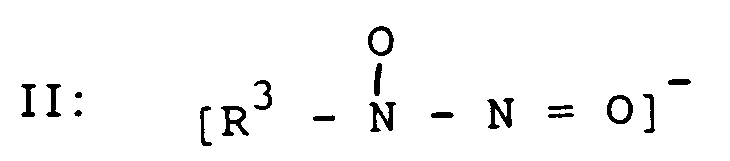
in which formula:
in which formula:
R³ represents:
C₁-C₆ alkyl , provided that when the alkyl group contains more than four carbon atoms
the group is a branched chain alkyl group.
2. A use according to Claim 1, in which the chelate comprises three identical bidentate
ligands.
3. A use according to Claim 2, in which R³ contains no more than four carbon atoms.
4. A use according to Claim 3, in which R³ is methyl, ethyl, or n-propyl.
5. A use according to Claim 3, in which the chelate comprises a ligand formed by loss
of a proton from one of the following compounds:
CH₃NOH.N=O
CH₃CH₂NOH.N=O
CH₃CH₂CH₂NOH.N=O
(CH₃)₂CHNOH.N=O
CH₃(CH₂)₂CH₂NOH.N=O
CH₃CH₂CH(CH₃)NOH.N=O
(CH₃)₂CHCH₂NOH.N=O
CH₃NOH.N=O
CH₃CH₂NOH.N=O
CH₃CH₂CH₂NOH.N=O
(CH₃)₂CHNOH.N=O
CH₃(CH₂)₂CH₂NOH.N=O
CH₃CH₂CH(CH₃)NOH.N=O
(CH₃)₂CHCH₂NOH.N=O
6. A use according to Claim 3, in which the chelate is of formula: FeIII[CH₃NON=O]₃ or FeIII[CH₃CH₂NON=O]₃ or FeIII[CH₃CH₂CH₂NON=O]₃.
7. A poison bait for molluscs which comprises a chelate molluscicide as defined in any
one of Claims 1 to 6 and a carrier therefor.
8. A poison bait according to Claim 7, which comprises a mollusc food.
9. A poison bait according to Claim 8, in which the mollusc food is a cereal, comminuted
cuttle fish, mollases or gelatin.
10. A poison bait according to any of Claims 7 to 9 which comprises a mollusc phagostimulant.
11. A poison bait according to Claim 10, in which the phagostimulant is a sugar or starch.
12. A poison bait according to Claim 7 which comprises a non nutrient carrier.
13. A poison bait according to Claim 12, in which the non nutrient carrier is an artificial
polymer, pumice, carbon or a material useful as a carrier for an insecticide.
14. A poison bait according to any of Claims 7 to 13, which comprises a binder.
15. A poison bait according to Claim 14, in which the binder is paraffin wax or casein.
16. A poison bait according to any of Claims 7 to 15, which comprises a bird repellent.
17. A poison bait according to Claim 16, in which the bird repellent is a blue colourant.
18. A poison bait according to any of Claims 7 to 17, which comprises a fungistat.
19. A poison bait according to any of Claims 7 to 18, which comprises at least 3% by weight
of a molluscicidal chelate as defined in any one of Claims 1 to 6.
20. A poison bait according to any of Claims 7 to 19, which comprises no more than 16%
by weight of a molluscicidal chelate as defined in any one of Claims 1 to 6.
21. A poison bait according to any of Claims 7 to 20, which comprises 10 - 12% by weight
of a molluscicidal chelate as defined in any one of Claims 1 to 6.
22. A process for the production of a poison bait for molluscs in which a chelate molluscicide
as defined in any one of Claims 1 to 6 is formulated with a carrier therefor.
23. A method of killing a mollusc in which the mollusc or an environment inhabited by
the mollusc is treated with a molluscicidal chelate as defined in any one of Claims
1 to 6.
24. A method according to Claim 23, in which an environment inhabited by the mollusc is
treated with a poison bait comprising a chelate as defined in any one of Claims 1
to 6.
1. Verwendung eines Eisen(III)-Chelats mit einem Liganden der Formel II

wobei
wobei
R³
C₁-C₆-Alkyl bedeutet, mit der Maßgabe, daß, wenn die Alkylgruppe mehr als vier
Kohlenstoffatome enthält, die Gruppe eine verzweigte Alkylgruppe ist,
2. Verwendung nach Anspruch 1, wobei das Chelat drei identische zweizähnige Liganden
umfaßt.
3. Verwendung nach Anspruch 2, wobei R³ nicht mehr als vier Kohlenstoffatome enthält.
4. Verwendung nach Anspruch 3, wobei R³ Methyl, Ethyl oder n-Propyl ist.
5. Verwendung nach Anspruch 3, wobei das Chelat einen Liganden umfaßt, der gebildet worden
ist durch Verlust eines Protons von einer der folgenden Verbindungen
CH₃NOH.N=O
CH₃CH₂NOH.N=O
CH₃CH₂CH₂NOH.N=O
(CH₃)₂CHNOH.N=O
CH₃(CH₂)₂CH₂NOH.N=O
CH₃CH₂CH(CH₃)NOH.N=O
(CH₃)₂CHCH₂NOH.N=O
CH₃NOH.N=O
CH₃CH₂NOH.N=O
CH₃CH₂CH₂NOH.N=O
(CH₃)₂CHNOH.N=O
CH₃(CH₂)₂CH₂NOH.N=O
CH₃CH₂CH(CH₃)NOH.N=O
(CH₃)₂CHCH₂NOH.N=O
6. Verwendung nach Anspruch 3, wobei das Chelat die Formel
FeIII [CH₃NON=O]₃ oder FeIII [CH₃CH₂NON=O]₃ oder FeIII [CH₃CH₂CH₂NON=O]₃
besitzt.
FeIII [CH₃NON=O]₃ oder FeIII [CH₃CH₂NON=O]₃ oder FeIII [CH₃CH₂CH₂NON=O]₃
besitzt.
7. Giftköder für Schnecken, umfassend ein Chelat-Molluskizid, nach einem der Ansprüche
1 bis 6, und einen Träger dafür.
8. Giftköder nach Anspruch 7, umfassend eine Schneckennahrung.
9. Giftköder nach Anspruch 8, bei dem die Schneckennahrung ein Getreide, fein zerteilter
Tintenfisch, Melasse oder Gelatine ist.
10. Giftköder nach einem der Ansprüche 7 bis 9, umfassend ein Schnecken-Phagostimulans.
11. Giftköder nach Anspruch 10, wobei das Phagostimulans ein Zucker oder Stärke ist.
12. Giftköder nach Anspruch 7, umfassend einen Nicht-Nahrungsträger.
13. Giftköder nach Anspruch 12, wobei der Nicht-Nahrungsträger ein künstliches Polymer,
Bimsstein, Kohle oder ein Material, das geeignet ist als Träger für Insektizide, ist.
14. Giftköder nach einem der Ansprüche 7 bis 13, umfassend einen Binder.
15. Giftköder nach Anspruch 14, wobei der Binder Paraffinwachs oder Kasein ist.
16. Giftköder nach einem der Ansprüche 7 bis 15, umfassend ein Abschreckmittel für Vögel.
17. Giftköder nach Anspruch 16, wobei das Abschreckmittel für Vögel ein blauer Farbstoff
ist.
18. Giftköder nach einem der Ansprüche 7 bis 17, umfassend ein Fungistatikum.
19. Giftköder nach einem der Ansprüche 7 bis 18, umfassend mindestens 3 Gew.-% eines Molluskizid-Chelats
nach einem der Ansprüche 1 bis 6.
20. Giftköder nach einem der Ansprüche 7 bis 19, umfassend nicht mehr als 16 Gew.-% eines
Molluskizid-Chelats nach einem der Ansprüche 1 bis 6.
21. Giftköder nach einem der Ansprüche 7 bis 20, umfassend 10 bis 12 Gew.-% eines Molluskizid-Chelats
nach einem der Ansprüche 1 bis 6.
22. Verfahren zur Herstellung eines Giftköders für Schnecken, bei dem ein Molluskizid-Chelat
nach einem der Ansprüche 1 bis 6 mit einem Träger dafür zubereitet wird.
23. Verfahren zum Abtöten einer Schnecke, wobei die Schnecke oder die Umgebung, in der
sie sich aufhält, mit einem Molluskizid-Chelat nach einem der Ansprüche 1 bis 6 behandelt
wird.
24. Verfahren nach Anspruch 23, wobei die Umgebung, in der sich die Schnecke aufhält,
mit einem Giftköder behandelt wird, umfassend ein Chelat nach einem der Ansprüche
1 bis 6.
1. Utilisation comme molluscicide d'un chélate de fer(III) avec un ligand de formule
II
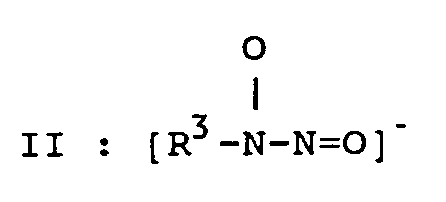
dans laquelle formule :
dans laquelle formule :
R³ représente :
un groupe alkyle en C₁-C₆, sous réserve que, lorsque le groupe alkyle contient
plus de quatre atomes de carbone, ce groupe soit un groupe alkyle à chaîne ramifiée.
2. Utilisation selon la revendication 1, dans laquelle le chélate comprend trois ligands
bidentés identiques.
3. Utilisation selon la revendication 2, dans laquelle R³ ne contient pas plus de quatre
atomes de carbone.
4. Utilisation selon la revendication 3, dans laquelle R³ est un groupe méthyle, éthyle
ou n-propyle.
5. Utilisation selon la revendication 3, dans laquelle le chélate comprend un ligand
formé par perte d'un proton d'un des composés suivants :
CH₃NOH.N=O
CH₃CH₂NOH.N=O
CH₃CH₂CH₂NOH.N=O
(CH₃)₂CHNOH.N=O
CH₃(CH₂)₂CH₂NOH.N=O
CH₃CH₂CH(CH₃)NOH.N=O
(CH₃)₂CHCH₂NOH.N=O.
CH₃NOH.N=O
CH₃CH₂NOH.N=O
CH₃CH₂CH₂NOH.N=O
(CH₃)₂CHNOH.N=O
CH₃(CH₂)₂CH₂NOH.N=O
CH₃CH₂CH(CH₃)NOH.N=O
(CH₃)₂CHCH₂NOH.N=O.
6. Utilisation selon la revendication 3, dans laquelle le chélate répond à la formule
: FeIII [CH₃NON=O]₃ ou FeIII[CH₃CH₂NON=O]₃ ou FeIII[CH₃CH₂CH₂NON=O]₃.
7. Appât toxique pour les mollusques, qui comprend un chélate molluscicide comme défini
dans l'une quelconque des revendications 1 à 6 et un support de celui-ci.
8. Appât toxique selon la revendication 7, qui comprend un aliment pour mollusques.
9. Appât toxique selon la revendication 8, dans lequel l'aliment pour mollusques est
une céréale, un broyat de seiche, de la mélasse ou de la gélatine.
10. Appât toxique selon l'une quelconque des revendications 7 à 9, qui comprend un appétitif
pour mollusques.
11. Appât toxique selon la revendication 10, dans lequel l'appétitif est un sucre ou de
l'amidon.
12. Appât toxique selon la revendication 7, qui comprend un support non nutritif.
13. Appât toxique selon la revendication 12, dans lequel le support non nutritif est un
polymère artificiel, de la pierre ponce, du charbon ou une matière utile comme support
pour un insecticide.
14. Appât toxique selon l'une quelconque des revendications 7 à 13, qui comprend un liant.
15. Appât toxique selon la revendication 14, dans lequel le liant est de la cire de paraffine
ou de la caséine.
16. Appât toxique selon l'une quelconque des revendications 7 à 15, qui comprend un répulsif
aviaire.
17. Appât toxique selon la revendication 16, dans lequel le répulsif aviaire est un colorant
bleu.
18. Appât toxique selon l'une quelconque des revendications 7 à 17, qui comprend un fongistatique.
19. Appât toxique selon l'une quelconque des revendications 7 à 18, qui comprend au moins
3 % en poids d'un chélate molluscicide, comme défini dans l'une quelconque des revendications
1 à 6.
20. Appât toxique selon l'une quelconque des revendications 7 à 19, qui ne comprend pas
plus de 16 % en poids d'un chélate molluscicide, comme défini dans l'une quelconque
des revendications 1 à 6.
21. Appât toxique selon l'une quelconque des revendications 7 à 20, qui comprend 10 à
12 % en poids d'un chélate molluscicide comme défini dans l'une quelconque des revendications
1 à 6.
22. Procédé pour la production d'un appât toxique pour les mollusques, dans lequel un
chélate molluscicide, comme défini dans l'une quelconque des revendications 1 à 6,
est formulé avec un de ses supports.
23. Procédé pour tuer un mollusque, dans lequel le mollusque ou un environnement habité
par le mollusque est traité avec un chélate molluscicide, comme défini dans l'une
quelconque des revendications 1 à 6.
24. Procédé selon la revendication 23, dans lequel un environnement habité par le mollusque
est traité avec un appât toxique comprenant un chélate comme défini dans l'une quelconque
des revendications 1 à 6.