| (19) |
 |
|
(11) |
EP 0 470 135 B1 |
| (12) |
EUROPEAN PATENT SPECIFICATION |
| (45) |
Mention of the grant of the patent: |
|
30.03.1994 Bulletin 1994/13 |
| (22) |
Date of filing: 26.04.1990 |
|
| (86) |
International application number: |
|
PCT/EP9000/728 |
| (87) |
International publication number: |
|
WO 9012/825 (01.11.1990 Gazette 1990/25) |
|
| (54) |
ORGANIC OXYGEN-CONTAINING POLYMERIZATION COCATALYSTS
POLYMERISATIONS-CO-KATALYSATOR, DER ORGANISCHEN SAUERSTOFF ENTHÄLT
COCATALYSEURS DE POLYMERISATION CONTENANT DE L'OXYGENE ORGANIQUE
|
| (84) |
Designated Contracting States: |
|
BE DE ES FR GB IT NL SE |
| (30) |
Priority: |
26.04.1989 IT 6730189
|
| (43) |
Date of publication of application: |
|
12.02.1992 Bulletin 1992/07 |
| (73) |
Proprietors: |
|
- Akzo Nobel N.V.
6824 BM Arnhem (NL)
- SAINT PETER S.R.L.
I-10121 Torino (IT)
|
|
| (72) |
Inventor: |
|
- GIOVANDO, Gualtiero
I-12065 Monforte d'Alba (IT)
|
| (74) |
Representative: Schalkwijk, Pieter Cornelis et al |
|
AKZO NOBEL N.V.
Patent Department (Dept. CO)
P.O. Box 9300
6800 SB Arnhem
6800 SB Arnhem (NL) |
| (56) |
References cited: :
FR-A- 2 429 239
GB-A- 881 629
|
GB-A- 833 764
US-A- 4 138 385
|
|
| |
|
|
- Database, WPIL, no 75-46904W, Derwent Publications Ltd, (London, GB)& JP-A-50032284
|
|
| |
|
| Note: Within nine months from the publication of the mention of the grant of the European
patent, any person may give notice to the European Patent Office of opposition to
the European patent
granted. Notice of opposition shall be filed in a written reasoned statement. It shall
not be deemed to
have been filed until the opposition fee has been paid. (Art. 99(1) European Patent
Convention).
|
[0001] The present invention relates to polymerization cocatalysts for the curing of unsaturated
maleic, allylic, vinylic and epoxide-type polyesters. The cocatalysts comprise organic
oxygen-containing compounds and at least two salts of at least two different metals
chosen from copper, lithium, vanadium, manganese, magnesium, cobalt and iron.
[0002] It is known to use lithium salts for the curing of unsaturated polyesters. For example,
U.S. patents 3,539,479 and 3,663,599 disclose the use of lithium salts for the polymerization
of unsaturated polyesters. The lithium salts include lithium decanoate, lithium thiocyanate,
lithium acrylate, lithium methacrylate and lithium soaps of unsaturated and saturated
aliphatic carboxylic acids.
[0003] British patent 2,085,464 suggests the use of cobalt, manganese or lithium naphthenate
or cobalt or tin octanoate as hardening accelerators for the peroxide curing of unsaturated
polyesters. Further, Japanese patent J5-0032-284 discloses the heat hardening of polyester
resins in the presence of peroxides and acid cobalt salts, acetoacetate or ascorbic
acid compounds.
[0004] "Melt Polymerization of Bisphenol A (BPA) Cyclic Polycarbonate Oligomers; Rheokinetics
of Polymerization Relevant to Reactive Processing," Stewart, K.R., Polym. Prepr. 89;
Vol. 30 (2); pp. 575-76, discloses the use of lithium salts or acetylacetonates as
polymerization catalysts for the polymerization of cyclic polycarbonate oligomers
with bisphenol A. Although the polymerization catalyst used here is similar to that
of the present invention, the polymerization system is quite different since it involves
phenolic compounds.
[0005] Another example of phenolic-resin curing is given in JP-62-053330 wherein lithium
acetylacetonate is employed as a hardening accelerator in the crosslinking of phenolic
resins in the presence of spiro orthocarbonates.
[0006] Finally, DE 30 16 051 discloses the use of a hardening accelerator for unsaturated
resins which comprises a mixture of a ketimine and an (in)organic cupric or ferric
compound in combination with a standard hardener.
[0007] None of the foregoing curing systems for unsaturated polyesters is entirely satisfactory.
They suffer from the disadvantages that some must be operated at high temperatures,
they often give discoloration of the resultant polymer and they are slow.
[0008] It is therefore the object of the present invention to overcome one or more of these
disadvantages by providing a novel curing accelerator for unsaturated allylic, maleic,
vinylic and epoxidic polyesters, a curable composition of a resin and at least one
curing accelerator and a process for curing these materials in the presence of this
curing accelerator. These and other objects of the present invention will be apparent
to one of ordinary skill in the art from the summary and detailed descriptions which
follow.
SUMMARY
[0009] For the curing of unsaturated maleic, vinylic, allylic and epoxide-type polyesters,
use as accelerators or cocatalysts is made of salts of at least two different metals
chosen from among lithium, copper, magnesium, manganese, vanadium, iron, and cobalt,
in combination with one or more oxygen-containing compounds, that are capable of forming
complexes with such salts and include at least one functional group selected from
aldehyde, ketone, ether, ester and alcohol. Also within the invention are a curable
resin composition including these accelerators and a curing process employing these
accelerators.
DESCRIPTION
[0010] The present invention refers generally to processes for the curing of unsaturated
maleic, allylic, vinylic, and epoxide-type polyesters by means of radical or ionic-radical
catalysis, and provides accelerators/promoters for the curing process.
[0011] Certain metal salts that can form complexes with organic oxygen compounds, are able
to substantially accelerate the process of curing of the abovementioned resins.
[0012] Salts of copper, lithium, magnesium, manganese, vanadium, cobalt and iron act as
accelerators in the curing process in the presence of conventional peroxidic initiators
in the presence of organic oxygen-containing compounds which are capable of forming
complexes with these metals. The primary object of the invention is therefore, to
provide an accelerator composition that comprises a complex of at least two salts
of at least two different metals chosen from among copper, lithium, magnesium, manganese,
cobalt, vanadium and iron or combinations of these, with oxygenated compounds.
[0013] It is considered that the metal salts are able to form a complex with the oxygenated
compound and consequently, the scope of the invention includes a composition comprising
a complex of an organic oxygen-containing compound with at least two salts of at least
two different metals chosen from the above-mentioned group, as well as a curable resin
composition including an accelerator and a process for curing unsaturated maleic,
allylic, vinylic, and epoxy-type polyesters in the presence of at least one of these
accelerators.
[0014] The complexes of the above-mentioned metals can be utilized as accelerators in combination
with conventional initiators of the peroxide type in processes for curing unsaturated
polyesters and such complexes can be employed along with known conventional accelerators
and peroxidic initiators.
[0015] The salt employed for the formation of the metal complex is preferably a halide,
nitrate, lactate, hexanoate or acetate. Chlorides are especially preferred. The same
salt may be employed with each of the at least two different metals or mixtures of
salts may also be employed.
[0016] In the procedure for curing of the above-mentioned resins, which is a further subject
of the present invention, the complex compound acting as the accelerator is typically
employed in such a way as to furnish an amount of metal which comprises between 0.1
and 200 ppm on the basis of the weight of the resin. More specifically, the preferred
concentrations on the basis of the weight of the resin are as follows:
Li, from 1 to 100 ppm,
Co, from 1 to 20 ppm,
Cu, from 0.1 to 10 ppm,
Fe, from 5 to 150 ppm,
Mg, from 3 to 200 ppm, and
V, Mn, from 1 to 200 ppm.
[0017] Combinations of two or more of these metals are employed advantageously in a single
accelerator composition.
[0018] In the procedure of curing, the accelerators that are the subject of the present
invention can be employed in the presence of conventional quantities of peroxidic
initiators. More particularly, between 0.02 and 5.0% by weight of peroxide initiator,
on the basis of the weight of the resin, are employed. These accelerators generally
permit a reduction in the amount of peroxidic initiator that can be employed as compared
with the same curing system in the absence of accelerator. Conventional peroxide initiators
known for use with unsaturated polyesters may be used.
[0019] The curing procedure of the present invention comprises the addition, to a resin
or prepolymer, of a peroxide initiator and at least one accelerator in accordance
with the present invention. Conventional accelerators may also be present during the
curing procedure of the present invention in addition to the accelerators of the present
invention. Further, other materials including thiols and nitrogen-containing compounds
may be present during the curing process of the present invention.
[0020] Among the nitrogen compounds are included ammonia, ammonium salts, heterocyclic nitrogenous
bases, cycloaliphatic primary amines and adducts of these materials with anhydrides
or epoxides. More particularly, the nitrogen-containing compounds include ammonium
acetate, cyclohexylaliphatic amines, secondary and tertiary C₁-C₃ alkylamines and
addition compounds of the said amines. More specific examples of the amines include
isophoronediamine, diaminodicyclohexylmethane, trimethylamine, triethylamine, diethylamine
and dimethylamine. A more detailed description of the nitrogen-containing compounds
and their adducts with anhydrides and epoxides can be found in applicants' copending
PCT application no EP 90/00727, entitled, "Organic Nitrogen-Containing Polymerization
Catalysts", filed on even date herewith.
[0021] The thiol compounds include mercaptans and more preferably materials containing at
least two thiol groups, and their adducts with anhydrides or epoxides. More particularly,
the preferred thiol compounds include dipentene dimercaptan, ethylcyclohexyl dimercaptan,
ethylene-1,2-bis-3-mercaptoacetate, ethylene-1,2-bis-3-mercaptopropionate, 1,2,3-propanetrithiol,
1,2,6-hexanetrithiol, pentaerythritothiol, pentaerythritol tetramercaptoacetate, pentaerythritol
tetramercaptopropionate, and thioesters of polyalcohols and sugars. A more detailed
description of the thiol compounds and their adducts with epoxides and anhydrides
can be found in applicants' copending PCT application entitled, "Thiolic Compound
Polymerization Cocatalysts", filed on even date herewith.
[0022] The thiol materials may be added to the accelerator compositions of the present invention
in amounts of from 0.1 to 0.7% by weight for non epoxy-type polyesters and from 1-150%
by weight for epoxy-type polyesters, based on the weight of the resin. The nitrogen-containing
compounds are generally used in amounts of 0.01% to 20% by weight, based on the weight
of the resin.
[0023] Another aspect of the curing procedure of the present invention comprises the curing
of a curable mixture of a resin or prepolymer chosen from among the group of unsaturated
polyester resins, maleic, allylic, vinylic and epoxy-type resins, and at least one
ethylenically unsaturated reactive monomer in the presence of an accelerator. Typical
ethylenically unsaturated reactive monomers include styrene and styrene derivatives
such as α-methylstyrene, indene, divinyl benzene, stilbene, dibenzalacetone, propenyl
benzene and isopropenyl benzene; triallyl cyanurate, triallyl isocyanurate and mixtures
thereof. The monomer may comprise from 0 to 50 wt.% of the material, based on the
weight of the resin.
[0024] The oxygenated compound is an oxygenated organic compound carrying an aldehyde, ketone,
ether, ester, or alcohol group on the molecule. The oxygen-containing compound must
also be capable of forming a complex with the metal salt.
[0025] Generally, the oxygen-containing compound enhances the known accelerating effect
of the metal salt. Thus, sufficient oxygen-containing compound should be employed
to enhance the accelerating effect.
[0026] In particular, the following can be employed as the oxygenated compound:
-- keto- and aldo-esters and ethers or alcohols, in particular methylacetoacetate,
ethylacetoacetate, mono- and diesters of ketoglutaric acid, pyruvates, sugars such
as glucose and fructose; and esters of ascorbic acid such as ascorbic palmitate;
-- 1,3-diketones and aldehydes, in particular acetylacetone, benzoylacetone, and dibenzoylmethane;
-- mono- and diesters more in particular diethylmalonate and succinates;
-- 1,2-diketones, in particular diacetyl and glyoxal; and
-- certain polyalcohols and other alcohols such as diethylene glycol, benzyl alcohol
and alcohols of the fatty series.
[0027] In the process of the present invention, the oxygen-containing compound is generally
employed in an amount of 0.002 to 0.3 weight percent on the basis of the resin. Specific
materials, such as ethylene glycol and ascorbic palmitate are preferably employed
in amounts of 0.01 to 0.2 and 0.02 to 1 weight percent on the basis of the resin,
respectively. In a further aspect, the present invention also relates to curable resin
compositions which include the accelerators of the present invention therein.
[0028] In the curing process of the present invention, one begins with the resin composition.
To this there may optionally be added an ethylenically unsaturated reactive monomer.
The accelerator composition may be added in several different manners. For example,
the accelerator composition may be pre-mixed to form the metal salt complex prior
to it being added to the resin composition. Another possibility is to add the individual
components of the accelerator composition to the resin and form the metal complex
in situ. which of these methods is preferred will depend on the specific curing process being
carried out.
[0029] Other additives, such as the peroxide initiator, or other accelerator enhancing materials
may be added directly to the resin without first mixing them with the accelerator
composition. However, in some cases it may be desirable to premix the accelerator
enhancing materials with one or more of the accelerator components prior to introduction
to the resin composition.
[0030] The curing process of the present invention may be carried out at any temperature
from room temperature up to 250°C, depending on the initiator system, accelerator
system and resin being cured. Other standard additives may also be employed including
conventional accelerators.
[0031] The accelerators and process of the present invention will be further illustrated
by the examples appended hereto.
Example 1
[0032] An accelerator was obtained by taking 25 parts diethylene glycol, 25 parts butyl
alcohol, 30 parts benzyl alcohol, 10 parts lithium chloride, 10 parts cupric chloride
or copper acetate, and 1 part CoCl₂.6H₂O.
The result was a very dark brown, stable complex.
Example 2
[0033] A complex accelerator was obtained by taking 70 parts diethylene glycol, 20 parts
cupric nitrate trihydrate, and 10 parts magnesium chloride. The results of polymerization
of 100 g of OSM NX 530 resin are shown in Table I.
Example 3: preparation of accelerator (called alpha-accelerator in the following)
[0034] The accelerator was prepared by dissolving 2 g of lithium chloride in 18 g diethyleneglycol,
and adding 25 g of acetylacetone and 12 g of a thiol adduct obtained by the addition
reaction between methylnadic anhydride and pentaerythritoltetramercaptopropionate,
in a mixed solvent of 8 g dimethylsulphoxide and 10 g tetrahydrofuran.
The thus obtained accelerator possesses a very low toxicity, and the polymerization
tests relative to its application yielded colourless transparent polymerization products.
Example 4
[0035] The accelerator obtained in example 3 was modified by the further addition of 2 g
of manganese acetate. This accelerator, containing the manganese salt in addition
to the lithium salt, presented an enhanced effect of gelation. Analogous accelerators
can be obtained by using not the acetate but the lactate, chloride or ethyl -hexanoate
of manganese (bivalent).
Examples 5-10
[0036] Effective accelerators were obtained according to the procedure of example 3 but
using as the thiol any one of the following:
-- adduct of maleic anhydride with pentaerythritol-tetramercaptoacetate;
-- adduct of 1,2,3-propanetrithiol with propane diglycidyl ether;
-- adduct of pentaerythritoltetramercaptoacetate with butane diglycidyl ether;
-- adduct of 1,2,3-propanetrithiol with glycerylglycidyl ether;
-- adduct of 1,2,3-propanetrithiol with Bisphenol-A glycidyl ether; and
-- adduct of dipentenedimercaptan with butanediglycidylether and pentaerythritoltetramercaptoacetate.
Examples 11-17
[0037] The alpha-accelerator obtained according to example 3, and the accelerator obtained
according to example 4, were employed in tests of polymerization of the commercially
available polyester resins DSM 530, DSM 170 and Alusuisse 5. Samples of 100-g size
were taken and were processed in a thermostat bath of 25°C. The results of the polymerizations
are reported in Table II.
[0038] The polymerization tests have yielded satisfactory results even in the absence of
conventional peroxidic initiators. The optimal quantities of peroxidic initiator proved
to range from 0.02 to 0.2%. All obtained samples were colourless and transparent,
and none liberated styrene during cross-linking. After the cross-linking they did
not smell of styrene, and showed high mechanical resistances.
[0039] The yield of the polymerization after 10 hours, with 2% of added peroxidic initiator,
is about 95%, while it is about 85% when the extent of added peroxidic initiator equals
0.02%, in which latter case, the yield can be raised to 98% by post-curing for 2-4
hours at 50-80°C.
Example 18: "Beta" accelerator
[0040] This accelerator was obtained by mixing 7 g of isophoronediamine with 6 g of cresyldiglycidylether
and 7 g of ethyleneglycol and heating at 80°C for 1 hour. Separately, a mixture of
11 g ethylacetoacetate and 14 g methylnadic anhydride was prepared, and heated to
80°C for 1 hour. The thus obtained products were mixed with the further addition of
0.15 g copper sulphate and 14.85 g diethyleneglycol.
Example 19
[0041] The procedure of example 18 was repeated, with the isophoronediamine being replaced
by diaminodicyclohexylmethane.
Example 20
[0042] The procedure of example 18 was repeated, with the further addition of one gram of
lithium chloride dissolved in 9 g of diethyleneglycol.
Example 21
[0043] The procedure of example 18 was repeated, with the further addition of one gram of
lithium chloride, and of magnesium chloride.
Examples 22-26
[0044] Polymerization tests were carried out, using the accelerators of examples 18, 20
and 21, on DSM NX 530 unsaturated polyester resin. The peroxidic initiator was 75%
methylethylketone peroxide in dibutylphthalate in amounts varying between 0.1 and
0.3 weight %, referred to the weight of the resin sample which was 100 g. All tests
were done in a thermostatted bath at 25°C. The results have been collected in Table
III.
[0045] In this case again, the best results were obtained when using a quantity of initiator
equal to about 1/10 of the conventional amount; the resulting samples were bright
transparent yellow, very hard, and exhibited a low volatilization of styrene during
and after the polymerization.
These tests demonstrate that the use of mixed complexes can, in certain cases, be
particularly advantageous in terms of increased activity. As the experimental tests
show, the invention provides new accelerators that are especially active in the curing
of unsaturated, ma-leic, allylic and epoxy-type polyester resins. Such accelerators
can be advantageously employed as they allow one to vary the temperature of the exothermal
peak and the times of cross-linking, in accordance with requirements. These accelerators
can find special application in the cross-linking of resins intended to embed delicate
inserts, e.g. in the electronics and natural sciences fields.
[0046] The tests demonstrate that in the curing of the resin, one can utilize the afore-mentioned
metal salt complexes, either ready-made or, alternatively, formed
in-situ by adding to the resin the thiolic compound and oxygenated or nitrogenated compound
and separately the metal salt.
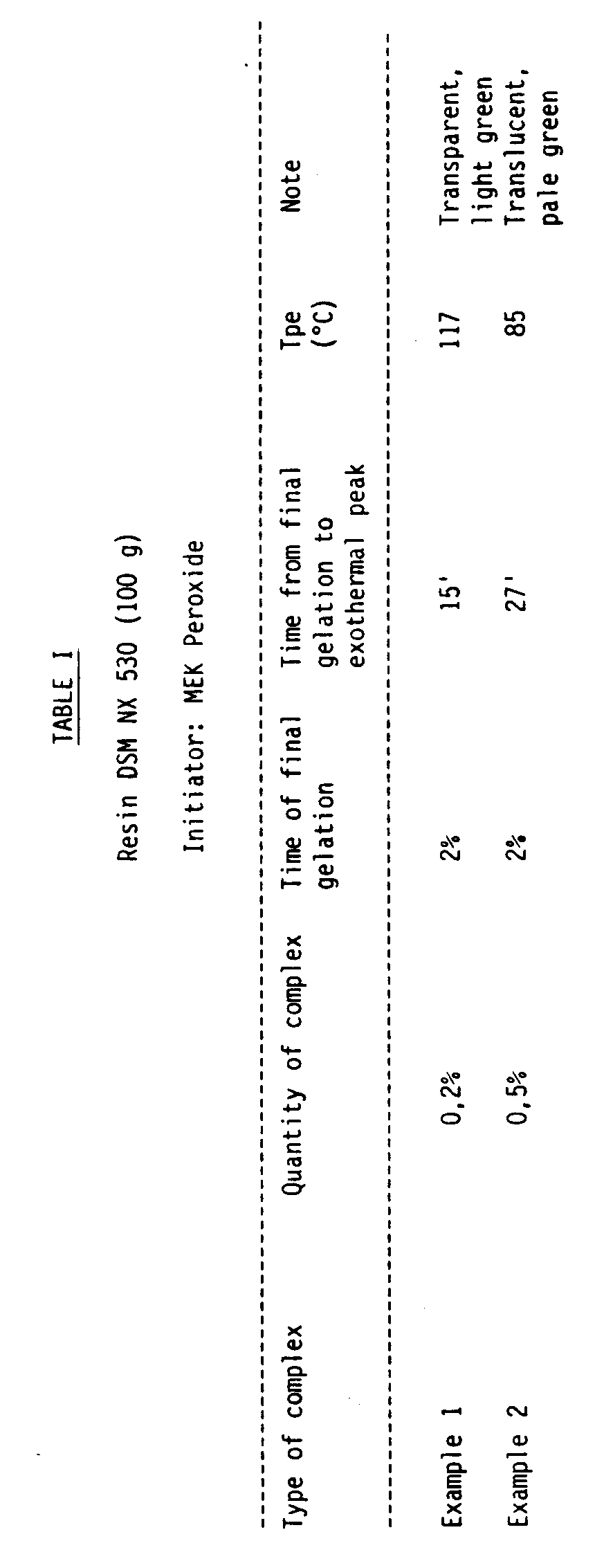
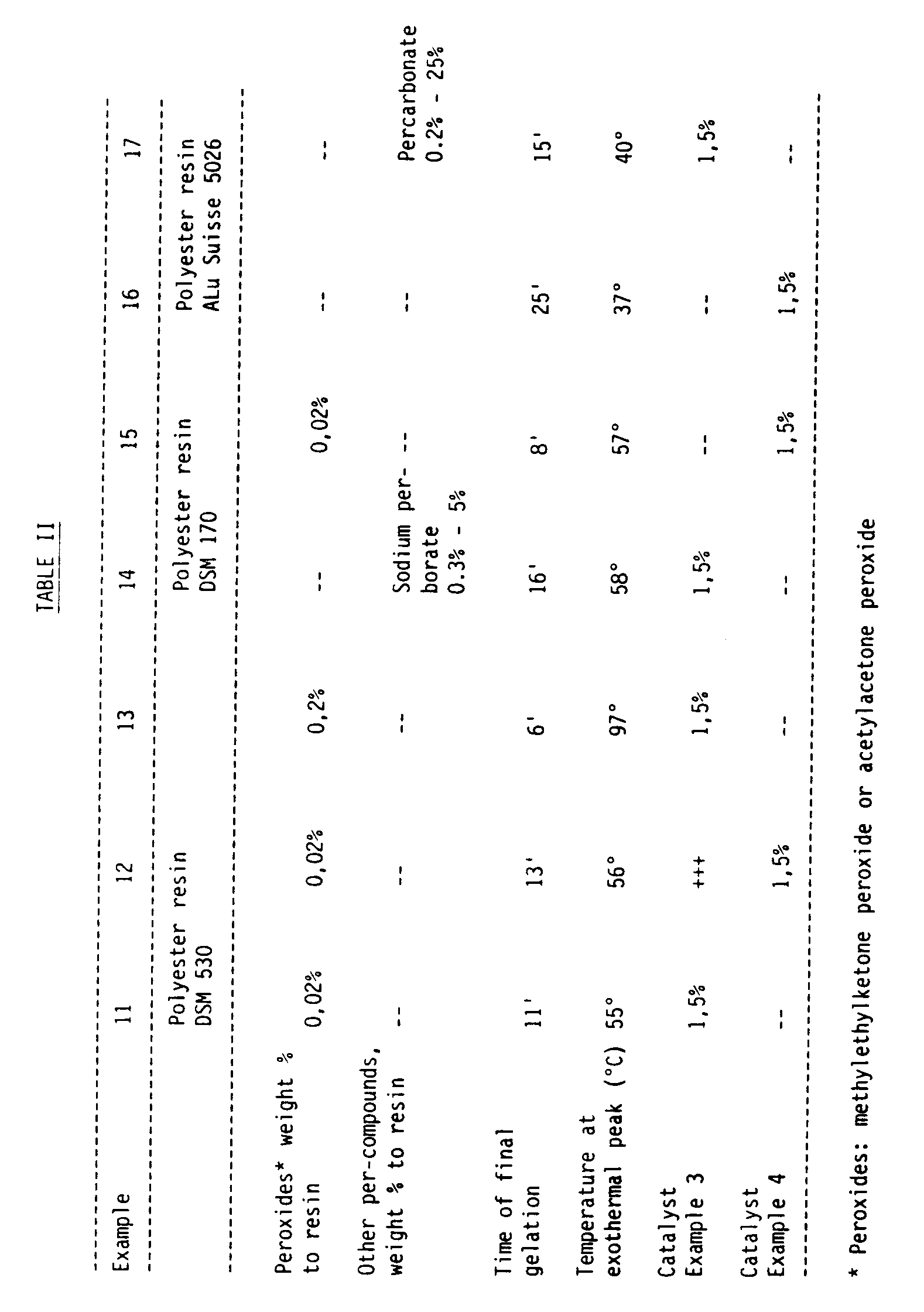
TABLE III
| Resin DSM NX 530 |
| Example |
22 |
23 |
24 |
25 |
26 |
| Peroxide%, weight to resin |
0,3% |
0,3% |
0,1% |
0,3% |
0,3% |
| Catalyst "β" (Ex. 18) |
1% |
2% |
1% |
-- |
-- |
| Catalyst "β" + Li (Ex. 20) |
-- |
-- |
-- |
2% |
-- |
| Catalyst "β" - Cu + Li + Mg (Ex. 21) |
-- |
-- |
-- |
-- |
1,5% |
| Time of final gelation |
4' |
2,30'' |
14' |
16' |
17' |
| Time from final gelation to exothermal peak |
5' |
2' |
15' |
11' |
14' |
| Temperature at exothermal peak |
121° |
123° |
81° |
120° |
95° |
NOTE Light-yellow-coloured samples, transparent, very hard
- colourless
- translucent
- low-toxic |
Claims for the following Contracting State(s): AT, BE, CH, DE, DK, FR, GB, IT, LI,
LU, NL, SE
1. An accelerator composition for the curing of resins selected from the group consisting
of unsaturated maleic, allylic, vinylic and epoxy-type polyester resins, said accelerator
composition comprising a complex of at least two salts of at least two different metals
selected from the group consisting of lithium, magnesium, manganese, copper, cobalt,
vanadium and iron, and an organic oxygen-containing compound capable of forming a
metal complex with said metal salt and including at least one functional group selected
from the group consisting of a(n) aldehyde, ketone, ether, ester, or alcohol group.
2. An accelerator composition as claimed in claim 1 wherein said oxygen-containing compound
is selected from the group consisting of methylacetoacetate, ethylacetoacetate, monoesters
of ketoglutaric acid, diesters of ketoglutaric acid, pyruvates, sugars, esters of
ascorbic acid, benzoylacetone, dibenzoylmethane, diethylmalonate, succinate esters,
diacetyl, glyoxal, diethylene glycol, benzyl alcohol and fatty alcohols.
3. An accelerator composition as claimed in claim 2 wherein said oxygen containing compound
is selected from the group consisting of diethylene glycol, ascorbic palmitate cresyl
glycidylether, methylnadic anhydride and methylacetoacetonate.
4. An accelerator composition as claimed in claim 1 wherein said at least one of said
metal salts is selected from the group consisting of halide, nitrate and acetate.
5. An accelerator composition for the curing of resins selected from the group consisting
of unsaturated maleic, allylic, vinylic and epoxy-type polyester resins, said accelerator
composition comprising a complex of a salt of a metal selected from the group consisting
of lithium, magnesium, manganese, copper, cobalt, vanadium and iron, an organic oxygen-containing
compound capable of forming a metal complex with said metal salt and including at
least one functional group selected from the group consisting of a(n) aldehyde, ketone,
ether, ester, or alcohol group, and at least one compound selected from thiols, thiol
adducts with anhydrides or epoxides, ammonia, ammonium salts, heterocyclic nitrogenated
bases, cycloaliphatic primary amines and adducts of cycloaliphatic primary amines
with anhydrides or epoxides.
6. A process for the curing of a resin selected from the group consisting of unsaturated
maleic, allylic, vinylic and epoxy-type polyesters, said process comprising the step
of curing said resin in the presence of an effective amount of a curing accelerator
as claimed in any one of claims 1-5.
7. A process in accordance with claim 6 wherein 0.02 to 5.0% by weight of a peroxide
compound is present during said curing step.
8. A process in accordance with any one of claims 6-7 wherein at least one ethylenically
unsaturated reactive monomer is present during said curing step.
9. A curable resin composition comprising at least one resin selected from the group
consisting of unsaturated maleic, allylic, vinylic or epoxy-type polyesters, and an
effective amount of a curing accelerator which comprises at least two metal salts
of at least two different metals selected from the group consisting of lithium, magnesium,
manganese, copper, cobalt, vanadium and iron, and an organic oxygen-containing compound
capable of forming a complex with said metal and including at least one functional
group selected from the group consisting of a(n) aldehyde, ketone, ether, ester or
alcohol group.
10. A curable resin composition in accordance with claim 9 which further comprises an
effective amount of a peroxide curing agent.
11. A curable resin composition as claimed in any one of claims 9 or 10 which further
comprises from 0-50 wt.%, based on the weight of said resin, of at least one ethylenically
unsaturated monomer.
Claims for the following Contracting State(s): ES
1. A process for making an accelerator composition for the curing of resins selected
from the group consisting of unsaturated maleic, allylic, vinylic and epoxy-type polyester
resins, said process comprising the step of forming a complex of at least two salts
of at least two different metals selected from the group consisting of lithium, magnesium,
manganese, copper, cobalt, vanadium and iron; with an organic oxygen-containing compound
capable of forming a metal complex with said metal salt and including at least one
functional group selected from the group consisting of a(n) aldehyde, ketone, ether,
ester, or alcohol group.
2. A process for making an accelerator composition as claimed in claim 1 wherein said
oxygen-containing compound is selected from the group consisting of methylacetoacetate,
ethylacetoacetate, monoesters of ketoglutaric acid, diesters of ketoglutaric acid,
pyruvates, sugars, esters of ascorbic acid, benzoylacetone, dibenzoylmethane, ammonium
acetate, diethylmalonate, succinate esters, diacetyl, glyoxal, diethylene glycol,
benzyl alcohol and fatty alcohols.
3. A process for making an accelerator composition as claimed in claim 2 wherein said
oxygen containing compound is selected from the group consisting of diethylene glycol,
ascorbic palmitate cresyl glycidylether, methylnadic anhydride and methyl acetoacetonate.
4. A process for making an accelerator composition as claimed in claim 1 wherein said
at least one of said metal salts is selected from the group consisting of halide,
nitrate and acetate.
5. A process for making an accelerator composition for the curing of resins selected
from the group consisting of unsaturated maleic, allylic, vinylic and epoxy-type polyester
resins, said accelerator composition comprising a complex of a salt of a metal selected
from the group consisting of lithium, magnesium, manganese, copper, cobalt, vanadium
and iron, an organic oxygen-containing compound capable of forming a metal complex
with said metal salt and including at least one functional group selected from the
group consisting of a(n) aldehyde, ketone, ether, ester, or alcohol group, and at
least one compound selected from thiols, thiol adducts with anhydrides or epoxides,
ammonia, ammonium salts, heterocyclic nitrogenated bases, cycloaliphatic primary amines
and adducts of cycloaliphatic primary amines with anhydrides or epoxides.
6. A process for the curing of a resin selected from the group consisting of unsaturated
maleic, allylic, vinylic and epoxy-type polyesters, said process comprising the step
of curing said resin in the presence of an effective amount of a curing accelerator
as claimed in any one of claims 1-5.
7. A process in accordance with claim 6 wherein 0.02 to 5.0% by weight of a peroxide
compound is present during said curing step.
8. A process in accordance with any one of claims 6-7 wherein at least one ethylenically
unsaturated reactive monomer is present during said curing step.
9. A process for making an curable resin composition comprising the step of mixing at
least one resin selected from the group consisting of unsaturated maleic, allylic,
vinylic or epoxy-type polyesters, and an effective amount of a curing accelerator
which comprises at least two metal salts of at least two different metals selected
from the group consisting of lithium, magnesium, manganese, copper, cobalt, vanadium
and iron, and an organic oxygen-containing compound capable of forming a complex with
said metal and including at least one functional group selected from the group consisting
of a(n) aldehyde, ketone, ether, ester or alcohol group.
Patentansprüche für folgende(n) Vertragsstaat(en): AT, BE, CH, DE, DK, FR, GB, IT,
LI, LU, NL, SE
1. Beschleuniger zum Vernetzen von Harzen gewählt aus ungesättigten Malein-, Allyl-,
Vinyl- und Epoxytyp-Polyesterharzen, wobei der Beschleuniger einen Komplex aus mindestens
zwei Salzen von mindestens zwei unterschiedlichen Metallen gewählt aus Lithium, Magnesium,
Mangan, Kupfer, Cobalt, Vanadium und Eisen sowie eine organische, sauerstoffenthaltende
Verbindung enthält, die zur Bildung eines Metallkomplexes mit dem Metallsalz befähigt
ist und mindestens eine funktionelle Gruppe gewählt aus Aldehyd-, Keton-, Ether-,
Ester- oder Alkoholgruppen enthält.
2. Beschleuniger nach Anspruch 1, worin die sauerstoffenthaltende Verbindung gewählt
ist aus Methylacetoacetat, Ethylacetoacetat, Monoester von Ketoglutarsäure, Diester
von Ketoglutarsäure, Pyruvate, Zucker, Ester von Ascorbinsäure, Benzoylaceton, Dibenzoylmethan,
Diethylmalonat, Bernsteinsäureester, Diacetyl, Glyoxal, Diethylenglycol, Benzylalkohol
und Fettalkoholen.
3. Beschleuniger nach Anspruch 2, bei welchem die sauerstoffenthaltende Verbindung gewählt
ist aus Diethylenglycol, Ascorbinsäurepalmitat, Cresylglycidylether, Methylnadinsäureanhydrid
und Methylacetoacetonat.
4. Beschleuniger nach Anspruch 1, bei welchem das mindestens eine Metallsalz gewählt
ist aus Halogeniden, Nitraten und Acetaten.
5. Beschleuniger zur Vernetzung von Harzen gewählt aus ungesättigten Malein-, Allyl-,
Vinyl- und Epoxytyp-Polyesterharzen, wobei der Beschleuniger einen Komplex eines Salzes
eines Metalls gewählt aus Lithium, Magnesium, Mangan, Kupfer, Cobalt, Vanadium und
Eisen, eine organische, sauerstoffenthaltende Verbindung, die zur Bildung eines Metallkomplexes
mit dem Metallsalz befähigt ist und mindestens eine funktionelle Gruppe enthält, die
gewählt ist aus Aldehyd-, Keton-, Ether-, Ester- oder Alkoholgruppen, sowie mindestens
eine Verbindung enthält, die gewählt ist aus Thiolen, Thioladdukten mit Anhydriden
oder Epoxiden, Ammoniak, Ammoniumsalzen, heterocyclischen nitrierten Basen, cycloaliphatischen
primären Aminen und Addukten von cycloaliphatischen, primären Aminen mit Anhydriden
oder Epoxiden.
6. Verfahren zum Vernetzen eines Harzes gewählt aus ungesättigten Malein-, Allyl-, Vinyl-
und Epoxytyp-Polyesterharzen, wobei das Verfahren den Schritt der Vernetzung des Harzes
in Gegenwart einer wirksamen Menge eines Vernetzungsbeschleunigers wie in einem der
Ansprüche 1-5 beansprucht umfasst.
7. Verfahren nach Anspruch 6, bei welchem während des Vernetzungsschrittes 0,02 bis 5,0
Gew.% einer Peroxidverbindung anwesend sind.
8. Verfahren nach einem der Ansprüche 6-7, bei welchem während der Vernetzung mindestens
ein ethylenisch ungesättigtes, reaktionsfähiges Monomer vorhanden ist.
9. Vernetzbare Harzzubereitung, enthaltend mindestens ein Harz gewählt aus ungesättigten
Malein-, Allyl-, Vinyl- und Epoxytyp-Polyesterharzen und eine wirksame Menge eines
Vernetzungsbeschleunigers, der mindestens zwei Metallsalze von mindestens zwei unterschiedlichen
Metallen gewählt aus Lithium, Magnesium, Mangan, Kupfer, Cobalt, Vanadium und Eisen,
und eine organische, sauerstoffenthaltende Verbindung enthält, die zur Bildung eines
Komplexes mit dem Metall befähigt ist und mindestens eine funktionelle Gruppe gewählt
aus Aldehyd-, Keton-, Ether-, Ester- oder Alkoholgruppen besitzt.
10. Vernetzbare Harzzubereitung gemäss Anspruch 9, die ausserdem eine wirksame Menge eines
Peroxid-Vernetzungsmittel enthält.
11. Vernetzbare Harzzubereitung gemäss einem der Ansprüche 9 oder 10, die ausserdem 0
bis 50 Gew.%, bezogen auf das Gewicht des Harzes, mindestens eines ethylenisch ungesättigten
Monomers enthält.
Patentansprüche für folgende(n) Vertragsstaat(en): ES
1. Verfahren zur Herstellung eines Beschleunigers zur Vernetzung von Harzen gewählt aus
ungesättigten Malein-, Allyl-, Vinyl- und Epoxytyp-Polyesterharzen, welches Verfahren
den Schritt der Bildung eines Komplexes aus mindestens zwei Salzen von mindestens
zwei unterschiedlichen Metallen gewählt aus Lithium, Magnesium, Mangan, Kupfer, Cobalt,
Vanadium und Eisen mit einer organischen, sauerstoffenthaltende Verbindungn umfasst,
die zur Bildung eines Metallkomplexes mit dem Metallsalz befähigt ist und mindestens
eine funktionelle Gruppe gewählt aus Aldehyd-, Keton-, Ether-, Ester- oder Alkoholgruppen
enthält.
2. Verfahren zur Herstellung eines Beschleunigers gemäss Anspruch 1, bei welchem die
sauerstoffenthaltende Verbindung gewählt ist aus Methylacetoacetat, Ethylacetoacetat,
Monoester von Ketoglutarsäure, Diester von Ketoglutarsäure, Pyruvate, Zucker, Ester
von Ascorbinsäure, Benzoylaceton, Dibenzoylmethan, Ammoniumacetat, Diethylmalonat,
Bernsteinsäureester, Diacetyl, Glyoxal, Diethylenglycol, Benzylalkohol und Fettalkoholen.
3. Verfahren zur Herstellung eines Beschleunigers nach Anspruch 2, bei welchem die sauerstoffenthaltende
Verbindung gewählt ist aus Diethylenglycol, Ascorbinsäurepalmitat, Cresylglycidylether,
Methylnadinsäureanhydrid und Methylacetoacetonat.
4. Verfahren zur Herstellung eines Beschleunigers nach Anspruch 1, bei welchem das mindestens
eine Metallsalz gewählt ist aus Halogeniden, Nitraten und Acetaten.
5. Verfahren zur Herstellung eines Beschleunigers zur Vernetzung von Harzen gewählt aus
ungesättigten Malein-, Allyl-, Vinyl- und Epoxytyp-Polyesterharzen, wobei der Beschleuniger
einen Komplex eines Salzes eines Metalls gewählt aus Lithium, Magnesium, Mangan, Kupfer,
Cobalt, Vanadium und Eisen, eine organische, sauerstoffenthaltende Verbindung, die
zur Bildung eines Metallkomplexes mit dem Metallsalz befähigt ist und mindestens eine
funktionelle Gruppe enthält, die gewählt ist aus Aldehyd-, Keton-, Ether-, Ester-
oder Alkoholgruppen, sowie mindestens eine Verbindung enthält, die gewählt ist aus
Thiolen, Thioladdukten mit Anhydriden oder Epoxiden, Ammoniak, Ammoniumsalzen, heterocyclischen
nitrierten Basen, cycloaliphatischen primären Aminen und Addukten von cycloaliphatischen,
primären Aminen mit Anhydriden oder Epoxiden.
6. Verfahren zur Vernetzung eines Harzes gewählt aus ungesättigten Malein-, Allyl-, Vinyl-
und Epoxytyp-Polyesterharzen, wobei das Verfahren den Schritt der Vernetzung des Harzes
in Gegenwart einer wirksamen Menge eines Vernetzungsbeschleunigers wie in einem der
Ansprüche 1-5 beansprucht umfasst.
7. Verfahren nach Anspruch 6, bei welchem während des Vernetzungsschrittes 0,02 bis 5,0
Gew.% einer Peroxidverbindung anwesend sind.
8. Verfahren nach einem der Ansprüche 6 bis 7, bei welchem während der Vernetzung mindestens
ein ethylenisch ungesättigtes, reaktionsfähiges Monomer vorhanden ist.
9. Verfahren zur Herstellung einer vernetzbaren Harzzubereitung umfassend den Schritt
des Vermischens mindestens eines Harzes gewählt aus ungesättigten Malein-, Allyl-,
Vinyl- und Epoxytyp-Polyesterharzen mit einer wirksamen Menge eines Vernetzungsbeschleunigers,
der mindestens zwei Metallsalze von mindestens zwei unterschiedlichen Metallen gewählt
aus Lithium, Magnesium, Mangan, Kupfer, Cobalt, Vanadium und Eisen sowie eine organische,
sauerstoffenthaltende Verbindung enthält, die zur Bildung eines Komplexes mit dem
Metall befähigt ist und mindestens eine funktionelle Gruppe gewählt aus Aldehyd-,
Keton-, Ether-, Ester- oder Alkoholgruppen besitzt.
Revendications pour l'(les) Etat(s) contractant(s) suivant(s): AT, BE, CH, DE, DK,
FR, GB, IT, LI, LU, NL, SE
1. Composition d'accélérateur pour le durcissement de résines choisies dans le groupe
consistant en des résines de polyester insaturé du type maléique, allylique, vinylique
et époxyde, ladite composition d'accélérateur comprenant un complexe d'au moins deux
sels d'au moins deux métaux differents choisis dans le groupe consistant en le lithium,
le magnésium, le manganèse, le cuivre, le cobalt, le vanadium et le fer, et un composé
organique contenant de l'oxygène capable de former un complexe de métal avec ledit
sel de métal et comprenant au moins un groupe fonctionnel choisi dans l'ensemble consistant
en un groupe aldéhyde, cétone, éther, ester ou alcool.
2. Composition d'accélérateur selon la revendication 1, dans laquelle ledit composé contenant
de l'oxygene est choisi dans l'ensemble consistant en l'acétoacétate de méthyle, l'acétoacétate
d'éthyle, des monoesters de l'acide cétoglutarique, des diesters de l'acide cétoglutarique,
des pyruvates, des sucres, des esters de l'acide ascorbique, la benzoylacétone, le
dibenzoylméthane, le malonate de diéthyle, des esters succiniques, le diacétyle, le
glyoxal, le diéthylèneglycol, l'alcool benzylique et des alcools gras.
3. Composition d'accélérateur selon la revendication 2, dans laquelle ledit composé contenant
de l'oxygène est choisi dans l'ensemble consistant en le diéthylèneglycol, du palmitate
ascorbique, de l'éther glycidylique de crésyle, l'anhydride méthylnadique et l'acétoacétonate
de méthyle.
4. Composition d'accélérateur selon la revendication 1, dans laquelle ledit au moins
un sel de métal est choisi dans l'ensemble consistant en un halogénure, un nitrate
et un acétate.
5. Composition d'accélérateur pour durcir des résines choisies dans le groupe consistant
en des résines de polyester insaturés du type maléique, allylique, vinylique et époxyde,
ladite composition d'accélérateur comprenant un complexe d'un sel d'un métal choisi
dans l'ensemble consistant en lithium, magnésium, le manganèse, le cuivre, le cobalt,
le vanadium et le fer, un composé organique contenant de l'oxygène capable de former
un complexe de métal avec ledit sel de métal et comprenant au moins un groupe fonctionnel
choisi dans l'ensemble consistant en un groupe aldéhyde, cétone, éther, ester ou alcool,
et au moins un composé choisi parmi des thiols, des produits d'addition d'un thiol
avec des anhydrides ou avec des époxydes, l'ammoniac, des sels d'ammonium, des bases
azotées hétérocycliques, des amines primaires cycloaliphatiques et des produits d'addition
d'amines primaires cycloaliphatiques avec des anhydrides ou avec des époxydes.
6. Procédé de durcissement d'une résine choisie dans l'ensemble consistant en des polyesters
insaturés du type maléique, allylique, vinylique et époxyde, ledit procédé comprenant
l'étape consistant à faire durcir ladite résine en présence d'une quantité efficace
d'un accélérateur de durcissement, tel que revendiqué dans l'une quelconque des revendications
1 a 5.
7. Procédé selon la revendication 6, dans lequel une proportion de 0,02 a 5% en poids
d'un peroxyde est présente au cours de ladite étape de durcissement.
8. Procédé selon l'une quelconque des revendications 6 ou 7, dans lequel au moins un
monomère réactif à insaturation éthylénique est present au cours de ladite étape de
durcissement.
9. Composition de résine durcissable comprenant au moins une résine choisie dans l'ensemble
consistant en des polyesters insaturés du type maléique, allylique, vinylique ou époxyde
et une quantité efficace d'un accélérateur de durcissement qui comprend au moins deux
sels de métaux d'au moins deux métaux differents, choisis dans l'ensemble consistant
en le lithium, le magnésium, le manganèse, le cuivre, le cobalt, le vanadium et le
fer, et un composé organique contenant de l'oxygène capable de former un complexe
avec ledit métal et comprenant au moins un groupe fonctionnel choisi dans l'ensemble
consistant en un groupe aldéhyde, cétone, éther, ester ou alcool.
10. Composition de résine durcissable selon la revendication 9, qui comprend en outre
une quantité efficace d'un agent de durcissement du type peroxyde.
11. Composition de résine durcissable selon l'une quelconque des revendications 9 ou 10,
qui comprend en outre de 0 à 50% en poids, sur la base du poids de ladite résine,
d'au moins un monomere a insaturation éthylénique.
Revendications pour l'(les) Etat(s) contractant(s) suivant(s): ES
1. Procédé pour produire une composition d'accélérateur pour le durcissement de résines,
choisies dans l'ensemble consistant en des résines de polyester insaturé du type maléique,
allylique, vinylique et époxyde, ledit procédé comprenant l'étape consistant à former
un complexe d'au moins deux sels d'au moins deux métaux differents choisis dans l'ensemble
consistant en le lithium, le magnésium, le manganèse, le cuivre, le cobalt, le vanadium
et le fer; avec un composé organique contenant de l'oxygène capable de former un complexe
de métal avec ledit sel de métal et comprenant au moins un groupe fonctionnel choisi
dans l'ensemble consistant en un groupe aldéhyde, cétone, éther, ester ou alcool.
2. Procédé pour produire une composition d'accélérateur selon la revendication 1, dans
lequel ledit composé contenant de l'oxygène est choisi dans l'ensemble consistant
en l'acétoacétate de methyle, l'acétoacétate d'éthyle, des monoesters de l'acide cétoglutarique,
des diesters de l'acide cétoglutarique, des pyruvates, des sucres, des esters de l'acide
ascorbique, la benzoylacétone, le dibenzoylméthane, l'acétate d'ammonium, le malonate
de diéthyle, des esters de l'acide succinique, le diacétyle, le glyoxal, le diéthylèneglycol,
l'alcool benzylique et des alcools gras.
3. Procédé pour produire une composition d'accélérateur selon la revendication 2, dans
lequel ledit composé contenant de l'oxygène est choisi dans l'ensemble consistant
en le diéthyléneglycol, du palmitate ascorbique, de l'éther glycidylique de crésyle,
l'anhydride méthylnadique et l'acétoacétonate de méthyle.
4. Procédé pour produire une composition d'accélerateur selon la revendication 1, dans
lequel ledit au moins un sel métallique est choisi dans l'ensemble consistant en un
halogénure, un nitrate et un acétate.
5. Procède pour produire une composition d'accelérateur pour le durcissement de résines
choisies dans l'ensemble consistant en des résines de polyester insaturé du type maléique,
allylique, vinylique et époxyde, ladite composition d'accélérateur comprenant un complexe
d'un sel d'un métal choisi dans l'ensemble consistant en le lithium, le magnésium,
le manganèse, le cuivre, le cobalt, le vanadium et le fer, un composé organique contenant
de l'oxygène capable de former un complexe de métal avec ledit sel de métal et incluant
au moins un groupe fonctionnel choisi dans l'ensemble consistant en un groupe aldéhyde,
cétone, éther, ester ou alcool, et au moins un composé choisi par les thiols, des
produits d'addition de thiols avec des anhydrides ou des époxydes, l'ammoniac, des
sels d'ammonium, des bases azotées hétérocycliques, des amines primaires cycloaliphatiques
et des produits d'addition d'amines primaires cycloaliphatiques avec des anhydrides
ou avec des époxydes.
6. Procédé pour le durcissement d'une résine choisie dans l'ensemble consistant en des
polyesters insaturés de type maléique, allylique, vinylique et époxyde, ledit procédé
comprenant l'étape consistant à faire durcir ladite résine en présence d'une quantité
efficace d'un accélérateur de durcissement, tel que revendiqué dans l'une quelconque
des revendications 1 a 5.
7. Procédé selon la revendication 6, dans lequel une proportion ponderale de 0,02 a 5,0%
en poids d'un peroxyde est présente au cours de ladite étape de durcissement.
8. Procédé selon l'une des revendications 6 et 7, dans lequel au moins un monomère réactif
à insaturation éthylénique est present au cours de ladite étape de durcissement.
9. Procédé pour produire une composition de résine durcissable comprenant l'étape consistant
à mélanger au moins une résine choisie dans l'ensemble consistant en des polyesters
insaturés du type maléique, allylique, vinylique ou époxyde, et une quantité efficace
d'un accélérateur de durcissement qui comprend au moins deux sels de métaux d'au moins
deux métaux differents, choisis dans l'ensemble consistant en le lithium, le magnésium,
le manganèse, le cuivre, le cobalt, le vanadium et le fer, et un composé organique
contenant de l'oxygène capable de former un complexe avec ledit métal et comprenant
au moins un groupe fonctionnel choisi dans l'ensemble consistant en un groupe aldéhyde,
cétone, éther, ester ou alcool.