| (19) |
 |
|
(11) |
EP 0 470 568 B1 |
| (12) |
EUROPEAN PATENT SPECIFICATION |
| (45) |
Mention of the grant of the patent: |
|
22.06.1994 Bulletin 1994/25 |
| (22) |
Date of filing: 06.08.1991 |
|
|
| (54) |
15-Deoxyspergualin suppository
15-Deoxyspergualin enthaltendes Zäpfchen
Suppositoire à base de 15-déoxyspergualine
|
| (84) |
Designated Contracting States: |
|
DE ES FR GB IT |
| (30) |
Priority: |
10.08.1990 JP 213505/90
|
| (43) |
Date of publication of application: |
|
12.02.1992 Bulletin 1992/07 |
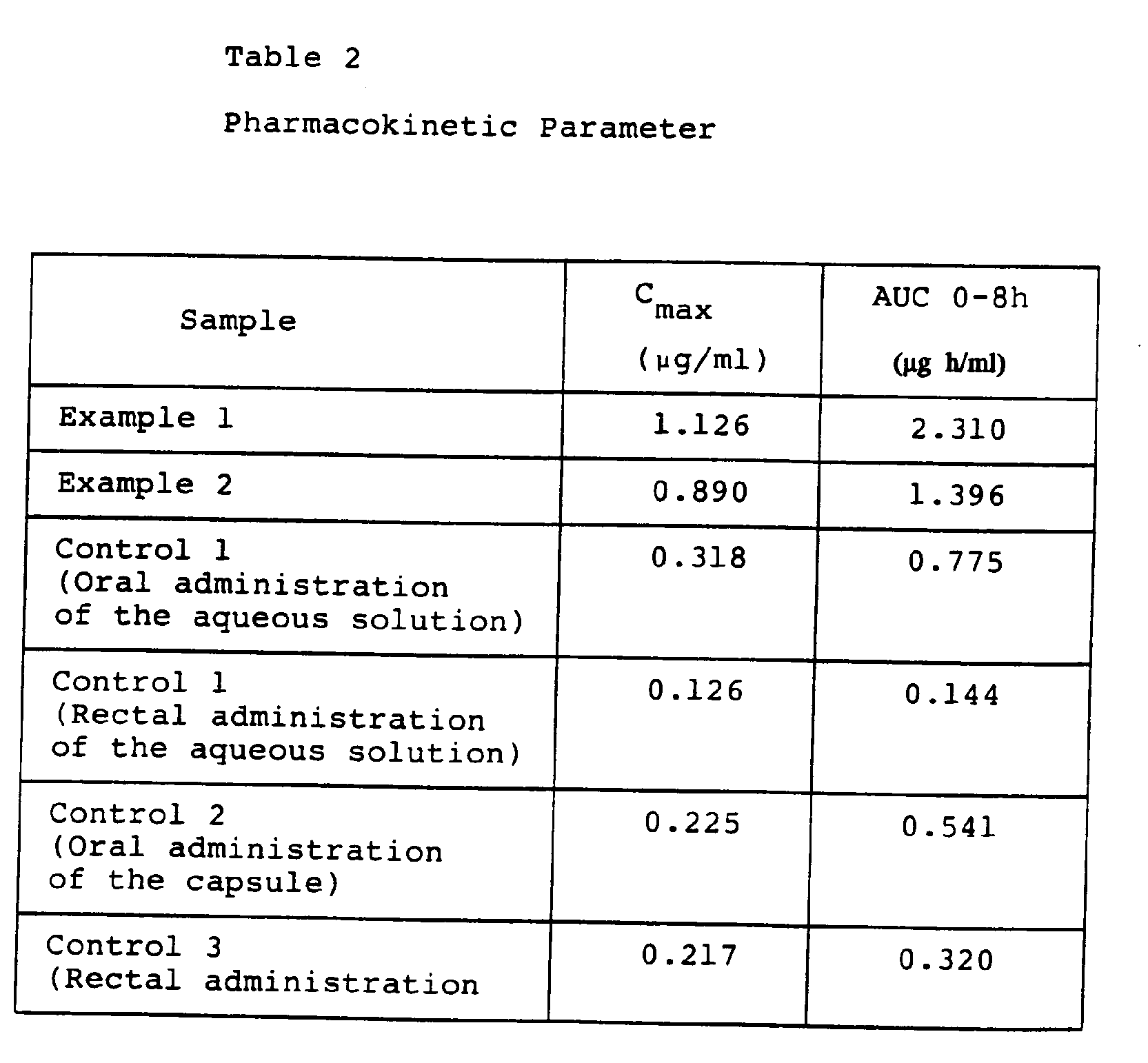
| (73) |
Proprietors: |
|
- NIPPON KAYAKU KABUSHIKI KAISHA
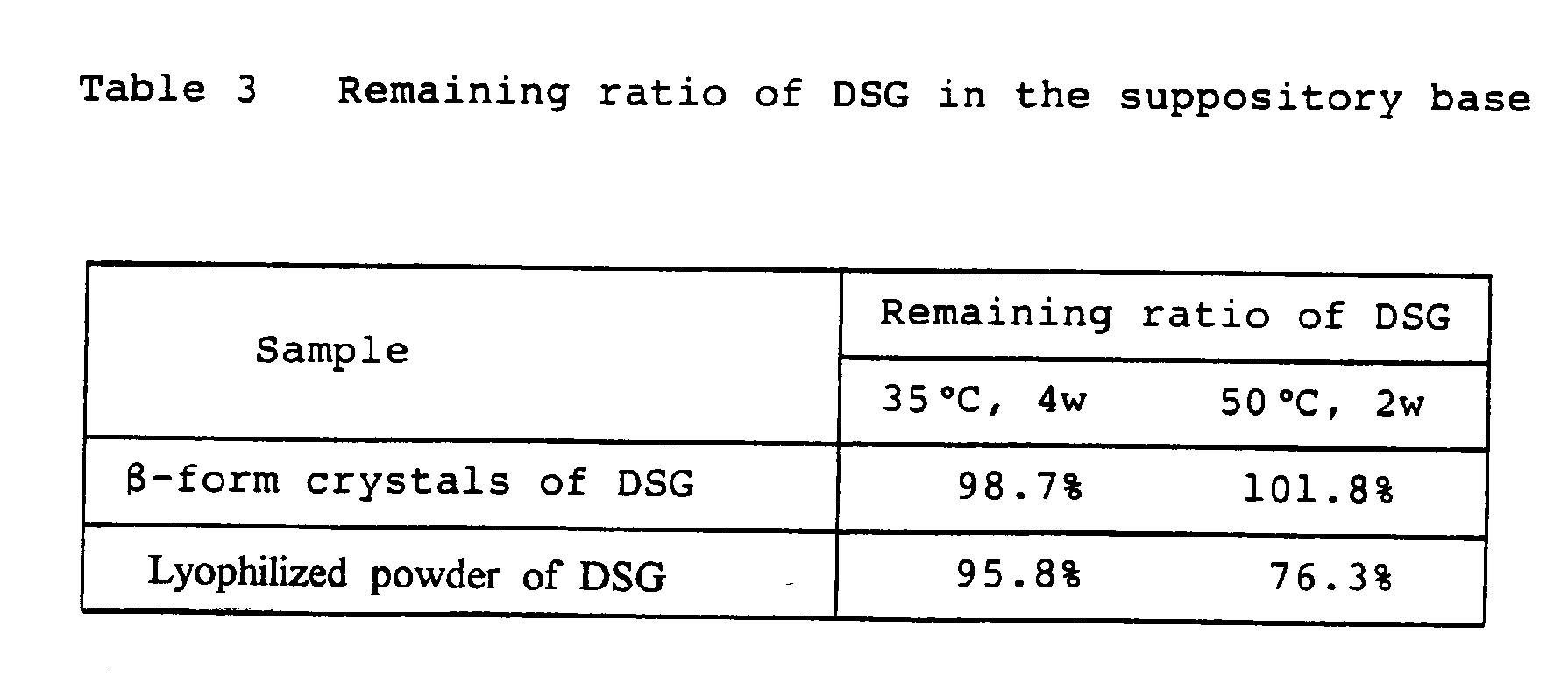
Tokyo 102 (JP)
- TAKARA SHUZO CO. LTD.
Fushimi-ku
Kyoto 612 (JP)
|
|
| (72) |
Inventors: |
|
- Hiraga, Hironobu
Yono-shi (JP)
- Okuma, Takaaki
Yono-shi (JP)
- Umeda, Yoshihisa
Otsu-shi (JP)
|
| (74) |
Representative: Türk, Dietmar |
|
Türk Gille Hrabal Leifert
Brucknerstrasse 20
D-40593 Düsseldorf
D-40593 Düsseldorf (DE) |
| (56) |
References cited: :
|
| |
|
|
- DATABASE WPIL, accession no. 90-056185 [08], Derwent Publications Ltd, London, GB
- DATABASE WPIL, accession no. 90-055509 [08], Derwent Publications Ltd, London, GB
|
|
| |
|
| Note: Within nine months from the publication of the mention of the grant of the European
patent, any person may give notice to the European Patent Office of opposition to
the European patent
granted. Notice of opposition shall be filed in a written reasoned statement. It shall
not be deemed to
have been filed until the opposition fee has been paid. (Art. 99(1) European Patent
Convention).
|
[0001] Spergualin is an antibiotic having anticancer activity which was found by Umezawa
et al. (U.S. Patent 4,416,899). Many derivatives and analogs of spergualin having
similar activity are disclosed in U.S. Patent 4,518,532, U.S. Patent 4,529,549, U.S.
Patent 4,556,735 and Japanese Patent Laid-open 62-48660 whereas derivatives having
immunosuppressive activity are disclosed in U.S. Patent 4,851,446.
[0002] Of these compounds, 15-deoxyspergualin [i.e. N-[4-(3-aminopropyl)aminobutyl]-2-(7-guanidinoheptaneamido)-2-hydroxyethaneamide)]
is usable as an immunosuppressor. As preparations of spergualins, injectable preparations
(U.S. Patent 4,876,244) and oral preparations for increasing the oral bioavailability
by using simple or complex fats have been proposed (Japanese Patent Laid-open 2-9816
and ibid. 2-11514).
[0003] 15-Deoxyspergualin is now being developed as an immunosuppressor. For the prophylaxis
or therapy of the diseases wherein an immunosuppressor is needed continuous administration
is required to some extent. Accordingly, it is desired to develop preparations other
than injectable preparations capable of giving a high plasma concentration of the
drug by easy administration at low dose. However, 15-deoxyspergualin hydrochloride
shows insufficient bioavailability even when it is administered orally as mentioned
above, and it is difficult to obtain a plasma concentration of the drug sufficient
to impart an immunosuppresive effect by an administration route other than injection.
[0004] In addition, 15-deoxyspergualin hydrochloride is hygroscopic and has a poor stability,
and therefore it was difficult to obtain preparations of this drug having good storage
stability.
[0005] An object of the present invention is to provide a 15-deoxyspergualin preparation
to solve the above-mentioned problems.
[0006] The present invention relates to a novel suppository containing 15-deoxyspergualin
trihydrochloride β-form crystals and lipophilic base which is solid at ambient temperature,
which can be used as an anticancer agent or an immunosuppressor.
[0007] As a result of the various researches, the present inventors have found that a powder
or an aqueous syrup of known 15-deoxyspergualin trihydrochloride (hereinafter referred
to as "15-deoxyspergualin hydrochloride") can be crystallized in the presence of a
mixture of water and a water miscible solvent, and that the resulting crystals (hereinafter
referred to as "β-form crystals") can be mixed with a lipophilic base which is solid
at an ambient temperature to give a suppository, which imparts high plasma concentration
of 15-deoxyspergualin when administered and has a good storage stability.
[0008] For formulation of the suppository of the present invention, one or a mixture of
two or more lipophilic bases, each of which is solid at normal ambient temperature,
are melted by heating, and 15-deoxyspergualin hydrochloride β-form crystals are added
thereto, and homogenized. The mixture is filled into suppository containers or gelatin
capsule shells and cooled to give suppositories.
[0009] 15-Deoxyspergualin hydrochloride β-form crystals are used in an amount of about 1
- 40% (all percentages are given "by weight"), preferably 3 - 25%, more preferably
10 - 20% based on the total weight of the preparation. The amount of base is 60 -
99%, preferably 75 - 97%, and more preferably 80 - 90%. For various purposes, other
additives can be added to the preparation of the present invention. The amount of
the additives is 0 - 0.3 part (all parts are "part by weight") relative to 1 part
of the mixture of 15-deoxyspergualin hydrochloride β-form crystals and the base. The
amount of the base is not less than 3 parts, preferably 4 - 100 parts relative to
1 part of the β-form crystals.
[0010] β-Form crystals of 15-deoxyspergualin hydrochloride used in the present invention
is prepared as follows: To about 100 parts of a powder of 15-deoxyspergualin hydrochloride
obtained by a prior art method is added 500 parts of 95% ethanol, and the mixture
is thoroughly mixed and allowed to stand at 5°C for 3 days, and the resulting crystals
are removed by suction filtration to give the β-form crystals.
[0011] Table 1 shows an X-ray diffraction pattern of β-form crystals of 15-deoxyspergualin
hydrochloride used in the present invention which is measured by means of an X-ray
diffraction apparatus (XD-3A, Shimadzu Co.) equipped with a Cu X-ray apparatus using
graphite monochrometer and with a scintillation counter.
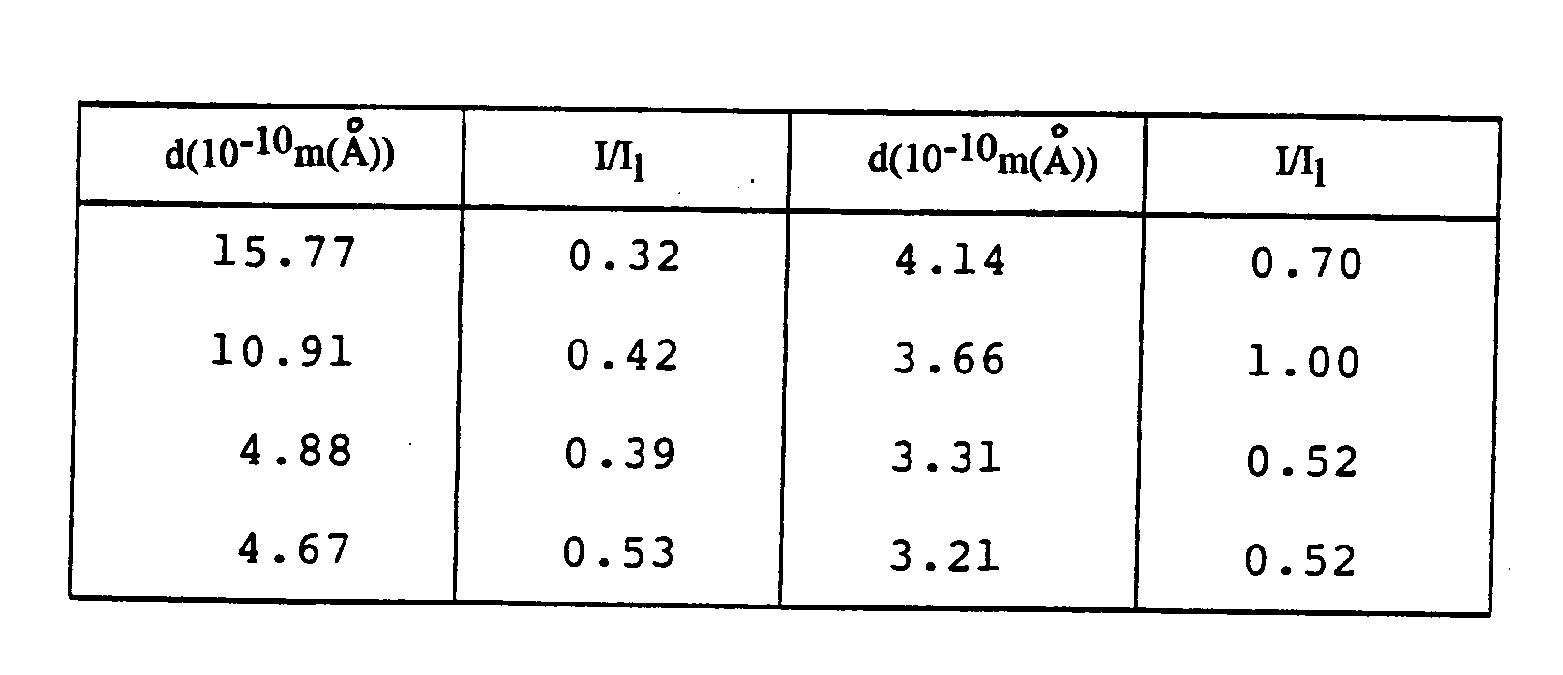
(Electric power Cu: Graphite monochrometer, 40 KV-30 mA, λ = 1. 54051)
[0012] The lipophilic base which is solid at ambient temperature for use in the present
invention includes medium chain fatty acid triglycerides which are solid at an ambient
temperature (e.g. capric acid triglyceride); and oil and fat suppository bases (e.g.
cacao butter, laurine butter, cinnamon butter, hydrogenated oil, semi-synthetic glycerides,
and the like). They can be used alone or in combination of two or more of them.
[0013] Examples of the lipophilic base which is solid at normal ambient temperature are
triglycerides of C₈ - C₁₈ saturated fatty acids, which preferably contain at least
50% of C₈ - C₁₄ saturated fatty acids. The fatty acids which constitute the triglycerides
preferably contain one or more members selected from C₈, C₁₀, C₁₂ and C₁₄ saturated
fatty acids.
[0014] The fatty acids attached to glycerin preferably contain 32 to 60%, preferably 44
to 57% of a C₁₂ saturated fatty acid; 12 to 25%, preferably 17 to 23% of a C₁₄ saturated
fatty acid; 9 to 20%, preferably 10 to 14% of a C₁₆ saturated fatty acid; 9 to 32%,
preferably 10 to 22% of a C₁₈ saturated fatty acid; and 0 to 4%, preferably 0 to 2%
of other fatty-acids based on the total weight of the fatty acids.
[0015] The suppository of the present invention may be a capsule for rectal use which is
prepared by molding suppositories by use of gelatin capsule shells and filling a mixture
of the medicine (solution or solid) and the base therein.
[0016] Besides the above components (15-deoxyspergualin and the suppository base), additives
may be added to the suppository of the present invention, for example, viscosity modifying
agents such as microcrystalline wax and microcrystalline cellulose; substances for
reducing rectal irritation such as fractionated coconut oils; a small amount of lecithin
for prevention of blooming of fats. The amount of these additives is 0 - 30% based
on the total weight of the drug and the suppository base.
[0017] The present invention is illustrated by the following examples. 15-Deoxyspergualin
is abbreviated as "DSG".
Example 1
(Formulation)
[0018]
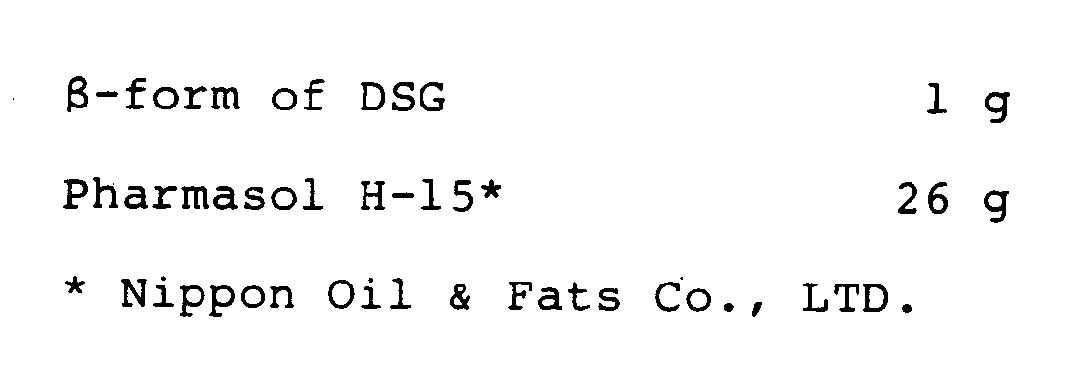
[0019] The above components are for 20 suppositories.
[0020] Pharmasol H-15 (proportion of fatty acids: about 54% of a C₁₂ fatty acid; about 22%
of a C₁₄ fatty acid; about 12% of a C₁₆ fatty acid; and about 12% of a C₁₈ fatty acid)
in a beaker was melted by heating on a water bath. Heating was stopped and 1 g of
DSG was added at 40°C to the solution under stirring and the components were homogenized
under sufficient mixing. The mixture was poured into suppository molds (suppository
containers), cooled at room temperature then solidified by cooling in a refrigerator
to give suppositories.
Example 2
(Formulation)
[0021]
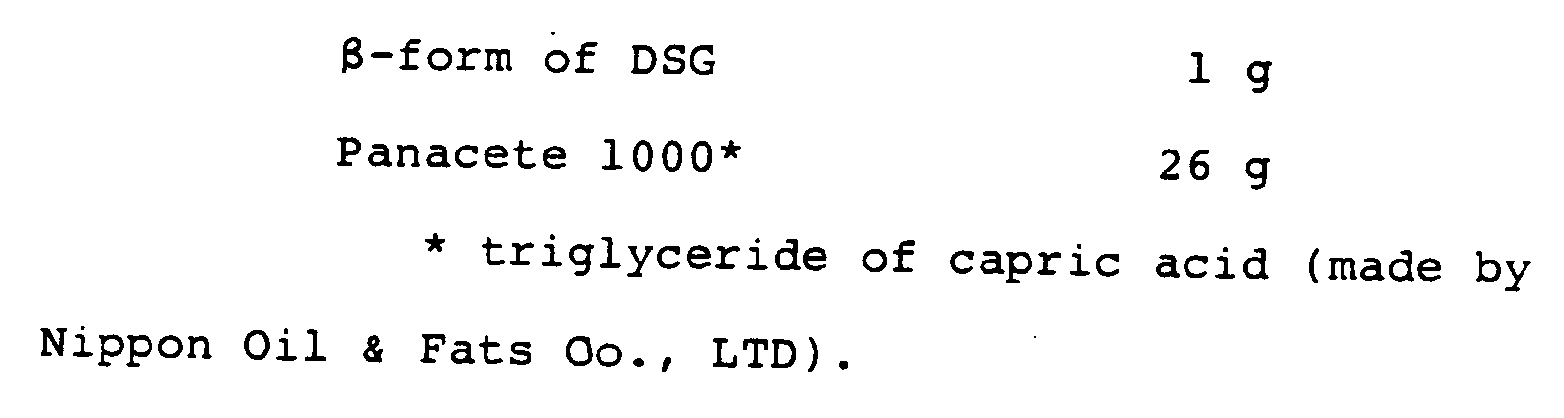
[0022] The above components are for 20 suppositories.
[0023] In a similar manner to that of Example 1, suppositories were obtained.
Example 3
(Formulation)
[0024]
- β-form of DSG
- 5 g
- Pharmasol H-15
- 35 g
[0025] The above components are for 20 suppositories.
[0026] In a similar manner to that of Example 1, suppositories were obtained.
Reference Example 1
[0027] A powder of DSG was dissolved in water to give a solution of 10 mg of DSG/ml.
Reference Example 2
[0028] 50 mg of a powder of DSG and 50 mg of Panacete 1000 were mixed and filled into No.
3 capsules (the Pharmacopoeia of Japan).
Reference Example 3
(Formulation)
[0029]
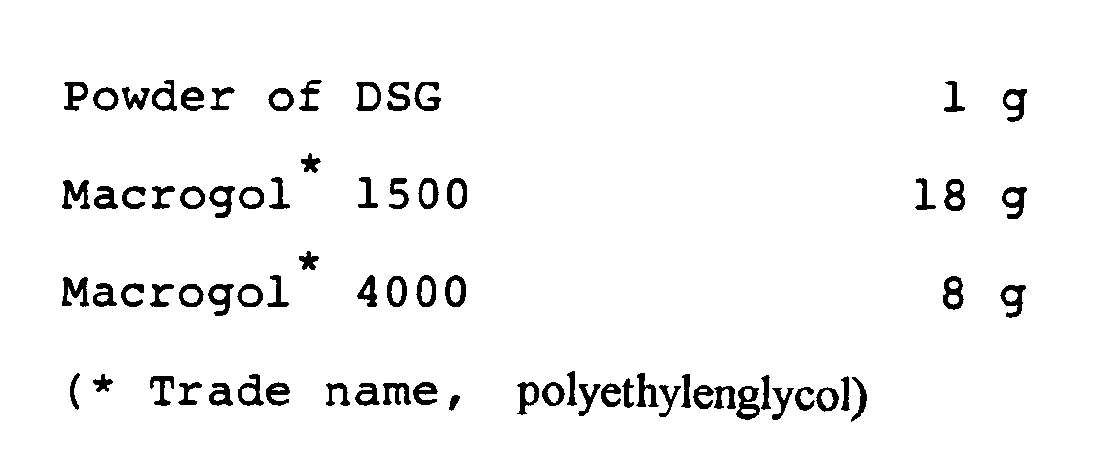
[0030] The above components are for 20 suppositories.
[0031] Macrogol 1500 and Macrogol 4000 were taken into a beaker, and melted on a warmed
water bath. DSG was added little by little to the solution with stirring and homogenized
with enough mixing. The mixture was filled into suppository molds, solidified by cooling
to give suppositories.
Test Example 1
(1) Test Method
[0032] Suppositories prepared in Examples 1 and 2 were each rectally administered to male
beagles weighing 9.0 - 11.0 kg (3 animals were used for each group). As control, 5
ml of a solution obtained in Reference Example 1 was administered orally or rectally,
a capsule obtained in Reference Example 2 was administered orally, and the suppository
of Reference Example 3 was administered rectally. In all cases, doses of DSG were
5 mg/kg. Animals were fasted from the day before the beginning of the test to the
conclusion of the test. Each about 5 mg of blood samples was collected into a heparin
treated syringe at 0.5, 1, 2, 4 and 8 hours after administration, and centrifuged
to separate the serum.
[0033] To 1 ml of the serum was added 1 »g of N-[4-(3-aminopropyl)aminobutyl]-2-(7-guanidinooctanamido)-2-hydroxyethanamide
as an internal standard, and the mixture was diluted with 5 ml of distilled water
and injected into CM-Sephadex® C-25 column [Na⁺ type (Pharmacia Fine Chemical Co.)
5 cm x 0.5 cm φ]. The column was washed with 10 ml of 0.3 M aqueous sodium chloride
solution, and then DSG and the internal standard were eluted with 10 ml of 0.5 M aqueous
sodium chloride solution. After desalting by using Sep-Pak C₁₈ cartridge, the mixture
was eluted with methanol, and the solvent was evaporated under reduced pressure.
[0034] The residue was dissolved in 250 »l of distilled water, and 100 »l of the solution
was injected in a high performance liquid chromatograph (HPLC), treated with o-phthalaldehyde
(OPA) to give its derivative (so-called postcolumn derivatization), which was determined
by HPLC with fluorescence detector.
- HPLC:
- Shimadzu liquid chromatography apparatus
- Column:
- Cosmosil 5C₁₈P (15 cm x 4.6 mmφ)
- Column temperature:
- 25°C
- Detection wavelength:
- excitation wavelength 335 nm, emission wavelength 435 nm.
- Mobile phase:
- 5mM sodium heptanesulfonate was dissolved in 10 mM phosphate buffer (pH 3.0) - acetonitrile
(80:20).
- Flow rate:
- mobile phase 1.0 ml/min.
OPA reagent 0.5 ml/min.
(2) Test Results
[0035]
- Cmax:
- The maximum plasma concentration
- AUC 0-8h :
- Area under the plasma concentration - time curve (0 ∼ 8 hours)
Test Example 2
Stability (severe Test)
(Test Method)
[0036] To 50 mg of exactly weighed β-form crystals of DSG (or a lyophilized powder of DSG)
in a hermetic vial was added 1.25 g of Witepsol® (proportion of fatty acids: about
54% of a C₁₂ fatty acid; about 22% of a C₁₄ fatty acid; about 12% of a C₁₆ fatty acid;
about 12% of a C₁₈ fatty acid) which was melted by heating on a water bath, and then
the mixture was thoroughly mixed. After being tightly closed, the mixture was kept
at 50°C for 2 weeks or at 35°C for 4 weeks.
[0037] The amount of DGS extracted from the base was measured according to a HPLC technique.
Test Example 3
Hygroscopicity Test
(Test Method)
Sample
[0038]

[0039] The above components are for 20 suppositories.

[0040] The above components are for 20 suppositories.
[0041] 26 g of Pharmasol® H-15 in a beaker was melted by heating on a water bath. After
stopping heating, 2 g of β-form crystals of DSG (a lyophilized powder of DSG) was
added to the solution at 40°C with stirring, homogenized with enough mixing, filled
into suppository molds, cooled at room temperature and solidified by cooling in a
refrigerator to give suppositories.
[0042] The above suppositories were stored at 25°C at 75% RH, and the increase ratio of
weight of the sample was measured.
(Test Results)
[0043] 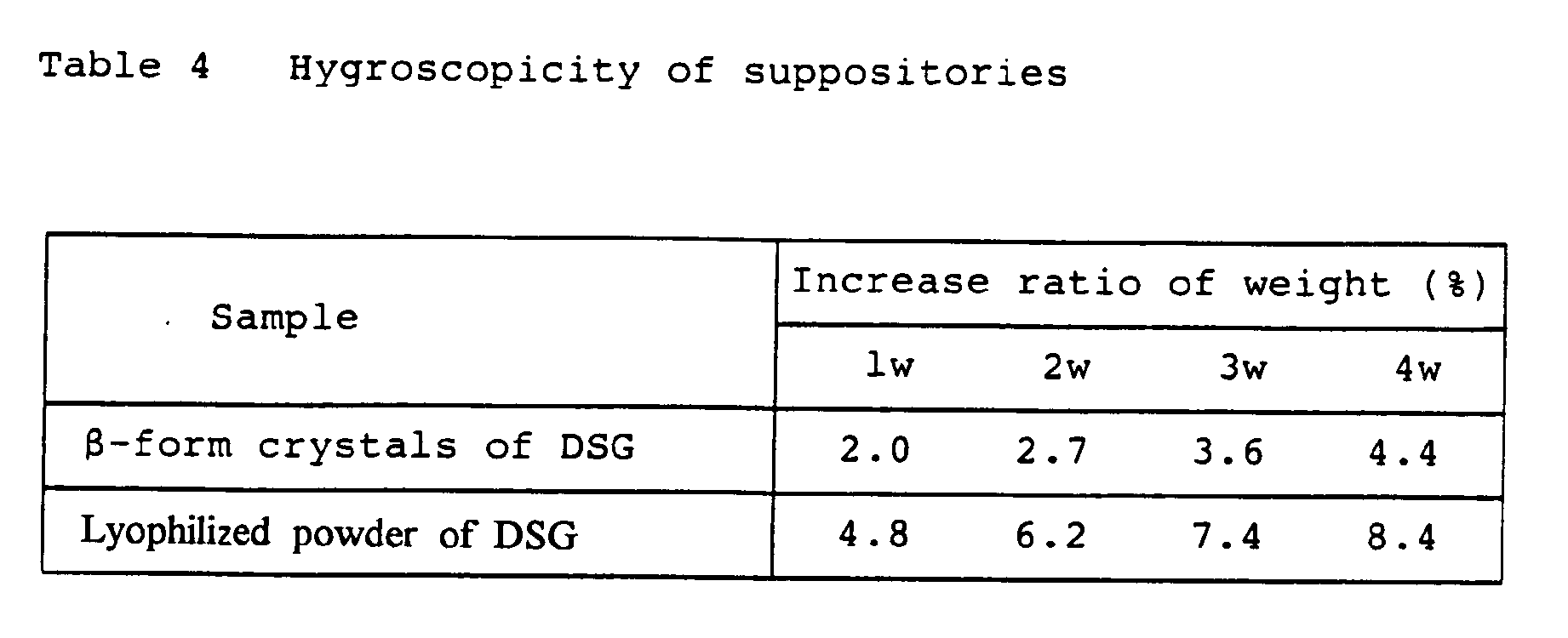
[0044] As shown in Table 2, the plasma concentration of DSG obtained by administration of
the suppository of the present invention is higher than the concentrations obtained
by the oral administration of DSG, by the rectal administration using the aqueous
solution of DSG, and by the rectal administration of the suppository of DSG using
a hydrophilic base (Macrogol). Particularly, the plasma concentration of DSG obtained
by administration of the suppository using the lipophilic base in Example 1 is about
3.5 times at C
max higher and about 3 times at AUC
0-8h higher than that obtained by administration of Control 1 which exhibited the highest
value in the control group.
[0045] As shown in Tables 3 and 4, the suppository containing β-form crystals of DSG exhibited
a higher DSG stability and a lower hygroscopicity than the suppository containing
a lyophilized powder of DSG.
[0046] It is apparent that, according to the invention, there is provided a 15-deoxyspergualin
suppository which can be obtained high plasma concentration of 15-deoxyspergualin
when administered and has good storage stability.
Claims for the following Contracting State(s): DE, FR, GB, IT
1. A suppository which comprises β-form crystals of 15-deoxyspergualin trihydrochloride
and a lipophilic base which is solid at an ambient temperature.
2. A suppository according to Claim 1 which comprises 3 - 25 % by weight of β-form crystals
of 15-deoxyspergualin and 97 - 75 % by weight of the lipophilic base.
3. A suppository according to Claim 1 which comprises 10 - 20% by weight of β-form crystals
of 15-deoxyspergualin and 90 - 80% by weight of the lipophilic base.
4. A suppository according to Claim 1, wherein the lipophilic base which is solid at
ambient temperature is a triglyceride of C₈ - C₁₈ saturated fatty acids containing
at least 50% by weight of C₈ - C₁₄ saturated fatty acids.
5. A suppository according to Claim 4 wherein the C₈ - C₁₄ saturated fatty acids attached
to glycerin are one or more members selected from C₈, C₁₀, C₁₂ and C₁₄ saturated fatty
acids.
6. A suppository according to Claim 4, wherein the saturated fatty acids attached to
glycerin contain an amount of from 32 to 60% by weight of a C₁₂ of a C₁₄ saturated
fatty acid; from 9 to 20% by weight of a C₁₆ saturated fatty acid; from 9 to 32% by
weight of a C₁₈ saturated fatty acid; and 0 to 4% by weight of other fatty acids.
7. A suppository according to Claim 4, wherein the saturated fatty acids attached to
glycerin contain an amount of from 44 to 57% by weight of a C₁₂ saturated fatty acid;
from 17 to 23% by weight of C₁₄ saturated fatty acid; from 10 to 14% by weight of
a C₁₆ saturated fatty acid; from 10 to 22% by weight of a C₁₈ saturated fatty acid;
and 0 to 2% by weight of other fatty acids.
8. Process for the manufacture of a suppository containing 15-deoxyspergualin trihydrochloride
β-form crystals and lipophilic base which is solid at an ambient temperature, comprising
a) melting by heating one or a mixture of two or more lipophilic bases which are solid
at room temperature,
b) adding 15-deoxyspergualin trihydrochloride β-form crystals and optionnally usual
pharmaceutically acceptable additives thereto,
c) homogenizing the mixture,
d) filling the mixture into suppository containers or gelatin capsule shells and cooling.
9. Process according to claim 8, wherein the 15-deoxsyspergualin trihydrochloride β-form
crystals are obtained by crystallizing 15-deoxyspergualin trihydrochloride in the
presence of a mixture of water and a water miscible solvent.
10. Process according to claim 9, wherein the crystallization is carried out by adding
a mixture of water and a water miscible solvent to a powder of 15-deoxyspergualin
trihydrochloride, thoroughly mixing and allowing the mixture to stand for 3 days at
a temperature of 5°C, and removing the resulting β-form crystals by suction filtration.
11. Process according to claim 9 or 10, wherein the mixture of water and a water miscible
solvent is 95% ethanol.
12. Process according to claim 11, wherein the ratio of powder of 15-deoxyspergualin trihydrochloride
and 95% ethanol is 1 : 5.
13. Process according to one or more of claims 8 to 12, wherein 3 - 25% by wt. of β-form
crystals of 15-deoxyspergualin hydrochloride and 97 - 75% by wt. of the lipophilic
base are used.
14. Process according to one or more of claims 8 to 13, wherein 10-20% by wt. of β-form
crystals of 15-deoxyspergualin hydrochloride and 90 - 80% by wt. of the lipophilic
base are used.
Claims for the following Contracting State(s): ES
1. Process for the manufacture of a suppository containing 15-deoxyspergualin trihydrochloride
β-form crystals and lipophilic base which is solid at an ambient temperature, comprising
a) melting by heating one or a mixture of two or more lipophilic bases which are solid
at room temperature,
b) adding 15-deoxyspergualin trihydrochloride β-form crystals and optionally usual
pharmaceutically acceptable additives thereto,
c) homogenizing the mixture,
d) filling the mixture into suppository containers or gelatin capsule shells and cooling.
2. Process according to claim 1, wherein the 15-deoxsyspergualin trihydrochloride β-form
crystals are obtained by crystallizing 15-deoxyspergualin trihydrochloride in the
presence of a mixture of water and a water miscible solvent.
3. Process according to claim 2, wherein the crystallization is carried out by adding
a mixture of water and a water miscible solvent to a powder of 15-deoxyspergualin
trihydrochloride, thoroughly mixing and allowing the mixture to stand for 3 days at
a temperature of 5°C, and removing the resulting β-form crystals by suction filtration.
4. Process according to claim 2 or 3, wherein the mixture of water and a water miscible
solvent is 95% ethanol.
5. Process according to claim 4, wherein the ration of powder of 15-deoxyspergualin trihydrochloride
and 95% ethanal is 1 : 5.
6. Process according to one or more of claims 1 to 5, wherein 3 - 25% by wt. of β-form
crystals of 15-deoxyspergualin hydrochloride and 97 - 75% by wt. of the lipophilic
base are used.
7. Process according to one or more of claims 1 to 6, wherein 10-20% by wt. of β-form
crystals of 15-deoxyspergualin hydrochloride and 90 - 80% by wt. of the lipophilic
base are used.
8. Process according to one or more of claims 1 to 7, wherein the lipophilic base which
is solid at ambient temperature is a triglyceride of C₈ to C₁₈ saturated fatty acids
containing at least 50% by wt. of C₈ to C₁₄ saturated fatty acids.
9. Process according to claim 8 wherein the C₈ - C₁₄ saturated fatty acids attached to
glycerin are one or more members selected from C₈, C₁₀, C₁₂ und C₁₄ saturated fatty
acids.
10. Process according to claim 8, wherein the saturated fatty acids attached to glycerin
contain an amount of from 32 to 60% by wt. of a C₁₂ saturated fatty acid; from 12
to 25% by wt. of a C₁₄ saturated fatty acid; from 9 to 20% by wt. of C₁₆ saturated
fatty acid; from 9 to 32% by wt. of C₁₈ saturated fatty acid; and 0 to 4% by wt. of
other fatty acids.
11. Process according to claim 8, wherein the saturated fatty acids attached to glycerin
contain an amount of from 44 to 57% by wt. a of C₁₂ saturated fatty acid; from 17
to 23% by wt. of C₁₄ saturated fatty acid; from 10 to 14% by wt. of C₁₆ saturated
fatty acid; from 10 to 22% by wt. of a C₁₈ saturated fatty acid; and 0 to 2% by wt.
of other fatty acids.
Patentansprüche für folgende(n) Vertragsstaat(en): DE, FR, GB, IT
1. Suppositorium, das umfaßt (enthält) β-Form-Kristalle von 15-Deoxyspergualintrihydrochlorid
und eine lipophile Basis, die bei Umgebungstemperatur fest ist.
2. Suppositorium nach Anspruch 1, das 3 bis 25 Gew.-% β-Form-Kristalle von 15-Deoxyspergualin
und 97 bis 75 Gew.-% der lipophilen Basis enthält.
3. Suppositorium nach Anspruch 1, das 10 bis 20 Gew.-% β-Form-Kristalle von 15-Deoxyspergualin
und 90 bis 80 Gew.-% der lipophilen Basis enthält.
4. Suppositorium nach Anspruch 1, worin die lipophile Basis, die bei Umgebungstemperatur
fest ist, ein Triglycerid von gesättigten C₈-C₁₈-Fettsäuren ist, die mindestens 50
Gew.-% gesättigte C₈-C₁₄-Fettsäuren enthalten.
5. Suppositorium nach Anspruch 4, worin die an Glycerin gebundenen gesättigten C₈-C₁₄-Fettsäuren
einen oder mehr Vertreter darstellen, der ausgewählt wird aus der Gruppe der gesättigten
C₈-, C₁₀-, C₁₂- und C₁₄-Fettsäuren.
6. Suppositorium nach Anspruch 4, worin die an Glycerin gebundenen gesättigten Fettsäuren
32 bis 60 Gew.-% einer gesättigten C₁₂-Fettsäure, 12 bis 25 Gew.-% einer gesättigten
C₁₄-Fettsäure, 9 bis 20 Gew.-% einer gesättigten C₁₆-Fettsäure, 9 bis 32 Gew.-% einer
gesättigten C₁₈-Fettsäure und 0 bis 4 Gew.-% andere Fettsäuren enthalten.
7. Suppositorium nach Anspruch 4, worin die an Glycerin gebundenen gesättigten Fettsäuren
44 bis 57 Gew.-% einer gesättigten C₁₂-Fettsäure, 17 bis 22 Gew.-% einer gesättigten
C₁₄-Fettsäure, 10 bis 14 Gew.-% einer gesättigten C₁₆-Fettsäure, 10 bis 22 Gew.-%
einer gesättigten C₁₈-Fettsäure und 0 bis 2 Gew.-% andere Fettsäuren enthalten.
8. Verfahren zur Herstellung eines Suppositoriums, das 15-Deoxyspergualintrihydrochlorid-β-Form-Kristalle
und eine lipophile Basis enthält, die bei Umgebungstemperatur fest ist, das umfaßt
a) das Schmelzen einer lipophilen Basis oder einer Mischung von zwei oder mehr lipophilen
Basen, die bei Raumtemperatur fest sind, durch Erhitzen,
b) die Zugabe von 15-Deoxyspergualintrihydrochlorid-β-Form-Kristallen und gegebenenfalls
von üblichen pharmazeutisch akzeptablen Additiven,
c) das Homogenisieren der Mischung und
d) das Einfüllen der Mischung in Suppositorien-Behälter oder Gelatinekapsel-Hüllen
und das Abkühlen.
9. Verfahren nach Anspruch 8, worin die 15-Deoxyspergualintrihydrochlorid-β-Form-Kristalle
erhalten werden durch Kristallisieren von 15-Deoxyspergualintrihydrochlorid in Gegenwart
einer Mischung aus Wasser und einem mit Wasser mischbaren Lösungsmittel.
10. Verfahren nach Anspruch 9, worin die Kristallisation durchgeführt wird durch Zugabe
einer Mischung aus Wasser und einem mit Wasser mischbaren Lösungsmittel zu einem Pulver
von 15-Deoxyspergualintrihydrochlorid, gründliches Durchmischen und Stehenlassen der
Mischung 3 Tage lang bei einer Temperatur von 5°C und Entfernen der resultierenden
β-Form-Kristalle durch Absaugen.
11. Verfahren nach Anspruch 9 oder 10, worin die Mischung aus Wasser und einem mit Wasser
mischbaren Lösungsmittel 95 %iges Ethanol ist.
12. Verfahren nach Anspruch 11, worin das Verhältnis zwischen dem Pulver von 15-Deoxyspergualintrihydrochlorid
und 95 %igem Ethanol 1:5 beträgt.
13. Verfahren nach einem oder mehr der Ansprüche 8 bis 12, worin 3 bis 25 Gew.-% der β-Form-Kristalle
von 15-Deoxyspergualinhydrochlorid und 97 bis 75 Gew.-% der lipophilen Basis verwendet
werden.
14. Verfahren nach einem oder mehr der Ansprüche 8 bis 13, worin 10 bis 20 Gew.-% der
β-Form-Kristalle von 15-Deoxyspergualinhydrochlorid und 90 bis 80 Gew.-% der lipophilen
Basis verwendet werden.
Patentansprüche für folgende(n) Vertragsstaat(en): ES
1. Verfahren zur Herstellung eines Suppositoriums, das 15-Deoxyspergualintrihydrochlorid-β-Form-Kristalle
und eine lipophile Basis enthält, die bei Umgebungstemperatur fest ist, das umfaßt
a) das Schmelzen einer lipophilen Basis oder einer Mischung von zwei oder mehr lipophilen
Basen, die bei Raumtemperatur fest sind, durch Erhitzen,
b) die Zugabe von 15-Deoxyspergualintrihydrochlorid-β-Form-Kristallen und gegebenenfalls
von üblichen pharmazeutisch akzeptablen Additiven,
c) das Homogenisieren der Mischung und
d) das Einfüllen der Mischung in Suppositorien-Behälter oder Gelatinekapsel-Hüllen
und das Abkühlen.
2. Verfahren nach Anspruch 1, worin die 15-Deoxyspergualintrihydrochlorid-β-Form-Kristalle
erhalten werden durch Kristallisieren von 15-Deoxyspergualintrihydrochlorid in Gegenwart
einer Mischung aus Wasser und einem mit Wasser mischbaren Lösungsmittel.
3. Verfahren nach Anspruch 2, worin die Kristallisation durchgeführt wird durch Zugabe
einer Mischung aus Wasser und einem mit Wasser mischbaren Lösungsmittel zu einem Pulver
von 15-Deoxyspergualintrihydrochlorid, gründliches Durchmischen und Stehenlassen der
Mischung 3 Tage lang bei einer Temperatur von 5°C und Entfernen der resultierenden
β-Form-Kristalle durch Absaugen.
4. Verfahren nach Anspruch 2 oder 3, worin die Mischung aus Wasser und einem mit Wasser
mischbaren Lösungsmittel 95 %iges Ethanol ist.
5. Verfahren nach Anspruch 4, worin das Verhältnis zwischen dem Pulver von 15-Deoxyspergualintrihydrochlorid
und 95 %igem Ethanol 1:5 beträgt.
6. Verfahren nach einem oder mehr der Ansprüche 1 bis 5, worin 3 bis 25 Gew.-% der β-Form-Kristalle
von 15-Deoxyspergualinhydrochlorid und 97 bis 75 Gew.-% der lipophilen Basis verwendet
werden.
7. Verfahren nach einem oder mehr der Ansprüche 1 bis 6, worin 10 bis 20 Gew.-% der β-Form-Kristalle
von 15-Deoxyspergualinhydrochlorid und 90 bis 80 Gew.-% der lipophilen Basis verwendet
werden.
8. Verfahren nach einem oder mehr der Ansprüche 1 bis 7, worin die lipophile Basis, die
bei Umgebungstemperatur fest ist, ein Triglycerid von gesättigten C₈-C₁₈-Fettsäuren
ist, die mindestens 50 Gew.-% gesättigte C₈-C₁₄-Fettsäuren enthalten.
9. Verfahren nach Anspruch 8, worin die an Glycerin gebundenen gesättigten C₈-C₁₄-Fettsäuren
ein oder mehr Vertreter sind, die ausgewählt werden aus der Gruppe der gesättigten
C₈-, C₁₀-, C₁₂- und C₁₄-Fettsäuren.
10. Verfahren nach Anspruch 8, worin die an Glycerin gebundenen Fettsäuren 32 bis 60 Gew.-%
einer gesättigten C₁₂-Fettsäure, 12 bis 25 Gew.-% einer gesättigten C₁₄-Fettsäure,
9 bis 20 Gew.-% einer gesättigten C₁₆-Fettsäure, 9 bis 32 Gew.-% einer gesättigten
C₁₈-Fettsäure und 0 bis 4 Gew.-% andere Fettsäuren enthalten.
11. Verfahren nach Anspruch 8, worin die an Glycerin gebundenen gesättigten Fettsäuren
44 bis 57 Gew.-% einer gesättigten C₁₂-Fettsäure, 17 bis 23 Gew.-% einer gesättigten
C₁₄-Fettsäure, 10 bis 14 Gew.-% einer gesättigten C₁₆-Fettsäure, 10 bis 22 Gew.-%
einer gesättigten C₁₈-Fettsäure und 0 bis 2 Gew.-% andere Fettsäuren enthalten.
Revendications pour l'(les) Etat(s) contractant(s) suivant(s): DE, FR, GB, IT
1. Suppositoire comprenant des cristaux sous forme β de trichlorhydrate de 15-désoxyspergualine,
et un excipient lipophile solide à température ambiante.
2. Suppositoire selon la revendication 1, comprenant de 3 à 25 % en poids de cristaux
sous forme β de 15-désoxyspergualine et de 97 à 75 % en poids de l'excipient lipophile.
3. Suppositoire selon la revendication 1, comprenant de 10 à 20 % en poids de cristaux
sous forme β de 15-désoxyspergualine et de 90 à 80 % en poids de l'excipient lipophile.
4. Suppositoire selon la revendication 1, dans lequel l'excipient lipophile solide à
température ambiante, est un triglycéride dérivé d'acides gras saturés en C₈ à C₁₈,
contenant au moins 50 % en poids d'acides gras saturés en C₈ à C₁₄.
5. Suppositoire selon la revendication 4, dans lequel les acides gras saturés en C₈ à
C₁₄ liés à la glycérine, comprennent au moins un composé choisi parmi les acides gras
saturés en C₈, C₁₀, C₁₂ et C₁₄.
6. Suppositoire selon la revendication 4, dans lequel les acides gras saturés liés à
la glycérine, contiennent une quantité de 32 à 60 % en poids d'un acide gras saturé
en C₁₂ ; de 12 à 25 % en poids d'un acide gras saturé en C₁₄ ; de 9 à 20 % en poids
d'un acide gras saturé en C₁₆ ; de 9 à 32 % d'un acide gras saturé en C₁₈ et de 0
à 4 % en poids d'autres acides gras.
7. Suppositoire selon la revendication 4, dans lequel les acides gras saturés liés à
la glycérine, contiennent une quantité de 44 à 57 % en poids d'un acide gras saturé
en C₁₂ ; de 17 à 23 % en poids d'un acide gras saturé en C₁₄ ; de 10 à 14 % en poids
d'un acide gras saturé en C₁₆, de 10 à 22 % en poids d'un acide gras saturé en C₁₈
; et de 0 à 2 % en poids d'autres acides gras.
8. Procédé de fabrication d'un suppositoire contenant des cristaux sous forme β de trichlorhydrate
de 15-désoxyspergualine et un excipient lipophile solide à température ambiante, selon
lequel :
a) on fond, en chauffant, un mélange d'au moins deux ou plusieurs excipients lipophiles
solides à la température ambiante ;
b) on ajoute des cristaux de trichlorhydrate de 15-désoxyspergualine sous forme β
et éventuellement des additifs pharmaceutiquement acceptables habituels ;
c) on homogénéise le mélange ; et
d) on introduit le mélange dans des récipients à suppositoire ou des enveloppes formant
capsule de gélatine, et on refroidit.
9. Procédé selon la revendication 8, dans lequel les cristaux sous forme β de trichlorhydrate
de 15-désoxyspergualine, sont obtenus par cristallisation du trichlorhydrate de 15-désoxyspergualine
en présence d'un mélange d'eau et d'un solvant miscible dans l'eau.
10. Procédé selon la revendication 9, dans lequel la cristallisation est effectuée en
ajoutant un mélange d'eau et d'un solvant miscible dans l'eau, dans une poudre de
trichlorhydrate de 15-désoxyspergualine, en mélangeant complètement et en laissant
le mélange reposer pendant trois jours à une température de 5 °C, et on sépare les
cristaux sous forme β résultants, par filtration par aspiration.
11. Procédé selon la revendication 9 ou 10, dans lequel le mélange d'eau et d'un solvant
miscible dans l'eau, consiste en de l'éthanol à 95 %.
12. Procédé selon la revendication 11, dans lequel le rapport de la poudre de trichlorhydrate
de 15-désoxyspergualine à l'éthanol à 95 % est de 1:5.
13. Procédé selon au moins l'une des revendications 8 à 12, dans lequel on emploie de
3 à 25 % en poids de cristaux sous forme β de trichlorhydrate de 15-désoxyspergualine,
et de 97 à 75 % en poids de l'excipient lipophile.
14. Procédé selon au moins l'une des revendications 8 à 13, dans lequel on emploie de
10 à 20 % en poids de cristaux sous forme β de trichlorhydrate de 15-désoxyspergualine,
et de 90 à 80 % en poids de l'excipient lipophile.
Revendications pour l'(les) Etat(s) contractant(s) suivant(s): ES
1. Procédé de fabrication d'un suppositoire contenant des cristaux sous forme β de trichlorhydrate
de 15-désoxyspergualine et un excipient lipophile solide à température ambiante, selon
lequel :
a) on fond, en chauffant, au moins deux ou plusieurs excipients lipophiles solides
à la température ambiante ;
b) on ajoute des cristaux de trichlorhydrate de 15-désoxyspergualine sous forme β
et éventuellement des additifs pharmaceutiquement acceptables habituels ;
c) on homogénéise le mélange ; et
d) on introduit le mélange dans des récipients à suppositoire ou des enveloppes formant
capsule de gélatine, et on refroidit.
2. Procédé selon la revendication 1, dans lequel les cristaux sous forme β de trichlorhydrate
de 15-désoxyspergualine, sont obtenus par cristallisation du trichlorhydrate de 15-désoxyspergualine
en présence d'un mélange d'eau et d'un solvant miscible dans l'eau.
3. Procédé selon la revendication 2, dans lequel la cristallisation est effectuée en
ajoutant un mélange d'eau et d'un solvant miscible dans l'eau, dans une poudre de
trichlorhydrate de 15-désoxyspergualine, en mélangeant complètement et en laissant
le mélange reposer pendant trois jours à une température de 5 °C, et on sépare les
cristaux sous forme β résultants, par filtration par aspiration.
4. Procédé selon la revendication 2 ou 3, dans lequel le mélange d'eau et d'un solvant
miscible dans l'eau, consiste en de l'éthanol à 95 %.
5. Procédé selon la revendication 4, dans lequel le rapport de la poudre de trichlorhydrate
de 15-désoxyspergualine à l'éthanol à 95 % est de 1:5.
6. Procédé selon au moins l'une des revendications 1 à 5, dans lequel on emploie de 3
à 25 % en poids de cristaux sous forme β de trichlorhydrate de 15-désoxyspergualine,
et de 97 à 75 % en poids de l'excipient lipophile.
7. Procédé selon au moins l'une des revendications 1 à 6, dans lequel on emploie de 10
à 20 % en poids de cristaux sous forme β de trichlorhydrate de 15-désoxyspergualine,
et de 90 à 80 % en poids de l'excipient lipophile.
8. Procédé selon au moins une des revendications 1 à 7, dans lequel la base lipophile
solide à température ambiante, est un triglycéride dérivé d'acides gras saturés en
C₈ à C₁₈ contenant au moins 50 % en poids d'acides gras en C₈ à C₁₄.
9. Procédé selon la revendication 8, dans lequel les acides gras saturés en C₈ à C₁₄
liés à la glycérine, comprennent au moins un composé choisi parmi les acides gras
saturés en C₈, C₁₀, C₁₂ et C₁₄.
10. Procédé selon la revendication 8, dans lequel les acides gras saturés liés à la glycérine,
contiennent une quantité de 32 à 60 % en poids d'un acide gras saturé en C₁₂, de 12
à 25 % en poids d'un acide gras saturé en C₁₄ ; de 9 à 20 % en poids d'un acide gras
saturé en C₁₆ ; de 9 à 32 % en poids d'un acide gras saturé en C₁₈ et de 0 à 4 % en
poids d'autres acides gras.
11. Procédé selon la revendication 8, dans lequel les acides gras saturés liés à la glycérine
contiennent une quantité de 44 à 57 % en poids d'un acide gras saturé en C₁₂ ; de
17 à 23 % en poids d'un acide gras saturé en C₁₄, de 10 à 14 % en poids d'un acide
gras saturé en C₁₆ ; de 10 à 22 % en poids d'un acide gras saturé en C₁₈ et de 0 à
2 % en poids d'autres acides gras.