|
(11) | EP 0 471 531 B1 |

| (12) | EUROPEAN PATENT SPECIFICATION |
|
|
| (54) |
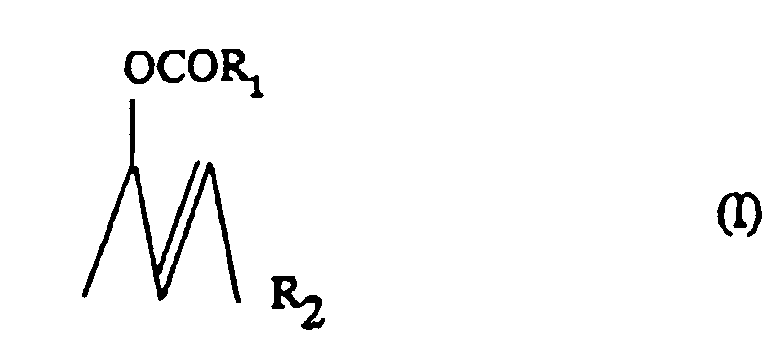
Process for preparing optically active alpha-hydroxyalkene derivatives Verfahren zur Herstellung optisch aktiver Alpha-Hydroxyalkenderivate Procédé de préparation de dérivés d'alpha-hydroxyalkènes optiquement actifs |
|
|
|||||||||||||||||||||||||||||||
| Note: Within nine months from the publication of the mention of the grant of the European patent, any person may give notice to the European Patent Office of opposition to the European patent granted. Notice of opposition shall be filed in a written reasoned statement. It shall not be deemed to have been filed until the opposition fee has been paid. (Art. 99(1) European Patent Convention). |
[0001] The present invention relates to a process for preparing optically active 1-substituted-3-hydroxy-1-butenes or their ester derivatives, and, more particularly, to a process for preparing optically active 1-substituted-3-hydroxy-1-butenes or their ester derivatives which comprises treating a racemic 1-substituted-3-hydroxy-1-butene or its ester derivative with a lipase.
[0002] The products of the present invention can be used, for example, as raw materials in preparing azetidinone compounds disclosed in Japanese Patent Application Laid-open No. 207373/1986. The inexpensive and simple preparation of the compounds herein exemplified is expected to make great contributions to the development in this field.
[0003] The demand for optically active compounds has been increasing in recent years in such areas as pharmaceuticals, agrichemicals, cosmetics, liquid crystals, and the like. Because synthesis of optically active compounds has been handicapped in terms of the production cost and the technology, the research in this area has remained only a preliminary stage. The recent increase in demand, however, has advanced the technology for synthesis of such compounds, offering more opportunities for their use.
[0004] A conventional process for producing optically active compounds involves selective reduction of carbonyl compounds. High prices of reducing agents and the requirements of special procedures in their handling have been problems in such a conventional process. Processes which microorganisms or enzymes produced therefrom are used, on the other hand, have had still to be improved in the selectivity, the reaction substrate concentration, and the like in order to apply them to a commercial production.
[0005] The process of the present invention in which an alcohol compound protected by an acyl group is used as a substrate can produce a desired optically active alcohol or its acyl-protected derivative in a high yield and in high optical purity under mild conditions by the treatment of the acylated alcohol substrate with a lipase. The process can provide a high substrate concentration at a small consumption of a lipase, and can be adaptable to large scale industrial production.
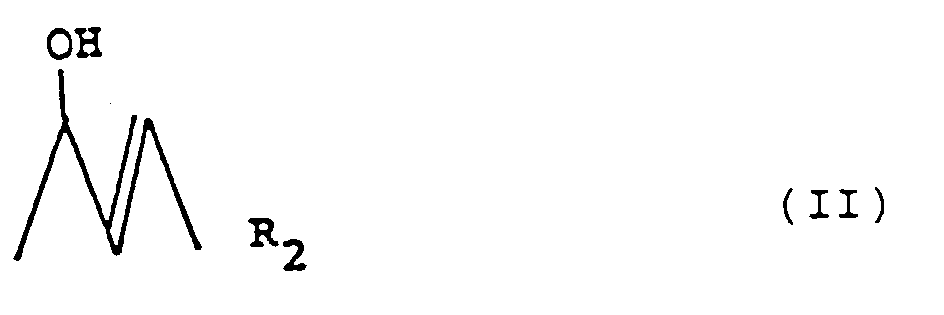
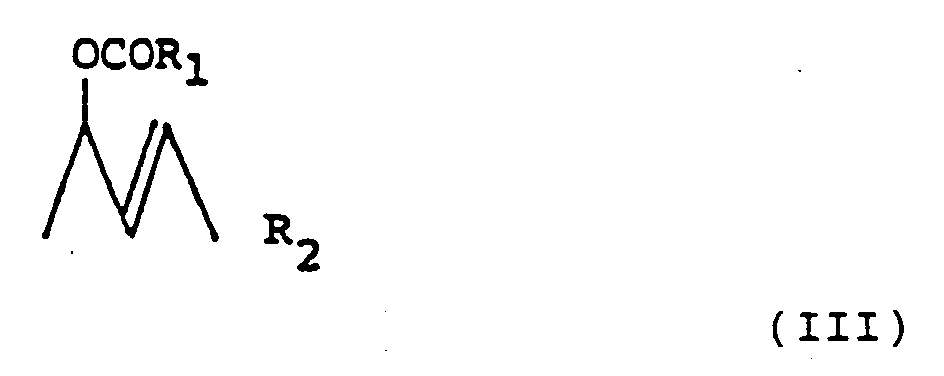
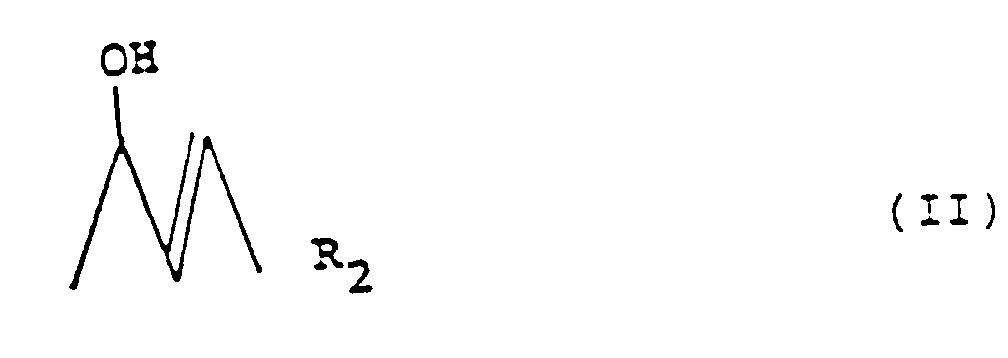
[0006] In view of this situation, the present inventors have undertaken extensive studies, and have found that an optically active 1-substituted-3-hydroxy-1-butene or its derivative represented by formula (II) or (III),
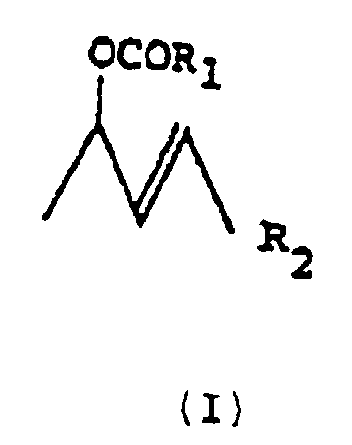
could be prepared in a high yield and a high selectivity by a simple process in which an ester derivative of racemic 1-substituted-3-hydroxy-1-butene of formula (I),
is treated with a lipase to effect asymmetric hydrolysis.
[0007] In the above formulae (I) to (III), R1 is an alkyl group having 1-8 carbon atoms, an aryl group having 6-10 carbon atoms, an alkoxy group having 1-6 carbon atoms, or an aryloxy group having 6-10 carbon atoms, wherein hydrogen atoms on the carbon atoms of the alkyl, aryl, alkoxy, or aryloxy group may optionally be substituted by alkyl, aryl, hydroxyl, alkoxy, alkylthio, or arylthio group, and R2 is a hydrogen atom, an alkyl group having 1-8 carbon atoms, an aryl group having 6-10 carbon atoms, a halogen atom, an alkoxy group having 1-6 carbon atoms, an aryloxy group having 6-10 carbon atoms, an alkylsulfonyloxy group having 1-8 carbon atoms, an arylsulfonyloxy group having 6-10 carbon atoms, an alkylthio group having 1-8 carbon atoms, or an arylthio group having 6-10 carbon atoms, wherein hydrogen atoms on the carbon atoms of the alkylsulfonyloxy, arylsulfonyloxy, alkylthio, or the arylthio group may optionally be substituted by halogen, alkyl, aryl, hydroxyl, or alkoxy group, and in formulae (II) and (III) the configuration at the 3-position is either R or S configuration.
[0008] Accordingly, an object of the present invention is to provide a process for preparing an optically active 1-substituted-3-hydroxy-1-butene or its derivative represented by formula (II) or (III),
wherein R1 is an alkyl group having 1-8 carbon atoms, an aryl group having 6-10 carbon atoms, an alkoxy group having 1-6 carbon atoms, or an aryloxy group having 6-10 carbon atoms, wherein hydrogen atoms on the carbon atoms of the alkyl, aryl, alkoxy, or aryloxy group may optionally be substituted by alkyl, aryl, hydroxyl, alkoxy, alkylthio, or arylthio group, and R2 is a hydrogen atom, an alkyl group having 1-8 carbon atoms, an aryl group having 6-10 carbon atoms, a halogen atom, an alkoxy group having 1-6 carbon atoms, an aryloxy group having 6-10 carbon atoms, an alkylsulfonyloxy group having 1-8 carbon atoms, an arylsulfonyloxy group having 6-10 carbon atoms, an alkylthio group having 1-8 carbon atoms, or an arylthio group having 6-10 carbon atoms, wherein hydrogen atoms on the carbon atoms of the alkylsulfonyloxy, arylsulfonyloxy, alkylthio, or the arylthio group may optionally be substituted by halogen, alkyl, aryl, hydroxyl, or alkoxy group, and the configuration at the 3-position is either R or S configuration, which comprises treating an ester derivative or racemic 1-substituted-3-hydroxy-1-butene of formula (I),
wherein R1 and R2 have the same meanings as defined above, with a lipase.
[0009] After selective hydrolysis of the compound of formula I to produce a mixture containing optically active compounds of formulae II and III, said mixture may be worked up to separate the compound of formula II and/or the compound of formula III in an optically active state.
[0010] If said compound of formula III is separated in an optically active state, it may then be hydrolysed to provide a compound of formula II in an optically active state.
[0011] The compounds of formulae I, II and III present in the reaction mixture after the lipase reaction may be extracted in a solvent immiscible with water and at least one of the compounds of formulae II and III may be purified by chromatography or solvent extraction.
[0012] Optionally, the compounds of formulae I, II and III present in the reaction mixture after the lipaase reaction are allowed to separate from the reaction mixture as an oil phase and at least one of the compounds of formulae II and III is purified thereafter by solvent extraction.
[0013] Other objects, features, and advantages of this invention will appear more fully form the following description.
[0014] There are a number of reports about the asymmetric hydrolysis of racemic compounds using lipase. Few of them, however, have confirmed their efficiency quantitatively, nor few processes have been developed to a commercially competent stage. The present inventors have conducted studies about quantitative analysis of enzymatic or biological resolution products, and contributed a report dealing with the relationship between the extent of conversion of the racemic substrate (c), the optical purity expressed as the enantiomeric excess (ee) of the product), and the enantiomeric ratio (E value) [J. Amer. Chem. Soc. 104, 7294 (1982)]. The effect of the present invention have specifically been proven by the calculation of the E value according to the following equation.
wherein,
E (E value) : enantiomeric ratio
c : extent of conversion of the racemic substrate
ee(P) : enantiomeric excess (ee) of the product
[0015] An ester derivative of racemic secondary alcohol represented by formula (I) can be prepared by a conventional esterification process. A typical example is a condensation reaction of an alcohol represented by formula (IV),
wherein R2 has the same meaning as defined above, and a carboxylic acid of the formula R1COOH (Formula (V)), wherein R1 has the same meaning as defined above, in the presence of an organic acid such as p-toluenesulfonic acid or the like or a mineral acid such as hydrochloric acid, sulfuric acid, or the like. Alternatively, instead of a carboxylic acid, a carboxylic acid halide, a carboxylic ester, or carboxylic acid anhydride of formula (VI),
R1COY (VI)
wherein R1 has the same meaning as defined above and Y is a halogen atom, an alkoxy group, or an acyloxy group, can be used for the condensation reaction with the alcohol of formula (IV) in the presence of an organic base such as triethylamine or the like or an inorganic base such as sodium hydroxide.
[0016] There are no specific restrictions as to the carboxylic acids, acid halides, esters, or acid anhydrides represented by formula (V) or (VI). Preferable compounds are linear alkyl carboxylic acids, e.g. acetic acid, propionic acid; branched alkyl carboxylic acids, e.g. isobutyric acid, pivalic acid; aryl carboxylic acid, e.g. benzoic acid; aralkyl phenyl; aralkyl carboxylic acid, e.g. phenylacetic acid; and acid halides, esters, or acid anhydrides derived from these carboxylic acids. The type of carboxylic acid is determined by the type of lipase used.
[0017] The reaction of a compound of formula (I) with a lipase is usually carried out in a buffer solution at temperature, preferably, of 20-50°C. Although there are no specific restrictions as to the pH of the buffer solution, an optimum pH is selected depending on the type of lipase used. Lipases derived from microorganisms are preferable, with particularly preferable lipases being those derived from the genus Pseudomonas. There are no specific restrictions as to the purity of the lipase used. For example, cultured living cells or deceased cells, either purified or unpurified, can be used.
[0018] The amount of lipase used is selected from the range of 0.0001 to 100% by weight, and the concentration of the reaction substrate is selected from the range of 10 to 200%. The reaction time is about 5 to 100 hours, although it is variable depending on the type of lipase and the type of substrate used.
[0019] After completion of the reaction, the reaction mixture is extracted with a solvent which is not soluble in water, and the extract is dried and concentrated to give a mixture of the target optically active alcohol and an ester derivative which is the enantiomer of the alcohol. The alcohol and the ester are separated from each other and purified by means of silica gel column chromatography, distillation, or the like.
[0020] Alternatively, the reaction mixture is left to stand to separate the oil layer and the water layer, following which the oil layer is washed several times with water or a water soluble solvent to obtain an almost pure ester as the residual oil.
[0021] An alcohol, e.g. methanol, ethanol; a ketone, e.g. acetone, methyl vinyl ketone; an ether, e.g. tetrahydrofuran; a nitrile, e.g. acetonitrile; or the like can be used as a water soluble solvent.
[0022] The mother liquor obtained in the above procedure can be collected and concentrated to give oil components contained therein. When the ester is contained in the oil components, an additional amount of the ester compound is produced by repeating the above procedure. In this way, the target alcohol compound can be obtained ultimately in an almost pure form. Since this fractional extraction method can produce the target alcohol compound or ester without procedures such as chromatography, distillation, or the like, it can be applied more advantageously to large scale production of unstable compounds or compounds for which a high degree of purification is not required.
[0023] Other features of the invention will become apparent in the course of the following description of the exemplary embodiments which are given for illustration of the invention.
EXAMPLES
Example 1
[0024] Into a suspension of 120 mg of (±)-3-acetoxyl-1-(phenylthio)-1-butene in 2 ml of 0.2 M phosphate buffer (pH 8), 30 mg of lipase shown in Table 1 below was added, and the mixture was stirred at 24°C until a degree of conversion of about 50% was achieved, upon which ethyl acetate was added to separate the water layer and the organic layer. The organic layer was dried over anhydrous sodium sulfate, and concentrated under a reduced pressure. The residue was purified over silica gel column chromatography to produce a pure ester compound and alcohol compound. The enantiomeric excess purity (ee%) of the ester compound was determined by the measurement of 200 M Hz PMR in the presence of Eu(hfc)3. The results are given in Table 1.
TABLE 1
| Lipase | Reaction time (hr) | Ester compound | Alcohol compound | C Value (%) | E Value | ||
| Absolute configuration | ee% | Absolute configuration | ee% | ||||
| K-10 | 15.5 | S | 26 | R | 91 | 22 | 27 |
| AK | 15.5 | S | 35 | R | 86 | 29 | 19 |
| P-30 | 15 | S | 86 | R | 96 | 47 | > 100 |
Example 2
[0025] An ester compound and an alcohol compound were prepared in the same manner as in Example 1, except that 200 mg of (±)-3-acetoxy-1-chloro-1-butene was treated with 20 mg of lipase in a 0.2 M phosphate buffer of pH 7. The results are given in Table 2.
TABLE 2
| Lipase | Reaction time (hr) | Ester compound | Alcohol compound | ||
| Absolute configuration | ee% | Absolute configuration | ee% | ||
| K-10 | 5 | S | 38 | R | 96 |
| AK | 5 | S | 38 | R | 95 |
| P-30 | 5 | S | 38 | R | 96 |
1. A process for preparing an optically active 1-substituted-3-hydroxy-1-butene represented
by formula (II) or a derivative thereof represented by formula (III)
wherein R1 is an alkyl group having 1-8 carbon atoms, an aryl group having 6-10 carbon atoms, an alkoxy group having 1-6 carbon atoms, or an aryloxy group having 6-10 carbon atoms, wherein hydrogen atoms on the carbon atoms of the alkyl, aryl, alkoxy, or aryloxy group may optionally be substituted by alkyl, aryl, hydroxyl, alkoxy, alkylthio, or arylthio groups, and R2 is a hydrogen atom, an alkyl group having 1-8 carbon atoms, an aryl group having 6-10 carbon atoms, a halogen atom, an alkoxy group having 1-6 carbon atoms, an aryloxy group having 6-10 carbon atoms, an alkylsulfonyloxy group having 1-8 carbon atoms, an arylsulfonyloxy group having 6-10 carbon atoms, an alkylthio group having 1-8 carbon atoms, or an arylthio group having 6-10 carbon atoms, wherein hydrogen atoms on the carbon atoms of the alkylsulfonyloxy, arylsulfonyloxy, alkylthio, or the arylthio group may optionally be substituted by halogen, alkyl, aryl, hydroxyl, or alkoxy groups, and the configuration at the 3-position is either R or S configuration, which comprises treating an ester derivative of racemic or partially racemic 1-substituted-3-hydroxy-1-butene of formula (I),
wherein R1 and R2 have the same meanings as defined above, with a lipase.
wherein R1 is an alkyl group having 1-8 carbon atoms, an aryl group having 6-10 carbon atoms, an alkoxy group having 1-6 carbon atoms, or an aryloxy group having 6-10 carbon atoms, wherein hydrogen atoms on the carbon atoms of the alkyl, aryl, alkoxy, or aryloxy group may optionally be substituted by alkyl, aryl, hydroxyl, alkoxy, alkylthio, or arylthio groups, and R2 is a hydrogen atom, an alkyl group having 1-8 carbon atoms, an aryl group having 6-10 carbon atoms, a halogen atom, an alkoxy group having 1-6 carbon atoms, an aryloxy group having 6-10 carbon atoms, an alkylsulfonyloxy group having 1-8 carbon atoms, an arylsulfonyloxy group having 6-10 carbon atoms, an alkylthio group having 1-8 carbon atoms, or an arylthio group having 6-10 carbon atoms, wherein hydrogen atoms on the carbon atoms of the alkylsulfonyloxy, arylsulfonyloxy, alkylthio, or the arylthio group may optionally be substituted by halogen, alkyl, aryl, hydroxyl, or alkoxy groups, and the configuration at the 3-position is either R or S configuration, which comprises treating an ester derivative of racemic or partially racemic 1-substituted-3-hydroxy-1-butene of formula (I),
wherein R1 and R2 have the same meanings as defined above, with a lipase.
2. A process as claimed in Claim 1, wherein after selective hydrolysis of the compound
of formula I to produce a mixture containing optically active compounds of formulae
II and III, said mixture is worked up to separate the compound of formula II and/or
the compound of formula III in an optically active state.
3. A process as claimed in Claim 2, wherein said compound of formula III is separated
in an optically active state and is then hydrolysed to provide a compound of formula
II in an optically active state.
4. A method as claimed in any preceding claim, wherein the compounds of formulae I, II
and III present in the reaction mixture after the lipase reaction are extracted in
a solvent immiscible with water and at least one of the compounds of formulae II and
III is purified by chromatography or solvent extraction.
5. A method as claimed in any one of Claims 1 to 3, wherein the compounds of formulae
I, II and III present in the reaction mixture after the lipase reaction are allowed
to separate from the reaction mixture as an oil phase and at least one of the compounds
of formulae II and III is purified thereafter by solvent extraction.
1. Verfahren zur Herstellung eines optisch aktiven 1-substituierten-3-Hydroxy-1-butens
der Formel (II) oder eines Derivats desselben der Formel (III)
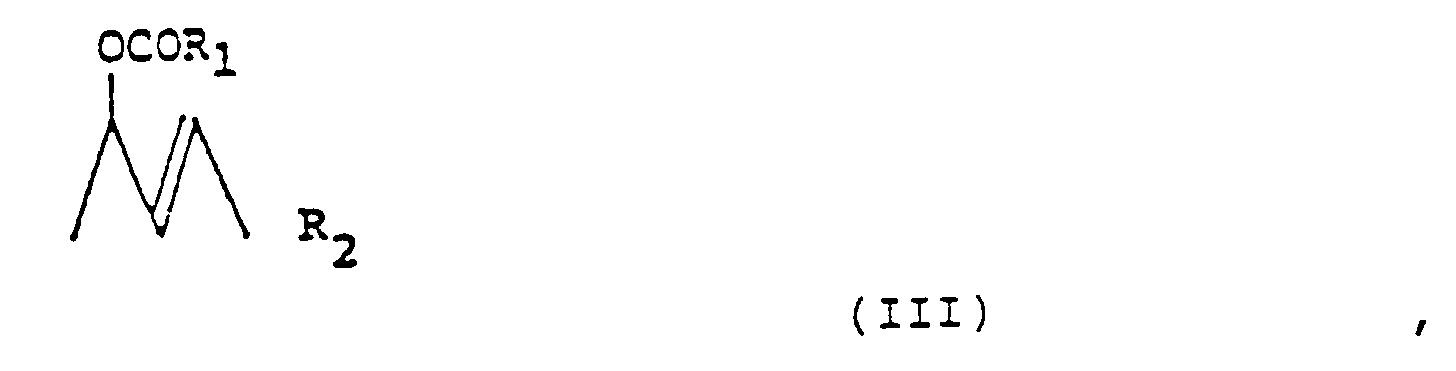
in denen R1 eine Alkylgruppe mit 1 bis 8 Kohlenstoffatomen, eine Arylgruppe mit 6 bis 10 Kohlenstoffatomen, eine Alkoxygruppe mit 1 bis 6 Kohlenstoffatomen oder eine Aryloxygruppe mit 6 bis 10 Kohlenstoffatomen ist, wobei Wasserstoffatome an den Kohlenstoffatomen der Alkyl-, Aryl-, Alkoxy- oder Aryloxygruppe gegebenenfalls durch Alkyl-, Aryl-, Hydroxyl-, Alkoxy-, Alkylthio- oder Arylthiogruppen ersetzt sein können, R2 ein Wasserstoffatom, eine Alkylgruppe mit 1 bis 8 Kohlenstoffatomen, eine Arylgruppe mit 6 bis 10 Kohlenstoffatomen, ein Halogenatom, eine Alkoxygruppe mit 1 bis 6 Kohlenstoffatomen, eine Aryloxygruppe mit 6 bis 10 Kohlenstoffatomen, eine Alkylsulfonyloxygruppe mit 1 bis 8 Kohlenstoffatomen, eine Arylsulfonyloxygruppe mit 6 bis 10 Kohlenstoffatomen, eine Alkylthiogruppe mit 1 bis 8 Kohlenstoffatomen oder eine Arylthiogruppe mit 6 bis 10 Kohlenstoffatomen ist, wobei Wasserstoffatome an den Kohlenstoffatomen der Alkylsulfonyloxy-, Arylsulfonyloxy-, Alkylthio- oder Arylthiogruppe gegebenenfalls durch Halogenatome, Alkyl-, Aryl-, Hydroxyl- oder Alkoxygruppen ersetzt sein können, und die Konfiguration an der 3-Position entweder eine R- oder eine S-Konfiguration ist,
bei dem ein Esterderivat von racemischem oder teilweise racemischem 1-substituiertem-3-Hydroxy-1-buten der Formel (I)
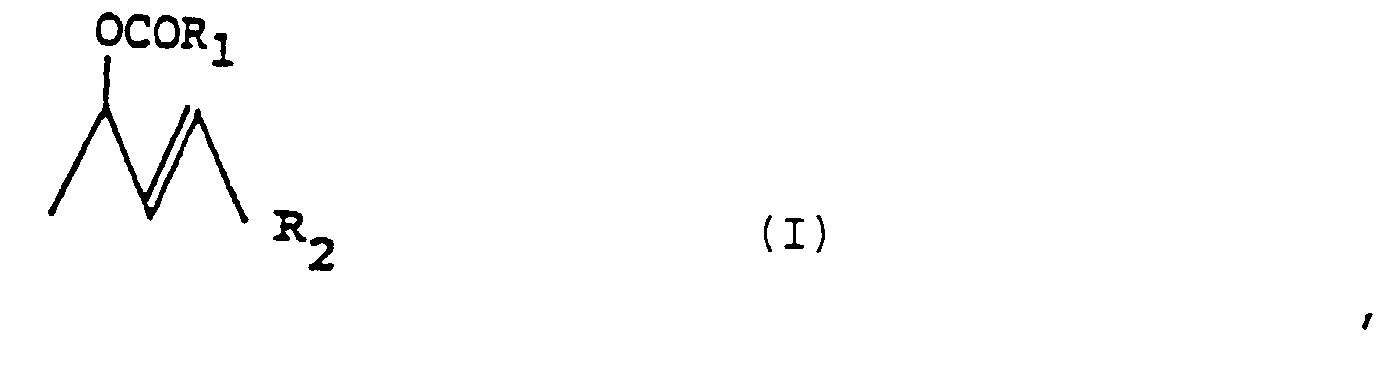
in der R1 und R2 die gleichen Bedeutungen wie oben definiert haben, mit einer Lipase behandelt wird.
in denen R1 eine Alkylgruppe mit 1 bis 8 Kohlenstoffatomen, eine Arylgruppe mit 6 bis 10 Kohlenstoffatomen, eine Alkoxygruppe mit 1 bis 6 Kohlenstoffatomen oder eine Aryloxygruppe mit 6 bis 10 Kohlenstoffatomen ist, wobei Wasserstoffatome an den Kohlenstoffatomen der Alkyl-, Aryl-, Alkoxy- oder Aryloxygruppe gegebenenfalls durch Alkyl-, Aryl-, Hydroxyl-, Alkoxy-, Alkylthio- oder Arylthiogruppen ersetzt sein können, R2 ein Wasserstoffatom, eine Alkylgruppe mit 1 bis 8 Kohlenstoffatomen, eine Arylgruppe mit 6 bis 10 Kohlenstoffatomen, ein Halogenatom, eine Alkoxygruppe mit 1 bis 6 Kohlenstoffatomen, eine Aryloxygruppe mit 6 bis 10 Kohlenstoffatomen, eine Alkylsulfonyloxygruppe mit 1 bis 8 Kohlenstoffatomen, eine Arylsulfonyloxygruppe mit 6 bis 10 Kohlenstoffatomen, eine Alkylthiogruppe mit 1 bis 8 Kohlenstoffatomen oder eine Arylthiogruppe mit 6 bis 10 Kohlenstoffatomen ist, wobei Wasserstoffatome an den Kohlenstoffatomen der Alkylsulfonyloxy-, Arylsulfonyloxy-, Alkylthio- oder Arylthiogruppe gegebenenfalls durch Halogenatome, Alkyl-, Aryl-, Hydroxyl- oder Alkoxygruppen ersetzt sein können, und die Konfiguration an der 3-Position entweder eine R- oder eine S-Konfiguration ist,
bei dem ein Esterderivat von racemischem oder teilweise racemischem 1-substituiertem-3-Hydroxy-1-buten der Formel (I)
in der R1 und R2 die gleichen Bedeutungen wie oben definiert haben, mit einer Lipase behandelt wird.
2. Verfahren nach Anspruch 1, bei dem nach einer selektiven Hydrolyse der Verbindung
der Formel I zur Herstellung einer Mischung, die optische aktive Verbindungen der
Formeln II und III enthält, diese Mischung aufgearbeitet wird, um die Verbindung der
Formel II und/oder die Verbindung der Formel III in einem optisch aktiven Zustand
abzutrennen.
3. Verfahren nach Anspruch 2, bei dem die Verbindung der Formel III in einem optisch
aktiven Zustand abgetrennt wird und dann hydrolysiert wird, um eine Verbindung der
Formel II in einem optischen aktiven Zustand zu liefern.
4. Verfahren nach einem der vorhergehenden Ansprüche, bei dem die Verbindungen der Formeln
I, II und III, die in der Reaktionsmischung nach der Lipaseumsetzung vorhanden sind,
in einem Lösungsmittel extrahiert werden, das mit Wasser nicht mischbar ist, und mindestens
eine der Verbindungen der Formeln II und III durch Chromatographie oder Lösungsmittelextraktion
gereinigt wird.
5. Verfahren nach einem der Ansprüche 1 bis 3, bei dem die Verbindungen der Formeln I,
II und III, die in der Reaktionsmischung nach der Lipaseumsetzung vorhanden sind,
sich aus der Reaktionsmischung in Form einer Ölphase abscheiden gelassen werden und
mindestens eine der Verbindungen der Formeln II und III anschließend durch Lösungsmittelextraktion
gereinigt wird.
1. Procédé de préparation d'un 3-hydroxy-1-butène 1-substitué optiquement actif représenté
par la formule (II) ou d'un dérivé de celui-ci représenté par la formule (III)
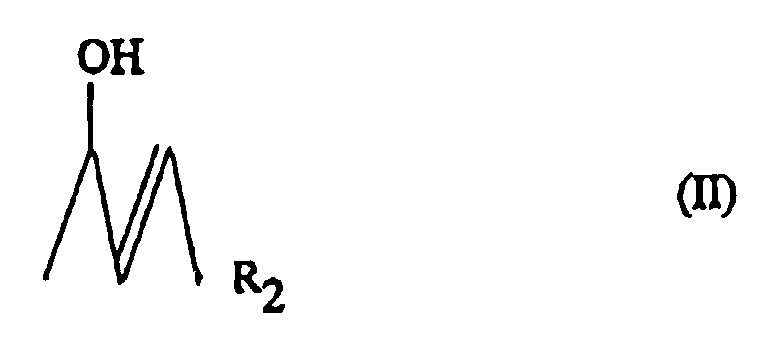
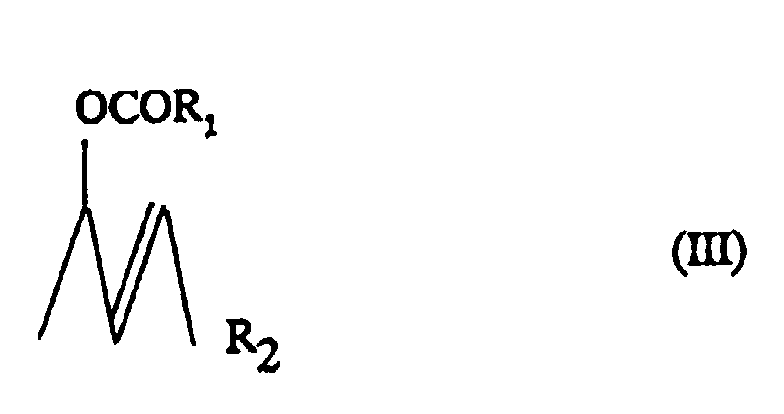
où R1 est un groupe alkyle ayant 1 à 8 atomes de carbone, un groupe aryle ayant 6 à 10 atomes de carbone, un groupe alcoxy ayant 1 à 6 atomes de carbone ou un groupe aryloxy ayant 6 à 10 atomes de carbone, où les atomes d'hydrogène sur les atomes de carbone du groupe alkyle, aryle, alcoxy ou aryloxy peuvent éventuellement être substitués par des groupes alkyle, aryle, hydroxyle, alcoxy, akylthio ou arylthio et R2 est un atome d'hydrogène, un groupe alkyle ayant 1 à 8 atomes de carbone, un groupe aryle ayant 6 à 10 atomes de carbone, un atome d'halogène, un groupe alcoxy ayant 1 à 6 atomes de carbone, un groupe aryloxy ayant 6 à 10 atomes de carbone, un groupe alkylsulfonyloxy ayant 1 à 8 atomes de carbone, un groupe arylsulfonyloxy ayant 6 à 10 atomes de carbone, un groupe alkylthio ayant 1 à 8 atomes de carbone ou un groupe arylthio ayant 6 à 10 atomes de carbone, où les atomes d'hydrogène sur les atomes de carbone du groupe alkylsulfonyloxy, arylsulfonyloxy, alkylthio ou arylthio peuvent éventuellement être substitués par des groupes halogène, alkyle, aryle, hydroxyle ou alcoxy, et la configuration en position 3 est une configuration R ou S, qui comprend le traitement avec une lipase d'un dérivé ester du 3-hydroxy-1-butène 1-substitué racémique ou partiellement racémique de formule (I)
dans laquelle R1 et R2 ont les mêmes significations que celles définies ci-dessus.
où R1 est un groupe alkyle ayant 1 à 8 atomes de carbone, un groupe aryle ayant 6 à 10 atomes de carbone, un groupe alcoxy ayant 1 à 6 atomes de carbone ou un groupe aryloxy ayant 6 à 10 atomes de carbone, où les atomes d'hydrogène sur les atomes de carbone du groupe alkyle, aryle, alcoxy ou aryloxy peuvent éventuellement être substitués par des groupes alkyle, aryle, hydroxyle, alcoxy, akylthio ou arylthio et R2 est un atome d'hydrogène, un groupe alkyle ayant 1 à 8 atomes de carbone, un groupe aryle ayant 6 à 10 atomes de carbone, un atome d'halogène, un groupe alcoxy ayant 1 à 6 atomes de carbone, un groupe aryloxy ayant 6 à 10 atomes de carbone, un groupe alkylsulfonyloxy ayant 1 à 8 atomes de carbone, un groupe arylsulfonyloxy ayant 6 à 10 atomes de carbone, un groupe alkylthio ayant 1 à 8 atomes de carbone ou un groupe arylthio ayant 6 à 10 atomes de carbone, où les atomes d'hydrogène sur les atomes de carbone du groupe alkylsulfonyloxy, arylsulfonyloxy, alkylthio ou arylthio peuvent éventuellement être substitués par des groupes halogène, alkyle, aryle, hydroxyle ou alcoxy, et la configuration en position 3 est une configuration R ou S, qui comprend le traitement avec une lipase d'un dérivé ester du 3-hydroxy-1-butène 1-substitué racémique ou partiellement racémique de formule (I)
dans laquelle R1 et R2 ont les mêmes significations que celles définies ci-dessus.
2. Procédé selon la revendication 1 dans lequel, après hydrolyse sélective du composé
de formule (I) pour produire un mélange contenant des composés optiquement actifs
des formules (II) et (III), ledit mélange est traité pour séparer le composé de formule
(II) et/ou le composé de formule (III) dans un état optiquement actif.
3. Procédé selon la revendication 2 dans lequel ledit composé de formule (III) est séparé
dans un état optiquement actif et est ensuite hydrolysé pour donner un composé de
formule (II) dans un état optiquement actif.
4. Procédé selon l'une quelconque des revendications précédentes dans lequel les composés
des formules (I), (II) et (III) présents dans le mélange réactionnel après la réaction
avec la lipase sont extraits dans un solvant immiscible à l'eau et au moins l'un des
composés des formule (II) et (III) est purifié par chromatographie ou extraction par
solvant.
5. Procédé selon l'une quelconque des revendications 1 à 3 dans lequel les composés des
formules (I), (II) et (III) présents dans le mélange réactionnel après la réaction
avec la lipase sont amenés à se séparer du mélange réactionnel sous forme d'une phase
huileuse et au moins l'un des composés des formules (II) et (III) est purifié ensuite
par extraction par solvant.